
Nearly one in three party wall disputes escalates unnecessarily — not because of genuinely complex legal issues, but because the appointed surveyor lacked the specialist credentials, experience, or process discipline to manage the matter correctly from the start. Choosing the wrong professional for notifiable works under the Party Wall etc. Act 1996 can mean missed deadlines, unenforceable awards, neighbour litigation, and costly delays to your build programme.
This guide to vetting top party wall surveyors in 2026: RICS, FPWS, and Pyramus & Thisbe Club accreditation checklist walks through every stage of the selection process — from verifying professional memberships to interrogating experience, pricing transparency, and working knowledge of the Act — so property owners, developers, and adjoining owners can appoint with confidence.
Key Takeaways 📋
- Three accreditation bodies matter most: RICS, FPWS, and the Pyramus & Thisbe Club each signal a different but complementary layer of professional credibility.
- Specialist focus beats generalist experience: A surveyor who treats party wall work as a core specialism — not an occasional add-on — is far less likely to make procedural errors.
- Ask structured vetting questions: Regulatory status, defined process, documentation quality, and specialist project experience are non-negotiable areas to probe before appointing.
- Red flags are avoidable: Vague fee structures, no verifiable memberships, and inability to explain the notice-to-award process are clear warning signs.
- The right appointment protects both sides: A well-credentialed surveyor protects the building owner and the adjoining owner — reducing conflict rather than amplifying it.
Understanding the Three Core Accreditation Bodies
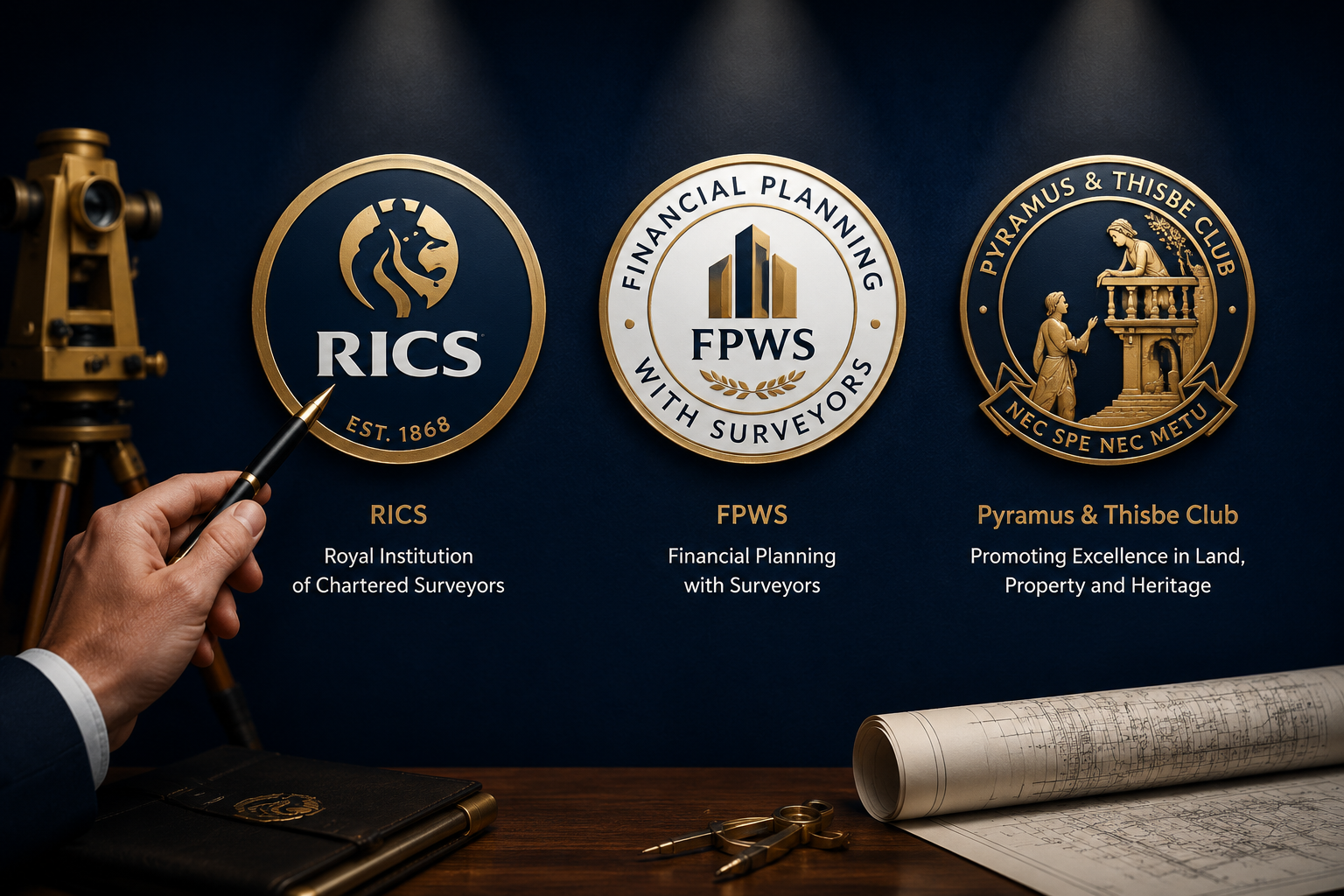
Before diving into the checklist itself, it is essential to understand what each professional body actually represents — and why membership in one does not automatically substitute for membership in another.
🏛️ RICS: The Baseline Standard
The Royal Institution of Chartered Surveyors (RICS) is the most widely recognised professional body in the UK property and construction sector. When a firm is RICS-regulated, clients are engaging surveyors who must meet defined conduct and service expectations set by an independent regulatory framework [1]. RICS chartered status means the surveyor has passed rigorous academic and practical assessments and is subject to ongoing Continuing Professional Development (CPD) requirements.
For party wall matters, RICS membership provides a baseline assurance of professional conduct. However, RICS covers a very broad range of surveying disciplines — from valuation to building surveying to quantity surveying. RICS membership alone does not confirm that a surveyor specialises in party wall work or has deep familiarity with the procedural nuances of the Party Wall etc. Act 1996.
💬 "Instructing a Chartered and/or RICS-regulated practice means choosing surveyors who must meet defined conduct and service expectations — providing an objective baseline for client protection." [1]
For broader property assessments alongside party wall work, an RICS home survey from the same regulated firm can provide a comprehensive picture of a property's condition before notifiable works begin.
🎓 FPWS: The Specialist Credential
The Faculty of Party Wall Surveyors (FPWS) is specifically focused on party wall matters — including education, professional standards, and support under the Party Wall etc. Act [1]. Unlike RICS, which covers the entire surveying landscape, FPWS membership signals that a surveyor treats party wall work as a specialist practice rather than an occasional service bolted onto a general surveying business [1].
FPWS-regulated firms operate regionally across England and Wales, offering free initial advice and maintaining clear contact points for both building owners and adjoining owners [2][3]. The Faculty also runs an active programme of professional events and CPD sessions to keep members current with legislative interpretations and case law [6].
Why FPWS membership matters for clients:
- Demonstrates commitment to party wall as a primary specialism
- Indicates familiarity with the full procedural cycle from notice to award
- Suggests the surveyor engages with peer review and professional development in this specific field
⚖️ Pyramus & Thisbe Club: The Longest-Standing Authority
The Pyramus & Thisbe Club — named after the characters separated by a wall in Ovid's Metamorphoses — describes itself as "The leading authority on Party Wall and related issues, relied upon since 1974." [4] This is the oldest specialist body in the field, and membership indicates a surveyor takes party wall procedure seriously and actively stays aligned with evolving industry standards [4].
The Club maintains a regular events programme [7], publishes guidance, and provides a network of practitioners who engage with complex and novel party wall scenarios. Membership here, particularly at Fellow level, is often a strong indicator of deep, long-standing expertise.
| Body | Focus Area | Est. | Key Signal |
|---|---|---|---|
| RICS | Broad surveying regulation | 1868 | Professional conduct baseline |
| FPWS | Party wall specialism | Recent | Specialist focus & CPD |
| Pyramus & Thisbe Club | Party wall authority | 1974 | Depth of expertise & peer engagement |
The Step-by-Step Vetting Checklist for 2026
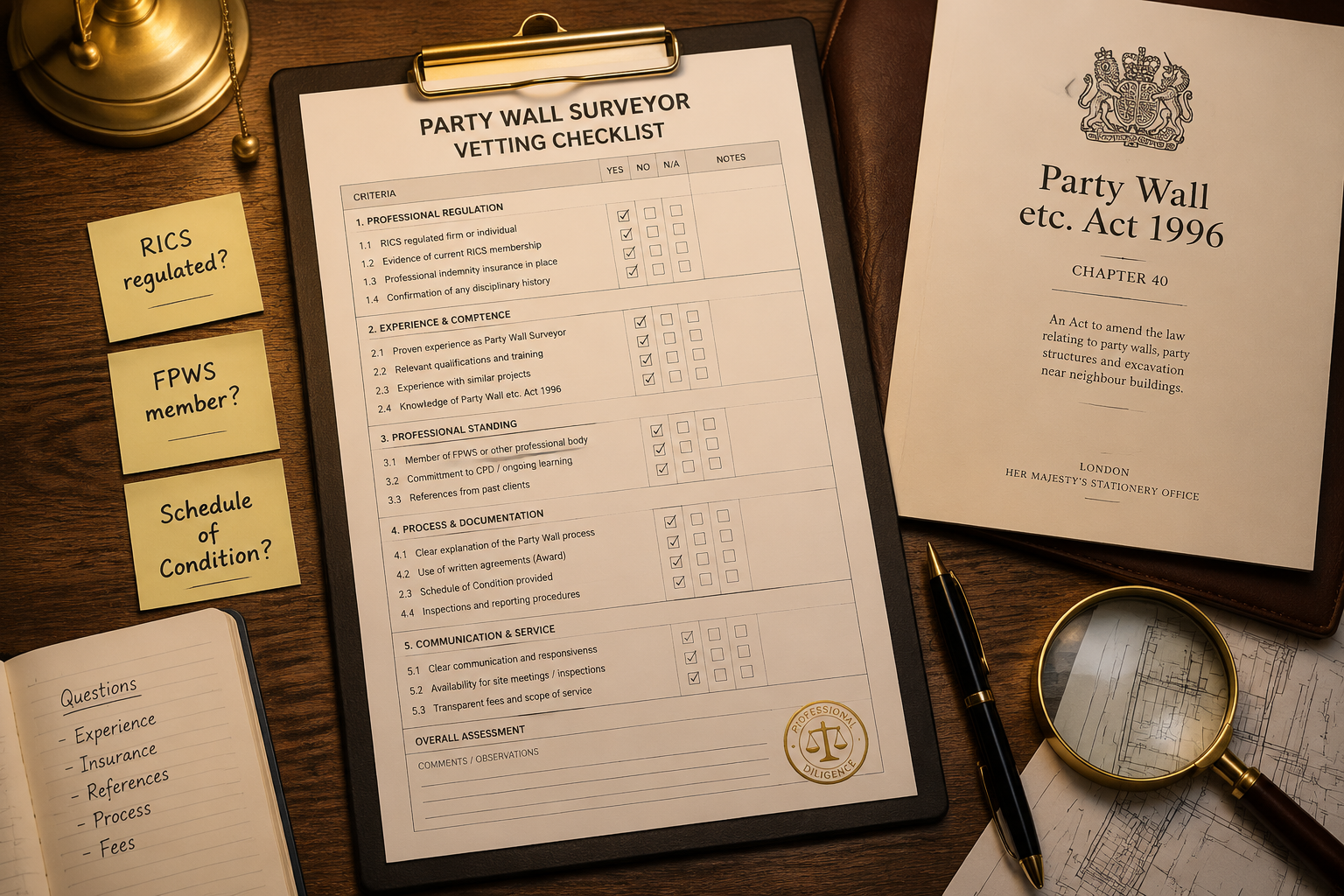
The core of vetting top party wall surveyors in 2026 lies in asking the right questions in the right order. The following checklist is structured to mirror the natural flow of a client's due diligence process — from initial credential verification through to pricing and documentation standards.
✅ Step 1: Verify Regulatory Status
Start with the basics. Before any conversation about fees or timelines, confirm the following:
- Is the firm RICS-regulated? Check the RICS public register at rics.org to verify the firm — not just the individual — holds regulated status [1].
- Is the individual surveyor RICS-chartered? Look for the designations MRICS (Member) or FRICS (Fellow).
- Is the surveyor an FPWS member? Check the FPWS directory at fpws.org.uk [2].
- Are they a member of the Pyramus & Thisbe Club? Membership can be verified through the Club's official channels [4].
⚠️ Red flag: A surveyor who cannot confirm their regulatory status in writing, or whose name does not appear on verifiable public registers, should not be appointed for notifiable works.
✅ Step 2: Assess Specialist Experience
General surveying experience is not the same as party wall experience. Ask directly:
- What percentage of your current workload is party wall matters?
- How many party wall awards have you drafted in the past 12 months?
- Do you have specific experience with the type of works planned?
Different project types carry different procedural risks. A surveyor experienced in rear extensions may have limited exposure to the additional complexities of loft conversions and party wall obligations, or the specific requirements around excavation notices for party wall works. Matching surveyor experience to project type is a critical vetting step [1].
Project-type experience to probe:
- 🏠 Rear extensions and rear wall works
- 🔝 Loft conversions (including steel beam insertions)
- 🪨 Basement excavations and underpinning
- 🏗️ New builds adjacent to existing structures
- 🔥 Party wall shared chimneys and stack alterations
✅ Step 3: Interrogate the Defined Process
A competent party wall surveyor should be able to articulate their end-to-end process without hesitation. The expected workflow under the Party Wall etc. Act 1996 follows a clear sequence:
- Notice service — correct notice type, correct timing, correct recipients
- Schedule of Condition — a detailed photographic and written record of the adjoining owner's property before works begin
- Negotiations — managing any dissent and agreeing terms
- Party Wall Award — a legally binding document governing how works are carried out
- Site follow-ups — monitoring during and after construction
Ask the surveyor to walk through this process for your specific project. Vague or incomplete answers suggest limited hands-on experience. For a deeper understanding of what a schedule of condition involves, reviewing guidance before your appointment conversation is strongly recommended.
💬 "Best practice vetting includes asking about a surveyor's defined process — from notice through to site follow-ups — not just their credentials." [1]
✅ Step 4: Review Documentation Quality
Ask for sample documents — redacted for confidentiality — including:
- A sample Party Wall Notice
- A sample Schedule of Condition report
- A sample Party Wall Award
The quality of these documents reveals a great deal. Well-drafted awards are precise, unambiguous, and clearly structured. Poorly drafted awards leave room for dispute during and after construction. Reviewing party wall award guidance in advance will help clients assess what good documentation looks like.
✅ Step 5: Probe Pricing Transparency
Party wall surveying fees vary significantly, and lack of transparency is a common source of client dissatisfaction. Ask:
- What is your fee structure — fixed fee or hourly rate?
- Who pays — the building owner, the adjoining owner, or both?
- Are there additional charges for site visits, additional notices, or disputed awards?
- What happens to fees if the project is delayed or cancelled?
Understanding the cost of party wall surveying before committing to an appointment helps avoid unexpected charges and ensures the fee arrangement is clearly documented from the outset.
✅ Step 6: Check Reviews and References
Professional accreditation is necessary but not sufficient. Supplement credential checks with:
- Google Reviews and Trustpilot ratings — look for patterns, not just overall scores
- Direct references from previous clients on similar project types
- Professional peer reputation — do other surveyors in the field recognise this practitioner?
Surveyors who are active in FPWS events [6] or Pyramus & Thisbe Club programmes [7] tend to have stronger peer networks and reputational accountability.
✅ Step 7: Test Act Knowledge
A final — and often overlooked — vetting step is to ask a specific, technical question about the Party Wall etc. Act 1996. For example:
- "What happens if the adjoining owner fails to respond to a notice within 14 days?"
- "Can a building owner proceed without a party wall agreement if the adjoining owner consents in writing?"
- "What are the surveyor's obligations if damage occurs during notifiable works?"
A surveyor who hesitates, gives incorrect answers, or cannot explain the implications of not having a party wall agreement in place should not be trusted with a notifiable project.
Common Pitfalls and How Accreditation Helps Avoid Them
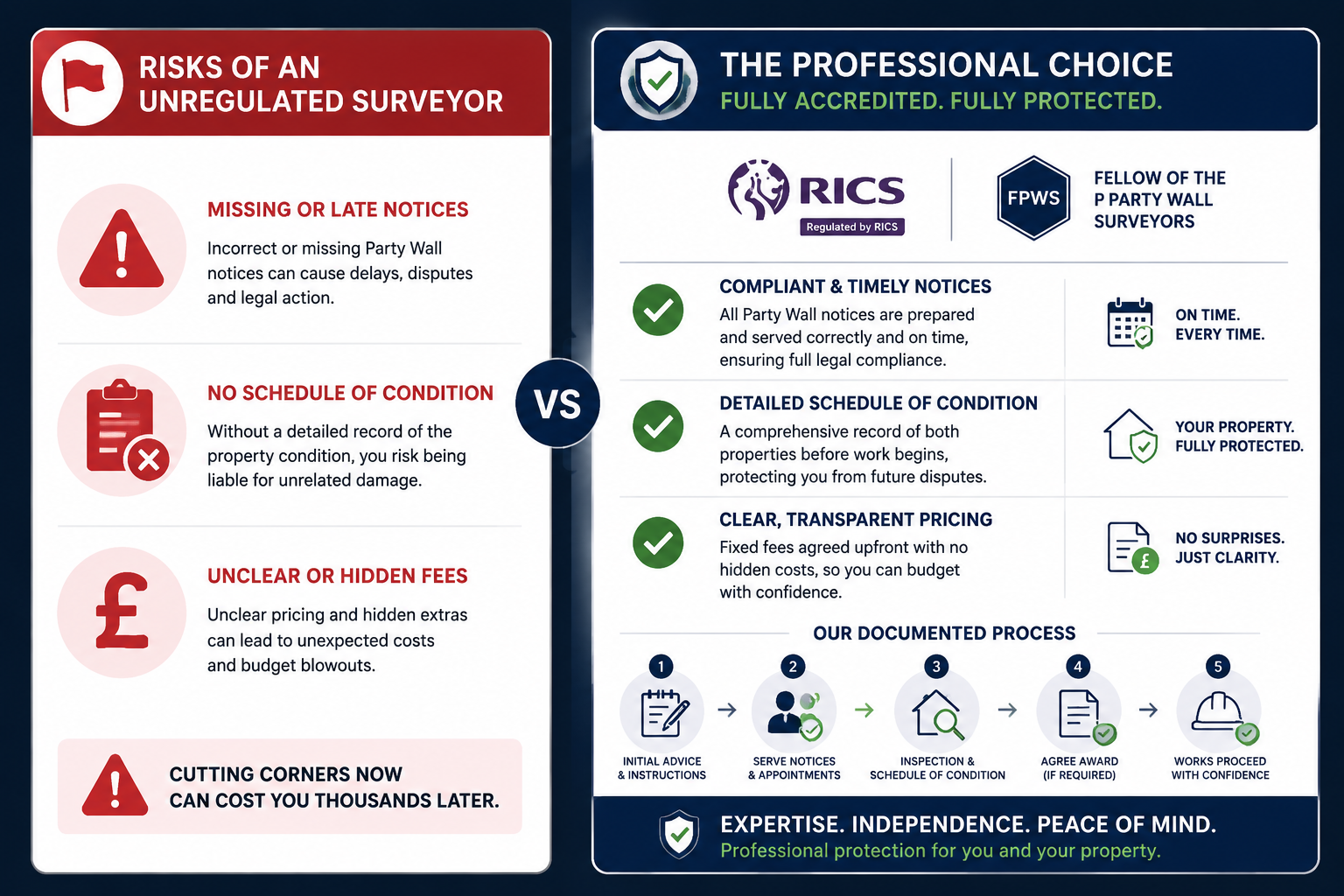
Even with a checklist in hand, property owners sometimes fall into predictable traps. Understanding where things go wrong — and how proper accreditation guards against each failure — is the final piece of the vetting puzzle when applying the RICS, FPWS, and Pyramus & Thisbe Club accreditation checklist in practice.
❌ Pitfall 1: Appointing an Unregulated Surveyor
The party wall surveying market is not legally restricted to regulated professionals. Anyone can, technically, call themselves a party wall surveyor. This makes the accreditation checks in Step 1 non-negotiable, not optional.
An unregulated surveyor has no professional body to answer to, no mandatory CPD requirements, and no client redress mechanism if things go wrong. RICS regulation provides a formal complaints process; FPWS and Pyramus & Thisbe Club membership adds peer accountability [1][4].
❌ Pitfall 2: Ignoring the Schedule of Condition
One of the most costly mistakes in party wall matters is proceeding without a thorough schedule of condition. Without a pre-works record of the adjoining property's condition, it becomes extremely difficult to determine whether any damage — cracking, settlement, dampness — was caused by the notifiable works or pre-existed them.
A competent, accredited surveyor will always insist on a schedule of condition before works commence. Its absence is a significant red flag [1].
❌ Pitfall 3: No Notice Served
Proceeding with notifiable works without serving the correct notices is a serious legal error. It does not invalidate the works, but it removes the statutory protections the Act provides — for both the building owner and the adjoining owner. Understanding the implications of no party wall notice being served is important for all parties involved.
❌ Pitfall 4: Conflicted or Biased Surveyors
Party wall surveyors — even those appointed by one party — have a quasi-judicial duty to act impartially. A surveyor who appears to advocate aggressively for one side, or who has an undisclosed commercial relationship with the building contractor, is in breach of their professional obligations. RICS-regulated surveyors are bound by conduct rules that prohibit such conflicts [1].
🟢 How Accreditation Mitigates These Risks
| Risk | RICS Protection | FPWS Protection | Pyramus & Thisbe |
|---|---|---|---|
| Unregulated practice | ✅ Formal regulation | ✅ Specialist register | ✅ Peer accountability |
| Poor documentation | ✅ Conduct standards | ✅ CPD & training | ✅ Guidance publications |
| Act ignorance | ✅ CPD requirements | ✅ Specialist focus | ✅ 50+ years of expertise |
| Conflicts of interest | ✅ Conduct rules | ✅ Professional ethics | ✅ Peer scrutiny |
Conclusion: Appoint with Confidence in 2026
The process of vetting top party wall surveyors in 2026 using the RICS, FPWS, and Pyramus & Thisbe Club accreditation checklist is not bureaucratic box-ticking — it is the most reliable way to protect a property investment, maintain neighbourly relations, and ensure that notifiable works proceed smoothly within the law.
Actionable Next Steps ✅
- Start with the RICS register — verify firm and individual status before any other conversation.
- Cross-reference FPWS and Pyramus & Thisbe Club membership — both directories are publicly accessible.
- Use the seven-step checklist above as a structured interview framework when speaking to candidate surveyors.
- Request sample documents — a schedule of condition and a party wall award — and assess their quality before committing.
- Get fees in writing — a transparent, itemised fee agreement should be provided before appointment.
- Check the party wall FAQ to build foundational knowledge before your first surveyor conversation.
- Do not proceed without a notice — if there is any doubt about whether works are notifiable, ask a regulated surveyor for a free initial assessment.
The right surveyor turns a potentially contentious process into a well-managed, legally compliant project. The accreditation checklist above makes finding that surveyor straightforward — even in a market where not all practitioners are equal.
References
[1] Why Hiring A Regulated Party Wall Surveyor Matters – https://www.houricanassociates.com/party-wall-news/why-hiring-a-regulated-party-wall-surveyor-matters/
[2] FPWS – https://fpws.uk
[3] Party Wall Surveyors In North London – https://fpws-northlondon.co.uk/party-wall-surveyors-in-north-london/
[4] Pyramus & Thisbe Society – https://pyramusandthisbesociety.org
[5] Choosing RICS Chartered Surveyors For Party Wall Matters – https://nottinghillsurveyors.com/blog/choosing-rics-chartered-surveyors-for-party-wall-matters-top-uk-firms-and-what-to-look-for-in-2026
[6] FPWS Events List – https://fpws.org.uk/eeeventslist/
[7] Pyramus & Thisbe Society Events – https://pyramusandthisbesociety.org/events/