
A full party wall agreement costs around £1,000 — and every penny of it lands on the building owner's bill the moment a neighbour formally dissents. [2] For straightforward projects like loft conversions or damp-proof course (DPC) installations, that expense is often entirely avoidable. Knowing when to skip party wall surveyors: neighbour consent strategies and condition schedules for low-risk 2026 projects is not about cutting corners — it is about understanding the law well enough to use it in your favour.
This guide breaks down exactly when surveyor involvement is unnecessary, how to secure written consent that protects both parties, and when a lightweight condition schedule is the smartest middle-ground option available.
Key Takeaways 📋
- Written neighbour consent eliminates the need for a party wall surveyor on most low-risk projects — saving up to £1,000 or more in fees.
- Minor works such as plastering, drilling for shelves, and electrical work are exempt from the Party Wall etc. Act 1996 entirely.
- Party wall notices can be served for free using standard forms — no solicitor or surveyor required at this stage.
- A condition schedule (optional survey of existing property condition) is a smart, low-cost safeguard even when formal surveyor involvement is not required.
- Homeowners remain liable for damage regardless of whether a surveyor is appointed — making documentation essential for all but the most trivial works.

Understanding the Party Wall Act: What Actually Triggers It?
The Party Wall etc. Act 1996 applies to three main categories of work:
| Work Type | Example | Notice Required? |
|---|---|---|
| Work on or to a party wall | Removing a chimney breast on a shared wall | ✅ Yes |
| New building at or astride the boundary | Garden wall, extension foundations | ✅ Yes |
| Excavation near a neighbour's foundations | New basement, deep footings | ✅ Yes |
| Internal minor works | Plastering, shelving, electrics | ❌ No |
The critical point many homeowners miss: not every building project near a shared wall triggers the Act. Plastering, fitting kitchen units, drilling for shelves, and running electrical cables through internal walls do not require a party wall agreement at all. [2] These works are simply outside the Act's scope.
💡 Pull Quote: "The Act is not a blanket requirement for all neighbour-adjacent work — it is a targeted framework for specific structural interventions."
For works that do fall under the Act — such as loft conversions involving a party wall or DPC work that affects a shared structure — the process begins with serving a notice. But serving a notice does not automatically mean hiring a surveyor.
Understanding what constitutes a party wall dispute versus a routine notifiable project is the first step in deciding whether professional involvement is genuinely necessary.
When to Skip Party Wall Surveyors: Neighbour Consent Strategies for Low-Risk 2026 Projects
The Written Consent Route: Your Most Powerful Tool
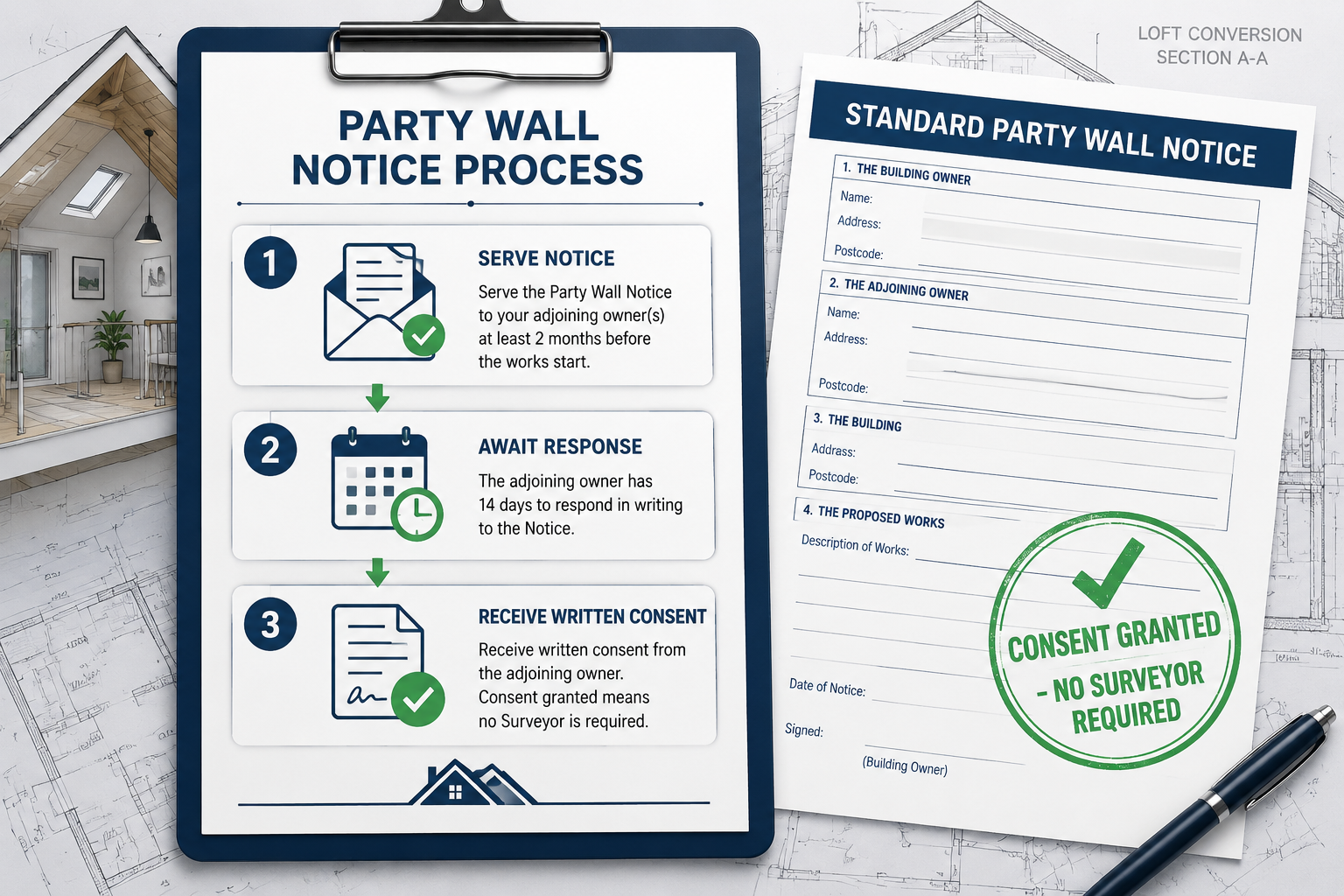
When a neighbour responds to a party wall notice by granting written consent, there is no legal requirement to appoint a surveyor. [2] This single fact is the foundation of every cost-saving strategy for low-risk projects in 2026.
Here is how the process works in practice:
Step 1 — Serve the Notice Yourself (Free)
Party wall notices can be served using standard government-approved forms at no cost. [2] No solicitor. No surveyor. Just a completed form delivered to your neighbour by hand or recorded post, with a copy kept for your records.
Step 2 — Allow the Response Window
Neighbours have 14 days to respond. If they consent in writing within this window, work can proceed. If they do not respond at all, they are deemed to have dissented — triggering the surveyor appointment process.
Step 3 — Receive Written Consent
If consent is granted, keep the signed document safely filed. This is your legal protection. No award is needed. No surveyor fees are payable. [2]
Step 4 — Proceed With Works
Begin work in line with what was described in the notice. Any deviation from the notified works may require a fresh notice.
What If a Neighbour Dissents?
Dissent changes everything financially. If a neighbour formally objects, the building owner — not the dissenting neighbour — pays all surveyor costs. [3] At current 2026 rates of £150–£200 per hour, with a full party wall award averaging around £1,000, this is a significant incentive to invest time in neighbourly communication before serving any notice. [2]
If dissent does occur and the neighbour fails to appoint a surveyor within 10 days, the building owner has the legal right to appoint one on their behalf. [3] This is a useful fallback — but reaching this point is avoidable with the right approach.
For a full breakdown of what these fees involve, the cost of a party wall agreement guide provides a detailed overview.
Practical Consent Strategies: Before You Serve the Notice
The most effective consent strategies happen before the formal notice is served:
- 🤝 Have an informal conversation first. Explain the project, the timeline, and the likely impact. Most neighbours are far more receptive when they feel informed rather than notified.
- 📄 Share plans or drawings. Visual information reduces anxiety. A simple architect's sketch often does more than a legal notice.
- ⏰ Give plenty of lead time. Serving a notice the week before work starts creates pressure. Serving it six weeks ahead allows goodwill to build.
- 📞 Follow up personally. A knock on the door after posting the notice reinforces that this is a neighbourly process, not a legal confrontation.
- 📝 Make consent easy. Provide a pre-written consent reply for the neighbour to sign and return. Neighbours can respond to low-risk work without a solicitor or surveyor. [3]
Low-Risk Projects Where Consent Is Typically Straightforward
Certain project types are particularly well-suited to the written consent route in 2026:
- Simple loft conversions — where structural work is limited to the roof and does not involve cutting into or loading the party wall significantly
- DPC (damp-proof course) injections — typically minor works that cause minimal disruption
- Rear single-storey extensions — where excavation is shallow and well away from the neighbour's foundations
- Chimney breast removal — on the building owner's side only, with no structural loading transferred to the shared wall
Always check whether the 3-metre rule for excavations applies to your project before assuming consent alone is sufficient.
Condition Schedules: The Smart Middle Ground
What Is a Schedule of Condition?
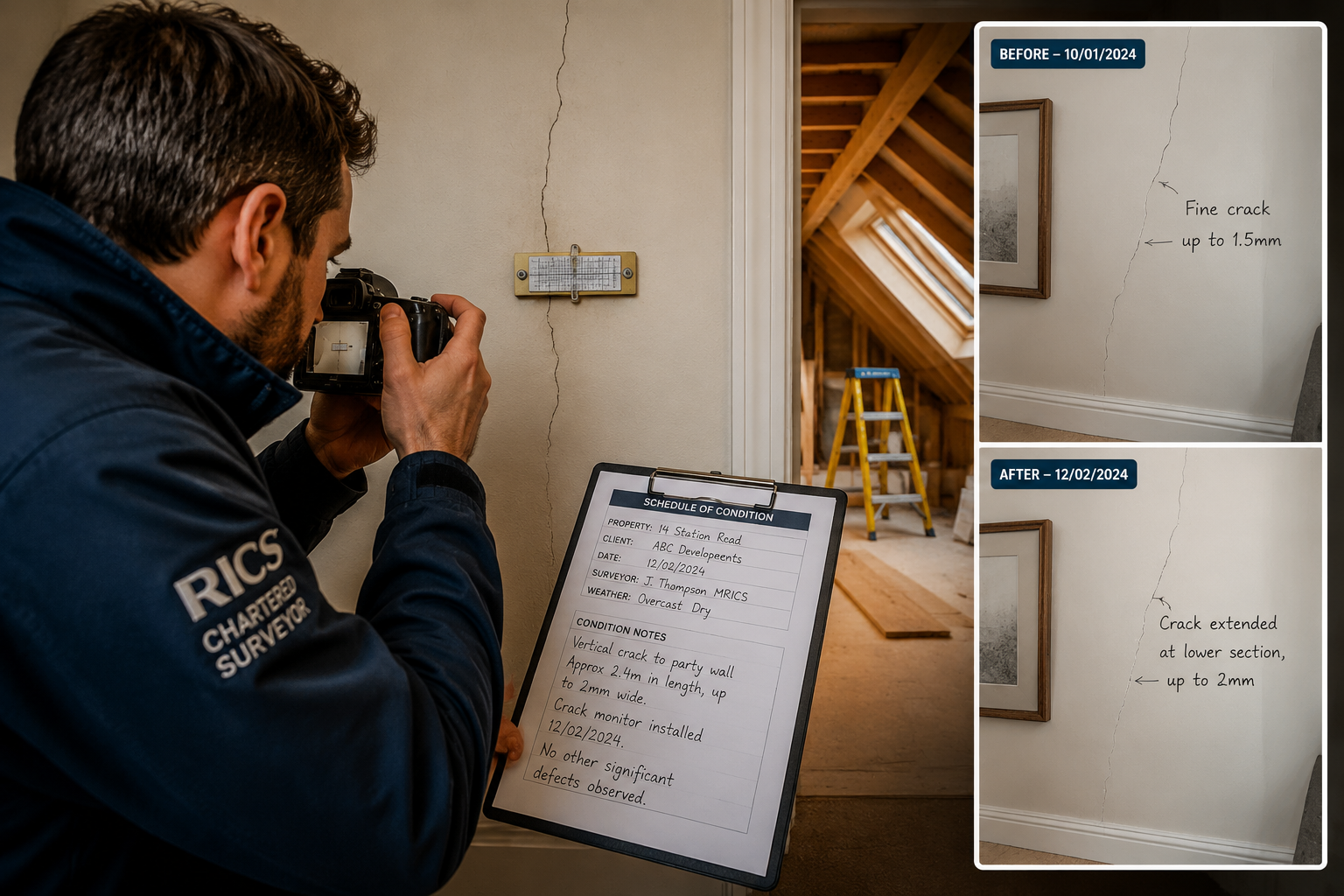
A schedule of condition is a photographic and written record of a property's existing state — typically the neighbour's property — taken before notifiable works begin. It documents cracks, settlement, existing defects, and the general condition of walls, ceilings, and floors adjacent to the works.
It is not the same as a full party wall award. It does not require both parties to appoint surveyors. And it can be commissioned independently, even when a neighbour has already given written consent.
💡 Pull Quote: "A condition schedule costs a fraction of a party wall award — and it can save thousands in disputed damage claims."
For detailed guidance on what this document covers, the schedule of condition guidance resource is an excellent reference.
When Should a Condition Schedule Be Commissioned?
Even when written consent has been secured and no surveyor appointment is legally required, a condition schedule is worth considering in the following situations:
| Scenario | Condition Schedule Recommended? |
|---|---|
| Loft conversion involving roof timbers near party wall | ✅ Strongly recommended |
| DPC injection along shared wall | ✅ Recommended |
| Minor internal works only | ❌ Usually unnecessary |
| Excavation within 3 metres of neighbour's foundations | ✅ Essential |
| Neighbour's property shows existing cracks or settlement | ✅ Essential |
| Neighbour's property is in excellent condition | ✅ Still advisable |
The reason is straightforward: homeowners remain fully liable for any damage caused during works, regardless of whether a surveyor was appointed. [2] Without a pre-works condition record, any crack or defect discovered after completion becomes a disputed liability — and disputes without documentation almost always favour the claimant.
Understanding the risks of damage to property in party wall situations makes clear why this documentation matters even on apparently simple projects.
Who Commissions a Condition Schedule?
Either party can commission one. Options include:
- The building owner — proactively, to protect against unfounded damage claims
- The consenting neighbour — as a condition of their written consent (entirely reasonable and common)
- A jointly agreed surveyor — acting for both parties on a fixed-fee basis, far cheaper than a full party wall award
A condition schedule commissioned this way costs significantly less than the £1,000+ associated with a full party wall award, while providing meaningful legal protection for both sides.
What a Condition Schedule Should Include
A thorough condition schedule for a loft conversion or DPC project should document:
- ✅ External wall elevations (photographs with date stamps)
- ✅ Internal rooms adjacent to the party wall
- ✅ Existing cracks, with crack width measurements
- ✅ Ceiling and floor condition in affected rooms
- ✅ Any pre-existing damp or staining
- ✅ Roof condition where relevant to loft works
- ✅ Signed and dated by both parties where possible
Liability, RICS Updates, and What 2026 Changes for Homeowners
You Are Always Liable — Surveyor or Not
One of the most important facts for any homeowner to understand: the absence of a surveyor does not reduce liability. If works cause damage to a neighbour's property, the building owner is responsible for making it good — full stop. [2]
This is why the condition schedule is not optional luxury. It is practical risk management. Without it, a pre-existing crack in a neighbour's plaster becomes indistinguishable from construction damage in any subsequent dispute.
If a neighbour believes works have caused damage without proper documentation or agreement in place, the situation can escalate quickly. Understanding what happens when a neighbour carries out works without a party wall agreement illustrates how quickly these disputes can become costly.
RICS 2026 Guidance Updates
The Royal Institution of Chartered Surveyors (RICS) launched a consultation in April–May 2026 on the draft 8th edition of Party Wall Legislation and Procedure. [1] The updated practice guidance is designed to improve competence and consistency among party wall surveyors — a signal that the profession is tightening its standards.
For homeowners, this means:
- Surveyors operating in 2026 are working to increasingly rigorous standards
- When surveyor involvement is required, quality and consistency should improve
- The guidance reinforces that proper documentation — including condition schedules — is best practice even on lower-risk projects
Avoiding Common Pitfalls in 2026
Pitfall 1: Serving notice too late
The Party Wall etc. Act requires notice to be served at least one month before structural works begin (two months for some excavation works). Late notice means delayed starts.
Pitfall 2: Assuming verbal consent is sufficient
Verbal agreement has no legal standing under the Act. Written consent is the only form that removes the need for a surveyor. [2]
Pitfall 3: Proceeding without notice at all
Failing to serve any notice when one is required is a legal breach. Neighbours can seek an injunction to stop works. See the risks outlined in our guide to no party wall notice being served.
Pitfall 4: Ignoring the condition schedule
Even on low-risk projects, skipping the condition schedule to save money can result in far larger costs if a dispute arises post-completion.
For answers to the most frequently asked questions about this process, the party wall FAQ covers a wide range of scenarios in plain language.
Conclusion: A Practical Framework for Low-Risk Projects in 2026
Knowing when to skip party wall surveyors: neighbour consent strategies and condition schedules for low-risk 2026 projects comes down to three clear principles:
-
Assess whether the Act applies at all. Minor internal works are exempt. If the project does not touch a party wall structurally, no notice is needed.
-
Invest in the relationship before the notice. Early, informal communication transforms neighbours from potential dissenters into willing signatories. Written consent is the single most effective cost-saving tool available.
-
Use a condition schedule as your safety net. Even without a formal party wall award, a pre-works photographic record protects both parties and costs a fraction of the disputes it prevents.
Actionable Next Steps ✅
- Check the Act's applicability to your specific project type before assuming a surveyor is required
- Download a free party wall notice form from the Planning Portal and serve it yourself
- Speak to your neighbour informally at least six weeks before planned works begin
- Prepare a simple written consent form for your neighbour to sign and return
- Commission a condition schedule before works start — even if consent has been granted
- Keep all documentation (notice, consent letter, condition schedule) in a single project file throughout the build
For projects where surveyor involvement is genuinely required, working with a qualified RICS chartered building surveyor ensures the process is handled correctly from the outset — protecting both the project and the neighbourly relationship.
References
[1] RICS Launches Consultation On Updated Party Wall Practice Guidance – https://www.rics.org/news-insights/rics-launches-consultation-on-updated-party-wall-practice-guidance
[2] Party Wall Agreement – https://hoa.org.uk/advice/guides-for-homeowners/i-am-improving/party-wall-agreement/
[3] Simple Guide To Party Wall Notice Reply – https://fpws.uk/simple-guide-to-party-wall-notice-reply/
[4] Party Wall Surveys And Neighbour Disputes During 2026's Construction Uptick RICS Compliance Framework – https://nottinghillsurveyors.com/blog/party-wall-surveys-and-neighbour-disputes-during-2026s-construction-uptick-rics-compliance-framework
[5] Party Wall FAQs – https://christopheranthony.org.uk/party-wall-faqs/