Nearly 70% of property disputes that reach formal litigation could have been resolved earlier — or abandoned entirely — had the parties obtained a proper technical assessment before committing to legal proceedings. That single fact explains why Pre-Litigation Brief Reports by Expert Witness Surveyors: Assessing Case Strength Without Full Commitment have become one of the most valuable yet underused tools in property law today.
Whether a dispute involves a boundary encroachment, a party wall disagreement, alleged building defects, or a negligent survey, instructing a qualified expert witness surveyor at the earliest stage gives solicitors and property owners a clear-eyed, evidence-based view of whether their case is worth pursuing — before spending thousands on full litigation.
Key Takeaways 📋
- Pre-litigation brief reports offer a cost-effective way to assess the technical strength of a property dispute before committing to full legal proceedings.
- A qualified expert witness surveyor can identify weaknesses, strengths, and risks in a case at an early stage.
- In some jurisdictions (such as California), consulting an expert before filing is a legal requirement, not just good practice [2].
- Well-structured reports must include factual background, methodology, analysis, and conclusions to be credible and admissible [4].
- Early expert assessment can save significant legal costs and help parties make informed decisions about settlement, negotiation, or withdrawal.
What Is a Pre-Litigation Brief Report?
A pre-litigation brief report is a focused, preliminary document prepared by a qualified expert witness surveyor. Unlike a full expert report filed in court proceedings, it is designed to:
- Give an honest technical opinion on the merits of a claim
- Identify the key issues in dispute
- Flag potential weaknesses that opposing counsel might exploit
- Help solicitors and clients decide whether to proceed, negotiate, or walk away
💡 Pull Quote: "The purpose of a pre-litigation brief is not to win the case — it is to tell you whether the case can be won."
These reports are typically shorter, faster to produce, and significantly less expensive than full expert witness reports. They are commissioned before any formal claim is issued, which is precisely what makes them so strategically valuable.
Who Commissions These Reports?
| Client Type | Typical Dispute |
|---|---|
| Homeowners | Boundary disputes, building defects |
| Solicitors | Party wall disagreements, negligent surveys |
| Property developers | Construction defects, land encroachment |
| Landlords & tenants | Dilapidations, structural condition disputes |
| Estate agents | Valuation negligence claims |
Why Pre-Litigation Brief Reports by Expert Witness Surveyors Matter: Assessing Case Strength Without Full Commitment
The Cost of Getting It Wrong
Litigation is expensive. Legal fees, court costs, expert witness fees, and the time burden on all parties can quickly escalate a modest property dispute into a six-figure exercise. A pre-litigation brief report acts as a financial filter — helping clients understand whether the technical evidence actually supports their position before those costs begin to accumulate.
Consider a common scenario: a homeowner believes their neighbour has encroached on their land by repositioning a boundary fence. Before instructing solicitors to issue proceedings, commissioning a boundary survey from an expert witness surveyor can confirm — or contradict — that belief with hard evidence.
Expert witness surveyors have identified cases where defendants relied on incorrect placement of boundary markers and used outdated or inaccurate data, issues that only become clear through detailed expert analysis [1]. Knowing this before filing a claim is invaluable.
The Legal Requirement Angle
In California, pre-litigation expert consultation is not optional. Under CCP 411.35, plaintiffs filing malpractice lawsuits against surveyors must serve a certificate of merit confirming they have consulted a qualified expert. The only valid exceptions are narrow: when at least three professionals have refused to consult, when the plaintiff relies solely on res ipsa loquitur, or when the statute of limitations is about to expire [2].
While English law does not impose an identical requirement, the Civil Procedure Rules (CPR) and pre-action protocols strongly encourage parties to exchange information and consider expert evidence before issuing proceedings. Courts have struck expert reports at pre-trial stage when they failed to meet admissibility thresholds — including relevance, necessity, and proper qualification of the expert [5].
⚠️ Important: Reports that contain subjective speculation, opinions on ultimate legal issues, or irrelevant material disguised as expert opinion risk being excluded entirely [5].
What a Strong Pre-Litigation Brief Report Looks Like
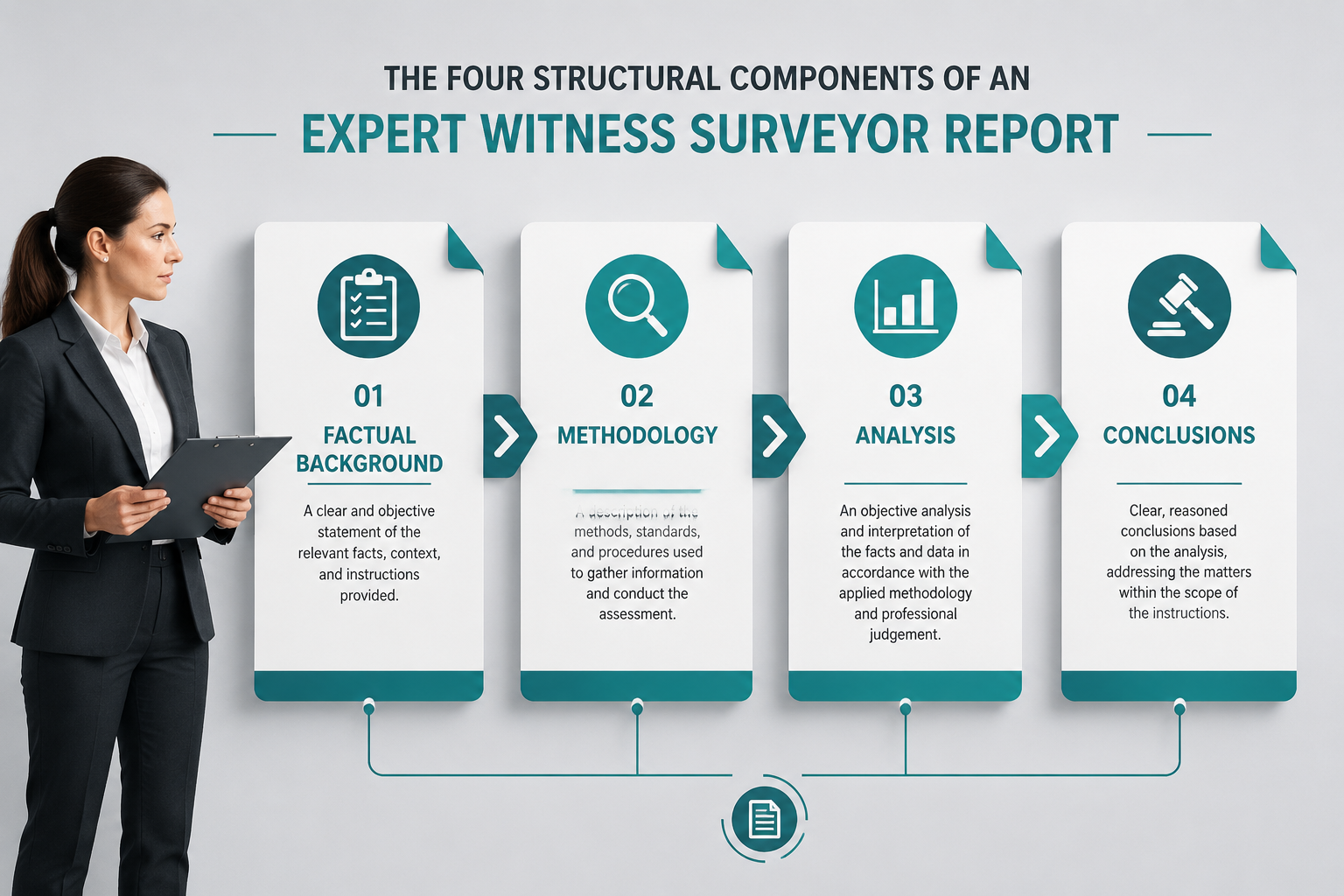
According to established best practice, high-quality expert witness reports — including pre-litigation briefs — must contain four core structural components [4]:
- Factual Background — A clear summary of the property, the parties, and the nature of the dispute
- Methodology — How the surveyor conducted their assessment (site visits, measurements, document review)
- Analysis — Technical examination of the evidence, including comparison of competing survey data
- Conclusions — A plain-English opinion on the merits of the claim
Each element must be written clearly enough for a judge or jury to follow the expert's reasoning [4]. Even at the pre-litigation stage, this structure ensures the report would hold up if proceedings are later issued.
How the Assessment Process Works in Practice
Step 1: Initial Instructions
The process begins when a solicitor or property owner contacts a qualified expert witness surveyor. The brief should include:
- A summary of the dispute
- Relevant documents (title deeds, previous surveys, correspondence)
- The specific questions the expert is being asked to address
Being precise about the scope at this stage keeps the report focused and the costs controlled.
Step 2: Site Inspection and Document Review
The surveyor will typically carry out a site visit, review title documents, examine any existing survey data, and assess physical evidence such as boundary features, structural elements, or building conditions. For specific defect reports, this might involve examining cracking, damp, or structural movement in detail.
Step 3: Drafting the Report
The expert prepares a structured brief report. At this stage, the report should:
✅ Support opinions with data and comparable case references [3]
✅ Acknowledge limitations in the analysis honestly
✅ Anticipate challenges from opposing counsel [3]
✅ Avoid personal observations about intent or subjective speculation [5]
✅ Maintain objectivity throughout
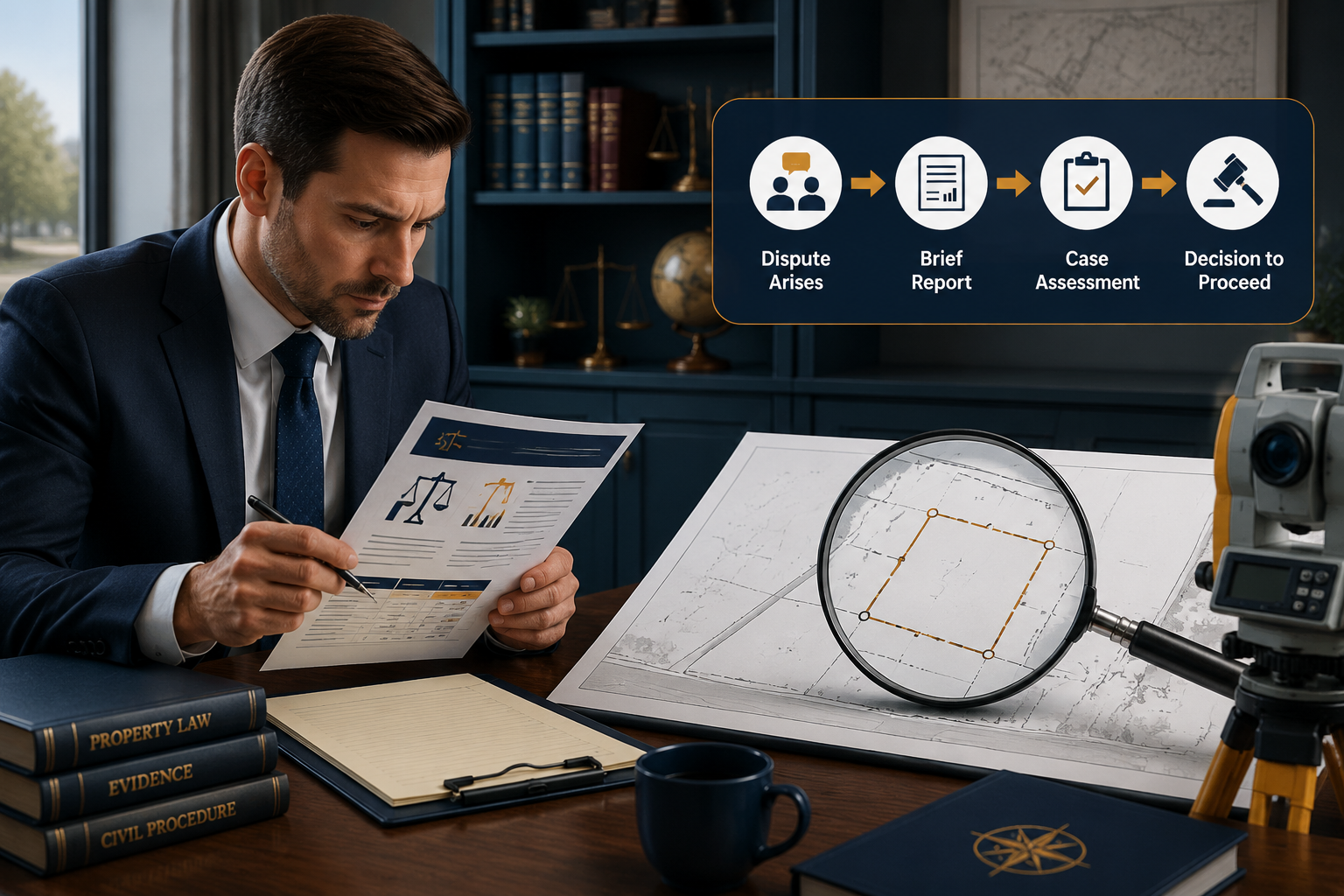
Step 4: Case Strength Assessment
The expert's conclusions give the instructing party a clear picture:
| Outcome | What It Means |
|---|---|
| Strong case | Technical evidence supports the claim; proceed with confidence |
| Moderate case | Some merit, but risks exist; consider negotiation |
| Weak case | Technical evidence does not support the claim; reconsider |
| Inconclusive | Further investigation needed before a decision |
This assessment helps solicitors advise clients accurately and helps clients make informed, rational decisions rather than emotionally driven ones.
Step 5: Decision Point
Armed with the pre-litigation brief, the client and their solicitor can decide to:
- Issue proceedings with confidence in the technical case
- Enter negotiation or mediation from a position of knowledge
- Withdraw before incurring significant legal costs
- Commission further investigation if the brief identifies gaps
Common Property Disputes Where Pre-Litigation Briefs Add the Most Value
🏠 Boundary Disputes
Boundary disagreements are among the most common — and most bitterly contested — property disputes in England and Wales. An expert witness surveyor can examine title deeds, Ordnance Survey data, historical maps, and physical boundary features to provide an independent opinion on where the legal boundary lies.
Expert witness surveyors may also claim additional competency in areas such as title research and local history, each of which may be subject to challenge during pre-litigation assessment [6]. Knowing this in advance allows solicitors to either bolster the expert's credentials or seek a specialist with the right background.
🧱 Party Wall Disputes
Party wall disputes often escalate quickly when neighbours disagree about proposed works. Understanding whether a neighbour is carrying out works without a party wall agreement — or whether a party wall dispute has genuine legal merit — is exactly the kind of question a pre-litigation brief can answer efficiently.
A brief report can assess:
- Whether the works trigger the Party Wall etc. Act 1996
- Whether proper notices were served
- What damage, if any, has been caused and its likely value
🔨 Building Defect Claims
When a property owner believes a builder, contractor, or previous surveyor has caused damage through negligence or poor workmanship, the technical complexity can be daunting. A pre-litigation brief from a qualified surveyor can assess whether the defects are consistent with negligent work, what the likely cause is, and what remediation would cost — all critical factors in deciding whether a claim is viable.
For complex structural issues, this may involve reviewing structural engineering assessments or commissioning a specific defect survey as part of the preliminary investigation.
📋 Surveyor Negligence Claims
When a homebuyer believes their pre-purchase survey failed to identify significant defects, a pre-litigation brief from an independent expert can compare what the original surveyor reported against what was actually present at the time of inspection. This is one of the most technically demanding assessments, requiring deep knowledge of RICS home survey standards and professional obligations.
Pre-Litigation Brief Reports by Expert Witness Surveyors: Assessing Case Strength Without Full Commitment — Key Risks to Avoid

Even at the pre-litigation stage, there are pitfalls that can undermine a brief report's value — or cause problems if proceedings are later issued.
❌ Pitfall 1: Selecting an Unqualified Expert
Courts apply strict admissibility thresholds, assessing whether expert evidence is proffered by a properly qualified expert [5]. For surveying disputes, this typically means a RICS-qualified chartered surveyor with relevant experience in the specific area of dispute. Selecting someone without the right credentials risks the entire report being challenged or excluded.
❌ Pitfall 2: Overly Broad Instructions
A pre-litigation brief is most valuable when it is tightly focused. Asking an expert to address too many issues dilutes the report and increases costs. The brief should identify the two or three key technical questions that will determine whether the case has merit.
❌ Pitfall 3: Ignoring Disclosure Obligations
Even pre-litigation expert reports may be subject to Rule 26-style disclosure obligations in certain proceedings [6]. Solicitors should advise clients that a pre-litigation brief, while privileged in many circumstances, could potentially be subject to disclosure depending on how proceedings develop.
❌ Pitfall 4: Treating the Brief as a Final Report
A pre-litigation brief is a preliminary assessment, not a final expert report. If proceedings are issued, a full CPR-compliant expert report will be required. The brief should be seen as the foundation for that report, not a substitute for it.
The Financial Case for Early Expert Assessment
The economics of pre-litigation brief reports are compelling:
| Stage | Typical Cost Range |
|---|---|
| Pre-litigation brief report | £500 – £2,500 |
| Full expert witness report | £3,000 – £15,000+ |
| Contested litigation (per side) | £20,000 – £100,000+ |
Spending a relatively modest sum on a pre-litigation brief can save tens of thousands in legal costs if it reveals a case is unlikely to succeed — or conversely, give a client the confidence to pursue a strong claim with proper preparation.
For those unsure about survey pricing and what different levels of assessment cost, understanding the range of available services helps set realistic expectations from the outset.
Conclusion: Actionable Next Steps
Pre-Litigation Brief Reports by Expert Witness Surveyors: Assessing Case Strength Without Full Commitment represent one of the smartest investments a property owner or solicitor can make at the outset of a dispute. They provide technical clarity, reduce financial risk, and enable informed decision-making before the costs and pressures of formal litigation take hold.
Here is what to do next:
- Identify the core technical question at the heart of the dispute — boundary location, defect causation, party wall damage, or surveyor negligence.
- Instruct a RICS-qualified expert witness surveyor with specific experience in the relevant area. Check their credentials carefully.
- Provide a focused, well-documented brief including all relevant title documents, correspondence, and existing survey data.
- Review the report's conclusions honestly — even if they are not what was hoped for. An unfavourable brief saves money and avoids a worse outcome in court.
- Use the brief as the foundation for any subsequent full expert report if proceedings are to be issued.
The goal is not simply to build a case — it is to build the right case, grounded in solid technical evidence, from the very beginning.
References
[1] Mapping & Surveying Expert Witness Case Summary – https://www.expertwitnessblog.com/mapping-surveying-expert-witness-case-summary/
[2] Consulting With An Expert Witness Prior To Filing A Lawsuit – https://schorr-law.com/consulting-with-an-expert-witness-prior-to-filing-a-lawsuit/
[3] The Expert Witness Report Structure Content And How It Strengthens Your Case Part 5 – https://www.iqubedadvisors.com/blog/the-expert-witness-report-structure-content-and-how-it-strengthens-your-case-part-5/
[4] The Critical Role Of Expert Witness Reports – https://litiligroup.com/the-critical-role-of-expert-witness-reports/
[5] Court Strikes Expert Reports Pre Trial – https://www.jdsupra.com/legalnews/court-strikes-expert-reports-pre-trial-5782504/
[6] The Surveyor as Expert Witness – Rule 26 Disclosure Reports – https://proceedings.esri.com/library/userconf/survey11/papers/pap_4028.pdf