Over 120,000 party wall notices are served in England and Wales every year — yet a significant proportion of disputes that follow stem not from the building works themselves, but from poorly drafted appointment letters, ambiguous terms of engagement, and award documents that fail to reflect current best practice. The Updated RICS Party Wall Templates for 2026: Letters of Appointment, Terms, and Award Drafts from the 8th Edition Consultation directly address this gap, offering practitioners and property owners a cleaner, more transparent framework for navigating one of property law's most misunderstood processes.
This article examines the enhanced appendices and revised templates emerging from the draft 8th edition of the RICS Surveying Safely and party wall guidance suite, with practical guidance on fee practices, professional conduct, and public engagement requirements for fully compliant appointments in 2026.
Key Takeaways 📌
- The draft 8th edition introduces revised appendices covering letters of appointment, terms of engagement, and award drafts aligned with 2026 compliance expectations.
- Fee transparency and conduct obligations have been significantly strengthened, requiring clearer upfront disclosure in appointment documents.
- Surveyors must now demonstrate public engagement competency within their appointment letters when acting in agreed surveyor or third surveyor roles.
- The updated templates are downloadable and adaptable but must be tailored to each specific project — blanket use without customisation is discouraged.
- Property owners who skip or misuse these documents risk costly disputes; understanding the templates is as important for building owners as it is for surveyors.
What the 8th Edition Consultation Changes — and Why It Matters in 2026
The RICS has been consulting on the 8th edition of its party wall guidance since late 2024, with the draft document circulated to member surveyors and stakeholder bodies for comment. The consultation closed with a revised set of appendices that represent the most substantive update to party wall template documents in over a decade.
Three areas have seen the most significant revision:
| Document Type | Key Change in 8th Edition Draft |
|---|---|
| Letter of Appointment | Mandatory fee estimate range and dispute resolution pathway disclosure |
| Terms of Engagement | Strengthened conduct clauses; updated GDPR-aligned data handling |
| Party Wall Award Draft | Clearer schedule of condition integration; revised remediation obligations |
💡 Pull Quote: "The 8th edition templates are not simply updated paperwork — they represent a shift toward greater accountability for every party in the wall process."
For anyone involved in party wall consent procedures, these changes are not optional reading. They set the standard against which professional conduct will be measured by RICS disciplinary panels and courts alike.
Breaking Down the Revised Letter of Appointment Template
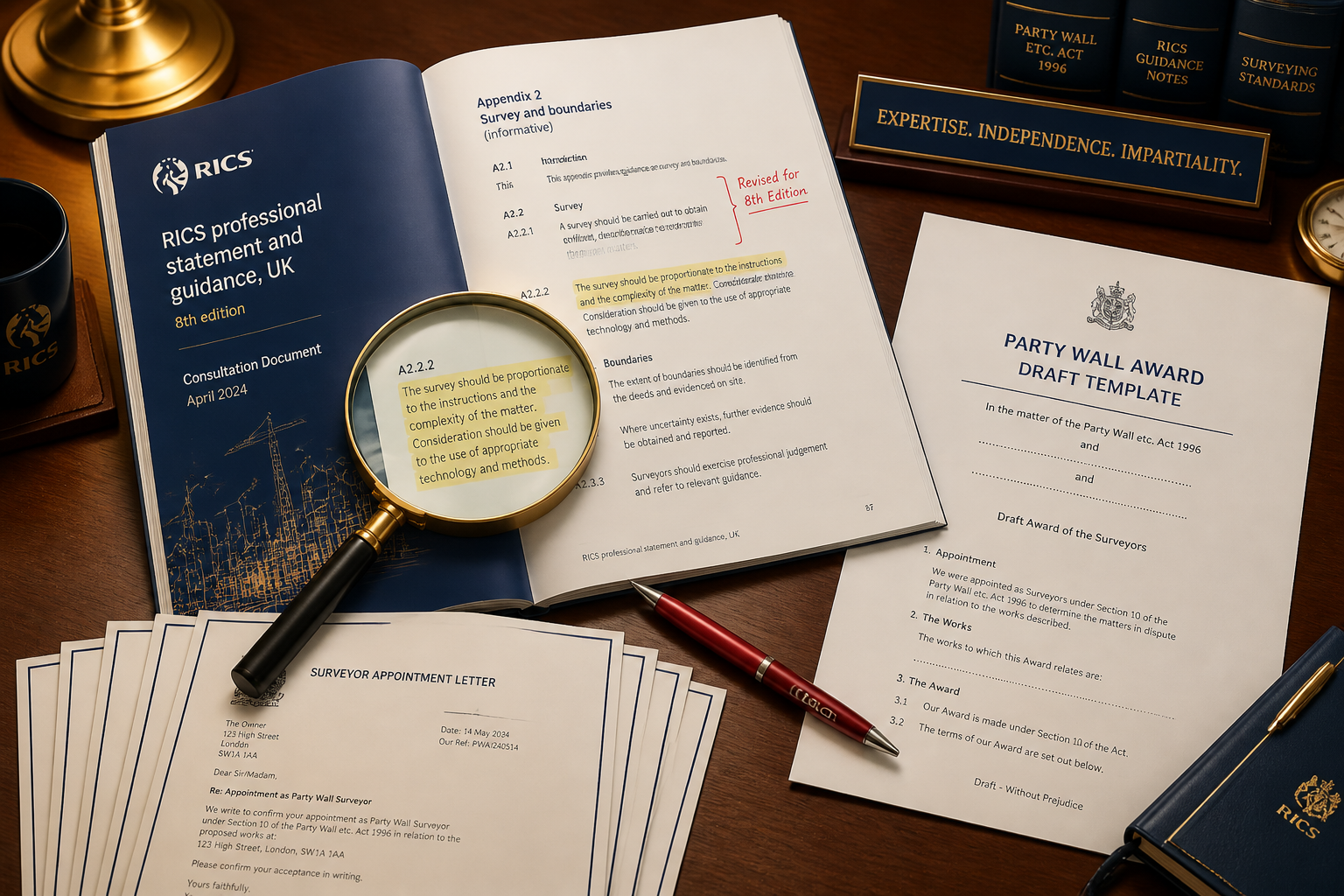
The letter of appointment is the foundation of the surveyor-client relationship in party wall proceedings. The updated RICS Party Wall Templates for 2026 introduce several mandatory and recommended elements that were previously left to individual practice.
Mandatory Disclosures in 2026 Appointment Letters
The draft 8th edition specifies that appointment letters must now include:
- ✅ A fee estimate range (not just an hourly rate), expressed as a realistic minimum-to-maximum figure based on project complexity
- ✅ Clear identification of whether the surveyor is acting as building owner's surveyor, adjoining owner's surveyor, or agreed surveyor
- ✅ A statement of the surveyor's RICS membership status and relevant professional indemnity insurance coverage
- ✅ Reference to the applicable dispute resolution mechanism if the appointment is contested
- ✅ A conflict of interest declaration — particularly important when one surveyor is proposed to act as agreed surveyor for both parties
Fee Practices: The New Transparency Standard
One of the most debated aspects of the 8th edition consultation has been fee transparency. The revised templates require surveyors to move away from vague "reasonable fees" language toward itemised or banded fee structures.
Recommended fee schedule elements include:
- Initial inspection and schedule of condition fee
- Award drafting fee
- Per-visit monitoring fee (where applicable)
- Correspondence and administration allowance
- Third surveyor referral costs (if triggered)
This approach protects both building owners and adjoining owners from fee surprises — a common source of the disputes described at what happens if you do not have a party wall agreement.
Conduct and Public Engagement Obligations
The 8th edition draft places new emphasis on public engagement competency. Surveyors acting under the Party Wall etc. Act 1996 are quasi-judicial officers — their duty is to the Act, not to the party who appointed them. The updated appointment letter template now includes a plain-English explanation of this duty, which must be communicated to clients at the point of appointment.
This is particularly relevant when obstruction in party wall situations arise, where a surveyor's impartiality may be questioned. The template language reinforces that the surveyor's primary obligation is to produce a fair and lawful award.
Updated Terms of Engagement: What's New for Surveyors and Owners
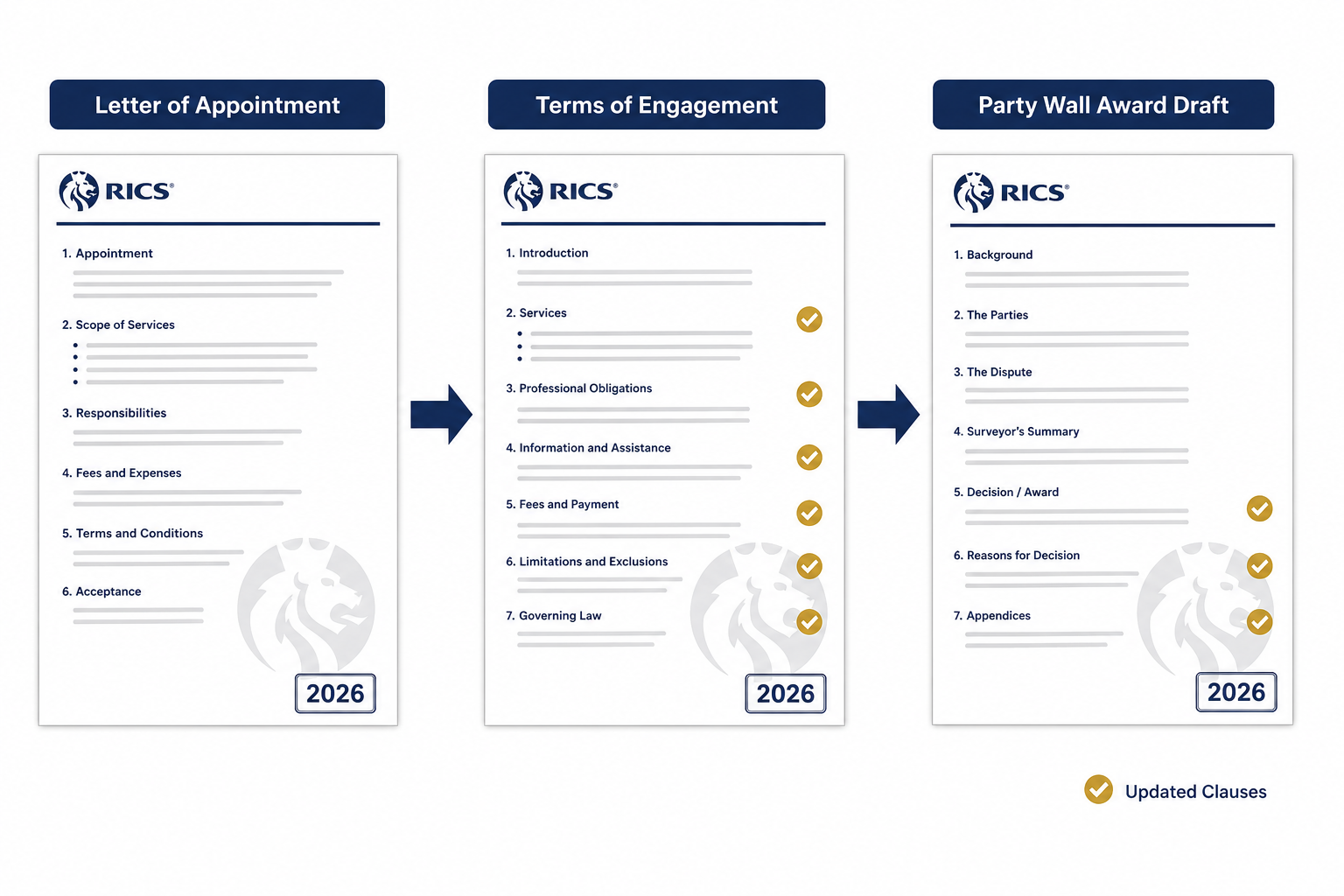
The terms of engagement document sits alongside the appointment letter and governs the ongoing relationship between surveyor and client. The 2026 revisions reflect both legal developments and lessons learned from recent RICS disciplinary cases.
Key Revisions to Standard Terms
1. GDPR and Data Handling Clause
The previous edition's data handling provisions were considered inadequate by the Information Commissioner's Office guidance standards. The 8th edition template now includes a dedicated data processing clause covering:
- What personal data is collected during party wall proceedings
- How long it is retained
- Third-party sharing (e.g., with the third surveyor or legal advisors)
2. Termination and Substitution Provisions
The revised terms clarify the circumstances under which an appointment can be terminated and how a replacement surveyor is appointed. This addresses a grey area that has generated significant case law since 2018.
3. Liability Cap Alignment
The updated template aligns liability cap language with current RICS professional indemnity insurance market standards, providing clearer protection for both surveyors and their clients.
4. Communication Standards
New provisions specify response timeframes for correspondence — typically 10 working days for substantive replies — reducing the delays that frequently extend party wall proceedings unnecessarily.
🔑 Important: Terms of engagement should always be signed before any site visit or schedule of condition inspection takes place. Retrospective signing creates enforceability risks.
For property owners working with RICS-certified experts, verifying that terms of engagement comply with 8th edition standards is a straightforward quality check that can prevent significant downstream problems.
The Party Wall Award Draft: Structural Changes in the 8th Edition Templates
The party wall award is the legally binding document that authorises building works and sets out the conditions under which they may proceed. The draft 8th edition award template is the most substantially revised of all three core documents.
New Award Template Structure
The 8th edition award draft follows a cleaner modular structure:
Section 1: Parties and Recitals
Section 2: Definitions
Section 3: Authorised Works
Section 4: Conditions and Restrictions
Section 5: Schedule of Condition (annexed)
Section 6: Access Rights
Section 7: Remediation Obligations
Section 8: Costs
Section 9: Dispute Resolution
This modular approach makes it easier to adapt the template for different project types — from simple loft conversions to complex underpinning works — without omitting critical provisions.
Schedule of Condition Integration
A major improvement in the 2026 award templates is the mandatory integration of the schedule of condition as a named annex, rather than a separate document. This ensures:
- The schedule forms an inseparable part of the award
- Photographic evidence is formally referenced and dated
- Baseline condition is unambiguous if a damage claim arises post-works
For complex structural projects, a structural survey may be recommended to supplement the schedule of condition, particularly where existing defects are present that could be confused with works-related damage.
Remediation Obligations: Clearer Language
The previous award template used broad language around making good damage, which courts have interpreted inconsistently. The 8th edition draft specifies:
- Standard of repair: "to a condition no worse than that recorded in the Schedule of Condition"
- Timeframe for making good: within 28 days of practical completion of relevant works
- Dispute escalation: any disagreement on remediation standard to be referred to the third surveyor within 14 days
Costs Provisions
The updated costs section reflects the Court of Appeal's guidance in recent party wall costs cases. Key changes include:
- A presumption that reasonable costs are recoverable from the building owner
- Clearer language on what constitutes "reasonable" in the context of the 8th edition fee transparency standards
- Provisions for interim cost awards where proceedings are prolonged
Downloadable Templates: Guidance on Adaptation and Compliant Use
The RICS makes the updated templates available to members through its online practice portal. However, the 8th edition consultation guidance is explicit: templates are starting points, not finished documents.
Adaptation Checklist ✅
Before using any 8th edition template, surveyors should verify:
- Project-specific details are inserted (not left as placeholders)
- Fee estimates reflect the actual complexity of the proposed works
- The correct surveyor role is identified throughout
- Schedule of condition photographs are referenced and annexed
- GDPR data handling clause reflects the surveyor's actual practice
- Conflict of interest declaration has been completed honestly
- Client has received and acknowledged the public engagement statement
Common Adaptation Errors to Avoid
❌ Using residential templates for commercial party wall matters — the 8th edition provides separate guidance for commercial properties.
❌ Omitting the fee estimate range — this is now a mandatory disclosure, not optional.
❌ Failing to update the dispute resolution clause — the template references RICS Dispute Resolution Service; confirm this is appropriate for the specific appointment.
❌ Backdating documents — a disciplinary risk that the 8th edition explicitly flags in its conduct guidance.
For property owners uncertain about whether their surveyor's documents meet 2026 standards, consulting with RICS-registered valuers and surveyors provides an independent quality check.
Professional Conduct Standards Embedded in the 2026 Templates

One of the most significant aspects of the Updated RICS Party Wall Templates for 2026 is how professional conduct obligations are now embedded directly into the template language, rather than existing only in separate guidance notes.
The Impartiality Statement
Every appointment letter template now includes a standard impartiality statement that the surveyor must sign alongside their client. This statement confirms:
- The surveyor understands their quasi-judicial role
- The surveyor will not act in a manner that favours their appointing party over the other
- The surveyor will refer irresolvable disputes to the third surveyor without delay
Handling Conflicts of Interest
The 8th edition templates introduce a two-stage conflict check:
- At appointment: Surveyor declares any prior relationship with either party or the property
- During proceedings: Surveyor has an ongoing duty to disclose any new conflicts that arise
This is particularly important for agreed surveyor appointments, where one professional acts for both building owner and adjoining owner. The template includes specific language for this scenario that was absent from earlier editions.
Communication with Unrepresented Parties
A notable addition to the 2026 templates is guidance on communicating with unrepresented adjoining owners — those who have not appointed their own surveyor. The template includes a plain-English covering letter template designed to explain the party wall process in accessible language, fulfilling the public engagement obligation without compromising the surveyor's professional position.
This matters enormously in practice. When adjoining owners feel uninformed or excluded, disputes escalate. The party wall consent process works most smoothly when all parties understand what is happening and why.
Practical Implications for Building Owners and Adjoining Owners
The Updated RICS Party Wall Templates for 2026 are primarily tools for surveyors — but building owners and adjoining owners benefit directly from understanding what these documents should contain.
For Building Owners
- Demand a fee estimate range in writing before appointing a surveyor
- Ensure the appointment letter clearly states the surveyor's role and RICS membership
- Confirm the award includes a properly annexed schedule of condition before works begin
- Understand that reasonable surveyor costs for the adjoining owner are typically your liability
For Adjoining Owners
- Request a copy of the appointment letter and terms of engagement from the building owner's surveyor
- If appointing your own surveyor, verify their documents comply with 8th edition standards
- Review the schedule of condition carefully before signing — this is your primary protection against unwarranted damage claims
- Know that the RICS chartered building surveyor you appoint has a duty to the Act, not just to you
Conclusion: Taking Action with the 2026 RICS Templates
The Updated RICS Party Wall Templates for 2026: Letters of Appointment, Terms, and Award Drafts from the 8th Edition Consultation represent a meaningful step forward in professionalising party wall practice across England and Wales. The enhanced appendices bring greater fee transparency, stronger conduct obligations, and clearer award structures that protect all parties — not just those with the best legal representation.
Actionable Next Steps 🚀
-
Surveyors: Download the 8th edition draft templates from the RICS practice portal and audit your current precedent documents against the new standards before taking on new appointments in 2026.
-
Building owners: Before serving party wall notices, confirm your chosen surveyor uses 8th edition-compliant appointment documents and can provide a written fee estimate range.
-
Adjoining owners: Request copies of all appointment documents and compare them against the checklist in this article. If documents appear non-compliant, raise this with the surveyor before proceeding.
-
Both parties: Ensure the party wall award includes a properly annexed schedule of condition with dated photographs — this single step prevents the majority of post-works disputes.
-
All stakeholders: Consider engaging an RICS chartered building surveyor with specific party wall experience to review template documents before execution.
The 8th edition consultation has produced templates that, when properly used, make the party wall process fairer, faster, and less contentious. The key word is properly — adaptation, disclosure, and conduct remain the responsibility of the individual surveyor. The templates provide the framework; professional judgement must do the rest.
References
- RICS. (2024). Party Wall Legislation and Procedure – Draft 8th Edition Consultation Document. Royal Institution of Chartered Surveyors.
- RICS. (2011). Party Wall Legislation and Procedure, 7th Edition Guidance Note. Royal Institution of Chartered Surveyors.
- HM Government. (1996). Party Wall etc. Act 1996. HMSO.
- Information Commissioner's Office. (2021). Guide to the UK General Data Protection Regulation (UK GDPR). ICO.
- RICS. (2023). Rules of Conduct. Royal Institution of Chartered Surveyors.
- Chynoweth, P. (2003). The Party Wall Casebook. Blackwell Publishing.