}

Fewer than one in three neighbour disputes that reach formal mediation in England and Wales are resolved without some form of professional expert evidence — yet the majority of property owners still assume a basic party wall award is where the surveyor's role ends. That assumption is costing people thousands of pounds and months of unnecessary litigation.
Party Wall Surveyors as CPR-Compliant Expert Witnesses in Neighbour Valuation Disputes: Beyond Basic Settlements represents a rapidly growing and critically important specialism. As neighbour conflicts increasingly spill from informal disagreement into formal legal proceedings, the surveyor who can combine technical party wall knowledge with Civil Procedure Rule (CPR) Part 35-compliant expert witness reporting becomes an indispensable asset — not just a procedural formality [1][2].
This article explores how qualified surveyors bridge the gap between party wall procedure and courtroom-ready valuation evidence, and what that means for property owners, solicitors, and surveyors alike in 2026.
Key Takeaways 📋
- CPR Part 35 compliance is non-negotiable for expert witness reports used in court — party wall surveyors must understand their duty to the court, not just their client.
- Valuation evidence and party wall findings are complementary, not separate — the surveyor identifies damage, the valuation expert quantifies it, but often one professional does both.
- Report structure directly affects credibility — poorly formatted or one-sided reports are routinely challenged and can undermine an otherwise strong case.
- Mediation increasingly relies on expert evidence — CPR-compliant reports carry weight even outside the courtroom, accelerating settlements.
- RICS-qualified surveyors with dual expertise in party wall matters and property valuation are the most effective expert witnesses in neighbour disputes [5].
Understanding the CPR Part 35 Framework for Party Wall Expert Witnesses
What CPR Part 35 Actually Requires
The Civil Procedure Rules Part 35 governs how expert evidence is used in civil litigation in England and Wales. For any party wall surveyor stepping into the role of expert witness, these rules are the foundation of everything [1].
Under CPR Part 35, the expert's primary duty is to the court, not to the party who instructed them. This is a fundamental shift from the surveyor's usual role as advocate for their client's interests. The rules require:
| Requirement | What It Means in Practice |
|---|---|
| Overriding duty to the court | Opinions must be objective, even if unfavourable to the instructing party |
| Written declaration of truth | The report must include a signed statement of truth |
| Statement of independence | The expert must confirm they have no conflict of interest |
| Reasoned opinions | Conclusions must be supported by evidence and reasoning |
| Disclosure of instructions | The substance of instructions received must be summarised |
Failing to meet any of these requirements can result in the report being excluded from proceedings entirely [1]. For party wall surveyors, this is a significant professional responsibility that goes well beyond issuing a standard party wall award.
Why Party Wall Surveyors Are Uniquely Positioned
Party wall surveyors occupy a distinctive position in neighbour disputes. They already operate under a quasi-judicial framework — the Party Wall etc. Act 1996 requires appointed surveyors to act impartially, even when appointed by one party. This built-in neutrality aligns naturally with the CPR Part 35 duty to the court [2].
When a dispute escalates beyond the party wall award — for example, when a neighbour claims that construction works have caused structural damage or reduced their property's market value — the party wall surveyor who already understands the technical context of the works is ideally placed to provide expert witness evidence.
💡 Key Insight: "Party wall surveyors determining whether damage occurred in disputes, with valuation experts quantifying compensation, represent two sides of the same expert coin — and the most effective practitioners do both." [2]
For complex cases, understanding damage to property in party wall disputes is essential groundwork before any expert report can be credibly structured.
How Valuation Evidence Integrates with Party Wall Expert Witness Roles
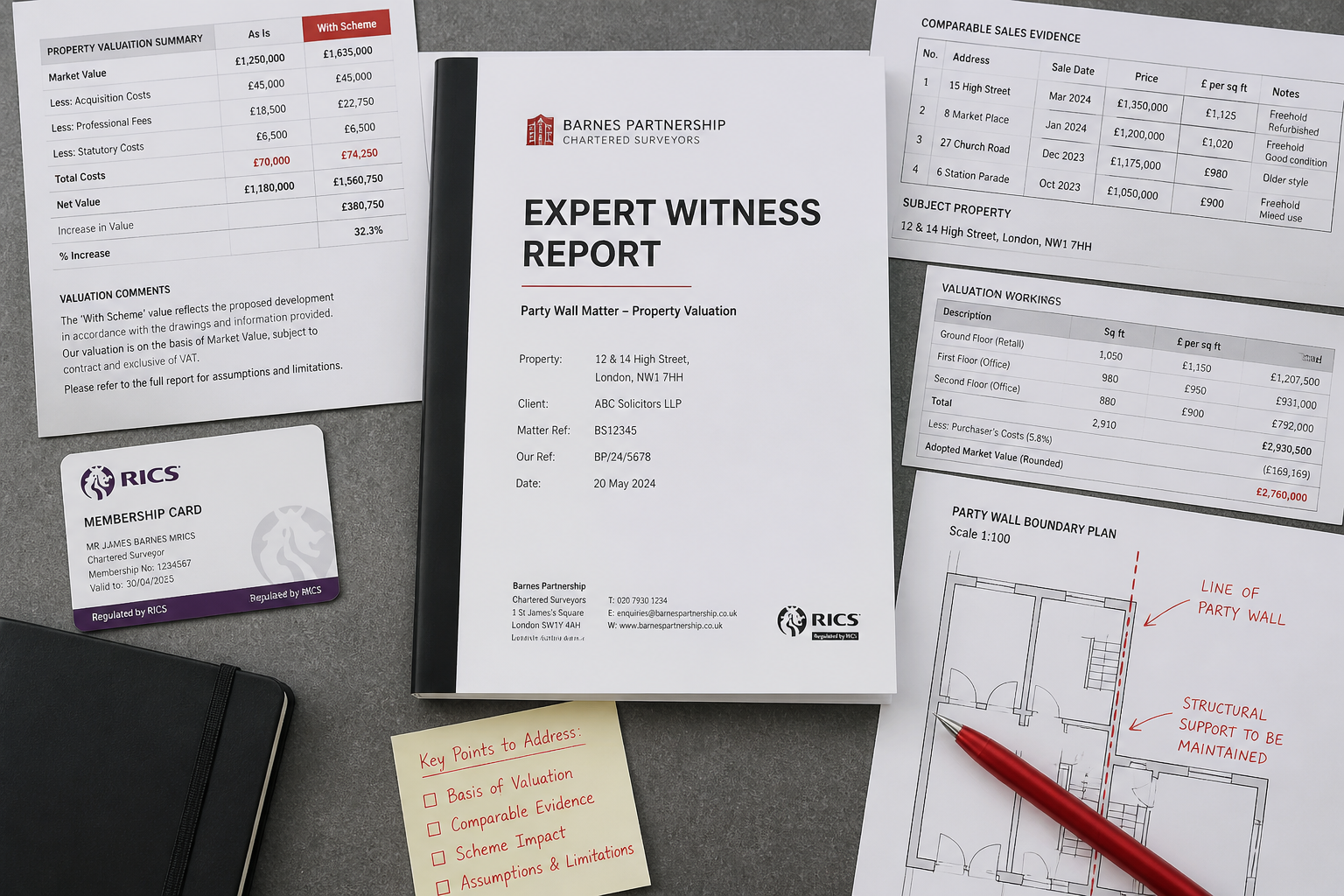
The Two-Stage Evidence Model
In neighbour valuation disputes, expert evidence typically operates in two stages:
- Technical liability stage — Did the works cause the alleged damage or diminution in value?
- Quantum stage — If so, what is the financial loss?
Party wall surveyors are naturally suited to the first stage. They have direct knowledge of the notified works, the schedule of condition recorded before works began, and any subsequent changes to the property's condition. This pre- and post-works comparison is the backbone of any liability argument [2].
The quantum stage — calculating actual financial loss — requires robust property valuation methodology. This is where RICS-qualified surveyors with valuation expertise become essential. RICS valuations carried out to Red Book standards provide the defensible, methodology-driven evidence that courts and mediators expect.
Common Valuation Scenarios in Neighbour Disputes
Not all neighbour disputes involve obvious physical damage. The valuation issues that arise can be subtle but financially significant:
- 🏠 Diminution in value — A property's market value has dropped due to neighbouring works (e.g., loss of light, overlooking, structural concerns)
- 🔧 Cost of remediation — The cost to repair damage caused by party wall works
- 📉 Rental income loss — Where damage has made a property unlettable during repairs
- 🌿 Amenity loss — Reduction in enjoyment of the property, which may be reflected in value
- 📋 Betterment arguments — Where the responding party argues that works actually improved the claimant's property
Each of these requires a different valuation approach, and each must be supported by comparable evidence, market analysis, and reasoned professional opinion to withstand cross-examination [5].
Understanding the factors of valuation that affect property worth is critical when constructing any quantum argument in a neighbour dispute context.
Mediation vs. Litigation: Does the Standard Change?
Short answer: no. While mediation is less formal than court proceedings, CPR Part 35-compliant reports carry significantly more weight in mediation precisely because they demonstrate rigour and objectivity [2]. Mediators and opposing solicitors are far more likely to accept a valuation that follows established expert witness protocols than one that reads as a partisan advocacy document.
Professional firms providing CPR Part 35-compliant expert witness reports have found that well-structured reports frequently resolve disputes at mediation stage, avoiding the cost and delay of trial [1]. This is a compelling reason for property owners and their solicitors to insist on properly compliant expert evidence from the outset.
Structuring a Credible CPR-Compliant Expert Witness Report: Practical Guidance
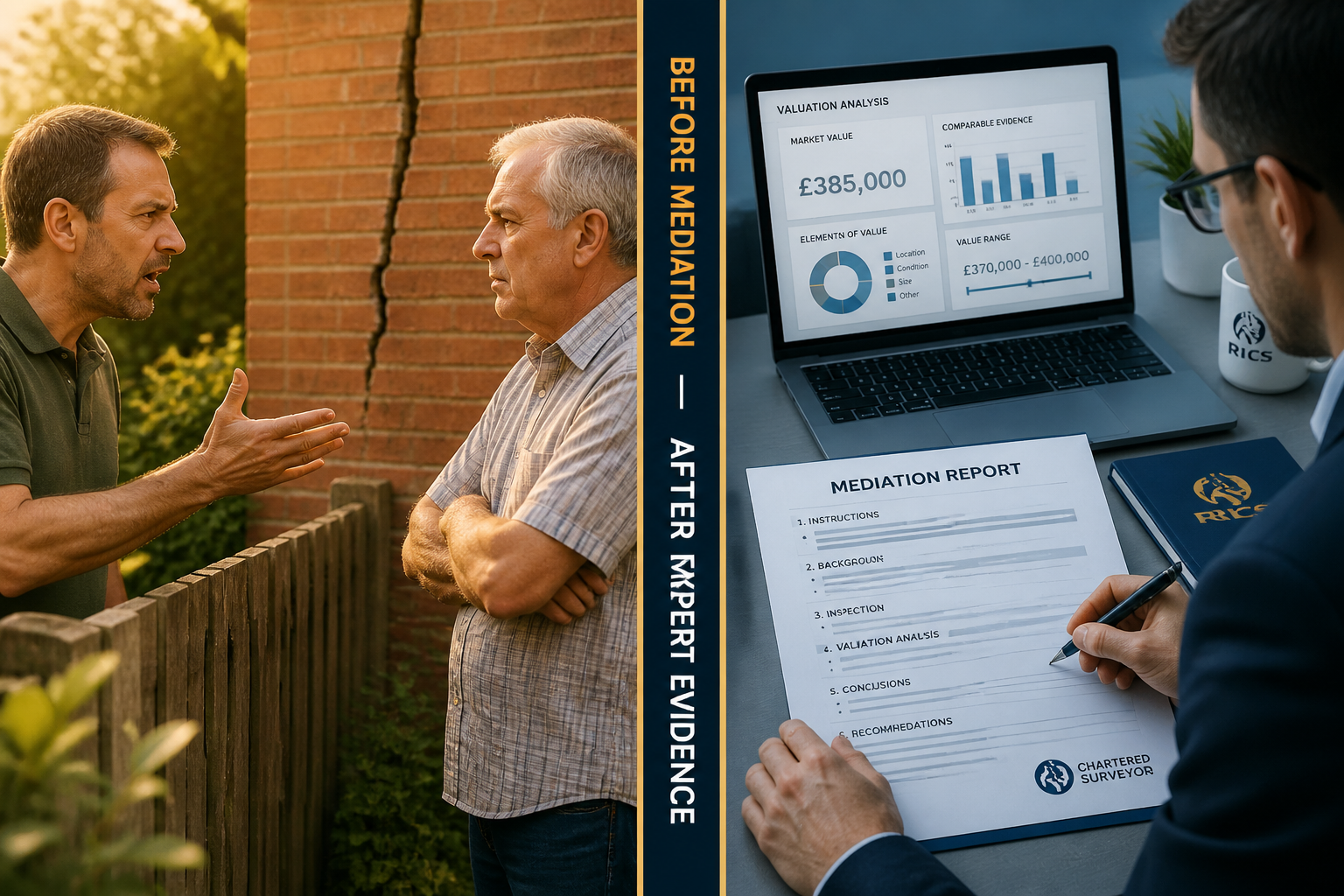
The Anatomy of a Defensible Report
Party Wall Surveyors as CPR-Compliant Expert Witnesses in Neighbour Valuation Disputes: Beyond Basic Settlements demands more than technical knowledge — it demands structured, persuasive, court-ready documentation. Here is what a credible report must contain:
1. 📄 Cover Page and Instructions Summary
- Expert's full name, qualifications (RICS membership, relevant experience)
- Summary of instructions received
- Confirmation of independence and no conflict of interest
2. 🔍 Executive Summary
- Brief, non-technical summary of findings and conclusions
- Written for a judge or mediator, not a fellow surveyor
3. 📐 Scope of Inspection and Methodology
- What was inspected, when, and how
- What records were reviewed (party wall notices, schedules of condition, building regulations approvals)
- Valuation methodology used (comparable method, depreciated replacement cost, etc.)
4. 🏗️ Technical Findings
- Detailed description of the works carried out
- Condition of the property before and after works (cross-referenced to the schedule of condition)
- Causation analysis — linking the works to the alleged damage or value impact
5. 💷 Valuation Evidence
- Comparable sales or rental data
- Market commentary relevant to the area and property type
- Quantified financial loss with supporting calculations
6. ✅ Conclusions and Declaration
- Clear, unequivocal conclusions
- Signed statement of truth per CPR Part 35 requirements
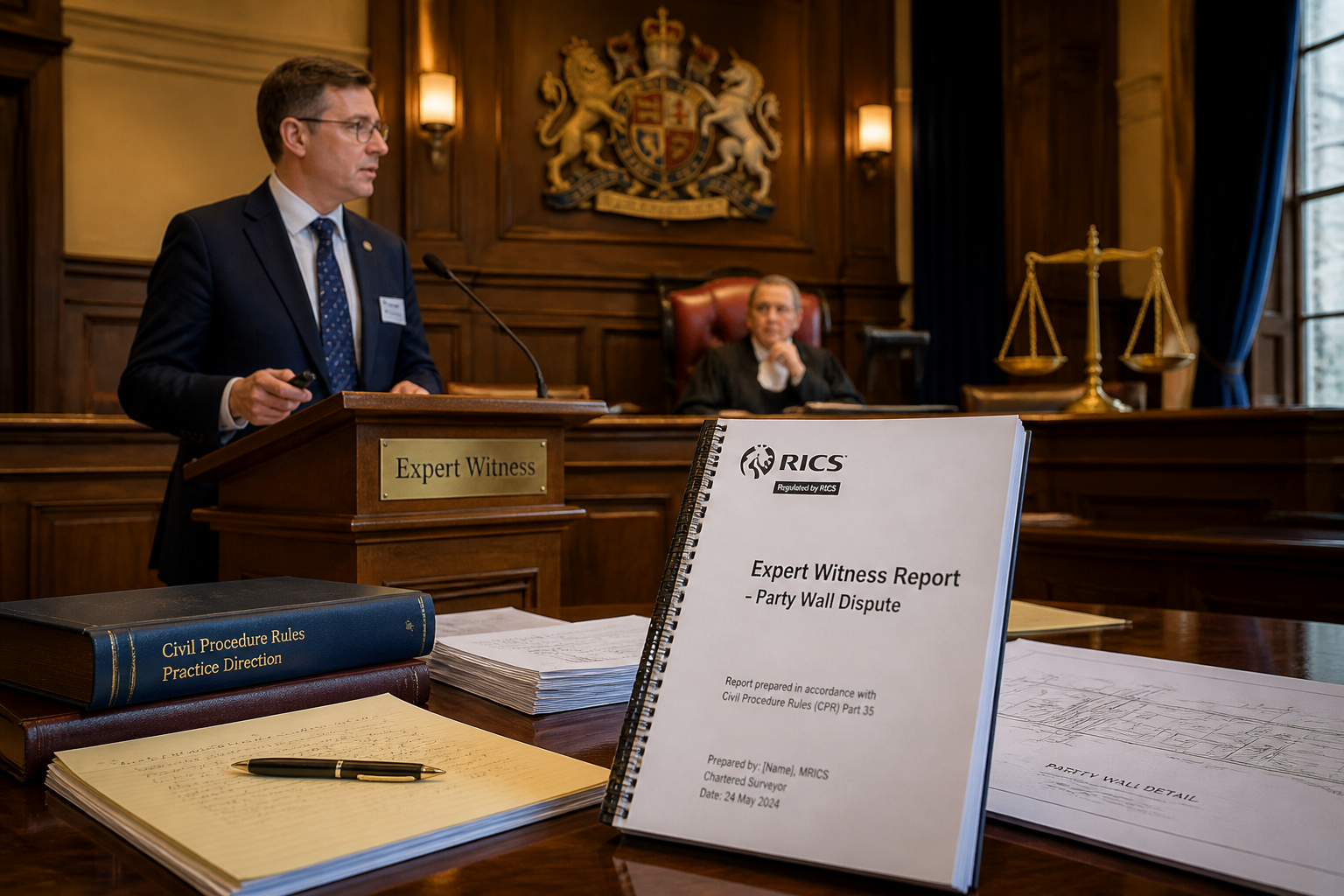
For those seeking a professional template and understanding of what a court-ready document looks like, reviewing a specialist expert witness report provides essential context.
Common Mistakes That Undermine Credibility
Even experienced surveyors make errors when transitioning into the expert witness role. The most damaging include:
- Advocacy language — Phrases like "it is clear that the neighbour was negligent" signal bias and invite challenge
- Unsupported assertions — Every opinion must be backed by evidence; bare assertions carry no weight
- Ignoring contrary evidence — A credible expert acknowledges and addresses evidence that does not support their conclusions
- Inadequate comparable data — Valuation conclusions without robust comparable evidence are routinely dismissed
- Missing the declaration — Forgetting the CPR Part 35 declaration of truth is a basic but fatal error [1]
The Role of Joint Expert Witnesses
In some cases, the court may direct that a single joint expert (SJE) be appointed rather than each party instructing their own. For party wall disputes, this is increasingly common in lower-value claims where the cost of two separate experts would be disproportionate.
RICS-qualified expert witnesses appointed as SJEs must be especially rigorous in their independence, as their report will be the primary technical evidence before the court [5]. The expert witness services offered by specialist firms are structured to accommodate both party-appointed and single joint expert appointments.
When Does a Party Wall Dispute Require Expert Witness Evidence?
Not every party wall disagreement needs to escalate to formal expert witness territory. Understanding the trigger points helps property owners and their advisers make informed decisions.
Indicators That Expert Evidence Is Needed
✅ The dispute has moved beyond the party wall award stage and into court or formal mediation
✅ A claim for financial compensation exceeds what can be agreed between the parties
✅ There is a genuine dispute about causation — did the works actually cause the damage?
✅ The property's market value is alleged to have been affected
✅ The matter involves complex structural issues requiring specialist interpretation
Indicators That a Standard Party Wall Process May Suffice
❌ The dispute is about the scope or timing of works, not financial loss
❌ Both parties have appointed surveyors and the award process is ongoing
❌ The financial amounts involved are modest and proportionate to mediation costs
Where a neighbour is carrying out works without proper agreement, the situation can escalate rapidly. Understanding what happens when a neighbour carries out works without a party wall agreement is an important first step before deciding whether expert witness involvement is necessary.
Similarly, if the dispute involves an obstruction in a party wall context, the technical complexity often warrants formal expert evidence from the outset.
Choosing the Right Expert: Qualifications and Due Diligence
What to Look For in a Party Wall Expert Witness
Not all surveyors are equipped to act as CPR-compliant expert witnesses. The following qualifications and attributes are essential:
| Attribute | Why It Matters |
|---|---|
| RICS membership (MRICS/FRICS) | Demonstrates professional standards and accountability [5] |
| Party wall specialism | Direct knowledge of the Act and its procedures |
| Valuation experience | Ability to quantify financial loss credibly |
| Prior court experience | Familiarity with cross-examination and court protocols |
| CPR Part 35 training | Understanding of the legal framework for expert evidence [1] |
| PI insurance | Professional indemnity cover appropriate to the claim value |
The Importance of RICS Standards
RICS-qualified expert witnesses are bound by both the CPR Part 35 framework and RICS professional standards. This dual accountability provides an additional layer of credibility that courts and mediators recognise [5]. When a report carries the weight of RICS professional standards alongside CPR compliance, it is significantly harder for the opposing party to mount a credible challenge to the expert's methodology.
Conclusion: Actionable Next Steps for Property Owners and Legal Advisers
Party Wall Surveyors as CPR-Compliant Expert Witnesses in Neighbour Valuation Disputes: Beyond Basic Settlements is not a niche concern — it is an increasingly mainstream requirement as property values rise and neighbour disputes become more financially significant.
Here are the key actions to take in 2026:
-
Engage early — If a party wall dispute shows signs of escalating beyond the award stage, instruct a CPR-qualified expert witness before positions become entrenched. Early expert evidence often prevents litigation entirely.
-
Insist on RICS qualifications — Any expert providing valuation evidence in a neighbour dispute should hold current RICS membership and be able to demonstrate relevant experience [5].
-
Commission a schedule of condition before works begin — This single document is the most powerful evidence in any subsequent dispute about damage causation. A properly prepared schedule of condition is invaluable.
-
Review the report structure carefully — Before submitting any expert witness report to court or mediation, verify it meets every CPR Part 35 requirement, including the signed declaration of truth [1].
-
Consider mediation with expert support — A CPR-compliant expert report presented at mediation frequently resolves disputes faster and at lower cost than proceeding to trial [2].
-
Seek specialist advice on valuation methodology — Neighbour dispute valuations are not the same as standard market valuations. The methodology must be appropriate to the specific type of loss being claimed.
The surveyor who masters both the technical party wall framework and the CPR expert witness requirements is not just resolving disputes — they are preventing them from becoming the costly, relationship-destroying litigation that nobody wants.
References
[1] Expert Witness Cpr Part 35 – https://www.kelhamconcept.com/professional-services/expert-witness-cpr-part-35/
[2] Expert Witness Valuations In Neighbour Dispute Settlements Mediation Evidence And Cpr Part 35 Compliance – https://nottinghillsurveyors.com/blog/expert-witness-valuations-in-neighbour-dispute-settlements-mediation-evidence-and-cpr-part-35-compliance
[3] Neighbour Boundary Disputes – https://www.jspubs.com/expert-witness/si/n/neighbour-boundary-disputes/
[4] Construction Expert Witness – https://seakexperts.com/specialties/construction-expert-witness
[5] Rics Expert Witness – https://www.jamesscottassociates.com/rics-expert-witness/