Fewer than 40% of buyers purchasing converted flats commission a Level 3 Building Survey — yet converted properties account for a disproportionate share of post-purchase defect disputes in the UK [1]. The gap between what a standard survey covers and what a converted flat actually conceals can cost buyers tens of thousands of pounds. Understanding Building Survey Red Flags in Converted Flats: Non-Standard Construction Assessment Protocols for 2026 is no longer optional for anyone navigating this complex corner of the property market.
Converted flats present a uniquely layered set of risks. Unlike purpose-built blocks, they combine original Victorian or Edwardian construction with modern interventions — creating hybrid structures where non-standard materials, compromised load paths, and hidden defects sit behind freshly decorated walls. This guide breaks down the critical red flags, the assessment protocols that matter in 2026, and the steps buyers and surveyors must take to avoid costly surprises.
Key Takeaways
- ✅ Converted flats often require a Level 3 Building Survey, not just a Level 2 HomeBuyer Report, due to their hybrid construction history
- ✅ Fire safety compliance, including EWS1 forms and cladding checks, remains a non-negotiable red flag category post-Grenfell
- ✅ Non-standard construction materials — including asbestos, steel frame infill panels, and non-cavity walls — demand specialist assessment
- ✅ Structural movement, damp, and inadequate soundproofing are the three most frequently missed defects in converted flat surveys
- ✅ Service charge liabilities and management pack gaps can represent hidden financial red flags that go beyond physical defects
Why Converted Flats Demand a Different Surveying Approach
Most converted flats began life as something else entirely — a Georgian townhouse, a Victorian terrace, a 1930s commercial premises. The conversion process introduces a fundamental tension: original structural systems designed for one use are adapted, sometimes poorly, to serve another. This is the core reason why Building Survey Red Flags in Converted Flats: Non-Standard Construction Assessment Protocols for 2026 must be treated as a specialist discipline rather than a variation on standard residential surveying.
The Limitations of a Standard Survey Scope
A Level 2 HomeBuyer Survey may be adequate for a modern, purpose-built flat in good condition. However, for older converted blocks — particularly those built before 1970 — a Level 3 Building Survey provides the depth of investigation that the property actually warrants [1].
Even at Level 3, there are scope limitations surveyors and buyers must understand:
- Surveyors typically focus on the individual unit and immediately accessible shared areas
- Full inspection of all communal parts, roof voids, and basement areas is rarely included by default [1]
- Services such as drainage, electrics, and gas installations may only be visually assessed rather than tested
💡 Pull Quote: "A converted flat survey that doesn't examine the roof structure, party walls, and drainage system in detail is leaving the buyer exposed to the most expensive categories of defect."
For buyers in London and the South East — where converted Victorian and Edwardian stock dominates the market — working with chartered surveyors in London who specialise in period conversions is strongly advisable.
Non-Standard Construction: What It Means in Practice
The term "non-standard construction" covers a wide range of building methods and materials that fall outside traditional brick-and-block or timber-frame construction. In converted flats, this commonly includes:
| Construction Type | Common Era | Key Risk |
|---|---|---|
| Steel-framed infill panels | 1950s–1970s | Corrosion, thermal bridging |
| Concrete large panel systems (LPS) | 1960s–1980s | Joint failure, carbonation |
| Timber-framed conversions | Pre-1900 | Rot, beetle infestation, fire spread |
| Airey, Wimpey No-Fines, Cornish | 1945–1960s | Structural degradation, unmortgageable |
| Mixed masonry with modern inserts | Various | Load path discontinuity |
Specialist assessment for non-standard construction is essential when any of these systems are identified or suspected. Mortgage lenders may decline applications outright on certain non-standard types without a detailed structural report.
The Critical Red Flags: What Surveyors Must Identify in 2026
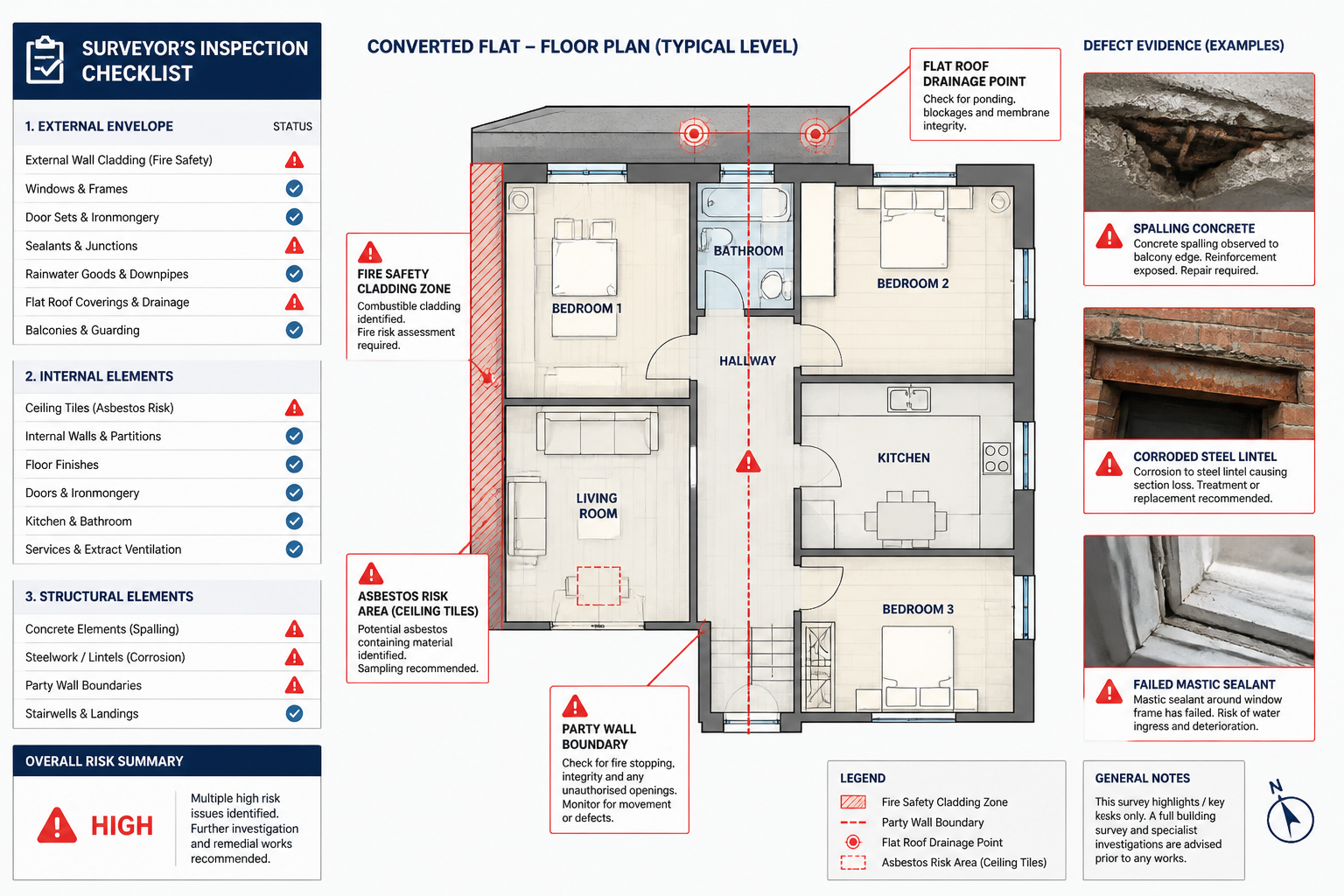
Understanding Building Survey Red Flags in Converted Flats: Non-Standard Construction Assessment Protocols for 2026 means knowing which defect categories carry the greatest financial and safety risk. The following represent the highest-priority issues.
🔴 1. Structural Movement and Subsidence
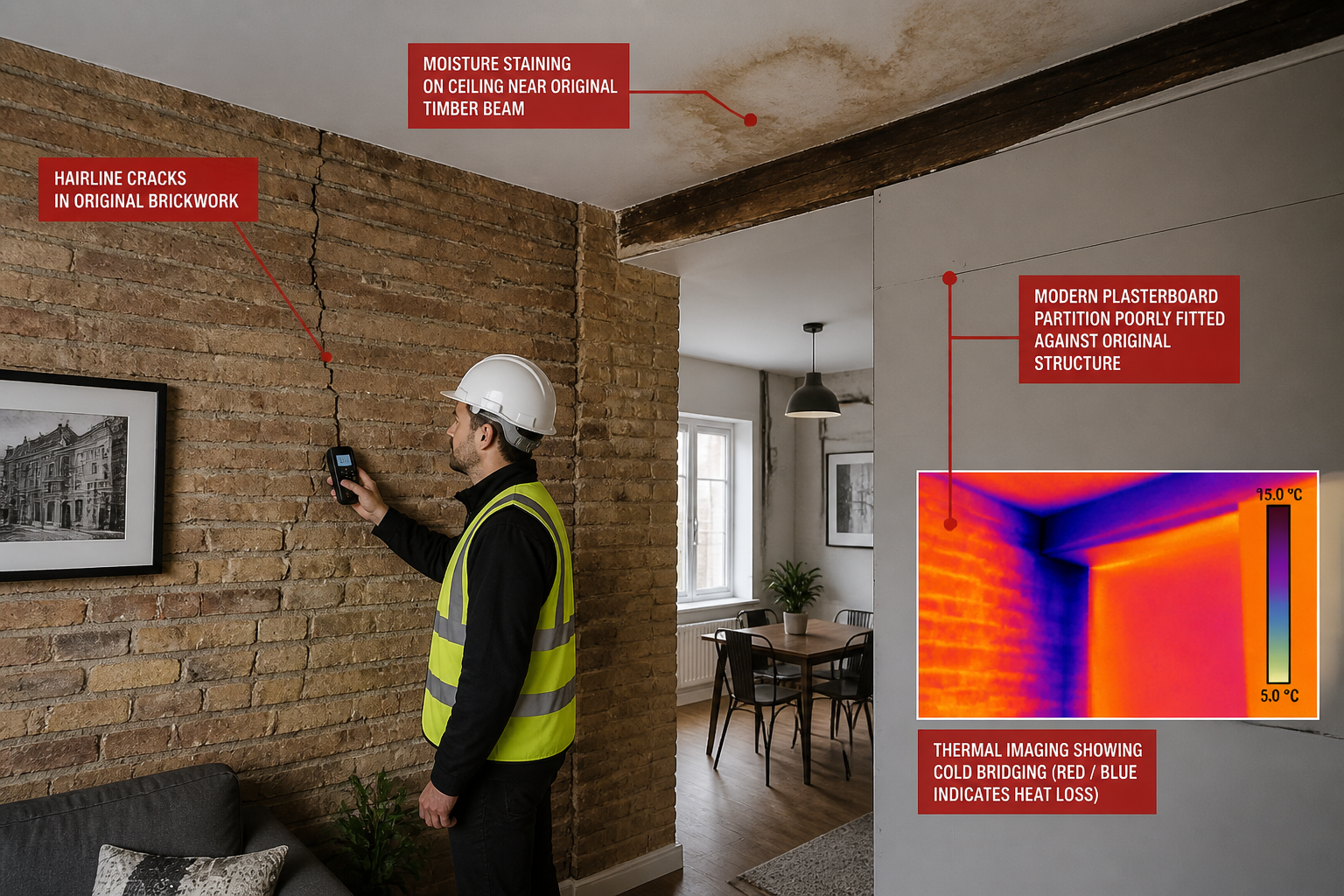
Structural movement in converted flats is among the most serious — and most expensive — red flags a survey can uncover [2]. In older converted blocks, the original foundations were designed for a single occupancy load. Subdivision into multiple units changes load distribution, and decades of differential settlement can manifest as:
- Diagonal cracking at window and door corners
- Stepped cracking following mortar joints in brickwork
- Floors that slope visibly or feel uneven underfoot
- Doors and windows that stick, bind, or no longer close properly [3]
Not all cracks indicate active subsidence — hairline cracks in plaster are common in old buildings. However, cracks wider than 5mm, cracks that have been repeatedly filled and reopened, or cracks accompanied by other movement signs warrant immediate referral to a structural engineer. A structural survey should be commissioned before exchange in any case where significant movement is flagged.
🔴 2. Damp, Condensation, and Water Ingress
Damp is the single most commonly reported defect in converted flat surveys [1]. Its sources in converted properties are more varied and harder to trace than in standard houses:
- Roof leaks penetrating through to upper-floor flats
- Balcony or terrace waterproofing failure causing penetrating damp
- Rising damp in ground-floor conversions with inadequate DPC
- Neighbour-sourced moisture from leaking pipes or appliances in adjacent units
- Interstitial condensation within walls where insulation has been poorly retrofitted
A professional damp survey using calibrated moisture meters, thermal imaging, and borescope inspection where accessible is the appropriate response when damp is suspected. Surface treatment alone rarely addresses the underlying cause in converted properties.
🔴 3. Fire Safety and Cladding Compliance
Post-Grenfell legislation has fundamentally changed the risk landscape for flat buyers in the UK. In 2026, fire safety compliance remains one of the most consequential red flags in any converted flat assessment:
- EWS1 (External Wall System) forms are required for mortgage approval on buildings where cladding or external wall materials may fail fire regulations [1]
- Combustible cladding, timber cladding, or High Pressure Laminate (HPL) panels on buildings over 11 metres trigger mandatory assessment
- Internal fire compartmentation — the fire-stopping between flats, in ceiling voids, and around service penetrations — is frequently compromised in older conversions
- Missing or inadequate fire doors in communal areas represent both a safety and a legal compliance failure
Buyers should request a copy of the building's Fire Risk Assessment as part of due diligence. If the freeholder or managing agent cannot provide one, this is itself a significant red flag.
🔴 4. Asbestos-Containing Materials (ACMs)
Asbestos was widely used in UK construction until its ban in 1999 [5]. In converted flats — particularly those converted from commercial or industrial premises — ACMs may be present in:
- Artex ceiling coatings (pre-1985)
- Floor tiles and adhesives
- Pipe lagging and boiler insulation
- Roof sheets and soffits
- Partition board materials (Asbestos Insulating Board)
The cost of asbestos removal varies enormously depending on the type and location of the material. Friable asbestos (loose fibres) in roof voids or pipe lagging represents the highest removal cost and health risk. A surveyor who identifies suspected ACMs should recommend a specialist asbestos survey and management plan before purchase.
🔴 5. Roofing Defects
For upper-floor flat buyers, the condition of the roof is directly relevant to their unit. For all flat buyers, roof defects affect service charge liability. Key indicators include:
- Missing, slipped, or cracked tiles on pitched roofs
- Sagging or ponding on flat roofs — flat roof replacement starts from approximately £1,200 and can reach significantly higher for larger blocks [5]
- Failed flashings at chimney stacks, parapet walls, and roof junctions
- Blocked or damaged gutters causing water to track back into the building fabric
The managing agent's service charge accounts should be reviewed for evidence of recent roof works or sinking funds earmarked for future replacement.
🔴 6. Inadequate Soundproofing
Poor acoustic separation is a defining characteristic of poorly executed conversions [1]. Original Victorian and Edwardian floors were not designed to meet modern acoustic standards. When a house is converted to flats, the floor/ceiling assembly between units must achieve minimum performance under Part E of the Building Regulations.
Red flags include:
- No evidence of acoustic insulation in floor voids (visible on inspection or from building control records)
- Thin partition walls between units (less than 100mm total construction)
- No resilient layer or floating floor construction visible at floor edges
This defect rarely affects mortgage approval but significantly affects quality of life and resale value.
🔴 7. Service Charge Liabilities and Management Pack Gaps
Physical defects are only part of the picture. Financial red flags embedded in the leasehold management pack can be equally damaging:
- Section 20 notices indicating major upcoming works (roof, lifts, external decoration)
- Inadequate sinking fund relative to the building's age and condition
- Ongoing disputes between leaseholders and the freeholder
- Short lease (below 80 years) triggering marriage value in lease extension valuations
Buyers should instruct their solicitor to obtain and scrutinise the full management pack before exchange, not after.
Assessment Protocols for Non-Standard Construction in 2026
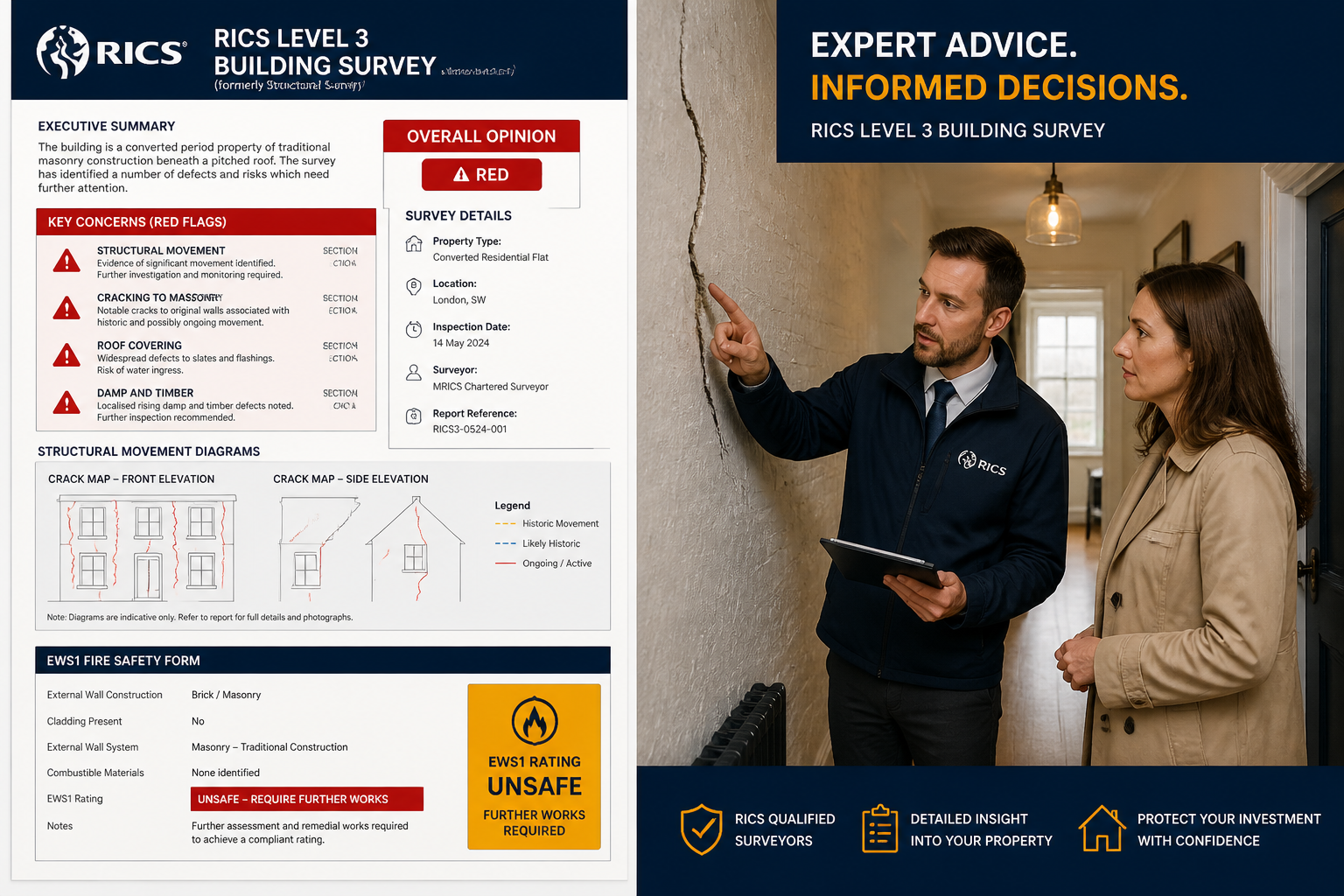
Applying Building Survey Red Flags in Converted Flats: Non-Standard Construction Assessment Protocols for 2026 in practice requires a structured, layered approach that goes beyond the standard visual inspection.
Step 1: Establish the Correct Survey Level
The starting point is always survey selection. For any converted flat in a building constructed before 1980, or where non-standard construction is suspected, a Level 3 Building Survey (formerly the Full Structural Survey) is the appropriate baseline [1]. Buyers unsure which level is appropriate can use guidance on which survey they need to make an informed decision.
Step 2: Commission Specialist Investigations Where Flagged
A Level 3 survey is the starting point, not the endpoint, when red flags are identified. The following specialist investigations should be triggered by specific findings:
| Red Flag Identified | Specialist Investigation Required |
|---|---|
| Suspected structural movement | Structural engineer's report |
| Damp above 20% moisture reading | Specialist damp survey and diagnosis |
| Suspected asbestos materials | Type 2 or Type 3 asbestos survey |
| Drainage concerns | CCTV drainage survey |
| Fire safety/cladding concerns | EWS1 assessment by qualified fire engineer |
| Solid floor suspected | Solid floor slab survey |
Step 3: Review All Available Documentation
Non-standard construction assessment is not solely a physical inspection exercise. Documentary review should include:
- Building Regulations completion certificates for conversion works
- Planning permission and any conditions attached
- Structural calculations if available
- Asbestos management plan (legally required in commercial-to-residential conversions)
- Fire Risk Assessment (required for buildings with common areas)
- EWS1 form where applicable
Step 4: Assess Party Wall Implications
In converted flats, the party walls between units carry both structural and legal significance. Unauthorised works to party walls — including removal of chimney breasts, installation of RSJs, or creation of new openings — without proper party wall agreements can leave buyers inheriting unresolved disputes or structural liabilities.
Step 5: Factor in Reinstatement Costs
For insurance purposes, converted flats in non-standard construction often carry higher reinstatement costs than standard builds. A reinstatement valuation ensures that building insurance cover is adequate — an issue that becomes critical when a major defect claim is made.
Conclusion: Actionable Next Steps for Buyers and Surveyors
The complexity of converted flat assessment is not a reason to avoid these properties — it is a reason to approach them with the right expertise and the right protocols. The Building Survey Red Flags in Converted Flats: Non-Standard Construction Assessment Protocols for 2026 framework outlined above provides a structured pathway from initial survey selection through to specialist investigation and documentation review.
Actionable next steps:
- Always commission a Level 3 Building Survey for any converted flat in a pre-1980 building — never rely on a mortgage valuation alone
- Request the management pack and Fire Risk Assessment before making any financial commitment
- Instruct specialist investigations for any red flags identified — structural movement, damp, asbestos, and fire safety all require expert diagnosis beyond a visual survey
- Check the lease length and service charge accounts for financial red flags that sit alongside physical defects
- Work with RICS-registered surveyors who have demonstrable experience in period conversions and non-standard construction assessment
The cost of a comprehensive survey and specialist investigations — typically £800 to £2,500 depending on scope — is a fraction of the remediation costs that undiscovered defects can generate. In 2026, with fire safety legislation, leasehold reform, and non-standard construction risks all converging, thorough due diligence is the only rational approach.
References
[1] Survey For Flats Apartments 2025 – https://surveymatch.co.uk/survey-for-flats-apartments-2025/
[2] Red Flags On A House Survey – https://stonesurvey.com/red-flags-on-a-house-survey/
[3] What Do Red Flags In A Home Survey Mean A Clear Guide For Buyers – https://harrisonclarke.co.uk/what-do-red-flags-in-a-home-survey-mean-a-clear-guide-for-buyers/
[5] Red Flags On House Survey – https://www.comparemymove.com/guides/surveying/red-flags-on-house-survey