Over 40% of party wall awards that reach the County Court face challenges on jurisdictional grounds — yet many of those disputes could have been avoided with clearer procedural steps at the outset. In 2026, the stakes for getting jurisdiction right have never been higher. Strengthening Party Wall Surveyor Jurisdiction: Lessons from Recent Award Challenges and RICS 8th Edition Safeguards is now a pressing concern for every surveyor, building owner, and adjoining owner involved in construction work near a shared boundary.
The RICS has launched a formal consultation on the 8th edition of Party Wall Legislation and Procedure, running across April and May 2026. At the same time, recent case law — most notably the Park Lane Holdings and K Group decision — has exposed critical gaps in how jurisdiction is established, maintained, and protected. Together, these developments are reshaping professional practice across England and Wales. [3]
Key Takeaways 📌
- ✅ A genuine dispute between named, aware parties is a mandatory prerequisite for surveyor jurisdiction to exist under the Party Wall etc. Act 1996.
- ✅ Surveyor appointments are personal and statutory — they cannot be directed by client instruction, and independence must be demonstrable.
- ✅ Jurisdiction under s10 ends once a dispute is resolved — new disputes require fresh appointments.
- ✅ The RICS 8th edition introduces revised appointment letters, updated award templates, and stronger conduct guidance to reduce invalid awards.
- ✅ Pre-construction documentation and specific award language are now essential safeguards against future court challenges.
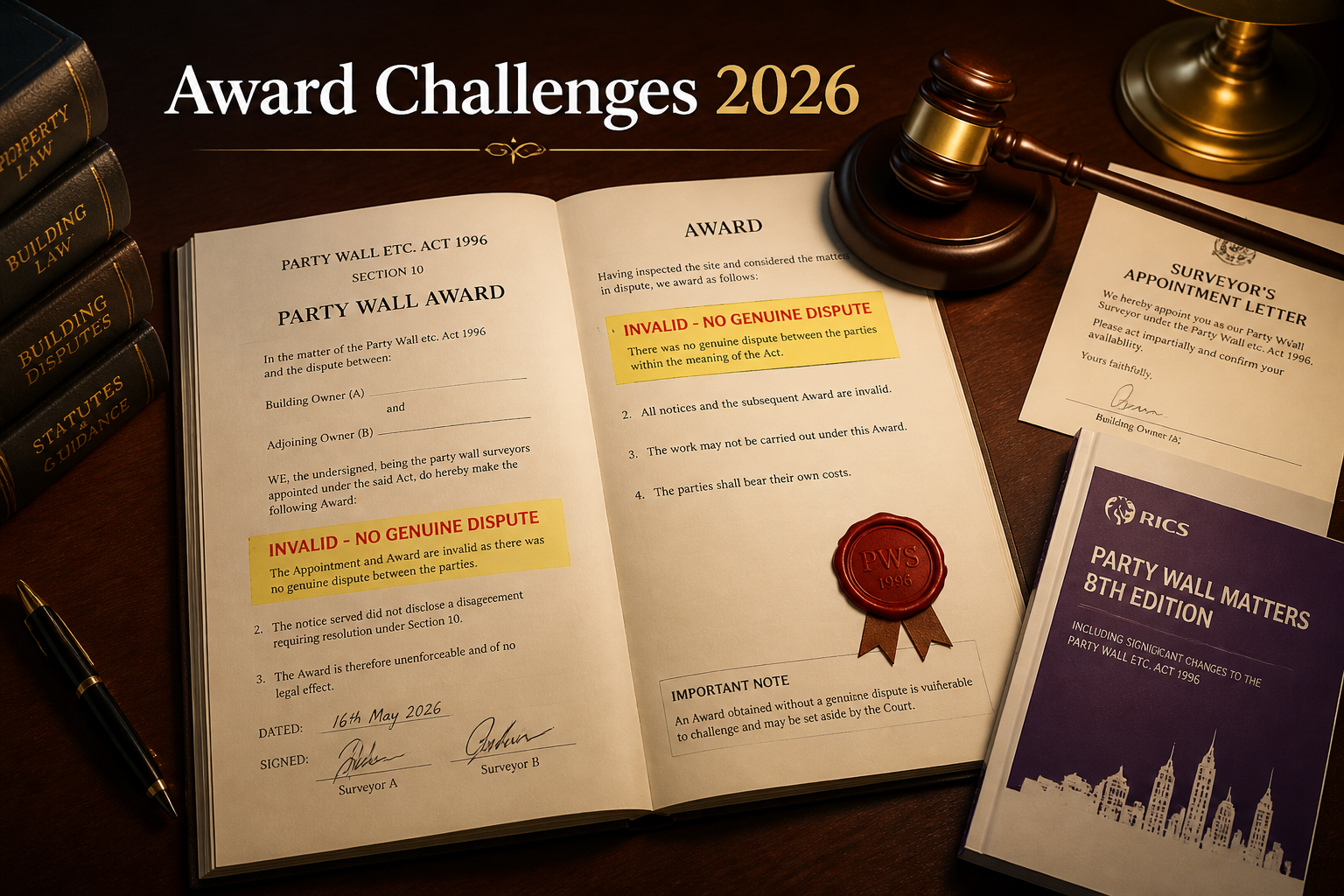
Why Award Challenges Are Rising: The Jurisdiction Problem in Focus
The party wall regime under the Party Wall etc. Act 1996 grants surveyors a powerful but narrow authority. When that authority is exceeded — even unintentionally — the resulting award is void. Recent litigation has made this painfully clear.
The Park Lane Holdings Case: A Watershed Moment
The Park Lane Holdings and K Group decision stands as one of the most significant party wall rulings in recent years. HHJ Parfitt agreed on all 12 grounds of appeal, delivering a comprehensive ruling on the limits of surveyor jurisdiction. [2]
The case established several principles that every surveyor must now treat as non-negotiable:
"Even if all other conditions are met, surveyors lack jurisdiction under s10 if the parties themselves do not know that issues exist." — HHJ Parfitt, Park Lane Holdings v K Group [2]
Key findings from the case:
| Principle | Practical Implication |
|---|---|
| Genuine dispute is mandatory | No jurisdiction exists without both parties being aware of the issues |
| Natural justice applies | Awards made without relevant parties' knowledge are invalid |
| Jurisdiction ends with the dispute | Later compensation claims need fresh appointments |
| Single surveyor rules are strict | An adjoining owner's surveyor cannot act alone without proper refusal from the building owner's surveyor |
The court confirmed that natural justice requirements apply to party wall surveyors. An award made while one party is suspended, unaware, or unable to meaningfully participate in a dispute is invalid — regardless of whether all technical procedural steps were followed. [2]
The Lea Valley Case: Why Award Language Matters
The Lea Valley Development Limited v Derbyshire case added another layer of complexity. Post-litigation practice now requires that damage clauses in party wall awards list specific rights or include introductory phrases such as "as required by the Act." [5]
Vague or generic award language — once common practice — now creates a direct route to a successful challenge. Surveyors who rely on boilerplate wording without tailoring it to the specific dispute risk producing an award that courts will set aside. [5]
Understanding what constitutes a party wall dispute is the essential first step before any award is drafted.
The RICS 8th Edition: What's Changing and Why It Matters
The RICS consultation on the 8th edition of Party Wall Legislation and Procedure is a direct response to the patterns emerging from award challenges. The updated guidance aims to close the procedural gaps that have allowed invalid awards to proliferate. [3]
Core Changes in the Draft 8th Edition
1. Personal and Statutory Appointment Emphasis
The 8th edition makes explicit what courts have been saying implicitly: a party wall surveyor's appointment is personal and statutory. This means:
- The surveyor's duty runs to the Act, not to the client
- Client instructions cannot override the surveyor's independent judgment
- Any appearance of client direction over surveyor decisions creates a jurisdiction risk [3]
This directly addresses cases where surveyors' independence was questioned or compromised by client pressure — a pattern RICS has identified as a growing concern. [1]
2. Revised Letters of Appointment and Award Templates
The draft 8th edition includes:
- 📄 Updated letters of appointment with clearer terms on independence
- 📄 A revised draft award template with specific language requirements
- 📄 Enhanced appendices covering fee practices, Third Surveyor use, and notice service [3]
For anyone unfamiliar with the costs involved, reviewing the cost of party wall procedures helps set realistic expectations before appointment.
3. Strengthened Conduct and Regulatory Direction
The 8th edition provides clearer guidance on:
- Fee practices that could compromise impartiality
- Proper use of the Third Surveyor mechanism
- Public engagement and transparency obligations
- Service of notices — a frequent source of procedural failure [3]
Why the Consultation Matters in 2026
The eight-week consultation targets surveyors, legal professionals, dispute resolution practitioners, and other stakeholders across England and Wales. RICS is explicitly seeking input on whether the proposed changes are workable in practice — making this a rare opportunity for the profession to shape its own regulatory framework. [3]
💡 Pull Quote: "The 8th edition is not just a guidance update — it is a direct response to courts telling the profession where its procedures have been falling short."
Practical Jurisdiction Checklist: Avoiding Invalid Awards in 2026 Projects
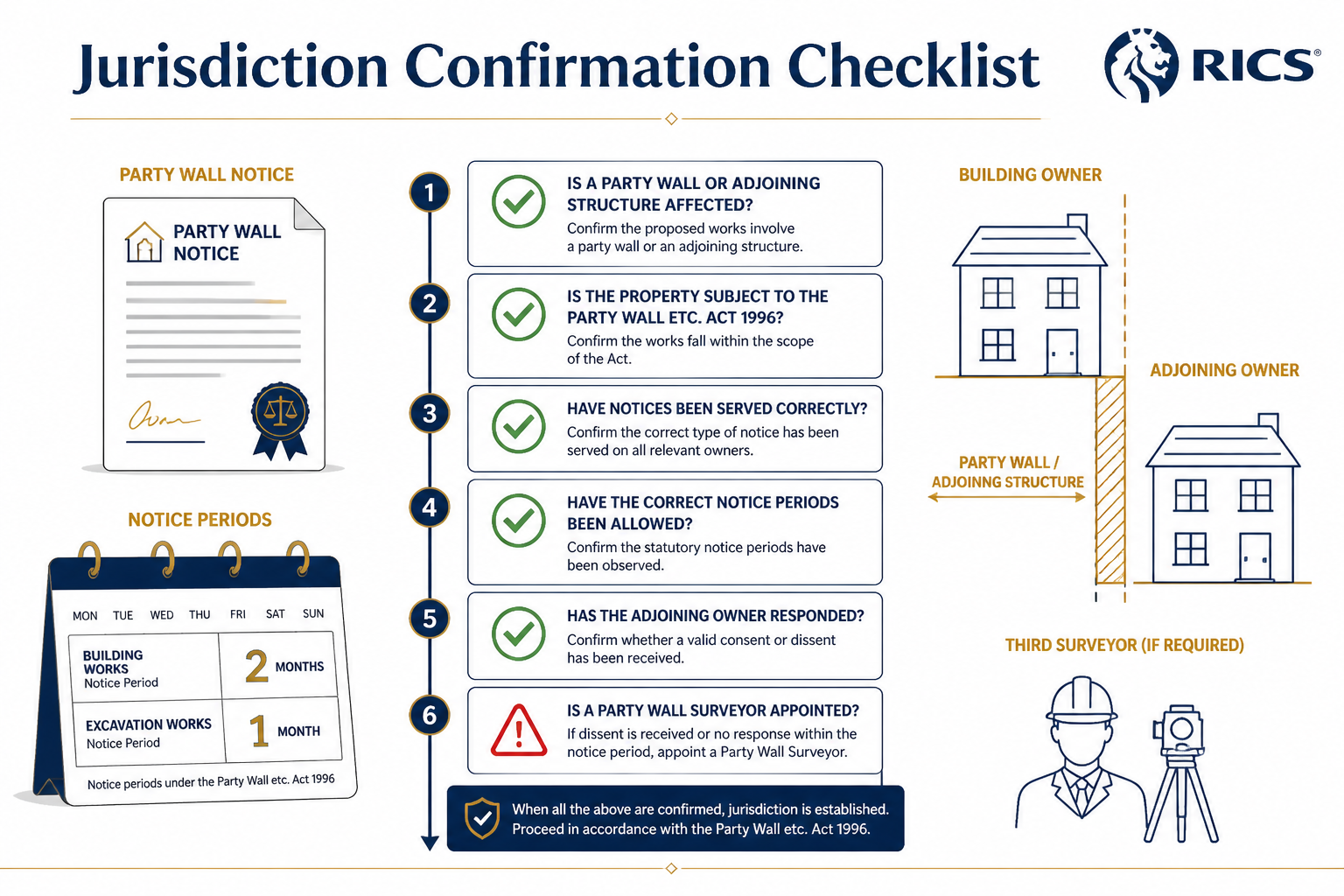
Strengthening Party Wall Surveyor Jurisdiction: Lessons from Recent Award Challenges and RICS 8th Edition Safeguards requires translating legal principles into daily practice. The following checklist reflects the combined lessons of recent case law and the RICS 8th edition draft. Use it at every stage of a party wall matter.
✅ Stage 1: Before Appointment — Confirming Jurisdiction Exists
- Identify the correct parties — both building owner and adjoining owner must be correctly named and legally capable of being in dispute
- Confirm a genuine dispute exists — both parties must be aware that issues exist; a deemed dispute cannot arise if one party is unaware or legally incapacitated [2]
- Verify proper notice has been served — check that the party wall notice has been properly served and that the notice period has elapsed
- Confirm the work falls within the Act — not all construction near boundaries triggers the Act; check whether excavation notice requirements apply
- Check for neighbour consent — if the adjoining owner has consented in writing, no dispute exists and no award is needed
✅ Stage 2: Appointment — Protecting Independence
- Accept appointment in personal capacity — document that the appointment is statutory, not contractual
- Confirm no conflict of interest — check for any financial, professional, or personal relationship with either party
- Refuse client instruction on substantive matters — record any attempts by clients to direct the award's content
- Designate a Third Surveyor — this must be done at appointment stage, not after a dispute about the award arises [2]
- Ensure the building owner's surveyor is properly appointed before the adjoining owner's surveyor takes any unilateral action [2]
✅ Stage 3: Drafting the Award — Language and Scope
- Limit the award to the current dispute — do not attempt to resolve anticipated future disputes in the same award [2]
- Use specific language for damage clauses — list individual rights and include "as required by the Act" where relevant [5]
- Complete a schedule of condition before works commence — this is essential evidence if damage is later claimed
- Avoid boilerplate provisions — every award should be tailored to the specific works and specific property
✅ Stage 4: Post-Award — Protecting Validity
- Serve the award on all parties simultaneously — delayed or selective service can invalidate the award
- Document all communications — maintain a complete record of notices, responses, and decisions
- Treat subsequent disputes as new matters — appoint fresh surveyors under s10(1) for any later compensation claims [2]
Pre-Construction Documentation: The Underrated Jurisdiction Safeguard
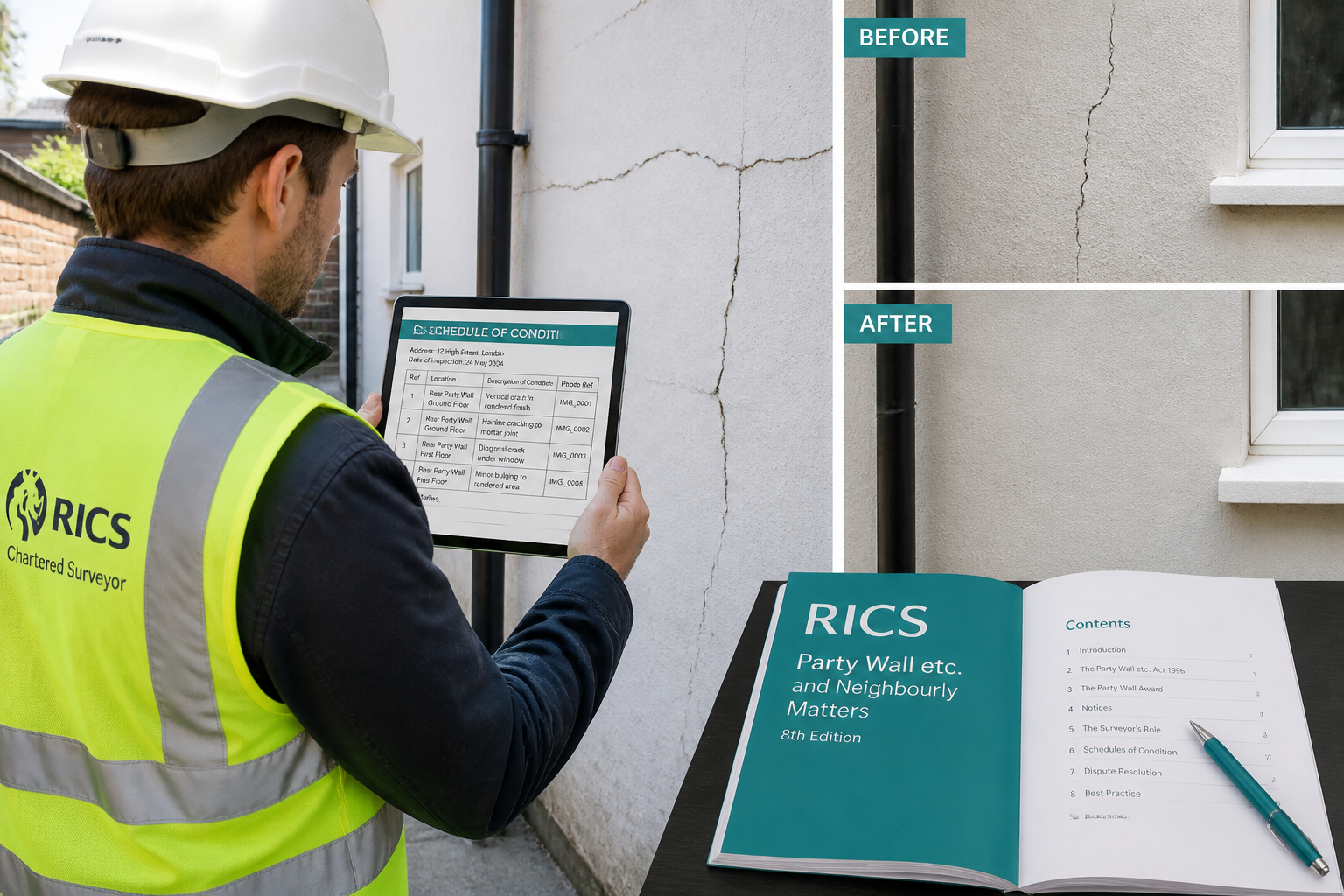
One of the most consistent findings across both case law and the RICS 8th edition draft is that pre-construction documentation prevents disputes before they start. When damage is later claimed, the existence of a thorough pre-construction record transforms a potential jurisdiction challenge into a straightforward factual assessment. [4]
What a Robust Schedule of Condition Includes
A properly prepared schedule of condition should document:
- Existing cracks — location, width, and orientation (diagonal, horizontal, vertical)
- Dampness or staining — pre-existing moisture issues that could be confused with construction damage
- Structural movement — any existing settlement or subsidence signs
- Decorative condition — plasterwork, paintwork, and finishes on both sides of the wall
- External condition — brickwork, pointing, and any existing damage to the boundary structure
Photographic evidence with timestamps, combined with written descriptions, creates a reference record that courts treat as highly persuasive. [4]
Impartiality as a Practical Safeguard
Party wall surveyors are explicitly required to act impartially. This is not merely an ethical obligation — it is a jurisdictional requirement. An award produced by a surveyor who demonstrably favoured one party is vulnerable to challenge on natural justice grounds, regardless of whether the substantive content of the award was correct. [4]
The RICS 8th edition formalises impartiality as a core professional obligation, reflecting the courts' increasing willingness to scrutinise surveyor conduct as part of award challenges. [3]
For situations where works have already begun without proper process, understanding what happens when a neighbour carries out works without a party wall agreement is critical to protecting adjoining owners' rights.
Working with a RICS-certified chartered building surveyor provides the professional foundation needed to navigate these requirements with confidence.
Common Jurisdiction Mistakes and How to Avoid Them
The following errors appear repeatedly in challenged awards. Recognising them early is the most effective form of risk management.
🚫 Mistake 1: Assuming a deemed dispute exists without checking party awareness
Courts have confirmed that a deemed dispute cannot arise if one party is suspended, unaware, or legally incapacitated. Always verify that both parties are aware of the issues before proceeding. [2]
🚫 Mistake 2: Extending the same award to cover new damage claims
Once an award resolves a dispute, the surveyors' jurisdiction under s10 ends. Any subsequent claim — even arising from the same works — requires fresh appointments and a new award. [2]
🚫 Mistake 3: Using vague damage clauses
Generic language such as "the building owner shall make good any damage" without specifying the nature, extent, or legal basis of the obligation creates ambiguity that courts will resolve against the award's validity. [5]
🚫 Mistake 4: Allowing the adjoining owner's surveyor to act unilaterally
Under s10(6) and s10(7), an adjoining owner's surveyor can only act alone if the building owner's surveyor has been properly appointed and formally refused to act, or if a third surveyor has been designated under s10(11). [2]
🚫 Mistake 5: Failing to document independence from client instruction
In an era of increased scrutiny, surveyors should maintain written records showing that their decisions were made independently. This is particularly important where clients have expressed strong preferences about award outcomes. [1]
Conclusion: Actionable Steps for Surveyors and Property Owners in 2026
The convergence of recent award challenges and the RICS 8th edition consultation has created a defining moment for party wall practice. Strengthening Party Wall Surveyor Jurisdiction: Lessons from Recent Award Challenges and RICS 8th Edition Safeguards is no longer an abstract professional concern — it is a practical necessity for every project involving shared boundaries.
Actionable next steps:
-
Engage with the RICS consultation — surveyors and legal professionals should submit responses to the 8th edition consultation before the May 2026 deadline to help shape final guidance.
-
Audit existing appointment procedures — review current letters of appointment and award templates against the draft 8th edition requirements. Update any language that could create independence or specificity challenges.
-
Implement the jurisdiction checklist — apply the four-stage checklist above to every new party wall matter, documenting compliance at each stage.
-
Commission pre-construction schedules of condition — treat this as a non-negotiable step, not an optional extra. The cost of a thorough schedule of condition is negligible compared to the cost of a contested award.
-
Treat each dispute as distinct — resist the temptation to extend existing awards to cover new issues. Fresh disputes require fresh appointments.
-
Seek specialist advice early — for complex projects or where jurisdiction is uncertain, engaging a chartered surveyor with specific party wall expertise before works commence is the most cost-effective risk management strategy available.
The courts have spoken clearly. The RICS is responding. The profession now has both the case law and the updated guidance it needs to produce awards that will withstand challenge — but only if practitioners apply these lessons consistently and rigorously.
References
[1] Rics Launches Consultation On Party Wall Guidance – https://thenegotiator.co.uk/news/regulation-law-news/rics-launches-consultation-on-party-wall-guidance/
[2] Limitation Jurisdiction And Dispute New Party Wall Decision – https://www.falcon-chambers.com/news/limitation-jurisdiction-and-dispute-new-party-wall-decision
[3] Rics Launches Consultation On Updated Party Wall Practice Guidance – https://www.rics.org/news-insights/rics-launches-consultation-on-updated-party-wall-practice-guidance
[4] Understanding The Importance Of Party Wall Surveys – https://akt-surveyors.com/understanding-the-importance-of-party-wall-surveys/
[5] Practice Changing Party Wall Case Law Lea Valley Development Limited V Derbyshire 2017 – https://www.peterbarry.co.uk/blog/practice-changing-party-wall-case-law-lea-valley-development-limited-v-derbyshire-2017/