
Commercial landlords and tenants in the UK collectively dispute hundreds of millions of pounds in dilapidations claims every year — yet the majority of those disputes hinge not on the damage itself, but on the quality of the survey evidence presented. A poorly documented building condition assessment can collapse a legitimate claim or expose a tenant to inflated costs they should never have paid.
This guide explores the full scope of valuation surveys for commercial dilapidations: building condition assessment and expert witness evidence standards, covering methodology, cost benchmarks, legal obligations, and what separates an admissible expert witness report from one that fails at tribunal.
Key Takeaways
- 📋 Dilapidations surveys should be commissioned 6–12 months before lease expiry to allow time for negotiation and remedial works.
- 💷 Survey costs range from £500–£1,500 for smaller commercial properties to £3,000–£10,000+ for large premises (all plus VAT).
- ⚖️ Expert witness reports must meet strict RICS and Civil Procedure Rules (CPR) Part 35 standards to be admissible in court or tribunal.
- 🏗️ Modern surveys increasingly use drone technology and 3D laser scanning to document hard-to-access areas accurately.
- 📄 A schedule of dilapidations is the cornerstone document — its accuracy directly determines the outcome of any dispute.
What Is a Commercial Dilapidations Survey?
A commercial dilapidations survey is a structured inspection of a commercial property carried out to identify breaches of lease covenants relating to repair, reinstatement, and redecoration. It documents the physical condition of a building at a specific point in time — most commonly at or near lease expiry — and maps each defect against the relevant lease obligations.[1]
These surveys serve two primary purposes:
- For landlords: To quantify the cost of making good any damage or disrepair caused during the tenancy.
- For tenants: To challenge inflated claims and demonstrate that the property was returned in an acceptable condition.
💬 "The dilapidations survey is not simply a list of defects — it is a legally structured document that must align every observed breach with a specific lease covenant and a defensible cost estimate."
Unlike a general commercial building survey, a dilapidations survey is explicitly focused on liability. It answers the question: who is responsible, and how much will it cost?
Timing, Scope, and the Building Condition Assessment Process

When Should a Survey Be Commissioned?
Timing is critical. Dilapidations surveys are typically conducted 6 to 12 months before lease expiry, giving both parties time to negotiate, plan remedial works, or prepare for dispute resolution.[5] Commissioning too late — after the tenant has vacated — limits the landlord's ability to claim certain heads of loss and removes the tenant's opportunity to carry out works themselves (often at a lower cost than a contractor appointed by the landlord).
Key timing milestones:
| Stage | Recommended Action |
|---|---|
| 12–18 months before expiry | Tenant reviews lease obligations; commissions condition check |
| 6–12 months before expiry | Landlord commissions dilapidations survey |
| 3–6 months before expiry | Scott Schedule prepared; negotiations begin |
| At lease expiry | Final inspection; terminal schedule served if needed |
What Does a Building Condition Assessment Cover?
A thorough building condition assessment for dilapidations purposes examines every element of the building fabric and services. Surveyors document findings with clause references, breach descriptions, remedial specifications, and cost estimates.[2]
Typical inspection areas include:
- 🏚️ Roof and roof coverings — missing tiles, failed flashings, blocked gutters
- 🧱 External walls and cladding — cracks, spalling, failed pointing
- 🪟 Windows and doors — broken seals, failed ironmongery, damaged frames
- 🏗️ Structural elements — floors, columns, load-bearing walls
- ⚡ Mechanical and electrical services — HVAC, lighting, fire systems
- 🎨 Internal decorations — condition relative to the lease's decorating covenant
- 🔧 Reinstatement obligations — removal of tenant alterations
For complex or large properties, surveyors may use drone surveys to safely inspect high-level elements such as roofs, facades, and plant rooms that would otherwise require costly access equipment. 3D laser scanning is increasingly used to produce precise as-built records, particularly where reinstatement of tenant alterations is in dispute.[2][7]
The Importance of a Schedule of Condition
If a schedule of condition was prepared at lease commencement, it becomes the benchmark against which the terminal dilapidations survey is measured. Tenants are only liable for deterioration beyond the condition recorded at the start of the lease.[4] A well-prepared schedule of condition report at lease inception is one of the most effective protections a tenant can have.
Without one, the default standard is typically "good repair" — a higher bar that can significantly increase tenant liability.
Valuation Surveys for Commercial Dilapidations: Costs, Methodology, and the Scott Schedule
Survey Costs in 2026
Survey fees vary with property size, complexity, and location. Based on current market data, the following benchmarks apply in 2026:[2]
| Property Size | Typical Survey Cost (excl. VAT) |
|---|---|
| Under 5,000 sq ft | £500 – £1,500 |
| 5,000 – 25,000 sq ft | £1,500 – £3,000 |
| 25,000+ sq ft | £3,000 – £10,000+ |
These figures cover the surveyor's inspection and the preparation of a full schedule of dilapidations. Costs for quantum (costing) work, negotiation support, and expert witness preparation are typically charged separately.
⚠️ Important: Instructing a cheaper, less experienced surveyor to save on survey fees can result in a poorly documented schedule that collapses under scrutiny — costing far more in the long run.
The Scott Schedule: Structuring the Claim
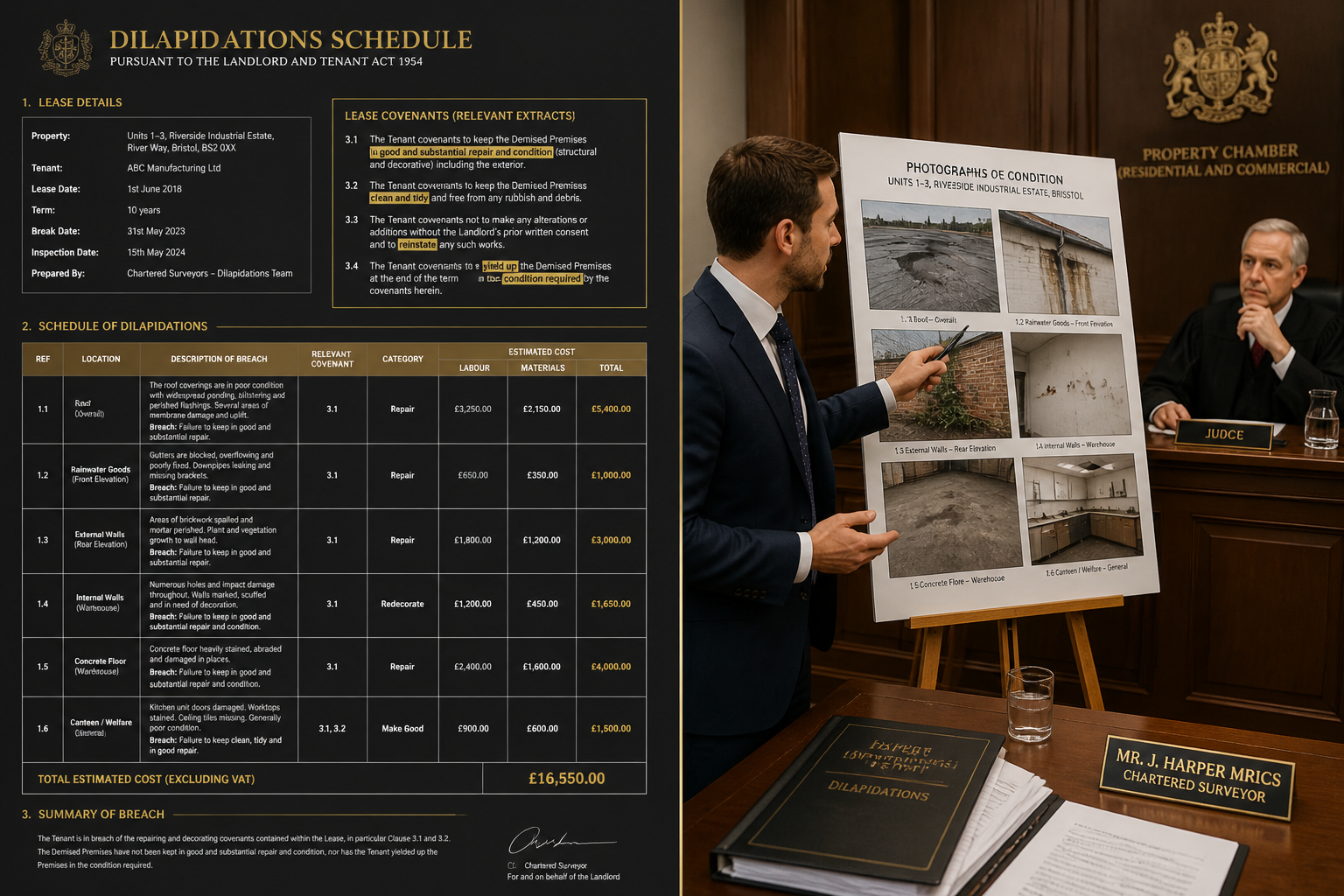
Once the dilapidations survey is complete, the findings are typically organised into a Scott Schedule — a structured document used in dispute resolution that sets out each alleged breach, the landlord's remedial specification and cost, and the tenant's response to each item.
A robust Scott Schedule will include:
- Lease clause reference — the specific covenant allegedly breached
- Description of the defect — clear, factual, and photographically evidenced
- Remedial specification — what work is required and how it should be done
- Landlord's cost estimate — based on realistic market rates
- Tenant's counter-position — dispute of liability, specification, or quantum
The Leasehold Property (Repairs) Act 1938 and Section 18(1) of the Landlord and Tenant Act 1927 impose important caps on dilapidations claims. Section 18(1) limits the landlord's damages to the diminution in the value of the reversion — meaning the claim cannot exceed what the disrepair actually costs the landlord in terms of property value. Surveyors must therefore consider both the cost of works and the Section 18 cap when preparing valuations.
Condition Surveys vs. Dilapidations Surveys: Understanding the Difference
These two survey types are frequently confused but serve very different purposes.[4]
| Feature | Condition Survey | Dilapidations Survey |
|---|---|---|
| Purpose | General health check of building | Identify lease covenant breaches |
| Legal framework | None specifically | Lease, statute, RICS guidance |
| Output | Condition report | Schedule of dilapidations |
| Timing | Any time | Near lease expiry |
| Liability focus | No | Yes |
A stock condition survey may inform maintenance planning, but it is not a substitute for a dilapidations survey in a lease-end dispute context.[6]
Expert Witness Evidence Standards in Commercial Dilapidations Disputes
When Does a Dispute Require Expert Witness Evidence?
When landlord and tenant cannot reach agreement on a dilapidations claim, the matter may proceed to the County Court, the Upper Tribunal (Lands Chamber), or arbitration. At this stage, the surveyor's role shifts from advocate to independent expert witness — a legally significant distinction.
Under Civil Procedure Rules (CPR) Part 35, an expert witness owes their primary duty to the court, not to the party that instructed them. This means the expert must:[3]
- Provide an objective, impartial opinion based on their expertise
- Disclose any facts that might undermine their own opinion
- Comply with the court's directions on format and timing
- Sign a declaration of truth confirming the report is their honest professional view
Failure to meet these standards can result in the expert's evidence being excluded — or worse, in adverse cost orders against the instructing party.
For specialist expert witness report preparation, it is essential to instruct a surveyor with specific experience in both dilapidations and litigation support. The expert witness role demands a different skill set from standard surveying work.
What Makes a Dilapidations Expert Witness Report Admissible?
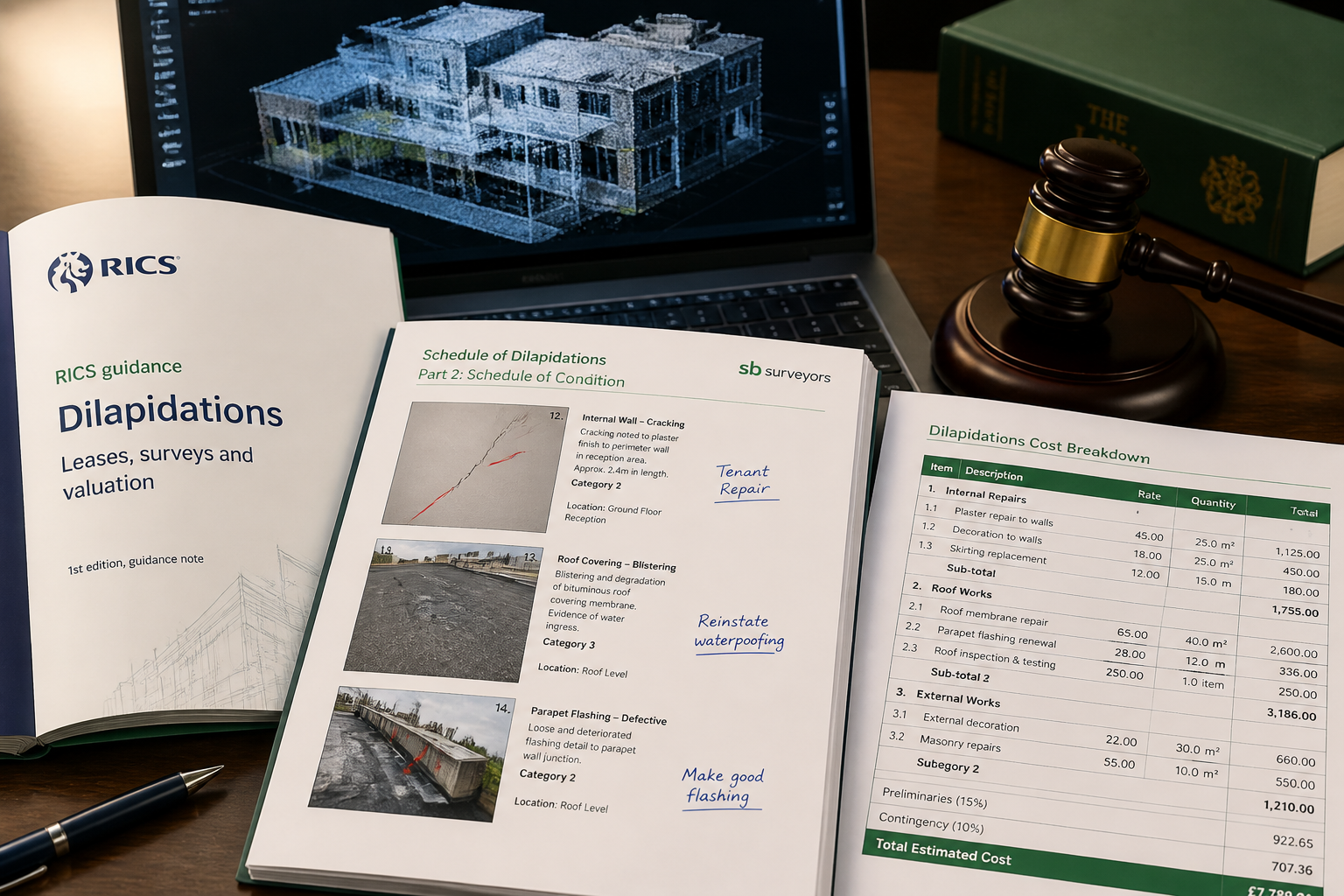
A court-ready expert witness report in a commercial dilapidations dispute must meet the following standards:
✅ Structural requirements:
- Clear statement of the expert's qualifications and experience
- Summary of instructions received and documents reviewed
- Statement of the facts upon which the opinion is based
- The expert's reasoned opinion on each disputed item
- CPR Part 35 declaration
✅ Technical requirements:
- Photographic evidence cross-referenced to the schedule
- Measurement data from site inspection
- Reference to comparable costs or industry pricing data
- Consideration of the Section 18(1) cap where applicable
- Commentary on any matters outside the expert's expertise
✅ RICS compliance:
- Adherence to the RICS Dilapidations in England and Wales guidance note (7th edition)
- Use of the RICS Valuation — Global Standards (Red Book) where diminution in value is assessed
- Compliance with RICS Professional Statement: Dilapidations requirements
💬 "An expert witness report that reads like an advocate's document — rather than an independent professional opinion — will be identified as such by the tribunal and given reduced weight accordingly."
The Single Joint Expert Approach
Courts increasingly encourage parties to appoint a Single Joint Expert (SJE) rather than each side commissioning their own expert. This reduces costs and speeds up resolution. However, both parties must agree on the expert's identity and terms of instruction.
Where a SJE is appointed, the expert must be especially careful to address all questions raised by both parties impartially. The SJE's report often becomes the primary determinant of the outcome — making the choice of surveyor critically important.
Practical Steps for Landlords and Tenants in 2026
Whether acting for the landlord or tenant, the following practical steps apply to any commercial dilapidations process in 2026:
For Landlords 🏢
- Review the lease — identify all repair, reinstatement, and decoration covenants before instructing a surveyor.
- Commission a dilapidations survey 6–12 months before expiry.[5]
- Serve the terminal schedule within a reasonable time of lease expiry.
- Obtain realistic cost estimates — inflated figures are routinely challenged and damage credibility.
- Consider the Section 18(1) cap — always obtain a diminution in value assessment alongside the cost of works.
- Instruct a qualified expert if the matter proceeds to dispute — see the RICS-registered valuers directory for qualified professionals.
For Tenants 🏭
- Obtain a copy of the original schedule of condition (if one exists) — this is your primary defence.
- Commission an independent survey to review the landlord's schedule and challenge inflated or incorrect items.
- Consider carrying out works yourself before lease expiry — this is almost always cheaper than paying the landlord's contractor rates.
- Respond formally to every item in the Scott Schedule — silence can be construed as acceptance.
- Instruct expert witness support early if dispute is likely — last-minute instructions compromise report quality.
Common Pitfalls in Commercial Dilapidations Valuations
Even experienced surveyors can fall into avoidable errors. The most common pitfalls include:
- ❌ Failing to reference specific lease clauses — every breach must be tied to a covenant
- ❌ Using speculative or inflated cost estimates — these are easily challenged by quantity surveyors
- ❌ Ignoring the Section 18(1) cap — the claim may be legally unenforceable above this level
- ❌ Poor photographic evidence — images must be dated, labelled, and cross-referenced
- ❌ Conflating condition and liability — a defect exists; the question is who is responsible
- ❌ Missing reinstatement obligations — tenant alterations must be identified and valued separately[8]
For properties with complex structural issues, a structural survey may be required alongside the dilapidations assessment to properly quantify repair costs.
Conclusion: Getting Dilapidations Right in 2026
The stakes in commercial dilapidations disputes are high. Claims regularly run to tens or hundreds of thousands of pounds, and the quality of the underlying survey evidence is almost always the deciding factor. Valuation surveys for commercial dilapidations — encompassing building condition assessment and expert witness evidence standards — demand a level of rigour, legal awareness, and technical precision that goes well beyond a standard property inspection.
Actionable Next Steps ✅
- Commission your dilapidations survey early — ideally 6–12 months before lease expiry — to maximise your options.
- Ensure your surveyor is RICS-qualified and experienced specifically in dilapidations, not just general building surveys.
- Prepare a schedule of condition at lease commencement for any new commercial lease — it is the single most effective risk management tool available to tenants.
- Instruct expert witness support at the first sign of dispute — do not wait until proceedings are issued.
- Always obtain a Section 18(1) diminution in value assessment alongside any landlord's schedule of dilapidations.
Whether a landlord seeking to recover legitimate losses or a tenant defending against an inflated claim, the path to a fair outcome runs through a well-executed, legally compliant dilapidations survey — prepared by a qualified professional who understands both the building and the law.
References
[1] Commercial Building Surveys Explained – https://horde.group/blog/commercial-building-surveys-explained/
[2] Dilapidations Survey – https://blackacresurveyors.com/2026/02/28/dilapidations-survey/
[3] What Are Commercial Surveys – https://fourthwallbc.com/blog/what-are-commercial-surveys/
[4] Condition Survey Vs Dilapidation Survey – https://www.propertywitnessexpert.com/condition-survey-vs-dilapidation-survey
[5] Dilapidations Survey Checklist – https://timgreenwood-associates.co.uk/news/dilapidations-survey-checklist/
[6] Guide To Commercial Property Surveys – https://www.apassociates.org/guide-to-commercial-property-surveys/
[7] Building Condition – https://matterport.com/learn/as-built-documentation/building-condition
[8] Building Surveys – https://www.bradley-mason.com/commercial/building-surveys/
[9] Dilapidations Surveys – https://mpgqs.com/services/survey-services/dilapidations-surveys/