Neighbour disputes reach the civil courts far more often than most people realise — boundary disagreements alone account for thousands of County Court claims in England and Wales every year, and the costs of getting expert evidence wrong can run into tens of thousands of pounds in wasted fees, cost penalties, and excluded reports. For surveyors stepping into the role of expert witness, the rules are strict, the stakes are high, and the margin for procedural error is razor-thin.
This guide covers everything surveyors and property professionals need to know about Expert Witness Surveyors in Neighbour Disputes: Evidence Standards, CPR Part 35 Compliance, and Court Preparation — from the foundational duty owed to the court, through the mandatory components of a compliant report, to practical courtroom strategies that hold up under cross-examination in 2026.
Key Takeaways 📌
- The overriding duty of an expert witness surveyor is to the court — not to the party that instructed them. [1][2]
- CPR Part 35 sets out strict mandatory requirements for expert reports; non-compliant reports can be excluded entirely. [5]
- Court permission is required before expert evidence can be adduced, ensuring proportionality. [1]
- Single Joint Experts (SJEs) are increasingly preferred in lower-value neighbour disputes to control costs. [1]
- Joint statements under CPR 35.12 narrow the issues in dispute and are a critical pre-trial step. [1]
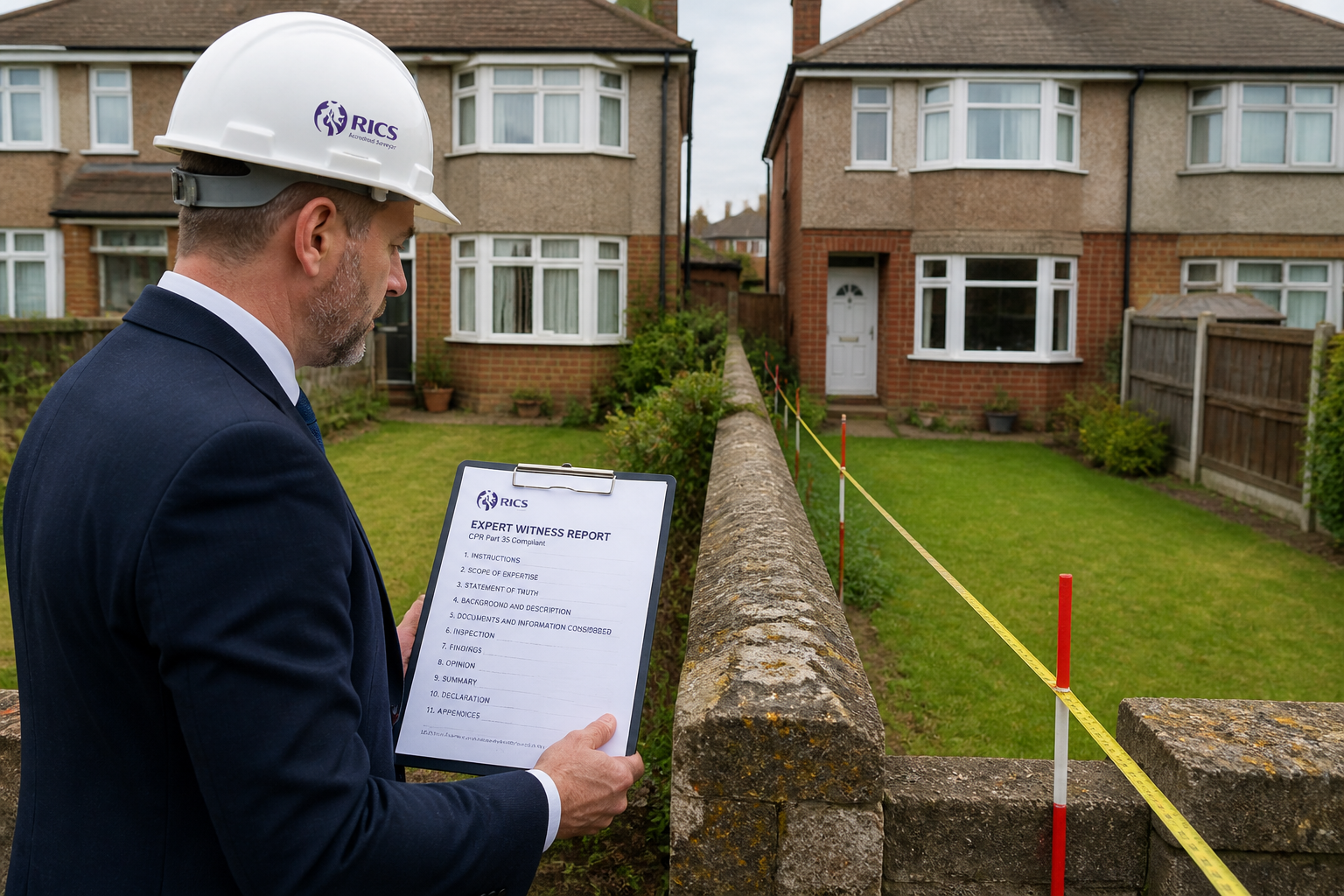
The Role of Expert Witness Surveyors in Neighbour Disputes
What Makes a Surveyor an "Expert Witness"?
Not every surveyor who gives evidence in court qualifies as an expert witness in the legal sense. An expert witness is a person with specialist knowledge, skill, or experience in a field that goes beyond the understanding of a typical judge or lay person. In neighbour disputes, this commonly includes:
- Boundary determination — interpreting title deeds, OS maps, and historical plans
- Party wall matters — assessing damage, compliance, and defects arising from construction [see our guide on what happens when a neighbour carries out works without a Party Wall Agreement]
- Structural damage — attributing cause and quantifying repair costs
- Diminution in value — calculating the financial impact of a neighbour's actions on property worth
- Rights of light and access — technical assessment of interference
The key distinction is that an expert witness is permitted to offer opinions, not just facts. A lay witness can only describe what they observed; an expert can interpret what those observations mean in a professional context. [2]
The Overriding Duty to the Court
"An expert's duty to the court overrides any obligation to the person from whom the expert has received instructions or by whom the expert is paid." — CPR Part 35.3 [5]
This principle is non-negotiable. Expert witness surveyors in neighbour disputes must understand from the outset that their role is to assist the court in reaching a just decision — not to act as an advocate for the party that hired them. [1][2]
Surveyors who shade their opinions to favour their instructing party risk:
- Having their evidence excluded
- Being reported to RICS for professional misconduct
- Facing personal cost sanctions
- Damaging their reputation for future expert witness work
This duty applies whether the surveyor is a party-appointed expert or a Single Joint Expert. [1]
CPR Part 35 Compliance: Evidence Standards for Expert Witness Surveyors in Neighbour Disputes
What Is CPR Part 35?
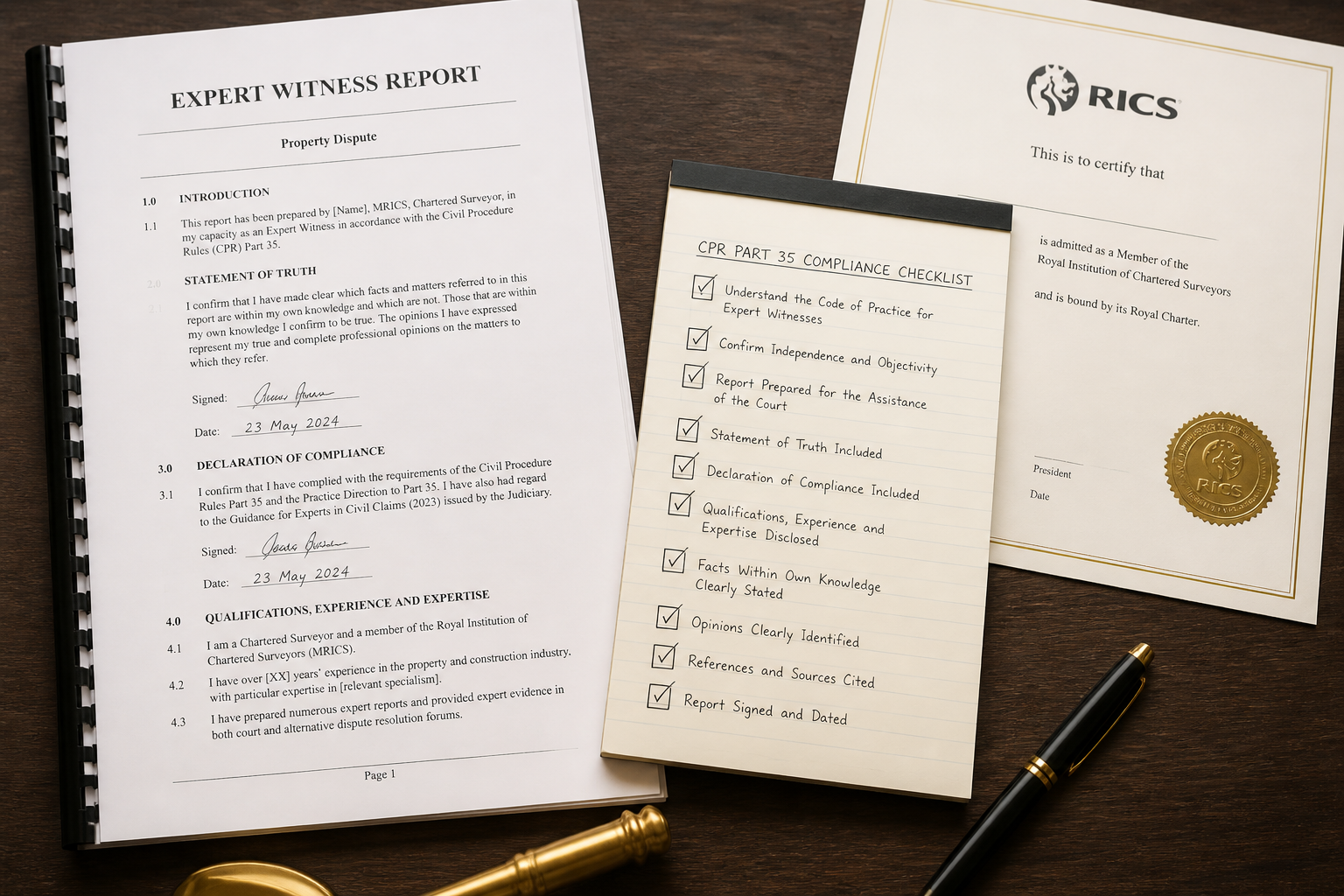
The Civil Procedure Rules (CPR) Part 35 governs the use of expert evidence in civil proceedings in England and Wales. [5] It is supported by Practice Direction 35, which provides detailed guidance on the content and format of expert reports. Together, they set the minimum standards that every expert witness surveyor must meet.
Failure to comply is not a technicality — courts have the power to exclude non-compliant expert evidence entirely, which can be catastrophic for the instructing party's case and may result in significant cost penalties. [1][3]
Mandatory Components of a CPR Part 35 Compliant Report
Every expert report in a neighbour dispute must include the following elements [1][5]:
| Report Component | What It Must Cover |
|---|---|
| Expert's qualifications | Relevant credentials, RICS membership, specialist experience |
| Instructions received | A summary of all instructions from the instructing party |
| Documents relied upon | Full list of title plans, photographs, reports, correspondence |
| Assumptions made | Any factual assumptions underpinning the expert's opinion |
| Reasoning and conclusions | Clear explanation of how the expert reached their opinion |
| Statement of Truth | Confirmation that the expert believes the facts stated are true |
| Declaration of Compliance | Statement that the expert understands and has complied with CPR Part 35 |
⚠️ Critical point: The Statement of Truth and Declaration of Compliance are not optional add-ons. A report without them is not CPR-compliant and may be rejected by the court. [5]
Court Permission Requirement
Under CPR 35.1, expert evidence may only be adduced with the court's permission. [1][5] This rule exists to prevent cases from being buried under competing expert reports on every conceivable issue. Courts will only grant permission where expert evidence is:
- Necessary — the issue genuinely requires specialist knowledge
- Proportionate — the cost of the expert evidence is reasonable relative to the value of the claim
- Relevant — the expert's opinion directly addresses a live issue in the proceedings
Surveyors should be aware that permission granted for one type of expert evidence (e.g., boundary determination) does not automatically extend to related issues (e.g., diminution in value). Each area of opinion may require separate permission. [5]
Single Joint Expert vs. Party-Appointed Experts
One of the most practically significant decisions in neighbour dispute litigation is whether the court will appoint a Single Joint Expert (SJE) or allow each party to instruct their own expert. [1]
Single Joint Expert (SJE):
- Instructed jointly by both parties
- Preferred by courts in lower-value or less complex cases
- Reduces costs and avoids duplication
- Both parties can put written questions to the SJE under CPR 35.6
Party-Appointed Experts:
- Each party instructs their own expert
- More common in complex, high-value, or technical disputes (e.g., major construction damage claims)
- Allows each party to develop their own expert narrative
- Increases costs and the risk of a "battle of experts"
💡 Practical tip for surveyors: If appointed as an SJE, it is essential to communicate equally and transparently with both parties. Any perception of favouritism can undermine the entire appointment and expose the surveyor to challenge.
For surveyors working across the UK, whether as expert witnesses or as chartered surveyors advising clients pre-litigation, understanding the SJE framework is increasingly important as courts push to manage costs.
Court Preparation: Best Practices for Expert Witness Surveyors in Neighbour Disputes
Preparing the Expert Report: Practical Standards
A technically correct report is the foundation of effective expert witness work. Beyond the mandatory CPR Part 35 components, the best expert reports in neighbour disputes share several qualities:
🔍 Clarity of scope
Define precisely what questions the expert has been asked to address. Scope creep — where the report strays into areas outside the expert's instructions or qualifications — is a common ground for challenge.
📐 Methodological transparency
Explain exactly how measurements were taken, which plans were used, and why particular comparables or standards were applied. In boundary disputes, for example, the expert should explain the hierarchy of evidence used: title deeds, physical features, long use, and so on. [6]
⚖️ Balanced treatment of contrary evidence
A CPR-compliant report must acknowledge evidence that does not support the expert's conclusions and explain why it has been given less weight. A one-sided report signals advocacy, not expertise. [1][2]
📸 Supporting evidence
Photographs, annotated plans, and schedules of condition should be clearly referenced and appended. For structural damage claims arising from neighbour works, a specific defect report or structural survey may form part of the evidential bundle.
The Joint Statement Process Under CPR 35.12
Where both parties have instructed their own experts, the court will typically direct the experts to meet and produce a joint statement before trial. [1] This process, governed by CPR 35.12, is one of the most important — and most misunderstood — stages of expert witness work.
The joint statement must:
- List the issues on which the experts agree
- List the issues on which they disagree
- Explain the reasons for any disagreement
- Be signed by both experts
⚠️ Important: The joint statement is not an opportunity for one expert to persuade the other to change their view under pressure. Any change of opinion must be based on new information or reasoning — not on the desire to avoid conflict. Courts are alert to joint statements that appear to have been "negotiated" rather than genuinely reasoned. [1]
The joint statement significantly narrows the issues for trial, saving court time and costs. In many neighbour disputes, a well-conducted joint statement process results in settlement before the case reaches a hearing.
Giving Evidence in Court: Practical Guidance
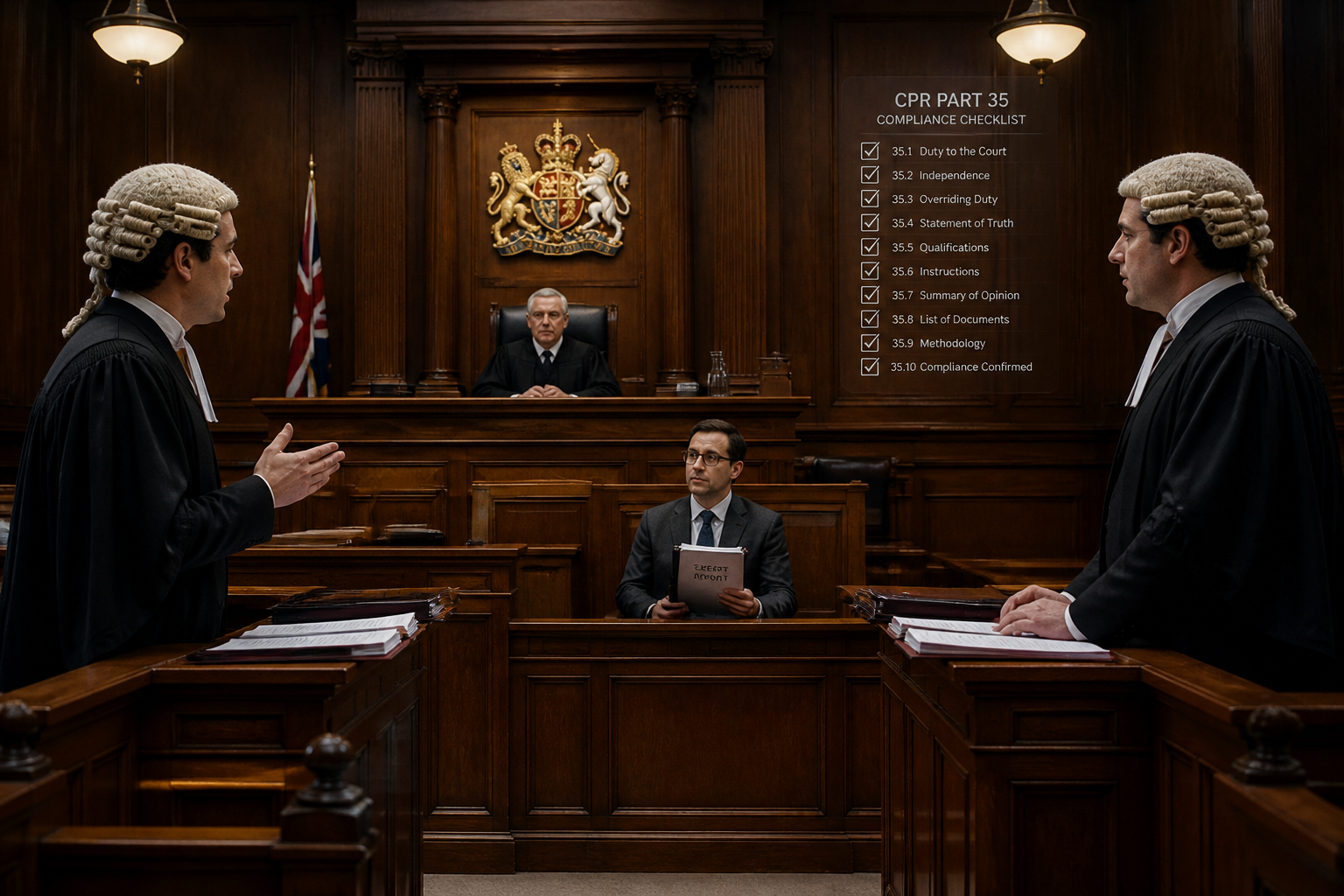
Even the most technically accomplished expert report can be undermined by poor performance in the witness box. Key principles for surveyors giving oral evidence include:
- Listen carefully to each question before answering — do not assume you know where the question is going
- Acknowledge uncertainty — saying "I don't know" or "that falls outside my instructions" is more credible than speculating
- Refer to your report — you are entitled to refer to your written report during cross-examination
- Maintain independence — if challenged on a point, assess the challenge on its merits rather than defending your position reflexively
- Address the judge — your answers are for the court's benefit, not for the cross-examining barrister
Surveyors who regularly undertake expert witness work in neighbour disputes should consider formal CPD training in courtroom advocacy and evidence presentation. RICS and the Academy of Experts both offer relevant programmes.
Common Grounds for Challenge and How to Avoid Them
| Challenge | How to Avoid It |
|---|---|
| Lack of relevant qualifications | Only accept instructions within your area of expertise |
| Failure to comply with CPR Part 35 | Use a compliance checklist before finalising every report |
| Apparent bias towards instructing party | Maintain a neutral, court-focused tone throughout |
| Opinions outside the scope of instructions | Define scope clearly at the outset and stick to it |
| Failure to consider contrary evidence | Actively address and weigh evidence that cuts against your conclusions |
| Inadequate reasoning | Explain every step of your reasoning, not just your conclusion |
For surveyors involved in complex cases — including those involving party wall disputes and loft conversions or significant structural works — the quality of the underlying survey evidence is critical. A stock condition survey or pre-works schedule of condition can provide the baseline evidence needed to attribute damage reliably.
Sanctions for Non-Compliance
Courts take CPR Part 35 compliance seriously. Where an expert report fails to meet the required standards, the consequences can include [1][3]:
- Exclusion of the expert evidence — the report is simply not admitted
- Cost penalties — the instructing party may be ordered to pay the other side's costs of challenging the evidence
- Adjournment — the trial is delayed while a compliant report is prepared, at significant cost
- Adverse inference — in some cases, the court may draw negative conclusions from the failure to produce compliant evidence
These sanctions underline why surveyors must treat CPR Part 35 compliance as a professional obligation, not a bureaucratic formality. [3][5]
Conclusion: Actionable Steps for Surveyors in 2026
The standards governing Expert Witness Surveyors in Neighbour Disputes: Evidence Standards, CPR Part 35 Compliance, and Court Preparation are demanding — but they exist for good reason. Courts depend on expert witnesses to illuminate technical issues that would otherwise be inaccessible to judges and lay parties. When surveyors fulfil that role with rigour and independence, they make a genuine contribution to justice.
Actionable next steps for surveyors preparing expert witness reports in 2026:
- ✅ Audit your report template against the mandatory CPR Part 35 checklist before every instruction
- ✅ Confirm court permission has been granted before investing significant time in report preparation
- ✅ Clarify your scope of instructions in writing at the outset — and decline instructions that fall outside your expertise
- ✅ Engage constructively in the joint statement process — approach it as a genuine attempt to narrow issues, not a negotiation
- ✅ Invest in CPD on expert witness skills, including courtroom presentation and cross-examination preparation
- ✅ Maintain a clear audit trail of all documents received, site visits conducted, and assumptions made
Whether acting as a party-appointed expert or a Single Joint Expert, surveyors who approach neighbour dispute cases with professional independence, methodological transparency, and strict CPR compliance will produce evidence that withstands scrutiny — and genuinely assists the court in reaching a just outcome.
For expert surveying support across England, including chartered surveying services in London and expert witness appointments, working with RICS-accredited professionals ensures the highest standards of evidence quality and court-readiness.
References
[1] Watch – https://www.youtube.com/watch?v=q-VnCRyMi90
[2] Expert Witness – https://antinoandassociates.com/expert-witness
[3] Expert Witness Valuations In Neighbour Dispute Settlements Mediation Evidence And Cpr Part 35 Compliance – https://nottinghillsurveyors.com/blog/expert-witness-valuations-in-neighbour-dispute-settlements-mediation-evidence-and-cpr-part-35-compliance
[5] Part35 – https://www.justice.gov.uk/courts/procedure-rules/civil/rules/part35
[6] Neighbour Boundary Disputes – https://www.jspubs.com/expert-witness/si/n/neighbour-boundary-disputes/