{"cover":"Professional landscape format (1536×1024) hero image with bold text overlay: 'Valuation Adjustments for Expanded Awaab's Law Hazards in 2026' in extra large 70pt white bold sans-serif font with dark semi-transparent background panel, centered upper third. Background shows a RICS chartered surveyor in high-visibility vest inspecting a residential flat corridor with fire safety signage and thermometer gauges visible on walls, dramatic architectural perspective. Color scheme: deep navy blue, white text, amber accent highlights. Magazine cover quality, editorial style, high contrast, professional photography aesthetic.","content":["Wide-angle editorial photograph of a professional building surveyor at a desk reviewing property valuation reports with highlighted hazard assessment documents, a laptop showing RICS Red Book valuation framework, sticky notes marked 'excess heat', 'fire risk', and 'Awaab's Law 2026'. Foreground shows printed risk premium tables and a clipboard. Color palette: cool grey, white, navy blue. Clean, professional office environment. Landscape format 1536×1024, sharp focus on documents, editorial quality.","Detailed infographic-style illustration showing five hazard category icons (fire safety, electrical risk, excess heat, excess cold, falls) arranged in a circular diagram around a central 'Awaab's Law 2026 PRS Expansion' label. Each icon connects to a valuation adjustment percentage range. Background is a subtle blueprint-style residential building floor plan. Color scheme: amber, red, dark blue, white. Clean data visualization aesthetic, landscape format 1536×1024, editorial quality.","Close-up editorial photograph of a RICS chartered surveyor in a hard hat using a thermal imaging camera pointed at a residential property wall, with a digital display showing heat map readings in red and orange gradients. Background shows a brick terraced house exterior. Secondary visual element: a fire risk assessment checklist on a clipboard. Color palette: deep orange, charcoal grey, white. Dramatic lighting, landscape format 1536×1024, high-contrast professional photography."]
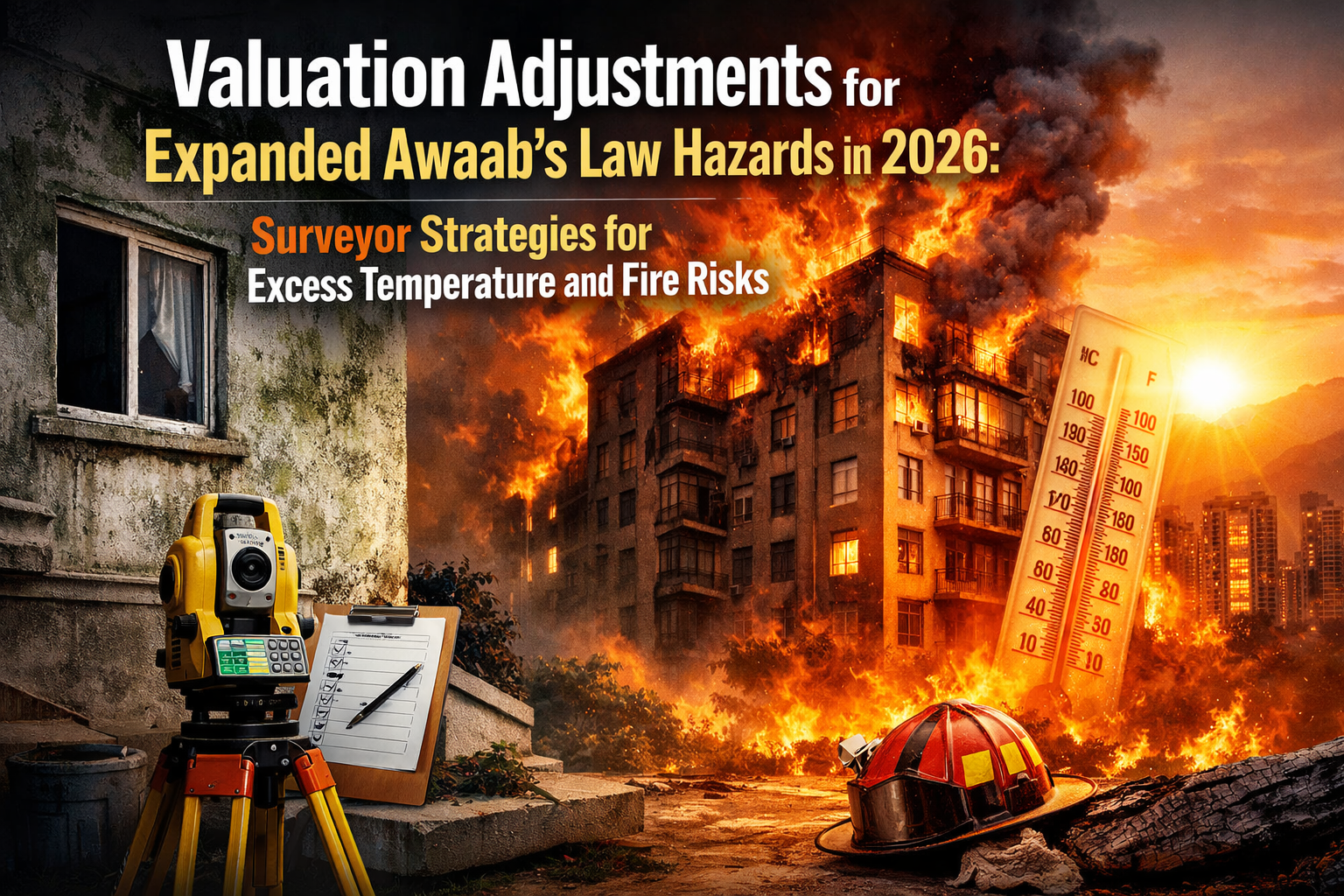
A 40% surge in landlord-tenant disputes is projected for 2026 — and the trigger is a single piece of legislation that has quietly redefined what a safe rental home looks like. [3] Awaab's Law, originally born from the tragic death of two-year-old Awaab Ishak in a mould-contaminated social housing flat, has now expanded far beyond its origins. For chartered surveyors, lenders, and property investors, Valuation Adjustments for Expanded Awaab's Law Hazards in 2026: Surveyor Strategies for Excess Temperature and Fire Risks is no longer a niche compliance topic — it is central to accurate, defensible property valuation across England and Wales.
This article explains what the 2026 expansion means in practice, how surveyors must adapt their methodologies, and what risk premiums and valuation adjustments are now expected by lenders and tribunals alike.
Key Takeaways 📋
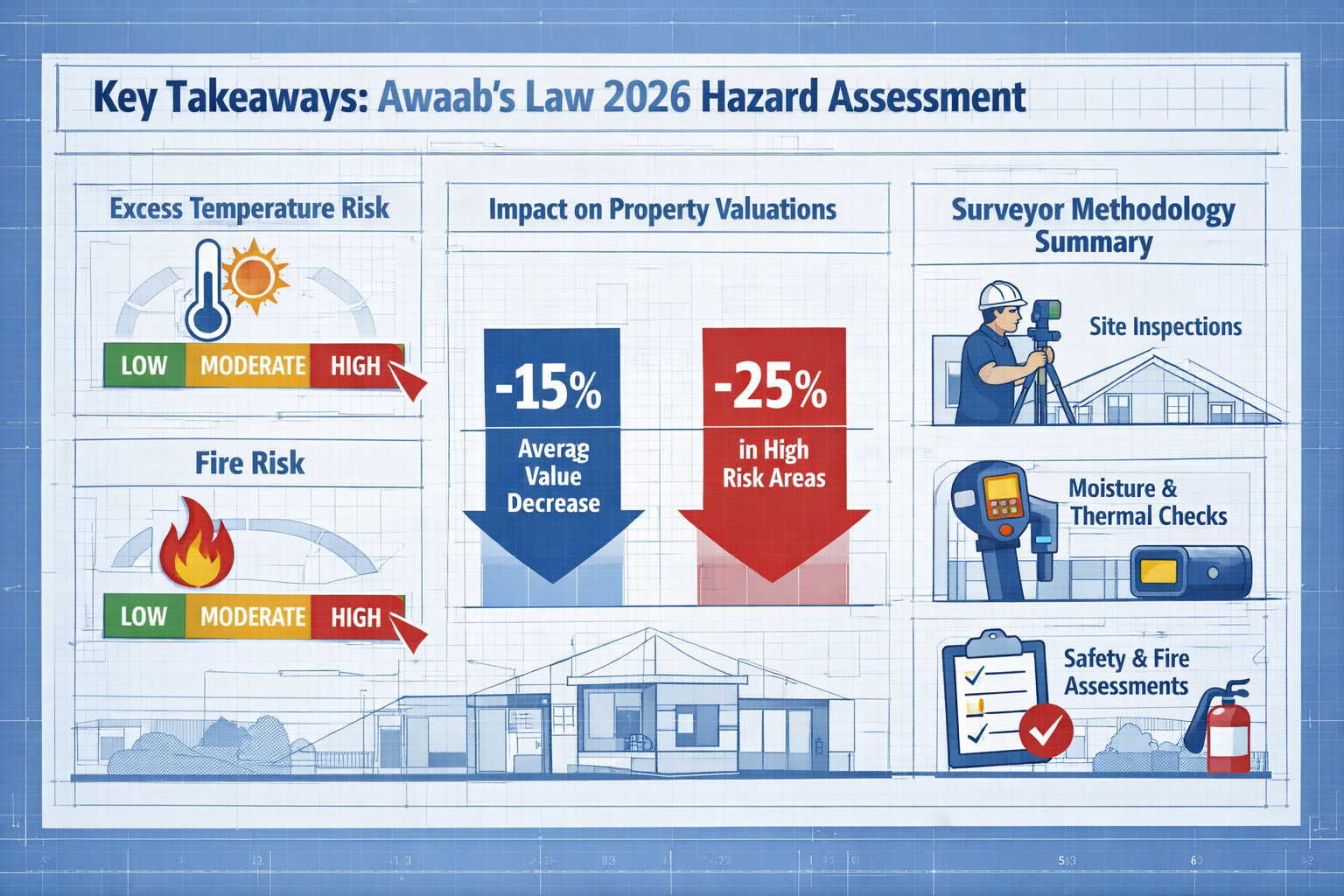
- Awaab's Law now covers five new hazard categories in 2026, including fire safety, electrical risks, excess heat, excess cold, and falls hazards — extending well beyond damp and mould. [2]
- The private rental sector (PRS) is covered for the first time, with mandatory remediation timelines that directly affect rental income projections and property valuations. [1]
- Surveyors must embed hazard assessments into formal valuations, particularly when acting as expert witnesses in dispute resolution. [3]
- RICS Red Book frameworks now need to account for hazard-linked risk premiums when assessing market and investment value.
- Lenders are adjusting mortgage criteria in response to expanded compliance obligations, making hazard-aware valuations essential for transaction security.
Understanding the 2026 Expansion: What Has Changed?
From Social Housing to the Private Rental Sector
When Awaab's Law was first introduced under the Social Housing (Regulation) Act 2023, it applied exclusively to social housing providers. The 2026 expansion changes that fundamentally. The private rental sector is now brought within scope for the first time, meaning that private landlords face the same mandatory investigation and repair timelines that housing associations have been navigating since 2023. [1]
This is not a minor administrative update. The PRS accounts for approximately 4.6 million households in England alone. Bringing this stock under Awaab's Law obligations means that a vast portion of the residential investment market now carries new compliance risk — and that risk must be reflected in valuations.
Five New Hazard Categories 🔥❄️⚡
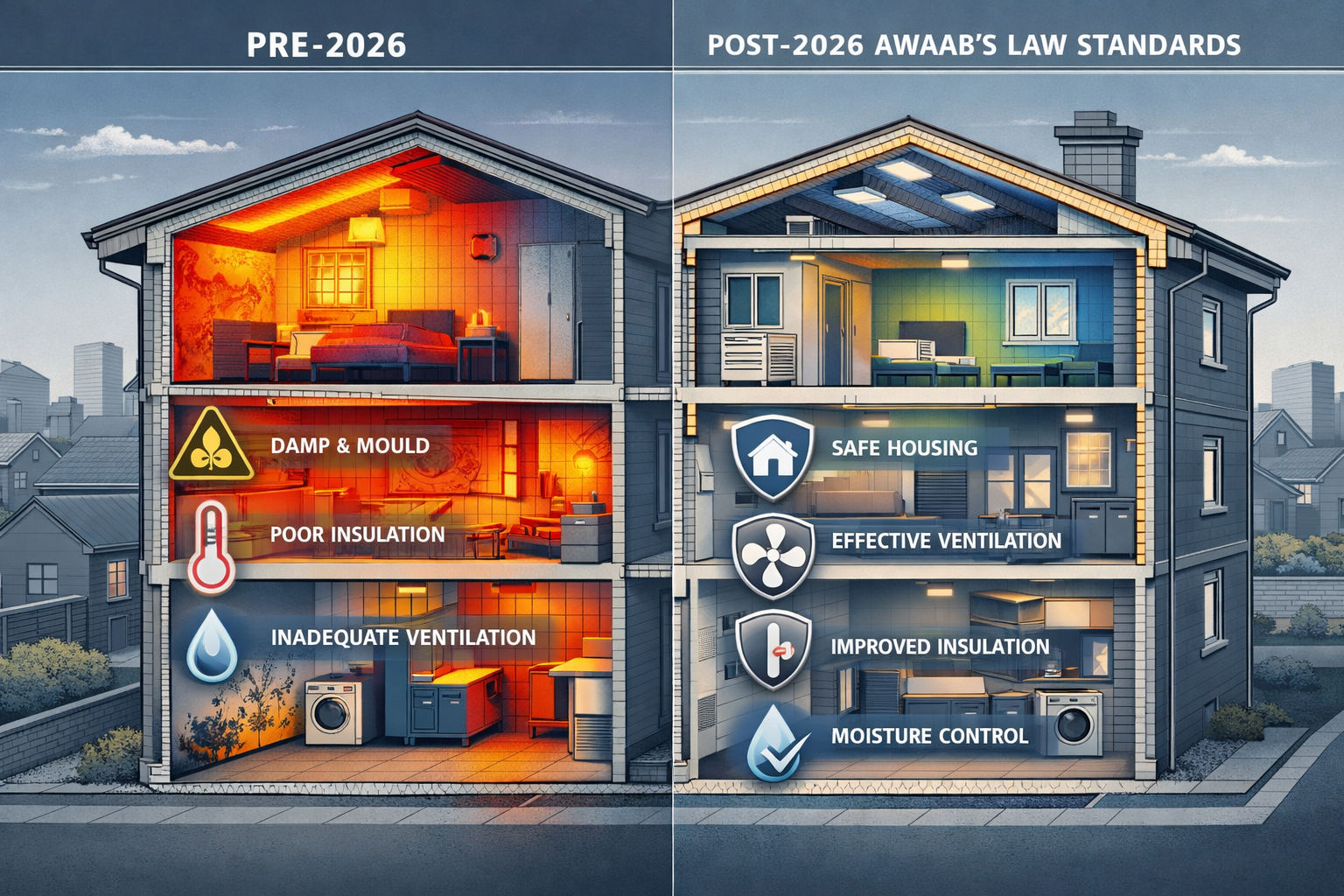
The 2026 expansion introduces five distinct hazard categories beyond the original damp and mould focus: [2]
| Hazard Category | Key Risk Factor | Valuation Impact |
|---|---|---|
| Fire Safety | Inadequate escape routes, smoke detection | High — potential prohibition orders |
| Electrical Risks | Outdated wiring, unsafe installations | Medium-High — EICR compliance costs |
| Excess Heat | Overheating in summer months | Medium — growing with climate risk |
| Excess Cold | Inadequate heating, poor insulation | Medium — EPC-linked |
| Falls Hazards | Stairs, balconies, uneven surfaces | Low-Medium — liability exposure |
For surveyors, each category demands a different assessment toolkit. Excess heat, for example, requires consideration of thermal mass, solar gain, and ventilation — factors that were rarely quantified in standard residential valuations before 2026.
"Awaab's Law 2026 does not merely add compliance checklists — it restructures the risk profile of an entire asset class."
Valuation Adjustments for Expanded Awaab's Law Hazards in 2026: Core Surveyor Methodologies
Embedding Hazard Assessments into Formal Valuations
The most significant shift for practising surveyors is the expectation that hazard assessments are no longer separate reports — they must be integrated directly into rental and capital valuations. Expert witness preparation now specifically requires proficiency in incorporating hazard assessments into rental valuations as part of dispute resolution. [3]
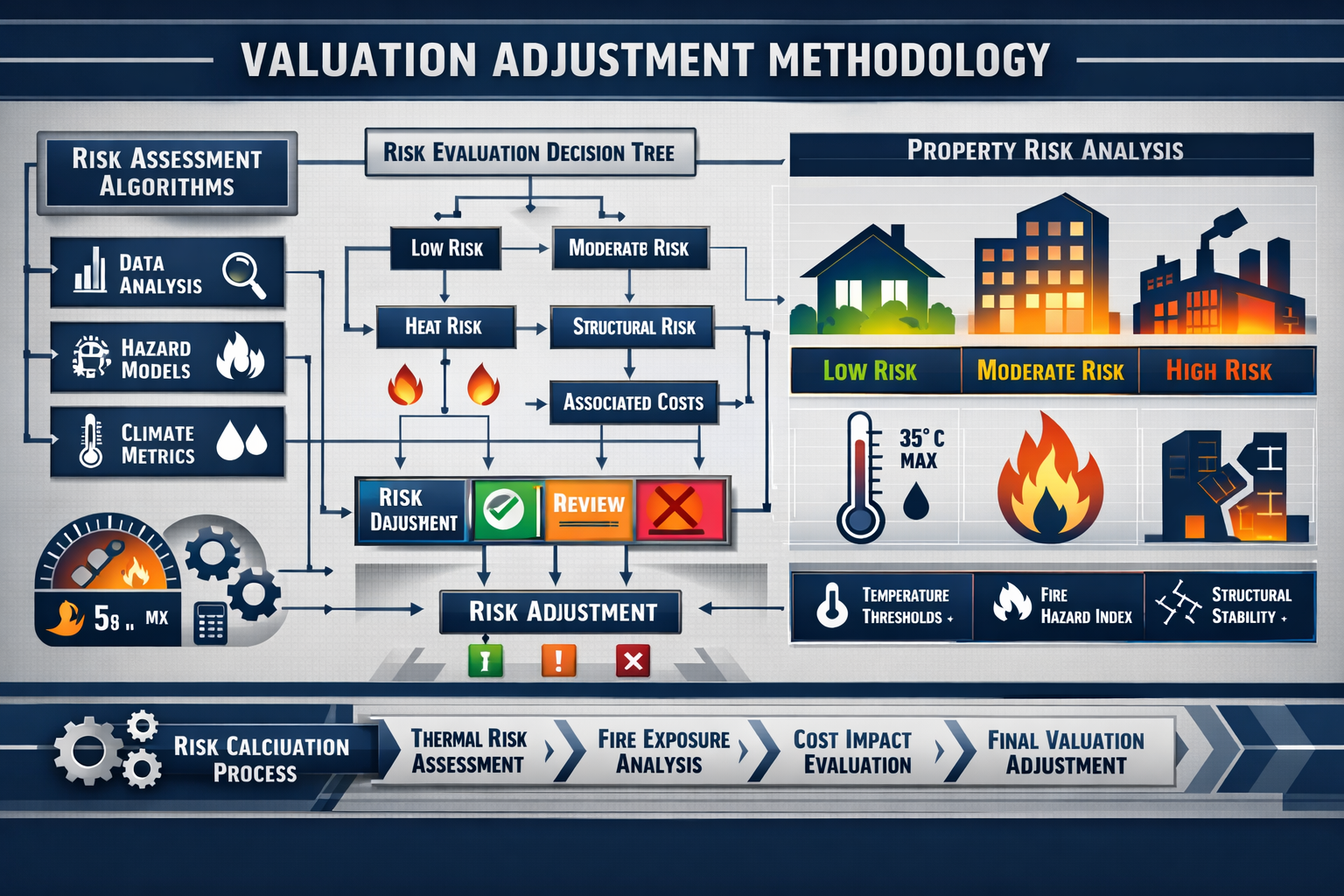
In practical terms, this means a surveyor completing a RICS Red Book valuation for a residential investment property must now:
- Identify all five hazard categories present or latent in the property
- Quantify remediation costs for each identified hazard
- Project the impact on rental income during any mandatory remediation period
- Apply a risk premium to the yield-based valuation to reflect residual compliance uncertainty
- Document the methodology to a standard suitable for tribunal or court submission
This is a materially higher bar than was expected of most residential surveyors even two years ago.
Calculating Risk Premiums for Excess Temperature Hazards
Excess temperature hazards — both heat and cold — present a particular challenge because their impact on value is non-linear and property-specific. A top-floor flat in a south-facing Victorian conversion may face significant overheating risk, while the ground-floor flat in the same building faces none.
Surveyors are increasingly applying a tiered risk premium model:
- 🟢 Tier 1 (No identified hazard): No adjustment required; standard yield applied
- 🟡 Tier 2 (Latent or borderline hazard): 0.25%–0.5% yield adjustment; note in valuation report
- 🟠 Tier 3 (Identified hazard, remediation planned): 0.5%–1.5% yield adjustment; cost deduction from capital value
- 🔴 Tier 4 (Active hazard, enforcement risk): 1.5%–3%+ yield adjustment; significant capital value reduction; possible restriction on use
These figures are not yet codified in RICS guidance, but they reflect emerging practice among surveyors working in active dispute and litigation contexts. [1]
Fire Safety Adjustments: A Higher Complexity Challenge
Fire safety valuations carry additional complexity because enforcement consequences are severe. A property subject to a prohibition order under the Housing Act 2004 — now more likely to be triggered by Awaab's Law compliance failures — has, in effect, zero rental income until remediated.
Surveyors must assess:
- Fire detection and alarm systems — presence, age, and compliance with BS 5839
- Means of escape — adequacy of escape routes, fire doors, and compartmentation
- Cladding and external wall systems — particularly relevant for flats above 11 metres
- Landlord's existing compliance documentation — EWS1 forms, fire risk assessments
When acting as an expert witness in fire safety disputes, surveyors need to expand their preparation to address testimony on fire safety and electrical risks, reflecting the broader hazard scope introduced by the 2026 expansion. [2] This is a substantively different skill set from traditional condition surveying, and many practitioners are investing in specialist CPD to meet the standard.
For those working on commercial building surveys that include mixed-use or residential-above-commercial properties, fire safety compliance now intersects with both Awaab's Law and Building Safety Act obligations simultaneously.
Surveyor Strategies for Excess Temperature and Fire Risks: Practical Frameworks
The RICS Evidence Standard in PRS Disputes
With a projected 40% increase in landlord-tenant disputes requiring expert witness involvement [3], surveyors must be prepared to produce evidence that meets the Civil Procedure Rules Part 35 standard. This means valuation reports and hazard assessments used in dispute contexts must be:
- Objective and impartial — the duty is to the court, not the instructing party
- Clearly reasoned — methodology must be explained in plain terms
- Supported by comparable evidence — market data, cost schedules, and hazard benchmarks
- Compliant with RICS Practice Statement PS1 — the overriding duty of expert witnesses
RICS evidence standards in PRS disputes now specifically contemplate the integration of hazard data into rental valuations. [1] Surveyors who produce reports that separate hazard findings from valuation conclusions — treating them as distinct documents — risk having their evidence challenged or discounted in tribunal proceedings.
Lender Expectations and Mortgage Valuation Adjustments
Lenders are acutely aware of the expanded Awaab's Law obligations. The question of whether a mortgage valuation is the same as a survey has always been important — but in 2026, the distinction carries new weight. A mortgage valuation that fails to flag Awaab's Law compliance risks could expose the lender to security shortfall if enforcement action reduces the property's income or value.
Major lenders are now including Awaab's Law compliance questions in their standard valuation instructions, requiring surveyors to confirm:
- Whether any of the five new hazard categories are present
- Whether mandatory remediation timelines are in place or overdue
- Whether the rental income used in the valuation reflects any compliance-related income voids
Buy-to-let lenders in particular are updating their stress-testing models to account for potential income interruption during remediation periods. This feeds directly into loan-to-value calculations and, ultimately, into the maximum advance available against a property.
Stock Condition Surveys as a Proactive Tool
For landlords managing larger portfolios, the most cost-effective strategy for managing Awaab's Law risk is proactive stock condition surveying. A stock condition survey provides a systematic baseline assessment of all properties against the five hazard categories, enabling landlords to prioritise remediation spend and avoid enforcement action.
From a valuation perspective, a portfolio with a current, comprehensive stock condition survey — and a documented remediation programme — will attract a lower risk premium than an equivalent portfolio without such documentation. This is increasingly recognised by institutional investors and lenders alike.
Damp Surveys and the Overlap with Excess Temperature Hazards
It is worth noting that damp and mould — the original focus of Awaab's Law — often overlaps with excess cold hazards. A property that cannot maintain adequate internal temperatures will frequently develop condensation and mould growth. Surveyors conducting damp surveys in 2026 should therefore consider whether identified damp issues are symptomatic of a broader excess cold hazard, and whether that hazard triggers Awaab's Law obligations independently of the damp condition itself.
This joined-up approach to hazard identification is essential for producing valuations that are both accurate and legally robust.
Expert Witness Roles and the Dilapidations Connection
In commercial and mixed-use contexts, Awaab's Law hazard disputes increasingly intersect with dilapidations claims. Understanding what a dilapidations surveyor does is relevant here: where a landlord's failure to remediate a hazard has caused damage to the property or to a tenant's business, the quantification of that loss may form part of a dilapidations or disrepair claim.
Surveyors acting as expert witnesses in these cases must be comfortable navigating both the technical hazard assessment and the financial quantification of loss — a dual competency that is now in high demand.
Valuation Adjustments for Expanded Awaab's Law Hazards in 2026: Key Considerations for Surveyors
Building a Defensible Valuation Report
A valuation report that will withstand scrutiny in 2026 — whether from a lender, a tribunal, or an opposing expert — should include the following elements when Awaab's Law hazards are relevant:
Section 1: Hazard Identification
- Systematic assessment against all five 2026 hazard categories
- Photographic and instrument-based evidence (thermal imaging, electrical testing records)
- Reference to any existing compliance documentation
Section 2: Remediation Cost Estimate
- Itemised schedule of works for each identified hazard
- Contingency allowance (typically 15%–20% for regulatory compliance works)
- Programme timeline, including any mandatory Awaab's Law deadlines
Section 3: Income Impact Analysis
- Projected rental income void during remediation
- Risk-adjusted income figure used as the basis for yield capitalisation
- Sensitivity analysis showing impact of delayed remediation
Section 4: Capital Value Adjustment
- Explicit statement of any deduction from gross development value or market value
- Risk premium applied to yield, with reasoning
- Comparable evidence to support the adjusted figure
Regional Considerations 🗺️
Awaab's Law compliance risks are not evenly distributed across the country. Older housing stock — concentrated in northern cities, inner London boroughs, and coastal towns — carries higher inherent hazard exposure. Surveyors working in areas with significant pre-1919 housing stock should apply heightened scrutiny to all five hazard categories.
For those operating across London and the South East, the combination of high property values, dense residential stock, and active enforcement by local authorities makes hazard-aware valuation particularly important. Whether working as chartered surveyors in North London, East London, or Surrey, the practical application of these frameworks will vary — but the underlying methodology remains consistent.
Conclusion: Actionable Next Steps for Surveyors in 2026
The 2026 expansion of Awaab's Law is not a distant regulatory development — it is already reshaping how properties are assessed, valued, and financed across the private rental sector. For surveyors, the message is clear: hazard assessment and valuation are no longer separate disciplines.
Here are the key actions to take now:
✅ Upskill on all five hazard categories — invest in CPD covering fire safety, electrical risk, excess heat, excess cold, and falls hazards as they relate to HHSRS assessments
✅ Update your valuation report templates to include a dedicated Awaab's Law compliance section with explicit risk premium methodology
✅ Build relationships with specialist contractors who can provide rapid remediation cost estimates for inclusion in valuation reports
✅ Review your expert witness protocols against RICS PS1 and the CPR Part 35 standard — the 40% increase in disputes means more surveyors will be called to give evidence [3]
✅ Proactively advise landlord clients to commission stock condition surveys before enforcement action creates valuation problems
✅ Stay current with RICS guidance — formal practice notes on Awaab's Law valuation methodology are expected to be updated throughout 2026
The surveyors who adapt quickly to these changes will not only protect their clients' interests — they will position themselves as the go-to experts in a market that is increasingly defined by regulatory complexity and compliance risk.
References
[1] Expert Witness Protocols For Excess Temperature Hazards Under Awaabs Law 2026 Rics Evidence Standards In Prs Disputes – https://nottinghillsurveyors.com/blog/expert-witness-protocols-for-excess-temperature-hazards-under-awaabs-law-2026-rics-evidence-standards-in-prs-disputes
[2] Expert Witness Preparation For Awaabs Law 2026 Expansions Testifying On New Rental Hazards Like Fire And Electrical Risks – https://nottinghillsurveyors.com/blog/expert-witness-preparation-for-awaabs-law-2026-expansions-testifying-on-new-rental-hazards-like-fire-and-electrical-risks
[3] Expert Witness Preparation For Awaabs Law Expansion Disputes 2026 Hazard Assessments In Rental Valuations – https://nottinghillsurveyors.com/blog/expert-witness-preparation-for-awaabs-law-expansion-disputes-2026-hazard-assessments-in-rental-valuations