The UK built environment accounts for approximately 25% of the nation's total carbon emissions — and a significant, often overlooked slice of that figure comes from the embodied carbon locked inside retrofit works carried out on existing homes. As 2026 retrofit projects accelerate under net zero policy pressure, the intersection of Whole Life Carbon Assessments in Party Wall Awards: RICS 2nd Edition Protocols for 2026 Retrofit Projects has become one of the most technically demanding areas a chartered surveyor can navigate.
The RICS Whole Life Carbon Assessment (WLCA) 2nd Edition, released in 2023, fundamentally changes how surveyors must approach carbon reporting — and its implications ripple directly into party wall practice. For any retrofit touching a shared or adjoining wall, the award document and schedule of condition are no longer purely legal instruments. They are increasingly becoming sustainability records too.
Key Takeaways 📋
- ✅ The RICS WLCA 2nd Edition (2023) extends carbon reporting to all built asset types, including retrofit and refurbishment projects sharing party walls.
- ✅ Retrofit projects must be treated as new projects under the standard, requiring full lifecycle reporting across Modules A, B, C, and D.
- ✅ New reporting stages — including A0 (preconstruction), B8 (commute/vehicle emissions), D1 (material reuse), and D2 (utility benefits) — add new surveyor duties.
- ✅ Party wall awards in 2026 are increasingly expected to reference or annex carbon assessment data, particularly where insulation or structural changes are involved.
- ✅ Surveyors who understand WLCA protocols are better positioned to protect both building owners and adjoining owners from future compliance risk.
What the RICS 2nd Edition Actually Changes for Retrofit Work
The original RICS WLCA guidance focused primarily on new-build projects. The 2nd Edition broadens the scope dramatically. It now applies to all types of built assets and infrastructure projects, and critically, it treats retrofit and refurbishment schemes as standalone projects requiring their own full lifecycle assessment [1].
This is a significant shift. Previously, a surveyor conducting a party wall survey for a loft conversion or external wall insulation project might have had no obligation to consider carbon data at all. Under the 2nd Edition framework, the expectation is that carbon is assessed across:
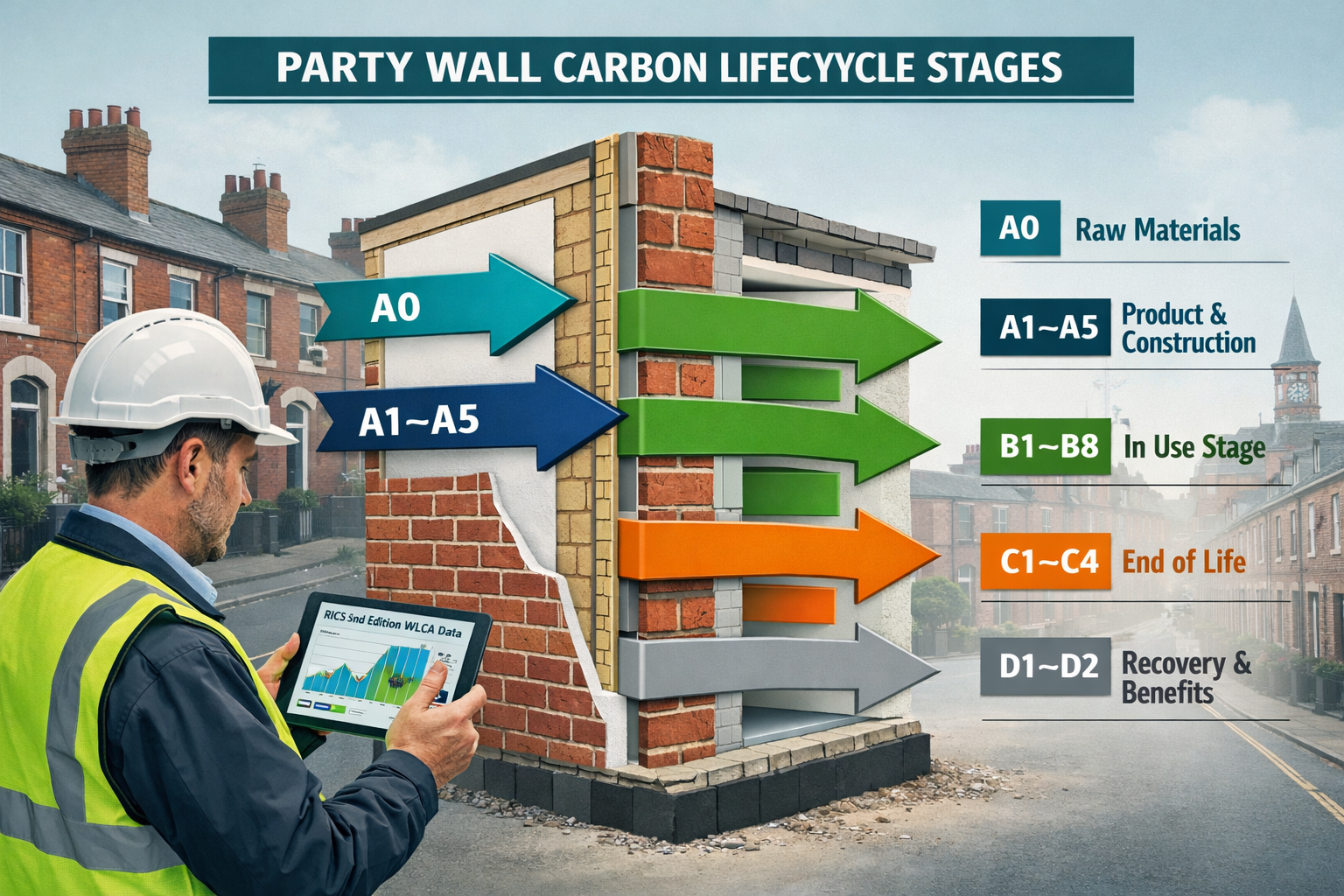
| Lifecycle Module | Description |
|---|---|
| A0 | Preconstruction design activities (new in 2nd Edition) |
| A1–A3 | Product manufacture and raw material extraction |
| A4–A5 | Transport and construction installation |
| B1–B7 | In-use operational and maintenance carbon |
| B8 | Employee commute and vehicle emissions (new in 2nd Edition) |
| C1–C4 | Demolition, waste, and end-of-life processing |
| D1 | Material reuse benefits beyond project boundary (refined) |
| D2 | Utility and infrastructure benefits (refined) |
For retrofit projects specifically, the standard mandates reporting against all lifecycle stages — Modules A, B, and C — plus Module D over a defined Reference Study Period [2]. This is not optional guidance; it is the benchmark against which RICS-regulated professionals are expected to operate.
💬 "Retrofit and refurbishment projects must be treated as new projects and require reporting against all life cycle stages." — RICS WLCA 2nd Edition [2]
How Whole Life Carbon Assessments in Party Wall Awards: RICS 2nd Edition Protocols for 2026 Retrofit Projects Intersect
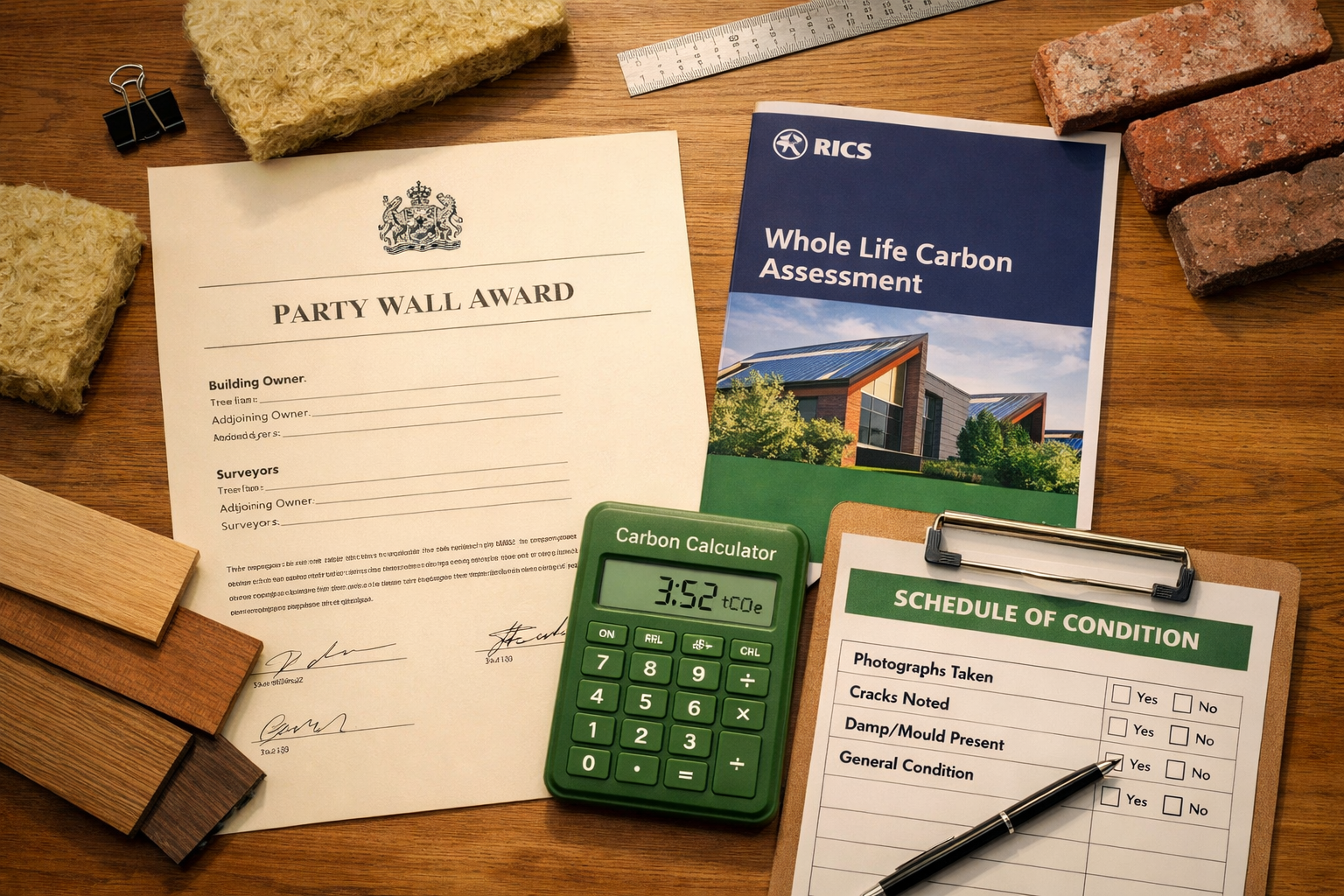
The Party Wall etc. Act 1996 governs works to shared walls, boundary structures, and excavations near adjoining properties. A party wall award is the formal document that sets out the rights, obligations, and conditions under which notifiable works can proceed. Traditionally, awards have focused on structural protection, access rights, and dispute resolution.
In 2026, however, surveyors are encountering a new layer of complexity: clients and local authorities increasingly expect carbon data to be embedded in or referenced by the award, particularly for retrofit projects that involve:
- External wall insulation (EWI) applied to a party wall or shared flank wall
- Internal wall insulation (IWI) affecting thermal bridging at party wall junctions
- Structural alterations that require demolition and rebuilding of party wall sections
- Loft conversions involving party wall raising or new chimney breast removal
For projects involving party wall insulation, the embodied carbon of the insulation material itself — mineral wool, rigid PIR, or recycled cellulose — must now be assessed using Environmental Product Declarations (EPDs) aligned with the WLCA 2nd Edition methodology.
What Goes Into a Carbon-Aware Party Wall Award?
A well-structured 2026 party wall award referencing WLCA protocols should include:
- Material specification with EPD references — identifying the carbon intensity of key materials touching the party wall
- A0 stage documentation — confirming that carbon assessment was initiated at preconstruction design stage
- Biogenic carbon disclosure — particularly relevant where timber frame or natural insulation products are used [1]
- Circular economy alignment statement — addressing how waste materials from party wall demolition or alteration will be managed under D1 (reuse) or D2 (utility benefit) modules [1]
- Reference Study Period declaration — confirming the timeframe over which lifecycle carbon has been assessed [2]
The schedule of condition — a photographic and written record of the adjoining owner's property before works begin — should also note any existing energy efficiency measures that could be affected by the proposed retrofit. This protects both parties if a dispute arises later about whether works degraded or improved the thermal envelope.
Surveyor Duties Under RICS 2nd Edition: A Practical Breakdown
Understanding the theoretical framework is one thing. Translating it into daily surveyor practice is another. Here is how the RICS WLCA 2nd Edition protocols affect specific surveyor roles in 2026 retrofit projects.
🔍 The Appointed Surveyor's Responsibilities
When appointed under the Party Wall etc. Act 1996, a surveyor's primary duty is to the award — not to either owner individually. Under the emerging WLCA framework, this duty now arguably extends to:
- Requesting carbon data from the building owner's design team before drafting the award
- Flagging material substitutions that could significantly alter the embodied carbon profile of party wall works
- Documenting baseline conditions in the schedule of condition with sufficient detail to support a pre-retrofit carbon benchmark
For surveyors unfamiliar with WLCA methodology, the RICS Home Survey and RICS Building Survey Level 3 frameworks provide useful structural assessment parallels — the same discipline of systematic, evidence-based documentation applies directly to carbon data collection.
📐 The Agreed Surveyor Scenario
Where both building owner and adjoining owner agree to use a single surveyor, that professional carries even greater responsibility. They must ensure that carbon reporting obligations are not inadvertently waived or overlooked in the interest of speed or cost efficiency.
💡 Pro tip: Always check whether the project has a planning condition requiring a WLCA submission. If it does, the party wall award should be drafted to complement — not contradict — that submission.
⚖️ Dispute Scenarios and Carbon Data
When a party wall dispute arises mid-retrofit, carbon assessment data can actually help resolve it. If an adjoining owner claims that proposed insulation will cause damp or structural issues, a properly conducted WLCA that includes Module B (in-use maintenance carbon) can demonstrate the long-term performance expectations of the materials — providing an evidence base that goes beyond opinion.
Whole Life Carbon Assessments in Party Wall Awards: RICS 2nd Edition Protocols for 2026 Retrofit Projects — Net Zero Case Studies

Case Study 1: Victorian Terrace EWI Retrofit, Greater Manchester
A row of 1890s terraced houses underwent a deep retrofit programme in 2025–2026. The project involved applying 120mm mineral wool external wall insulation to the shared flank walls — triggering party wall notices under Section 2 of the Act.
The appointed surveyor, working to RICS WLCA 2nd Edition standards, requested EPD data for the mineral wool system from the contractor. The embodied carbon of the insulation (Module A1–A3) was calculated at 8.2 kgCO₂e/m², while the projected operational carbon saving over a 60-year Reference Study Period was estimated at -142 kgCO₂e/m² — a strongly positive whole life carbon outcome.
This data was annexed to the party wall award, providing the adjoining owner with transparent evidence that the works would deliver genuine net zero benefit rather than simply shifting carbon from operational to embodied sources.
Case Study 2: Loft Conversion with Party Wall Raising, London
A semi-detached property in South East London required party wall raising by 600mm to accommodate a new loft room. The structural works involved demolishing and rebuilding the upper section of the party wall using reclaimed London stock bricks.
Under Module D1 (material reuse), the use of reclaimed bricks — rather than new manufactured bricks — reduced the embodied carbon of the wall section by approximately 35% compared to a standard specification [1]. The surveyor documented this in the award under the circular economy alignment statement, satisfying both the WLCA 2nd Edition requirement and the local authority's sustainability planning condition.
For projects like this, a structural survey prior to the party wall notice can identify reuse opportunities early — saving both carbon and cost.
Common Mistakes Surveyors Make With WLCA and Party Wall Awards
Awareness of the RICS 2nd Edition is growing, but implementation errors remain common. Watch out for these pitfalls:
- ❌ Treating retrofit as a minor works exemption — the 2nd Edition is explicit: retrofit is a new project for assessment purposes [2]
- ❌ Ignoring Module A0 — failing to document preconstruction design activities means the carbon timeline is incomplete [1]
- ❌ Using generic carbon factors instead of EPDs — product-specific EPDs are required for accuracy under the standard [3]
- ❌ Omitting biogenic carbon disclosure — particularly problematic where hemp, wood fibre, or other bio-based insulation products are used at party wall junctions [1]
- ❌ Failing to coordinate with the planning WLCA submission — the party wall award and the planning carbon report must tell a consistent story
If a party wall notice was never served and works have already begun, the surveyor's role becomes even more complex. Understanding the implications of no party wall notice being served is essential before attempting to retrospectively incorporate WLCA data into any remedial award.
Software, Tools, and the Future of Carbon-Integrated Party Wall Practice
The RICS WLCA 2nd Edition has driven rapid development in assessment software. Tools like eTool, One Click LCA, and Tally are aligning their platforms with the 2nd Edition framework, making it easier for surveyors and their design team partners to generate compliant lifecycle assessments [6].
For party wall surveyors, the practical implication is that carbon data is becoming easier to obtain, verify, and annex to award documents. The barrier is no longer technical — it is awareness and professional habit.
The RICS itself has been actively engaging with retrofit leaders to discuss how the profession can support the UK's net zero transition [5]. Party wall practice sits at the heart of that conversation, because the vast majority of the UK's existing housing stock — the terraces, semis, and flats that make up most of our cities — cannot be retrofitted without engaging the Party Wall etc. Act 1996.
For surveyors seeking to build expertise in this area, a property certification framework that integrates WLCA data with party wall documentation is likely to become standard practice within the next few years.
Conclusion: Actionable Next Steps for Surveyors in 2026
The convergence of Whole Life Carbon Assessments in Party Wall Awards: RICS 2nd Edition Protocols for 2026 Retrofit Projects is not a distant regulatory concern — it is a present-day professional obligation for any surveyor working on UK retrofit schemes. The 2nd Edition has raised the bar, and party wall practice must rise with it.
Here are the immediate actions every party wall surveyor should take in 2026:
- Download and study the RICS WLCA 2nd Edition — familiarise yourself with the new modules, particularly A0, B8, D1, and D2 [3]
- Update your award template to include a section for carbon assessment annexes and material EPD references
- Build relationships with WLCA-competent consultants — you do not need to conduct the assessment yourself, but you do need to know how to request and verify the data
- Review your schedule of condition process — ensure it captures baseline energy efficiency data that can support pre/post retrofit carbon comparisons; see our schedule of condition guidance for a structured approach
- Stay current with RICS CPD on sustainability — the profession is moving fast, and the gap between early adopters and laggards is widening [5]
The party wall award of 2026 is not just a legal document. It is a sustainability record, a carbon accountability instrument, and — when done well — a demonstration that the surveying profession is genuinely committed to net zero. That is a powerful professional proposition, and it starts with understanding the RICS 2nd Edition.
References
[1] Understanding The Rics Whole Life Carbon Assessment Standard – https://www.tsariley.com/news/understanding-the-rics-whole-life-carbon-assessment-standard/
[2] 474983 Uk Guidance For A Refurbishment Retrofit Submission In Accordance With Rics 2nd Edition – https://help.oneclicklca.com/en/articles/474983-uk-guidance-for-a-refurbishment-retrofit-submission-in-accordance-with-rics-2nd-edition
[3] Whole Life Carbon Assessment – https://www.rics.org/profession-standards/rics-standards-and-guidance/sector-standards/construction-standards/whole-life-carbon-assessment
[4] Whole Life Carbon Assessments In 2026 Valuations Rics 2nd Edition Standards For Surveyors – https://nottinghillsurveyors.com/blog/whole-life-carbon-assessments-in-2026-valuations-rics-2nd-edition-standards-for-surveyors
[5] Retrofit Leaders Meet Rics Hq Discuss Importance Transformative Projects – https://www.rics.org/news-insights/retrofit-leaders-meet-rics-hq-discuss-importance-transformative-projects
[6] New Rics Whole Life Carbon Assessment – https://cerclos.com/new-rics-whole-life-carbon-assessment/