Landlords who fail to register on the new Private Rented Sector (PRS) Database face penalties of up to £40,000 — and without current registration, they cannot obtain possession orders under most Section 8 grounds [1]. That single fact has transformed building surveys from a "nice-to-have" into a legal prerequisite for every private landlord operating in England in 2026.
The Renters' Rights Act 2026 has fundamentally reshaped how landlords manage, document, and evidence the condition of their properties. Building Surveys for Private Landlord Database Registration: Pre-Section 8 Notice Protocols Under Renters' Rights 2026 sit at the heart of this new compliance landscape. Understanding exactly what surveys are needed, when they must be completed, and how they feed into Section 8 evidence packs is no longer optional — it is the difference between a successful possession claim and a costly legal defeat.
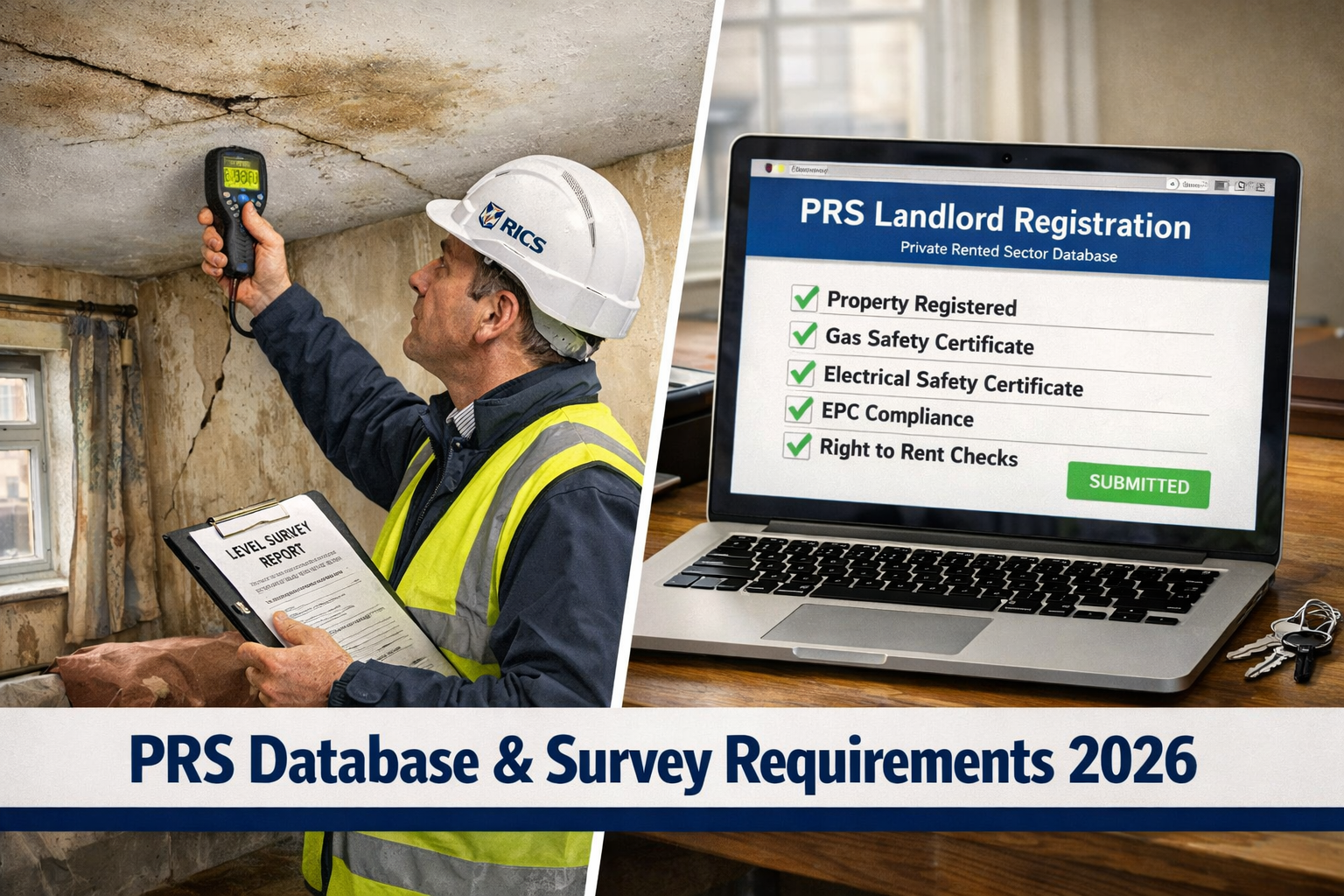
Key Takeaways 📋
- PRS Database registration is mandatory from late 2026, with nationwide rollout by 2027; non-registration blocks most Section 8 possession orders [1].
- Building surveys (Level 3) provide the condition evidence required for PRS Database registration and form a critical part of Section 8 evidence packs [4].
- Safety certificates must be digitised — Gas Safe, EICR, and EPC documents are required for registration [1].
- Section 21 notices were abolished on 1 May 2026, making properly evidenced Section 8 grounds the only route to possession [1].
- Penalties for non-compliance reach £40,000 for failure to register, with additional risks of invalid possession proceedings [1].
The Renters' Rights Act 2026: What Changed on 1 May
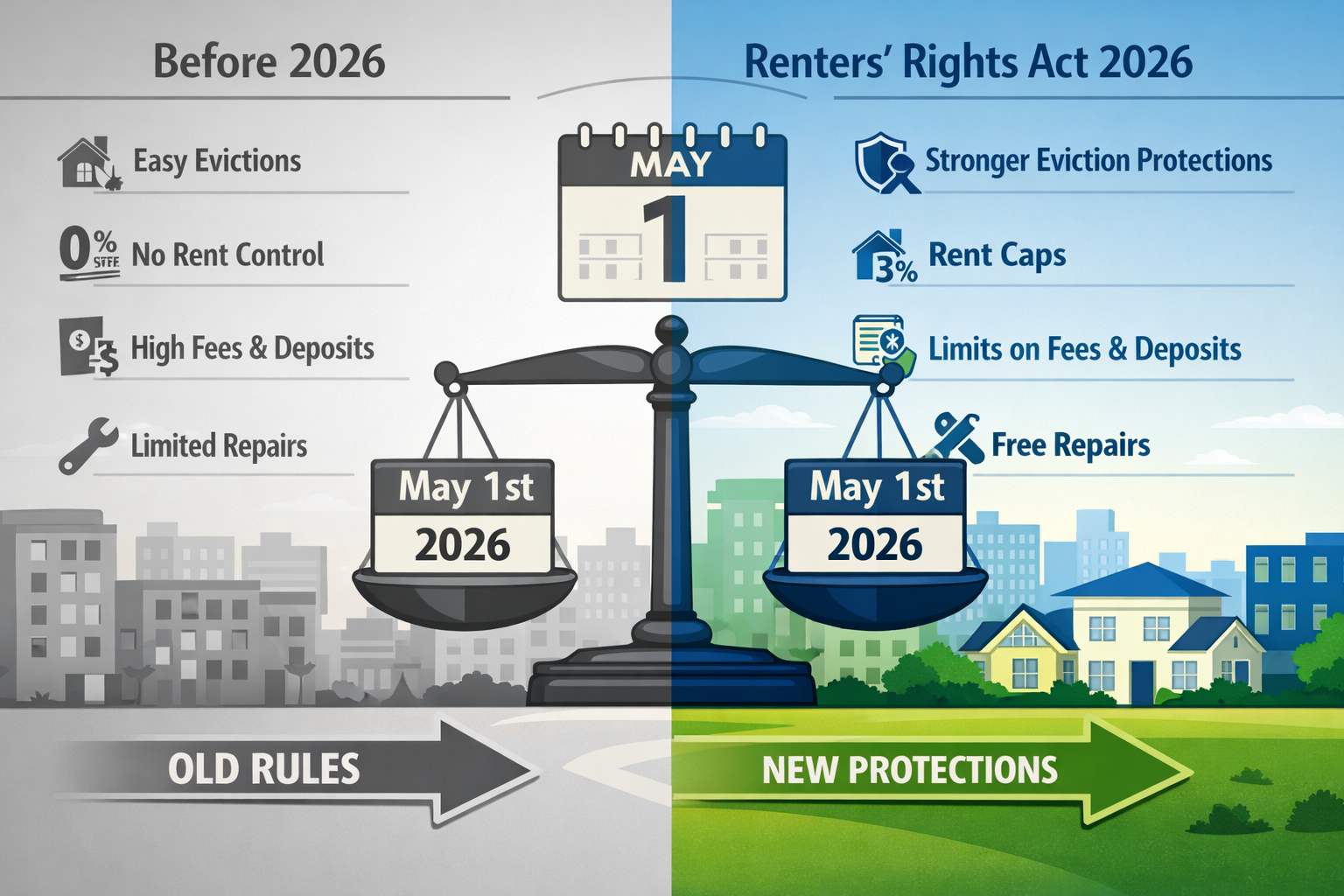
The so-called "Big Bang" implementation date of 1 May 2026 marked the most significant shift in English landlord-tenant law in a generation [1]. Three changes hit simultaneously:
- Section 21 "no-fault" evictions were abolished — landlords can no longer end tenancies without a valid ground.
- Assured Shorthold Tenancies (ASTs) ended — all tenancies became periodic from this date.
- New rent procedures (Form 4A) came into force for rent increases.
💬 "The abolition of Section 21 means every landlord now needs a legally robust reason to seek possession — and the evidence to back it up."
For landlords, this creates an immediate and practical problem: how do you prove your grounds for possession without the safety net of Section 21? The answer lies in meticulous documentation — and building surveys are the foundation of that documentation.
Understanding the PRS Database Registration Requirement
What Is the PRS Database?
The Private Rented Sector (PRS) Database is a new national register that all private landlords in England must join. Regional rollout begins in late 2026, with nationwide mandatory registration by 2027 [1]. The database is designed to:
- Create a transparent record of rental properties and their compliance status.
- Enable local authorities to enforce minimum standards.
- Provide tenants with access to information about their landlord's compliance history.
Rental registries of this type have demonstrated significant public health and housing quality benefits in comparable international contexts [5]. The English PRS Database follows a similar logic: accountability drives improvement.
What Do Landlords Need to Register?
Registration is not simply a matter of submitting a name and address. Landlords must provide verified compliance documentation, including:
| Document | Requirement |
|---|---|
| Gas Safety Certificate | Current, digitised |
| EICR (Electrical Installation Condition Report) | Current, digitised |
| EPC (Energy Performance Certificate) | Current, digitised, minimum Band E |
| Building condition evidence | Survey report confirming no Category 1 HHSRS hazards |
| Property details | Address, tenure type, number of units |
Safety certificates must be digitised and current at the point of registration [1]. Paper-only records will not satisfy the database requirements.
Why Building Surveys Are the Critical Missing Piece
While gas and electrical certificates are familiar to most landlords, the building condition evidence requirement is new — and it is where many landlords are underprepared. A professional building survey provides the structured, RICS-compliant condition report that satisfies this requirement.
Without a current survey demonstrating that the property is free from Category 1 hazards under the Housing Health and Safety Rating System (HHSRS), registration may be refused or challenged. More critically, a property with unresolved hazards cannot legally be let — and attempting to do so compounds the landlord's legal exposure significantly [4].
Building Surveys for Private Landlord Database Registration: Pre-Section 8 Notice Protocols Under Renters' Rights 2026 — The Level 3 Standard
Why Level 3 (Full Building Survey) Is the Appropriate Standard
Not all surveys are equal. For PRS Database registration and Section 8 evidence purposes, a Level 3 Building Survey (formerly known as a Full Structural Survey) is the appropriate choice for most rental properties, particularly:
- Properties built before 1919 (Victorian and Edwardian stock).
- Properties that have undergone significant alterations.
- Properties showing visible signs of defects such as damp, cracking, or roof deterioration.
- HMOs (Houses in Multiple Occupation).
- Any property where the landlord intends to rely on condition-related Section 8 grounds.
A Level 3 survey provides a comprehensive assessment of all accessible parts of the building, including the roof structure, walls, floors, drainage, and services. It identifies defects, assesses their severity, and recommends remedial action [4].
For properties where specific concerns exist, specialist surveys may supplement the Level 3 report:
- 🔍 Damp surveys — essential where moisture ingress is suspected, as damp is one of the most common Category 1 HHSRS hazards.
- 🏗️ Structural engineering assessments — required where cracking or subsidence is present.
- 🏠 Roof surveys — critical for older properties where roof failure poses a safety risk.
- 🔬 Dilapidation surveys — useful for documenting property condition at the start and end of tenancies.
What the Survey Must Document for HHSRS Compliance
The HHSRS assesses 29 categories of hazard. For PRS Database registration, the survey must confirm the absence of — or remediation plan for — the following Category 1 hazards most commonly found in private rental stock:
- Damp and mould growth — linked to respiratory conditions.
- Excess cold — particularly relevant given EPC requirements.
- Falls on stairs and steps — structural integrity of staircases.
- Electrical hazards — though covered by EICR, structural issues affecting wiring must be noted.
- Structural collapse — walls, roofs, floors.
- Fire — means of escape, fire doors, smoke detection.
The survey report should explicitly reference HHSRS categories and provide a condition rating for each element inspected [4].
Digitising the Survey Report
In line with the broader digitisation requirement for PRS Database registration, the building survey report must be available in a digital format that can be uploaded to the database portal. Landlords should ensure their surveyor provides:
- A PDF report with embedded photographs.
- Clear defect schedules with priority ratings.
- Explicit HHSRS hazard assessments.
- Recommendations with indicative timescales for remediation.
Section 8 Notice Protocols: Building Surveys as Evidence
The End of Section 21 and the Rise of Evidence-Based Possession
With Section 21 abolished from 1 May 2026, Section 8 is now the primary possession mechanism for private landlords [1][2]. Each ground for possession has specific evidential requirements, and building surveys play a direct role in several of them.
Ground-by-Ground Evidence Requirements
Ground 1 / 1A — Landlord Requires Property for Own Use
These grounds require the landlord to demonstrate a genuine intention to occupy or sell. Evidence packs must include:
- Agent instruction documentation.
- Family or personal circumstances evidence.
- Valuation evidence — a current market valuation of the property.
While a building survey is not the primary evidence here, a current survey demonstrating the property's condition supports the credibility of the landlord's case and prevents tenants from raising counter-claims about disrepair.
Ground 8 — Serious Rent Arrears
Ground 8 requires granular rent ledgers with Universal Credit (UC) carve-out analysis [1]. This means landlords must demonstrate that arrears are genuine and not attributable to UC payment delays. A building survey becomes relevant here if the tenant raises a counterclaim for disrepair — a common defensive tactic. A current, clean survey report removes this line of defence.
Grounds 7A / 14 — Anti-Social Behaviour
These grounds require incident logs, police references, and warning letters [1]. Notably, Grounds 7A and 14 are among the limited exceptions that allow possession proceedings even without current PRS Database registration [1]. However, building condition evidence may still be relevant if the anti-social behaviour has caused physical damage to the property.
💬 "A building survey is not just a compliance document — it is a strategic legal asset that protects landlords against disrepair counterclaims in possession proceedings."
The Disrepair Defence: Why Surveys Matter More Than Ever
Under the Renters' Rights Act 2026, tenants have enhanced rights to raise disrepair as a defence to possession proceedings. A tenant who can demonstrate that the landlord has failed to maintain the property in a habitable condition can:
- Seek a rent reduction or rent repayment order.
- Apply for an improvement notice from the local authority.
- Use disrepair as grounds to resist a possession order.
A current Level 3 building survey, combined with documented evidence of remediation works, is the most effective way to pre-empt and defeat disrepair defences [4]. Landlords who commission surveys proactively — rather than reactively — are in a significantly stronger legal position.
For landlords managing properties with complex issues, a schedule of dilapidations provides a formal record of property condition that can be referenced throughout the tenancy lifecycle.
Building Surveys for Private Landlord Database Registration: Pre-Section 8 Notice Protocols Under Renters' Rights 2026 — A Step-by-Step Compliance Framework
The Pre-Registration Checklist
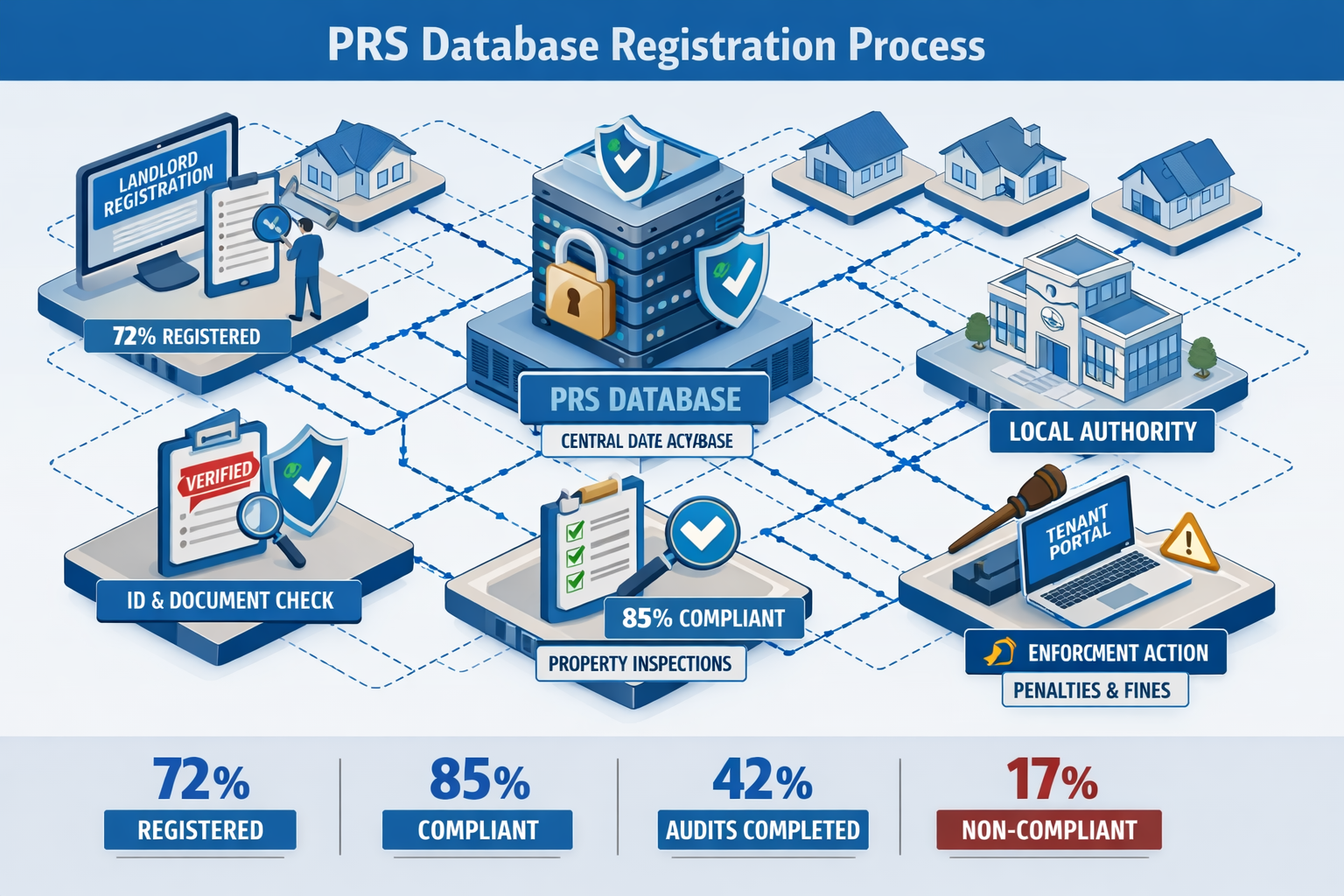
The following framework helps landlords move from survey commission to PRS Database registration efficiently:
Step 1: Commission a Level 3 Building Survey 🔍
- Engage a RICS-accredited chartered surveyor.
- Specify that the survey must address HHSRS hazard categories.
- Request a digitised report with embedded photographs.
Step 2: Address Category 1 Hazards 🔧
- Prioritise hazards identified as Category 1 (immediate risk).
- Obtain contractor quotes and schedule works.
- Retain all invoices and completion certificates as evidence of remediation.
Step 3: Digitise All Safety Certificates 📄
- Ensure Gas Safe certificate is current (annual renewal).
- Confirm EICR is within its validity period (typically 5 years for rental properties).
- Check EPC rating meets minimum Band E requirement.
- Store all documents in a secure, accessible digital format [1].
Step 4: Register on the PRS Database 💻
- Upload all required documentation to the database portal.
- Confirm registration reference number.
- Set calendar reminders for certificate renewal dates.
Step 5: Maintain Ongoing Compliance 📅
- Commission renewal surveys at appropriate intervals (typically every 5 years, or following significant works).
- Update the PRS Database when certificates are renewed.
- Document all maintenance and repair works throughout the tenancy.
Timelines and Deadlines
| Milestone | Date |
|---|---|
| Section 21 abolition / AST end | 1 May 2026 |
| PRS Database regional rollout begins | Late 2026 |
| PRS Database nationwide mandatory | 2027 |
| Maximum penalty for non-registration | £40,000 |
Landlords should treat the late 2026 regional rollout as their hard deadline for survey commissioning. Given current surveyor capacity constraints, leaving survey commissioning until the rollout date risks delays that could leave landlords unregistered and unable to serve valid Section 8 notices.
Common Pitfalls and How to Avoid Them
Pitfall 1: Using a Level 2 Survey When Level 3 Is Required
A Level 2 HomeBuyer Report (available via a RICS home survey) is appropriate for standard modern properties in good condition. For most rental stock — particularly older properties — it does not provide the depth of inspection required for HHSRS hazard assessment. Always confirm the survey level with the surveyor before commissioning.
Pitfall 2: Failing to Address Identified Hazards Before Registration
Registering on the PRS Database with unresolved Category 1 hazards is not simply a compliance failure — it is a potential criminal offence under housing legislation. The survey report must be followed by documented remediation before registration is submitted.
Pitfall 3: Neglecting Specialist Surveys
A Level 3 building survey is comprehensive, but it does not replace specialist assessments where specific issues are present. For example:
- Properties with suspected subsidence require a subsidence survey in addition to the Level 3 report.
- Properties with flat roofs or complex drainage systems benefit from a drainage survey.
Pitfall 4: Poor Document Management
The PRS Database requires digitised, current documents. Landlords who rely on paper records or allow certificates to lapse will find themselves unable to maintain registration — and therefore unable to serve valid Section 8 notices on most grounds [1].
Conclusion: Actionable Next Steps for Landlords in 2026
The convergence of PRS Database registration requirements and the abolition of Section 21 has created a new compliance imperative for private landlords. Building surveys are no longer a discretionary due diligence step — they are a legal prerequisite for operating lawfully and enforcing tenancy agreements under the Renters' Rights Act 2026.
Immediate Actions for Landlords 🎯
- Audit your portfolio now. Identify which properties have current Level 3 surveys and which do not.
- Commission surveys immediately. Surveyor capacity is finite — early commissioning avoids deadline pressure.
- Address hazards systematically. Prioritise Category 1 HHSRS hazards and document all remediation works.
- Digitise your compliance records. Gas Safe, EICR, EPC, and survey reports must all be in digital format before registration.
- Engage a RICS-accredited surveyor. Only RICS-accredited professionals can provide the level of report required for PRS Database registration and Section 8 evidence purposes.
- Build your Section 8 evidence packs proactively. Do not wait until possession proceedings are needed — assemble rent ledgers, correspondence, and survey evidence now.
The landlords who navigate the Renters' Rights Act 2026 successfully will be those who treat compliance as an ongoing system rather than a one-time task. A current, comprehensive building survey is the cornerstone of that system.
References
[1] Renters Rights Act 2025 Landlord Guide – https://blackacresurveyors.com/2026/04/24/renters-rights-act-2025-landlord-guide/
[2] Whats Changing For Renters From 1 May A Simple Guide To The Renters Rights Act – http://housinghand.com/help-and-advice/guides-for-tenants/whats-changing-for-renters-from-1-may-a-simple-guide-to-the-renters-rights-act
[4] Building Survey Defect Documentation Under New Renters Rights Act 2026 Landlord Compliance Evidence For Section 8 Eviction Grounds – https://nottinghillsurveyors.com/blog/building-survey-defect-documentation-under-new-renters-rights-act-2026-landlord-compliance-evidence-for-section-8-eviction-grounds
[5] Rental Registries Restoring Public Health In Chicago And Across The Nation – https://yalelawjournal.org/fellow-essays/rental-registries-restoring-public-health-in-chicago-and-across-the-nation