
New buyer enquiries collapsed to a net balance of -39% in March 2026 — the weakest reading on record — signalling that the spring housing market has arrived with far less optimism than many anticipated [3]. For legal professionals, litigants, and courts relying on property evidence, this environment makes the quality of expert witness valuations more consequential than ever. Understanding the forces driving this caution is not merely academic; it directly shapes how valuers construct defensible, court-ready opinions in 2026.
Expert Witness Valuations Amid Cautious Spring 2026 Housing Market: RICS Insights on Interest Rates and Regional Recovery sits at the intersection of market volatility, legal standards, and professional methodology. This article unpacks what the latest RICS data reveals, why interest rate movements are disrupting valuations, and how regional divergence is forcing expert witnesses to refine their evidence.
Key Takeaways 📌
- Buyer demand hit historic lows in March 2026, with enquiries at -39% net balance, complicating comparable evidence for expert witnesses [3].
- London faces the sharpest price correction, with 12-month expectations collapsing from +56% to +7% between January and February 2026 [1].
- Northern regions remain relatively resilient, offering expert witnesses in those areas a more stable comparables pool [1].
- SWAP rates surged to 4.18% (five-year) in early April 2026, triggering rapid lender rate increases that directly affect mortgage-dependent valuations [4].
- Long-term price expectations deteriorated sharply, with the 12-month balance falling to just +2% in March 2026 — signalling broadly flat growth ahead [3].
The Spring 2026 Housing Market: What RICS Data Reveals
A Market Under Significant Pressure
The RICS UK Residential Market Survey for February and March 2026 paints a sobering picture. Buyer demand — a leading indicator of future transaction volumes — deteriorated sharply across both months. The net balance for new buyer enquiries stood at -26% in February, then fell further to -39% in March [1][3]. These are not minor fluctuations; they represent a sustained withdrawal of purchasing intent at a time when spring traditionally injects momentum into the market.
💬 "Deterioration in the geopolitical backdrop and rising oil and energy prices weighed heavily on buyer confidence." — Tarrant Parsons, RICS Head of Market Research & Analytics [1]
Agreed sales followed a similar trajectory. The net balance for completed sales registered -12% in February 2026, with near-term expectations softening to -2% [1]. For expert witnesses preparing valuations for dispute resolution, this matters enormously: fewer transactions mean thinner comparable evidence, which in turn demands more rigorous methodology and clearer justification of adjustments.
Price Trends: Flat Nationally, Diverging Regionally
The headline price net balance sat at -12% in February 2026, reflecting broadly flat to slightly declining conditions nationally [1]. However, the near-term outlook deteriorated sharply. By March 2026, the three-month price expectations balance had fallen to -43%, indicating that surveyors anticipated further downward pressure in the months immediately ahead [3].
Long-term sentiment also weakened considerably. The 12-month price expectations balance dropped from +33% in February to just +2% in March 2026 — a near-complete erosion of medium-term optimism [1][3].
| Indicator | February 2026 | March 2026 |
|---|---|---|
| New Buyer Enquiries (net balance) | -26% | -39% |
| Agreed Sales (net balance) | -12% | — |
| Headline Price Balance | -12% | — |
| 3-Month Price Expectations | — | -43% |
| 12-Month Price Expectations | +33% | +2% |
Source: RICS UK Residential Market Survey [1][3]
Regional Divergence: The North-South Divide Widens
One of the most important findings for expert witness practice is the stark regional divergence in price trends:
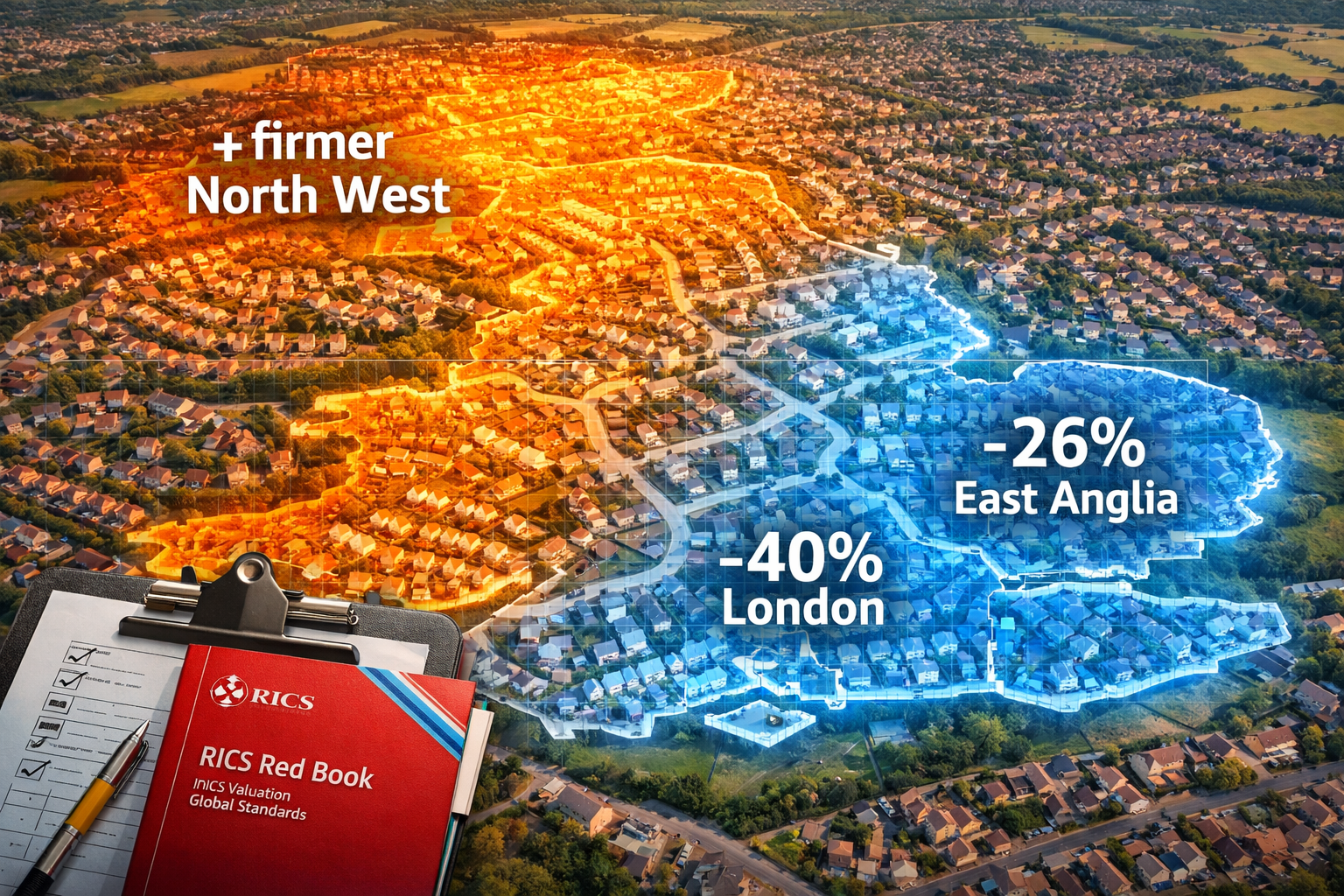
- 🔴 London: -40% net balance for price trends in February 2026. The 12-month expectations balance collapsed from +56% in January to just +7% in February — a dramatic reversal [1].
- 🟠 South East: -24% net balance; continued downward pressure [1].
- 🟠 East Anglia: -26% net balance; similar softening [1].
- 🟢 Northern Ireland, Scotland, North West England: Continued to report firmer price trends relative to southern counterparts [1].
For expert witnesses instructed in disputes involving northern properties, this divergence offers a more stable comparables landscape. For those working on London or South East cases, the volatility demands explicit acknowledgement of market conditions at the relevant valuation date.
Understanding the factors of valuation that drive these regional differences — including local employment, transport connectivity, and housing stock composition — is essential when constructing robust expert evidence.
Expert Witness Valuations Amid Cautious Spring 2026 Housing Market: Methodology and Standards Under Scrutiny

Why Market Volatility Raises the Stakes for Expert Evidence
When markets are stable, comparable evidence is plentiful and adjustments are modest. When markets are volatile — as they clearly are in spring 2026 — the expert witness faces a more complex task. Courts and tribunals expect valuers to:
- Identify the relevant valuation date precisely, since conditions shifted materially between January and March 2026.
- Explain market conditions at that date using authoritative sources such as RICS surveys.
- Justify comparable selection in a thin transactions environment.
- Quantify adjustments for time, condition, and location with transparent reasoning.
The RICS Red Book provides the professional framework underpinning all compliant expert witness valuations. Adherence to its standards is not optional in a litigation context — it is the baseline expectation.
The Role of RICS-Registered Valuers in Dispute Resolution
Expert witnesses in property disputes must be appropriately qualified. Valuers registered with the RICS carry a professional obligation to provide independent, impartial opinions grounded in market evidence. In a cautious spring 2026 market, this independence is particularly valuable: instructing parties may have strong incentives to argue for higher or lower values, but the expert's duty is to the court.
Key obligations include:
- Transparency about data sources and methodology
- Acknowledgement of uncertainty where market evidence is thin
- Consistency with RICS professional standards
- Disclosure of any assumptions or special assumptions made
Comparable Evidence in a Low-Transaction Environment
With agreed sales at a net balance of -12% in February 2026 [1], the pool of recent comparables is shallower than in a buoyant market. Expert witnesses must therefore:
- Cast a wider geographic net while justifying why more distant comparables remain relevant
- Use time adjustments to account for the sharp deterioration in expectations between January and March 2026
- Reference RICS survey data explicitly to contextualise market conditions at the valuation date
- Consider rental evidence where appropriate, noting that landlord instructions remained firmly negative at -27% net balance in February 2026, reflecting ongoing rental supply shortages [1]
For properties subject to shared ownership or right-to-buy arrangements, specialist valuation approaches apply. RICS shared ownership valuations and right-to-buy valuations each carry specific methodological requirements that become even more important when market conditions are in flux.
12-Month Price Uplift Expectations in Non-London Regions: A Critical Variable
For disputes involving properties in Northern Ireland, Scotland, or the North West of England, the 12-month price uplift expectations present a notably different picture from London. While London's 12-month expectations collapsed to just +7% in February 2026 [1], northern regions maintained firmer outlooks.
This divergence has direct implications for expert evidence in cases involving:
- Matrimonial disputes where future value projections inform settlement
- Compulsory purchase cases where development uplift is contested
- Lease extension disputes where relativity and hope value arguments depend on market trajectory
- Negligence claims against surveyors or estate agents where the market context at the time of an alleged breach must be reconstructed
Expert witnesses in these northern regions can draw on a more optimistic — though still cautious — market backdrop when forming 12-month opinions. Those in London must grapple with the dramatic reversal from +56% to +7% expectations within a single month [1], which may itself become a material fact in some disputes.
Interest Rates, SWAP Rates, and Their Impact on Expert Witness Valuations Amid Cautious Spring 2026 Housing Market Recovery

The Interest Rate Shock of Early April 2026
The interest rate environment has added a further layer of complexity to an already cautious market. In the week of April 1, 2026, five-year SWAP rates surged to 4.18% — up from 3.47% just one month prior and above levels recorded a year earlier. Two-year SWAPs reached 4.24%, compared with 3.31% a month before [4].
Lenders responded rapidly:
| Lender | Rate Increase |
|---|---|
| Capital Home Loans | Up to 4.00% |
| Santander | Up to 0.80% |
| HSBC | Up to 0.70% |
| Skipton Building Society | Up to 0.40% |
| BM Solutions, Aldermore, TMW | Varying increases |
Source: MF Brokers [4]
These increases directly affect the affordability calculations underpinning residential valuations. When mortgage costs rise sharply, the pool of qualifying buyers shrinks, exerting downward pressure on achievable prices — particularly in higher-value markets such as London and the South East.
Bank of England Base Rate Trajectory
Oxford Economics revised its forecasts to project the Bank of England base rate reaching 3.25% by December 2026 [2]. This represents a continued easing trajectory, but the pace of cuts has slowed relative to earlier expectations. For expert witnesses, this creates a nuanced picture:
- Short-term: Higher SWAP rates and mortgage costs suppress demand and prices
- Medium-term: Anticipated base rate reductions to 3.25% by year-end may provide some recovery support
- Long-term: The 12-month expectations balance of just +2% in March 2026 suggests the market does not anticipate significant appreciation [3]
💡 Key insight for expert witnesses: When a valuation date falls in early spring 2026, the expert must reflect the prevailing SWAP rate environment and its impact on buyer affordability — not the anticipated future rate trajectory.
How Rising Rates Affect Specific Valuation Contexts
🏠 Residential Sales Valuations
Higher mortgage rates reduce the maximum loan a buyer can service, compressing the price ceiling for mortgage-dependent purchasers. Expert witnesses must factor this into their assessment of the hypothetical willing buyer's purchasing power.
🏢 Investment and Buy-to-Let Properties
Rising financing costs squeeze landlord yields. Combined with the -27% net balance for landlord instructions in February 2026 [1], this signals continued stress in the private rented sector. RICS valuations for investment properties must reflect both the income approach and the market evidence approach, with explicit recognition of financing cost pressures.
📋 Freehold and Leasehold Disputes
Freehold valuations in a rising rate environment require careful treatment of the deferment rate and capitalisation rate assumptions. Courts have historically scrutinised these inputs closely, and in a volatile rate environment, the expert must demonstrate that their chosen rates are consistent with current market evidence.
🔍 Building Surveys and Structural Assessments
While not strictly a valuation matter, RICS Level 3 building surveys often accompany expert witness instructions, particularly in negligence claims. A thorough structural assessment can be critical to establishing the condition of a property at a specific date — relevant to both valuation and liability arguments.
Practical Guidance for Expert Witnesses in Spring 2026
Given the market conditions outlined above, expert witnesses should consider the following best practices:
✅ Date-stamp all market commentary — conditions shifted materially between January and March 2026; the valuation date is critical.
✅ Cite RICS survey data explicitly — reference the February and March 2026 RICS UK Residential Market Surveys as authoritative market evidence [1][3].
✅ Acknowledge regional variation — a London valuation requires different market context than a North West England valuation.
✅ Address the SWAP rate environment — particularly for mortgage-dependent properties valued in March–April 2026.
✅ Quantify uncertainty — where the evidence base is thin, acknowledge this transparently rather than projecting false precision.
✅ Maintain RICS Red Book compliance — courts expect this as a minimum standard; departures must be explained.
✅ Separate current value from future expectations — the near-term price expectations of -43% [3] are relevant to some dispute types but must not be conflated with the current market value opinion.
For those seeking a comprehensive RICS valuation service that meets these standards, working with appropriately qualified and experienced professionals is essential.
Conclusion: Actionable Steps for Expert Witnesses and Instructing Parties
The spring 2026 housing market presents a genuinely challenging environment for property valuation. Buyer demand at historic lows, SWAP rates surging, London prices under severe pressure, and long-term expectations collapsing to near-zero — these are not background noise. They are material facts that must be woven into every expert witness valuation prepared during this period.
For expert witnesses, the priority is methodological rigour: precise valuation dates, transparent comparable selection, explicit market commentary grounded in RICS data, and full Red Book compliance. The regional divergence between northern resilience and southern weakness demands location-specific analysis rather than national generalisations.
For solicitors and instructing parties, the lesson is to brief experts fully on the market context at the relevant date and to scrutinise opposing expert reports for any failure to account for the dramatic market shifts of early 2026.
For property owners and investors navigating disputes, understanding that valuations are not static opinions but market-moment snapshots is essential — particularly when that moment falls in one of the most volatile springs the UK housing market has seen.
Immediate Next Steps 🎯
- Commission a RICS-compliant valuation from a registered valuer with demonstrable experience in your property type and region.
- Request explicit market commentary covering the RICS February and March 2026 survey findings in any expert report.
- Challenge any expert report that fails to address regional divergence, SWAP rate movements, or the thin comparables environment.
- Engage early — in a low-transaction market, gathering sufficient comparable evidence takes longer.
- Consider a structural survey alongside any valuation instruction to ensure condition-related adjustments are fully evidenced.
The cautious spring 2026 housing market demands cautious, rigorous expert witness practice. The professionals who rise to that challenge will produce the most defensible, court-ready evidence — and ultimately serve their clients and the courts most effectively.
References
[1] UK Residential Survey February 2026 – https://www.rics.org/news-insights/uk-residential-survey-february-2026
[2] Budget Preview – https://ww3.rics.org/uk/en/journals/construction-journal/budget-preview.html
[3] UK Residential Market Survey March 2026 – https://www.rics.org/content/dam/ricsglobal/documents/market-surveys/uk-residential-market-survey/UK-Residential-Market-Survey-March-2026.pdf
[4] Rising Rates And New Regulations – https://www.mfbrokers.co.uk/resources/news-and-insights/rising-rates-and-new-regulations