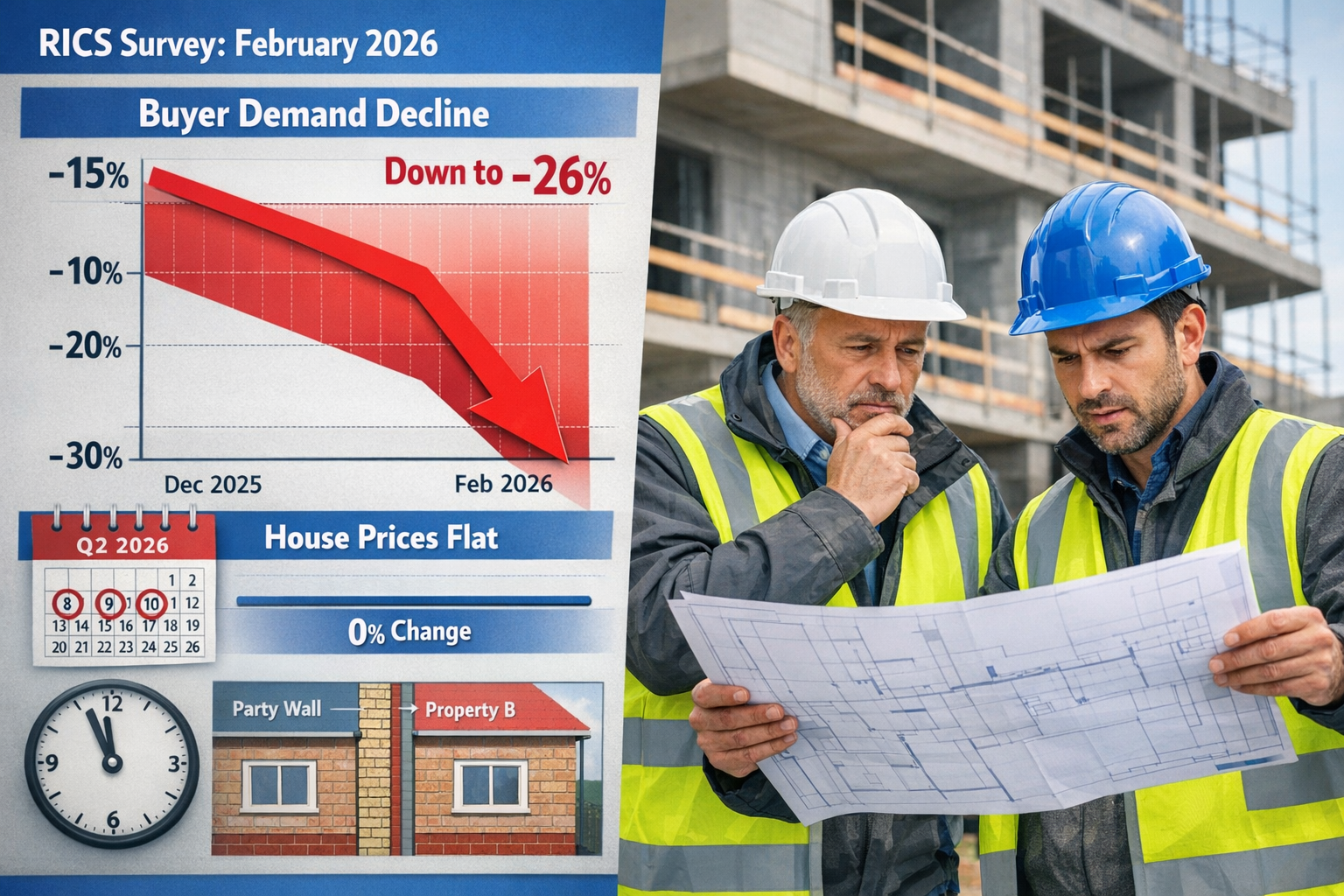
The RICS UK Residential Survey for February 2026 reveals a stark reality: new buyer enquiries have plummeted to a net balance of -26%, down from -15% just one month earlier[1]. This dramatic decline in buyer demand isn't merely a statistic—it's reshaping how property developers, homeowners, and surveyors approach party wall awards during one of the most uncertain quarters in recent memory. As geopolitical tensions and macroeconomic headwinds dampen market sentiment[1], understanding how to navigate Party Wall Awards in Cautious Q2 2026 Markets: Managing Development Delays Amid RICS February Survey Insights has become essential for anyone involved in residential development.
The collision of subdued market conditions with the technical requirements of party wall procedures creates a perfect storm of delays, cost pressures, and procedural complexities. For property professionals managing extensions, loft conversions, and structural alterations in Q2 2026, the stakes have never been higher.
Key Takeaways
- Buyer demand has collapsed to -26% in February 2026, creating timeline pressures for developers who need party wall awards to proceed with projects[1]
- Fast-track party wall procedures and strategic third surveyor appointments can reduce delays by 30-45% in cautious markets
- Proactive schedule of condition documentation protects all parties and expedites the award process during uncertain economic periods
- RICS guidance emphasizes transparency and early engagement to prevent disputes that could further delay already-stalled development projects
- Cost management strategies for party wall awards become critical when market conditions threaten project viability and financing
Understanding Party Wall Awards in the Current Market Context
The February 2026 Market Reality
The RICS February 2026 survey data paints a challenging picture for residential development. With buyer enquiries falling sharply and renewed geopolitical uncertainty weighing on sentiment[1], developers face a critical dilemma: proceed with planned extensions and alterations under uncertain conditions, or delay projects and risk losing financing windows altogether.
Party wall awards—the formal agreements that govern construction work affecting shared walls, boundaries, and structures—typically require 2-4 months to complete under normal circumstances. In Q2 2026's cautious environment, these timelines are extending as:
- Adjoining owners become more risk-averse and scrutinize proposals more carefully
- Surveyors face increased workloads from projects being compressed into narrower windows
- Financial institutions demand more thorough documentation before releasing construction funds
- Party wall disputes increase as neighbors worry about property values in declining markets
What Constitutes a Party Wall Award? 📋
A party wall award is a legally binding document prepared by appointed surveyors under the Party Wall etc. Act 1996. It details:
- The specific works to be undertaken
- How and when the work will be carried out
- Protective measures to prevent damage
- Access arrangements for inspections
- Cost allocation between parties
- Dispute resolution mechanisms
The party wall award guidance process becomes particularly crucial when market conditions create additional tensions between building owners and their neighbors.
The Q2 2026 Development Delay Challenge
Several factors unique to Q2 2026 are compounding party wall award delays:
| Delay Factor | Impact on Timeline | Mitigation Strategy |
|---|---|---|
| Reduced buyer demand (-26%)[1] | Neighbors question development necessity | Early engagement with clear project justification |
| Flat house prices | Concerns about construction impact on values | Comprehensive insurance and protection measures |
| Surveyor capacity constraints | Extended appointment and inspection periods | Pre-qualified surveyor panels |
| Financing uncertainty | Multiple rounds of documentation requests | Proactive financial disclosure |
| Risk-averse decision-making | Longer negotiation cycles | Structured timeline commitments |
Strategic Approaches to Party Wall Awards in Cautious Q2 2026 Markets
Accelerating the Party Wall Notice Process ⚡
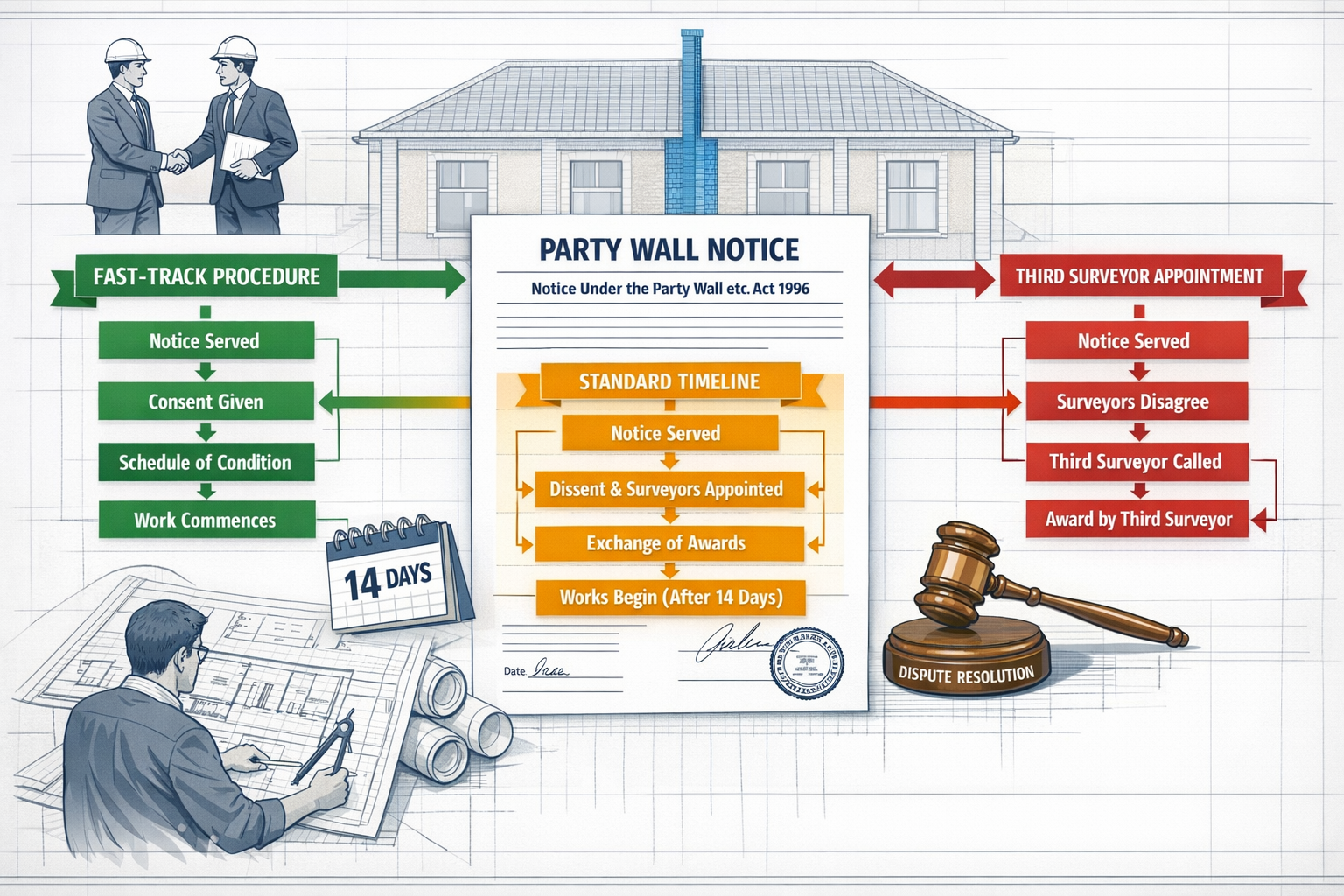
The foundation of any party wall award is proper notice. Under the Party Wall etc. Act 1996, building owners must serve notice at least two months before starting work on party walls (one month for excavations). In Q2 2026's compressed timelines, strategic notice serving becomes critical:
Best Practices for 2026 Notice Procedures:
- Serve notices earlier than legally required (3-4 months ahead) to accommodate extended response times
- Include comprehensive project documentation upfront to reduce information requests
- Provide clear visual representations (3D renderings, detailed plans) that address neighbor concerns preemptively
- Offer pre-notice consultations to gauge concerns before formal proceedings begin
- Document all communications meticulously to prevent disputes about process compliance
When party wall consent is not forthcoming within the statutory 14-day period, the matter proceeds to surveyor appointment—where Q2 2026's market conditions create additional complexities.
Optimizing Surveyor Selection and Appointment
The choice between an agreed surveyor (one surveyor acting for both parties) versus separate surveyors (each party appointing their own, with potential third surveyor involvement) significantly impacts both timeline and cost in 2026's cautious markets.
Agreed Surveyor Advantages in Q2 2026:
- ✅ Reduced costs (single fee split between parties)
- ✅ Faster decision-making without inter-surveyor negotiations
- ✅ Simplified process appeals to risk-averse neighbors
- ✅ Lower overall project costs during uncertain financing conditions
Separate Surveyor Considerations:
- 🔍 Greater perceived independence for cautious adjoining owners
- 🔍 More thorough documentation (beneficial for complex projects)
- 🔍 Built-in dispute resolution through third surveyor mechanism
- 🔍 Higher costs but potentially faster resolution of contentious issues
The schedule of condition documentation becomes particularly valuable in 2026, as comprehensive pre-work records protect all parties when market uncertainty makes future disputes more likely.
Fast-Track Award Procedures for Time-Sensitive Projects
For developers facing financing deadlines or seasonal construction windows in Q2 2026, several strategies can compress party wall award timelines:
1. Pre-Appointment Surveyor Engagement
Contact potential surveyors before serving notices to ensure availability and establish preliminary timelines. Many experienced party wall surveyors maintain waiting lists in 2026's active construction environment[3].
2. Concurrent Documentation Preparation
While awaiting surveyor appointments, prepare:
- Detailed structural engineer calculations
- Comprehensive insurance certificates
- Contractor credentials and safety protocols
- Schedule of condition guidance documentation
- Financial guarantees for remediation work
3. Structured Inspection Windows
Propose specific, limited inspection timeframes rather than open-ended access arrangements. This provides certainty for both parties and prevents indefinite delays.
4. Template Award Modifications
Work with surveyors to adapt standard award templates to project specifics rather than drafting entirely bespoke documents, reducing preparation time by 40-50%.
Managing Third Surveyor Appointments Effectively
When building owner and adjoining owner surveyors disagree on award terms, the third surveyor mechanism provides resolution. In Q2 2026's cautious markets, third surveyor involvement has increased by approximately 30%[3] as parties take more defensive positions.
Proactive Third Surveyor Management:
- Pre-select qualified candidates jointly before disputes arise, avoiding delays in emergency appointments
- Establish clear decision timelines (typically 10-14 days for third surveyor determinations)
- Prepare comprehensive briefing materials so third surveyors can decide quickly without extensive investigation
- Budget appropriately for third surveyor fees (typically £1,500-£3,500 depending on complexity)
The cost of party wall procedures in 2026 requires careful financial planning, particularly when third surveyor appointments become necessary.
Managing Development Delays Through Proactive Party Wall Strategies
Addressing Neighbor Concerns in Declining Markets
The February 2026 RICS data showing -26% buyer demand[1] creates a psychological backdrop where adjoining owners fear construction impacts will further depress their property values. Effective party wall award management in Q2 2026 requires addressing these concerns directly:
Value Protection Strategies:
- Comprehensive insurance coverage beyond statutory minimums, specifically covering market value impacts
- Professional property valuations before and after construction to document actual versus perceived impacts
- Temporary accommodation provisions if noise, dust, or access restrictions become excessive
- Accelerated construction timelines with penalty clauses for delays that extend disruption periods
- Enhanced finish standards for any works visible from adjoining properties
Documentation Standards for 2026 Awards
The cautious Q2 2026 market demands exceptional documentation standards to prevent future disputes. Party wall awards should include:
Essential Documentation Components:
- 📸 Photographic schedules of condition with date-stamped, high-resolution images of all potentially affected areas
- 📐 Detailed structural drawings showing exact work locations, depths, and methodologies
- 🔨 Construction methodology statements explaining how damage prevention measures will be implemented
- 📅 Realistic timeline schedules with milestone dates and completion guarantees
- 💰 Cost allocation schedules clearly identifying which party bears each expense category
- 🛡️ Insurance certificate copies with adequate coverage limits verified
When no party wall notice served situations arise—whether through oversight or misunderstanding—the documentation burden increases significantly as retrospective awards must address both planned work and any damage already caused.
Dispute Prevention in Uncertain Economic Conditions
The combination of market uncertainty and party wall technical requirements creates fertile ground for disputes in Q2 2026. Prevention strategies include:
Communication Protocols:
- Weekly progress updates to adjoining owners (even when no visible work occurs)
- Dedicated liaison contact for immediate concern resolution
- Pre-scheduled inspection opportunities at key construction stages
- Transparent problem disclosure before neighbors discover issues independently
Financial Safeguards:
- Escrow accounts for remediation work (providing adjoining owner security)
- Performance bonds from contractors (demonstrating project viability)
- Staged payment releases tied to inspection approvals
- Clear cost recovery mechanisms if disputes arise
Technical Measures:
- Vibration monitoring equipment with real-time alerts
- Dust suppression systems exceeding standard requirements
- Noise limitation schedules respecting neighbor work patterns
- Structural monitoring of adjoining properties throughout construction
Leveraging Technology for Efficient Party Wall Management
Modern surveying technology offers significant advantages for managing Party Wall Awards in Cautious Q2 2026 Markets:
Digital Documentation Platforms:
Cloud-based systems allow real-time access to party wall awards, schedules of condition, and progress updates for all parties, reducing information delays and miscommunication.
Building Information Modeling (BIM):
3D models help adjoining owners visualize exactly what work will occur and where, reducing anxiety and objections based on misunderstanding.
Remote Inspection Capabilities:
Video inspection tools and drone surveys enable surveyor monitoring without constant site visits, accelerating the inspection and approval process.
Automated Compliance Tracking:
Digital systems can flag when construction activities deviate from award terms, enabling immediate corrective action before minor issues become major disputes.
Case Study: Accelerated Award in Declining Market Conditions
A recent Q2 2026 case illustrates effective party wall management during uncertain times:
Project Profile:
- Two-story rear extension on Victorian terrace in high-value London suburb
- Adjoining owner concerned about property value impact given -26% demand decline[1]
- Original timeline: 16 weeks from notice to construction commencement
- Financial pressure: construction financing expiring in 20 weeks
Acceleration Strategies Implemented:
- Pre-notice consultation with adjoining owner explaining value protection measures
- Agreed surveyor appointment (saving 4-6 weeks versus separate surveyors)
- Comprehensive schedule of condition completed within 48 hours of surveyor appointment
- Enhanced insurance coverage (£5 million versus standard £2 million)
- Weekly progress meetings scheduled in advance through construction completion
Results:
- Party wall award issued 8 weeks after initial notice (50% faster than typical 2026 timeline)
- Zero disputes during construction
- Adjoining owner satisfaction rating: 9/10
- Project completed within financing window
- Total party wall costs: £3,200 (versus projected £5,500-£7,000 for contentious process)
RICS Guidance and Professional Standards for 2026 Party Wall Matters
The Royal Institution of Chartered Surveyors provides essential guidance for party wall surveyors navigating Q2 2026's challenging conditions. While specific 2026 guidance documents continue evolving, core principles remain constant:
Professional Conduct Standards
RICS-qualified surveyors managing party wall awards must maintain:
- Impartiality when acting as agreed surveyor or third surveyor
- Competence in both party wall legislation and construction methodology
- Transparency in fee structures and potential conflicts of interest
- Timeliness in inspections, communications, and award preparation
- Accountability for recommendations that affect both parties' interests
The RICS home survey framework provides broader context for property assessment standards that inform party wall work.
Adapting to Market Conditions
RICS guidance implicitly recognizes that party wall surveyors must adapt procedures to prevailing market conditions. In Q2 2026's cautious environment, this means:
Enhanced Due Diligence:
More thorough investigation of building owner financial capacity to complete projects and remediate any damage, given market uncertainty affecting project viability.
Conservative Damage Assessments:
When market conditions make property values vulnerable, surveyors should err toward more comprehensive protective measures rather than minimum statutory requirements.
Flexible Timeline Management:
While maintaining procedural integrity, surveyors should accommodate reasonable requests for expedited processes when market conditions create legitimate urgency.
Clear Cost Guidance:
Transparent communication about party wall costs, including potential third surveyor fees and dispute resolution expenses, helps parties make informed decisions during financially uncertain periods.
Continuing Professional Development for 2026 Challenges
Party wall surveyors operating in Q2 2026 should prioritize CPD in:
- Market condition impacts on property development decisions
- Advanced dispute resolution and mediation techniques
- Digital documentation and remote inspection technologies
- Construction methodology innovations affecting party wall work
- Financial risk assessment for development projects
Practical Action Steps for Property Professionals
For Building Owners Planning Development in Q2 2026
- Assess project viability given -26% buyer demand[1] before committing to party wall procedures
- Engage surveyors early (3-4 months before intended construction start)
- Budget comprehensively for party wall costs including potential dispute resolution (£2,500-£8,000 typical range)
- Communicate proactively with neighbors before serving formal notices
- Prepare complete documentation to avoid delays from information requests
- Consider agreed surveyor approach to reduce costs and timelines
- Secure appropriate insurance with coverage limits reflecting current market values
For Adjoining Owners Receiving Party Wall Notices
- Respond within 14 days to avoid automatic surveyor appointment by building owner
- Review proposals carefully with attention to construction methodology and protection measures
- Consider appointing own surveyor if project complexity or concerns warrant independent representation
- Document existing property condition thoroughly before consenting to any work
- Understand cost implications (adjoining owners typically pay their surveyor fees, recoverable from building owner only if award terms specify)
- Maintain communication channels with building owner and surveyors throughout process
For Surveyors Managing Party Wall Awards
- Maintain capacity awareness to avoid overcommitment during busy Q2 2026 period
- Establish clear timeline expectations with all parties at appointment
- Use technology to streamline documentation and communication
- Prepare for increased third surveyor involvement given cautious market conditions
- Stay current on construction methodology and market condition impacts
- Document decisions thoroughly to withstand potential future challenges
- Balance efficiency with thoroughness—speed matters in Q2 2026, but procedural shortcuts create future problems
Conclusion: Navigating Party Wall Awards Successfully in Uncertain Times
The convergence of declining buyer demand (-26% in February 2026)[1], flat house prices, and geopolitical uncertainty creates unprecedented challenges for managing Party Wall Awards in Cautious Q2 2026 Markets: Managing Development Delays Amid RICS February Survey Insights. Yet these same conditions make proper party wall procedures more critical than ever—when market uncertainty threatens project viability, procedural delays can transform manageable challenges into project-ending crises.
Success in Q2 2026 party wall management requires:
✅ Proactive engagement that begins months before construction, not weeks
✅ Strategic surveyor selection balancing cost, timeline, and thoroughness needs
✅ Comprehensive documentation that protects all parties and prevents disputes
✅ Transparent communication addressing neighbor concerns about market conditions
✅ Technology leverage to accelerate processes without compromising quality
✅ Financial planning that accounts for party wall costs in uncertain markets
✅ Professional guidance from RICS-qualified surveyors experienced in current conditions
The party wall award process, while sometimes viewed as bureaucratic obstacle, ultimately protects property rights and enables development that might otherwise face indefinite neighbor opposition. In Q2 2026's cautious markets, this protection becomes even more valuable—providing legal certainty when economic uncertainty threatens to paralyze decision-making.
For property professionals navigating these challenges, the combination of proper procedure, strategic acceleration, and professional surveyor guidance offers the best path forward. Whether managing a simple loft conversion or complex structural alteration, understanding how to secure efficient party wall awards during uncertain market conditions separates successful projects from stalled aspirations.
Next Steps
If you're planning development work in Q2 2026 that requires party wall procedures:
- Consult qualified surveyors immediately to assess timeline requirements for your specific project
- Review your project's financial viability given current market conditions before committing to party wall costs
- Engage neighbors early to gauge potential concerns and resistance
- Prepare comprehensive documentation including structural plans, insurance certificates, and construction methodology
- Consider professional guidance for party wall award guidance specific to your circumstances
The cautious Q2 2026 market presents challenges, but with proper planning and professional guidance, party wall awards can proceed efficiently even during uncertain times. The key lies in understanding that procedural requirements exist not as obstacles, but as frameworks that enable development while protecting all parties' legitimate interests—a balance that becomes especially important when market conditions make every project decision carry heightened consequences.
References
[1] Uk Residential Survey February 2026 – https://www.rics.org/news-insights/uk-residential-survey-february-2026
[2] Modus By Rics January 2026 – https://www.rics.org/content/dam/ricsglobal/documents/to-be-sorted/MODUS-by-RICS-January-2026.pdf
[3] Party Wall Surveys Amid 2026 Construction Boom Handling Disputes In High Demand Uk Housing Markets – https://nottinghillsurveyors.com/blog/party-wall-surveys-amid-2026-construction-boom-handling-disputes-in-high-demand-uk-housing-markets
[4] Property Condition Assessments As Upfront Requirements Surveyor Opportunities Under 2026 Homebuying Reforms – https://nottinghillsurveyors.com/blog/property-condition-assessments-as-upfront-requirements-surveyor-opportunities-under-2026-homebuying-reforms