{"cover":"Professional landscape format (1536×1024) hero image with bold text overlay 'Building Pathology and Defect Diagnosis in Party Wall Disputes: Creating Defensible Schedules of Condition' in extra large 70pt white sans-serif font with dark shadow and semi-transparent overlay box, positioned in upper third. Background shows close-up of Victorian terraced houses sharing party walls with visible brick detail, structural elements, and surveying equipment. Split composition showing before/after inspection documentation. Color scheme: deep navy blue, white text, burnt orange accents. High contrast, editorial magazine cover quality, professional surveying aesthetic with architectural precision","content":["Landscape format (1536×1024) detailed technical illustration showing professional surveyor conducting joint party wall inspection with both property owners present. Scene includes surveyor with digital tablet and laser measuring device documenting wall cracks, moisture meter readings on exposed brickwork, clipboard with detailed condition notes. Split-screen composition showing physical defects on left (hairline cracks, efflorescence, settlement indicators) and corresponding digital documentation on right with annotations, measurements, and photographic evidence. Warm natural lighting, professional surveying equipment visible, architectural cross-section overlay showing party wall structure, color scheme of professional blues and grays with red markup indicators","Landscape format (1536×1024) comprehensive infographic-style visualization displaying the complete schedule of condition documentation process. Central flowchart showing five key stages from pre-construction baseline assessment through post-completion verification. Surrounding elements include sample photographic evidence cards with timestamp metadata, annotated floor plans highlighting inspection zones, defect classification matrix with severity ratings, chain of custody documentation trail. Visual includes examples of common party wall defects: subsidence cracks, moisture ingress, structural movement indicators. Professional color coding system with green (acceptable), amber (monitor), red (actionable) status indicators. Clean technical aesthetic with architectural blueprint styling and measurement scales","Landscape format (1536×1024) dramatic courtroom or dispute resolution scene showing presentation of defensible schedule of condition evidence. Large display screen showing side-by-side comparison photographs with clear timestamps and metadata proving pre-existing versus new damage. Foreground shows organized evidence binders, technical reports, and photographic documentation spread on table. Background includes architectural drawings with highlighted party wall sections, expert witness presenting findings. Professional legal-technical environment with emphasis on documented proof, forensic-quality photography, and systematic record-keeping. Color scheme of authoritative dark wood, white documents, highlighted evidence in yellow, professional lighting emphasizing credibility and thoroughness"]
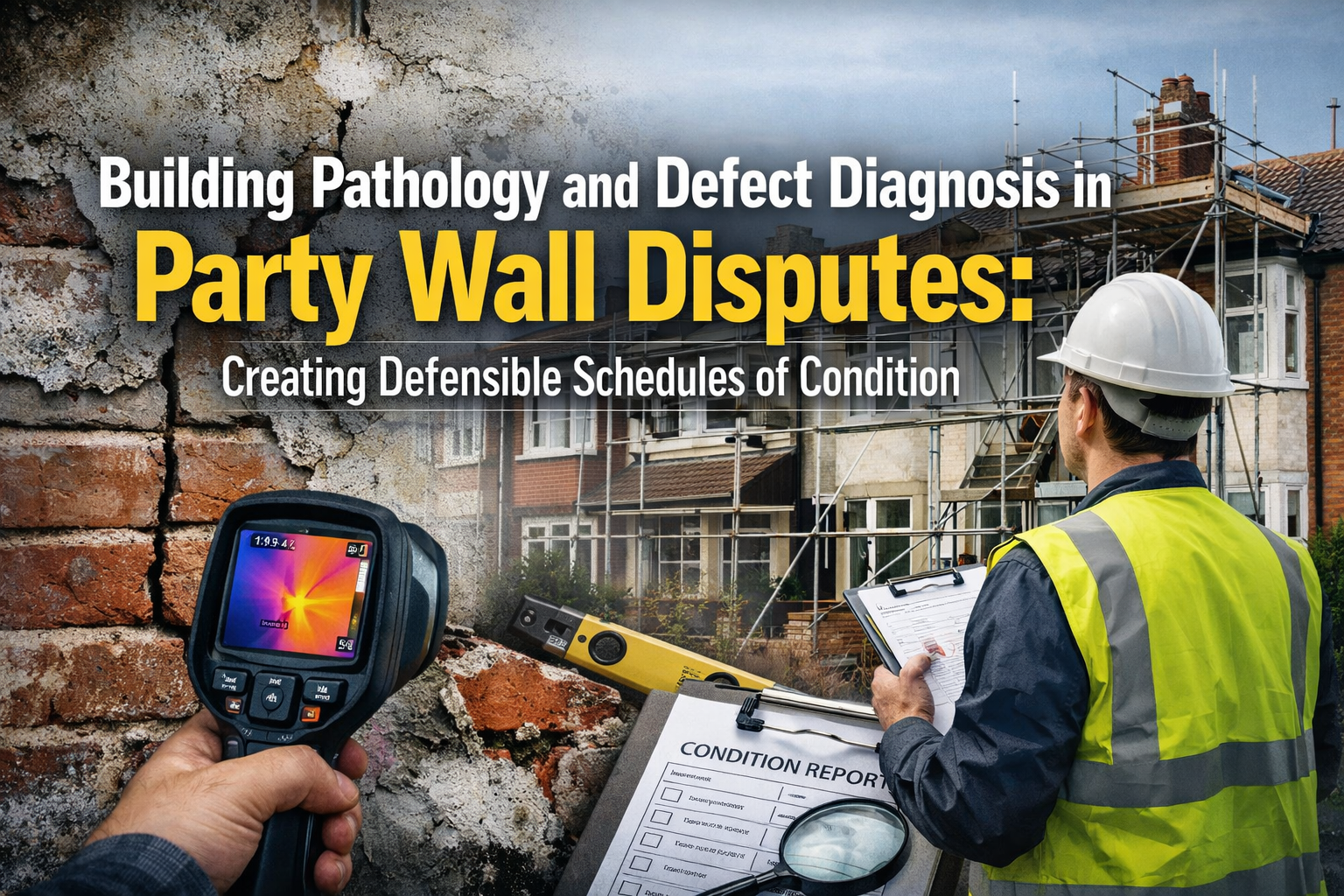
Nearly 70% of party wall disputes escalate due to disagreements over pre-existing versus new damage—a costly problem that proper building pathology expertise can prevent. When construction work begins on adjoining properties, the absence of robust defect documentation creates a breeding ground for spurious claims, protracted disputes, and expensive litigation. The solution lies in understanding how surveyors apply building pathology principles to create schedules of condition that withstand legal scrutiny.
Building Pathology and Defect Diagnosis in Party Wall Disputes: Creating Defensible Schedules of Condition represents a critical intersection of technical expertise, legal compliance, and forensic documentation. As construction activity continues to intensify across urban areas in 2026, the demand for accurate baseline assessments has never been more pressing. This comprehensive guide examines the protocols, methodologies, and best practices that transform basic property inspections into legally defensible evidence.
Key Takeaways
- Accurate defect diagnosis before construction begins prevents up to 70% of post-completion damage disputes
- Joint inspections with all parties present establish transparency and reduce conflicting claims
- Systematic photographic evidence with metadata creates an irrefutable timeline of property condition
- Building pathology expertise identifies subtle defects that non-specialists frequently overlook
- Standardized documentation protocols ensure schedules of condition meet legal admissibility requirements
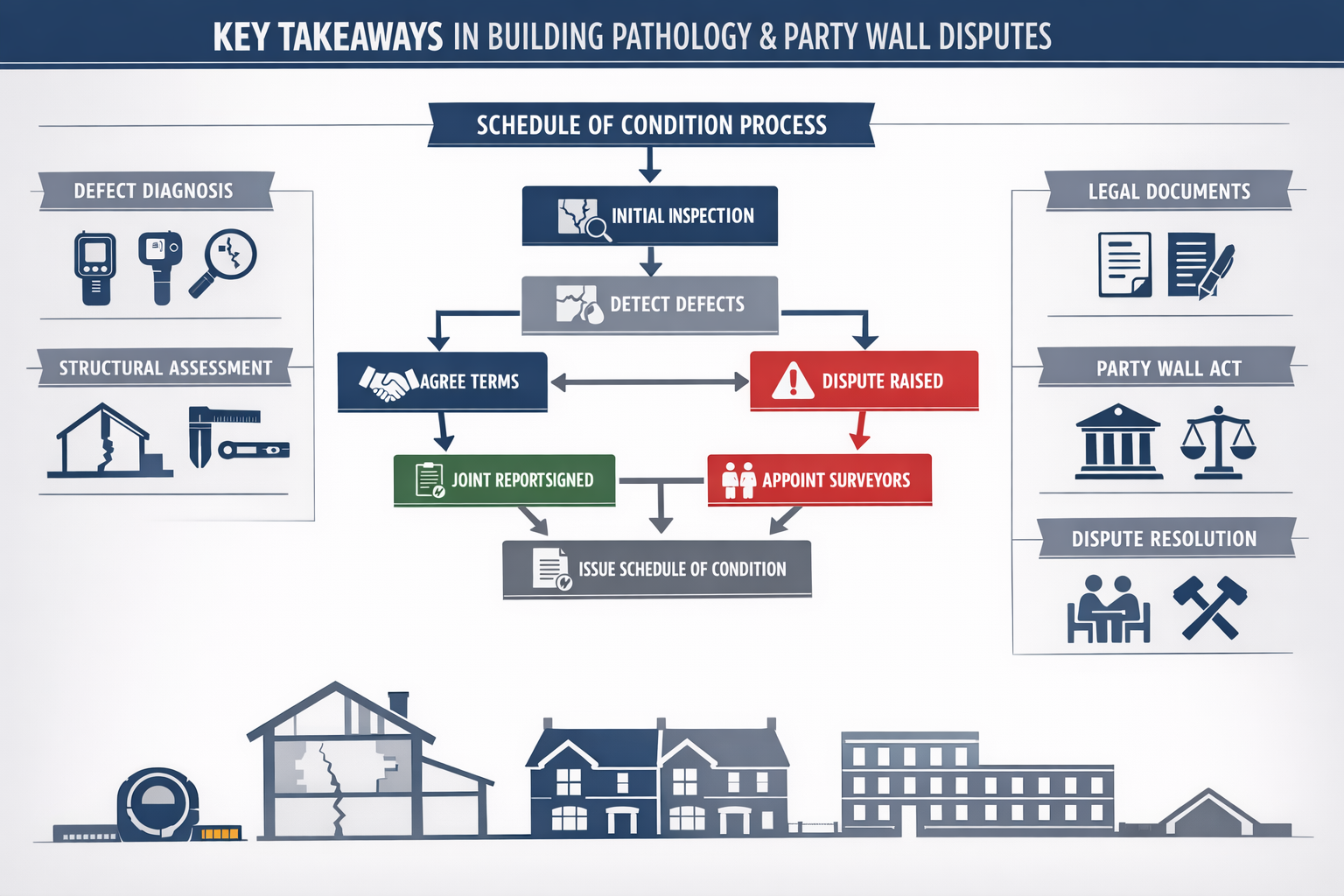
Understanding Building Pathology in Party Wall Contexts
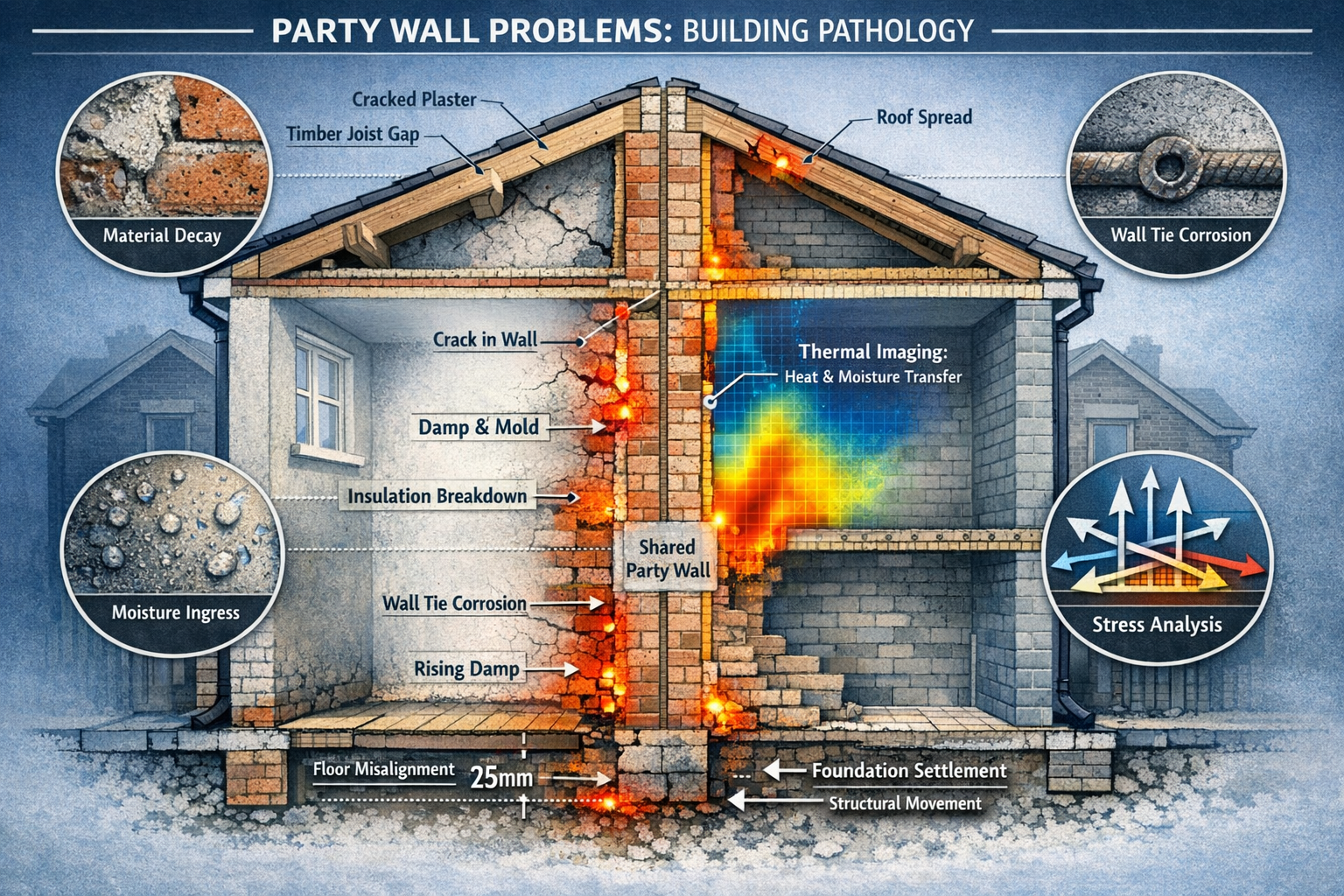
Building pathology forms the scientific foundation for accurate defect diagnosis in party wall scenarios. This specialized discipline examines the causes, processes, and effects of building defects, deterioration, and failure [1]. Unlike general property inspections, building pathology applies forensic-level analysis to distinguish between normal wear, pre-existing defects, and damage attributable to construction activities.
The Science Behind Defect Identification
Building pathologists employ systematic investigation techniques that go far beyond surface-level observations. They understand material behavior, structural mechanics, and environmental interactions that cause buildings to deteriorate over time [4]. This knowledge proves essential when examining party walls, where defects may result from:
- Historical settlement and ground movement
- Moisture ingress from failed damp-proof courses
- Thermal expansion and contraction cycles
- Previous alterations or repairs
- Natural aging of materials
The distinction between these pre-existing conditions and new damage caused by adjacent construction work requires specialized training. A qualified building pathologist can identify subtle indicators—such as weathering patterns on crack faces, paint layers within fissures, or vegetation growth in masonry joints—that reveal when defects originated [3].
Common Party Wall Defects Requiring Documentation
Party walls present unique pathological challenges due to their shared nature and exposure to stresses from both properties. Critical defects that must be documented before construction commences include:
| Defect Type | Visual Indicators | Pathological Significance |
|---|---|---|
| Structural Cracks | Width, orientation, pattern | Indicates foundation movement or settlement |
| Moisture Penetration | Staining, efflorescence, dampness | Suggests failed waterproofing or drainage issues |
| Material Deterioration | Spalling brickwork, mortar erosion | Shows age-related decay versus impact damage |
| Previous Repairs | Patching, repointing, reinforcement | Reveals historical problems and intervention attempts |
| Deflection/Bulging | Out-of-plumb walls, bowing | Indicates structural instability or load issues |
Understanding these pathological signatures enables surveyors to create comprehensive baseline records. For instance, when conducting loft conversions, additional loads on party walls may exacerbate existing weaknesses. Documenting these conditions beforehand protects all parties from unfounded claims.
Building Pathology and Defect Diagnosis in Party Wall Disputes: Methodologies for Accurate Assessment
The methodology employed during defect diagnosis directly impacts the defensibility of schedules of condition. In 2026, best practice combines traditional surveying techniques with modern technology to create comprehensive, irrefutable documentation.
Joint Inspection Protocols
Joint inspections represent the gold standard for creating defensible schedules of condition. This approach involves the building owner's surveyor, the adjoining owner's surveyor, and ideally representatives from both properties conducting a simultaneous inspection. The benefits include:
✅ Immediate consensus on existing conditions
✅ Reduced disputes through transparent observation
✅ Shared understanding of defect severity
✅ Multiple witness verification of findings
✅ Real-time discussion of ambiguous conditions
During joint inspections, surveyors should follow a systematic room-by-room approach, documenting every surface, structural element, and finish adjacent to or potentially affected by the proposed works. This includes areas covered by the 3-metre rule, where excavation work may impact neighboring foundations.
The inspection protocol should address:
- External elevations – All faces of party walls visible from outside
- Internal surfaces – Walls, ceilings, and floors in rooms adjoining the party wall
- Structural elements – Beams, lintels, chimneys, and load-bearing components
- Services – Pipes, cables, and installations that penetrate or attach to party walls
- Finishes – Plasterwork, decorations, and surface treatments
- Ancillary structures – Shared chimneys, flues, and foundations
Photographic Evidence Standards
Photography forms the cornerstone of defensible documentation, but not all photographic evidence carries equal weight. In 2026, courts and arbitrators expect digital images to meet stringent standards:
📸 Essential Photographic Requirements:
- High resolution (minimum 12 megapixels) for detail capture
- Embedded metadata including date, time, and GPS coordinates
- Scale references in every image (measuring tape or known dimensions)
- Multiple angles of each defect for spatial context
- Overview and detail shots showing defect location and close-up condition
- Consistent lighting to accurately represent colors and textures
- Unedited originals preserved with chain of custody documentation
Advanced practitioners now employ photogrammetry and 3D scanning technologies to create dimensional records of party walls. These techniques generate measurable digital models that can be revisited long after the initial inspection, providing irrefutable evidence of pre-construction conditions [7].
When documenting defects, surveyors should capture:
- Wide shots establishing room context and defect location
- Medium shots showing the defect in relation to surrounding features
- Close-ups revealing texture, material condition, and severity
- Measurement images with scale bars or dimensional annotations
This multi-level approach ensures that anyone reviewing the schedule of condition can understand both the location and nature of documented defects without visiting the property.
Creating Legally Defensible Schedules: Documentation Standards
A schedule of condition only achieves defensibility when it meets rigorous documentation standards. The difference between a basic property report and a legally robust schedule lies in the systematic approach to recording, organizing, and presenting evidence.
Structural Components of Defensible Schedules
Professional schedules of condition follow a standardized structure that ensures completeness and facilitates reference during disputes. The essential components include:
1. Executive Summary
- Property addresses and ownership details
- Date and time of inspection
- Weather conditions (affecting visibility and access)
- Parties present during inspection
- Scope and limitations of the assessment
2. Methodology Statement
- Standards and protocols followed (RICS guidance, etc.)
- Equipment and technology employed
- Areas inspected and areas inaccessible
- Classification system for defects
3. Room-by-Room Documentation
- Systematic progression through the property
- Numbered reference system for defects
- Cross-referenced photographs
- Dimensional information and locations
4. Defect Register
- Comprehensive list of all identified defects
- Severity classifications
- Probable causes (where determinable)
- Existing repairs or interventions noted
5. Photographic Appendix
- Organized by room or elevation
- Numbered to correspond with defect register
- Include metadata tables
- Scale references visible
6. Plans and Drawings
- Annotated floor plans showing defect locations
- Party wall elevations with marked defects
- Cross-sections where relevant
Classification and Description Standards
Consistency in describing defects prevents ambiguity that could undermine a schedule's defensibility. Building pathologists use standardized terminology that conveys precise information about defect characteristics [1].
Crack Classification Example:
- Hairline: Less than 0.1mm width, typically cosmetic
- Fine: 0.1-1mm width, may indicate minor movement
- Moderate: 1-5mm width, suggests structural movement requiring investigation
- Wide: 5-15mm width, significant structural concern
- Severe: Greater than 15mm width, major structural failure
Similarly, moisture-related defects require specific descriptors:
- Surface condensation – temporary moisture on cold surfaces
- Penetrating dampness – moisture ingress through building fabric
- Rising dampness – capillary action from ground moisture
- Hygroscopic dampness – moisture absorption from atmospheric humidity
This precision ensures that when damage to property is alleged post-construction, the schedule provides unambiguous baseline information for comparison.
Chain of Custody and Evidence Preservation
For schedules of condition to withstand legal challenge, the evidence must maintain an unbroken chain of custody from collection through presentation. This concept, borrowed from forensic science, ensures that documentation cannot be questioned on grounds of tampering or alteration.
🔒 Chain of Custody Best Practices:
- Immediate backup of digital photographs to multiple secure locations
- Write-protected storage preventing file modification
- Hash verification to prove files remain unchanged
- Timestamped logs of all file access and transfers
- Secure storage with access controls and audit trails
- Professional archiving for long-term preservation
When disputes arise years after construction completion, this rigorous approach to evidence management proves invaluable. Courts and arbitrators place greater weight on documentation that demonstrably hasn't been altered since the original inspection date.
Building Pathology and Defect Diagnosis in Party Wall Disputes: Preventing Spurious Claims
The ultimate purpose of applying building pathology expertise to schedules of condition is preventing spurious damage claims. Understanding how these claims emerge—and how proper documentation defeats them—protects all parties from costly, time-consuming disputes.
Common Sources of Spurious Claims
Spurious claims typically arise from several predictable scenarios:
1. Pre-Existing Defects Attributed to New Works
The most common spurious claim involves damage that existed before construction but wasn't properly documented. Without a comprehensive schedule of condition, adjoining owners may genuinely believe (or claim) that cracks, staining, or other defects resulted from the building work.
2. Natural Deterioration Misattributed to Construction
Buildings continuously deteriorate through natural processes. Paint yellows, plaster develops hairline cracks, and materials weather. When these changes coincide with adjacent construction, causation becomes disputed without baseline documentation.
3. Unrelated Third-Party Damage
Damage from other sources—severe weather, ground movement, or work by utility companies—may occur during construction periods. Comprehensive schedules of condition establish that such damage didn't exist when construction commenced.
4. Exaggerated Severity Claims
Minor pre-existing defects may worsen during construction. Without precise documentation of the original condition, adjoining owners may exaggerate the severity of pre-existing problems to maximize compensation claims.
How Pathological Evidence Defeats Unfounded Claims
Building pathology expertise transforms schedules of condition from simple property descriptions into powerful defensive tools. When spurious claims emerge, pathological analysis of the documented evidence typically reveals:
Temporal Indicators:
- Weathering patterns inconsistent with recent damage
- Paint layers or debris within cracks indicating age
- Biological growth (algae, moss) requiring extended time periods
- Rust staining or material oxidation from long-term exposure
Mechanical Indicators:
- Crack patterns inconsistent with alleged construction impacts
- Defect locations incompatible with vibration or settlement from works
- Material failure modes indicating different causation mechanisms
- Structural behavior inconsistent with construction-related stress
Environmental Indicators:
- Moisture patterns predating construction activities
- Staining chemistry indicating long-term exposure
- Material degradation requiring extended timeframes
- Thermal or freeze-thaw damage from seasonal cycles
This forensic approach, combined with comprehensive photographic evidence, creates a powerful defense against unfounded claims. When presented with irrefutable documentation of pre-existing conditions, most spurious claims collapse before reaching formal dispute resolution.

Integration with Party Wall Procedures
Building pathology expertise doesn't operate in isolation—it must integrate seamlessly with established party wall procedures to maximize effectiveness. Understanding this integration ensures schedules of condition fulfill their protective function within the broader party wall framework.
Timing Within the Party Wall Process
The schedule of condition should be prepared at a specific point in the party wall process to maximize its effectiveness:
Optimal Timing:
- After party wall notice served – Establishes the formal relationship
- After surveyors appointed – Ensures professional oversight
- Before construction commences – Captures true baseline conditions
- After access agreed – Permits comprehensive inspection
Preparing the schedule too early (before formal notices) may result in conditions changing before work begins. Preparing it too late (after construction starts) defeats its purpose. The ideal window occurs after party wall awards are prepared but before any physical work commences.
Incorporation into Party Wall Awards
Schedules of condition should be formally incorporated into party wall awards as appendices. This integration provides:
- Legal recognition of the documented baseline
- Binding acceptance by all parties
- Reference framework for post-completion inspections
- Dispute resolution foundation if claims arise
The party wall award should explicitly reference the schedule of condition and establish protocols for post-completion verification inspections. This might include provisions for:
- Joint post-completion inspection within specified timeframes
- Comparison methodology between baseline and post-work conditions
- Procedures for identifying and addressing new damage
- Dispute resolution mechanisms if parties disagree on causation
Addressing Non-Compliance Situations
Unfortunately, not all party wall situations proceed smoothly. When no party wall notice is served or procedures aren't followed correctly, schedules of condition become even more critical.
In non-compliant situations, adjoining owners should consider:
- Commissioning independent schedules of condition immediately upon discovering unauthorized works
- Serving formal notices requiring cessation until proper procedures followed
- Documenting ongoing conditions throughout unauthorized construction periods
- Preserving evidence of any damage occurring during non-compliant works
The cost of party wall procedures, including comprehensive schedules of condition, represents a small fraction of the potential costs of unresolved disputes. Investment in proper documentation invariably proves cost-effective when compared to litigation expenses.
Advanced Considerations and Emerging Technologies
The field of building pathology and defect diagnosis continues to evolve, with emerging technologies and methodologies enhancing the defensibility and comprehensiveness of schedules of condition in 2026.
Digital Documentation Technologies
Modern surveyors increasingly employ advanced technologies that supplement traditional inspection methods:
Thermal Imaging:
Infrared cameras reveal hidden moisture, insulation defects, and thermal bridges invisible to conventional photography. These images provide additional evidence of pre-existing building performance issues.
Moisture Meters:
Non-invasive moisture detection equipment quantifies dampness levels, creating objective baseline measurements that can be compared post-construction.
3D Laser Scanning:
LiDAR technology creates dimensionally accurate point clouds of entire properties, capturing every surface detail. These scans enable virtual revisitation of properties and precise measurement of any subsequent changes.
Drone Surveys:
Unmanned aerial vehicles safely document roof conditions, tall elevations, and inaccessible areas, ensuring comprehensive coverage without safety risks.
Digital Annotation Tools:
Tablet-based applications allow real-time annotation of photographs, floor plans, and elevations during inspections, streamlining documentation and reducing transcription errors.
Specialist Pathology Investigations
Complex party wall scenarios may require specialist pathology investigations beyond standard schedules of condition. These include:
Structural Analysis:
When significant structural concerns exist, structural engineers may conduct detailed analysis of load paths, structural adequacy, and potential vulnerability to construction impacts.
Materials Testing:
Laboratory analysis of mortar, brick, timber, or other materials can determine age, composition, and deterioration state, providing objective evidence of pre-existing conditions.
Subsidence Monitoring:
Installation of crack monitoring gauges or precise leveling surveys establishes whether movement is ongoing or historical, distinguishing active problems from stabilized historic settlement.
For properties requiring specific defect reports or building surveys, these specialist investigations may be incorporated into comprehensive schedules of condition.
Cross-Disciplinary Collaboration
The most effective building pathology assessments in party wall contexts often involve collaboration between multiple specialists:
- Chartered Building Surveyors – Overall coordination and general building assessment
- Structural Engineers – Analysis of structural elements and stability
- Geotechnical Engineers – Ground conditions and foundation assessment
- Damp Specialists – Detailed moisture investigation and diagnosis
- Materials Scientists – Laboratory testing and analysis
This collaborative approach ensures that schedules of condition benefit from comprehensive expertise across all relevant disciplines. When selecting professionals, property owners should prioritize RICS Chartered Building Surveyors with demonstrable building pathology expertise.
Case Studies: When Schedules of Condition Prevented Disputes
Real-world examples illustrate the protective value of properly prepared schedules of condition:
Case Study 1: Victorian Terrace Basement Excavation
Scenario: Building owner planned basement excavation beneath a Victorian terrace, triggering party wall procedures with adjoining properties.
Challenge: Neighboring properties exhibited extensive pre-existing cracking, settlement, and historic repairs. Without documentation, the building owner faced potential liability for all visible defects.
Solution: Comprehensive schedule of condition documented:
- 47 separate pre-existing cracks with width measurements
- Historic underpinning visible in exposed foundations
- Previous repairs to party walls with different mortar compositions
- Existing dampness in basement areas
Outcome: Post-completion inspection revealed two new hairline cracks attributable to construction vibration. Because the schedule comprehensively documented pre-existing conditions, the building owner's liability was limited to these specific new defects, saving approximately £35,000 in spurious claim costs.
Case Study 2: Loft Conversion with Shared Chimney
Scenario: Loft conversion involving alterations to a shared chimney structure.
Challenge: The chimney exhibited significant weathering, loose masonry, and historic repairs. Adjoining owner expressed concerns about potential damage from the works.
Solution: Joint inspection with both surveyors and property owners documented:
- Photogrammetric survey of entire chimney structure
- Detailed photography of every loose brick and mortar defect
- Thermal imaging revealing moisture penetration patterns
- Structural assessment of chimney stability
Outcome: During construction, severe weather caused additional weathering to exposed masonry. The schedule of condition clearly demonstrated that the deterioration pattern matched pre-existing conditions rather than construction impacts. The joint inspection approach meant the adjoining owner accepted the findings without dispute.
Professional Standards and Regulatory Framework
Building pathology assessments for party wall schedules of condition must comply with professional standards and regulatory requirements to ensure defensibility.
RICS Guidance and Standards
The Royal Institution of Chartered Surveyors (RICS) provides authoritative guidance on party wall procedures and schedules of condition. Surveyors should ensure their methodologies align with:
- RICS Guidance Note on Party Wall Legislation
- RICS Building Surveys Standards
- RICS Professional Standards and Practice
Compliance with RICS standards provides professional credibility and demonstrates adherence to recognized best practices. When disputes reach formal resolution, RICS-compliant documentation carries significant weight [8].
Legal Admissibility Requirements
For schedules of condition to serve as evidence in legal proceedings, they must meet admissibility standards:
✓ Relevance: Documentation must relate directly to the disputed issues
✓ Authenticity: Evidence must be genuine and unaltered
✓ Reliability: Methods must be scientifically sound and professionally executed
✓ Completeness: Documentation must comprehensively cover relevant areas
✓ Timeliness: Records must be contemporaneous with the inspection
Surveyors should maintain awareness of evolving legal standards for digital evidence, particularly regarding metadata preservation and chain of custody for electronic files.
Insurance and Liability Considerations
Professional indemnity insurance considerations affect how surveyors approach schedules of condition:
- Scope limitations should be clearly stated to manage liability exposure
- Professional disclaimers regarding areas not inspected or inaccessible
- Competency boundaries ensuring work remains within surveyor expertise
- Record retention policies maintaining documentation for potential claims
Building owners and adjoining owners should verify that appointed surveyors maintain adequate professional indemnity insurance covering party wall work and building pathology assessments.
Practical Implementation: Step-by-Step Process
For property owners and surveyors preparing to create defensible schedules of condition, this practical implementation guide provides a systematic approach:
Pre-Inspection Preparation
Step 1: Scope Definition
- Identify all areas potentially affected by proposed works
- Determine inspection extent based on work nature and proximity
- Establish access requirements and coordinate with all parties
- Review any existing documentation or previous surveys
Step 2: Equipment and Technology Selection
- High-resolution camera with GPS and metadata capabilities
- Moisture detection equipment
- Laser measuring devices
- Adequate lighting equipment
- Scale references and measuring tapes
- Tablet or laptop for field notes and annotations
Step 3: Coordination and Scheduling
- Arrange joint inspection with all relevant parties
- Confirm access permissions and key arrangements
- Schedule sufficient time for thorough documentation
- Plan inspection route and systematic approach
During the Inspection
Step 4: Systematic Documentation
- Follow room-by-room progression
- Document every surface adjacent to or potentially affected by works
- Take overview, medium, and close-up photographs of all defects
- Record measurements and dimensional information
- Note environmental conditions (temperature, humidity, weather)
- Invite observations and comments from all parties present
Step 5: Real-Time Recording
- Create field notes contemporaneously
- Number and reference all photographs systematically
- Mark defect locations on floor plans
- Record any disagreements or differing interpretations
- Obtain signatures from attending parties confirming inspection occurred
Post-Inspection Processing
Step 6: Documentation Assembly
- Organize photographs by location and defect
- Verify metadata integrity on all digital files
- Create backup copies with write protection
- Prepare annotated floor plans and elevations
- Compile defect register with cross-references
Step 7: Report Preparation
- Write comprehensive narrative descriptions
- Prepare photographic appendices with captions
- Create executive summary and methodology statement
- Include all required components for defensibility
- Professional formatting and presentation
Step 8: Distribution and Incorporation
- Provide copies to all relevant parties
- Incorporate into party wall award as appendix
- Establish agreement on documented conditions
- Secure acknowledgment signatures
- Archive master copies securely
Conclusion
Building Pathology and Defect Diagnosis in Party Wall Disputes: Creating Defensible Schedules of Condition represents far more than administrative box-ticking—it provides essential protection against costly, time-consuming disputes that can derail construction projects and damage neighbor relationships. The systematic application of building pathology expertise transforms basic property inspections into forensic-quality documentation that withstands legal scrutiny and prevents spurious claims.
The key to success lies in understanding that schedules of condition serve multiple purposes simultaneously: they establish irrefutable baseline records, create transparency between parties, demonstrate professional diligence, and provide dispute resolution frameworks. When prepared by qualified professionals using systematic methodologies and modern technologies, these documents prove invaluable in distinguishing pre-existing conditions from construction-related damage.
Actionable Next Steps
For property owners planning construction work affecting party walls:
- Engage qualified professionals early – Appoint RICS Chartered Building Surveyors with demonstrable building pathology expertise
- Insist on joint inspections – Ensure all parties participate in baseline documentation
- Invest in comprehensive documentation – The cost of thorough schedules of condition is minimal compared to dispute resolution expenses
- Integrate with party wall procedures – Ensure schedules are formally incorporated into party wall awards
- Maintain evidence integrity – Establish secure archiving and chain of custody protocols
For adjoining owners concerned about neighboring construction:
- Exercise party wall rights promptly – Respond to notices and appoint qualified surveyors
- Participate in joint inspections – Your presence ensures transparency and accuracy
- Review documentation thoroughly – Ensure the schedule comprehensively covers your property
- Understand your protections – Familiarize yourself with party wall FAQs and your rights
- Preserve the schedule – Maintain secure copies for future reference
The investment in professional building pathology expertise and defensible schedules of condition invariably proves cost-effective when compared to the alternative: protracted disputes, legal fees, expert witness costs, and damaged relationships. As construction activity continues to intensify in 2026, the importance of this protective documentation will only grow.
By following the protocols, methodologies, and best practices outlined in this guide, property owners and surveyors can create schedules of condition that fulfill their essential protective function—preventing spurious claims, establishing clear baselines, and ensuring that when legitimate damage occurs, it can be identified, attributed, and remedied fairly and efficiently.
References
[1] Building Pathology – https://earlkendrick.com/building-pathology/
[3] Pathology Defect Diagnosis – https://peritussurveying.com/professional-services/pathology-defect-diagnosis/
[4] Building Pathology Identifying And Solving Building Defects – https://www.parkerbrent.com.au/blog/building-pathology-identifying-and-solving-building-defects/
[7] Building Pathology – https://andrews-eades.co.uk/surveying-services/building-pathology/
[8] Building Expert Publishes Latest Edition Industry Leading Book – https://www.socotec.co.uk/media/news/building-expert-publishes-latest-edition-industry-leading-book