
Property disputes involving expert witness valuations cost UK litigants over £200 million annually, yet nearly 40% of these cases involve challenges to the expert's impartiality or methodology. As courts tighten scrutiny under Civil Procedure Rules (CPR) Part 35, the margin for error has never been smaller. Expert Witness Valuations in Property Disputes: Building Credible Evidence Under CPR Part 35 in 2026 requires surveyors to navigate increasingly complex regulatory frameworks while maintaining absolute independence from the parties who instruct them.
The role of the expert witness in property litigation has evolved dramatically. No longer simply technical advisors, RICS chartered surveyors acting as experts must balance professional valuation standards with legal obligations that prioritize the court's needs above client interests. This fundamental shift demands a sophisticated understanding of both valuation methodology and procedural compliance.

Key Takeaways
- CPR Part 35 mandates absolute impartiality: Expert witnesses owe their primary duty to the court, not to instructing parties, with specific declaration requirements
- RICS Red Book compliance remains essential: All expert valuations must adhere to current RICS Valuation Global Standards while meeting legal evidence standards
- Conflicting valuations require methodological transparency: Courts expect experts to explain differences in approach, assumptions, and comparable evidence clearly
- Documentation and audit trails prove credibility: Comprehensive working papers, site visit records, and research documentation strengthen expert testimony
- Pre-action protocols increasingly require joint expert appointments: Early collaboration between opposing experts can reduce litigation costs and streamline dispute resolution
Understanding CPR Part 35 Requirements for Expert Witness Valuations in Property Disputes
The Civil Procedure Rules Part 35 establishes the framework governing expert evidence in civil litigation across England and Wales. For property valuers, these rules create specific obligations that extend far beyond standard professional practice. The fundamental principle states that experts have an overriding duty to help the court on matters within their expertise, regardless of who pays their fees.
The Expert's Overriding Duty to the Court
Every expert witness must understand that their loyalty lies with the court, not with the solicitor or client who instructs them. This duty manifests in several practical requirements:
- Complete independence from the litigation outcome
- Objective analysis of all available evidence, including facts that may undermine the instructing party's position
- Transparent methodology that can withstand cross-examination
- Willingness to modify opinions when presented with new evidence
The Practice Direction 35 accompanying CPR Part 35 requires experts to include a declaration in every report confirming they understand this duty and have complied with it. This isn't mere formality—courts have excluded expert evidence when witnesses demonstrate bias or advocacy for their instructing party.
Essential Components of CPR Part 35 Compliant Reports
A compliant expert witness report in property valuation disputes must contain specific elements mandated by the rules. Missing any component can result in the court refusing to admit the evidence or reducing the weight given to expert testimony.
Required Report Elements:
✅ Statement of Truth: Declaration that the expert understands and has complied with their duty to the court
✅ Qualifications and Experience: Detailed CV demonstrating relevant expertise in the specific property type and valuation context
✅ Instructions Summary: Clear statement of questions posed and documents reviewed
✅ Factual Basis: Distinction between facts, assumptions, and opinions
✅ Methodology Explanation: Detailed description of valuation approach and why it was selected
✅ Range of Opinion: Acknowledgment of uncertainty and alternative viewpoints
✅ Summary of Conclusions: Clear, concise answers to the questions posed
For RICS valuation surveyors, this means integrating Red Book requirements with legal procedural standards. The valuation must be defensible both as a professional opinion and as admissible court evidence.
Common Pitfalls That Undermine Expert Credibility
Courts in 2026 have become increasingly sophisticated in identifying expert witnesses who cross the line from objective advisor to partisan advocate. Several behaviors consistently damage credibility:
🚫 Cherry-picking comparables that support only one party's position
🚫 Failing to disclose contrary evidence discovered during research
🚫 Overstating certainty in areas involving professional judgment
🚫 Adopting instructions verbatim without independent analysis
🚫 Inadequate site inspection or reliance solely on desktop research
The consequences extend beyond individual cases. Surveyors who repeatedly fail to meet CPR Part 35 standards may face professional sanctions from RICS and find themselves excluded from expert witness panels maintained by major law firms.
Building Credible Evidence: RICS Protocols for Expert Witness Valuations in Property Disputes
The intersection of RICS professional standards and legal requirements creates a rigorous framework for expert witness work in 2026. Surveyors must demonstrate not only technical competence but also procedural compliance that satisfies both professional regulators and judicial scrutiny.
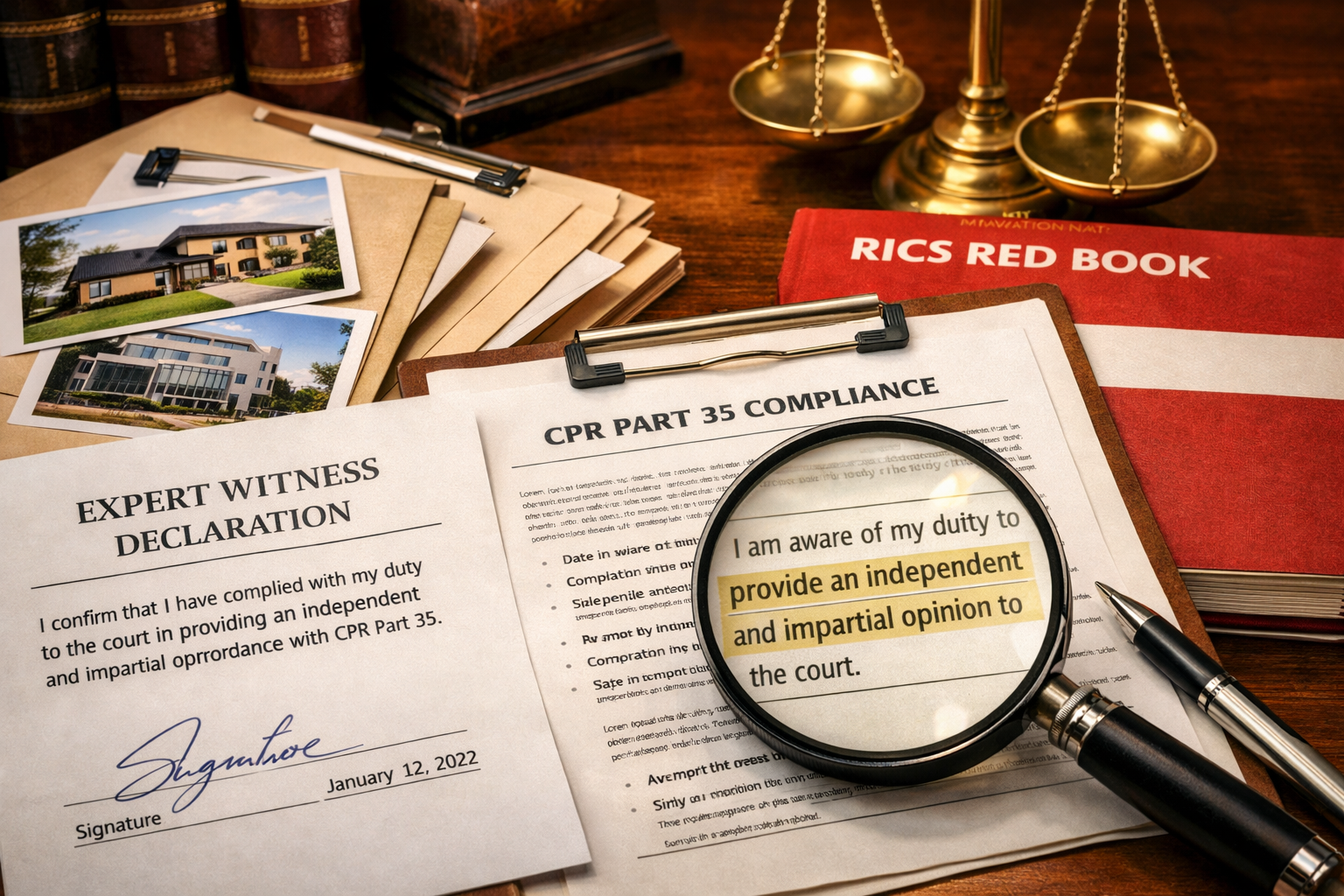
RICS Red Book and Expert Witness Standards Integration
The RICS Valuation – Global Standards (Red Book) provides the professional foundation for all expert witness valuations. However, litigation work requires additional layers of rigor beyond standard commercial practice.
Key Integration Points:
| Red Book Requirement | Expert Witness Enhancement |
|---|---|
| Terms of Engagement | Must reference CPR Part 35 duties explicitly |
| Basis of Value | Requires detailed justification for approach selected |
| Valuation Approach | Must explain why alternatives were rejected |
| Assumptions & Special Assumptions | Each must be clearly identified and impact quantified |
| Comparable Evidence | Complete disclosure including rejected comparables |
| Uncertainty and Limitations | Explicit discussion of confidence levels |
When preparing matrimonial valuations or other dispute-related work, the surveyor must anticipate cross-examination on every assumption and conclusion. This demands documentation standards that exceed typical commercial practice.
Establishing Independence and Impartiality
Demonstrating independence begins before accepting instructions. Expert witnesses should implement clear protocols to avoid conflicts of interest and maintain objectivity throughout the engagement.
Pre-Instruction Conflict Checks:
- Previous work for either party within the last five years
- Personal or business relationships with parties or their representatives
- Financial interests in the outcome of the litigation
- Previous expert witness work on related properties or issues
Once instructed, maintaining impartiality requires conscious effort. Experts should avoid:
- Ex parte communications with instructing solicitors about opinions (as opposed to factual matters)
- Advocacy language in reports or testimony
- Selective research that only seeks supporting evidence
- Pressure to modify conclusions based on litigation strategy
For party wall disputes involving damage claims, maintaining independence proves particularly challenging when one party has engaged the surveyor for previous work. Clear disclosure and careful boundary-setting become essential.
Site Inspection and Evidence Gathering Best Practices
The credibility of any property valuation rests on thorough investigation. Expert witnesses must document their site work with litigation requirements in mind.
Comprehensive Site Visit Protocol:
📸 Photographic Evidence: Extensive photographs with metadata showing date, time, and location
📏 Measurements: Independent verification of floor areas and dimensions
📝 Condition Assessment: Detailed notes on defects, repairs, and maintenance standards
🗺️ Location Analysis: Documentation of accessibility, amenities, and neighborhood characteristics
👥 Witness Interviews: When appropriate, contemporaneous notes from conversations with occupiers or neighbors
The site inspection report should be sufficiently detailed that another expert could understand the property's characteristics without visiting. This level of documentation proves invaluable when cross-examination occurs months or years after the initial inspection.
For complex cases involving damage to property, photographic evidence with clear dating becomes crucial for establishing causation timelines.
Navigating Conflicting Valuations in Expert Witness Property Disputes Under CPR Part 35
Perhaps the most challenging aspect of expert witness work involves addressing significant valuation differences between opposing experts. Courts expect professionals to narrow disagreements through reasoned discussion while maintaining independent judgment.
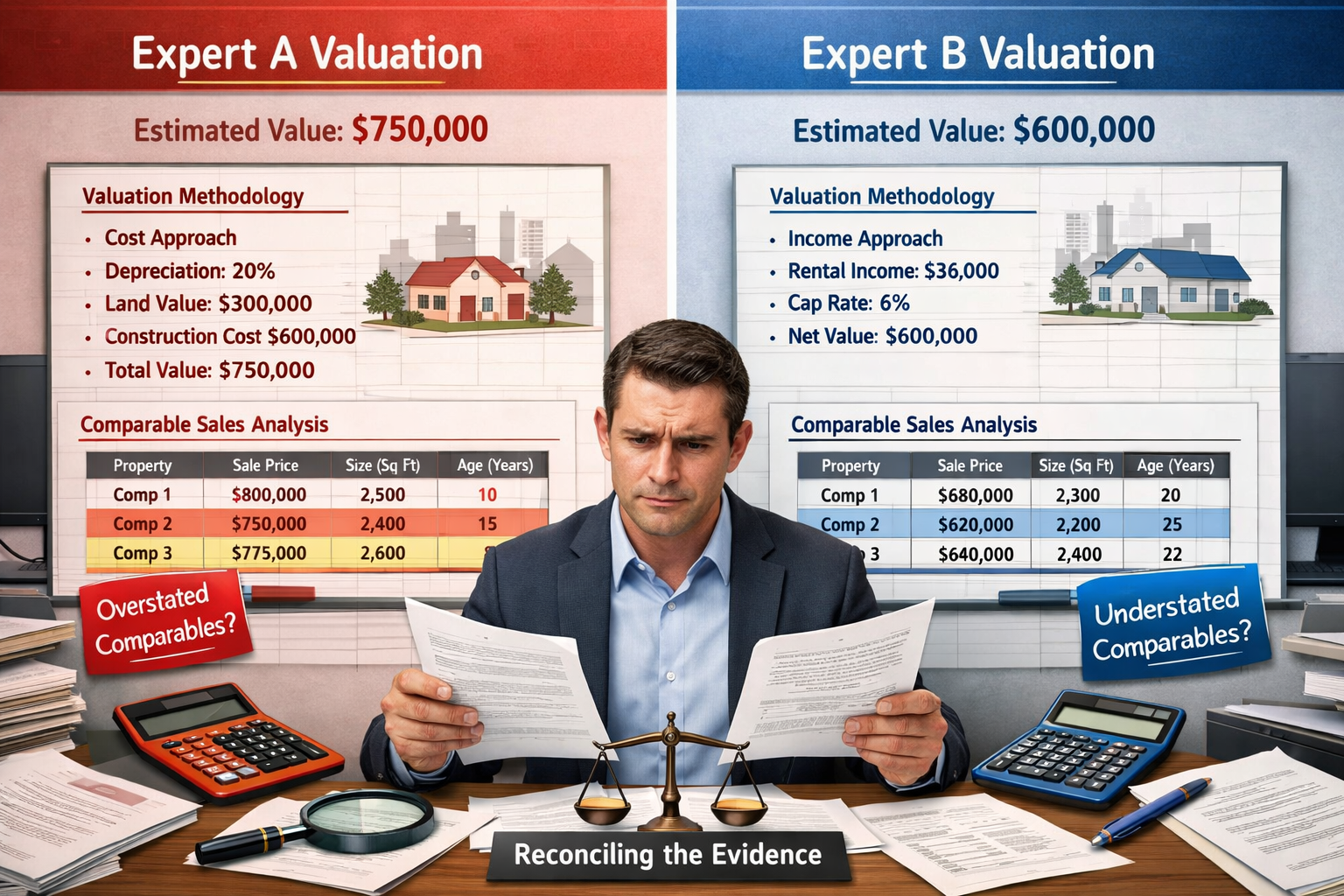
Understanding Why Valuations Differ
Valuation is not an exact science. Even highly competent experts applying appropriate methodology can reach different conclusions. Understanding the legitimate sources of variation helps experts explain differences constructively.
Common Sources of Valuation Divergence:
- Comparable Selection: Different properties chosen as market evidence
- Adjustment Methodology: Varying approaches to adjusting comparable sales for differences
- Market Interpretation: Different views on market trends and buyer motivation
- Condition Assessment: Disagreement on extent or impact of defects
- Assumptions: Different special assumptions about planning, tenure, or other factors
When preparing capital gains tax valuations or other retrospective work, experts often face additional challenges due to limited comparable evidence from the relevant valuation date.
The Without Prejudice Discussion Process
CPR Part 35 encourages experts to meet and discuss their evidence without prejudice to identify areas of agreement and disagreement. These discussions, typically held after exchange of expert reports, serve to streamline trial proceedings.
Effective Expert Discussion Protocol:
✅ Prepare thoroughly: Review opposing expert's report with detailed notes on methodology differences
✅ Focus on technical issues: Avoid discussing legal strategy or client positions
✅ Document agreements: Clearly record points of consensus in joint statement
✅ Explain disagreements: Articulate the technical basis for remaining differences
✅ Quantify impacts: Show how different assumptions affect final valuation conclusions
✅ Remain respectful: Professional courtesy maintains credibility with courts
The joint statement produced from these discussions becomes a key court document. It should clearly identify:
- Agreed facts about the property and market
- Agreed methodology where experts concur on approach
- Remaining disagreements with each expert's position and reasoning
- Impact quantification showing how differences affect valuation conclusions
Presenting Technical Disagreements to Non-Technical Audiences
Judges and juries rarely possess specialized property valuation knowledge. Expert witnesses must translate complex technical disagreements into accessible explanations without oversimplifying.
Effective Communication Strategies:
🎯 Use Visual Aids: Maps showing comparable locations, photographs highlighting condition differences, charts illustrating adjustment calculations
🎯 Analogies and Examples: Relate valuation concepts to everyday experiences
🎯 Step-by-Step Logic: Break complex methodology into clear sequential steps
🎯 Acknowledge Uncertainty: Explain confidence levels and ranges rather than false precision
🎯 Define Technical Terms: Never assume understanding of specialized vocabulary
When testifying about reinstatement cost valuations or other specialized work, experts should prepare glossaries and visual materials that help courts understand technical distinctions.
Case Study: Matrimonial Property Dispute Resolution
Consider a typical 2026 matrimonial dispute involving a substantial residential property. Wife's expert values the property at £2.8 million; husband's expert concludes £2.3 million—a £500,000 difference representing nearly 18% of the lower valuation.
Analysis of the Disagreement:
The experts meet and identify the key differences:
- Comparable selection: Wife's expert used three sales from premium streets; husband's expert included properties from adjacent, less prestigious roads
- Condition adjustment: Wife's expert applied minimal deduction for dated kitchen; husband's expert deducted £150,000 for comprehensive refurbishment needs
- Market timing: Valuations prepared six months apart during a softening market
Through discussion, experts agree:
✅ Property requires kitchen and bathroom updating (cost £75,000-£100,000)
✅ Market has declined approximately 3% between valuation dates
✅ Location is superior to some comparables used by husband's expert
Remaining disagreement: Whether refurbishment cost should be deducted pound-for-pound from value or discounted to reflect buyer behavior in this market segment.
This focused disagreement allows the court to make an informed decision on the specific technical issue rather than choosing between two vastly different overall conclusions.
Documentation and Working Papers: Supporting Expert Witness Valuations in Property Disputes
The credibility of expert witness valuations under CPR Part 35 in 2026 depends heavily on comprehensive documentation. Courts increasingly require disclosure of working papers, and experts must maintain records that withstand detailed scrutiny.
Creating Comprehensive Valuation Working Files
Every expert witness file should contain sufficient documentation for another competent professional to understand the valuation process and verify conclusions.
Essential Working File Components:
📁 Instructions and Correspondence: Complete record of questions posed and information provided
📁 Site Visit Records: Detailed notes, photographs, measurements, and observations
📁 Research Documentation: Comparable evidence with sources, rejected comparables with reasons, market data
📁 Calculation Sheets: All mathematical workings showing how conclusions were reached
📁 Draft Reports: Versions showing evolution of opinion (with clear notation if opinions changed)
📁 Peer Review Records: Any internal quality control or second opinion processes
📁 Reference Materials: Market reports, planning documents, title information, surveys
For RICS Red Book valuations used in litigation, the working papers must demonstrate compliance with both professional standards and legal requirements.
Disclosure Obligations and Privilege Considerations
Expert witnesses face different disclosure rules than other litigation participants. While solicitor-client communications typically enjoy privilege, expert-client communications do not.
Key Disclosure Principles:
⚖️ Expert reports are disclosable once served on opposing parties
⚖️ Working papers may be requested by opposing counsel or ordered by the court
⚖️ Draft reports can be disclosable if they show opinion changes
⚖️ Instructions to experts are disclosable unless they contain legal advice
⚖️ Without prejudice discussions between experts remain privileged
This disclosure environment demands careful documentation practices. Experts should:
- Avoid advocacy language in working notes
- Document all research, including contrary evidence
- Clearly separate factual information from opinion
- Maintain professional tone in all communications
- Never delete or destroy working papers
Maintaining Audit Trails for Complex Valuations
Complex property disputes often involve multiple valuation dates, scenarios, or assumptions. Maintaining clear audit trails prevents confusion and demonstrates thoroughness.
Effective Audit Trail Practices:
🔍 Version Control: Clear labeling of all document versions with dates
🔍 Assumption Tracking: Separate calculations for each scenario or special assumption
🔍 Source Attribution: Every fact or figure linked to its source
🔍 Decision Documentation: Notes explaining why particular approaches were selected
🔍 Calculation Verification: Independent checks of all mathematical workings
For commercial building surveys forming the basis of dilapidations claims or other disputes, the audit trail must connect site observations to valuation impacts clearly.
Specialized Contexts: Expert Witness Valuations Across Different Property Dispute Types
Different types of property disputes present unique challenges for expert witnesses. Understanding context-specific requirements ensures appropriate methodology and compliance with relevant legal frameworks.
Matrimonial and Family Law Valuations
Matrimonial property valuations require particular sensitivity to timing and assumptions. Courts typically require "open market value" assuming a willing seller, but the reality of forced sale may affect achievable prices.
Matrimonial Valuation Considerations:
- Valuation date precision: Often the date of separation or petition filing
- Forced sale discounts: Whether to reflect urgency in marketing assumptions
- Shared ownership complications: Valuing one party's interest in jointly held property
- Emotional attachments: Explaining why personal value differs from market value
Expert witnesses must navigate emotional dynamics while maintaining objectivity. Clear communication about the difference between market value and settlement negotiations proves essential.
Tax-Related Property Disputes
Tax valuations involve retrospective work with specific statutory definitions of value. Whether for capital gains tax, inheritance tax, or Annual Tax on Enveloped Dwellings (ATED), experts must understand the relevant tax legislation.
Tax Valuation Challenges:
- Historical market reconstruction: Limited comparable evidence from past valuation dates
- Statutory definitions: Applying specific legal definitions of value rather than Red Book bases
- Hypothetical scenarios: Valuing properties in assumed states (e.g., without subsequent improvements)
- HMRC scrutiny: Valuations subject to challenge by tax authorities with their own experts
For ATED valuations, experts must understand the specific valuation date requirements and the self-assessment framework that governs these tax calculations.
Commercial Lease and Dilapidations Disputes
Commercial property disputes often involve technical issues around lease obligations, repair standards, and diminution in value. Expert witnesses must understand both property valuation and lease interpretation.
Commercial Dispute Expertise Requirements:
- Schedule of dilapidations analysis: Assessing repair costs and diminution valuations
- Lease interpretation: Understanding repairing obligations and service charge provisions
- Landlord and tenant law: Knowledge of statutory frameworks affecting valuations
- Commercial market dynamics: Understanding investor and occupier perspectives
Dilapidations surveys form the basis for many commercial property disputes, requiring experts to quantify both repair costs and the impact on property value.
Boundary and Party Wall Disputes
Boundary disputes and party wall matters often involve relatively modest sums but generate disproportionate conflict. Expert witnesses must address both technical surveying issues and valuation impacts.
Boundary Dispute Considerations:
- Title plan interpretation: Understanding Land Registry plans and their limitations
- Adverse possession claims: Valuing land subject to competing ownership claims
- Access and rights of way: Impact of easements on property values
- Encroachment remedies: Valuing options for resolving boundary breaches
For disputes involving party wall damage, experts must establish causation, quantify repair costs, and assess any permanent diminution in value resulting from the works.
Cross-Examination Preparation and Courtroom Testimony for Expert Witnesses
Even the most thoroughly prepared expert report may be tested through cross-examination. Effective courtroom testimony requires specific skills beyond technical competence in property valuation.
Anticipating Cross-Examination Challenges
Opposing counsel will probe for weaknesses in methodology, assumptions, and conclusions. Experts should anticipate common lines of attack:
Typical Cross-Examination Strategies:
❓ Challenging qualifications: Questions about experience with specific property types or dispute contexts
❓ Highlighting omissions: Pointing out comparables not considered or alternative methodologies not explored
❓ Testing assumptions: Questioning the basis for key assumptions underlying the valuation
❓ Exposing bias: Suggesting financial incentives or relationships that compromise independence
❓ Comparing to published data: Contrasting conclusions with market indices or other published sources
❓ Exploiting uncertainty: Emphasizing ranges of value or qualifications in the report
Preparation involves reviewing the entire file with a critical eye, identifying potential vulnerabilities, and developing clear explanations for every methodological choice.
Effective Testimony Techniques
Expert witness testimony differs fundamentally from everyday professional communication. Courts require clarity, precision, and appropriate confidence without arrogance.
Testimony Best Practices:
✅ Listen carefully: Ensure you understand each question before answering
✅ Answer only what's asked: Avoid volunteering information beyond the question
✅ Speak to the judge: Direct answers to the decision-maker, not the questioning lawyer
✅ Admit limitations: Acknowledge uncertainty or areas outside your expertise
✅ Maintain composure: Stay professional even under aggressive questioning
✅ Use simple language: Explain technical concepts clearly without condescension
✅ Refer to your report: It's acceptable to consult your written evidence
When testifying about RICS valuations, experts should be prepared to explain Red Book requirements and how they applied them to the specific property and dispute context.
Handling Hypothetical Questions and Alternative Scenarios
Cross-examination often involves hypothetical questions designed to test the robustness of expert opinions. "If I told you X, would that change your conclusion?" requires careful handling.
Responding to Hypotheticals:
🎯 Clarify the premise: Ensure you understand the hypothetical scenario completely
🎯 Assess materiality: Explain whether the changed fact would significantly affect your conclusion
🎯 Maintain consistency: Ensure hypothetical answers align with your methodology
🎯 Avoid speculation: Distinguish between informed professional judgment and guesswork
🎯 Request time if needed: It's acceptable to ask to consider complex hypotheticals carefully
The key is demonstrating that your valuation methodology is sound and consistently applied, even when facts change.
Technology and Innovation in Expert Witness Valuations for Property Disputes in 2026
The landscape of expert witness work continues to evolve with technological advancement. In 2026, surveyors must balance traditional professional judgment with emerging tools and data sources.
Digital Evidence and Data Analytics
Modern property valuations increasingly rely on sophisticated data analysis and digital tools. Expert witnesses must understand both the capabilities and limitations of these technologies.
Technology Applications in Expert Witness Work:
💻 Automated Valuation Models (AVMs): Using algorithmic valuations as supporting evidence while explaining their limitations
💻 Geographic Information Systems (GIS): Mapping comparable evidence and location factors visually
💻 3D Property Scanning: Creating precise digital records of property condition and dimensions
💻 Market Data Platforms: Accessing comprehensive transaction databases for comparable evidence
💻 Document Management Systems: Maintaining organized, searchable working files
However, courts remain skeptical of purely algorithmic valuations. Expert witnesses must explain how technology supports, rather than replaces, professional judgment.
Remote Inspections and Virtual Evidence
The pandemic accelerated acceptance of remote inspection technologies. By 2026, virtual evidence has become routine in many dispute contexts, though with important limitations.
Virtual Inspection Considerations:
- Video walkthroughs: Conducted by instructing party or occupier with expert guidance
- Drone photography: Aerial perspectives for large estates or access-restricted properties
- Virtual reality tours: Immersive property experiences for courts and experts
- Limitations disclosure: Clear explanation of what cannot be assessed remotely
Expert witnesses must carefully document when physical inspection proves impractical and explain any resulting limitations in their conclusions.
Blockchain and Property Records
Emerging blockchain-based property registries promise to revolutionize evidence verification. While still developing in 2026, experts should understand how distributed ledger technology may affect future dispute resolution.
Blockchain Applications:
- Immutable transaction records: Verifiable property transaction histories
- Smart contract disputes: New categories of property-related conflicts
- Title verification: Streamlined evidence of ownership and encumbrances
- Comparable data integrity: Trustworthy market transaction databases
Continuing Professional Development and Expert Witness Accreditation
Maintaining credibility as an expert witness requires ongoing professional development beyond standard RICS CPD requirements. Specialized training in legal procedures and expert witness skills proves essential.
RICS Expert Witness Certification
RICS offers specific expert witness certification programs that demonstrate competence in litigation support work. These qualifications signal to courts and instructing solicitors that the expert understands legal as well as technical requirements.
Certification Benefits:
🏆 Enhanced credibility: Demonstrated understanding of CPR Part 35 obligations
🏆 Professional recognition: Inclusion in RICS expert witness directories
🏆 Network access: Connections with legal professionals and other expert witnesses
🏆 Quality assurance: Structured approach to maintaining standards
Choosing an RICS chartered surveyor with expert witness certification provides additional assurance of appropriate qualifications for dispute work.
Legal Procedure Training
Understanding courtroom procedures, evidence rules, and litigation processes enhances expert effectiveness. Training programs covering civil procedure, cross-examination techniques, and report writing specifically for litigation contexts prove valuable.
Essential Legal Knowledge Areas:
- Civil Procedure Rules: Comprehensive understanding of CPR Part 35 and related provisions
- Evidence law: Rules governing admissibility and weight of expert evidence
- Court structure: Understanding different court levels and their procedures
- Litigation process: Familiarity with timelines, disclosure, and trial procedures
Peer Review and Quality Assurance
Many expert witness practices implement peer review processes to maintain quality standards. Having another experienced expert review reports before submission catches errors and strengthens conclusions.
Quality Assurance Practices:
✓ Internal peer review: Colleague review of methodology and conclusions
✓ Technical checks: Verification of calculations and comparable evidence
✓ Compliance review: Ensuring CPR Part 35 and Red Book requirements are met
✓ Clarity assessment: Confirming reports are understandable to non-specialists
This quality control becomes particularly important for high-value disputes where expert evidence significantly influences outcomes.
Ethical Considerations and Professional Responsibilities in Expert Witness Work
Expert witness work presents unique ethical challenges beyond standard surveying practice. The tension between serving the instructing party and maintaining objectivity requires careful navigation.
Managing Client Expectations
Solicitors and their clients often misunderstand the expert's role, expecting advocacy rather than independent analysis. Setting clear expectations at the outset prevents later conflicts.
Initial Engagement Clarity:
📋 Explain the overriding duty: Make clear that court obligations supersede client loyalty
📋 Discuss potential outcomes: Acknowledge that honest opinions may not support the client's position
📋 Clarify report ownership: Explain that reports become court documents subject to disclosure
📋 Address fee arrangements: Ensure fees are not contingent on favorable conclusions
When conducting matrimonial valuations or other emotionally charged work, managing expectations becomes particularly crucial.
Recognizing and Avoiding Conflicts of Interest
Conflicts of interest can be subtle in property valuation work. Previous professional relationships, financial interests, or personal connections may compromise independence.
Conflict Identification:
⚠️ Previous instructions: Work for either party within the last five years
⚠️ Ongoing relationships: Current professional engagements with parties or their associates
⚠️ Financial interests: Ownership stakes or investments affected by the dispute outcome
⚠️ Personal relationships: Family or close personal connections to parties or representatives
⚠️ Fee arrangements: Contingency fees or success-based compensation
When conflicts exist, the expert must either decline the instruction or obtain informed consent from all parties after full disclosure.
Professional Indemnity Insurance Considerations
Expert witness work carries significant liability exposure. Professional indemnity insurance must specifically cover litigation support and expert testimony.
Insurance Requirements:
- Adequate coverage limits: Reflecting potential claim values in dispute work
- Expert witness coverage: Specific inclusion of litigation support activities
- Run-off coverage: Protection for claims arising after retirement
- Disclosure requirements: Informing insurers of expert witness instructions
Surveyors should verify their insurance covers expert witness work before accepting instructions, as some policies exclude or limit this activity.
Conclusion: Excellence in Expert Witness Valuations Under CPR Part 35 in 2026
Expert Witness Valuations in Property Disputes: Building Credible Evidence Under CPR Part 35 in 2026 demands a sophisticated blend of technical competence, procedural knowledge, and ethical integrity. The surveyor who excels in this specialized field understands that credibility stems not from advocacy but from rigorous independence and transparent methodology.
The landscape of expert witness work continues to evolve. Courts expect higher standards of evidence, technology provides new tools and challenges, and the consequences of inadequate expert testimony grow more severe. Surveyors must invest in specialized training, maintain comprehensive documentation practices, and prioritize their overriding duty to the court above all other considerations.
Key Success Factors for Expert Witnesses
🎯 Master both professional and legal standards: RICS Red Book compliance alone is insufficient—CPR Part 35 requirements must be thoroughly understood and implemented
🎯 Document everything comprehensively: Working papers must withstand disclosure and support every conclusion under cross-examination
🎯 Maintain absolute independence: The expert's duty to the court supersedes client loyalty, fee arrangements, and litigation strategy
🎯 Communicate clearly to non-specialists: Technical accuracy means nothing if judges and juries cannot understand the evidence
🎯 Engage constructively with opposing experts: Professional discussions narrow issues and demonstrate objectivity
Actionable Next Steps
For surveyors seeking to develop or enhance expert witness practices:
- Obtain specialized training in CPR Part 35 requirements and courtroom testimony techniques
- Pursue RICS expert witness certification to demonstrate competence and enhance credibility
- Develop comprehensive templates for reports, working papers, and documentation that ensure compliance
- Build relationships with legal professionals who understand the value of truly independent experts
- Implement quality assurance processes including peer review before report submission
- Verify insurance coverage specifically includes expert witness and litigation support work
- Maintain ongoing CPD focused on legal developments, case law, and evolving standards
For property owners and legal professionals instructing expert witnesses:
- Select experts with appropriate qualifications including RICS membership and expert witness training
- Clarify expectations early regarding independence and the expert's duty to the court
- Provide complete instructions including all relevant documents and clear questions to be addressed
- Allow adequate time for thorough investigation and report preparation
- Facilitate expert discussions to narrow issues and potentially resolve disputes without trial
The future of expert witness work in property disputes will likely see continued emphasis on transparency, technology integration, and professional accountability. Surveyors who embrace these trends while maintaining the fundamental principles of independence and rigor will find expanding opportunities in this challenging but rewarding specialization.
Property disputes involve significant financial stakes and emotional investment. The expert witness who provides credible, well-reasoned evidence serves not only the court but also the broader goal of justice. By adhering to the highest professional and ethical standards, RICS chartered surveyors fulfill a crucial role in the civil justice system—helping courts reach informed decisions based on reliable technical evidence.
Whether the dispute involves party wall matters, matrimonial property division, tax valuations, or complex commercial conflicts, the principles remain constant: independence, transparency, thorough investigation, and clear communication. These fundamentals of expert witness practice ensure that property valuations contribute meaningfully to fair dispute resolution under CPR Part 35 in 2026 and beyond.