
A staggering 90% of building owners serve invalid party wall notices that fail to meet statutory requirements[1]. This compliance failure rate represents the single greatest legal vulnerability in construction projects involving shared boundaries, exposing property owners to injunctions, project delays costing thousands of pounds, and potential damages claims from adjoining owners. Understanding Party Wall Notices: Common Drafting Errors That Invalidate Compliance and Trigger Injunctions is essential for anyone planning building work near a shared wall or boundary.
The Party Wall etc. Act 1996 establishes strict requirements for notice content, timing, and service. Yet most property owners and even some professionals treat notice preparation as a simple administrative task rather than the legal document it truly is. When notices contain errors—whether missing mandatory information, incorrect dates, or vague work descriptions—the consequences extend far beyond paperwork. Invalid notices provide no legal protection, leaving building owners vulnerable to immediate injunction applications that can halt construction overnight.
This article examines the critical drafting errors that invalidate party wall notices, drawing on case law and professional guidance to explain how seemingly minor omissions trigger major legal consequences.
Key Takeaways
- 90% of party wall notices contain errors that render them legally invalid, primarily due to missing statutory information, wrong notice types, or insufficient technical details[1]
- Invalid notices provide zero legal protection and can result in immediate injunction applications halting construction work completely
- Mandatory elements include: building owner's full legal name matching Land Registry records, precise property identification, correct commencement dates (2 months for Party Structure Notices, 1 month for others), and statutory rights explanations[1]
- Notices expire after 12 months if works don't commence or aren't prosecuted with due diligence, requiring complete reservice[1]
- Professional review before service prevents costly project delays and legal disputes that far exceed the cost of expert assistance
Understanding Party Wall Notices: Common Drafting Errors That Invalidate Compliance and Trigger Injunctions
The Legal Framework and Notice Requirements
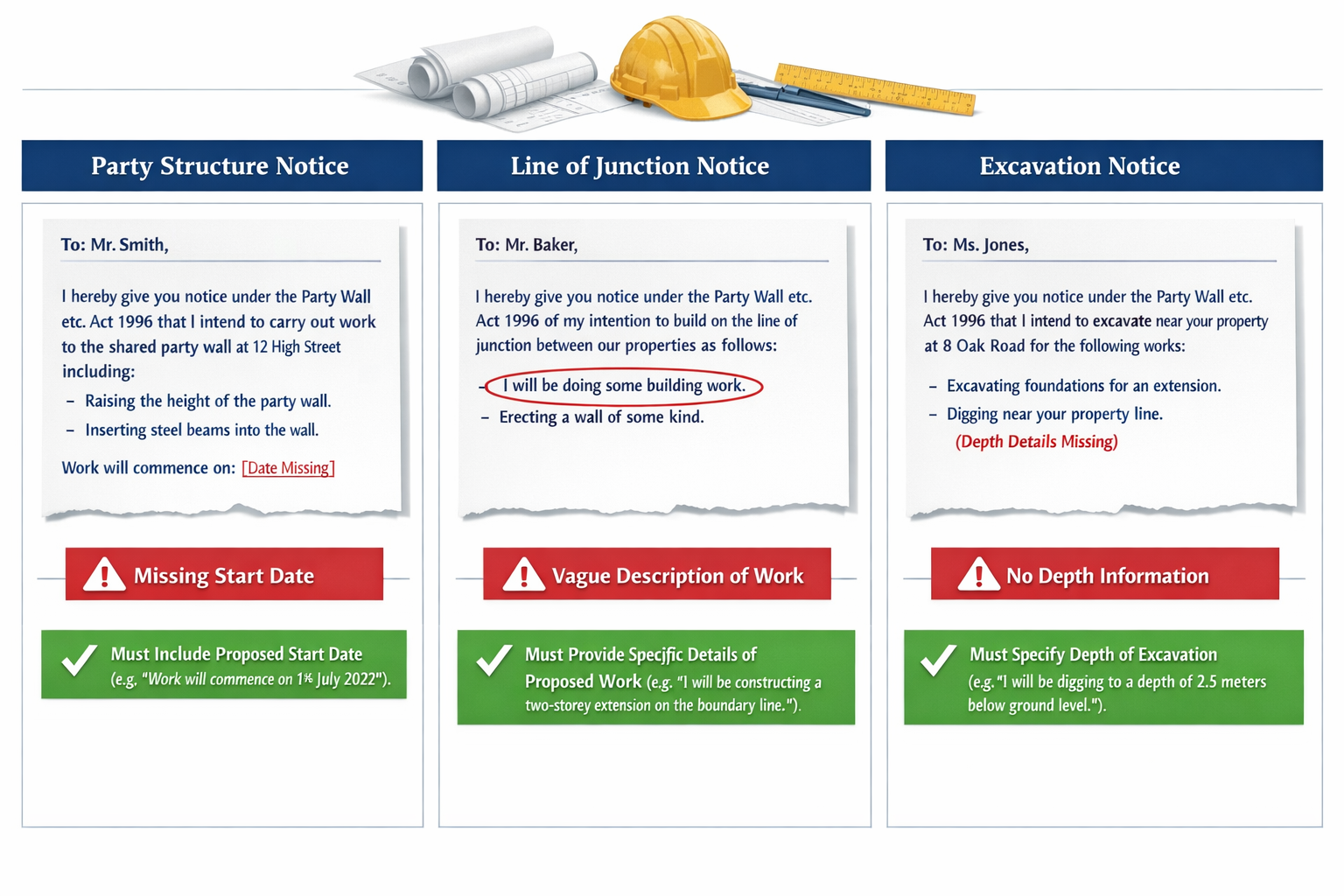
The Party Wall etc. Act 1996 creates a statutory framework requiring building owners to serve formal notice on adjoining owners before commencing specific types of work. This legislation applies throughout England and Wales, establishing three distinct notice types:
- Party Structure Notice (Section 3) – for work directly to an existing party wall or structure
- Line of Junction Notice (Section 1) – for building new walls on or astride the boundary line
- Excavation Notice (Section 6) – for excavations within 3 or 6 meters of a neighboring building
Each notice type has different content requirements and notice periods. Selecting the wrong statutory route represents one of the most fundamental errors that invalidates compliance[2].
Mandatory Information That Must Appear in Every Notice
Regardless of notice type, certain information is non-negotiable[1]:
| Required Element | Why It Matters | Common Error |
|---|---|---|
| Building owner's full legal name | Must match Land Registry records exactly | Using trading names or incomplete names |
| Complete property address | Establishes which property the notice covers | Vague descriptions like "the adjoining property" |
| Adjoining owner's name and address | Identifies who must respond | Serving on tenants instead of freeholders |
| Commencement date | Triggers statutory notice periods | Missing dates or "ASAP" descriptions |
| Work description | Enables adjoining owner to understand proposals | Generic statements like "building work" |
| Statutory rights explanation | Informs recipient of their legal options | Omitting surveyor appointment information |
| Response deadline | Usually 14 days from service | Not specifying the timeframe clearly |
⚠️ Critical Point: If any mandatory element is missing or incorrect, the entire notice may be deemed invalid, providing no legal protection whatsoever.
The 12-Month Validity Window
Even perfectly drafted notices don't last forever. Notices remain valid for only 12 months from the date of service[1]. If construction work doesn't commence within this timeframe, or if work begins but isn't prosecuted with "due diligence" (meaning reasonable continuous progress), the notice ceases to have legal effect.
This creates a significant trap for building owners who:
- Serve notices early but face planning delays
- Start work but encounter extended interruptions
- Change contractors mid-project causing gaps in activity
When a notice expires, the building owner must serve fresh notice and wait through the entire statutory notice period again—potentially adding 2-3 months to project timelines.
Critical Drafting Errors in Party Wall Notices: Common Drafting Errors That Invalidate Compliance and Trigger Injunctions
Error #1: Selecting the Wrong Notice Type
The Problem: Many building owners assume one notice covers all circumstances, or they serve multiple notices when only one is required. The Act establishes three distinct statutory routes, each with specific triggers[2].
Wrong notice selection typically occurs when:
- Serving a Party Structure Notice for work that doesn't actually touch the party wall
- Using a Line of Junction Notice for excavation work near boundaries
- Failing to serve an Excavation Notice when digging within the statutory distances
- Serving all three notices "just to be safe" when only one applies
Legal Consequence: Courts have held that serving the wrong notice type provides no statutory protection. The adjoining owner can argue they never received valid notice for the actual work proposed, potentially obtaining an injunction to stop work immediately.
Best Practice: Carefully analyze the proposed work against the Act's definitions. If work involves multiple elements (e.g., building on the boundary AND excavating nearby), multiple notices may genuinely be required—but each must accurately describe only the work falling within that statutory category.
Error #2: Vague or Incomplete Work Descriptions
The Problem: Generic descriptions like "extension work," "building alterations," or "general construction" fail to inform the adjoining owner what will actually happen[2]. The adjoining owner cannot make an informed decision about consent or surveyor appointment without understanding the work's nature and extent.
Inadequate descriptions often omit:
- Specific dimensions and measurements
- Depth of excavations or foundations
- Whether work involves underpinning
- Types of structural interventions (cutting, drilling, inserting beams)
- Duration and phasing of works
Legal Consequence: Vague notices can be challenged as invalid because they don't enable the adjoining owner to exercise their statutory rights meaningfully. Courts recognize that adjoining owners must understand what they're consenting to or disputing.
Best Practice: Include comprehensive work descriptions with:
- Precise measurements (depths, widths, heights)
- Specific structural interventions planned
- Foundation types and depths
- Materials to be used
- Expected duration and working hours
For more information on proper work descriptions, see our guide on what happens if you do not have a party wall agreement.
Error #3: Missing or Inadequate Plans and Drawings
The Problem: Words alone cannot adequately convey spatial relationships, excavation depths, or structural positions. Missing plans and sections create particular problems for excavation notices, boundary work, and structural alterations where depth and position cannot be assessed from descriptions alone[2].
Common drawing deficiencies include:
- No drawings attached at all
- Plans without scale bars or dimensions
- Missing cross-sections showing excavation depths relative to neighboring foundations
- Drawings that don't clearly identify the party wall or boundary line
- Outdated plans that don't reflect current conditions
Legal Consequence: Without adequate drawings, adjoining owners cannot assess potential risks to their property. This uncertainty almost always results in dissent and surveyor appointment, even for relatively minor works. In extreme cases, inadequate drawings render the entire notice invalid.
Best Practice: Attach:
- Site location plan showing both properties
- Floor plans indicating work locations relative to party walls
- Cross-sections showing excavation depths and relationship to neighboring foundations
- Elevations for work affecting party walls or structures
- All drawings clearly labeled, scaled, and dimensioned
Professional surveyors can prepare appropriate drawings as part of the notice package. Learn more about excavation notices for party walls and required documentation.
Error #4: Incorrect or Missing Commencement Dates
The Problem: The commencement date triggers the statutory notice period—at least 2 months for Party Structure Notices and 1 month for Line of Junction and Excavation Notices[1]. Notices with missing dates, dates that don't allow sufficient notice periods, or vague statements like "as soon as possible" fail to meet statutory requirements.
Timing errors include:
- Serving notice only 2-3 weeks before intended start
- Using past dates (notice served after work has already begun)
- Stating "immediate commencement" or "ASAP"
- Providing dates that fall on weekends or bank holidays
- Not accounting for the notice period running from service date, not preparation date
Legal Consequence: Insufficient notice periods render the notice invalid. Building owners cannot shorten statutory periods by agreement—these are mandatory minimums. Starting work before the notice period expires constitutes trespass and breach of statutory duty.
Best Practice: Serve notices 3-4 months before intended commencement[3]. This provides:
- Full statutory notice periods
- Time for surveyor appointment if the adjoining owner dissents
- Buffer for unexpected delays in the notice process
- Flexibility if the project timeline shifts slightly
Understanding the cost of party wall procedures helps with proper project budgeting and timeline planning.
Error #5: Failing to Identify All Relevant Adjoining Owners
The Problem: Building owners often serve notice only on the person they know lives next door, without verifying legal ownership. Serving on the wrong person renders the notice ineffective[2], even if that person occupies the property.
Identification failures occur when serving notice on:
- Tenants instead of freeholders
- Only one co-owner when multiple people hold title
- Former owners after property has been sold
- Managing agents without authority to receive notices
- Adult children living at the property but not on title
Legal Consequence: If the true legal owner never receives notice, they can argue the statutory process was never properly initiated. This provides grounds for injunction applications even after work has commenced.
Best Practice:
- Conduct Land Registry searches to identify current registered proprietors
- Serve notice on all persons with legal interest in the adjoining property
- If ownership is unclear, serve on "The Owner" at the property address
- Keep proof of service (recorded delivery receipts, process server certificates)
- For leasehold properties, serve on both freeholder and leaseholder if work affects their respective interests
Error #6: Omitting Statutory Rights Information
The Problem: Notices must inform adjoining owners of their rights under the Act, including the right to consent, dissent, or appoint a surveyor[1]. Notices that read like simple notifications rather than formal statutory documents fail to provide this essential information.
Missing rights information includes:
- No mention of the 14-day response period
- Failure to explain consent vs. dissent options
- Omitting surveyor appointment procedures
- Not providing building owner's surveyor contact details (if already appointed)
- Missing explanation of the Award process
Legal Consequence: Adjoining owners cannot exercise rights they don't know they have. Courts may find that inadequate rights information invalidates the notice, particularly if the adjoining owner can demonstrate they were prejudiced by the omission.
Best Practice: Include a clear statutory rights section explaining:
- The 14-day deadline for response
- What consent means (work can proceed as described)
- What dissent means (surveyors must be appointed)
- How to appoint a surveyor
- What happens if they don't respond (deemed dissent after 14 days)
- Their right to request a schedule of condition before work commences
Legal Consequences and Injunction Risks: Party Wall Notices: Common Drafting Errors That Invalidate Compliance and Trigger Injunctions
How Invalid Notices Trigger Injunctions
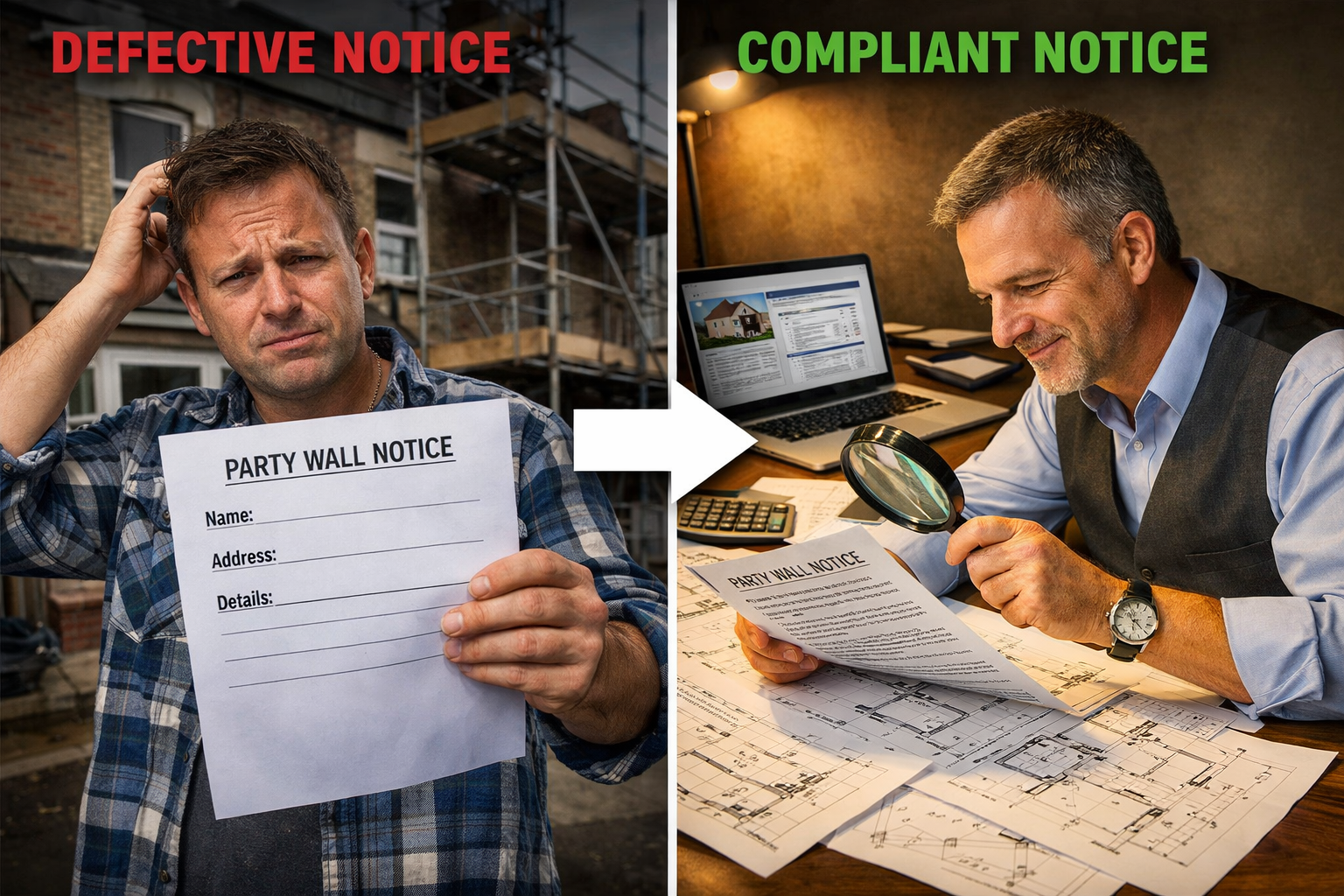
When a party wall notice contains material errors, the building owner proceeds without valid statutory authority. This creates immediate grounds for the adjoining owner to seek injunctive relief from the courts.
The injunction process typically unfolds as follows:
- Discovery of Invalid Notice: Adjoining owner (often through their own surveyor or solicitor) identifies defects in the notice
- Pre-Action Correspondence: Solicitor's letter demanding work cessation and proper notice service
- Urgent Injunction Application: If work continues, application to court for immediate interim injunction
- Court Hearing: Building owner must demonstrate why work should continue despite invalid notice
- Injunction Grant: Courts typically grant injunctions when statutory procedures haven't been followed properly
🚨 Critical Reality: Courts show little sympathy for building owners who fail to follow statutory procedures. The Act provides a clear framework—failure to comply typically results in work stoppage until proper notice is served and the statutory period expires.
Real-World Consequences of Defective Notices
The practical impact of invalid notices extends far beyond legal technicalities:
Financial Consequences:
- Construction delays of 2-4 months while proper notice is served
- Contractor standby costs (£500-£2,000+ per week)
- Legal fees defending injunction applications (£5,000-£15,000+)
- Potential damages to adjoining owner for trespass
- Loss of fixed-price contractor quotes due to delays
- Additional professional fees for re-preparing notices
Project Consequences:
- Complete work stoppage mid-construction
- Scaffold and equipment rental continuing during delays
- Weather exposure of partially completed work
- Loss of contractor availability when work can resume
- Compressed construction timeline creating quality risks
Relationship Consequences:
- Breakdown of neighbor relations
- Increased likelihood of disputes over the actual work
- Adjoining owner's heightened scrutiny of all aspects
- Difficulty reaching pragmatic agreements on minor issues
Case Law Principles
While the Party Wall Act itself doesn't contain extensive case law compared to other property legislation, several principles have emerged:
Strict Compliance Required: Courts interpret the Act's notice requirements strictly. Minor errors might be overlooked if the adjoining owner clearly understood the work proposed, but material omissions invalidate notices.
No Substantial Compliance Doctrine: Unlike some areas of law where "substantial compliance" suffices, party wall notices must meet statutory requirements precisely. Close enough isn't good enough.
Trespass Liability: Work carried out without valid notice constitutes trespass, even if no physical damage occurs. Building owners remain liable for this statutory breach regardless of their good faith belief that notice was adequate.
No Retrospective Validation: Courts cannot retrospectively validate defective notices. If a notice was invalid when served, it remains invalid. The only remedy is serving a fresh, compliant notice.
For guidance on the award process following valid notice, see our article on party wall award guidance.
The Reservice Penalty: Doubling Your Delay
Perhaps the most painful consequence of defective notices is the reservice penalty. When a notice must be corrected and re-served, the relevant notice period typically must run again from the date of reservice[2].
This means:
- Original defective notice served: Day 0
- Error discovered: Week 6
- Corrected notice re-served: Day 42
- New notice period begins: Days 42-102 (for 2-month Party Structure Notice)
- Total delay: 102 days instead of 60 days
This effectively doubles the project delay and can push work into unfavorable seasons, miss contractor availability windows, or cause financing issues if purchase completion dates are involved.
Professional Negligence Considerations
Building owners who rely on professional advice for notice preparation may have recourse against advisors if notices prove defective. However, this provides cold comfort when construction is halted by injunction.
Professionals potentially liable include:
- Architects who prepare and serve notices on behalf of clients
- Party wall surveyors who draft defective notices
- Project managers responsible for statutory compliance
- Solicitors advising on party wall procedures
The RICS has launched consultations on updated party wall practice guidance[4], recognizing the need for clearer professional standards in this area.
Preventing Notice Errors: Best Practices for Compliance
Professional Review Before Service
The single most effective strategy for avoiding invalid notices is professional review before service. While this involves upfront costs, these pale in comparison to the costs of defective notices[3].
Professional party wall surveyors provide:
- Correct notice type identification
- Comprehensive work descriptions
- Appropriate technical drawings
- Verification of adjoining owner details
- Proper statutory rights information
- Correct timing and service procedures
The typical cost of professional notice preparation (£300-£800 depending on complexity) represents a fraction of the potential delay costs from defective notices.
Template Dangers
Online templates and standard forms create a false sense of security. Treating templates as a substitute for project-specific review frequently results in inadequate notices[3].
Template limitations include:
- Generic work descriptions requiring customization
- Boilerplate text that may not match your specific work
- No verification that you're using the correct notice type
- No professional judgment about adequacy
- No drawings or technical specifications
- No verification of adjoining owner details
Templates can serve as starting points, but they require substantial customization and professional review to ensure compliance.
Timing Strategy
Serve notices 3-4 months before intended commencement[3], not the minimum statutory period. This provides:
✅ Full statutory notice periods
✅ Time for surveyor appointment and Award preparation if needed
✅ Buffer for unexpected delays
✅ Flexibility for project timeline adjustments
✅ Reduced pressure on all parties
✅ Better neighbor relations through non-rushed process
Documentation and Record-Keeping
Maintain comprehensive records of the notice process:
- Copies of all notices served with dates
- Proof of service (recorded delivery receipts, certificates of posting)
- Land Registry searches confirming adjoining owner identities
- All drawings and technical specifications attached to notices
- Correspondence with adjoining owners and their representatives
- Photographic evidence of service if hand-delivered
This documentation proves invaluable if disputes arise or if you need to demonstrate compliance with statutory procedures.
The Surveyor Appointment Advantage
Consider appointing your own party wall surveyor before serving notice. This provides several advantages:
- Expert notice preparation ensuring compliance
- Professional credibility with adjoining owners
- Immediate availability if adjoining owner dissents
- Consistent advice throughout the process
- Reduced likelihood of disputes over notice validity
When adjoining owners see that a professional surveyor is involved from the outset, they often feel more comfortable with the process and are less likely to challenge notice validity.
For situations where notice wasn't properly served, see our guide on what to do when no party wall notice was served.
Special Considerations for Complex Projects
Certain project types require additional care:
Basement excavations: Require detailed cross-sections showing depths relative to neighboring foundations, underpinning proposals, and temporary works methodology.
Shared chimneys: Need specific attention to structural details and access arrangements. See our article on party wall shared chimneys.
Multiple adjoining owners: Require separate notices to each owner, with work descriptions tailored to how the work affects each specific property.
Leasehold properties: May require serving notice on both freeholder and leaseholder, depending on lease terms and work type.
Conservation areas: While planning restrictions don't affect party wall requirements, the complexity of work often requires more detailed notices.
Conclusion
Party Wall Notices: Common Drafting Errors That Invalidate Compliance and Trigger Injunctions represent one of the most preventable yet costly mistakes in construction projects. With 90% of notices containing errors[1], the compliance failure rate demonstrates that most building owners and even some professionals underestimate the legal precision required.
The consequences of defective notices extend far beyond paperwork inconvenience. Invalid notices provide no legal protection, exposing building owners to immediate injunction applications that halt construction completely. The resulting delays, legal costs, and relationship damage typically far exceed the cost of professional notice preparation.
Key principles to remember:
🔑 Mandatory elements cannot be omitted – building owner's full legal name, precise property details, correct commencement dates, comprehensive work descriptions, and statutory rights information must all appear[1]
🔑 Notice type matters – selecting the wrong statutory route (Party Structure, Line of Junction, or Excavation) invalidates the entire notice[2]
🔑 Plans and drawings aren't optional – spatial relationships, depths, and structural positions cannot be adequately conveyed through words alone[2]
🔑 Timing is critical – serve notices 3-4 months before intended commencement, not at the last minute[3]
🔑 Professional review prevents problems – the cost of expert assistance is minimal compared to the cost of defective notices and resulting delays[3]
Actionable Next Steps
If you're planning building work that may require party wall notices:
- Conduct initial assessment – determine whether your proposed work triggers party wall requirements
- Engage a professional party wall surveyor – before preparing or serving notices
- Verify adjoining owner details – through Land Registry searches
- Prepare comprehensive documentation – detailed work descriptions and appropriate drawings
- Serve notices early – 3-4 months before intended commencement
- Maintain thorough records – of all notices, service methods, and correspondence
- Don't start work – until the statutory notice period has expired and any necessary Award is in place
The Party Wall Act creates a framework that protects both building owners and adjoining owners when properly followed. Investing time and resources in compliance at the outset prevents the far greater costs of injunctions, delays, and disputes that arise from defective notices.
For expert assistance with party wall notices and to ensure your project proceeds without legal complications, consult with qualified professionals who understand both the statutory requirements and the practical realities of construction projects. The modest cost of professional guidance represents the best insurance against the catastrophic delays that invalid notices trigger.
References
[1] How To Serve A Party Wall Notice – https://onlinearchitecturalservices.com/how-to-serve-a-party-wall-notice/
[2] What Makes A Party Wall Notice Valid – https://www.houricanassociates.com/party-wall-news/what-makes-a-party-wall-notice-valid/
[3] Partywallsurveyoressex – https://www.oseimc.com/partywallsurveyoressex
[4] Rics Launches Consultation On Updated Party Wall Practice Guidance – https://www.rics.org/news-insights/rics-launches-consultation-on-updated-party-wall-practice-guidance
[5] Party Wall Surveys For Renters Rights Act Compliance Managing Notices When Landlord Initiated Works Face New Section 8 Ground Requirements – https://nottinghillsurveyors.com/blog/party-wall-surveys-for-renters-rights-act-compliance-managing-notices-when-landlord-initiated-works-face-new-section-8-ground-requirements