
The Private Rented Sector (PRS) Database represents the most significant regulatory shift for UK landlords in decades, with civil penalties reaching £40,000 for serious breaches and mandatory registration now required before issuing Section 8 possession notices [5]. For valuation surveyors, this fundamental change demands a complete recalibration of assessment methodologies, as properties must now be evaluated not just on market comparables but on their compliance status within an enforceable national database. Understanding Valuation Surveyor Strategies for PRS Database Compliance: Assessing Rental Properties Post-Renters' Rights Act 2026 has become essential for professionals navigating this transformed regulatory landscape.
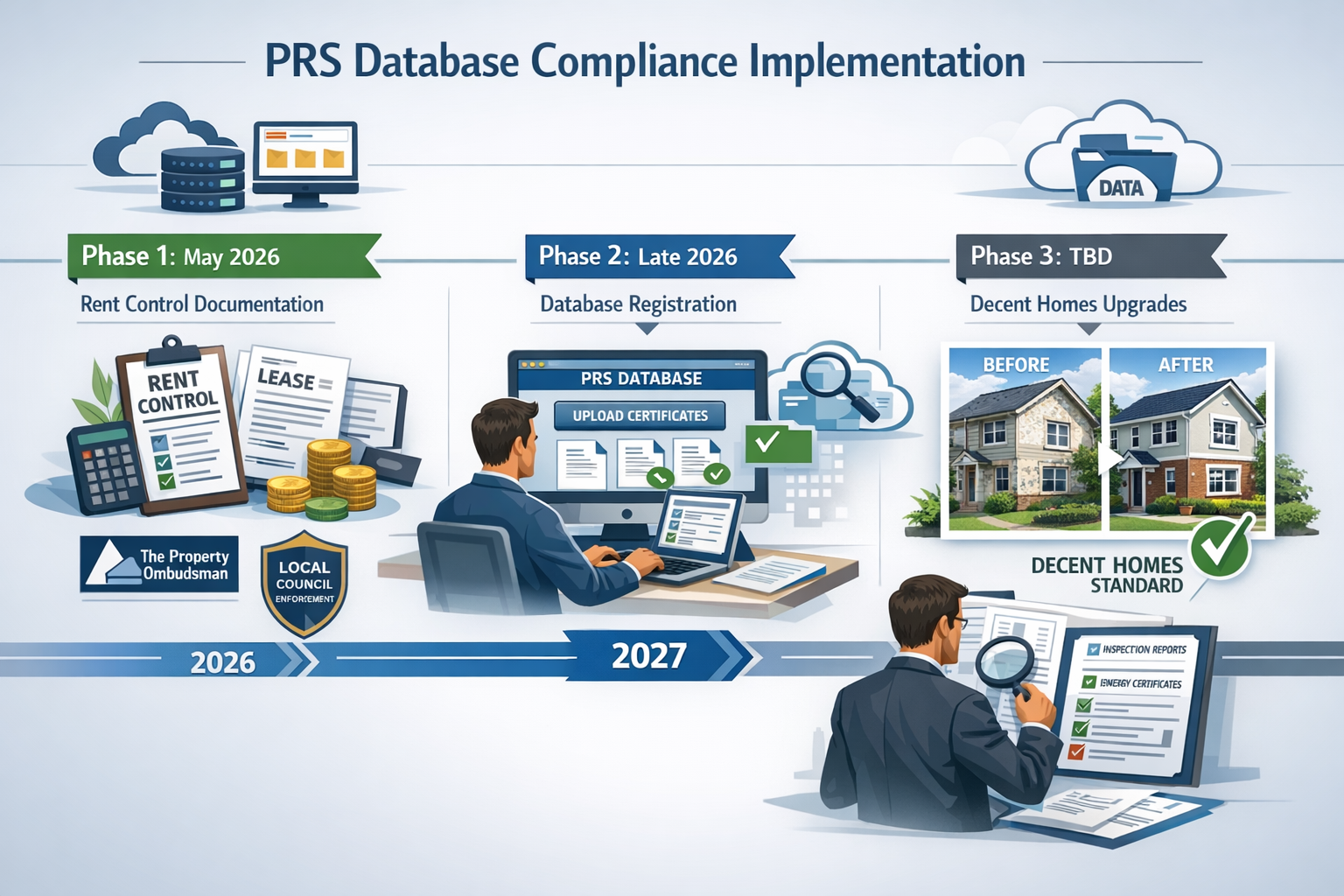
The Renters' Rights Act 2026 introduces a three-phase implementation timeline that directly impacts property valuations. Phase 1 began on May 1, 2026, with rent control measures; Phase 2 will launch the PRS Database in late 2026; and Phase 3 will apply the Decent Homes Standard to rental properties, though the date remains unconfirmed [2]. Valuation surveyors must now factor database registration status, compliance documentation completeness, and potential upgrade costs into every rental property assessment.
Key Takeaways
- Mandatory registration requirements: All landlords must register with the PRS Database before legally letting properties, with registration required for Section 8 notices and civil penalties up to £40,000 for serious breaches [5]
- Compliance documentation critical: Valid gas safety certificates, electrical certificates, fire safety documentation, and current Energy Performance Certificates (EPCs) are mandatory for database registration [3]
- Valuation methodology shift: Surveyors must adjust valuations based on database compliance status, Decent Homes Standard upgrade costs, and enhanced tenant rent challenge rights [7]
- Enhanced record-keeping demands: The database and new Property Ombudsman require landlords to maintain organized, accessible compliance documentation as key evidence in disputes [2]
- Proactive preparation advantage: Early compliance preparation minimizes registration stress, reduces penalty risks, and demonstrates professionalism to attract quality tenants [3]
Understanding the PRS Database Framework and Its Impact on Property Valuations
The PRS Database represents a fundamental infrastructure change for the rental sector, creating a centralized registry that local councils and enforcement agencies can access to verify landlord compliance. This transparency mechanism transforms how valuation surveyors must approach rental property assessments in 2026 and beyond.
Core Database Registration Requirements
Landlords face comprehensive disclosure obligations when registering properties in the PRS Database. The registration process requires detailed information about property type, number of occupants, management arrangements (including letting agent involvement), and confirmation of legal compliance including deposit protection and right to rent checks [3]. For valuation surveyors, this means assessments must now verify that all these elements are in place and properly documented.
The database operates as more than a simple registry—it functions as an enforcement tool. Local councils possess strengthened powers to take action against landlords who fail to join the PRS Database or attempt to market properties where the landlord is not registered [5]. This creates a binary compliance state: properties are either fully registered and legally marketable, or they face enforcement action and cannot be legally let.
Financial Penalties and Risk Assessment
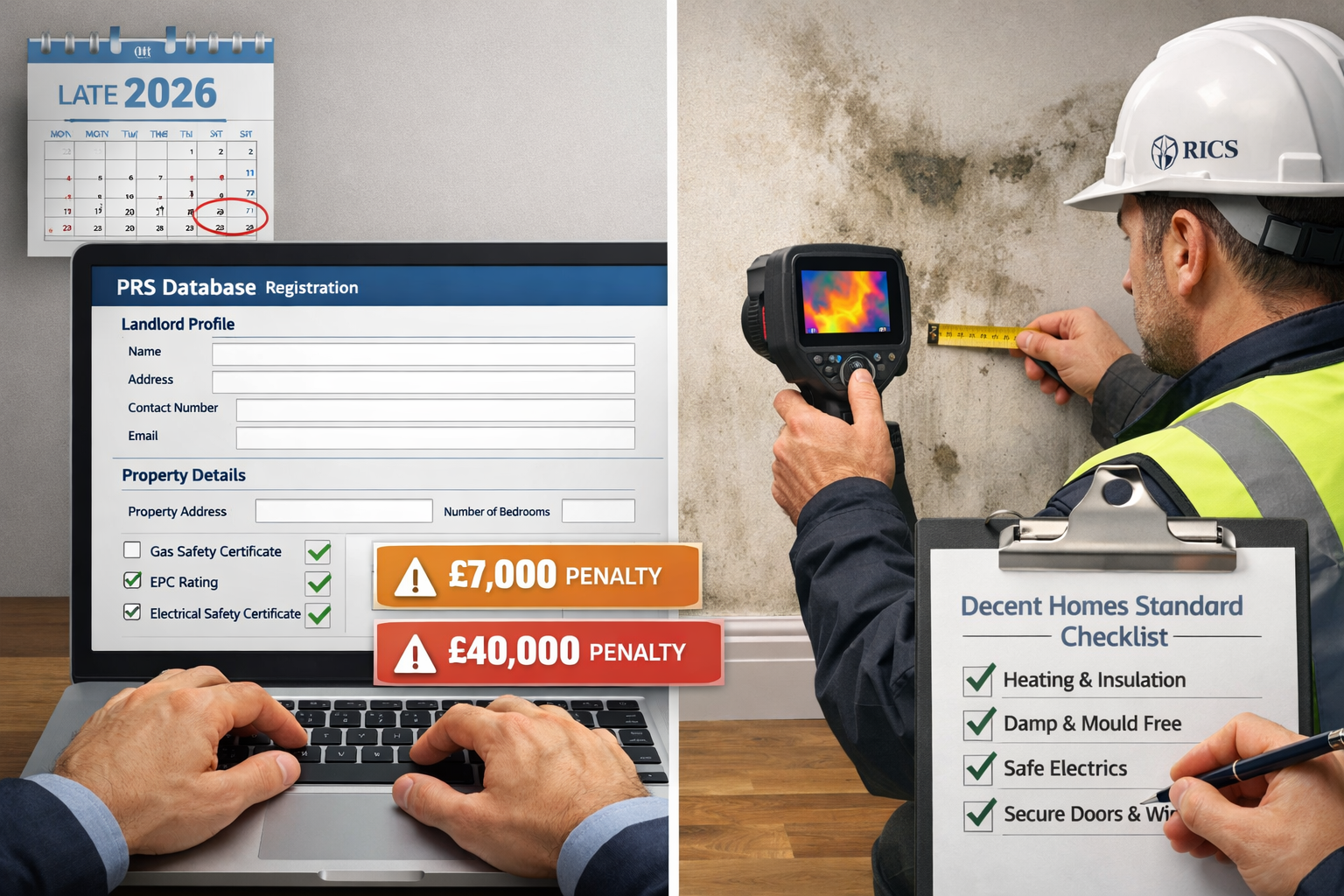
The penalty structure under the Renters' Rights Act 2026 creates significant financial risks that must be factored into property valuations. Local councils can issue civil penalties of up to £7,000 for initial breaches of PRS Database registration requirements, with repeated or serious breaches resulting in penalties up to £40,000 or criminal prosecution [5]. These aren't theoretical maximums—they represent real financial liabilities that affect property investment returns.
For valuation surveyors conducting RICS valuations, this penalty structure necessitates a risk-adjusted valuation approach. Properties with incomplete compliance documentation or landlords with poor compliance histories present elevated risk profiles that should be reflected in valuation figures. The potential for £40,000 penalties can significantly impact investment returns, particularly for smaller portfolio landlords.
Timeline Considerations for Valuation Surveyors
The phased implementation timeline creates distinct valuation considerations for each stage. Phase 1, which began May 1, 2026, introduced rent controls that affect rental income projections. Phase 2, expected in late 2026, will launch the PRS Database itself, making registration mandatory for continued letting activity [2]. Phase 3 will apply the Decent Homes Standard to PRS properties, though the implementation date remains unconfirmed.
Valuation surveyors must consider where properties sit within this timeline when conducting assessments. Properties being valued in mid-2026 face imminent database registration requirements, while those assessed later in the year must account for both registration costs and potential Decent Homes Standard upgrade expenses.
Valuation Surveyor Strategies for PRS Database Compliance: Documentation and Assessment Protocols
Effective valuation strategies for PRS Database compliance require systematic documentation review and rigorous assessment protocols. Surveyors must verify not just property condition but the completeness and validity of all compliance paperwork that landlords must submit to the database.
Essential Compliance Documentation Checklist
The PRS Database registration process demands specific safety and compliance certificates that valuation surveyors must verify during assessments. Required documentation includes [3]:
- Gas Safety Certificates: Annual inspections by Gas Safe registered engineers
- Electrical Installation Condition Reports (EICR): Valid within the last five years
- Fire Safety Documentation: Smoke alarms, carbon monoxide detectors, and fire risk assessments for HMOs
- Energy Performance Certificates (EPCs): Current certificates showing property energy efficiency ratings
- Deposit Protection Confirmation: Evidence of compliant deposit protection scheme enrollment
- Right to Rent Checks: Documentation proving tenant eligibility verification
Valuation surveyors should develop standardized checklists that mirror database registration requirements. This ensures assessments identify compliance gaps that could delay registration or trigger penalties. Properties missing critical certificates face immediate marketability issues and require valuation adjustments reflecting both certificate procurement costs and potential rental income loss during compliance resolution.
Decent Homes Standard Assessment Integration
The Decent Homes Standard introduces specific criteria that PRS properties must meet, creating substantial implications for property valuations. Properties must be free from serious hazards, in reasonable repair, equipped with modern facilities, provide thermal comfort, and be free from damp and mould [2]. These aren't subjective standards—they're enforceable requirements that can affect property lettability.
Valuation surveyors should integrate Decent Homes Standard assessments into their inspection protocols. This means evaluating:
- Hazard Assessment: Using the Housing Health and Safety Rating System (HHSRS) to identify Category 1 and Category 2 hazards
- Repair Status: Assessing structural elements, external envelope, and internal components for reasonable repair standards
- Modern Facilities: Verifying adequate kitchen and bathroom facilities meet contemporary expectations
- Thermal Performance: Evaluating heating systems, insulation levels, and EPC ratings for thermal comfort compliance
- Damp and Mould: Conducting thorough inspections for moisture ingress, condensation issues, and existing mould growth
Properties failing to meet Decent Homes Standard criteria require valuation adjustments reflecting upgrade costs. For comprehensive property condition assessments, surveyors may recommend building surveys that thoroughly document all defects requiring remediation.
Enhanced Record-Keeping Requirements for Landlords
The PRS Database and new Property Ombudsman create heightened scrutiny of landlord practices, requiring clear, organized processes for collecting and storing all compliance documentation as key evidence in disputes or investigations [2]. Valuation surveyors should assess not just whether compliance documentation exists but how systematically it's maintained.
Properties with well-organized compliance systems present lower risk profiles than those with ad-hoc documentation practices. During valuations, surveyors should note the quality of record-keeping systems, as this indicates landlord professionalism and reduces future compliance risks. Landlords using digital document management systems, maintaining compliance calendars for certificate renewals, and retaining historical records demonstrate lower risk profiles that may justify premium valuations.
Rent Review Implications and Tenant Challenge Rights
The Renters' Rights Act 2026 significantly strengthens tenant rights to challenge rent increases at tribunal, requiring landlords to prepare robust justifications for rental valuations [7]. This creates new obligations for valuation surveyors conducting rent reviews, as their assessments may be scrutinized in formal dispute proceedings.
Valuation reports supporting rent increases must now include:
✅ Comprehensive comparable evidence from similar properties in the local area
✅ Property improvement documentation justifying rent increases based on upgrades
✅ Market condition analysis demonstrating rental value changes
✅ Compliance status verification confirming database registration and certificate validity
Surveyors should anticipate that their valuation methodologies may be challenged at tribunal, requiring defensible approaches grounded in RICS Red Book standards and supported by extensive market evidence.
Implementing Valuation Surveyor Strategies for PRS Database Compliance: RICS Methodologies and Risk Adjustment Techniques
Professional valuation surveyors must adapt traditional RICS methodologies to account for the new regulatory environment created by the PRS Database and Renters' Rights Act 2026. This requires sophisticated risk adjustment techniques that reflect compliance status, upgrade requirements, and enforcement exposure.
RICS Red Book Compliance for PRS Valuations
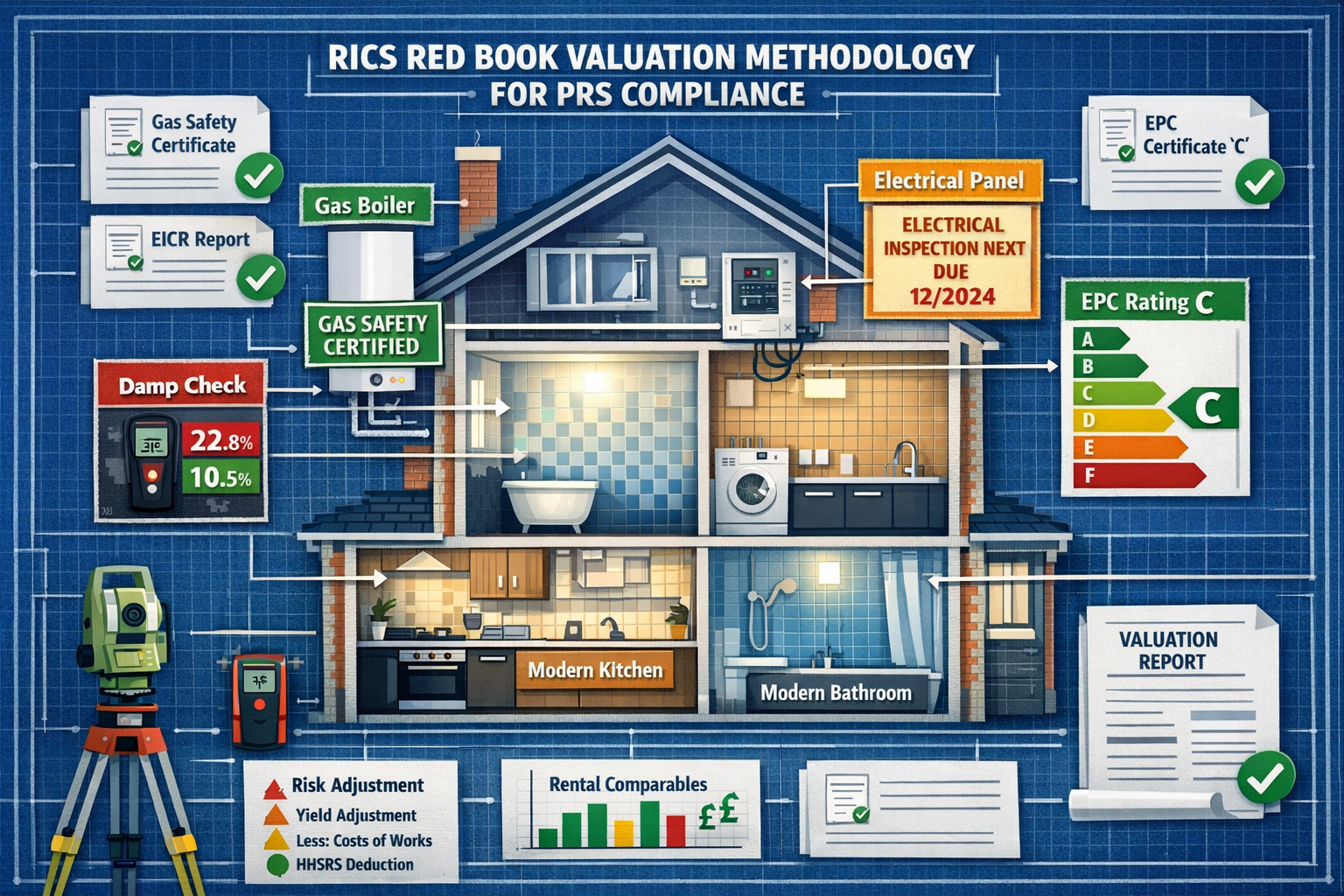
The RICS Valuation – Global Standards (Red Book) provides the professional framework for all property valuations, but PRS Database compliance introduces additional considerations that must be integrated into standard methodologies. Surveyors conducting valuations for rental properties must ensure their approaches comply with Red Book requirements while addressing database-specific factors.
Key Red Book principles applicable to PRS Database compliance valuations include:
Basis of Value: Clearly defining whether the valuation reflects Market Value, Market Rent, or Investment Value, with explicit assumptions about compliance status and regulatory risks.
Assumptions and Special Assumptions: Documenting any assumptions about future compliance, upgrade completion, or database registration status that affect the valuation figure.
Material Uncertainty: Declaring material uncertainty when Phase 3 Decent Homes Standard implementation dates remain unconfirmed or when regulatory interpretation is unclear.
Departure Provisions: Following proper procedures if departing from Red Book requirements due to specific client instructions or unusual property circumstances.
Valuation surveyors should ensure their terms of engagement explicitly address PRS Database compliance assessment scope, clarifying whether they're verifying documentation completeness, assessing upgrade costs, or providing opinions on compliance risks.
Risk-Adjusted Valuation Approaches
Traditional comparable-based valuation methods must be enhanced with risk adjustment factors reflecting PRS Database compliance status. Surveyors should develop systematic approaches for quantifying compliance-related risks and reflecting them in valuation figures.
Compliance Status Risk Matrix:
| Compliance Status | Risk Level | Valuation Adjustment |
|---|---|---|
| Fully registered, all certificates current | Low | Baseline value |
| Registration pending, certificates valid | Moderate | -2% to -5% |
| Missing certificates, upgrade needs identified | High | -5% to -15% |
| Serious hazards present, enforcement risk | Severe | -15% to -30% |
These adjustment ranges should be calibrated based on specific property circumstances, local enforcement patterns, and upgrade cost estimates. Properties in areas with active council enforcement face higher risk premiums than those in jurisdictions with limited enforcement resources.
Upgrade Cost Assessment and Capital Expenditure Forecasting
Properties requiring upgrades to meet Decent Homes Standard criteria need detailed capital expenditure forecasting that informs valuation adjustments. Surveyors should develop cost estimates for common upgrade scenarios:
Typical Upgrade Requirements and Costs:
- EPC Rating Improvements (D to C grade): £3,000-£8,000 (insulation, heating system upgrades)
- Electrical System Upgrades: £2,000-£5,000 (rewiring, consumer unit replacement)
- Damp and Mould Remediation: £1,500-£10,000+ (depending on severity and cause)
- Kitchen/Bathroom Modernization: £5,000-£15,000 per room
- Heating System Replacement: £3,000-£6,000 (modern boiler installation)
These costs should be deducted from valuation figures or factored into investment return calculations, depending on the valuation basis. For properties requiring multiple upgrades, surveyors should provide detailed schedules of works with associated cost estimates, potentially recommending specialist reports for complex issues like structural defects or extensive damp problems.
Comparable Evidence Adjustment for Database Compliance
Market comparable evidence must now be adjusted to reflect compliance status differences between subject properties and comparables. A property that's fully database-registered with all certificates current represents a different risk profile than a comparable property with uncertain compliance status.
Surveyors should develop systematic approaches for adjusting comparable evidence:
Comparable Adjustment Methodology:
- Identify base comparables: Recent lettings or sales of similar properties in the local market
- Verify compliance status: Determine whether comparables are database-registered and compliant
- Apply compliance adjustments: Adjust comparable evidence upward or downward based on relative compliance positions
- Weight adjusted comparables: Give greater weight to comparables with known compliance status
- Document adjustment rationale: Clearly explain all adjustments in valuation reports
This systematic approach ensures valuation conclusions reflect the new regulatory reality while maintaining defensible methodologies grounded in market evidence.
Integration with Broader Property Assessment Services
PRS Database compliance valuations often benefit from integration with broader property assessment services that provide comprehensive property condition information. Surveyors should consider recommending complementary assessments when compliance issues are identified:
- Building Surveys: Level 3 surveys providing detailed condition analysis for properties with suspected defects
- Stock Condition Surveys: Systematic assessments for portfolio landlords managing multiple properties
- Specialist Investigations: Damp surveys, subsidence surveys, or structural engineering assessments for serious defects
This integrated approach ensures landlords receive comprehensive information about compliance requirements and associated costs, supporting informed decision-making about property investments and upgrade priorities.
Strategic Compliance Planning and Early Preparation Advantages
Proactive landlords preparing for PRS Database compliance now can minimize stress at mandatory registration, reduce penalties risk, and demonstrate professionalism to attract quality tenants and build trust [3]. Valuation surveyors play a crucial advisory role in helping landlords develop strategic compliance plans that protect property values and investment returns.
Phased Compliance Implementation Strategies
Rather than waiting until late 2026 when the PRS Database launches, strategic landlords should implement phased compliance programs that systematically address requirements over time. Valuation surveyors can provide valuable guidance on prioritization and sequencing.
Recommended Compliance Implementation Phases:
Phase A (Immediate – Q3 2026):
- Audit existing compliance documentation
- Identify missing certificates and expired documents
- Commission urgent safety inspections (gas, electrical, fire)
- Develop compliance tracking systems
Phase B (Q4 2026):
- Complete all outstanding certificate renewals
- Address critical Decent Homes Standard deficiencies
- Prepare database registration documentation
- Register with PRS Database upon launch
Phase C (Early 2027):
- Implement ongoing compliance monitoring systems
- Schedule proactive certificate renewals before expiry
- Conduct annual property condition reviews
- Maintain organized digital documentation archives
This phased approach distributes costs over time, prevents last-minute compliance rushes, and demonstrates systematic professionalism that enhances property marketability.
Portfolio-Level Compliance Assessment
Landlords with multiple properties face amplified compliance challenges and risks. Portfolio-level compliance assessments provide systematic evaluation across all properties, identifying common deficiencies and enabling efficient remediation strategies.
Valuation surveyors conducting portfolio assessments should:
🏢 Standardize assessment protocols across all properties for consistent evaluation
📊 Develop compliance dashboards showing status of each property against database requirements
💰 Aggregate upgrade cost estimates to inform capital allocation decisions
⚠️ Prioritize high-risk properties facing immediate enforcement exposure
📈 Model portfolio-wide value impacts of systematic compliance improvements
Portfolio landlords benefit from economies of scale when addressing compliance requirements, potentially negotiating bulk rates for certificate renewals or coordinating upgrade works across multiple properties.
Market Positioning and Competitive Advantage
Early compliance creates market positioning advantages that savvy landlords can leverage. Properties with complete database registration and comprehensive compliance documentation appeal to quality tenants who value professionalism and stability.
Valuation surveyors should help landlords understand the market premium that compliant properties can command. Rental properties demonstrating full compliance, modern facilities meeting Decent Homes Standard criteria, and professional management practices justify premium rents and attract longer-term, higher-quality tenants who reduce void periods and maintenance issues.
This market positioning advantage becomes particularly valuable as enforcement increases and non-compliant properties face letting restrictions. Properties that can be immediately marketed without compliance delays gain competitive advantages in tight rental markets.
Local Enforcement Patterns and Geographic Risk Variation
Enforcement intensity varies significantly across local councils, creating geographic risk variations that affect property valuations. Some councils have dedicated enforcement teams actively monitoring PRS compliance, while others have limited resources for proactive enforcement.
Valuation surveyors should research local enforcement patterns when assessing properties in different jurisdictions. Properties in areas with active enforcement face higher immediate compliance pressures and penalty risks, while those in less active enforcement areas may face lower short-term risks (though regulatory requirements remain identical).
Understanding local enforcement patterns helps surveyors calibrate risk adjustments and advise landlords on compliance urgency. Properties in high-enforcement areas require immediate compliance attention, while those in lower-enforcement jurisdictions may have slightly more flexibility in implementation timing (though early compliance remains advisable).
Property Ombudsman Considerations
The new Property Ombudsman service provides dispute resolution for PRS complaints, operating alongside the database as part of broader sector reforms [3]. This creates additional accountability mechanisms that affect property management practices and valuation considerations.
Landlords must register with the Property Ombudsman scheme, and properties with histories of upheld complaints may face reputational damage affecting marketability. Valuation surveyors should consider complaint history when assessing properties, as patterns of tenant disputes indicate management quality issues that affect long-term investment performance.
Properties managed by professional letting agents with strong compliance records and low complaint rates present lower risk profiles than those managed by landlords with poor track records. This management quality factor should inform valuation opinions, particularly for investment properties where tenant satisfaction affects void periods and rental income stability.
Technology Solutions for Compliance Management
Digital compliance management systems provide efficient solutions for tracking certificate renewals, organizing documentation, and maintaining audit trails required by the PRS Database. Valuation surveyors should recommend technology adoption as part of compliance strategies.
Modern property management software offers features including:
- Automated certificate expiry alerts preventing lapses in safety compliance
- Digital document storage with secure cloud backup and easy retrieval
- Compliance dashboard views showing status across property portfolios
- Tenant communication portals documenting maintenance requests and responses
- Integration with database registration streamlining submission processes
Landlords adopting these technology solutions demonstrate professional management practices that reduce compliance risks and enhance property values. Surveyors can note technology adoption as a positive factor in valuation reports, indicating lower future compliance risks.
Conclusion
The introduction of the PRS Database under the Renters' Rights Act 2026 fundamentally transforms valuation surveyor practices for rental property assessments. With mandatory registration requirements, civil penalties reaching £40,000 for serious breaches, and comprehensive compliance documentation demands, surveyors must adopt sophisticated strategies that integrate database compliance verification into traditional valuation methodologies.
Valuation Surveyor Strategies for PRS Database Compliance: Assessing Rental Properties Post-Renters' Rights Act 2026 require systematic approaches encompassing documentation verification, Decent Homes Standard assessment, risk-adjusted valuation techniques, and strategic compliance planning. Surveyors who master these enhanced methodologies provide invaluable guidance to landlords navigating the transformed regulatory landscape, protecting property values and investment returns while ensuring legal compliance.
The phased implementation timeline—with Phase 2 database launch expected in late 2026 and Phase 3 Decent Homes Standard application date still unconfirmed—creates both challenges and opportunities. Proactive landlords working with skilled valuation surveyors to achieve early compliance gain competitive advantages, reduce penalty risks, and position properties for premium market performance.
Actionable Next Steps
For landlords and property investors:
- Commission comprehensive compliance audits from qualified RICS surveyors before the late 2026 database launch
- Develop systematic documentation management systems ensuring all certificates remain current and accessible
- Budget for Decent Homes Standard upgrades based on professional surveyor cost estimates
- Establish relationships with compliance-focused letting agents or property managers
- Monitor local council enforcement patterns and adjust compliance urgency accordingly
For valuation surveyors:
- Update valuation templates to incorporate PRS Database compliance assessment sections
- Develop standardized risk adjustment matrices reflecting compliance status variations
- Build relationships with specialist contractors for accurate upgrade cost estimation
- Stay current on regulatory developments as Phase 3 implementation details emerge
- Consider additional training on Decent Homes Standard criteria and HHSRS hazard assessment
The PRS Database represents more than a regulatory burden—it creates opportunities for professional valuation surveyors to provide enhanced advisory services that protect client interests and ensure sustainable rental property investments. By adopting comprehensive compliance assessment strategies now, surveyors position themselves as essential advisors in the transformed private rented sector of 2026 and beyond.
For expert guidance on rental property valuations and compliance assessments, consider consulting with chartered surveyors who understand the complexities of PRS Database requirements and can provide professional RICS valuations tailored to the new regulatory environment.
References
[1] Party Wall Notice Requirements For Prs Database Compliance Works Surveyor Tactics Post Renters Rights Act Registration In 2026 – https://nottinghillsurveyors.com/blog/party-wall-notice-requirements-for-prs-database-compliance-works-surveyor-tactics-post-renters-rights-act-registration-in-2026
[2] Renters Rights Act A Compliance Guide For Landlords – https://www.hibberts.com/renters-rights-act-a-compliance-guide-for-landlords/
[3] The New Prs Database A Landlords Guide To Early Compliance And Registration – https://www.whitegates.co.uk/guides/landlord/the-new-prs-database-a-landlords-guide-to-early-compliance-and-registration/
[5] Guide To The Renters Rights Act – https://www.gov.uk/government/publications/guide-to-the-renters-rights-act/guide-to-the-renters-rights-act
[7] Valuing Prs Properties Under New Rent Review Rules Rics Tactics Post Renters Rights Act 2026 – https://nottinghillsurveyors.com/blog/valuing-prs-properties-under-new-rent-review-rules-rics-tactics-post-renters-rights-act-2026