
{"cover":"Professional landscape format (1536×1024) hero image with bold text overlay 'Level 3 Building Surveys in Cautious Q2 2026 Markets: RICS Tools to Counter -26% Buyer Demand Dip' in extra large 70pt white sans-serif font with dark shadow effect, positioned in upper third with perfect alignment. Background shows split-screen composition: left side features RICS chartered surveyor in hard hat examining period property exterior with clipboard and thermal imaging camera, right side displays subtle overlay of declining demand graph with -26% highlighted in red. Color palette: deep navy blue, white, warning orange accents. Magazine cover aesthetic, editorial quality, high contrast, professional business photography style with depth of field, rule of thirds composition, conveying expertise and market analysis.","content":["Detailed landscape format (1536×1024) editorial photograph showing RICS-accredited surveyor conducting comprehensive Level 3 building inspection inside Victorian-era property. Close-up view of surveyor using moisture meter on exposed brick wall, with visible damp patches and structural concerns. Foreground shows professional survey equipment including thermal camera, laser measure, and tablet displaying digital survey form. Background reveals period features: ornate ceiling cornicing, sash windows, original floorboards with visible wear. Soft natural lighting from window, documentary photography style, shallow depth of field focusing on surveyor's hands and equipment. Color grading: warm interior tones with professional blue surveyor uniform. Text overlay in corner: 'Beyond AVMs: Physical Inspection Value'. High-resolution, professional quality capturing technical expertise and thorough assessment methodology.","Wide-angle landscape format (1536×1024) infographic-style visualization showing RICS survey protocol comparison table overlaid on blurred background of residential street with mixed property types. Main focus: three-column comparison chart displaying Level 1 Condition Report vs Level 2 HomeBuyer vs Level 3 Building Survey, with checkmarks and detailed scope differences highlighted. Each column features icon representations: magnifying glass for basic inspection, house with warning symbols for intermediate, and detailed blueprint with multiple inspection points for comprehensive Level 3. Side panel displays February 2026 market statistics: -26% buyer demand metric in large red numbers, -12% agreed sales figure, +14% survey demand projection in green. Clean infographic design with RICS branding colors: navy, white, and teal accents. Professional business visualization style with clear hierarchy and data-driven aesthetic.","Landscape format (1536×1024) conceptual editorial photograph showing modern property transaction scene adapted for cautious 2026 market conditions. Foreground: professional meeting table with Level 3 building survey report prominently displayed (thick bound document with RICS logo visible), surrounded by property documents, mortgage papers, and tablet showing virtual property tour. Middle ground: diverse group of three people in business casual attire reviewing documents – buyer couple and surveyor in discussion, pointing at survey findings section. Background: large window overlooking suburban residential area with mix of period and modern properties under overcast spring sky, symbolizing uncertain market conditions. Warm interior lighting contrasts with cooler exterior tones. Professional photography with balanced composition, shallow depth of field on survey report. Text overlay: 'Certainty in Uncertain Times'. Color palette: warm wood tones, professional navy, reassuring green accents, editorial magazine quality."]

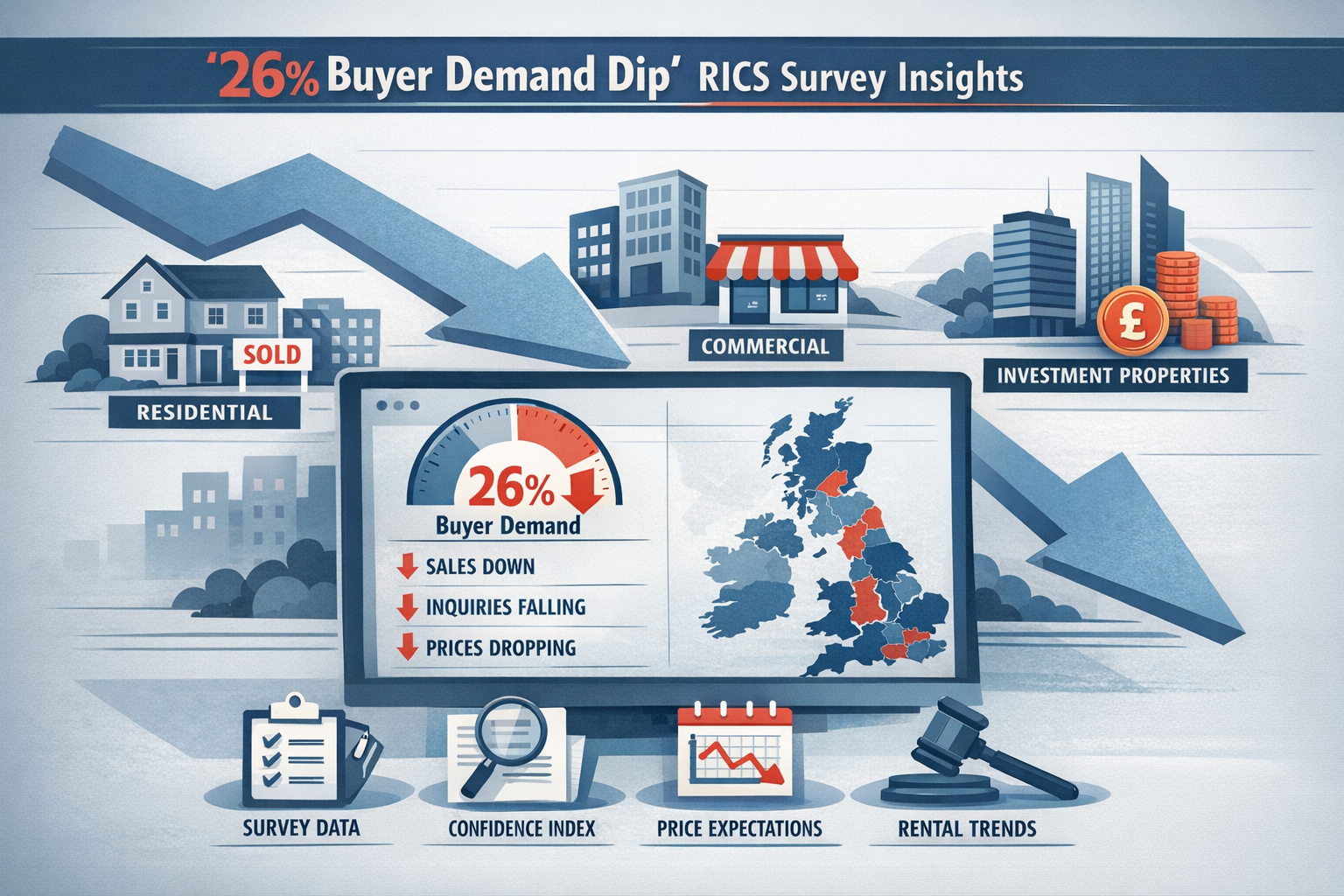
Buyer demand plummeted to -26% in February 2026, marking the steepest decline since late 2025 and sending shockwaves through the UK property market[1]. Yet amid this uncertainty, building survey demand is projected to surge 14% nationally this spring—a paradox that reveals a fundamental shift in how cautious buyers are approaching property purchases in 2026[6]. When geopolitical tensions and interest rate concerns dampen market sentiment, Level 3 Building Surveys in Cautious Q2 2026 Markets: RICS Tools to Counter -26% Buyer Demand Dip emerge as the critical tool for buyers seeking certainty beyond automated valuation models (AVMs).
This comprehensive guide explores how RICS-accredited Level 3 building surveys provide the detailed property intelligence that today's risk-averse buyers demand, offering tailored protocols for resilient property types even as transaction volumes remain subdued.
Key Takeaways
- 🔍 Buyer demand dropped to -26% in February 2026, the weakest reading in months, driven by geopolitical uncertainty and interest rate concerns
- 📊 Building survey demand is projected to increase 14% in Spring 2026, indicating buyers prioritize thorough inspections despite market hesitation
- 🏠 Level 3 surveys deliver comprehensive property analysis that AVMs cannot replicate, providing crucial certainty in volatile markets
- 📋 RICS protocols offer standardized, professional frameworks for assessing structural integrity, defects, and long-term maintenance needs
- 💡 Strategic survey deployment helps buyers negotiate effectively and make informed decisions despite subdued transaction activity
Understanding the Q2 2026 Market Downturn and Survey Demand Surge
The -26% Buyer Demand Reality
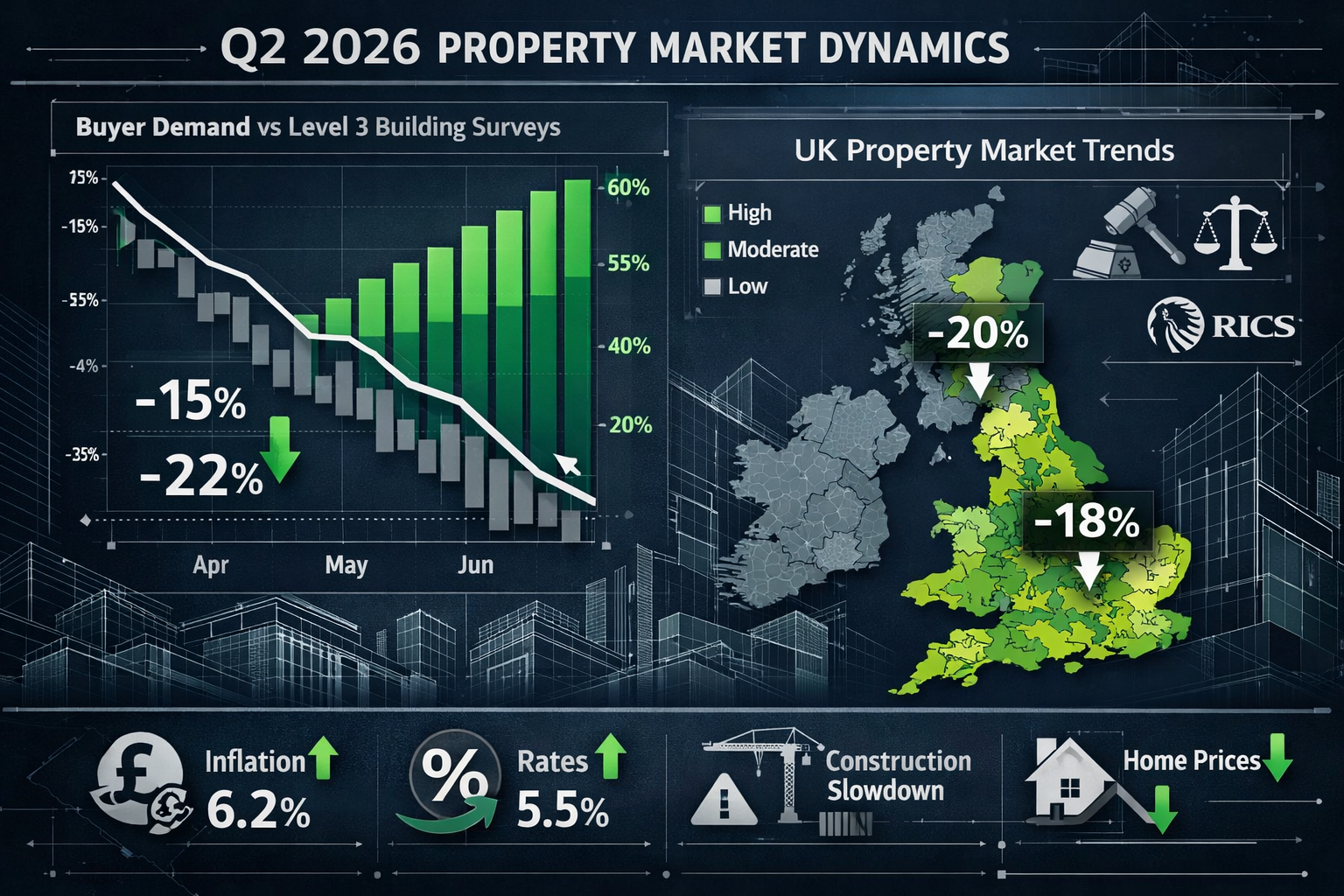
The latest RICS UK Residential Survey reveals a sobering picture of the property market entering Q2 2026. Buyer demand registered a net balance of -26% in February, deteriorating sharply from -15% in January[1][2]. This represents the most significant monthly decline in recent quarters and signals growing caution among prospective purchasers.
Several factors converged to create this challenging environment:
Geopolitical Uncertainty 🌍
Events in the Middle East have created widespread economic anxiety, with buyers postponing major financial commitments until global stability improves[1][5].
Interest Rate Concerns 💰
Persistent uncertainty around Bank of England policy has kept mortgage rates elevated, reducing affordability and dampening enthusiasm for property purchases.
Transaction Activity Decline 📉
Agreed sales posted a net balance of -12% in February, reflecting the direct impact of reduced buyer interest on completed transactions[1].
Weakening Near-Term Expectations ⏰
Near-term sales expectations fell to just -2%, marking the weakest reading since November 2025 and indicating that professionals anticipate continued sluggish activity in the immediate future[2].
The Survey Demand Paradox
Despite—or perhaps because of—this market caution, building survey demand is experiencing significant growth. Projections indicate a 14% national increase in Spring 2026[6], creating an apparent contradiction: fewer buyers are entering the market, yet those who do are investing more heavily in comprehensive property assessments.
This paradox reveals a fundamental shift in buyer psychology. In uncertain markets, purchasers become more risk-averse and demand greater certainty before committing capital. Level 3 Building Surveys in Cautious Q2 2026 Markets: RICS Tools to Counter -26% Buyer Demand Dip represent the gold standard for property due diligence, offering the detailed analysis that cautious buyers require.
Why Level 3 Building Surveys Matter More in Uncertain Markets
Beyond Automated Valuation Models
Automated Valuation Models (AVMs) have proliferated in recent years, offering instant property valuations based on algorithms and comparable sales data. However, AVMs cannot identify structural defects, hidden maintenance issues, or property-specific risks that materially affect value and long-term ownership costs.
In a market characterized by the -26% buyer demand dip, purchasers cannot afford costly surprises after completion. Level 3 building surveys provide comprehensive physical inspections that reveal:
✅ Structural integrity concerns including subsidence, settlement, or movement
✅ Hidden defects in roofing, drainage, damp-proofing, and foundations
✅ Building regulation compliance issues that may affect insurance or resale value
✅ Detailed repair cost estimates enabling accurate budgeting and negotiation
✅ Long-term maintenance planning to protect investment value over decades
The RICS Professional Framework
The Royal Institution of Chartered Surveyors (RICS) establishes rigorous standards for building surveys, ensuring consistency, professionalism, and comprehensive coverage. RICS home surveys follow standardized protocols that give buyers confidence in the assessment quality.
RICS Survey Levels Comparison:
| Feature | Level 1 (Condition Report) | Level 2 (HomeBuyer Report) | Level 3 (Building Survey) |
|---|---|---|---|
| Property Type | Modern, good condition | Standard construction | All properties, especially older/altered |
| Inspection Depth | Visual overview | Accessible areas | Comprehensive, detailed |
| Defect Analysis | Traffic light system | Basic identification | Extensive technical detail |
| Repair Guidance | Minimal | General advice | Detailed recommendations |
| Cost Estimates | ❌ | Limited | ✅ Comprehensive |
| Best For | New builds, flats | Standard homes | Period properties, renovations |
For buyers navigating Level 3 Building Surveys in Cautious Q2 2026 Markets: RICS Tools to Counter -26% Buyer Demand Dip, the comprehensive Level 3 option provides maximum protection and negotiating power.
RICS Level 3 Survey Protocols for Resilient Property Types
Period and Heritage Properties
With 12-month price expectations remaining positive at +33% nationally despite short-term caution[1], period properties continue to attract buyers seeking character and long-term value appreciation. However, these properties present unique challenges that demand thorough Level 3 assessment.
Critical Inspection Areas for Period Properties:
🏛️ Original Features and Alterations
RICS surveyors assess whether period features (cornicing, fireplaces, joinery) remain intact and evaluate the quality of any historical alterations or extensions.
🧱 Traditional Construction Methods
Solid wall construction, lime mortar, and traditional roofing materials require specialist knowledge to assess condition and recommend appropriate repair techniques.
💧 Moisture and Ventilation
Period properties often lack damp-proof courses and rely on breathable construction. Surveyors evaluate moisture levels and ventilation adequacy to prevent long-term deterioration.
⚡ Services and Compliance
Electrical systems, plumbing, and heating in period properties frequently require updating to meet modern safety standards—a key consideration for budget planning.
Non-Standard Construction Properties
Non-standard construction properties including concrete frame, steel frame, timber frame, and system-built homes require specialized assessment protocols. These properties can present mortgage and insurance challenges, making comprehensive surveys essential.
Level 3 Survey Focus Areas:
- Structural system integrity specific to construction method
- Material degradation (concrete carbonation, steel corrosion, timber decay)
- Thermal performance and energy efficiency considerations
- Mortgage and insurance implications based on construction type
- Repair methodology appropriate to non-standard materials
Properties with Known Defects
When specific defects are already identified, Level 3 surveys provide detailed analysis of extent, cause, and remediation requirements. This proves particularly valuable in the cautious Q2 2026 market, where buyers demand comprehensive understanding before proceeding.
RICS surveyors conducting Level 3 assessments will:
- Investigate root causes rather than simply documenting symptoms
- Assess progression risk to determine urgency of remediation
- Provide detailed repair specifications for accurate cost estimation
- Evaluate impact on property value and long-term viability
- Recommend specialist consultations where technical expertise is required
Strategic Deployment of Level 3 Surveys in Low-Demand Markets
Negotiating Power in Subdued Markets
With agreed sales at -12% and transaction volumes suppressed[1], buyers who do proceed hold significant negotiating leverage—particularly when armed with comprehensive survey evidence.
Level 3 Building Surveys in Cautious Q2 2026 Markets: RICS Tools to Counter -26% Buyer Demand Dip provide concrete evidence for price renegotiation:
💼 Documented Defects
Detailed survey findings with repair cost estimates create objective justification for price reduction requests.
📊 Market Context
In a market where sellers face limited buyer interest, comprehensive survey evidence carries greater weight in negotiations.
🔧 Remediation Requirements
Buyers can request that sellers complete repairs before completion, or negotiate price reductions reflecting repair costs plus inconvenience.
⚖️ Risk Transfer
Detailed survey documentation protects buyers from future disputes about pre-existing conditions and provides evidence for insurance claims if needed.
Timing Considerations for Q2 2026
Spring traditionally represents peak property market activity, but Q2 2026 presents unique timing considerations given the subdued demand environment.
Optimal Survey Timing Strategy:
- Early survey commissioning (immediately after offer acceptance) maintains momentum despite slower market pace
- Coordinating with mortgage valuations ensures all assessments align and avoid duplication
- Building in negotiation time recognizes that sellers may need longer to consider concessions in difficult markets
- Scheduling specialist follow-ups for issues requiring structural engineering or other technical input
The projected 14% surge in survey demand[6] may create capacity constraints with leading RICS-accredited firms, making early booking essential for buyers proceeding in Spring 2026.

Regional Variations and London Market Dynamics
London's Dramatic Expectation Shift
While national 12-month price expectations remain positive at +33%, London expectations dropped sharply to +7% from +56% previously[1]—the most dramatic regional shift recorded in the February 2026 RICS survey.
This London-specific caution reflects several factors:
🏙️ Higher absolute prices making affordability particularly challenging
🌍 Greater exposure to international economic uncertainty affecting high-value segments
💼 Commercial real estate concerns spilling over into residential sentiment
🚇 Infrastructure uncertainty around major transport and development projects
For London buyers, Level 3 surveys provide even greater value given the capital's complex property stock, including:
- Converted flats requiring assessment of structural alterations and lease terms
- Basement extensions needing evaluation of waterproofing, underpinning, and compliance
- Tall buildings with cladding and fire safety considerations
- Conservation areas where planning restrictions affect alteration potential
Regional Resilience and Survey Requirements
Outside London, regional markets show varied resilience. Chartered surveyors across different locations report differing local conditions that affect survey priorities.
Regional Survey Focus Areas:
| Region | Primary Concerns | Survey Priorities |
|---|---|---|
| South East | High prices, commuter demand | Transport links, conversion quality |
| North West | Industrial heritage stock | Structural integrity, damp issues |
| Midlands | Mixed property ages | Period features, modern extensions |
| South West | Coastal exposure, tourism | Weather damage, holiday let potential |
The Rental Market Context and Investment Properties
Landlord Supply Constraints
The February 2026 RICS survey revealed that landlord instructions remain firmly negative at -27%, while tenant demand stayed stable at +2%[1]. This supply-demand imbalance continues to pressure rental markets, with 20% of surveyors expecting rents to rise in the coming three months[2].
For investors considering rental properties despite the -26% buyer demand dip, Level 3 surveys provide critical intelligence:
🏘️ Rental yield potential based on condition and required improvements
📜 Regulatory compliance with evolving landlord safety and energy efficiency standards
🔨 Refurbishment requirements to achieve target rental levels
💡 Long-term maintenance costs affecting investment returns
⚡ Energy Performance Certificate (EPC) implications and improvement pathways
Commercial Building Considerations
Investors evaluating commercial building surveys face additional complexity in Q2 2026 markets. Level 3 commercial surveys address:
- Business rates implications of property condition and classification
- Tenant covenant strength in uncertain economic conditions
- Lease obligations and dilapidation survey requirements
- Change of use potential if market conditions shift
- Accessibility compliance and disabled access provisions
Integrating Level 3 Surveys with Broader Due Diligence
Complementary Specialist Assessments
While Level 3 surveys provide comprehensive coverage, certain issues require specialist follow-up assessments that RICS surveyors will recommend.
Common Specialist Referrals:
🧪 Asbestos Surveys
Properties built before 2000 may contain asbestos materials requiring specialist identification and management planning.
🏗️ Structural Engineering Assessments
Significant structural concerns identified in Level 3 surveys warrant detailed engineering analysis and remediation design.
📐 Beam Calculations
Properties with removed or altered load-bearing walls require structural calculations to verify safety and compliance.
🔬 Specific Defect Reports
Targeted investigations of particular issues (e.g., Japanese knotweed, mining subsidence) provide focused expert analysis.
☀️ Solar Panel Roof Engineer Calculations
Properties with existing or planned solar installations require structural assessment of roof loading capacity.
Legal and Financial Coordination
Level 3 Building Surveys in Cautious Q2 2026 Markets: RICS Tools to Counter -26% Buyer Demand Dip should integrate seamlessly with legal and financial due diligence:
Conveyancing Coordination 📋
Survey findings inform legal searches and enquiries, particularly regarding building regulation compliance, planning permissions, and boundary disputes.
Mortgage Valuation Alignment 🏦
While separate from Level 3 surveys, mortgage valuations should consider survey findings, particularly where significant defects affect property value or mortgageability.
Insurance Implications 🛡️
Survey evidence of subsidence, flooding risk, or non-standard construction affects insurance availability and premiums—critical considerations in risk assessment.
Tax and Valuation Planning 💷
For investors, survey findings inform valuation for capital gains tax and other tax planning considerations.
Technology Integration in Modern RICS Surveys
Digital Survey Tools
Leading RICS surveyors increasingly deploy advanced technology to enhance Level 3 survey accuracy and presentation:
📱 Digital Reporting Platforms
Cloud-based systems enable real-time report compilation with integrated photography, annotations, and clear condition ratings.
🚁 Drone Surveys
Aerial photography and video capture provide safe, detailed assessment of roofs, chimneys, and other high-level features without scaffolding.
🌡️ Thermal Imaging
Infrared cameras identify heat loss, moisture ingress, and insulation deficiencies invisible to standard visual inspection.
📏 Laser Measurement
Precise dimensional surveys support accurate floor plans and identify structural irregularities indicating movement or settlement.
📊 Monitoring Surveys
For properties with active movement or settlement, periodic monitoring tracks progression and informs remediation timing.
Enhanced Client Communication
Technology also improves how survey findings are communicated to buyers navigating cautious Q2 2026 markets:
- Video walkthroughs explaining key findings in accessible language
- Interactive reports with clickable photography and detailed annotations
- Priority matrices clearly distinguishing urgent repairs from long-term maintenance
- Cost estimation tools providing realistic budget ranges for identified works
- Follow-up consultation via video call to discuss findings and next steps
Cost-Benefit Analysis in Subdued Markets
Survey Investment vs. Risk Exposure
With average Level 3 survey costs ranging from £600-£1,500 depending on property size and complexity, buyers may question whether this investment makes sense in a market characterized by the -26% demand dip.
Cost-Benefit Considerations:
✅ Negotiation Savings
Survey evidence typically generates price reductions or seller-funded repairs worth 5-10× the survey cost.
✅ Hidden Defect Protection
Identifying major structural issues (subsidence, roof failure, damp) before purchase prevents five-figure remediation costs falling on the buyer.
✅ Transaction Confidence
Comprehensive survey evidence reduces buyer anxiety and supports confident decision-making despite market uncertainty.
✅ Long-Term Planning
Detailed maintenance recommendations enable proper budgeting and prevent deferred maintenance escalating into major problems.
✅ Insurance and Resale
Survey documentation supports insurance claims and provides evidence for future buyers, protecting resale value.
When to Walk Away
Level 3 surveys sometimes reveal issues so significant that proceeding with purchase becomes inadvisable—particularly valuable intelligence in markets where buyer options remain limited despite subdued demand.
Red Flags Warranting Reconsideration:
🚫 Uneconomic repairs exceeding 20-30% of purchase price
🚫 Structural movement requiring underpinning or major stabilization works
🚫 Building regulation breaches that cannot be retrospectively regularized
🚫 Unmortgageable defects that prevent financing or future resale
🚫 Health hazards including extensive asbestos or serious contamination
In these scenarios, the survey investment prevents a catastrophic purchase decision, delivering value far exceeding its cost.
Preparing for Survey Day and Maximizing Value
Pre-Survey Preparation
Buyers can maximize Level 3 survey value through proper preparation:
📝 Document Review
Provide surveyors with all available property documentation including previous surveys, planning permissions, building regulation certificates, and warranty information.
🔑 Access Arrangements
Ensure comprehensive access to all areas including lofts, basements, outbuildings, and gardens. Restricted access limits survey scope and may require follow-up visits.
❓ Specific Concerns
Brief surveyors on any particular concerns or known issues requiring focused attention during the inspection.
🏘️ Neighborhood Context
Share information about local issues (flooding history, subsidence patterns, planning developments) that may affect the property.
Post-Survey Action Plan
Receiving a comprehensive Level 3 survey report can feel overwhelming, particularly for first-time buyers. A structured approach helps prioritize actions:
Immediate Actions (Days 1-3):
- Review executive summary and priority ratings
- Identify any deal-breaker issues requiring immediate discussion with solicitor
- Schedule follow-up consultation with surveyor to clarify findings
Short-Term Actions (Week 1-2):
- Obtain specialist quotes for major repairs identified
- Compile negotiation evidence for estate agent and seller
- Review mortgage offer conditions in light of survey findings
Medium-Term Actions (Weeks 2-4):
- Finalize price renegotiation or repair agreements
- Commission any specialist follow-up surveys recommended
- Develop post-completion maintenance and improvement plan
Conclusion: Certainty in Uncertain Times
Level 3 Building Surveys in Cautious Q2 2026 Markets: RICS Tools to Counter -26% Buyer Demand Dip represent far more than routine property assessments—they provide the comprehensive intelligence and negotiating power that cautious buyers require in today's challenging market environment.
While buyer demand has plummeted to -26% and near-term sales expectations remain weak at -2%[1][2], the projected 14% surge in building survey demand[6] demonstrates that serious buyers recognize the value of professional, standardized property assessment. RICS Level 3 surveys deliver certainty that automated valuation models cannot replicate, revealing hidden defects, structural concerns, and long-term maintenance requirements that materially affect property value and ownership costs.
In markets characterized by geopolitical uncertainty, interest rate concerns, and subdued transaction activity, comprehensive due diligence becomes not just prudent but essential. The investment in a thorough RICS building survey typically generates returns many times its cost through negotiated price reductions, avoided catastrophic purchases, and informed long-term property management.
Next Steps for Buyers in Q2 2026
For buyers proceeding in today's cautious market:
- Commission Level 3 surveys early in the transaction process to maintain momentum and allow time for negotiations
- Choose RICS-accredited surveyors with specific experience in your property type and local market
- Integrate survey findings with legal, financial, and specialist due diligence for comprehensive risk assessment
- Use survey evidence strategically in price negotiations, recognizing your strong position in a market with limited buyer competition
- Plan for the long term using detailed maintenance recommendations to protect your investment value over decades
The Q2 2026 market presents challenges, but also opportunities for well-informed buyers who leverage professional survey intelligence to secure properties at fair prices with full understanding of their condition and potential. In uncertain times, comprehensive RICS Level 3 building surveys provide the certainty that confident property decisions require.
Ready to proceed with confidence? Get a quote for a comprehensive Level 3 building survey from experienced RICS-accredited professionals who understand today's challenging market dynamics.
References
[1] Uk Residential Survey February 2026 – https://www.rics.org/news-insights/uk-residential-survey-february-2026
[2] Buyer Demand Slips Amid Doubts For A Housing Market Recovery Rics – https://www.mortgagesolutions.co.uk/mortgage-news/2026/03/12/buyer-demand-slips-amid-doubts-for-a-housing-market-recovery-rics/
[3] Uk Residential Market Survey February 2026 – https://www.rics.org/content/dam/ricsglobal/documents/market-surveys/uk-residential-market-survey/UK-Residential-Market-Survey_February-2026.pdf
[4] Uk Residential Market Survey February 2026 – https://www.navah-consulting.co.uk/news/uk-residential-market-survey-february-2026
[5] Uk Rics Residential Market Survey Feb 2026 – https://www.capitaleconomics.com/publications/uk-housing-market-update/uk-rics-residential-market-survey-feb-2026
[6] Spring 2026 Market Recovery Building Survey Demand Surge And First Time Buyer Assessments Amid Improved Lender Volumes – https://nottinghillsurveyors.com/blog/spring-2026-market-recovery-building-survey-demand-surge-and-first-time-buyer-assessments-amid-improved-lender-volumes