Electrical safety non-compliance penalties have surged from £30,000 to £40,000 under updated 2026 regulations, while Q1 2026 data reveals a staggering 42% increase in hazard-related complaints across social housing properties[3][9]. As Awaab's Law expands beyond its initial focus on damp and mould to encompass electrical hazards, fire safety risks, and structural failures, property owners conducting remediation work on shared walls face a complex intersection of safety legislation and party wall procedures. Understanding Party Wall Notices for Electrical Hazard Remediation Under Awaab's Law: 2026 Compliance for Adjoining Properties has become essential for landlords, surveyors, and property managers navigating this evolving regulatory landscape.
The expansion of Awaab's Law Phase 2 in 2026 introduces stringent requirements for addressing electrical hazards in rental properties, particularly where remediation work affects party walls shared between adjoining properties[4][5]. This convergence of housing safety legislation and the Party Wall etc. Act 1996 creates unique compliance challenges that demand specialized surveyor expertise and meticulous documentation.
Key Takeaways
- ⚡ Awaab's Law Phase 2 (2026) extends mandatory hazard remediation to electrical safety issues, requiring emergency responses within 24 hours and formal investigations within 10 working days
- 📋 Party wall notices become legally required when electrical rewiring or hazard remediation affects shared walls between adjoining properties
- 💰 Non-compliance penalties have increased to £40,000 for electrical safety violations, making proper surveyor guidance critical
- 🏗️ Specialized risk assessments must address both Awaab's Law compliance timeframes and Party Wall Act procedural requirements simultaneously
- 📊 Hazard-related complaints increased 42% in Q1 2026, with electrical and fire safety issues among the most prominent categories
Understanding Awaab's Law 2026 Expansion and Electrical Hazards
Awaab's Law, named after two-year-old Awaab Ishak who tragically died from prolonged exposure to mould in social housing, initially launched Phase 1 compliance on October 27, 2025, focusing exclusively on damp and mould hazards[1][5]. The legislation established strict timeframes: emergency hazards require response within 24 hours, non-emergency investigations must begin within 10 working days, and remedial works must commence within 5 working days of hazard confirmation[3][5].
Phase 2 expansion in 2026 significantly broadens the scope to include:
- Electrical hazards (faulty wiring, overloaded circuits, exposed cables)
- Fire safety risks (inadequate detection systems, blocked escape routes)
- Excess heat and cold (inadequate heating, thermal comfort failures)
- Structural failures (compromised load-bearing elements)
This expansion reflects growing recognition that housing hazards extend far beyond moisture-related issues. The Regulator of Social Housing now requires landlords to demonstrate comprehensive hazard identification and remediation protocols across all these categories[6].
Electrical Hazards Under the Housing Health and Safety Rating System
Electrical hazards fall under Category 1 hazards within the Housing Health and Safety Rating System (HHSRS), which assesses risks based on likelihood and severity of harm. Common electrical hazards requiring immediate attention include:
| Hazard Type | Examples | Awaab's Law Classification |
|---|---|---|
| Wiring Defects | Outdated systems, damaged insulation, improper installations | Category 1 – Emergency |
| Overloading | Insufficient circuits, excessive socket use, inadequate capacity | Category 1 – High Priority |
| Exposed Components | Uncovered junction boxes, accessible live wires, damaged fixtures | Category 1 – Emergency |
| Inadequate Earthing | Missing earth connections, faulty RCD protection | Category 1 – High Priority |
For properties with shared party walls, electrical remediation often requires invasive work that affects adjoining properties, triggering Party Wall Act obligations alongside Awaab's Law compliance requirements[4].
Party Wall Act Requirements for Electrical Remediation Work
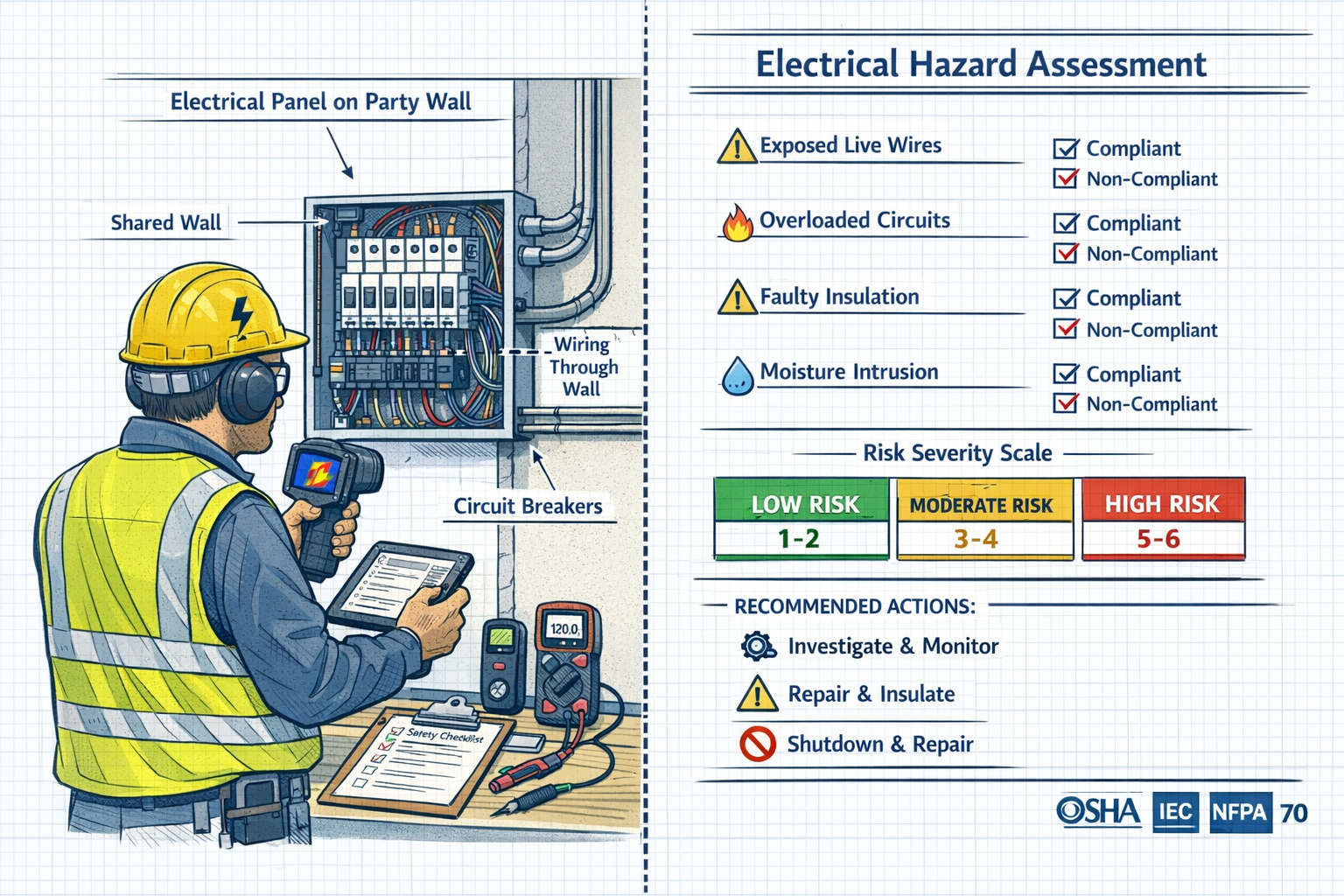
The Party Wall etc. Act 1996 governs construction work affecting shared walls, boundaries, and excavations near adjoining properties. When electrical hazard remediation under Awaab's Law involves work on or near party walls, property owners must follow specific notification procedures.
When Party Wall Notices Are Required for Electrical Work
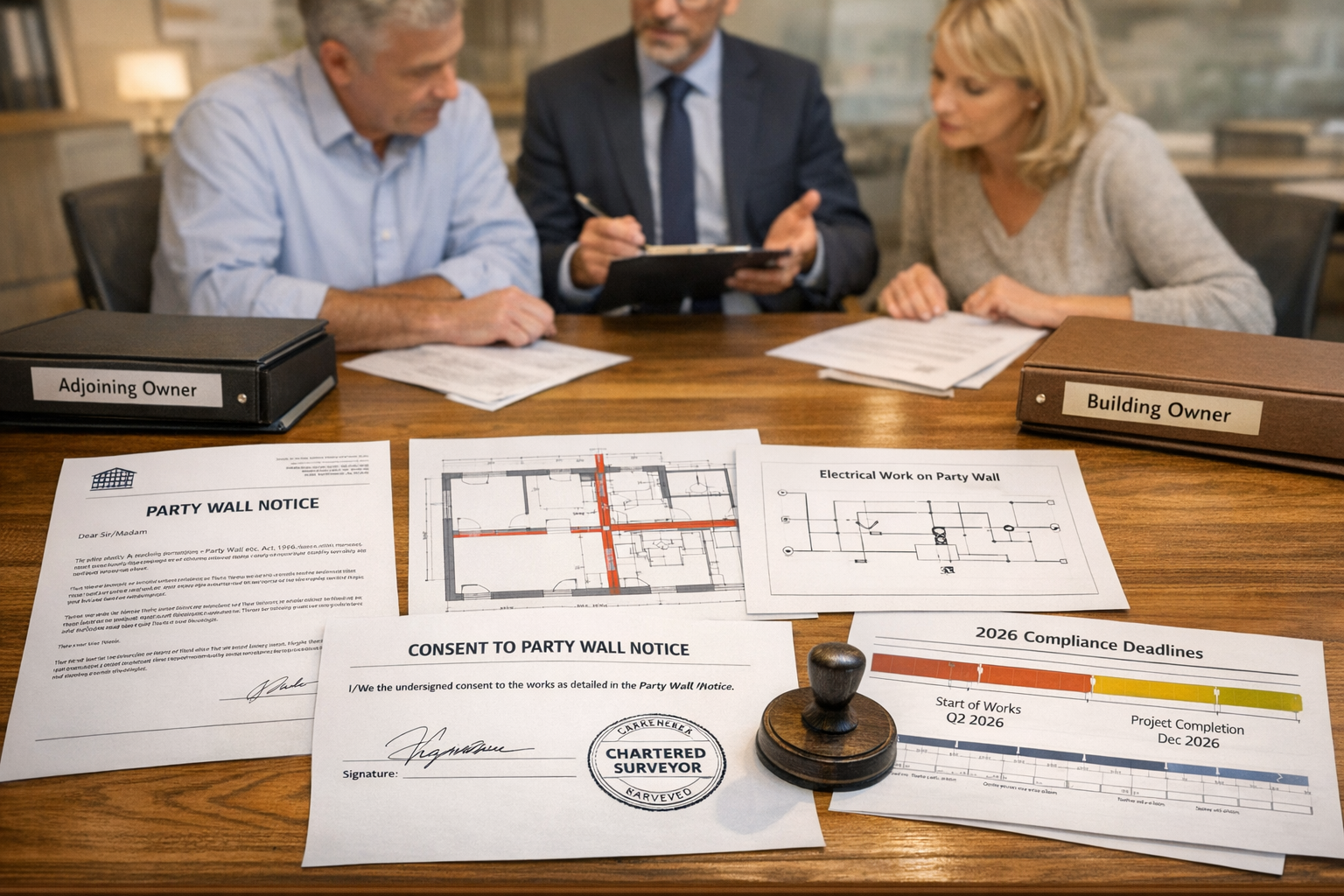
Party Wall Notices for Electrical Hazard Remediation Under Awaab's Law: 2026 Compliance for Adjoining Properties become mandatory when work includes:
✅ Rewiring through party walls – Installing new electrical conduits or cables that penetrate shared structures
✅ Removing or replacing electrical installations – Taking out old wiring systems embedded in party walls
✅ Installing new electrical panels or distribution boards – Mounting equipment on or within party wall structures
✅ Cutting into party walls – Creating chases, recesses, or openings for electrical infrastructure
✅ Strengthening party walls – Reinforcing structures compromised by electrical installations or fire damage
The Party Wall Act guidance establishes three notice types under different sections:
Section 1 Notice – For new walls built on the boundary line (rarely applicable to electrical work)
Section 2 Notice – For work directly to existing party walls (most relevant for electrical remediation)
Section 6 Notice – For excavations within 3-6 meters of adjoining properties (applicable when electrical work requires foundation access)
Notice Periods and Adjoining Owner Rights
Property owners must serve party wall notices at least two months before starting work on existing party structures or one month before for excavation work[1]. The notice must include:
- Detailed description of proposed electrical remediation work
- Drawings showing party wall locations and work scope
- Anticipated start date and duration
- Name and address of the building owner's surveyor (if appointed)
Adjoining owners have three response options:
- Consent in writing – Work proceeds without formal party wall procedures
- Dissent or no response – Triggers the party wall dispute resolution process
- Request modifications – Negotiations occur before formal consent or dissent
When adjoining owners dissent or fail to respond within 14 days, both parties must appoint surveyors to prepare a party wall award – a legally binding document governing the work.
Surveyor Protocols for Electrical Hazard Risk Assessments
Chartered surveyors play a critical role in navigating Party Wall Notices for Electrical Hazard Remediation Under Awaab's Law: 2026 Compliance for Adjoining Properties. Their responsibilities extend beyond traditional party wall matters to encompass specialized electrical safety assessments aligned with 2026 regulatory requirements.
Comprehensive Pre-Work Risk Assessment
Professional surveyors must conduct multi-layered risk assessments that address:
🔍 Electrical Hazard Identification
- Visual inspection of existing electrical installations
- Testing of circuit integrity and earthing systems
- Thermal imaging to detect overheating components
- Assessment of electrical capacity versus demand
- Identification of non-compliant or outdated wiring
🏠 Party Wall Structural Impact Analysis
- Evaluation of how electrical work will affect wall integrity
- Assessment of load-bearing capacity if chasing or cutting required
- Review of fire resistance ratings and compartmentation
- Analysis of sound insulation implications
- Consideration of moisture barrier integrity
⏱️ Awaab's Law Timeframe Compliance
- Classification of hazards as emergency or non-emergency
- Development of remediation timelines meeting statutory deadlines
- Coordination of work schedules with party wall notice periods
- Contingency planning for unexpected hazard discoveries
📋 Documentation Requirements
- Photographic evidence of existing conditions
- Electrical test certificates and reports
- Structural calculations for wall modifications
- Compliance certificates for completed work
The surveyor's risk assessment forms the foundation for both the party wall award and Awaab's Law compliance documentation[4][9].
Specialized Surveyor Qualifications for 2026 Compliance
Given the technical complexity of Party Wall Notices for Electrical Hazard Remediation Under Awaab's Law: 2026 Compliance for Adjoining Properties, surveyors should possess:
- RICS Chartered Surveyor status with building surveying specialization
- Electrical safety training covering HHSRS hazard assessment protocols
- Party Wall Act expertise with experience in dispute resolution
- Awaab's Law compliance knowledge including Phase 2 expansion requirements
- Understanding of social housing regulations and enforcement mechanisms
Many surveyors now collaborate with qualified electricians and fire safety engineers to provide comprehensive assessments that satisfy all regulatory requirements simultaneously.
Drafting Party Wall Awards for Electrical Remediation Projects
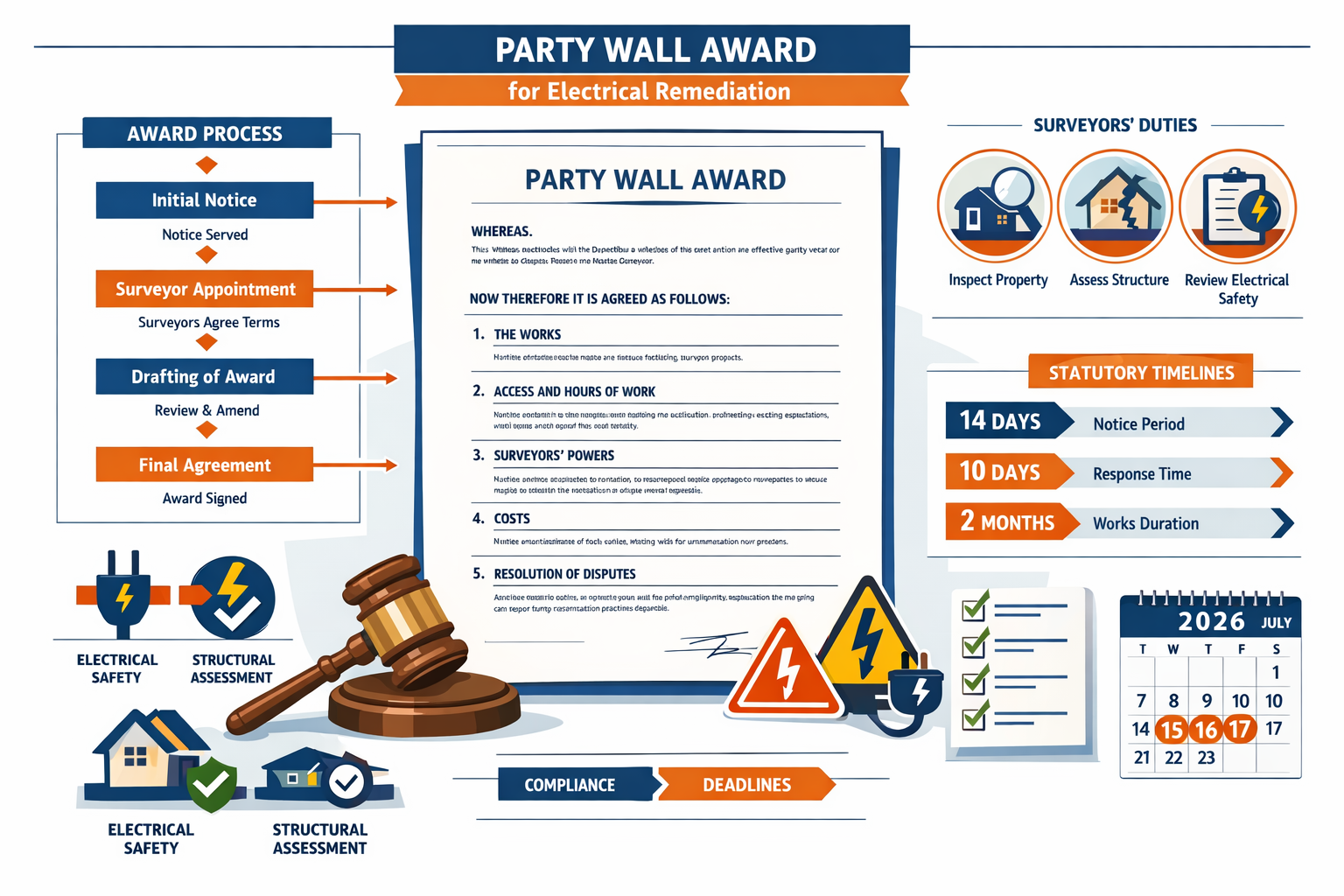
The party wall award represents the formal agreement governing electrical hazard remediation work affecting shared walls. When preparing awards for Party Wall Notices for Electrical Hazard Remediation Under Awaab's Law: 2026 Compliance for Adjoining Properties, surveyors must incorporate specific provisions addressing both party wall protection and regulatory compliance.
Essential Award Components for Electrical Work
A comprehensive party wall award for electrical remediation should include:
1. Detailed Work Scope Description
- Specific electrical hazards being addressed
- Remediation methods and materials
- Extent of party wall involvement
- Access requirements to adjoining property
- Temporary works and protective measures
2. Condition Schedule
- Pre-work photographic survey of party walls
- Documentation of existing cracks, defects, or damage
- Baseline electrical safety assessment
- Record of adjoining owner's property condition
3. Working Hours and Access Provisions
- Permitted working times (typically 8am-6pm weekdays)
- Notice requirements for accessing adjoining property
- Emergency access protocols for urgent hazards
- Restrictions during sensitive periods
4. Protection and Insurance Requirements
- Specifications for dust sheets, barriers, and protective coverings
- Insurance coverage minimums (typically £5-10 million public liability)
- Indemnity provisions for damage or loss
- Security measures for open walls or exposed electrical systems
5. Dispute Resolution Mechanisms
- Process for raising concerns during work
- Third surveyor appointment procedures
- Timelines for addressing disputes
- Cost allocation for additional surveys or assessments
Integrating Awaab's Law Compliance Timeframes
A critical challenge in drafting awards for Party Wall Notices for Electrical Hazard Remediation Under Awaab's Law: 2026 Compliance for Adjoining Properties involves reconciling statutory compliance deadlines with party wall procedural timelines.
⚖️ Balancing Competing Timeframes:
| Requirement | Standard Timeline | Emergency Override |
|---|---|---|
| Party Wall Notice Period | 2 months before work | Can be shortened by agreement |
| Awaab's Law Emergency Response | 24 hours | Takes precedence over notice periods |
| Awaab's Law Investigation | 10 working days | Concurrent with party wall procedures |
| Awaab's Law Remediation Start | 5 days after confirmation | May require expedited awards |
When electrical hazards pose immediate danger, Awaab's Law emergency response requirements may necessitate immediate access to party walls before standard notice periods expire[5]. Surveyors should include emergency provisions in awards that allow:
- Immediate temporary repairs to eliminate imminent danger
- Expedited formal remediation following emergency stabilization
- Retrospective party wall procedures for work completed under emergency powers
- Fair compensation for adjoining owners affected by urgent work
The party wall consent process can be significantly accelerated when both parties understand the regulatory urgency driving the work.
Compliance Challenges and Best Practice Solutions
Navigating Party Wall Notices for Electrical Hazard Remediation Under Awaab's Law: 2026 Compliance for Adjoining Properties presents several practical challenges that require strategic solutions.
Common Compliance Obstacles
🚧 Challenge 1: Adjoining Owner Delays
When adjoining owners delay responding to party wall notices, landlords face potential Awaab's Law deadline violations. The 14-day response window for party wall notices can consume significant portions of the 10-day investigation period.
✅ Solution: Serve party wall notices immediately upon hazard identification, before formal investigation completion. Include preliminary electrical assessment findings to demonstrate urgency. Consider offering adjoining owners incentives for expedited responses, such as upgraded electrical safety checks for their properties.
🚧 Challenge 2: Unexpected Hazard Escalation
Initial electrical assessments may reveal more extensive hazards during remediation, requiring expanded party wall work beyond the original notice scope.
✅ Solution: Draft party wall awards with flexibility provisions allowing scope expansion for related electrical safety work. Include pre-agreed protocols for notifying adjoining owners of additional work requirements and obtain blanket consent for hazard-related modifications within defined parameters.
🚧 Challenge 3: Multi-Property Coordination
Terraced houses and apartment buildings may require simultaneous electrical remediation affecting multiple party walls with different adjoining owners.
✅ Solution: Appoint a single agreed surveyor to act for all parties where possible, streamlining communication and decision-making. Develop standardized party wall awards applicable across multiple boundaries with property-specific schedules of condition. For complex projects, consider our chartered surveyors who specialize in multi-party coordination.
🚧 Challenge 4: Cost Allocation Disputes
Adjoining owners may dispute responsibility for electrical remediation costs when hazards affect shared infrastructure.
✅ Solution: Include clear cost allocation provisions in party wall awards based on:
- Benefit analysis (who benefits from safer electrical systems)
- Causation assessment (whose property originated the hazard)
- Proportional use (relative usage of shared electrical infrastructure)
- Statutory obligations (landlord responsibilities under Awaab's Law)
Documentation Best Practices
Maintaining comprehensive documentation proves essential for demonstrating compliance with both party wall requirements and Awaab's Law obligations:
📄 Essential Documentation Checklist:
- Initial electrical hazard assessment reports
- Party wall notice service records with proof of delivery
- Adjoining owner responses or non-response documentation
- Surveyor appointment letters and acceptance confirmations
- Pre-work condition schedules with timestamped photographs
- Party wall awards with all parties' signatures
- Electrical test certificates and compliance documentation
- Progress reports showing adherence to Awaab's Law timeframes
- Completion certificates and final condition surveys
- Cost breakdowns and payment records
Digital documentation systems increasingly support compliance management, with platforms offering automated deadline tracking, document version control, and audit trails demonstrating regulatory adherence[6].
Regional Considerations and Surveyor Selection
The application of Party Wall Notices for Electrical Hazard Remediation Under Awaab's Law: 2026 Compliance for Adjoining Properties varies across different property types and locations throughout England and Wales.
Property Type Variations
Social Housing Properties
Awaab's Law applies directly to social housing providers, making compliance non-negotiable. Social landlords must demonstrate systematic hazard identification and remediation programs. When electrical work affects party walls in social housing estates, housing associations typically appoint experienced surveyors familiar with both regulatory frameworks.
Private Rental Properties
While Awaab's Law Phase 2 expansion primarily targets social housing, private landlords face similar obligations under existing electrical safety regulations and HHSRS requirements. The convergence of these standards means private landlords conducting electrical remediation should follow comparable procedures to ensure comprehensive compliance.
Owner-Occupied Properties
Owner-occupiers undertaking electrical upgrades that affect party walls must comply with Party Wall Act requirements regardless of Awaab's Law applicability. However, understanding the regulatory standards helps ensure work meets best practice electrical safety standards.
Selecting Qualified Surveyors
Choosing the right surveyor proves critical for successful navigation of Party Wall Notices for Electrical Hazard Remediation Under Awaab's Law: 2026 Compliance for Adjoining Properties. Consider surveyors with:
✨ Proven party wall experience in residential properties
✨ Electrical safety assessment qualifications or collaborative relationships with electrical engineers
✨ Social housing sector knowledge for Awaab's Law compliance
✨ Local area expertise understanding regional property characteristics
For projects in specific locations, specialized local knowledge proves invaluable. Property owners can access chartered surveyors in North London, chartered surveyors in West London, or chartered surveyors in South East London who understand local building characteristics and common electrical hazard patterns.
Future Regulatory Developments and Preparedness
The regulatory landscape surrounding Party Wall Notices for Electrical Hazard Remediation Under Awaab's Law: 2026 Compliance for Adjoining Properties continues evolving as enforcement data emerges and best practices develop.
Anticipated Regulatory Trends
📈 Expanded Enforcement
The 42% increase in hazard-related complaints during Q1 2026 suggests heightened tenant awareness and regulatory scrutiny[9]. Enforcement agencies are likely to increase inspection frequencies and penalty applications, making proactive compliance essential.
🔧 Technology Integration
Digital tools increasingly support Awaab's Law compliance, with platforms offering:
- Automated hazard reporting and tracking systems
- Predictive maintenance algorithms identifying electrical risks
- Digital party wall notice service and response management
- Integrated compliance dashboards showing real-time status
These technological solutions help landlords and surveyors manage complex compliance requirements more efficiently[6].
⚖️ Case Law Development
As disputes arise regarding Party Wall Notices for Electrical Hazard Remediation Under Awaab's Law: 2026 Compliance for Adjoining Properties, court decisions will establish precedents clarifying:
- Emergency access rights versus party wall procedural requirements
- Cost allocation principles for hazard remediation affecting multiple properties
- Standard of care expectations for surveyors managing dual compliance obligations
- Compensation frameworks for adjoining owners affected by urgent electrical work
🏛️ Potential Private Sector Extension
Government consultations suggest Awaab's Law principles may eventually extend to private rental sectors beyond social housing. Property owners should anticipate similar compliance requirements becoming universal standards for all rental properties.
Proactive Compliance Strategies
Forward-thinking property owners can prepare for evolving requirements by:
1. Conducting Preventive Electrical Assessments
Regular electrical safety inspections identify hazards before they become emergencies, allowing planned remediation with full party wall compliance rather than rushed emergency work.
2. Establishing Surveyor Relationships
Building ongoing relationships with qualified surveyors familiar with your properties enables rapid response when hazards emerge. Consider retainer arrangements for multi-property portfolios.
3. Implementing Digital Management Systems
Adopting compliance management platforms creates audit trails demonstrating systematic hazard management and regulatory adherence.
4. Educating Adjoining Owners
Proactively informing adjoining owners about Awaab's Law requirements and potential electrical work needs builds understanding and facilitates smoother party wall procedures when remediation becomes necessary.
5. Budgeting for Compliance
Allocating dedicated budgets for electrical safety assessments, party wall procedures, and remediation work ensures financial readiness for compliance requirements.
For comprehensive property assessments supporting compliance planning, consider RICS building surveys that identify potential electrical hazards and party wall considerations before they become urgent issues.
Conclusion
Party Wall Notices for Electrical Hazard Remediation Under Awaab's Law: 2026 Compliance for Adjoining Properties represents a complex intersection of housing safety legislation and property law that demands specialized expertise and meticulous planning. The expansion of Awaab's Law to encompass electrical hazards, combined with increased penalties reaching £40,000 for non-compliance, makes understanding these requirements essential for landlords, property managers, and surveyors operating in 2026.
The key to successful compliance lies in recognizing that electrical hazard remediation affecting party walls triggers dual obligations: the statutory timeframes established by Awaab's Law (24 hours for emergencies, 10 days for investigations, 5 days to begin remediation) and the procedural requirements of the Party Wall etc. Act 1996 (two-month notice periods, formal surveyor appointments, and detailed party wall awards).
Actionable Next Steps
Property owners and managers should take these immediate actions:
🎯 Commission comprehensive electrical safety assessments for all properties with party walls to identify potential hazards before they become emergencies
🎯 Establish relationships with qualified surveyors experienced in both party wall procedures and Awaab's Law compliance requirements
🎯 Review existing party wall documentation to determine if electrical work provisions need updating or if new notices are required
🎯 Implement digital compliance tracking systems to monitor hazard identification, remediation timelines, and party wall procedure deadlines
🎯 Educate adjoining property owners about potential electrical remediation needs to facilitate smoother party wall consent processes
🎯 Allocate appropriate budgets for surveyor fees, party wall awards, electrical assessments, and remediation work
For expert guidance on navigating Party Wall Notices for Electrical Hazard Remediation Under Awaab's Law: 2026 Compliance for Adjoining Properties, consult with specialized chartered surveyors who understand the technical and legal complexities of this evolving regulatory landscape. Additional resources on party wall procedures and party wall FAQs provide further guidance for property owners facing these compliance challenges.
The convergence of electrical safety regulations and party wall requirements demands proactive management, specialized expertise, and comprehensive documentation. By understanding these obligations and implementing systematic compliance strategies, property owners can protect tenant safety, maintain positive relationships with adjoining owners, and avoid substantial financial penalties in the evolving regulatory environment of 2026.
References
[1] Awaabs Law Social Housing Compliance – https://rebim.io/awaabs-law-social-housing-compliance/
[2] Awaabs Law Technical Compliance Hvac Ventilation – https://www.arm-environments.com/resources/awaabs-law-technical-compliance-hvac-ventilation
[3] Awaabs Law – https://www.apizee.com/awaabs-law.php
[4] Awaabs Law 2026 Hazard Expansions Surveyor Protocols For Electrical Fire And Excess Heat Risks In Rentals – https://nottinghillsurveyors.com/blog/awaabs-law-2026-hazard-expansions-surveyor-protocols-for-electrical-fire-and-excess-heat-risks-in-rentals
[5] Awaabs Law Guidance For Social Landlords Timeframes For Repairs In The Social Rented Sector – https://www.gov.uk/government/publications/awaabs-law-guidance-for-social-landlords/awaabs-law-guidance-for-social-landlords-timeframes-for-repairs-in-the-social-rented-sector
[6] How Digital Tools Help Social Landlords Meet Awaabs Law – https://www.trimble.com/blog/construction/en-US/article/how-digital-tools-help-social-landlords-meet-awaabs-law
[7] Awaabs Law Damp And Mould In The Social Housing Sector – https://www.titon.com/blog-ventilation/awaabs-law-damp-and-mould-in-the-social-housing-sector
[8] Awaabs Law A Guide For Social And Private Landlords – https://cydinnovation.com/knowledge_hub/awaabs-law-a-guide-for-social-and-private-landlords/
[9] Expert Witness Preparation For Awaabs Law 2026 Expansions Testifying On New Rental Hazards Like Fire And Electrical Risks – https://nottinghillsurveyors.com/blog/expert-witness-preparation-for-awaabs-law-2026-expansions-testifying-on-new-rental-hazards-like-fire-and-electrical-risks