The built environment accounts for nearly 40% of global carbon emissions, yet until recently, property valuations rarely factored in a building's carbon footprint. In 2026, this oversight is rapidly becoming obsolete as lenders, investors, and regulators demand carbon accountability in every transaction. The convergence of RICS Whole Life Carbon Assessment (WLCA) standards and PAS 2080:2023 has fundamentally transformed how surveyors evaluate properties, with carbon performance now directly influencing lending decisions and property values across the UK market.
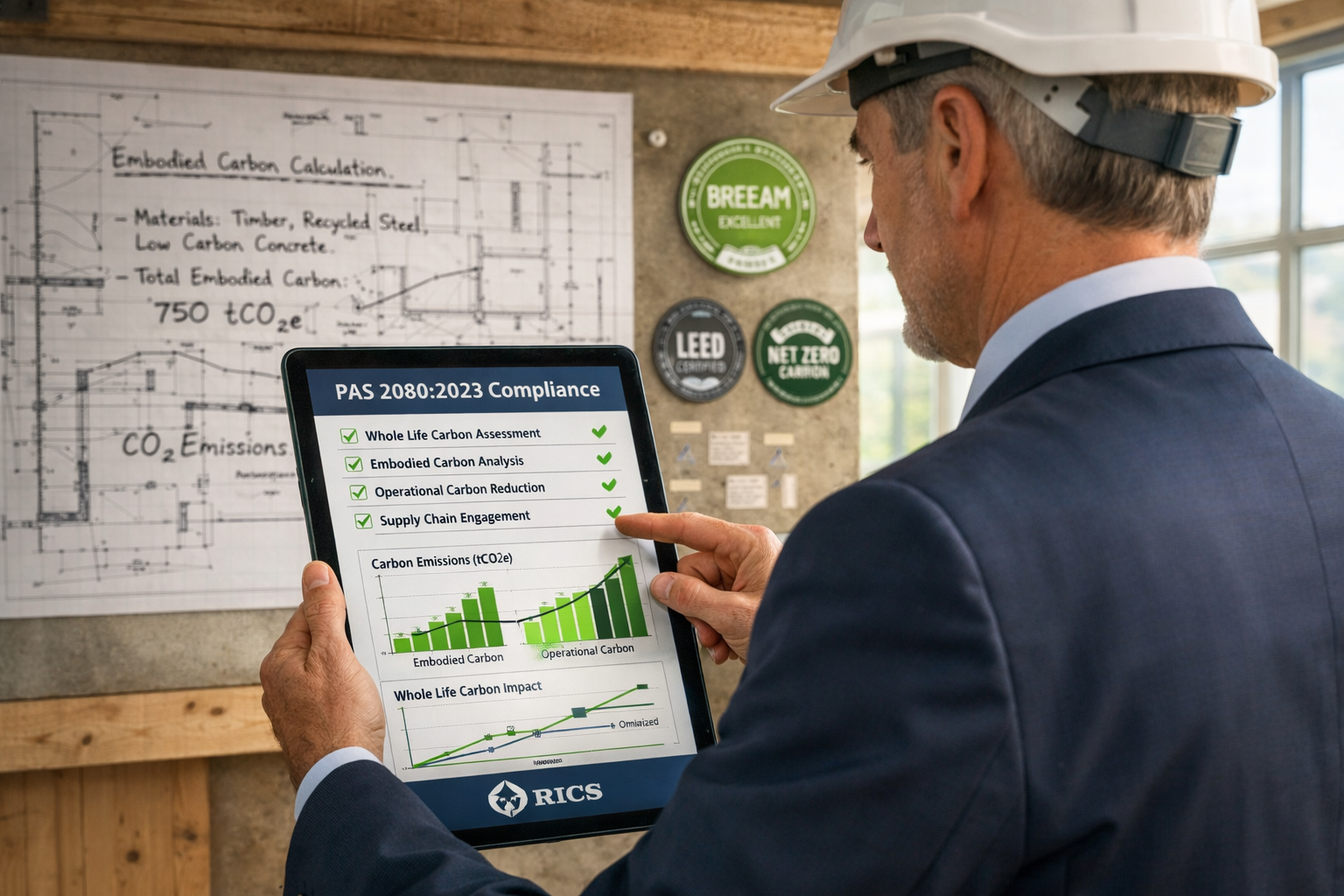
Valuation Surveys Incorporating Whole Life Carbon Under PAS 2080:2023: RICS Standards for 2026 Green Transactions represents a paradigm shift in property assessment methodology. Surveyors must now audit embodied carbon alongside traditional structural and financial metrics, creating a comprehensive picture of a property's true environmental and economic value. This integration affects everything from RICS valuation reports to building surveys, fundamentally reshaping green transaction protocols.
Key Takeaways
- Mandatory Carbon Auditing: RICS WLCA 2nd edition (effective July 2024) requires surveyors to measure and report whole life carbon in valuations, directly impacting property values and lending decisions
- Integrated Framework: PAS 2080:2023 provides governance processes while RICS WLCA delivers measurement methodology, creating a comprehensive carbon management system for buildings and infrastructure
- Financial Impact: Properties with lower carbon footprints command premium valuations, with retrofit projects demonstrating 15-25% value increases in green finance markets
- Regulatory Alignment: UK government bodies including NHS and Department for Education have adopted these standards, signaling widespread regulatory enforcement ahead
- Systems Thinking Approach: Carbon budgets are now tracked throughout project lifecycles, making emission reductions a shared responsibility across the entire value chain
Understanding the RICS WLCA and PAS 2080:2023 Framework
The Evolution of Carbon Standards in Property Valuation
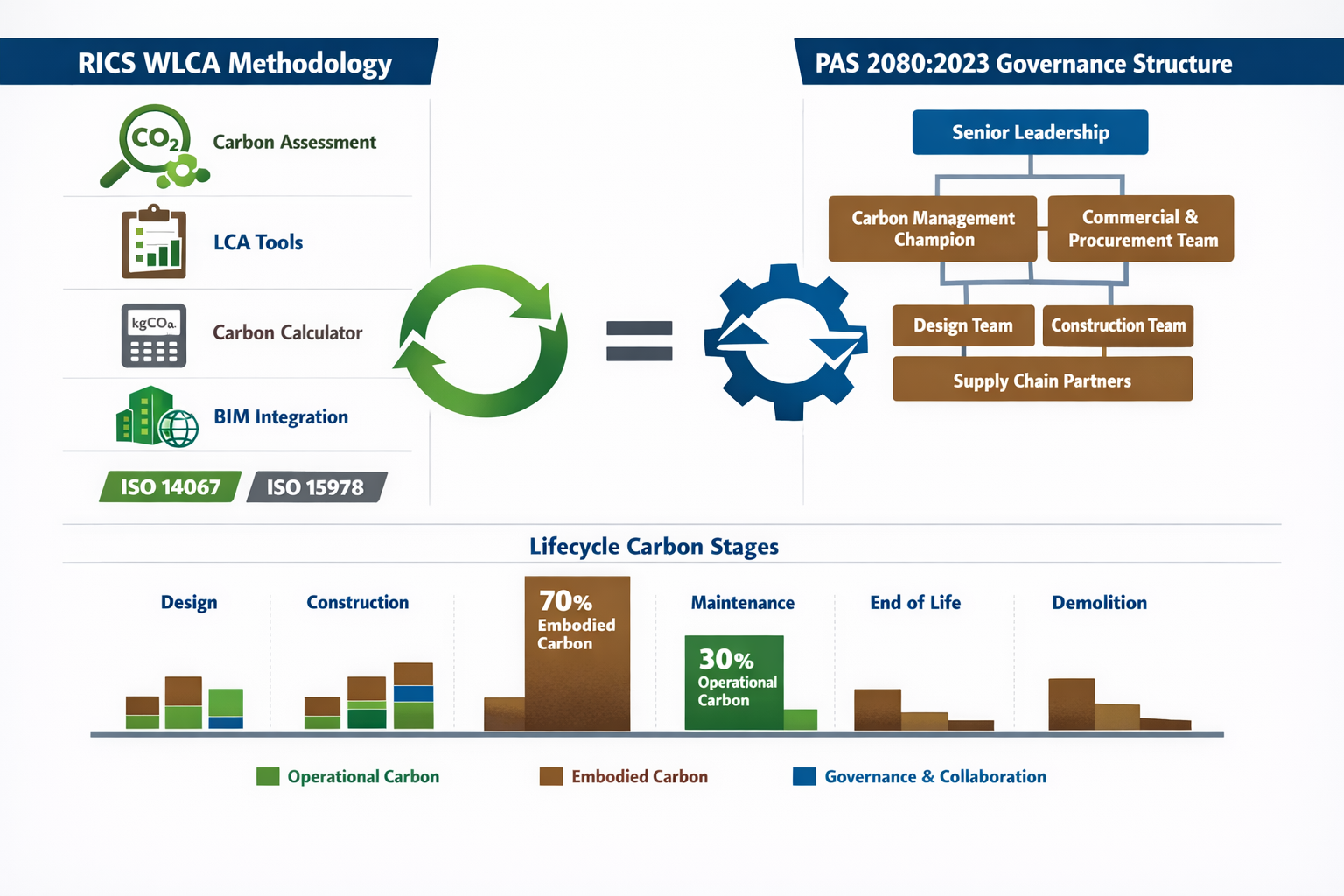
The RICS Whole Life Carbon Assessment standard 2nd edition came into effect on July 1, 2024, marking a watershed moment for property professionals. This methodology aligns with ISO/TC 59/SC 17 Sustainability in buildings and civil engineering works, establishing globally recognized benchmarks for carbon measurement [1]. The standard provides surveyors with a systematic approach to quantifying both operational carbon (energy consumed during building use) and embodied carbon (emissions from materials, construction, and eventual demolition).
Simultaneously, PAS 2080:2023 underwent significant expansion, being renamed from its infrastructure-focused origins to "Carbon Management in Buildings and Infrastructure" [3]. This revision reflects the standard's broader application across the entire built environment, addressing the critical interfaces between buildings and infrastructure systems.
How RICS WLCA and PAS 2080:2023 Work Together
The relationship between these two standards creates a powerful complementary framework:
| Standard | Primary Function | Key Focus Areas |
|---|---|---|
| RICS WLCA | Measurement methodology | Quantifying carbon across lifecycle stages, data collection protocols, reporting formats |
| PAS 2080:2023 | Governance framework | Roles and responsibilities, carbon budgets, procurement processes, value chain management |
RICS WLCA provides the "what to measure" while PAS 2080:2023 specifies the "how to manage" throughout a building's lifecycle [1][2]. This integration enables surveyors conducting Red Book valuations to deliver comprehensive assessments that satisfy both measurement accuracy and governance requirements.
Key Principles of Systems Thinking in Carbon Management
PAS 2080:2023 applies systems thinking to carbon management, recognizing that emission reductions require coordinated action across multiple stakeholders [1]. For surveyors, this means:
✅ Tracking carbon budgets from initial design through demolition
✅ Identifying intervention points where design changes yield maximum carbon savings
✅ Engaging the entire value chain in emission reduction targets
✅ Balancing trade-offs between embodied carbon, operational efficiency, and climate resilience
This approach transforms carbon management from a compliance checkbox into a strategic decision-making tool that influences property values, insurance premiums, and financing terms.
Implementing Valuation Surveys Incorporating Whole Life Carbon Under PAS 2080:2023 in 2026 Practice
Essential Components of Carbon-Integrated Valuations
Modern chartered surveyors conducting valuations in 2026 must incorporate several new assessment components:
1. Embodied Carbon Calculation 🏗️
Surveyors analyze materials used in construction, quantifying the carbon footprint of structural elements, finishes, and building systems. This includes:
- Extraction and manufacturing emissions
- Transportation to site
- Installation processes
- Replacement cycles over building lifespan
- End-of-life disposal or recycling
2. Operational Carbon Projection ⚡
Assessment of energy consumption patterns based on building systems, insulation performance, and anticipated usage profiles. This extends traditional energy performance certificate (EPC) analysis to provide lifecycle projections.
3. Carbon Budget Compliance 📊
Verification that the property meets or exceeds carbon reduction targets established by PAS 2080:2023 governance frameworks, particularly for properties involving public sector funding or institutional investment.
4. Retrofit Potential Analysis 🔧
Evaluation of opportunities to reduce whole life carbon through interventions such as:
- Improved insulation and air tightness
- Low-carbon heating systems
- Renewable energy integration
- Material substitution in planned renovations
Alignment with International Cost Management Standards
The RICS WLCA methodology aligns seamlessly with the International Cost Management Standards (ICMS) 3rd Edition, enabling surveyors to measure and report both carbon and life cycle costs in an integrated manner [1][2]. This alignment is particularly valuable for commercial property valuations where investors demand comprehensive financial and environmental performance metrics.
The integration allows for:
💰 Cost-Carbon Trade-off Analysis: Identifying interventions that deliver optimal financial returns alongside carbon reductions
📈 Lifecycle Financial Modeling: Projecting operational savings from carbon-efficient systems over 25-60 year horizons
🎯 Investment Decision Support: Providing data-driven recommendations for sustainable property portfolios
Data Collection and Verification Protocols
Implementing Valuation Surveys Incorporating Whole Life Carbon Under PAS 2080:2023: RICS Standards for 2026 Green Transactions requires rigorous data collection:
Primary Data Sources:
- Building specifications and material bills of quantities
- Energy consumption records (minimum 12 months)
- Maintenance and replacement histories
- Transportation and logistics documentation
Secondary Data Sources:
- Industry-standard carbon factors (UK-based assumptions per RICS guidance) [5]
- Manufacturer environmental product declarations (EPDs)
- Regional energy grid carbon intensity factors
- Benchmark data from comparable properties
The RICS WLCA methodology is globally applicable; however, numerical assumptions are based on UK locations and standard practices due to data availability [5]. Surveyors working on international properties must adapt these assumptions to local contexts while maintaining methodological consistency.
The Impact of Carbon Standards on Property Values and Lending Decisions
How Carbon Performance Influences Valuations
The integration of whole life carbon assessment into property valuations creates tangible financial impacts. Properties demonstrating superior carbon performance command premium valuations for several reasons:
1. Reduced Operating Costs 💵
Lower operational carbon typically correlates with reduced energy consumption, translating to decreased utility expenses. For commercial properties, this directly impacts net operating income and capitalization rates.
2. Regulatory Risk Mitigation ⚖️
Properties meeting PAS 2080:2023 standards face lower risk of obsolescence as carbon regulations tighten. The UK government's adoption of these standards across NHS and Department for Education estates signals broader regulatory enforcement ahead [4].
3. Enhanced Marketability 🌟
Green-certified properties attract environmentally conscious tenants willing to pay premium rents, while also appealing to ESG-focused investors with substantial capital reserves.
4. Access to Green Finance 🏦
Lenders increasingly offer preferential terms for properties with verified low-carbon credentials, including:
- Reduced interest rates (typically 0.25-0.75% below standard rates)
- Higher loan-to-value ratios
- Extended amortization periods
- Expedited approval processes
Case Study: Commercial Retrofit Delivering Value Uplift
A 2025 Manchester office building retrofit demonstrates the financial impact of carbon-focused improvements:
Pre-Retrofit Profile:
- 1970s construction with high embodied carbon materials
- EPC Rating: D
- Whole Life Carbon: 1,850 kgCO2e/m²
- Market Value: £2.8 million
Retrofit Interventions:
- External wall insulation (reducing operational carbon)
- Air source heat pump installation
- LED lighting and smart building controls
- Partial facade replacement with low-carbon alternatives
Post-Retrofit Profile:
- EPC Rating: B
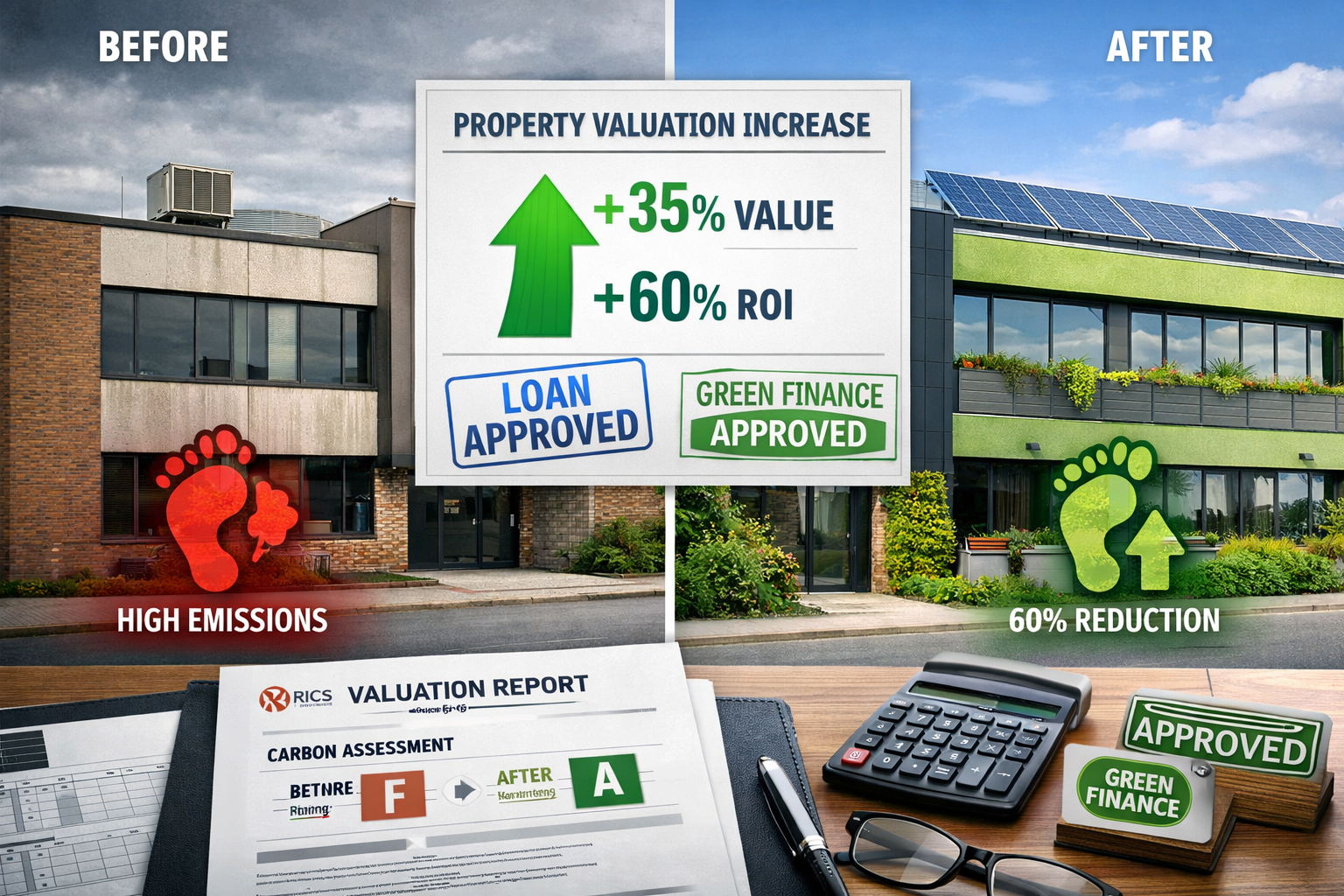
- Whole Life Carbon: 720 kgCO2e/m² (61% reduction)
- Market Value: £3.4 million (21% increase)
- Green finance secured at 3.2% (vs. 4.1% standard rate)
This case illustrates how structural surveys incorporating carbon assessment can identify value-creation opportunities that traditional valuations overlook.
Lender Requirements and Sustainability Mandates
Major UK lenders have implemented sustainability mandates requiring carbon disclosure for commercial property transactions exceeding £1 million. Typical requirements include:
✔️ RICS WLCA-compliant carbon assessment conducted by qualified surveyor
✔️ PAS 2080:2023 governance documentation demonstrating carbon management processes
✔️ Decarbonization roadmap outlining pathway to net-zero alignment
✔️ Climate risk assessment addressing physical and transition risks
Properties failing to meet these requirements face:
- Loan application rejection or referral for manual underwriting
- Higher interest rate premiums (50-100 basis points)
- Reduced maximum loan amounts
- Mandatory escrow accounts for planned carbon reduction works
Government Adoption and Regulatory Landscape
Public Sector Leadership in Carbon Standards
UK government bodies have emerged as early adopters of integrated carbon management frameworks. The NHS and Department for Education have incorporated PAS 2080 and RICS methodology into their estate management standards [4]. The Department for Education's Education Estates Strategy reaffirms commitment to emissions reductions supporting UK Government net zero targets, requiring carbon assessments for all new construction and major renovation projects.
This public sector leadership creates a cascade effect throughout the property market:
🏛️ Procurement Requirements: Contractors and consultants serving public clients must demonstrate carbon management capabilities
📋 Standard Setting: Public sector specifications become de facto industry standards
💼 Skills Development: Professional development programs align with government-mandated competencies
🔄 Supply Chain Pressure: Manufacturers and suppliers adapt offerings to meet carbon requirements
Nature-Based Solutions and Climate Resilience Integration
The 2023 revision of PAS 2080 emphasizes the interrelationships between nature-based solutions and climate resilience [3]. This expanded scope recognizes that carbon management cannot be divorced from broader sustainability considerations.
For surveyors conducting homebuyer surveys or comprehensive building surveys, this means evaluating:
🌳 Green infrastructure: Trees, green roofs, and permeable surfaces that sequester carbon while managing flood risk
💧 Water management systems: Sustainable drainage reducing operational carbon from water treatment
🌡️ Passive climate control: Natural ventilation and thermal mass reducing mechanical system dependence
🐝 Biodiversity enhancement: Habitat creation supporting ecosystem services
Procurement Mechanisms Accelerating Decarbonization
PAS 2080:2023 outlines procurement mechanisms designed to accelerate decarbonization across the value chain [3]. Key approaches include:
Carbon Capping: Setting maximum carbon budgets for projects with financial penalties for exceedance
Performance-Based Contracting: Linking payment milestones to verified carbon reduction achievements
Supply Chain Transparency: Requiring EPDs and carbon declarations from all material suppliers
Innovation Incentives: Rewarding contractors who deliver carbon savings beyond baseline requirements
These mechanisms create market incentives for continuous improvement in carbon performance, driving innovation in low-carbon construction methods and materials.
Practical Implementation for Surveyors in 2026
Essential Tools and Resources
Surveyors implementing Valuation Surveys Incorporating Whole Life Carbon Under PAS 2080:2023: RICS Standards for 2026 Green Transactions require specialized tools:
Software Platforms:
- RICS-approved whole life carbon calculators
- Building information modeling (BIM) software with carbon analysis modules
- Energy modeling platforms (IES, DesignBuilder, TAS)
- Lifecycle cost analysis tools with carbon integration
Reference Materials:
- RICS WLCA Professional Standard (2nd Edition)
- PAS 2080:2023 full specification document
- UK Government carbon factors database
- Industry-specific carbon benchmarks
Professional Development:
- RICS-accredited WLCA training courses
- PAS 2080 implementation workshops
- Continuing professional development (CPD) in sustainable construction
- Cross-disciplinary collaboration with environmental consultants
Integration with Existing Survey Types
Carbon assessment integrates across multiple survey types offered by professional practices:
RICS Home Surveys: Residential properties now include basic carbon footprint estimates and retrofit recommendations for homeowners seeking to reduce environmental impact and energy costs.
Dilapidations Surveys: Lease-end assessments evaluate whether tenant alterations improved or degraded the property's carbon performance, affecting reinstatement obligations.
Reinstatement Valuations: Insurance valuations now account for the cost of replacing buildings with equivalent carbon performance, often requiring premium materials and construction methods.
Specific Defect Surveys: Targeted investigations assess whether defects (such as thermal bridging or air leakage) contribute to excessive operational carbon.
Overcoming Implementation Challenges
Surveyors face several challenges when implementing carbon-integrated valuations:
Data Availability 📊
Historical buildings often lack comprehensive material documentation. Surveyors must develop estimation methodologies based on construction period norms, visual inspection, and selective material testing.
Valuation Uncertainty ❓
The market is still developing pricing mechanisms for carbon performance. Surveyors should:
- Reference comparable sales with verified carbon credentials
- Apply scenario analysis showing value ranges under different carbon pricing assumptions
- Clearly document assumptions and limitations in valuation reports
Client Education 🎓
Many property owners remain unfamiliar with carbon assessment requirements. Effective communication strategies include:
- Visual presentations showing carbon impact in relatable terms
- Financial modeling demonstrating return on investment for carbon reduction measures
- Regulatory roadmaps illustrating future compliance requirements
Interdisciplinary Collaboration 🤝
Carbon assessment requires expertise spanning surveying, engineering, and environmental science. Successful practices develop networks of specialist consultants and invest in cross-training team members.
Future Trends and Emerging Developments
Evolution Toward Real-Time Carbon Monitoring
The next frontier in Valuation Surveys Incorporating Whole Life Carbon Under PAS 2080:2023: RICS Standards for 2026 Green Transactions involves real-time monitoring systems. Smart building technologies enable continuous tracking of operational carbon, with data feeds directly informing property valuations.
Emerging capabilities include:
- IoT sensors measuring energy consumption at granular levels
- Blockchain-verified carbon credits linked to building performance
- AI-powered optimization algorithms reducing operational carbon in real-time
- Digital twins enabling scenario testing for retrofit interventions
Expansion of Carbon Markets
Carbon pricing mechanisms are evolving from abstract policy concepts to tangible market forces affecting property values. Developments to watch include:
Shadow Carbon Pricing: Institutional investors applying internal carbon prices (typically £50-150 per tonne CO2e) when evaluating property acquisitions, effectively reducing valuations for high-carbon assets.
Mandatory Disclosure Regimes: Expansion of requirements similar to Energy Performance Certificates to include whole life carbon declarations for all property transactions.
Carbon-Linked Mortgages: Residential mortgage products with interest rates tied to property carbon performance, creating direct financial incentives for homeowners to improve efficiency.
International Harmonization Efforts
While RICS WLCA methodology is globally applicable, regional variations in carbon factors and construction practices create challenges for international property portfolios [5]. Ongoing standardization efforts aim to:
- Develop globally consistent carbon factor databases
- Establish mutual recognition agreements between national standards bodies
- Create conversion protocols enabling comparison across different assessment frameworks
- Align with emerging EU taxonomy requirements for sustainable activities
Conclusion
The integration of whole life carbon assessment into property valuations represents a fundamental transformation in surveying practice. Valuation Surveys Incorporating Whole Life Carbon Under PAS 2080:2023: RICS Standards for 2026 Green Transactions is no longer an emerging trend but an established requirement shaping lending decisions, property values, and investment strategies across the UK market.
The complementary framework of RICS WLCA measurement methodology and PAS 2080:2023 governance processes provides surveyors with robust tools to quantify and manage carbon throughout building lifecycles. Properties demonstrating superior carbon performance command premium valuations, access preferential financing terms, and face reduced regulatory risk as climate policies tighten.
For property professionals, the imperative is clear: developing carbon assessment competencies is essential to remaining relevant in 2026 and beyond. The convergence of environmental imperatives, regulatory mandates, and financial incentives has created an irreversible shift toward carbon-conscious property transactions.
Actionable Next Steps
For Surveyors:
- Complete RICS-accredited WLCA training and PAS 2080 implementation courses
- Invest in carbon assessment software and establish data collection protocols
- Develop referral networks with environmental consultants and sustainability specialists
- Update standard survey templates to incorporate carbon assessment sections
- Communicate carbon integration benefits to existing clients through case studies
For Property Owners:
6. Commission RICS valuation surveys incorporating whole life carbon assessment
7. Develop decarbonization roadmaps identifying cost-effective retrofit opportunities
8. Engage with lenders offering green finance products for carbon reduction projects
9. Maintain comprehensive documentation of materials, energy consumption, and maintenance activities
For Investors and Lenders:
10. Establish carbon performance thresholds for portfolio acquisitions
11. Integrate whole life carbon metrics into underwriting criteria
12. Develop green finance products incentivizing carbon reduction
13. Require PAS 2080:2023 governance documentation for commercial transactions
The transition to carbon-integrated property valuation creates both challenges and opportunities. Those who embrace these standards position themselves at the forefront of sustainable property markets, while those who delay risk obsolescence in an increasingly carbon-conscious economy.
References
[1] Rics And Ice Harmonise Messaging On Carbon Assessment And Manage – https://www.rics.org/news-insights/rics-and-ice-harmonise-messaging-on-carbon-assessment-and-manage
[2] pbctoday.co.uk – https://www.pbctoday.co.uk/news/planning-construction-news/five-hot-topics-for-surveyors-spring-2026/158511/
[3] Pas 2080 2023 Guidance Document For Pas 2800 – https://www.scribd.com/document/780163397/PAS-2080-2023-Guidance-Document-for-PAS-2800
[4] Nista Wlc Management Handbook 2026 – https://assets.publishing.service.gov.uk/media/69a81a47b9bd90e63a252292/NISTA_WLC_Management_Handbook_2026.pdf
[5] Whole Life Carbon Assessment – https://www.rics.org/profession-standards/rics-standards-and-guidance/sector-standards/construction-standards/whole-life-carbon-assessment