More than 4,700 excess cold-related deaths occur annually in England and Wales, with private rental sector (PRS) properties disproportionately affected due to inadequate heating systems and poor insulation. As Awaab's Law enters Phase 2 implementation in 2026, excess cold hazards now join damp and mould as priority risks requiring urgent landlord action—fundamentally changing how Level 3 Surveys for Excess Cold Hazards Under Awaab's Law: 2026 PRS Compliance Checklists must be conducted across rental portfolios.
The tragic death of two-year-old Awaab Ishak from prolonged mould exposure in 2020 catalysed legislative reform that now extends far beyond its original damp and mould focus. Private landlords face strict investigation timelines, mandatory written summaries to tenants, and person-centred assessment protocols that prioritize vulnerable occupants over traditional hazard scoring systems. Understanding Level 3 Surveys for Excess Cold Hazards Under Awaab's Law: 2026 PRS Compliance Checklists is no longer optional—it's essential for avoiding enforcement action and protecting tenant welfare.
Key Takeaways
- ✅ Phase 2 expansion: Excess cold hazards joined the regulatory framework in 2026, requiring landlords to investigate significant cold risks within 10 working days and complete remedial works within strict timeframes [5]
- 🔍 Level 3 surveys recommended: Comprehensive building surveys identify multiple HHSRS hazards simultaneously—including excess cold, fire, and electrical issues—rather than single-hazard inspections [2]
- 👥 Person-centred approach: Vulnerability assessments for elderly tenants, children, and those with respiratory conditions determine hazard significance, potentially elevating Category 2 hazards to significant status requiring urgent action [5]
- 📋 Documentation requirements: Landlords must provide written summaries to tenants within 3 working days of investigation completion, detailing identified hazards, planned actions, and timeframes [4]
- 🏗️ Retrofit integration: Survey reports must include thermal imaging data, heating system assessments, and costed retrofit recommendations to demonstrate compliance with excess cold remediation obligations [1]
Understanding Awaab's Law Phase 2: Excess Cold Hazards in 2026
The Regulatory Evolution from Damp to Temperature Hazards
Awaab's Law initially focused on damp and mould hazards when Phase 1 launched in October 2025, establishing strict investigation and repair timeframes for social housing providers. The 2026 Phase 2 expansion fundamentally broadens this scope to include excess cold, excess heat, falls, structural collapse, fire, and electrical hazards—transforming the regulatory landscape for private rental sector landlords [5].
This expansion reflects growing recognition that temperature-related hazards pose severe health risks, particularly for vulnerable populations. Excess cold contributes to cardiovascular disease, respiratory illness, and increased winter mortality rates. Unlike the original Housing Health and Safety Rating System (HHSRS) approach that relied purely on numerical scoring, Awaab's Law applies a person-centred assessment standard that considers household composition and tenant vulnerability when determining hazard significance [5].
Emergency vs. Significant Hazard Classification
Understanding the distinction between emergency and significant hazards is crucial for Level 3 Surveys for Excess Cold Hazards Under Awaab's Law: 2026 PRS Compliance Checklists. The classification determines response timelines:
| Hazard Type | Investigation Timeline | Works Completion | Examples in Excess Cold Context |
|---|---|---|---|
| Emergency | Inspection within 24 hours | Initial safety work within 24 hours | Complete heating system failure in winter with vulnerable occupants; no alternative heating source |
| Significant | Investigation within 10 working days | Complete works within 5 working days OR begin within 5 days and complete within 12 weeks for complex works | Inadequate heating capacity for property size; single-glazed windows with elderly tenant; broken heating controls affecting vulnerable child |
The person-centred approach means an excess cold hazard that would traditionally score as HHSRS Category 2 (lower risk) may be reclassified as significant if it affects elderly residents, young children, or tenants with respiratory conditions such as asthma or COPD [5].
Written Summary Documentation: The 3-Day Requirement
One of Awaab's Law's most significant compliance obligations is the mandatory written summary to tenants. Within 3 working days after investigation completion, landlords must provide documentation stating [4]:
- ✍️ Whether a significant or emergency hazard was identified
- 🔧 Specific actions to be taken to remediate the hazard
- 📅 Relevant timeframes for works completion
- ❌ Justification if no action is required (with supporting evidence)
For excess cold investigations, this summary must reference thermal imaging data, heating system assessments, and insulation surveys conducted during the Level 3 building survey. The written summary creates a permanent compliance record and demonstrates landlord accountability to both tenants and enforcement authorities.
Conducting Level 3 Surveys for Excess Cold Hazards Under Awaab's Law: 2026 PRS Compliance Checklists
Why Level 3 Building Surveys Are Essential for PRS Compliance
Traditional single-hazard inspections no longer meet the comprehensive assessment requirements under Awaab's Law Phase 2. Level 3 building surveys—the most detailed RICS survey type—provide the systematic, multi-hazard evaluation necessary for 2026 compliance [2].
A compliant Level 3 survey for excess cold hazards must include:
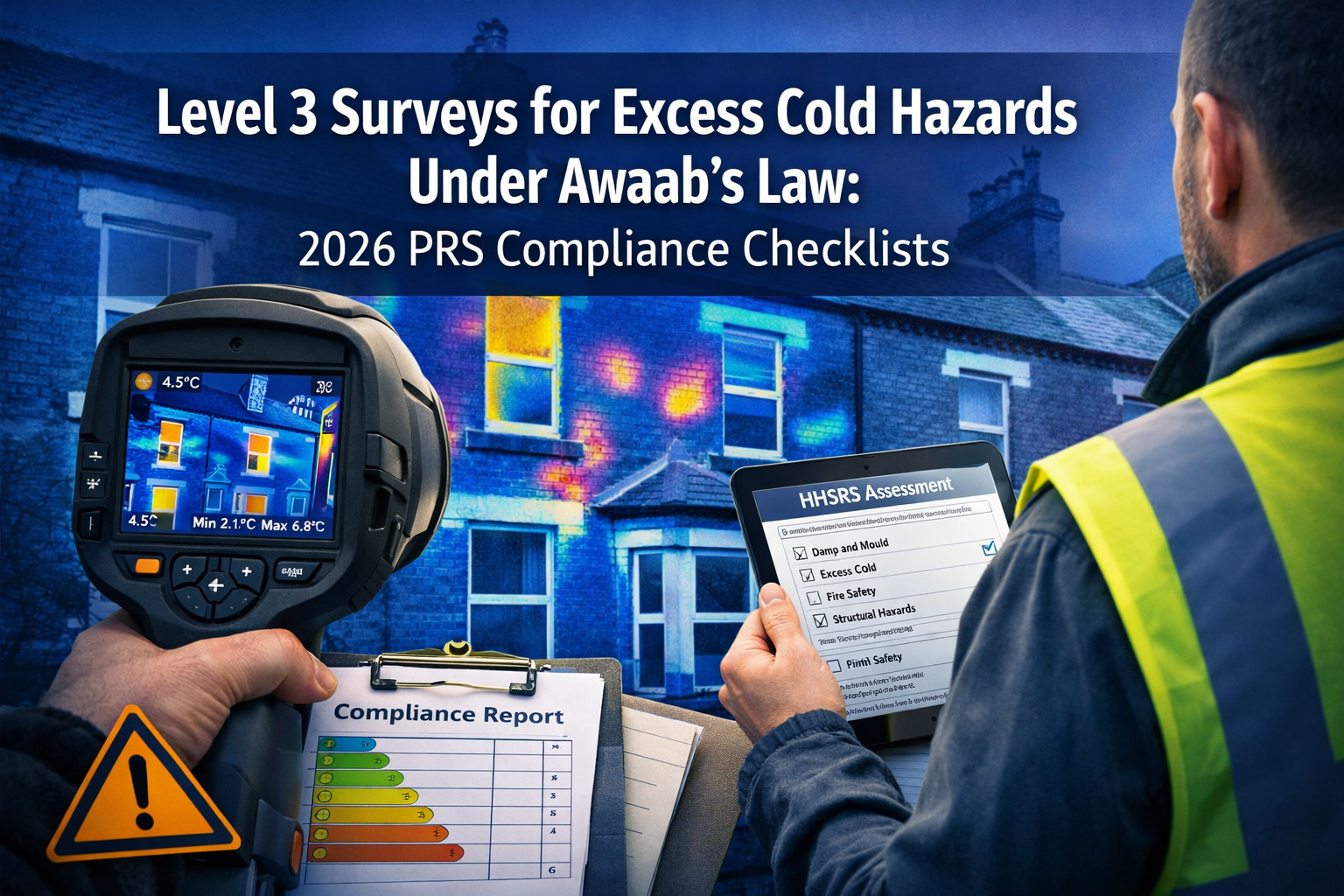
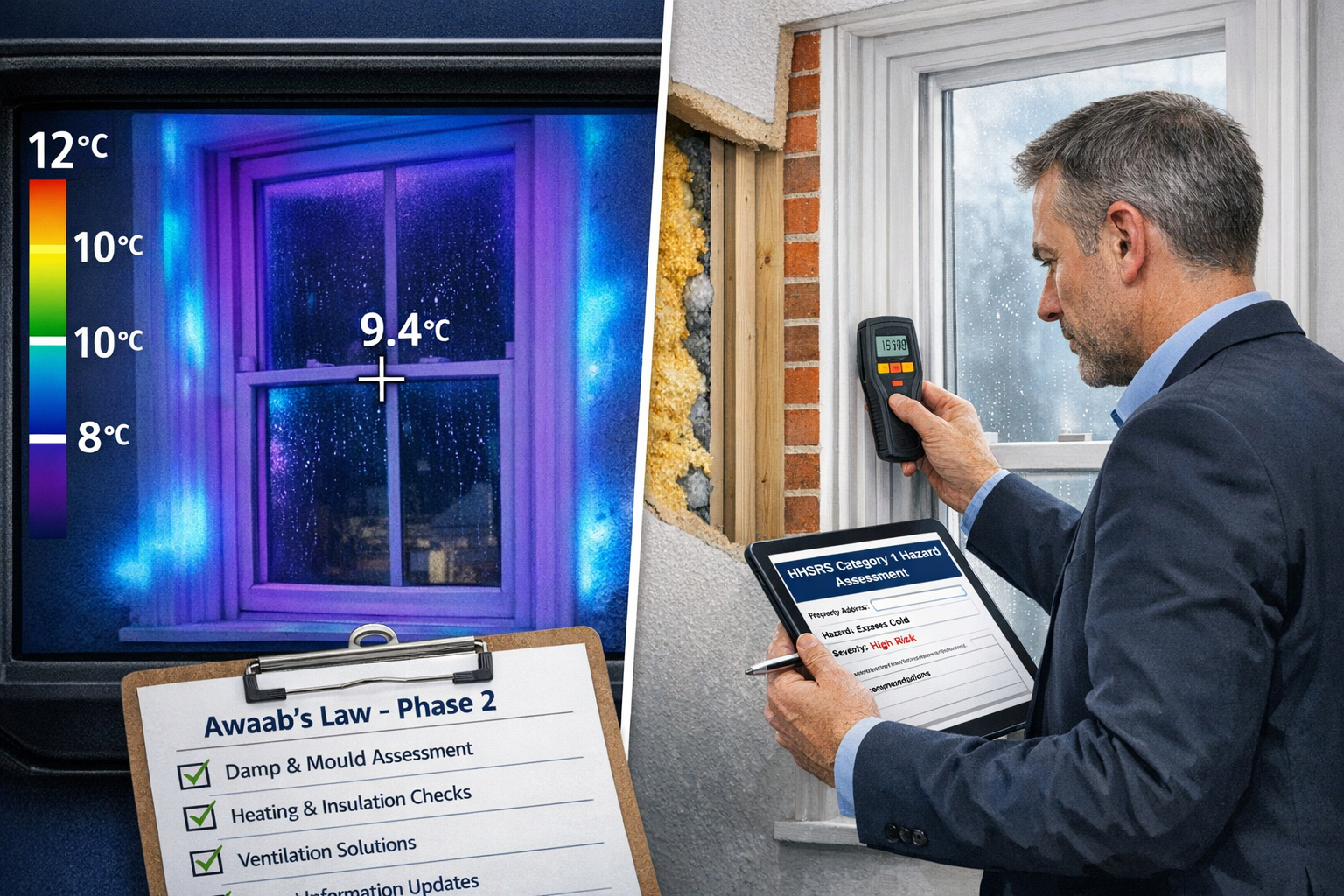
🔬 Thermal Imaging Assessment: Infrared thermography identifies cold spots, thermal bridging, and insulation deficiencies invisible to visual inspection. Thermal cameras detect temperature differentials across building fabric, revealing areas where heat loss occurs.
🌡️ Heating System Evaluation: Comprehensive assessment of boiler capacity, radiator sizing, heating controls, and distribution efficiency. Surveyors must verify whether the heating system can maintain WHO-recommended minimum temperatures of 18°C in bedrooms and 21°C in living areas.
🪟 Building Fabric Analysis: Detailed examination of windows (single vs. double glazing, U-values), wall construction (solid vs. cavity, insulation presence), roof insulation depth, and draught-proofing effectiveness.
📊 Energy Performance Integration: Cross-reference with current Energy Performance Certificate (EPC) ratings and identify discrepancies between predicted and actual thermal performance.
The comprehensive nature of Level 3 surveys enables surveyors to identify multiple HHSRS hazards simultaneously—including fire risks from portable heaters used to compensate for inadequate central heating, and electrical hazards from overloaded circuits powering supplementary heating devices [2].
Person-Centred Vulnerability Assessment Protocols
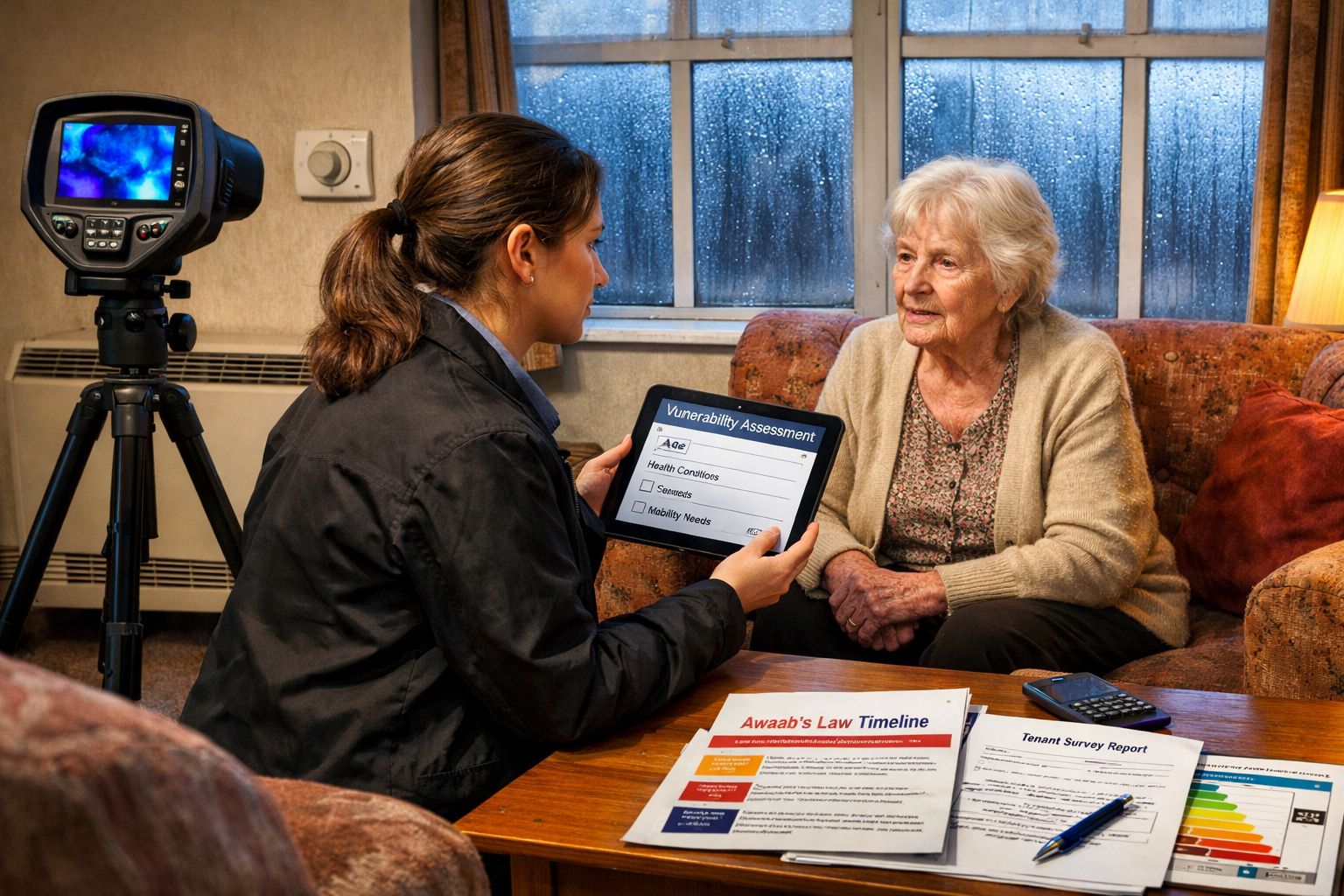
Awaab's Law requires housing officers and surveyors to conduct tenant vulnerability screening as part of excess cold hazard assessment. This person-centred approach moves beyond objective temperature measurements to consider how cold conditions affect specific occupants [5].
Essential vulnerability screening questions include:
👶 Household Composition: Are there children under 5 or adults over 65 residing in the property?
🏥 Health Conditions: Do any occupants have respiratory conditions (asthma, COPD, bronchitis), cardiovascular disease, arthritis, or compromised immune systems?
♿ Mobility Limitations: Do any residents have mobility impairments that restrict their ability to access heated rooms or operate heating controls?
💊 Support Services: Are any occupants receiving support from health or social care services that have raised concerns about property temperature?
This vulnerability data directly influences hazard classification. An excess cold hazard affecting a healthy working-age adult may be classified as Category 2 (significant but not urgent), while the identical temperature conditions affecting an elderly tenant with COPD would be classified as significant under Awaab's Law, triggering the 10-day investigation and 5-day works completion requirements [5].
Surveyors conducting stock condition surveys across rental portfolios must integrate this vulnerability screening framework into their assessment protocols.
Thermal Imaging Protocols and Temperature Monitoring
Effective thermal imaging for excess cold hazard identification requires systematic methodology rather than ad-hoc scanning. Best practice protocols include:
Optimal Survey Conditions:
- Conduct surveys during heating season (November-March) when temperature differentials are greatest
- Ensure property has been heated for at least 4 hours before survey
- Survey during early morning or evening when external temperatures are lowest
- Minimum 10°C temperature differential between inside and outside
Systematic Scanning Pattern:
- External envelope scan: Identify heat loss through walls, roof, and windows from exterior
- Internal room-by-room scan: Document cold spots, thermal bridging, and draught pathways
- Junction point focus: Examine wall-floor junctions, window reveals, and loft hatches where cold bridging commonly occurs
- Heating system thermal profile: Verify radiator surface temperatures and heat distribution
Documentation Requirements:
- Annotated thermal images with temperature scale overlays
- Comparative photographs showing visible and thermal views
- Temperature spot readings at key locations (minimum/maximum/average per room)
- Time-stamped data linked to external weather conditions
For properties requiring ongoing monitoring, monitoring surveys with data loggers can track temperature patterns over extended periods, providing evidence of persistent excess cold conditions.
Heating System Capacity Calculations
Determining whether a heating system provides adequate capacity is fundamental to excess cold hazard assessment. Surveyors must calculate:
Heat Loss Calculation: Using building dimensions, construction type, insulation levels, and ventilation rates to determine total heat loss in watts per degree Celsius temperature differential.
Boiler Output Assessment: Verify whether installed boiler capacity (kW rating) exceeds calculated heat loss plus domestic hot water demand.
Radiator Sizing Verification: Calculate required radiator output per room based on room volume and heat loss, comparing against installed radiator specifications (measured in BTUs or watts).
Heating Controls Evaluation: Assess whether thermostatic radiator valves (TRVs), room thermostats, and programmer controls enable occupants to maintain comfortable temperatures efficiently.
A common excess cold hazard scenario involves properties with inadequate radiator sizing—where the boiler has sufficient capacity but heat emitters cannot distribute warmth effectively to all rooms. This often occurs in properties with room conversions or extensions where radiators were not upgraded to match increased space.
For properties requiring structural engineering assessments due to planned heating system upgrades or insulation retrofits, coordinated survey approaches ensure all compliance requirements are addressed simultaneously.
2026 PRS Compliance Checklists and Retrofit Recommendations
Essential Compliance Checklist for Landlords
Private rental sector landlords must implement systematic compliance frameworks to meet Awaab's Law Phase 2 obligations. This comprehensive checklist ensures all excess cold hazard requirements are addressed:
Pre-Survey Preparation ✅
- Schedule Level 3 building survey with RICS-qualified surveyor experienced in HHSRS assessment
- Provide surveyor with property construction details, EPC, and previous survey reports
- Notify tenants of survey purpose and Awaab's Law compliance objectives
- Complete initial tenant vulnerability screening questionnaire
- Arrange property access during heating season for accurate thermal assessment
During Survey Execution ✅
- Thermal imaging of complete building envelope (walls, roof, windows, doors)
- Heating system capacity calculations and radiator output verification
- Temperature monitoring in all habitable rooms (minimum 18°C bedroom, 21°C living areas)
- Draught detection around windows, doors, and service penetrations
- Insulation depth measurement in loft spaces (minimum 270mm recommended)
- Ventilation adequacy assessment (balanced with heat retention)
- Person-centred risk evaluation considering tenant vulnerability factors
Post-Survey Documentation ✅
- Receive comprehensive survey report with HHSRS hazard ratings
- Review thermal imaging analysis and temperature data
- Obtain costed retrofit recommendations prioritized by hazard severity
- Prepare written summary for tenant (within 3 working days if hazard identified)
- Develop remedial works schedule meeting 5-day or 12-week timeframes
- Update property compliance records and hazard register
Ongoing Compliance Monitoring ✅
- Annual heating system servicing with capacity verification
- Periodic thermal imaging surveys (recommended every 3-5 years)
- Tenant feedback mechanisms for reporting cold conditions
- Vulnerability reassessment when household composition changes
- Documentation retention for enforcement authority inspection
This systematic approach to Level 3 Surveys for Excess Cold Hazards Under Awaab's Law: 2026 PRS Compliance Checklists demonstrates proactive landlord responsibility and reduces enforcement risk [1].
Retrofit Recommendations and Remediation Strategies
Survey reports must translate hazard identification into actionable retrofit recommendations. Effective excess cold remediation typically involves a hierarchy of interventions:
Immediate Interventions (Emergency Hazards) ⚡
- Emergency heating provision (portable heaters with safety monitoring)
- Urgent boiler repair or temporary replacement
- Emergency draught-proofing of critical areas
- Immediate vulnerable tenant support (temporary rehousing if necessary)
Short-Term Remediation (5-Day Completion) 🔧
- Heating system repairs restoring full functionality
- Thermostatic radiator valve installation or replacement
- Programmer and thermostat upgrades for improved control
- Window draught-proofing and secondary glazing installation
- Door threshold draught excluders and letterbox seals
Medium-Term Retrofit (12-Week Complex Works) 🏗️
- Boiler replacement with appropriately sized modern condensing unit
- Radiator upgrades to match heat loss calculations
- Loft insulation upgrade to current standards (270mm+)
- Cavity wall insulation installation (where suitable)
- Double glazing replacement for single-glazed windows
Long-Term Fabric Improvement 🏠
- External wall insulation for solid-wall properties
- Internal wall insulation where external not feasible
- Whole-house ventilation with heat recovery (MVHR)
- Solar thermal or heat pump integration
- Comprehensive building fabric upgrade to EPC Band C or above
Retrofit recommendations must include cost estimates, energy savings projections, and compliance verification methods. For properties requiring multiple interventions, phased approaches should prioritize hazards affecting vulnerable tenants [2].
Landlords planning significant retrofit works should consider coordinating with structural surveys to ensure building fabric can accommodate insulation systems and heating upgrades without creating new structural or damp risks.
Report Template Updates for Awaab's Law Compliance
Standard survey report templates require substantial updates to capture Awaab's Law-specific data points. Essential template sections include [2]:
Awaab's Law Compliance Section:
- Phase 2 hazard identification matrix (excess cold, fire, electrical, falls, structural, excess heat)
- Emergency vs. significant hazard classification with justification
- Person-centred risk assessment summary including vulnerability factors
- Investigation timeline documentation (date of tenant report, inspection date, investigation completion)
- Written summary preparation checklist
Excess Cold Hazard-Specific Content:
- Thermal imaging report with annotated images and temperature data
- Heating system capacity calculations vs. property heat loss
- Room-by-room temperature monitoring results
- Insulation survey findings (walls, roof, floors)
- Window and door thermal performance assessment
- Draught detection and air leakage quantification
Remediation Planning Section:
- Prioritized retrofit recommendations with cost estimates
- Works timeline indicating 5-day or 12-week compliance pathway
- Specialist investigation requirements (if applicable)
- Interim safety measures during complex works
- Post-remediation verification methodology
Tenant Communication Template:
- Written summary template pre-populated with property-specific findings
- Plain language hazard explanation for tenant understanding
- Works schedule with key milestones and completion dates
- Tenant rights information and complaint escalation process
Updated report templates ensure surveyors capture all compliance data during initial inspection, avoiding costly return visits and enabling landlords to meet the strict 3-day written summary deadline [4].
Phase 3 Preparation: Full HHSRS Coverage by 2027
While 2026 focuses on Phase 2 hazards including excess cold, landlords should prepare for Phase 3 implementation in 2027, which extends Awaab's Law coverage to all 29 HHSRS hazards (excluding overcrowding) where they present significant risk [3].
Additional hazards coming into scope in 2027 include:
- 🧪 Asbestos and manufactured mineral fibres (MMF)
- 🦠 Biocides (pesticides, fungicides, preservatives)
- ☠️ Carbon monoxide and fuel combustion products
- 💨 Volatile organic compounds (VOCs)
- 🏚️ Entry by intruders and personal hygiene issues
- 🌊 Domestic hygiene, pests, and refuse
Forward-thinking landlords should commission comprehensive RICS building surveys that address all HHSRS hazards simultaneously, rather than conducting separate Phase 2 and Phase 3 assessments. This integrated approach reduces survey costs, minimizes tenant disruption, and ensures complete compliance documentation ahead of enforcement deadlines.
Properties with suspected asbestos-containing materials, older heating systems with potential carbon monoxide risks, or pest issues should prioritize early comprehensive assessment to avoid multiple emergency investigations under Phase 3 timelines.
Practical Implementation: Case Studies and Common Challenges
Case Study: Victorian Terrace with Vulnerable Elderly Tenant
A 75-year-old tenant with COPD reported persistent cold conditions in a Victorian terraced rental property during January 2026. The landlord commissioned a Level 3 survey to assess excess cold hazards under Awaab's Law.
Survey Findings:
- Thermal imaging revealed significant heat loss through single-glazed sash windows (U-value 5.0 W/m²K vs. modern standard 1.4 W/m²K)
- Loft insulation measured only 100mm depth (inadequate vs. 270mm recommended)
- Original cast-iron radiators undersized for room volumes by approximately 30%
- No thermostatic radiator valves, limiting temperature control
- Living room temperatures measured 16°C with heating on maximum
Person-Centred Assessment:
Given the tenant's age (75) and respiratory condition (COPD), the surveyor classified the excess cold hazard as significant under Awaab's Law, despite traditional HHSRS scoring potentially rating it Category 2. The tenant's vulnerability elevated the urgency of remediation [5].
Compliance Response:
- Written summary provided to tenant within 2 working days
- Emergency portable heaters installed within 24 hours pending permanent works
- Radiator replacement and TRV installation completed within 5 working days
- Double glazing installation and loft insulation upgrade scheduled within 12-week complex works timeframe
- Monthly temperature monitoring implemented until full retrofit completion
This case demonstrates how person-centred assessment protocols fundamentally change hazard classification and response timelines compared to traditional HHSRS approaches.
Common Survey Challenges and Solutions
Challenge 1: Tenant-Caused Excess Cold (Heating System Not Used)
Some landlords argue excess cold results from tenants not using provided heating rather than property deficiencies. However, Awaab's Law requires assessment of whether heating systems are affordable to operate and easy to control [5].
Solution: Survey reports must document:
- Heating system running costs per hour/day/week
- Control complexity (can elderly/vulnerable tenants operate systems?)
- Alternative heating provision if primary system unaffordable
- Energy efficiency measures reducing heating costs
If heating costs are disproportionate to tenant income or controls are too complex for vulnerable occupants, the excess cold hazard remains the landlord's responsibility.
Challenge 2: Conflicting Priorities (Insulation vs. Ventilation)
Excess cold remediation through improved insulation can inadvertently create or worsen damp and mould hazards by reducing ventilation. This creates a compliance paradox under Awaab's Law Phase 1 (damp/mould) and Phase 2 (excess cold) requirements [1].
Solution: Integrated retrofit design including:
- Mechanical ventilation with heat recovery (MVHR) systems
- Balanced ventilation maintaining air quality while retaining heat
- Condensation risk analysis using thermal modeling
- Coordinated drainage surveys to address external moisture sources
Surveyors must assess both excess cold and damp/mould hazards simultaneously, recommending solutions that address both without creating new risks.
Challenge 3: Specialist Investigation Delays
Complex excess cold cases may require specialist thermal modeling, heating engineering consultations, or structural engineering assessments for retrofit feasibility. These specialist investigations can extend beyond the 10-day investigation timeline [4].
Solution: Awaab's Law permits specialist investigation delays provided:
- Initial safety measures are implemented within required timeframes
- Tenant receives written summary explaining specialist investigation need
- Specialist report completion date is specified
- Interim temperature monitoring and support are provided
Landlords should maintain relationships with specialist consultants to minimize investigation delays and ensure rapid response when complex assessments are needed.
Technology Integration: Digital Compliance Tools
Modern compliance management increasingly relies on digital tools that streamline Level 3 Surveys for Excess Cold Hazards Under Awaab's Law: 2026 PRS Compliance Checklists:
📱 Mobile Survey Apps: Surveyors use tablet-based applications capturing thermal images, temperature data, and HHSRS assessments in real-time, with automatic report generation reducing the 3-day written summary timeframe.
🌡️ IoT Temperature Monitoring: Wireless sensors provide continuous temperature logging across multiple rooms, creating evidence-based records of excess cold conditions and post-remediation verification.
📊 Compliance Dashboards: Portfolio landlords implement software tracking survey schedules, hazard registers, remediation progress, and deadline alerts across multiple properties.
🤖 AI-Assisted Thermal Analysis: Machine learning algorithms analyze thermal imaging data, automatically identifying cold spots and quantifying heat loss severity for consistent hazard classification.
These technological solutions enhance compliance efficiency but cannot replace the professional judgment required for person-centred vulnerability assessment and complex retrofit recommendation [6].
Conclusion: Proactive Compliance and Tenant Welfare
Awaab's Law Phase 2 implementation in 2026 fundamentally transforms private rental sector obligations for excess cold hazards. The shift from reactive repair approaches to proactive person-centred assessment requires landlords to commission comprehensive Level 3 Surveys for Excess Cold Hazards Under Awaab's Law: 2026 PRS Compliance Checklists that identify multiple HHSRS hazards simultaneously.
The key compliance principles are clear:
🎯 Person-centred assessment prioritizes vulnerable tenant welfare over traditional hazard scoring
⏱️ Strict timelines demand 10-day investigation and 5-day works completion for significant hazards
📝 Documentation requirements mandate written summaries to tenants within 3 working days
🔬 Technical rigor requires thermal imaging, heating capacity calculations, and vulnerability screening
🏗️ Retrofit integration transforms survey findings into actionable remediation strategies
Landlords who adopt proactive compliance strategies—commissioning regular Level 3 surveys, maintaining comprehensive hazard registers, and implementing systematic retrofit programs—will not only avoid enforcement action but also improve tenant welfare, reduce void periods, and enhance property values.
Next Steps for PRS Landlords
- Schedule Level 3 surveys for all rental properties, prioritizing those with elderly tenants, young children, or known heating deficiencies
- Implement vulnerability screening protocols for all tenancies, updating assessments when household composition changes
- Update compliance documentation systems to capture Awaab's Law-specific data points and timeline requirements
- Develop retrofit budgets for properties identified with excess cold hazards, prioritizing vulnerable tenant properties
- Establish specialist consultant relationships for thermal imaging, heating engineering, and complex remediation design
- Prepare for Phase 3 by commissioning comprehensive HHSRS assessments covering all 29 hazards ahead of 2027 implementation
For professional survey services meeting Awaab's Law compliance requirements, consider engaging qualified surveyors experienced in thermal imaging, HHSRS assessment, and retrofit design. Comprehensive building surveys provide the foundation for effective compliance management and tenant welfare protection.
The regulatory landscape has permanently shifted toward proactive hazard identification and rapid remediation. Landlords who embrace this change through systematic Level 3 Surveys for Excess Cold Hazards Under Awaab's Law: 2026 PRS Compliance Checklists will be best positioned for long-term success in the evolving private rental sector.
References
[1] Awaabs Law Extensions To Prs In 2026 Party Wall And Building Survey Protocols For New Hazard Categories – https://nottinghillsurveyors.com/blog/awaabs-law-extensions-to-prs-in-2026-party-wall-and-building-survey-protocols-for-new-hazard-categories
[2] Building Surveys And Awaabs Law 2026 Extensions Identifying Electrical Fire And Temperature Hazards In Prs Properties – https://nottinghillsurveyors.com/blog/building-surveys-and-awaabs-law-2026-extensions-identifying-electrical-fire-and-temperature-hazards-in-prs-properties
[3] Awaabs Law Guide – https://wordnerds.ai/awaabs-law-guide
[4] Awaabs Law Is Here The Surveyors Guide For Compliance – https://www.surventrix.com/blog/awaabs-law-is-here-the-surveyors-guide-for-compliance
[5] Awaabs Law Guidance For Social Landlords Timeframes For Repairs In The Social Rented Sector – https://www.gov.uk/government/publications/awaabs-law-guidance-for-social-landlords/awaabs-law-guidance-for-social-landlords-timeframes-for-repairs-in-the-social-rented-sector
[6] Awaabs Law Damp Mould Survey Compliance Guide – https://www.swiftreporter.com/blog/awaabs-law-damp-mould-survey-compliance-guide