
The built environment is responsible for approximately 39% of global carbon emissions — a figure that has pushed regulators, developers, and surveyors to fundamentally rethink how properties are assessed, planned, and built. As 2026 brings tighter energy efficiency mandates and more demanding green certification requirements across the UK and beyond, sustainability in property surveying: tools for eco-conscious development has moved from a niche interest to a professional necessity.
Capturing accurate ecological data, predicting environmental impacts, and aligning with green regulations are no longer optional extras in a surveyor's toolkit. They are core competencies that shape planning outcomes, asset values, and long-term viability. This article explores the most powerful tools available today, how they integrate into surveying practice, and why eco-conscious development is reshaping the entire property sector.
Key Takeaways 🌿
- Ecological data capture through GIS, remote sensing, and continuous monitoring devices is transforming how surveyors assess land and buildings.
- Certification frameworks like BREEAM, LEED, and GRESB are increasingly tied to asset value and regulatory compliance in 2026.
- ESG execution platforms help property managers track sustainability goals, manage audits, and maintain transparency.
- Circular economy principles and sustainable materials are being embedded into building surveys and condition reports.
- Surveyors who adopt eco-focused tools position themselves — and their clients — ahead of incoming legislation and market expectations.
Why Ecological Data Capture Is Central to Sustainability in Property Surveying: Tools for Eco-Conscious Development
"The surveyor of 2026 is not just measuring walls and roofs — they are measuring ecosystems."
Historically, a property survey focused on structural integrity, defects, and valuation. Today, the scope has expanded dramatically. Environmental impact assessment, biodiversity net gain requirements, and carbon performance data are now embedded in planning policy across England and Wales. Surveyors who understand how to capture and interpret ecological data hold a significant professional advantage.
GIS and Remote Sensing: Seeing the Land in New Ways
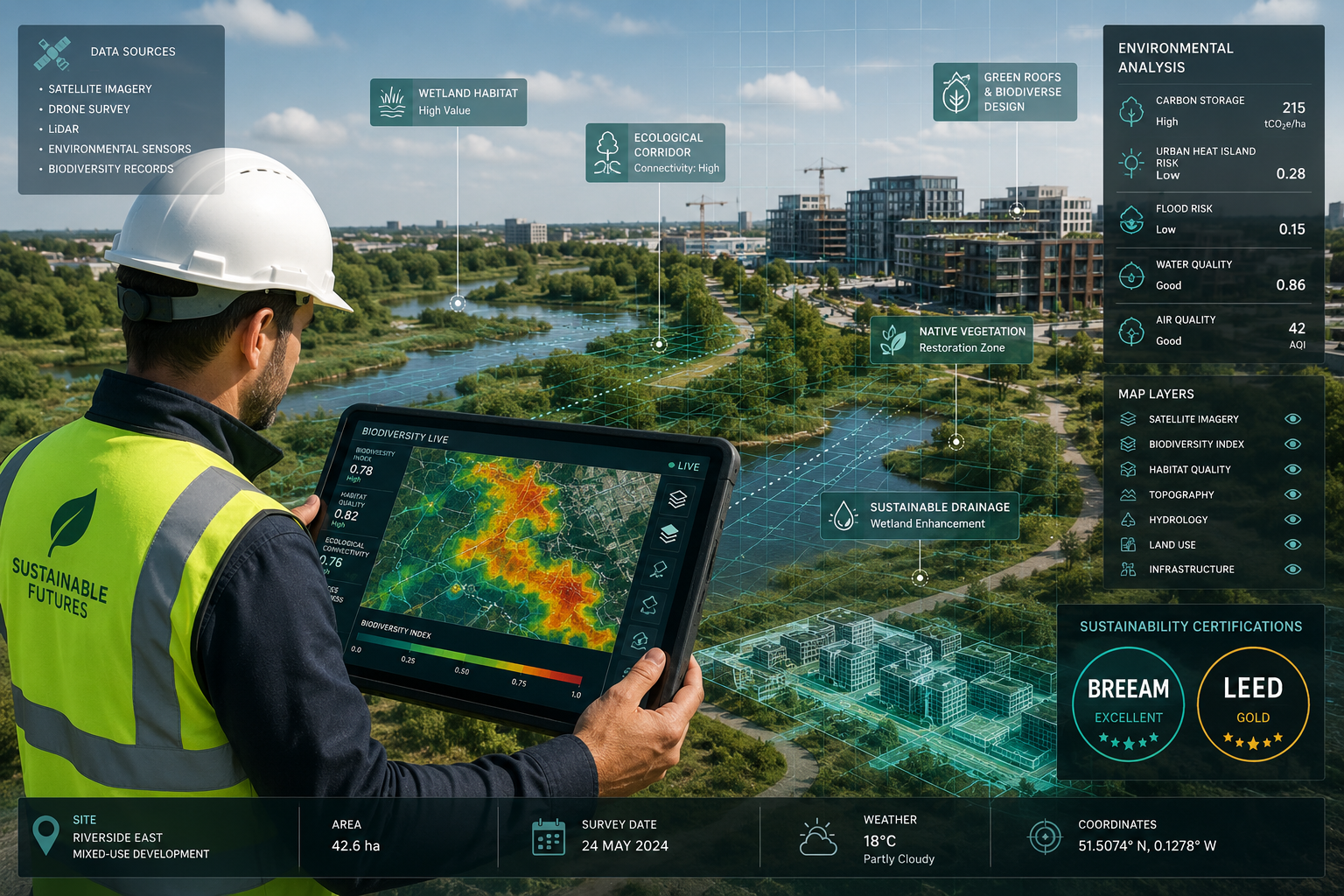
Geographic Information System (GIS) technology and remote sensing have become foundational tools in eco-conscious property assessment. Platforms offered by specialists like Property Enviro Tech provide high-resolution spatial data and real-time environmental insights that allow surveyors and developers to evaluate land conditions before a single spade enters the ground [2].
Key capabilities include:
- 🛰️ Satellite and aerial imagery analysis to detect land contamination, flood risk zones, and vegetation health
- 📍 Spatial mapping of ecological corridors, protected habitats, and biodiversity hotspots
- 📊 Real-time environmental data layers overlaid on site plans for planning submissions
- ⚠️ Risk identification for subsidence, drainage issues, and soil instability
These tools directly support the work of RICS chartered building surveyors who are increasingly expected to provide environmental context alongside traditional structural assessments.
Biodiversity Monitoring: The Rise of Continuous Data Devices
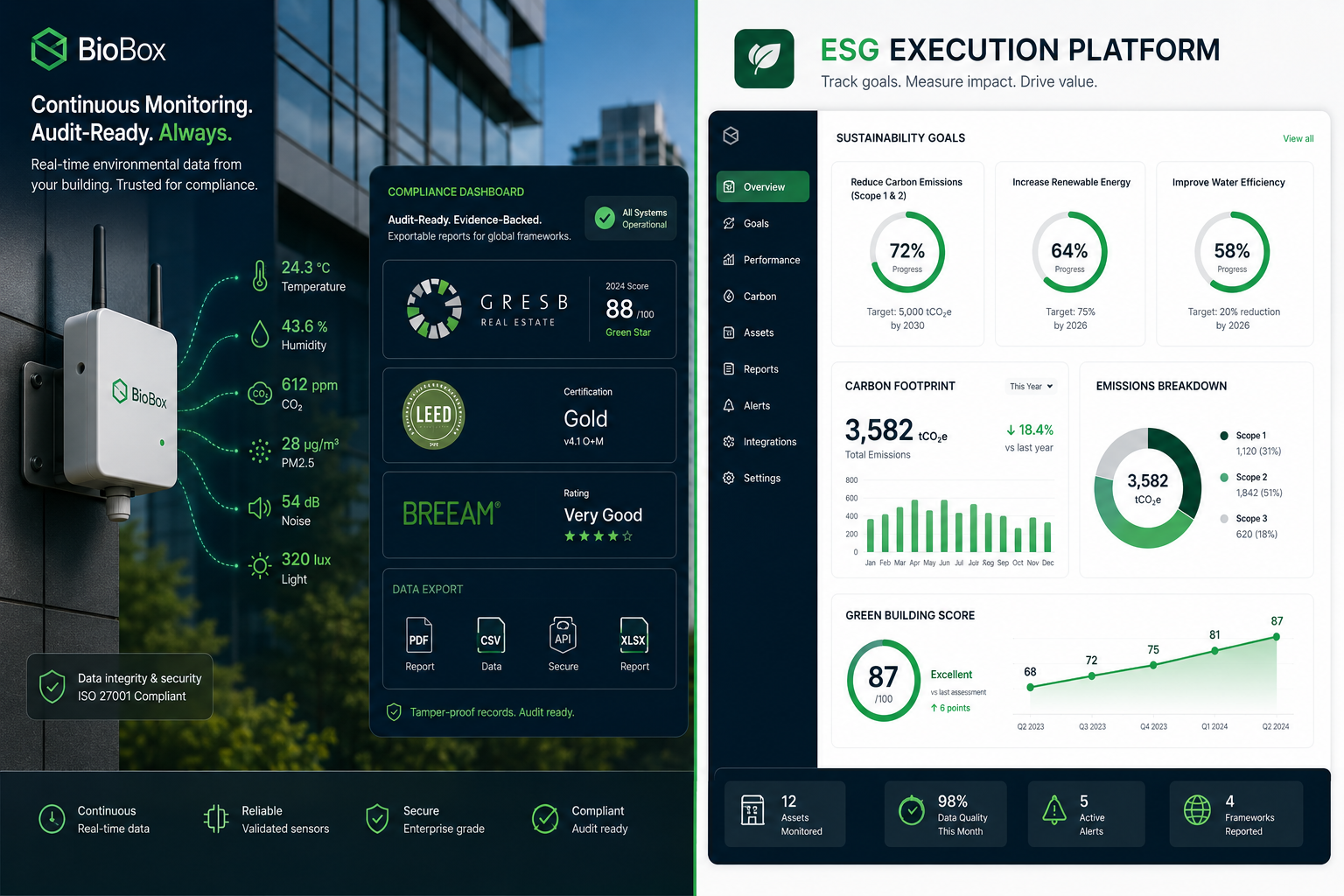
One of the most significant innovations in recent years is the emergence of plug-and-play biodiversity monitoring devices. BioBox, developed by Verdant Metrics, is a prime example — a device that continuously monitors biodiversity and environmental conditions on a property, generating audit-ready reports compatible with LEED, BOMA BEST, GRESB, and BREEAM certifications [1].
The value for surveyors is clear:
| Feature | Traditional Survey | BioBox / Continuous Monitoring |
|---|---|---|
| Data frequency | Point-in-time | Continuous, real-time |
| Certification compatibility | Manual documentation | Automated audit-ready reports |
| Cost over time | Repeated site visits | One-time installation |
| Biodiversity accuracy | Snapshot only | Trend and pattern data |
| Regulatory alignment | Retrospective | Proactive compliance |
This kind of technology is particularly relevant when conducting commercial property surveys where ESG obligations are now a standard part of due diligence for institutional investors.
Sustainable Remediation Tools
When land contamination is identified, surveyors and environmental consultants need tools that assess not just the contamination itself, but the environmental footprint of the remediation process. The Sustainable Remediation Tool (SRT™) and the U.S. EPA's Spreadsheets for Environmental Footprint Analysis (SEFA) are widely used to evaluate greenhouse gas emissions, energy consumption, and ecological impact of different remediation strategies [6].
These tools allow eco-conscious developers to choose remediation approaches that minimise secondary environmental harm — a consideration that is increasingly scrutinised during planning applications.
Key Sustainability Tools and Certification Frameworks in Property Surveying: Tools for Eco-Conscious Development
The landscape of sustainability assessment tools is broad and growing. Understanding which tools apply to which scenarios is essential for surveyors advising clients on eco-conscious development.
Green Building Certification Frameworks 🏆
The Royal Institution of Chartered Surveyors (RICS) has explicitly highlighted the growing importance of certifications like LEED, BREEAM, and Green Star in building surveying practice, noting that stricter energy efficiency standards are reshaping how buildings are assessed and valued [4]. These frameworks are not just badges — they directly influence:
- Planning approval timelines and conditions
- Asset valuation and investment attractiveness
- Rental and sale premiums in commercial and residential markets
- Insurance and reinstatement cost calculations
For clients seeking an insurance reinstatement valuation, understanding a building's sustainability credentials can affect rebuild cost estimates significantly, particularly where sustainable materials or energy systems must be replaced like-for-like.
Environmentally Sustainable Design (ESD) Assessment Tools
A suite of practical ESD tools helps surveyors and planners evaluate building performance across multiple environmental dimensions [5]:
- BESS (Built Environment Sustainability Scorecard) — Assesses energy, water, stormwater, urban heat, and indoor environment quality
- STORM — Evaluates stormwater management and runoff reduction strategies
- MUSIC — Models urban stormwater improvement conceptualisation
- Green Star — Comprehensive green building rating system covering design, construction, and performance
- FirstRate5 — Energy rating software for residential buildings
These tools are particularly useful during the building survey stage, where surveyors can flag sustainability performance gaps and recommend improvements before a transaction completes.
ESG Execution Platforms: Managing Sustainability at Scale
For asset owners and property managers overseeing multiple properties, individual tools are not enough. ESG execution platforms like Proprli's platform allow organisations to set and track ESG goals, align with major sustainability standards (GRESB, LEED, INREV, BREEAM, CDP), and manage ESG-related projects and audits in one place [3].
Key features of leading ESG platforms include:
- ✅ Goal-setting and progress tracking against sustainability KPIs
- 📋 Audit management and documentation storage
- 🔗 Integration with certification bodies and reporting standards
- 📈 Transparency dashboards for investors and stakeholders
- 🌍 Carbon footprint tracking across property portfolios
This type of platform is transforming how commercial property valuations are approached, as ESG performance data becomes a material factor in determining market value.
Neighbourhood-Scale Sustainability Assessment
Sustainability in property surveying is not limited to individual buildings. Research has critically reviewed seven neighbourhood sustainability assessment tools from various regions, analysing their strengths, weaknesses, and applicability across different planning contexts [8]. These tools evaluate:
- Mixed-use land efficiency
- Green infrastructure connectivity
- Transport and mobility sustainability
- Community resilience and social equity
- Energy and water performance at district level
The SBToolPT framework, originally developed for Portugal, has evolved to assess the broader built environment rather than just individual structures — reflecting a holistic approach that is gaining traction internationally [7].
Integrating Eco-Conscious Practices into Surveying Workflows
Understanding the tools is one thing. Embedding them into everyday surveying practice is another. Here is how eco-conscious development principles are being integrated across key surveying activities in 2026.
Circular Economy Principles in Building Surveys
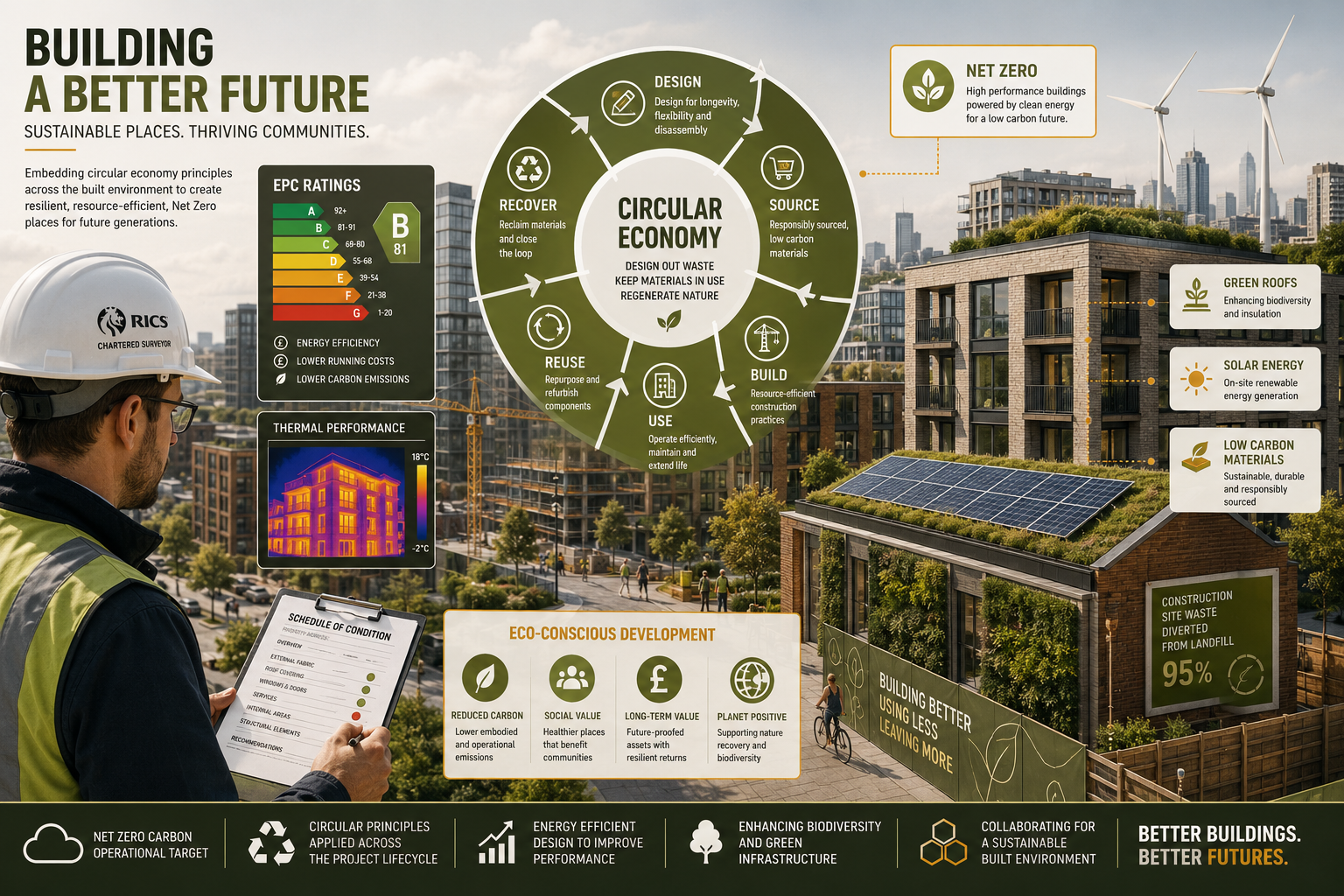
RICS advocates strongly for integrating circular economy principles and sustainable materials into building practices [4]. For surveyors, this means:
- Assessing the reuse and recyclability of existing building materials before recommending demolition
- Identifying opportunities for adaptive reuse of structures
- Documenting material specifications in schedule of condition reports to support future deconstruction planning
- Recommending low-carbon alternatives for repairs and upgrades
Sustainable design itself aims to eliminate negative environmental impacts through sensitive, innovative design that relies on renewable resources and minimises ecological harm [10]. Surveyors who understand these principles can guide clients toward development decisions that hold long-term value.
Energy Performance and Thermal Assessment
Energy Performance Certificates (EPCs) are a regulatory baseline, but eco-conscious surveyors go further. Thermal imaging, air permeability testing, and daylight modelling are increasingly included in comprehensive building assessments. Research consistently highlights the role of environmental assessment tools in evaluating and minimising environmental impacts throughout the construction process [9].
For properties undergoing specific defect surveys, thermal imaging can reveal hidden insulation failures, cold bridges, and moisture ingress — all of which affect both energy performance and structural health.
Solar and Renewable Energy Integration
As renewable energy installations become standard on new and retrofitted buildings, surveyors are increasingly asked to assess structural suitability for solar panels and other systems. Solar panel roof engineer calculations are now a recognised part of project management services, ensuring that roof structures can safely accommodate the additional loads imposed by photovoltaic systems.
Damp, Drainage, and Water Management
Water management is a core sustainability concern. Poor drainage contributes to urban flooding, biodiversity loss, and building deterioration. Damp surveys that integrate stormwater assessment tools like STORM and MUSIC provide a more complete picture of a property's environmental performance and long-term resilience.
The Business Case for Sustainable Surveying in 2026
The environmental argument for eco-conscious development is well established. But the commercial case is equally compelling.
How Sustainability Affects Property Value
| Factor | Impact on Value |
|---|---|
| High EPC rating (A/B) | Premium of 5–20% in some markets |
| BREEAM Excellent/Outstanding | Stronger investor demand, lower vacancy |
| Biodiversity Net Gain compliance | Smoother planning approval |
| ESG-aligned portfolio | Access to green finance and lower borrowing costs |
| Poor sustainability credentials | Stranded asset risk as regulations tighten |
Surveyors who can accurately assess and communicate these value drivers — through tools like ESG platforms, GIS analysis, and continuous monitoring — provide clients with a genuine competitive advantage.
Regulatory Pressure Is Only Increasing
The UK government's commitment to net zero by 2050, combined with 2026's tightened Minimum Energy Efficiency Standards (MEES) for commercial properties, means that non-compliant buildings face real financial risk. Surveyors play a critical role in identifying compliance gaps early and recommending cost-effective pathways to improvement.
"Sustainability is no longer a feature of premium development — it is the baseline expectation for any development that expects to retain value."
Conclusion: Actionable Next Steps for Eco-Conscious Surveyors ✅
Sustainability in property surveying: tools for eco-conscious development is not a future trend — it is the present reality of professional practice in 2026. The tools exist. The frameworks are established. The regulatory pressure is real. What remains is adoption and integration.
Here are concrete next steps for surveyors and developers:
- Audit your current toolkit — Identify which sustainability assessment tools (GIS, BESS, ESG platforms) you are already using and where gaps exist.
- Invest in continuous monitoring — Consider BioBox-style devices for commercial properties where GRESB or BREEAM compliance is required.
- Embed ESD tools into standard reports — Integrate energy, water, and biodiversity metrics into building survey outputs as standard practice.
- Upskill on circular economy principles — RICS CPD resources on sustainable materials and adaptive reuse are increasingly relevant.
- Communicate sustainability value to clients — Help clients understand how eco-credentials affect valuation, finance access, and planning outcomes.
- Partner with environmental specialists — GIS and remote sensing expertise may require collaboration with environmental consultants for complex sites.
The surveyors and developers who master these tools today will be the ones shaping the built environment of tomorrow — and capturing the value that eco-conscious development increasingly commands.
References
[1] Outsized Compliance – https://www.verdantmetrics.com/outsized-compliance?utm_source=openai
[2] Remote Sensing And Gis Based Environmental Assessment – https://propertyenvirotech.com/site-environmental-condition-technologies/remote-sensing-and-gis-based-environmental-assessment/?utm_source=openai
[3] Esg Execution – https://proprli.com/esg-execution/?utm_source=openai
[4] Navigating The Landscape Of Evolving Building Standards While Excelling In Sustainability – https://www.rics.org/news-insights/navigating-the-landscape-of-evolving-building-standards-while-excelling-in-sustainability?utm_source=openai
[5] Tools To Guide Environmentally Sustainable Design Assessments – https://www.monash.vic.gov.au/Planning-Development/Planning/Environmentally-Sustainable-Design/Tools-to-guide-Environmentally-Sustainable-Design-assessments?utm_source=openai
[6] Index – https://www.enviro.wiki/index.php?title=Sustainable_Remediation&utm_source=openai
[7] Pmc3925566 – https://pmc.ncbi.nlm.nih.gov/articles/PMC3925566/?utm_source=openai
[8] S0195925512000558 – https://www.sciencedirect.com/science/article/abs/pii/S0195925512000558?utm_source=openai
[9] S0301479706004270 – https://www.sciencedirect.com/science/article/pii/S0301479706004270?utm_source=openai
[10] Sustainable Design – https://en.wikipedia.org/wiki/Sustainable_design?utm_source=openai