Roughly 200,000 shared ownership households in England hold the right to staircase, yet a significant number are delayed or derailed because the valuation report does not meet the standards their housing association or lender requires. A failed or disputed valuation adds months to a transaction and, in some cases, costs the leaseholder the mortgage offer they were counting on.
This article explains what makes property valuation for shared ownership staircasing different from an ordinary market appraisal, what a RICS Red Book report must contain, how lease terms shape the valuer's assumptions, and what evidence housing associations and lenders expect to see before they will proceed.
Key Takeaways
- Staircasing valuations must be carried out by a RICS-registered valuer following Red Book Global Standards; the housing association, not the leaseholder, typically appoints the valuer.
- The price paid for additional shares is always based on the current full open market value of the property, not the original purchase price.
- Most leases require the valuation to be completed within three months; if the transaction does not complete in time, a fresh valuation is needed.
- The RICS report must include a comparable sales schedule, a clear statement of the interest valued, and the lease assumptions applied.
- Where a leaseholder believes the figure is too high, a formal challenge process exists, but it must follow the procedure set out in the lease.
Why Staircasing Valuations Are Not Ordinary Market Appraisals
A standard estate-agent appraisal or even a mortgage valuation for a freehold purchase starts from a relatively simple premise: what would a willing buyer pay a willing seller in the open market today? Staircasing introduces several layers of complexity that change both the instruction and the report.
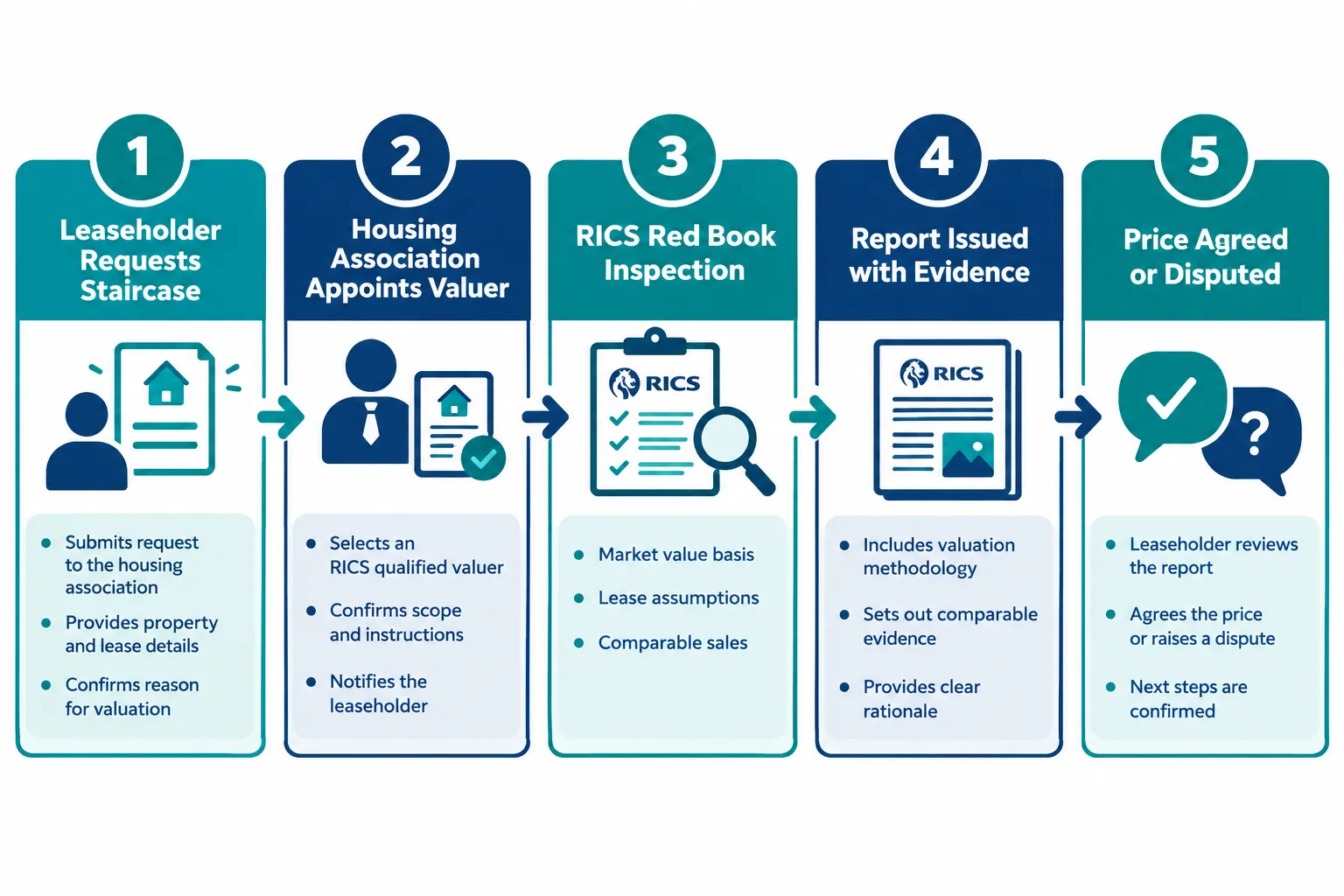
The interest being valued is the whole property, not the share. Even though the leaseholder may currently own 25% or 50%, the price of the additional shares they wish to buy is calculated as a proportion of the full open market value of the property. A leaseholder buying from 25% to 75% pays 50% of whatever the whole property is worth on the date of valuation [7]. The valuer must therefore assess the unencumbered freehold or leasehold interest as if it were being sold on the open market with vacant possession.
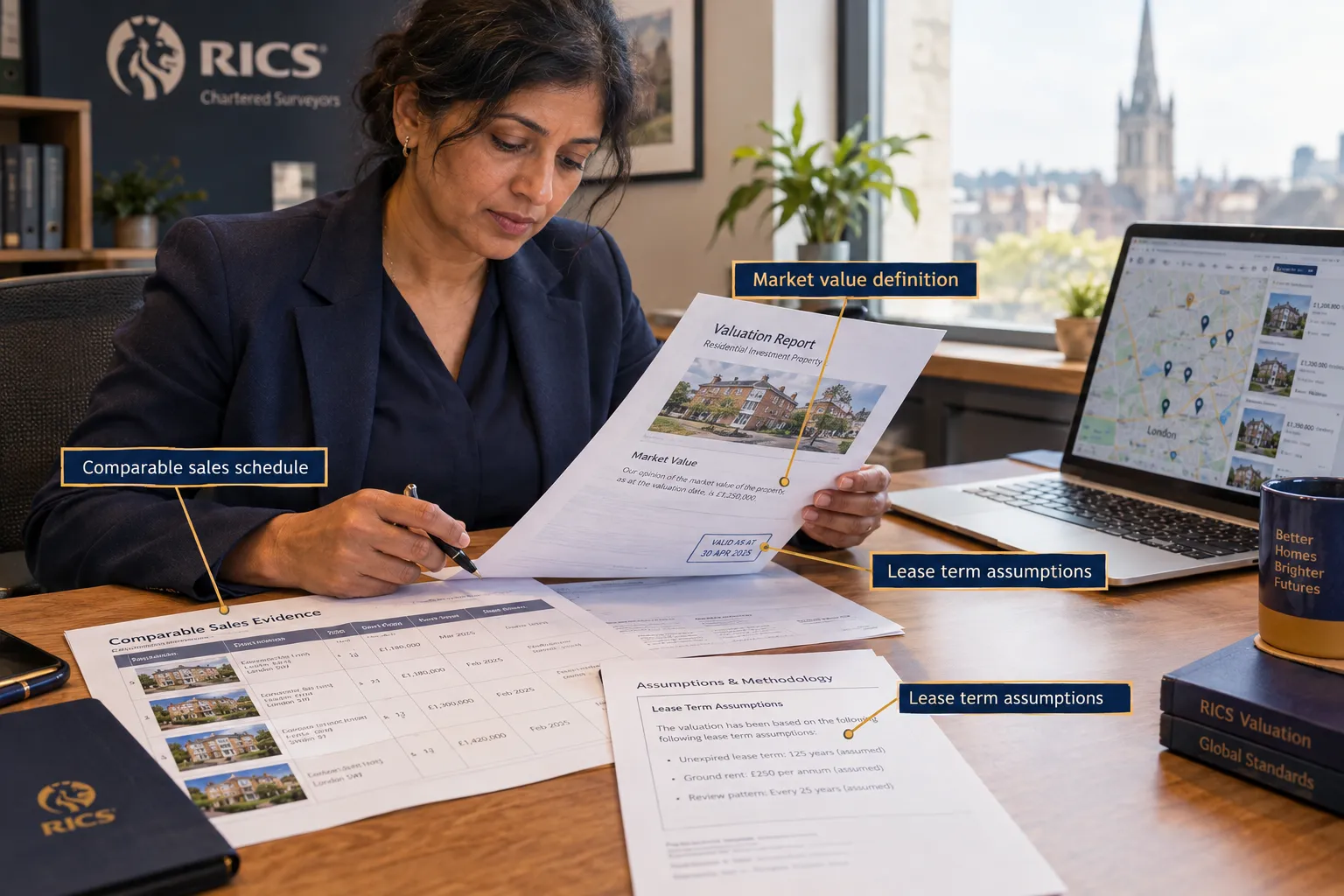
Lease terms directly affect the valuation basis. Shared ownership leases, particularly those issued under the 2021 model lease, contain specific definitions of market value and set out assumptions the valuer must apply. These commonly include the assumption that the property is sold with the benefit of a full repairing and insuring lease, that the buyer is not already a shared owner of the property, and that any improvements carried out by the leaseholder at their own cost are disregarded [1]. Disregarding leaseholder improvements is a critical point: a leaseholder who has spent £30,000 on a kitchen extension should not pay for that improvement twice. The valuer must identify which works were funded by the leaseholder and exclude them from the assessed value.
The appointment is controlled by the landlord. Unlike a buyer commissioning their own survey, the leaseholder does not instruct the valuer directly. The housing association appoints a RICS-registered valuer from a panel it maintains, and the leaseholder pays the fee [1]. This arrangement exists to protect the integrity of the figure, both parties need confidence that the valuation is independent. The leaseholder's role is to provide access and, where relevant, documentary evidence of any improvements they have funded.
RICS Red Book Compliance: What the Report Must Contain
The valuation must comply with RICS Valuation, Global Standards (the "Red Book"), which sets out mandatory requirements for all formal valuations used in regulated transactions. A Red Book valuation is not a survey of condition; it is a formal written opinion of value supported by market evidence, prepared by a RICS Registered Valuer.
For staircasing purposes, the report must include:
| Required Element | Why It Matters |
|---|---|
| Full property description | Confirms the interest valued and the assumptions applied |
| Statement of market value | The headline figure from which share prices are calculated |
| Lease assumptions adopted | Evidences compliance with lease definitions |
| Comparable sales schedule | Supports the figure with recent, local transactional evidence |
| Disregarded improvements schedule | Protects the leaseholder from paying twice for their own works |
| Valuation date | Triggers the validity period (typically three months) |
| Valuer's RICS registration number | Confirms the report is Red Book compliant |
Housing associations and lenders will check all of these elements before accepting the report [1]. A report that omits the comparable sales schedule or fails to state the lease assumptions applied is likely to be returned, causing delay.
Comparable evidence is the backbone of the report. The valuer must identify recent sales of similar properties, comparable in size, type, condition, and location, and make reasoned adjustments for any differences. In active urban markets this is relatively straightforward. In rural areas or for unusual property types, the valuer may need to draw on a wider geographic area and explain the adjustments clearly [3]. The report should show the address, sale price, sale date, floor area, and a brief description of each comparable used.
The validity period matters. Most shared ownership leases specify that the valuation is valid for three months from the valuation date [4]. If the transaction does not complete within that window, because of delays in mortgage processing, legal work, or negotiations, the housing association will require a fresh valuation. Leaseholders should be aware of this when planning their timeline, particularly if they are also selling a property or waiting for a mortgage offer.
Standard Versus Gradual Staircasing: When a RICS Report Is Not Required
Not every staircasing transaction requires a formal RICS valuation. The distinction between standard and gradual staircasing is important.
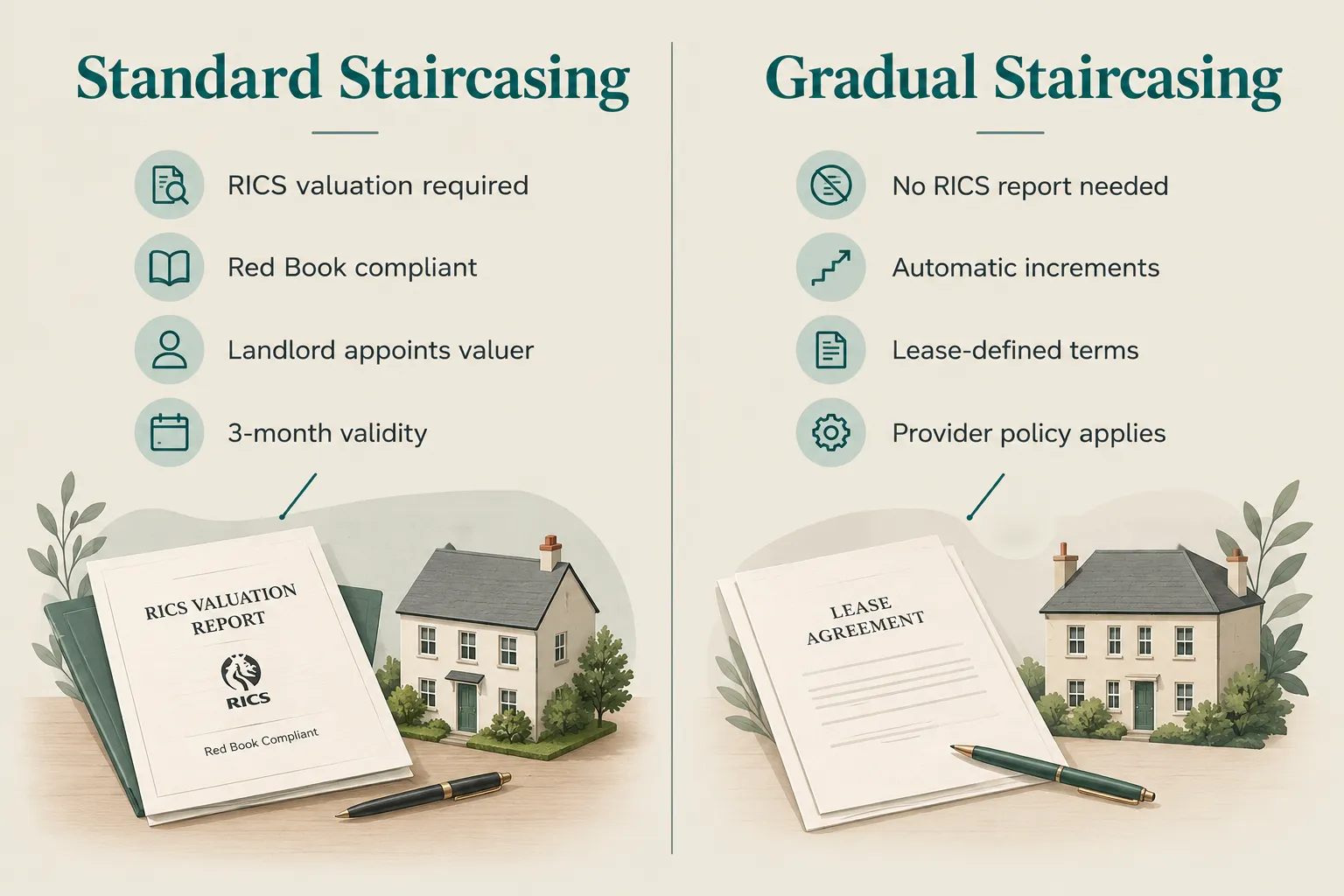
Standard staircasing involves the leaseholder purchasing a defined tranche of shares, typically 10% or more, in a single transaction. This triggers the full valuation requirement: a RICS Red Book report, a formal lease variation, and in most cases a mortgage lender's involvement. This is the route most leaseholders take when they have accumulated savings or equity and wish to increase their ownership stake meaningfully [7].
Gradual staircasing (sometimes called "1% staircasing") is a newer mechanism introduced under the 2021 model lease. Eligible leaseholders can purchase additional 1% shares each year for a ten-year period. The price of each 1% tranche is calculated using a formula set out in the lease, based on the most recent formal valuation or an index-linked adjustment, rather than requiring a fresh RICS report for each annual purchase [7]. This reduces transaction costs significantly for leaseholders who want to increase their share incrementally.
The table below summarises the key differences:
| Feature | Standard Staircasing | Gradual (1%) Staircasing |
|---|---|---|
| Minimum tranche | Usually 10% | 1% per year |
| RICS valuation required | Yes | Not for each tranche |
| Lease variation needed | Yes | Typically no |
| Lender involvement | Usually required | Often not required |
| Validity period | 3 months | Lease formula applies |
| Applicable leases | All shared ownership | 2021 model lease and some providers |
Leaseholders should check their lease carefully to confirm which route is available to them. Not all housing associations have adopted the 2021 model lease, and some provider-level policies add conditions beyond the national standard [10].
Lease Terms, Landlord Policies and the Valuer's Assumptions
The lease is the primary document governing the staircasing process, and the valuer must read it before preparing the report. Different leases, particularly older ones issued before 2021, may contain different definitions of market value, different assumptions about the state of repair, and different rules about which improvements are disregarded [1].
A valuation of shared ownership carried out without reference to the specific lease assumptions is not Red Book compliant and will not be accepted by a housing association or lender. The valuer's terms of engagement should confirm that they have reviewed the lease and identified the relevant clauses before the inspection takes place.
Common lease assumptions the valuer must apply:
- The property is sold with vacant possession on the open market.
- The buyer is not an existing shared owner of the same property.
- Any improvements funded entirely by the leaseholder are excluded from the value.
- Any disrepair attributable to the leaseholder's failure to maintain is included (i.e., the property is not assumed to be in better condition than it actually is).
Landlord appointment and fee structures. The housing association selects the valuer from its approved panel. Fees vary by location and property type, but typical costs in 2026 range from approximately £300 to £600 for a standard residential property [4]. Some providers charge an administration fee on top of the valuation fee. Leaseholders should request a full schedule of costs before proceeding.
Time limits for requesting a valuation. Once a leaseholder serves notice of their intention to staircase, most leases require the housing association to arrange the valuation within a set period, commonly four to eight weeks. If the landlord fails to act within that period, some leases allow the leaseholder to appoint their own RICS valuer [1]. Leaseholders should note these time limits in writing and keep records of all correspondence.
Evidence Requirements, Disputes and Challenging a Valuation
Even a well-prepared Red Book report can produce a figure the leaseholder believes is too high. This is not uncommon in rising markets, where recent comparable sales may reflect a peak that the leaseholder considers unsustainable. A challenge is possible, but it must follow the process set out in the lease, not simply a letter of complaint to the housing association.
The standard challenge process involves the leaseholder obtaining an independent RICS valuation at their own expense and submitting it to the housing association within the period specified in the lease (often 21 days from receipt of the original report) [6]. If the two figures differ, most leases provide for a third RICS valuer to be appointed as an independent expert, with the cost shared between the parties. The third valuer's decision is usually binding [6].
Leaseholders who believe a dispute may arise should consider whether a valuation dispute expert witness is appropriate, particularly where the difference in value is significant or where there are complex lease assumptions in dispute. An expert witness can prepare a report that meets the standards required if the matter proceeds to a tribunal or court.
What lenders and conveyancers need. Mortgage lenders will typically require a copy of the RICS report and confirmation from the housing association that the valuation has been accepted before they will issue a formal mortgage offer [1]. Conveyancers need the report to draft the lease variation and calculate the premium payable. A report that is out of date, missing required elements, or not prepared by a RICS Registered Valuer will stall the transaction at the legal stage.
Documentation the leaseholder should prepare:
- Copies of planning permissions and building regulations certificates for any improvements carried out.
- Receipts or contracts showing the leaseholder funded the works (not the landlord).
- The original shared ownership lease and any previous lease variations.
- Correspondence with the housing association confirming the staircasing intention.
Providing this documentation promptly reduces the risk of the valuer making incorrect assumptions about which improvements to include or exclude [3].
For leaseholders who want to understand how a Red Book report differs from a building survey, the article on building survey versus valuation survey sets out the distinction clearly. A valuation report does not assess condition in detail; a separate RICS building survey may be advisable if the leaseholder wants a full picture of the property's condition before committing to a larger ownership stake.
Where a leaseholder has previously received a valuation for capital gains tax purposes, for example, on a previous disposal, that report cannot be used for staircasing. Each purpose requires a separately instructed Red Book valuation with the correct assumptions applied.
Frequently Asked Questions
Can a leaseholder choose their own valuer for staircasing?
In most cases, no. The lease gives the housing association the right to appoint the valuer. If the landlord fails to arrange a valuation within the time limit set out in the lease, the leaseholder may then appoint their own RICS valuer. Check the specific wording in your lease.
Does the staircasing valuation take into account what I paid originally?
No. The price of additional shares is always based on the current open market value of the whole property at the date of valuation, regardless of what was paid when the shared ownership was first purchased [4].
What happens if the valuation expires before I complete?
A new valuation will be required. Most leases set a three-month validity period. If your transaction is likely to take longer, discuss this with your housing association and solicitor as early as possible.
Are leaseholder improvements always disregarded?
Only improvements funded entirely by the leaseholder and carried out with the landlord's consent are disregarded. Works funded partly or wholly by the housing association, or carried out without consent, may be included in the valuation [1].
Can I use the same valuation for both staircasing and a mortgage application?
Possibly, but only if the lender accepts the report prepared for the housing association. Some lenders require their own panel valuer to inspect the property. Confirm this with your mortgage broker before the valuation is instructed.
What does a staircasing valuation cost in 2026?
Fees typically range from £300 to £600 for a standard residential property, depending on location and property type [4]. Administration fees charged by the housing association are additional. Always request a full cost breakdown before proceeding.
Is gradual 1% staircasing available on all shared ownership properties?
No. It is only available under leases that incorporate the 2021 model lease terms. Leaseholders with older leases should check with their housing association whether the terms have been updated [7].
Conclusion
Property valuation for shared ownership staircasing requires a level of precision that goes beyond a standard market appraisal. The valuer must understand the lease, apply the correct assumptions, disregard leaseholder improvements, and produce a Red Book compliant report with a clear comparable sales schedule, all within a validity window that is typically just three months.
Leaseholders can protect themselves by:
- Reading the staircasing provisions in their lease before serving notice.
- Preparing documentation for all improvements they have funded.
- Confirming the valuer's RICS registration and Red Book compliance before the inspection.
- Keeping written records of all dates and correspondence with the housing association.
- Taking independent advice promptly if the valuation figure appears significantly higher than comparable sales in the area.
Housing associations, lenders and conveyancers all rely on the same report, so a report that does not meet the required standard creates delays for everyone in the chain. Instructing a qualified RICS Registered Valuer with experience of shared ownership transactions is the most reliable way to keep the process on track.
References
[1] Shared Ownership Guidance For Lenders Landlords And Conveyancers – gov.uk
[2] Shared Ownership Policy (Newcastle) – new.newcastle.gov.uk
[3] Shared Ownership Valuation Buying Selling – sharedownershipresources.org
[4] UK Shared Ownership Staircasing – calchub.uk
[6] Can I Challenge A Staircasing Valuation – sharedownershipresources.org
[7] Capital Funding Guide: Shared Ownership – gov.uk
[10] Alliance Homes Staircasing Policy Jun 2025 – alliancehomes.org.uk