
The UK property market in 2026 tells a tale of two nations. While Scottish surveyors report the strongest house price growth in nearly a year, their counterparts in London and the South East navigate stagnant or declining valuations. This stark regional divergence demands a fundamental shift in how chartered surveyors approach building surveys and property valuations across different UK markets. The Regional Market Divergence Strategy for Surveyors: Tailoring Building Surveys and Valuations Across Scotland, North West, and Southern Markets has become essential for professionals seeking to deliver accurate, market-responsive assessments that reflect local economic realities rather than outdated national averages.

Key Takeaways
- 🏴 Scotland leads UK growth: A net balance of 42% of Scottish respondents reported rising house prices in early 2026, compared to -10% UK-wide, requiring surveyors to adjust valuation methodologies accordingly
- 📊 Regional defect prioritization varies: Construction types, climate conditions, and building ages differ substantially across Scotland, North West England, and Southern markets, demanding tailored survey approaches
- 💷 Valuation adjustments must reflect local dynamics: Scottish competitive pricing and strong demand contrast sharply with Southern England's premium valuations and slower market activity
- 🔍 Survey scope adaptation is critical: Market conditions dictate whether comprehensive Level 3 surveys or streamlined Level 2 assessments better serve clients in each regional context
- 📈 Future-proofing strategies differ regionally: Growth markets require different investment advice and defect assessment priorities than declining or stable markets
Understanding the 2026 Regional Market Landscape
The UK property market has fractured into distinct regional ecosystems, each operating under different economic pressures and growth trajectories. This fragmentation represents the most significant challenge—and opportunity—for chartered surveyors working across multiple markets in 2026.
Scotland's Market Momentum
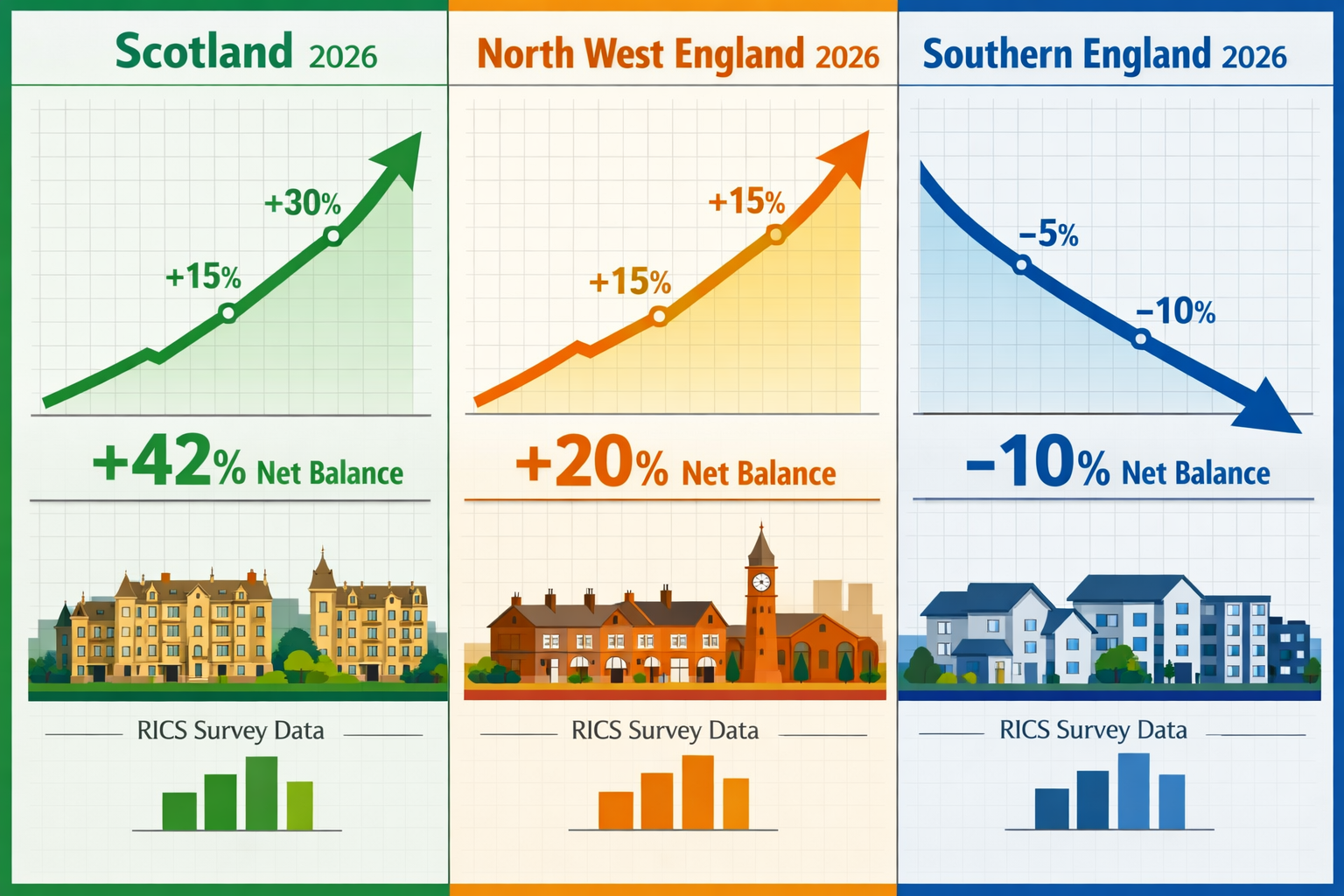
Scotland has emerged as the unexpected powerhouse of UK property growth in 2026. According to recent RICS survey data, 42% net balance of Scottish respondents reported house prices rising over the past three months—the strongest reading in nearly a year[1]. This performance stands in stark contrast to the UK headline house price balance of -10%, revealing a market operating on fundamentally different principles than the rest of Britain.
Key Scottish market indicators include:
- 📈 21% net balance reporting rising buyer enquiries in January 2026
- 🏘️ 27% net balance reporting increased instructions to sell
- 🎯 55% of Scottish respondents anticipate higher prices over the coming year
- 💰 Nine Scottish locations dominating national growth forecasts, with Motherwell projected at 3.4% average price rise[8]
This momentum stems from Scotland's combination of competitive pricing, active demand, and disciplined stock levels[4]. For surveyors, this translates to a market where thorough valuations must account for rapid appreciation potential and where buyers increasingly seek comprehensive building surveys to justify premium offers in competitive bidding situations.
North West England's Transitional Position
The North West occupies a middle ground between Scotland's exuberance and Southern England's lethargy. This region demonstrates moderate growth characteristics with pockets of stronger performance in specific towns and cities. Chartered surveyors in North West London and surrounding areas report steady transaction volumes without the dramatic price swings seen in other regions.
The transitional nature of this market requires surveyors to maintain balanced perspectives—neither overly optimistic nor pessimistic—when conducting valuations and assessing property conditions.
Southern England's Cooling Market
Southern England, including London and the South East, faces a markedly different reality in 2026. Higher existing valuations, affordability constraints, and economic uncertainty have created a slower-growth environment. Some areas experience small price declines as the market recalibrates from previous peaks.
This cooling creates specific challenges for surveyors:
- Valuations must reflect realistic market conditions rather than seller expectations based on historical growth
- Buyers exercise greater caution, demanding more detailed defect analysis before committing
- Lenders apply stricter criteria, requiring more conservative valuation approaches
- The gap between asking prices and achieved prices widens, complicating comparative analysis
Regional Market Divergence Strategy for Surveyors: Adapting Survey Methodologies
Implementing an effective Regional Market Divergence Strategy for Surveyors: Tailoring Building Surveys and Valuations Across Scotland, North West, and Southern Markets requires fundamental adjustments to survey methodologies based on regional characteristics.
Scotland: Comprehensive Surveys for Competitive Markets
In Scotland's hot market, buyers face intense competition and often make rapid decisions. This environment paradoxically increases the need for thorough structural surveys despite time pressures.
Scottish survey adaptations should include:
-
Expedited turnaround protocols: Develop streamlined reporting processes that maintain thoroughness while delivering results within 48-72 hours to support competitive offer timelines
-
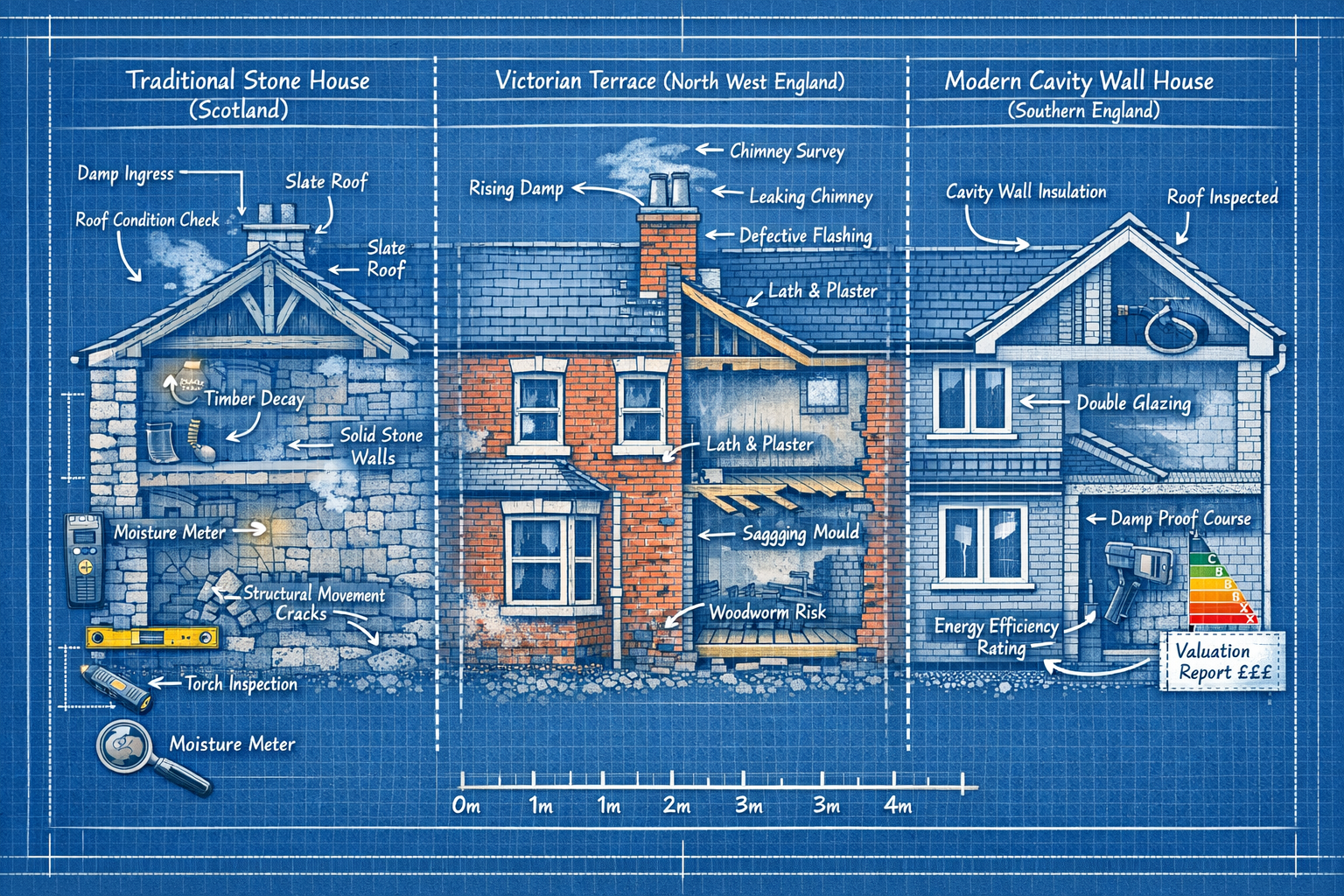
Traditional construction expertise: Scottish properties frequently feature solid wall construction, stone facades, and traditional building methods requiring specialized assessment skills. Surveyors must identify common issues like:
- Stone wall deterioration and repointing requirements
- Slate roof condition and replacement costs
- Solid wall moisture penetration
- Traditional timber floor systems
- Single-glazed sash window conditions
-
Growth potential assessment: Include market commentary that helps buyers understand appreciation potential, particularly important when properties receive multiple offers above asking price
-
Climate-specific defect analysis: Scotland's wetter climate and exposure to harsh weather necessitates particular attention to:
- External render condition and weatherproofing
- Gutter and downpipe adequacy
- Roof covering integrity
- Damp penetration risks
North West England: Balanced Assessment Approaches
The North West's transitional market requires surveyors to maintain equilibrium between thoroughness and efficiency. Understanding which survey you need becomes particularly important in this balanced market.
North West survey considerations:
-
Victorian and Edwardian housing stock: The region's predominance of terraced housing from this era demands expertise in:
- Solid wall construction defects
- Chimney breast removal identification
- Damp proof course failures
- Bay window structural issues
- Cellar and basement conditions
-
Moderate market pricing: Valuations should reflect steady rather than dramatic growth, avoiding both excessive optimism and unwarranted pessimism
-
Standard survey levels: Most transactions benefit from RICS Level 2 Homebuyer Surveys rather than full Building Surveys, though older properties warrant more comprehensive assessment
-
Local market knowledge: Understanding survey pricing variations and competitive positioning within the regional market
Southern Markets: Conservative Valuations and Detailed Defect Analysis
Southern England's cooling market demands conservative approaches that protect both buyers and lenders from overpayment risks.
Southern market survey strategies:
-
Rigorous comparable analysis: With wider gaps between asking and achieved prices, valuations must rely on recent, verified transaction data rather than listing prices
-
Defect cost quantification: Buyers in slower markets negotiate more aggressively on defects, making detailed repair cost estimates essential. Consider providing:
- Itemized defect repair budgets
- Priority categorization (immediate, short-term, long-term)
- Impact on valuation clearly stated
- Recommendations for specific defect reports where warranted
-
Modern construction assessment: Southern regions contain more recent developments requiring expertise in:
- Cavity wall construction and insulation
- Modern building regulation compliance
- Contemporary materials and systems
- New-build defect identification
- Non-standard construction types
-
Lender requirement alignment: Understand that mortgage valuations differ from surveys, and ensure valuations meet increasingly conservative lending criteria
Tailoring Valuation Approaches Across Regional Markets
The Regional Market Divergence Strategy for Surveyors: Tailoring Building Surveys and Valuations Across Scotland, North West, and Southern Markets fundamentally transforms how professionals approach property valuation in 2026.
Scotland: Growth-Adjusted Valuation Methodologies
Scottish valuations in 2026 must account for sustained growth momentum while maintaining professional objectivity. Understanding factors of valuation becomes particularly nuanced in appreciating markets.
Scottish valuation considerations:
-
Recent comparable weighting: Prioritize transactions from the past 3-6 months over older data, as rapid appreciation renders 12-month-old comparables less relevant
-
Demand intensity factors: Consider:
- Days on market (shorter indicates stronger demand)
- Offer-to-asking price ratios (multiple offers above asking common in hot areas)
- Stock levels relative to historical norms
- Buyer enquiry trends from local agents
-
Conservative growth projections: While 55% of Scottish respondents anticipate higher prices[4], professional valuations should avoid speculative future growth assumptions
-
Location micro-analysis: With nine Scottish locations dominating UK growth forecasts[8], distinguish between high-performing areas and those with more modest prospects
North West England: Stability-Focused Valuations
North West valuations should emphasize market stability and sustainable value rather than dramatic appreciation or decline scenarios.
Balanced valuation approach:
-
Historical trend analysis: Examine 3-5 year price trends to identify sustainable growth rates rather than short-term fluctuations
-
Local economic indicators: Consider employment stability, infrastructure investment, and demographic trends affecting long-term value
-
Condition-adjusted pricing: Given the region's older housing stock, condition variations significantly impact value. Develop clear adjustment matrices for:
- Modernization levels
- Energy efficiency ratings
- Structural condition
- Remaining useful life of major components
-
Realistic market positioning: Avoid both the optimism warranted in Scottish markets and the conservatism required in Southern markets
Southern Markets: Conservative, Evidence-Based Valuations
Southern England valuations in 2026 demand rigorous evidence-based approaches that protect all parties from overvaluation risks in cooling markets.
Conservative valuation framework:
-
Verified transaction emphasis: Rely exclusively on completed sales rather than listing prices or agreed sales that may fall through
-
Downward adjustment readiness: Be prepared to value properties below asking prices when market evidence supports lower figures, even when this creates difficult conversations with sellers or estate agents
-
Affordability constraint consideration: High price-to-income ratios in Southern markets limit buyer pools, affecting liquidity and sustainable values
-
Lender requirement alignment: Ensure valuations meet conservative lending criteria, understanding that Red Book valuations must serve lender risk management needs
-
Market time projections: In slower markets, include realistic assessments of likely marketing periods, as extended time on market often necessitates price reductions
Specialized Valuation Scenarios Across Regions
Certain valuation types require additional regional adaptation:
Commercial property valuations: Commercial building surveys and commercial property valuations must account for regional economic performance, with Scotland's stronger economic indicators supporting more optimistic yield assumptions than Southern markets
Lease extensions and enfranchisement: Lease extension valuations vary significantly by region, with Scottish leasehold being rare while Southern markets require frequent lease extension assessments
Help to Buy and shared ownership: Help to Buy valuations and shared ownership valuations must reflect regional affordability constraints and scheme availability

Implementing Regional Divergence Strategies in Practice
Translating regional market understanding into practical surveying excellence requires systematic implementation across business operations.
Building Regional Expertise
Professional development must prioritize regional specialization:
-
Local market immersion: Regularly review regional RICS survey data, attend local property events, and maintain relationships with regional estate agents and solicitors
-
Construction type specialization: Develop deep expertise in the predominant construction types within your primary operating regions—Scottish traditional stone, North West Victorian terraced, or Southern modern construction
-
Regional networking: Join regional RICS branches and participate in local continuing professional development focused on regional market dynamics
Technology and Data Integration
Modern surveying practices leverage technology to enhance regional market understanding:
-
Comparable databases: Maintain region-specific databases of recent transactions, organized by property type, location, and condition
-
Market tracking systems: Implement systems that monitor regional house price indices, days on market, and supply-demand indicators
-
Digital reporting adaptations: Customize report templates to emphasize region-relevant factors—growth potential in Scotland, stability in North West, conservative positioning in Southern markets
Client Communication Strategies
Regional market divergence requires tailored client communication:
For Scottish clients:
- Emphasize competitive market dynamics and need for rapid decision-making
- Explain how thorough surveys protect against overpayment despite time pressures
- Provide context on regional growth trends supporting investment decisions
For North West clients:
- Focus on steady value and long-term stability
- Highlight importance of condition assessment in older housing stock
- Provide balanced market perspectives avoiding extremes
For Southern clients:
- Set realistic expectations about market conditions and value growth
- Emphasize thorough defect analysis as negotiation leverage
- Explain conservative valuation approaches as protection rather than pessimism
Quality Assurance and Professional Standards
Regional adaptation must never compromise professional standards:
-
RICS compliance: Ensure all regional adaptations comply with RICS Red Book standards and professional conduct requirements
-
Peer review processes: Implement regional peer review where valuations in different markets are reviewed by surveyors with relevant regional expertise
-
Documentation standards: Maintain thorough documentation of regional market factors influencing valuations and survey findings
-
Continuous calibration: Regularly compare valuations against subsequent transaction prices to calibrate regional adjustment factors
Conclusion
The Regional Market Divergence Strategy for Surveyors: Tailoring Building Surveys and Valuations Across Scotland, North West, and Southern Markets represents essential professional adaptation to the fragmented UK property landscape of 2026. Scotland's remarkable 42% net balance of rising house prices[1] stands in stark contrast to the -10% UK headline figure, creating fundamentally different operating environments that demand distinct surveying approaches.
Successful surveyors in 2026 recognize that one-size-fits-all methodologies no longer serve clients effectively. Scottish markets require expedited comprehensive surveys that support competitive decision-making while assessing traditional construction types. North West England demands balanced approaches that reflect steady markets and Victorian housing stock. Southern markets necessitate conservative valuations and detailed defect analysis that protect buyers and lenders in cooling conditions.
Actionable Next Steps
For surveying professionals:
-
Assess your regional expertise: Identify knowledge gaps in your primary operating regions and develop targeted learning plans focused on regional construction types, market dynamics, and valuation factors
-
Audit current methodologies: Review recent surveys and valuations to ensure they reflect appropriate regional adaptations rather than generic national approaches
-
Invest in regional data: Develop or subscribe to region-specific market intelligence systems that provide real-time comparable data and market indicators
-
Customize client communications: Revise report templates and client consultation approaches to emphasize region-relevant factors and market conditions
-
Network regionally: Strengthen relationships with regional estate agents, solicitors, and fellow surveyors to enhance market intelligence and professional knowledge
For property buyers and investors:
Seek surveyors who demonstrate clear regional expertise and adapt their approaches to local market conditions. Ask potential surveyors how their methodologies differ across regions and what regional market factors they consider most significant in 2026.
The UK property market's regional divergence will likely persist throughout 2026 and beyond, making regional specialization not merely advantageous but essential for surveying excellence. Those who master the Regional Market Divergence Strategy for Surveyors: Tailoring Building Surveys and Valuations Across Scotland, North West, and Southern Markets will deliver superior value to clients while building sustainable competitive advantages in an increasingly complex professional landscape.
References
[1] Scottish Housing Market 2026 Rics Survey – https://www.simpsonmarwick.com/journal/scottish-housing-market-2026-rics-survey
[2] The Scottish Property Market In 2026 What Buyers And Sellers Can Expect – https://mov8realestate.com/2026/01/the-scottish-property-market-in-2026-what-buyers-and-sellers-can-expect/
[3] Article – https://www.sovereign-house.com/property-news/article.html?id=1772635874
[4] Why Scotland Is Set To Lead Uk House Price Growth In 2026 – https://www.northwooduk.com/guides/news/why-scotland-is-set-to-lead-uk-house-price-growth-in-2026/
[5] Watch – https://www.youtube.com/watch?v=gi4BmnONNCw
[6] Revealed The 10 Uk Locations Which Could See The Biggest House Price Growth In 2026 – https://moneyweek.com/investments/house-prices/revealed-the-10-uk-locations-which-could-see-the-biggest-house-price-growth-in-2026
[7] Six Themes That Will Define Scotlands Property Market In 2026 – https://gilsongray.co.uk/properties/six-themes-that-will-define-scotlands-property-market-in-2026/
[8] Uk House Prices Set To Rise 15 In 2026 Scotland Leads Growth 93ch 4443626 – https://www.investing.com/news/economic-indicators/uk-house-prices-set-to-rise-15-in-2026-scotland-leads-growth-93CH-4443626
[9] Looking Ahead To 2026 With Dr John Boyle – https://www.rettie.co.uk/blog/looking-ahead-to-2026-with-dr-john-boyle
[10] Scottish Housing Market 2026 Rics Survey – https://www.simpsonmarwick.com/journal/scottish-housing-market-2026-rics-survey