Fewer than one in three homeowners planning a rear extension or basement conversion correctly identifies their Party Wall Act obligations before work starts, and awards made on defective notices are now more vulnerable to legal challenge than at any point in the last decade. The September 2026 Party Wall Guidance Update: What Extension and Basement Projects Must Check Before Works Begin sets out what has changed, what has not, and what every building owner, appointed surveyor and solicitor must verify before a single foundation is dug.
Key Takeaways
- The Party Wall etc. Act 1996 has not been amended; what has changed is the RICS 8th Edition guidance standard and associated Faculty of Party Wall Surveyors Guidance Notes 14-17, which raise the bar for documentation and surveyor conduct.
- Extensions that break ground within 3 metres of an adjoining owner's structure, or basements that excavate within 6 metres of a neighbouring foundation at a depth that would undercut it, trigger mandatory notice requirements.
- Defective notices and poorly evidenced awards face a higher risk of successful challenge under 2026 scrutiny; getting the groundwork right before works begin is not optional.
- HM Land Registry refreshed its boundary guidance on 24 September 2026; title clarity must be confirmed before a notice is served.
- Early neighbour communication, a proper schedule of condition and an independently appointed surveyor remain the three pillars of a compliant project.
What the September 2026 Party Wall Guidance Update Actually Changes
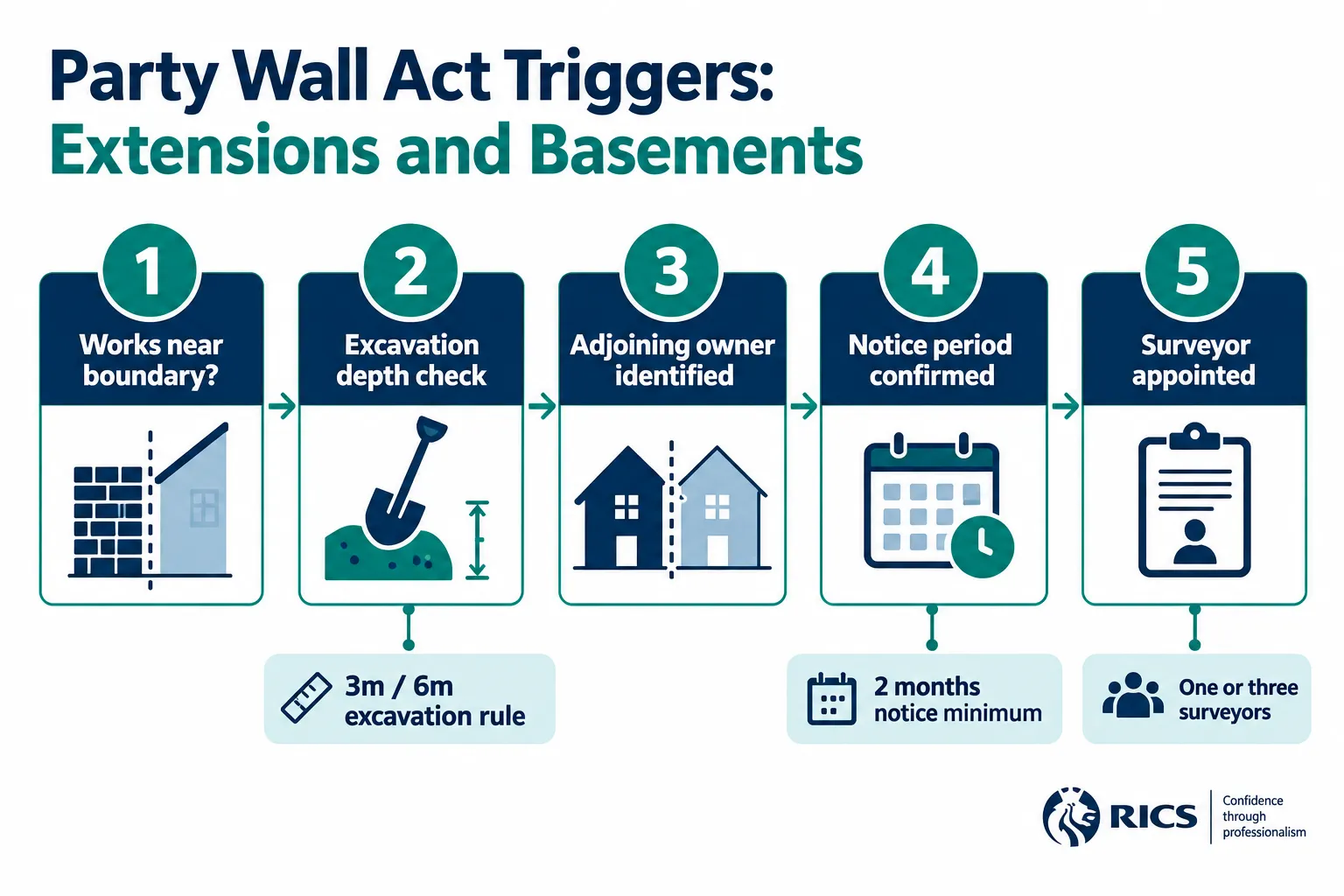
The statutory framework remains the Party Wall etc. Act 1996. Parliament has not amended it. What has shifted is the professional standard against which surveyors, building owners and their advisers are measured [1].
RICS launched a consultation on updated party wall practice guidance that culminated in the 8th Edition becoming the reference standard for projects commencing in autumn 2026 [1]. Alongside it, the Faculty of Party Wall Surveyors rolled out Guidance Notes 14-17 through September 2026 CPD events. These notes address surveyor independence, the quasi-judicial nature of the appointed surveyor's role, and the evidential requirements for awards covering complex schemes including deep basements and large lateral extensions.
What has materially tightened:
- Surveyors must now document their independence more explicitly. An appointed surveyor who has a prior commercial relationship with the building owner faces a higher risk of their award being challenged.
- Awards covering basement and large extension projects must include or reference a schedule of condition prepared before any works begin. An award without this baseline is considered inadequately evidenced under the 8th Edition standard.
- Notice validity is scrutinised more closely. A notice that omits a proper description of the proposed works, or that is served on the wrong party, is more likely to be treated as a nullity, meaning the award that follows it may be set aside on appeal.
The Planning Portal confirmed on 3 October 2026 that Party Wall Act obligations sit alongside, and are entirely separate from, planning permission and building regulations approval. Obtaining planning consent does not discharge the obligation to serve notice [3].
For a plain-English overview of when the Act applies and what it requires, the government's own guidance at Party Wall Act: when and how to tell your neighbours remains the starting point [3].
Excavation Thresholds: The Triggers for Extensions and Basements
The Act contains three notice types. For extension and basement projects, two are most relevant.
Party Structure Notices apply where a building owner proposes to carry out work directly to a party wall or party fence wall, for example, cutting in a new beam bearing, underpinning, or raising the height of a shared wall [3].
Three-Metre and Six-Metre Notices (under section 6 of the Act) apply where excavation work is proposed:
| Notice Type | Trigger Distance | Depth Condition |
|---|---|---|
| 3-metre notice | Within 3m of neighbour's structure | Excavation goes below neighbour's foundation bottom |
| 6-metre notice | Within 3-6m of neighbour's structure | Excavation cuts a 45-degree line drawn from the bottom of their foundation |
These thresholds catch the majority of basement conversions in urban areas and many rear extension foundations in terraced or semi-detached properties. A structural engineer's input is needed to confirm whether the 45-degree line is breached; this is not a calculation a building owner should attempt without professional advice [4].
If you are uncertain whether your proposed works trigger the Act, the question do I need a party wall agreement? is a useful starting point before instructing a surveyor.
Notice Periods, Validity and the Risk of Defective Notices
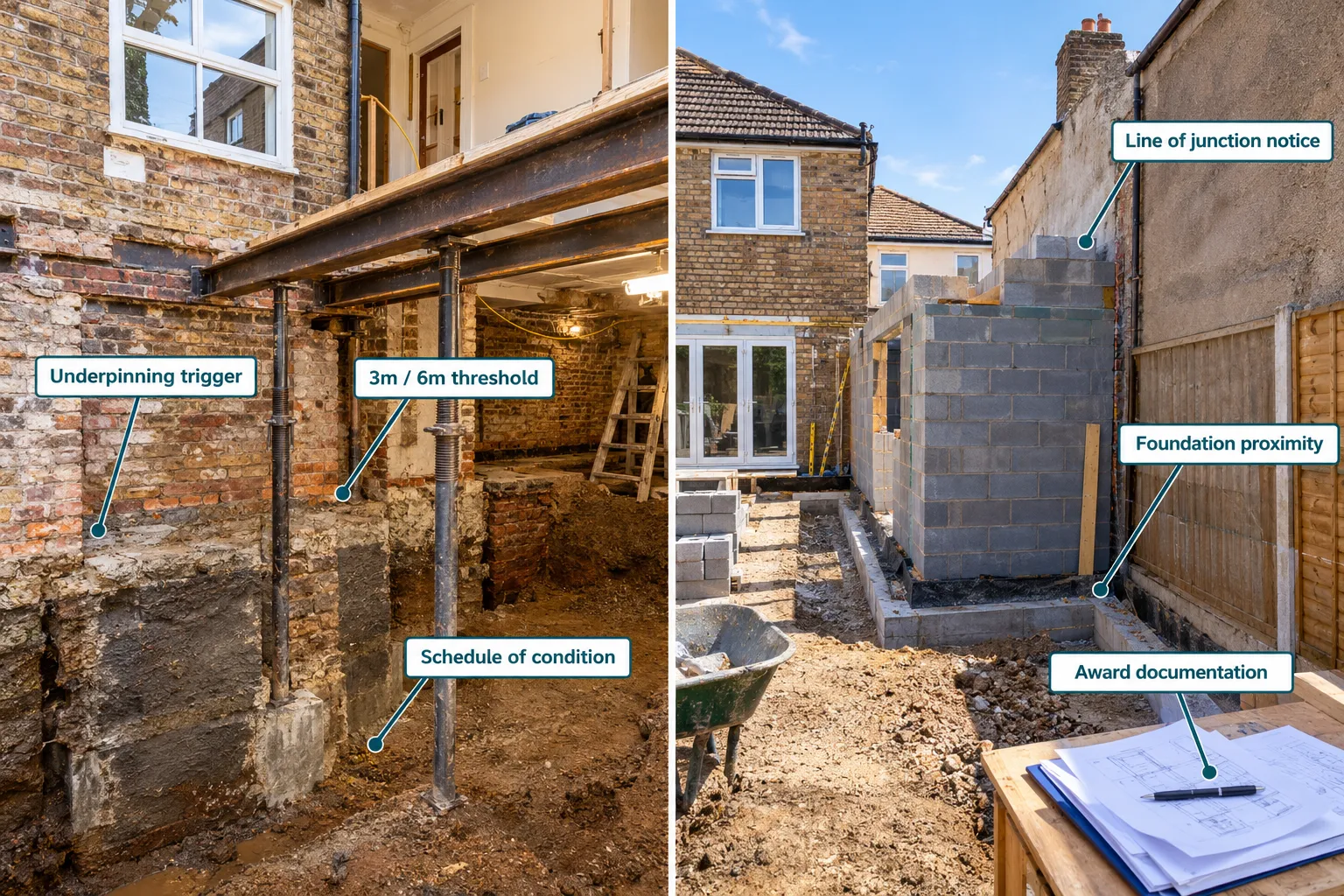
Under the Act, a Party Structure Notice must be served at least two months before the proposed start date. A section 6 notice (excavation) requires at least one month's notice. These are minimum periods; the 8th Edition guidance encourages earlier service for complex schemes to allow adequate time for the adjoining owner to respond and appoint a surveyor [7].
A notice is only valid if it:
- Identifies the building owner by name and address
- Identifies the adjoining owner correctly (which requires title clarity, see below)
- Describes the proposed works with sufficient precision
- States the proposed start date
- Is served by hand, recorded post, or in accordance with section 15 of the Act
The defective notice risk in 2026 is real. Courts have set aside awards where the underlying notice was a nullity. Under the heightened scrutiny introduced by the 8th Edition, a surveyor who proceeds to award on a notice that is plainly defective may face a professional negligence claim. For more on what constitutes a valid notice and how to prepare one, see the party wall notices step-by-step template guide for UK homeowners.
If an adjoining owner dissents or fails to respond within 14 days, a dispute is deemed to exist and surveyors must be appointed. The building owner cannot simply proceed [7]. For an explanation of what happens when no agreement is in place, see what if you do not have a party wall agreement.
Boundary and Title Clarity: The HM Land Registry Refresh
On 24 September 2026, HM Land Registry refreshed its published guidance on boundaries and boundary disputes. The core message is unchanged, the general boundary rule means that the Land Register does not fix the precise legal boundary, but the refreshed guidance places greater emphasis on building owners confirming the position of the boundary before serving notice [2].
This matters for party wall purposes because:
- A notice served on the wrong person (for example, a leaseholder rather than the freeholder, or a neighbour whose title does not include the wall in question) is defective.
- Where a boundary is genuinely disputed, a party wall surveyor cannot resolve that dispute. It must be addressed separately, potentially through the Land Registry's boundary determination process or litigation [2].
- Line of junction notices, served where a building owner proposes to build at or astride the boundary on land that is not yet built upon, require particular care about boundary position.
Before serving any notice, a building owner should obtain official copies of their own title and the adjoining owner's title from HM Land Registry. This is a low-cost step that eliminates a common source of invalid notices.
Surveyor Appointments and the Quasi-Judicial Role
The 8th Edition guidance and Guidance Notes 14-17 together place the surveyor's independence at the centre of the party wall process. An appointed surveyor, whether agreed jointly or appointed separately by each party, acts in a quasi-judicial capacity. Their duty is to the Act, not to the party who appointed them [1] [10].
Three appointment models exist:
| Model | Description | When Used |
|---|---|---|
| Agreed surveyor | Single surveyor agreed by both parties | Straightforward, low-risk works |
| Two surveyors | Each party appoints their own | Disputed or complex works |
| Three surveyors | Two appointed surveyors select a third | Deadlock between the two |
For basement and large extension projects, two surveyors is the more common model. The 8th Edition guidance discourages the agreed surveyor model where works are high-risk or where the building owner has a pre-existing relationship with the proposed agreed surveyor.
A surveyor who acts partially, for example, by delaying the award to benefit the building owner, or by refusing to consider the adjoining owner's reasonable concerns, may face a challenge to the award and a referral to RICS for professional conduct review [10].
If an award is challenged, the matter goes to the county court. Awards that are poorly reasoned, made on defective notices, or made by a surveyor whose independence is in question are more likely to be overturned. For context on how party wall disputes escalate, see what is a party wall dispute.
The Pre-Works Checklist for Extensions and Basements in 2026
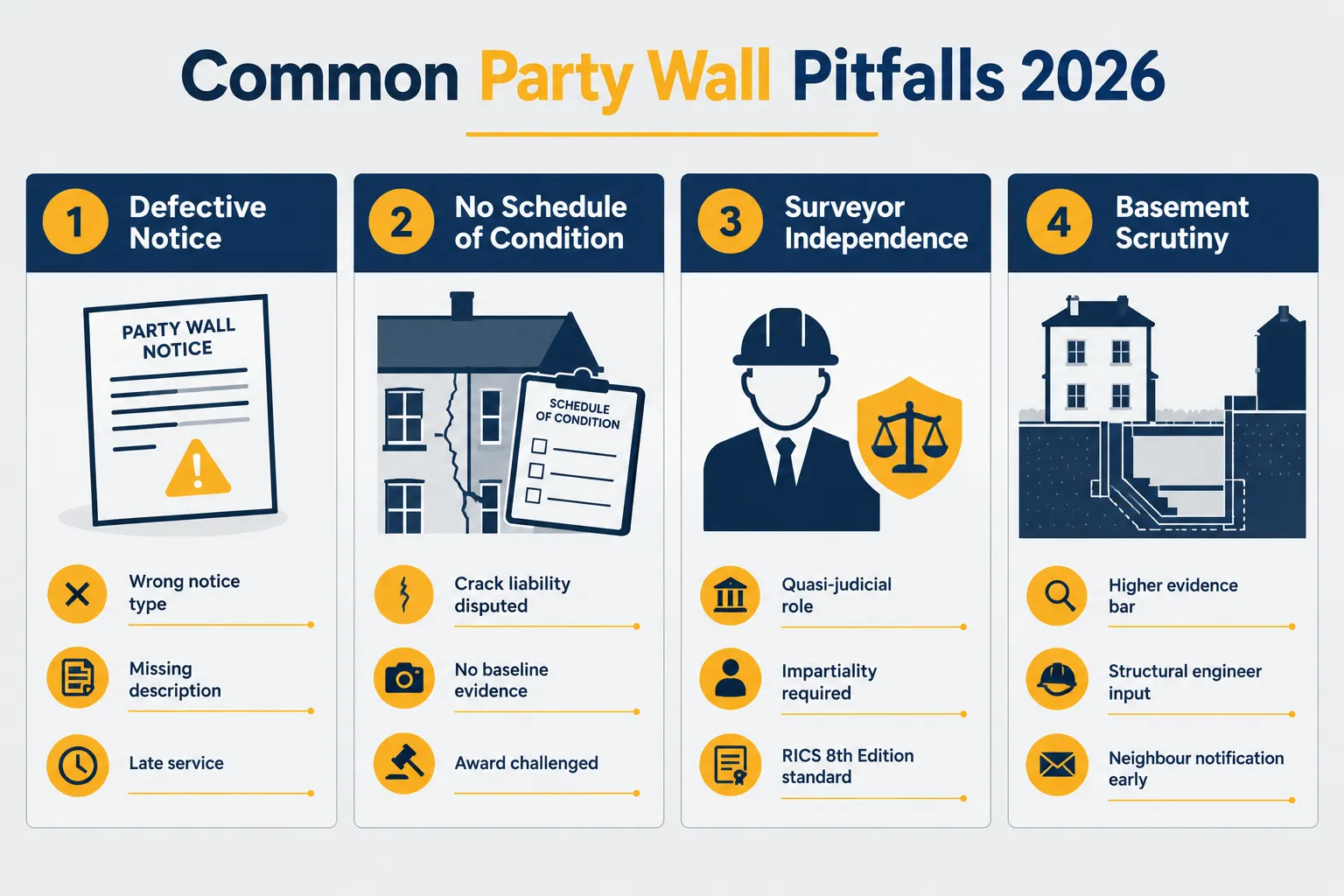
The following checks should be completed before any works begin on an extension or basement project that may engage the Act.
1. Confirm whether the Act applies
Review the proposed works against the three-metre and six-metre thresholds. Obtain a structural engineer's confirmation of foundation depths where relevant.
2. Identify all adjoining owners correctly
Pull official copies of neighbouring titles. Check whether the property is leasehold; if so, both the leaseholder and the freeholder may need to be served depending on the lease term.
3. Confirm boundary position
Cross-reference the title plan with the physical boundary. If there is any ambiguity, address it before serving notice, not after [2].
4. Serve the correct notice type with the correct lead time
Use the right form for the right section of the Act. Allow at least two months for party structure works and one month for excavation works, measured from the date of service [7].
5. Prepare a schedule of condition before works begin
Commission a photographic and written schedule of condition covering the adjoining owner's property. This is the baseline evidence if a damage claim arises during or after works. For more on what happens when damage does occur, see damage to property in party wall.
6. Appoint a surveyor who meets the independence standard
Under the 8th Edition, the surveyor should have no prior commercial relationship with the building owner that could compromise their quasi-judicial role [1].
7. Do not start works before the award is made
Starting works before a valid award is in place, or before the notice period has expired without dissent, exposes the building owner to an injunction and potential liability for the adjoining owner's legal costs.
Complex and Institutional Projects: Higher Scrutiny Under 2026 Guidance
Basement conversions beneath terraced London properties and large institutional extensions (build-to-rent blocks, commercial-to-residential conversions) face the highest level of scrutiny under the September 2026 Party Wall Guidance Update. The Faculty of Party Wall Surveyors' Guidance Notes 14-17 specifically address these project types.
Key additional requirements for complex projects include:
- A structural engineer's method statement for underpinning or temporary propping, attached to or referenced in the award
- Vibration and noise monitoring protocols agreed in the award before works begin
- An access licence agreed in advance where the surveyor requires entry to the adjoining owner's property to prepare the schedule of condition
- Consideration of whether the adjoining owner requires their own independent structural engineer to review the method statement
For projects where a dispute escalates to court, a party wall expert witness may be required. The role and limits of that appointment are set out in the party wall expert witness guidance.
Frequently Asked Questions
Does the September 2026 guidance change the notice periods under the Act?
No. The statutory notice periods, two months for party structure works, one month for excavation, are set by the Party Wall etc. Act 1996 and have not changed. The guidance raises the standard for how notices are prepared and served, not the periods themselves.
My builder says I do not need a party wall agreement for a small rear extension. Is that correct?
It depends entirely on the proximity of the proposed foundations to the neighbouring structure and whether the works touch any party wall. A builder is not qualified to make that determination. A RICS-accredited party wall surveyor should be consulted before works begin.
Can I use the same surveyor as my neighbour?
Yes, provided both parties genuinely agree and the surveyor has no prior relationship with either party that would compromise their independence. For complex or high-value works, separate appointments are generally advisable.
What happens if I start works without serving notice?
The adjoining owner can apply to the county court for an injunction to stop the works. The building owner may also be liable for the adjoining owner's legal costs and any damage caused. There is no retrospective route to regularise works already carried out without notice [3].
Does a party wall award replace planning permission?
No. A party wall award is entirely separate from planning permission and building regulations approval. All three may be required for the same project [3].
How does the HM Land Registry boundary refresh affect me?
If your title plan is unclear about the boundary position, the refreshed guidance makes it easier to understand your options, but it does not change the legal position. Confirm the boundary before serving notice to avoid serving on the wrong party [2].
Conclusion
The September 2026 Party Wall Guidance Update: What Extension and Basement Projects Must Check Before Works Begin does not rewrite the law. It raises the professional standard for everyone involved, building owners, appointed surveyors and their advisers. Awards made on defective notices, by surveyors whose independence is in question, or without a proper schedule of condition are more exposed to challenge than ever.
The practical steps are clear: confirm whether the Act applies, identify the correct adjoining owners, check the boundary position against the refreshed HM Land Registry guidance, serve the right notice with the right lead time, commission a schedule of condition, and appoint a surveyor who meets the 8th Edition independence standard. None of these steps is optional for an extension or basement project that engages the Act.
For projects starting in autumn 2026, the time to act on these checks is before the scaffolding goes up, not after the first wall is cut.
References
[1] RICS Launches Consultation On Updated Party Wall Practice Guidance – rics.org
[2] HM Land Registry Boundaries And Boundary Disputes – gov.uk
[3] Party Walls Building Works – gov.uk
[4] RICS 8th Edition Party Wall Guidance – hudsonpartywallsurveyors.co.uk
[7] When How Tell Them – gov.uk
[10] Party Walls – rics.org