A mortgage lender approved a loan on a Victorian terrace in 2023, relying on a desktop valuation that missed severe rising damp behind freshly painted walls. The borrower later discovered the repair bill exceeded £18,000. The valuer had never set foot inside the property. That case illustrates precisely why the question of whether a surveyor can value a property without visiting carries real financial weight, and why the answer is more nuanced than a simple yes or no.
This article examines desktop valuations, drive-by assessments and full physical inspections side by side, explaining how missing condition evidence affects reliability across lending, tax, probate and dispute contexts. It draws on RICS Red Book Global Standards, current lender practice and professional guidance to help buyers, owners, solicitors and lenders make informed decisions.
Key Takeaways
- A surveyor can produce a desktop valuation without visiting, but RICS standards require the inspection limitation to be clearly disclosed and professionally justified.
- Desktop valuations rely on comparable sales data, Land Registry records and automated valuation model (AVM) outputs, none of which capture physical condition.
- They are acceptable for certain low-risk mortgage cases, portfolio reviews, probate estimates and capital gains tax calculations, but carry higher uncertainty than a full inspection.
- The RICS Red Book Global Standards (effective 31 January 2025) tightened the rules around limited and desktop inspections, requiring explicit documentation of assumptions and constraints.
- Where condition is material to value, structural defects, damp, non-standard construction, a physical inspection is almost always necessary for a reliable, defensible figure.
What a Desktop Valuation Actually Is
A desktop valuation is a professional opinion of market value produced without any physical inspection of the property. The surveyor works entirely from secondary sources: Land Registry price-paid data, comparable sales evidence, Ordnance Survey mapping, planning records, energy performance certificates and, increasingly, AVM outputs generated by algorithms trained on large transaction datasets [1].
The term is sometimes used loosely to cover two distinct approaches:
- Pure desktop: no visit of any kind; the valuer relies solely on data sources and their local market knowledge.
- Drive-by (or kerbside) valuation: the valuer views the exterior from the street but does not enter the property. This provides limited condition evidence, visible roof defects, obvious structural movement, condition of windows and render, but nothing about the interior.
Neither approach meets the standard of a full Red Book inspection. Both require the valuer to make explicit assumptions about condition, tenure, legal title and any factors that a physical visit would normally verify [1].
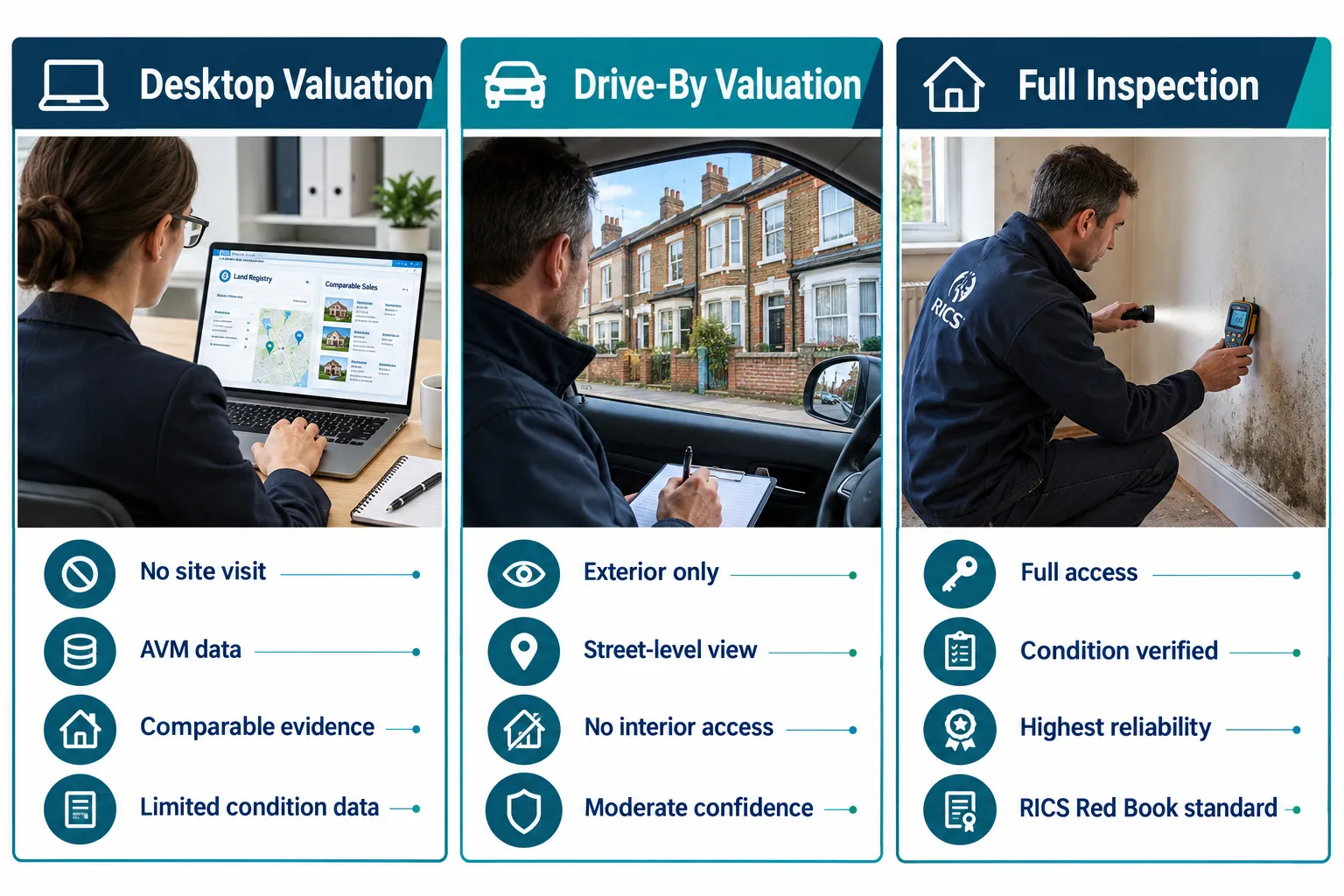
The RICS guidance on desktop valuations is clear: the valuer must set out every assumption made, explain the limitations of the approach, and confirm that the client has accepted those limitations in writing before the report is issued [1]. The Red Book Global Standards, updated with effect from 31 January 2025, reinforce this by requiring that any departure from a full inspection be recorded in the terms of engagement and the report itself [5].
For a broader understanding of what a full physical inspection covers, the RICS Level 3 Building Survey: What UK Homebuyers Should Expect sets out the scope in detail.
How Inspection Limits Affect Valuation Reliability
The reliability of any valuation depends on the quality of the evidence feeding into it. Physical condition is one of the most significant value-affecting factors for residential and commercial property alike, and it is precisely the factor that a desktop approach cannot directly assess.
What condition evidence a desk-based approach misses
| Factor | Full Inspection | Drive-By | Desktop |
|---|---|---|---|
| Structural movement and cracking | Yes | Partial (exterior only) | No |
| Damp, rot and timber defects | Yes | No | No |
| Roof condition (internal) | Yes | Partial (visible slopes) | No |
| Services and heating condition | Yes | No | No |
| Internal layout and specification | Yes | No | No |
| Planning or building control issues | Partial | No | No |
| Comparable sales evidence | Yes | Yes | Yes |
| Land Registry title data | Yes | Yes | Yes |
The gap between columns is not merely academic. A property with significant structural movement, unresolved damp or a flat roof nearing end of life may be worth 10-25% less than a comparable property in sound condition. A desktop valuation that assumes average condition will systematically overstate value in such cases [3].
RICS professional guidance on valuation judgement and due diligence acknowledges that the valuer's professional judgement must compensate for the absence of inspection evidence, and that this compensation has limits [3]. Where the risk of condition-related value adjustment is material, the guidance points firmly toward a physical inspection.
AVMs sit at the automated end of this spectrum. They process thousands of data points rapidly but apply no human judgement to condition, presentation or local micro-market nuance [8]. Desktop valuations produced by a qualified surveyor sit between AVMs and full inspections: they add professional judgement to the data, but without the condition evidence that only a visit can provide.
When Can a Surveyor Value a Property Without Visiting?
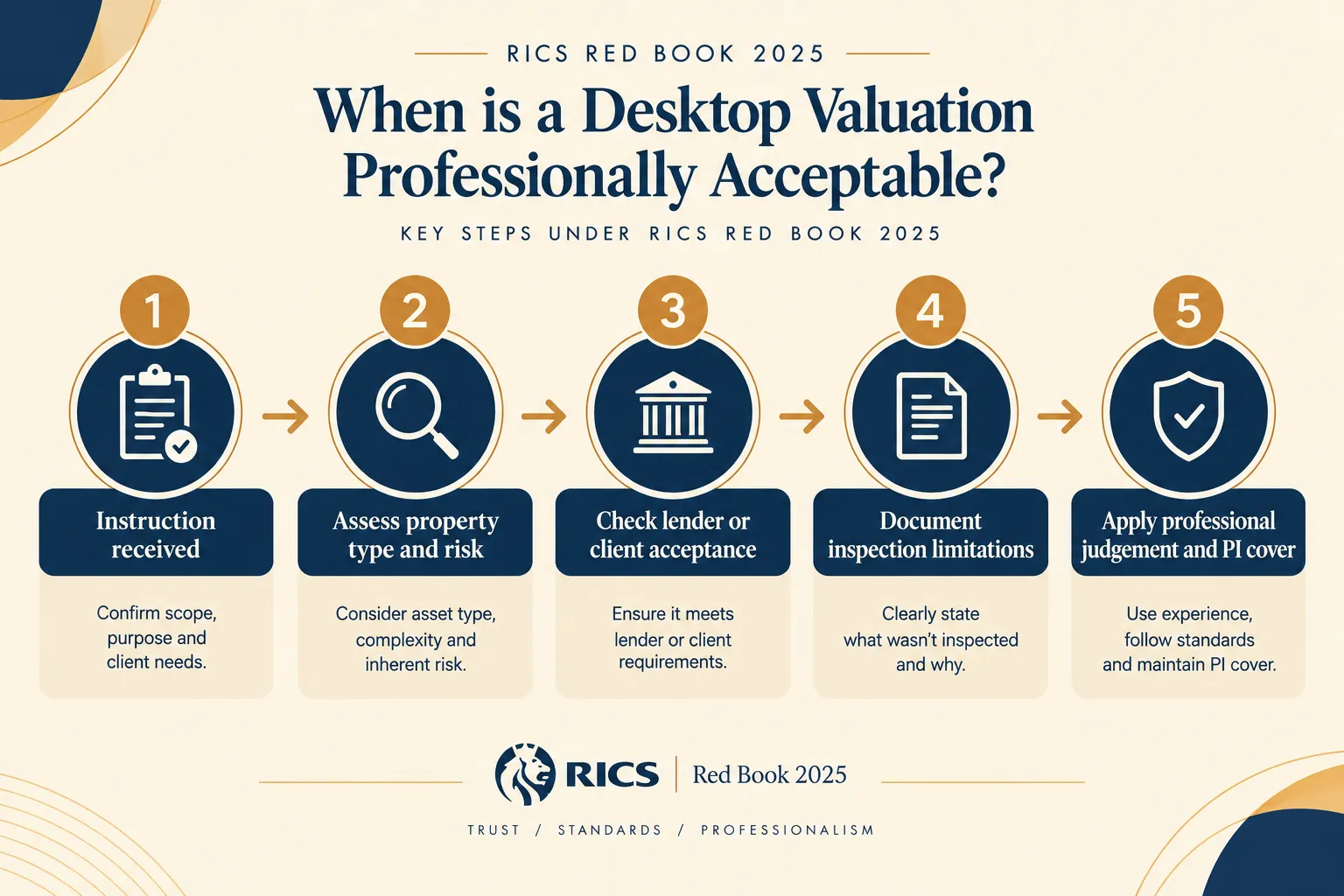
The answer to whether a surveyor can value a property without visiting depends on the purpose of the valuation, the risk profile of the property and the requirements of the instructing party. RICS residential valuation guidance aligned with the 2025 Red Book identifies specific circumstances where a desktop approach is professionally defensible [7].
Mortgage lending
Mainstream mortgage lenders have expanded their use of desktop and AVM-based valuations for standard residential cases where:
- The loan-to-value (LTV) ratio is relatively low (typically below 75-80%).
- The property is of standard construction and in a well-transacted area.
- Recent comparable sales provide strong market evidence.
- There are no known condition concerns flagged by the borrower or broker.
Lenders such as United Trust Bank have introduced desktop valuation options for bridging finance, positioning them as a faster route between a pure AVM and a full survey for lower-risk cases [2]. Barclays and other high-street lenders have similarly used AVM and desktop approaches for remortgages where the borrower has held the property for several years and LTV is modest [6].
The key constraint is lender acceptance. Even if a RICS valuer is willing to produce a desktop report, the lender's panel instructions may require a physical inspection for certain property types, LTV bands or loan sizes. The valuer must follow those instructions or decline the instruction.
Portfolio and periodic revaluations
Fund managers, registered providers and public-sector bodies sometimes commission desktop revaluations of large portfolios between full inspection cycles. RICS guidance permits this where:
- A full inspection was carried out recently (typically within one to three years).
- No material changes to condition or use are known or suspected.
- The purpose is periodic financial reporting rather than a secured lending decision.
Public-sector financial reporting standards allow desktop revaluations only in narrow circumstances, generally where the asset class is homogeneous and market movements can be reliably tracked without re-inspection.
Tax and legal purposes
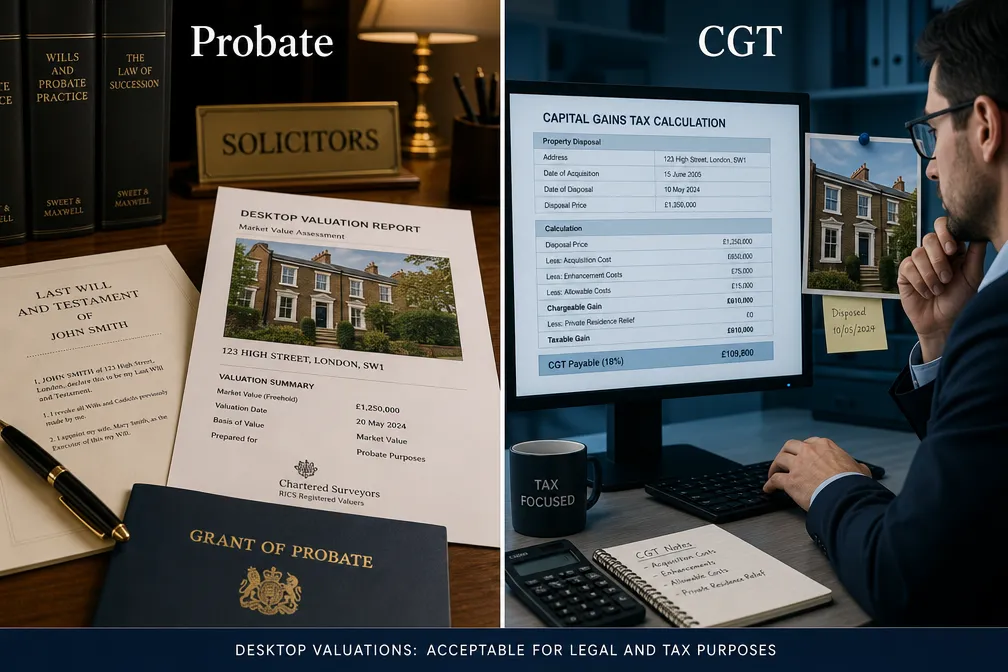
For capital gains tax calculations, inheritance tax and probate valuations, HMRC accepts desktop valuations in many cases, particularly for retrospective valuations of a past date where a physical inspection is impossible or impractical. The Valuation for Capital Gains Tax page explains the specific evidence requirements for CGT purposes.
Solicitors instructing surveyors for probate should confirm with the District Valuer Service whether a desktop approach will be accepted before commissioning the report. For straightforward residential properties with good comparable evidence, it often will be.
Expert witness and dispute work
Desktop valuations appear in property disputes, rent reviews, lease renewals, matrimonial proceedings and boundary disputes, where the valuer is asked to assess value at a historical date. In these cases the valuer must be transparent about the inspection limitation and its effect on the opinion. Courts and tribunals expect the expert to explain precisely what assumptions underpin the figure and what the margin of uncertainty is. See the Expert Witness in Property Disputes: When You Need One and How guide for more on the standards applied to expert evidence.
Professional Obligations and PI Insurance
A surveyor producing a desktop valuation does not shed professional liability simply because they did not visit. The duty of care to the client, and potentially to third parties who rely on the report, remains. RICS requires that the terms of engagement clearly state the inspection limitation, the assumptions made and the effect those assumptions have on the reliability of the opinion [1].
Professional indemnity (PI) insurance implications are significant. Some PI policies impose conditions or exclusions on desktop valuations, particularly for secured lending purposes. A qualified building surveyor should confirm their PI cover extends to the specific type of desktop instruction before accepting it.
The RICS Valuation Professional Standards (Red Book) make clear that the valuer must be satisfied their PI cover is adequate for the instruction [5]. Where it is not, the instruction should either be declined or restructured to include a physical inspection.
RICS APC candidates are examined on these obligations. Desktop valuation considerations, including the duty to disclose limitations, the treatment of assumptions and the PI implications, appear in APC valuation competency assessments [10].
Choosing the Right Approach: A Practical Guide
The table below summarises which valuation approach is generally appropriate for common UK property scenarios.
| Scenario | Recommended Approach | Desktop Acceptable? |
|---|---|---|
| Residential mortgage, standard construction, LTV below 75% | Desktop or AVM (lender-dependent) | Often yes |
| Residential mortgage, non-standard construction | Full inspection | No |
| High-LTV mortgage (above 85%) | Full inspection | Rarely |
| Bridging finance, lower LTV | Desktop (lender-dependent) | Sometimes |
| Buy-to-let remortgage, well-transacted area | Desktop or AVM | Often yes |
| Probate / inheritance tax | Desktop (with caveats) | Usually yes |
| Capital gains tax (retrospective) | Desktop | Usually yes |
| Matrimonial / dispute proceedings | Full inspection preferred | With disclosure |
| Portfolio revaluation (post recent full inspection) | Desktop | Yes, with conditions |
| Property with known structural issues | Full inspection | No |
| Pre-purchase valuation for buyer | Full inspection | No |
For buyers who receive a valuation they believe is inaccurate, whether desktop or otherwise, the How to Challenge a Surveyor's Valuation: Your Rights and the Appeals page sets out the formal process.
If you are comparing survey types and costs before instructing, the Online House Valuation vs RICS Valuation article explains the material differences between automated tools and professionally produced reports.
Frequently Asked Questions
Can a mortgage lender insist on a full inspection rather than a desktop valuation?
Yes. Lenders set their own panel instructions and risk criteria. Even where RICS standards permit a desktop approach, a lender may require a physical inspection for certain property types, LTV bands or loan amounts. The valuer must comply with the lender's instructions.
Is a desktop valuation the same as an AVM?
No. An AVM is a fully automated algorithmic output with no human professional input. A desktop valuation is produced by a qualified surveyor who applies professional judgement to the available data. The surveyor remains professionally accountable for the opinion; the AVM does not carry that accountability.
Will HMRC accept a desktop valuation for probate?
In many cases, yes, particularly for standard residential properties with good comparable evidence. The District Valuer Service may query the figure and request supporting evidence. A surveyor should document their comparable evidence carefully and note the inspection limitation explicitly.
Does a drive-by valuation count as a desktop valuation?
Not precisely. A drive-by involves an exterior observation and provides marginally more condition evidence than a pure desktop. RICS treats both as forms of limited inspection, each requiring explicit disclosure of what was and was not observed.
What happens if a desktop valuation turns out to be materially wrong?
The client may have a negligence claim against the valuer if the error resulted from a failure to apply reasonable professional skill and care. The fact that no inspection took place does not automatically constitute negligence, but failing to disclose the limitation, making unjustified assumptions about condition, or accepting a desktop instruction where a physical visit was clearly necessary, can all ground a claim. The Building Surveyor Negligence tag page covers related cases and principles.
Can a surveyor refuse to produce a desktop valuation?
Yes. A surveyor is entitled, and sometimes professionally obliged, to decline an instruction if they cannot produce a reliable opinion without a physical inspection. RICS standards support this position.
Conclusion
A surveyor can value a property without visiting, but doing so responsibly requires clear professional justification, explicit disclosure of every assumption, client acceptance of the limitations, and confirmation that PI insurance covers the instruction. The RICS Red Book Global Standards (effective 31 January 2025) have tightened these requirements, not relaxed them.
Desktop and drive-by valuations serve a legitimate purpose in low-risk mortgage cases, portfolio reviews, probate, CGT and certain dispute contexts. They are not appropriate where physical condition is likely to be a material value driver, non-standard construction, known defects, older properties with deferred maintenance, or any case where the lender or instructing party requires a full inspection.
Practical next steps:
- Before instructing a desktop valuation, confirm the purpose and check whether the instructing party (lender, HMRC, court) will accept a report produced without a physical inspection.
- Ask the surveyor to confirm their PI cover extends to desktop instructions of this type.
- Request that the report clearly states every assumption made about condition, tenure and legal title.
- If the property has any known condition issues, instruct a full physical inspection, the cost of a proper survey is modest compared with the financial exposure of an inaccurate figure.
- If you receive a desktop valuation that appears to undervalue or overvalue the property materially, seek a second opinion from a RICS-registered valuer before acting on it.
References
[1] Desktop Valuation – community.rics.org
[2] United Trust Bank Bridging Launches Desktop Valuation Option And Enhanced Avm Criteria – mortgagesolutions.co.uk
[3] Valuation Professional Judgement Due Diligence – ww3.rics.org
[4] Valuation Standards – rics.org
[5] Red Book – rics.org
[6] How Long Does It Take To Get A Mortgage Through Barclays – trinityfinancialgroup.co.uk
[7] Residential Valuations – rics.org
[8] Automated Valuation Models The Future Of Surveying – beale-law.com
[9] Profession Standards – rics.org
[10] Rics Apc Valuation Flash Cards – quizlet.com