
The digital infrastructure landscape is shifting beneath our feet. As the UK's data centre sector matures beyond its initial explosive growth phase, property professionals face a new challenge: managing Party Wall Agreements for Data Centre Expansions Beyond Initial Boom: 2026 Infrastructure Compliance Updates with unprecedented complexity. With AI-driven demand pushing facilities to expand into adjacent properties and regulatory frameworks tightening across multiple jurisdictions, understanding these compliance requirements has never been more critical. 🏗️
The convergence of grid connection delays, environmental mandates, and neighbour relations creates a perfect storm for data centre developers in 2026. Traditional party wall procedures—already complex—now intersect with cutting-edge digital tools like digital twins and automated compliance tracking systems. This article explores how property professionals can navigate these evolving requirements while preventing costly disputes and project delays.

Key Takeaways
- Party Wall Act 1996 obligations remain fundamental for UK data centre expansions involving excavation, foundation work, and boundary modifications in 2026
- Digital twin technology and Building Information Modeling (BIM) are transforming traditional party wall survey processes, enabling proactive dispute prevention
- Grid connection delays and regulatory moratoria in multiple jurisdictions are extending project timelines, making early party wall compliance essential
- Advanced notice protocols must now account for multi-phase expansion plans rather than single construction events
- Automated compliance tracking systems help manage complex documentation requirements across neighbouring properties and multiple regulatory frameworks
Understanding Party Wall Agreements for Data Centre Expansions in 2026
The Legal Framework for Data Centre Party Wall Work
The Party Wall Act 1996 continues to govern boundary work across England and Wales, but its application to data centre infrastructure has evolved significantly. Data centre developments frequently trigger multiple sections of the Act simultaneously due to their unique construction requirements [3].
Key triggers for data centre projects include:
- Section 1 work: Building new walls on boundary lines between properties
- Section 2 work: Modifications to existing party walls, including structural reinforcement for heavy equipment loads
- Section 6 work: Excavation within three to six metres of neighbouring buildings, particularly relevant for deep foundation requirements
Modern data centres require substantial excavation depths to accommodate cooling systems, cable management infrastructure, and seismic isolation foundations. These excavation requirements often extend well beyond the typical three-metre trigger zone, creating obligations to serve notices on multiple neighbouring property owners.
"Data centre developments frequently trigger Party Wall Act 1996 obligations due to excavation depths, foundation work, and boundary wall modifications." [3]
Understanding party wall consent requirements early in the planning process prevents costly delays. Many developers in 2026 are learning that proactive engagement with neighbours yields better outcomes than minimum statutory compliance.
Why Data Centre Expansions Differ from Traditional Developments
Unlike residential or commercial office developments, data centre expansions present unique party wall challenges:
Operational continuity requirements mean phased construction with live facilities operating adjacent to construction zones. This creates ongoing vibration, noise, and access concerns that traditional party wall agreements may not adequately address.
Load-bearing considerations for server equipment, backup power systems, and cooling infrastructure often require foundation reinforcement that impacts party walls. A single server rack can weigh several tonnes, multiplying across thousands of units.
24/7 construction schedules to meet aggressive deployment timelines can conflict with neighbouring property rights, requiring carefully negotiated access arrangements and working hour agreements.
Environmental systems including cooling towers, emergency generators, and ventilation systems positioned near boundaries create noise and vibration concerns that must be documented in pre-construction condition surveys.
The schedule of condition process has become increasingly sophisticated, incorporating thermal imaging, vibration monitoring baselines, and structural integrity assessments that go far beyond traditional photographic records.
Compliance Challenges in the Post-Boom Era
Grid Connection Delays and Their Impact on Party Wall Timelines
One of the most significant infrastructure challenges facing data centre developers in 2026 is grid connection congestion. In some UK regions, power connection timelines for large-scale projects have been pushed toward the end of the decade [5].
These delays create a cascading effect on party wall compliance:
| Challenge | Impact on Party Wall Process | Mitigation Strategy |
|---|---|---|
| Extended project timelines | Party wall notices may expire before construction begins | Serve conditional notices with extended validity periods |
| Phased development uncertainty | Difficulty predicting which boundaries will be affected | Comprehensive site-wide notices covering all potential phases |
| Changing scope during delays | Original party wall agreements may not cover revised plans | Include flexibility clauses for scope modifications |
| Neighbour fatigue | Reduced cooperation after multiple delays | Maintain regular communication and provide timeline updates |
The party wall notice process must now account for these extended and uncertain timelines. Developers who fail to serve proper notices face significant legal and financial consequences, including injunctions that can halt construction entirely.
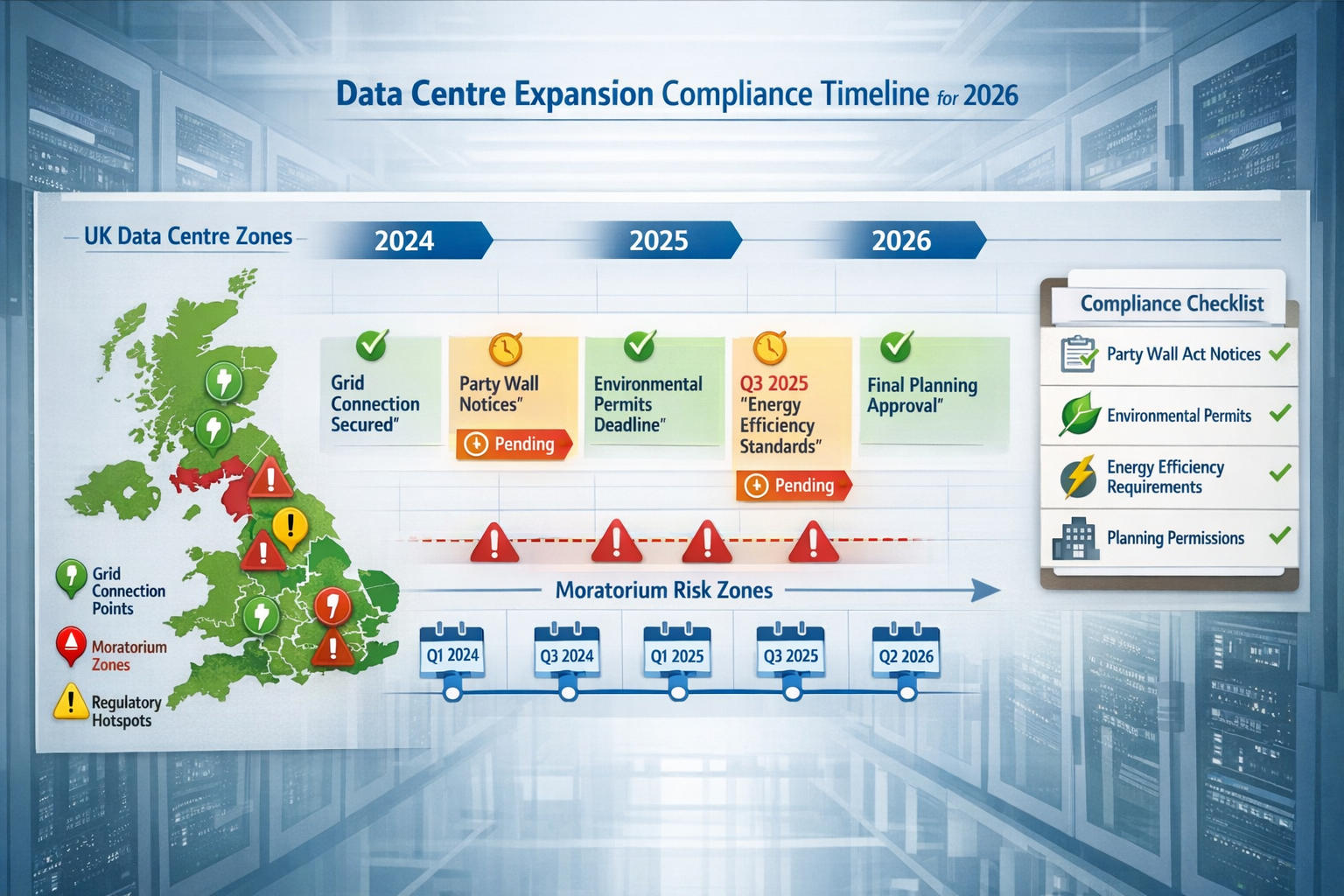
Regulatory Moratoria and Regional Variations
The regulatory landscape for data centre development has fragmented significantly in 2026. While the UK maintains relatively supportive policies, international precedents are creating caution among planners and neighbouring property owners [4].
Notable regulatory developments include:
- Vermont: Proposed freeze on data centre construction until July 2030
- Maryland: Proposed halt on new applications until July 2028
- Georgia: Proposed one-year construction ban beginning July 1, 2026
While these moratoria apply to US jurisdictions, they reflect growing community concerns about infrastructure strain, energy consumption, and environmental impact that are influencing UK planning decisions.
For party wall purposes, this means:
✅ Increased scrutiny from local planning authorities on neighbour consultation processes
✅ Higher standards for environmental impact documentation in party wall awards
✅ Greater emphasis on community benefit agreements as part of expansion approvals
✅ More detailed noise, vibration, and traffic management plans required in party wall documentation
Understanding what happens if you do not have a party wall agreement has become even more critical as regulatory scrutiny intensifies.
Advanced Notice Protocols for Multi-Phase Expansions
Serving Comprehensive Initial Notices
Traditional party wall practice involves serving notices for specific, defined works. However, data centre expansion projects in 2026 require a more strategic approach to notice serving.
Best practices for initial notices include:
- Site-wide assessment: Identify all potential neighbouring properties that could be affected by any phase of planned expansion over the next 3-5 years
- Comprehensive scope description: Include all types of work that might be undertaken, even if specific details aren't yet finalized
- Phasing transparency: Clearly communicate that work will occur in multiple phases with varying timelines
- Digital documentation: Provide neighbours with access to digital plans, 3D visualizations, and project timelines through secure portals
The standard two-month notice period under the Party Wall Act remains unchanged, but sophisticated developers are extending this informally to three or four months for complex projects, allowing more time for neighbour questions and surveyor appointments.
Managing Ongoing Communication During Extended Projects
Party wall compliance doesn't end when the initial agreement is signed. For multi-year data centre expansions, ongoing communication prevents disputes and maintains positive neighbour relations.
Effective communication strategies include:
- Quarterly update meetings with affected neighbours and their surveyors
- Real-time construction progress dashboards accessible to neighbouring property owners
- Dedicated liaison officers available to address concerns promptly
- Regular condition monitoring with reports shared with neighbours' surveyors
- Advance notification of particularly disruptive work phases (piling, heavy equipment installation)
Many developers are discovering that investing in robust communication infrastructure pays dividends by preventing damage to property disputes before they escalate to formal proceedings.
Technology Integration: Digital Twins and BIM in Party Wall Management
How Digital Twins Transform Party Wall Surveys
Digital twin technology represents perhaps the most significant advancement in party wall practice since the Act's introduction in 1996. A digital twin creates a virtual replica of the physical data centre facility and surrounding properties, enabling unprecedented analysis and planning capabilities.
Applications in party wall management include:
🔧 Pre-construction modeling: Simulate excavation impacts on neighbouring foundations before breaking ground
🔧 Vibration prediction: Model equipment operation and construction activity vibration propagation to adjacent properties
🔧 Structural monitoring: Real-time tracking of movement in party walls during construction phases
🔧 Dispute prevention: Visual demonstrations of proposed work help neighbours understand scope and impact
🔧 Condition documentation: 3D laser scanning creates comprehensive baseline records far exceeding traditional photography
The integration of digital twins with traditional party wall surveys creates a powerful risk management tool. Surveyors can identify potential issues before they manifest physically, allowing proactive mitigation measures.
Building Information Modeling (BIM) for Compliance Tracking
Building Information Modeling (BIM) has evolved from a design tool to a comprehensive compliance management platform. For party wall purposes, BIM Level 2 or higher implementations offer significant advantages:
Compliance tracking features:
- Automated notice generation: BIM systems can identify when design changes trigger new party wall obligations
- Document management: Centralized storage of all party wall awards, notices, and correspondence linked to specific building elements
- Surveyor coordination: Multiple surveyors can access current project information simultaneously
- Change management: Automatic flagging when modifications affect agreed party wall works
- Audit trails: Complete documentation of all decisions and approvals for regulatory review
Forward-thinking developers are requiring BIM integration clauses in party wall agreements, ensuring all surveyors work from the same digital information model throughout the project lifecycle.

AI-Powered Dispute Prediction and Prevention
Artificial intelligence is now being applied to party wall management with impressive results. Machine learning algorithms trained on historical dispute data can identify risk factors early in the process.
AI applications include:
- Risk scoring: Analyzing project characteristics to predict dispute likelihood
- Optimal surveyor matching: Identifying surveyors with relevant experience for specific property types and work scopes
- Settlement prediction: Estimating likely outcomes for disputed items based on precedent analysis
- Documentation completeness checks: Ensuring all required information is included before serving notices
- Timeline optimization: Suggesting optimal notice serving sequences for multi-property projects
These tools don't replace professional judgment but augment surveyor expertise with data-driven insights. The result is fewer disputes, faster resolutions, and lower overall costs.
Dispute Prevention Strategies for 2026 and Beyond
Proactive Neighbour Engagement
The most effective dispute prevention strategy remains early, transparent engagement with neighbouring property owners. Data centre developers in 2026 are adopting community relations approaches that go well beyond minimum statutory requirements.
Engagement best practices:
- Pre-notice consultation: Meet with neighbours before serving formal notices to explain plans and answer questions
- Visual presentations: Use 3D renderings and virtual reality walkthroughs to help non-technical neighbours understand proposed work
- Impact mitigation offers: Proactively offer measures like temporary accommodation during particularly disruptive phases
- Community benefit agreements: Consider contributions to local infrastructure or amenities as goodwill gestures
- Independent expert access: Offer to fund independent technical advice for neighbours who want additional reassurance
This approach requires additional upfront investment but typically saves multiples of that cost by avoiding formal dispute resolution processes and construction delays.
Comprehensive Condition Surveys with Advanced Technology
Traditional photographic condition surveys are giving way to multi-modal documentation that provides far more comprehensive baseline records:
Modern condition survey components:
- 3D laser scanning: Creates point cloud data capturing every surface detail with millimeter accuracy
- Thermal imaging: Identifies existing moisture issues, insulation problems, and structural anomalies
- Vibration baseline monitoring: Establishes normal vibration levels before construction begins
- Structural integrity testing: Non-destructive testing methods assess existing party wall condition
- Drone surveys: External condition documentation from multiple angles and elevations
- Underground utility mapping: Ground-penetrating radar identifies services near excavation zones
This comprehensive documentation protects both building owners and neighbours by establishing clear baseline conditions. When disputes arise about damage to property, this evidence proves invaluable in determining causation and appropriate remediation.
Structured Dispute Resolution Protocols
Despite best prevention efforts, some disputes are inevitable in complex projects. Having structured resolution protocols in place accelerates resolution and minimizes cost escalation.
Effective dispute resolution frameworks include:
Tier 1 – Direct negotiation: Building owner and neighbour representatives meet with both surveyors present to discuss concerns informally
Tier 2 – Mediation: Independent mediator facilitates structured discussions before formal dispute procedures begin
Tier 3 – Third surveyor appointment: Formal dispute resolution under Party Wall Act provisions with agreed third surveyor
Tier 4 – Arbitration or litigation: Final resort for unresolved disputes, with clearly defined arbitration procedures
The key is establishing these protocols in the initial party wall agreement rather than trying to negotiate them during an active dispute when positions have hardened.
Environmental and Energy Compliance Integration
Energy Efficiency Requirements in Party Wall Work
Data centres face increasing pressure to improve energy efficiency and reduce carbon emissions. These requirements often intersect with party wall obligations, particularly regarding insulation and thermal performance [5].
Key considerations include:
- Party wall insulation: Adding or upgrading insulation may require consent under Section 2 of the Act
- Cooling system modifications: Changes to external cooling infrastructure near boundaries trigger party wall obligations
- Renewable energy installations: Solar panels, wind turbines, or ground-source heat pumps may affect party structures
- Waste heat recovery: Systems capturing and redistributing waste heat may impact neighbouring properties
Understanding party wall insulation requirements ensures energy efficiency upgrades don't inadvertently create compliance violations.
Environmental Impact Documentation
Party wall awards in 2026 increasingly incorporate environmental impact provisions that go beyond traditional structural considerations:
✅ Noise level limits during construction and operation
✅ Vibration thresholds with continuous monitoring requirements
✅ Air quality impacts from backup generators and cooling systems
✅ Light pollution from 24/7 operations affecting residential neighbours
✅ Traffic management for construction vehicles and operational deliveries
These provisions reflect growing recognition that party wall obligations extend beyond purely structural matters to encompass the full range of impacts on neighbouring property enjoyment.
Regional Compliance Variations Across the UK
England and Wales: Party Wall Act 1996 Application
The Party Wall Act 1996 provides the statutory framework for England and Wales, but local planning authorities add their own requirements that affect party wall compliance:
London boroughs often require additional community consultation beyond statutory minimums for large infrastructure projects. Metropolitan areas like Manchester, Birmingham, and Leeds have developed specific guidance for data centre developments given their concentration in these regions.
Scotland and Northern Ireland: Different Frameworks
It's crucial to note that Scotland and Northern Ireland operate under different legal frameworks:
Scotland follows common law principles rather than statutory party wall procedures, requiring different approaches to neighbour consent and dispute resolution.
Northern Ireland has its own Access to Neighbouring Land Act (Northern Ireland) 2015, which addresses some similar issues but through different mechanisms.
Data centre developers operating across multiple UK jurisdictions must ensure their compliance approaches adapt to these regional variations.
Practical Implementation: A 2026 Compliance Checklist
Pre-Planning Phase (6-12 Months Before Construction)
✅ Conduct comprehensive site boundary survey identifying all potentially affected neighbouring properties
✅ Engage party wall surveyors with specific data centre infrastructure experience
✅ Develop digital twin model incorporating existing structures and planned expansions
✅ Initiate informal neighbour consultations before serving formal notices
✅ Prepare preliminary condition surveys using multi-modal documentation approaches
✅ Review local planning authority requirements for additional consultation or documentation
✅ Establish project communication protocols including digital dashboards and liaison contacts
Notice Serving Phase (2-4 Months Before Construction)
✅ Serve comprehensive party wall notices covering all potential work phases
✅ Provide detailed plans and specifications with 3D visualizations where helpful
✅ Offer to fund neighbours' surveyor appointments to facilitate timely responses
✅ Document all communications through centralized BIM-integrated system
✅ Schedule detailed condition surveys with all appointed surveyors present
✅ Negotiate party wall awards including dispute resolution protocols
✅ Finalize monitoring and reporting arrangements for construction phase
Construction Phase (Ongoing)
✅ Implement continuous monitoring of vibration, noise, and structural movement
✅ Provide regular progress updates to neighbours and their surveyors
✅ Conduct periodic condition inspections comparing to baseline documentation
✅ Address concerns promptly through established liaison channels
✅ Document any variations from agreed works and obtain necessary consents
✅ Maintain comprehensive audit trail of all compliance activities
Post-Construction Phase (3-6 Months After Completion)
✅ Conduct final condition surveys comparing to pre-construction baselines
✅ Address any identified damage through agreed remediation processes
✅ Obtain formal sign-offs from neighbours' surveyors
✅ Archive all documentation in accessible digital format
✅ Review lessons learned for future expansion phases
Cost Considerations and Budgeting
Direct Party Wall Compliance Costs
Understanding the financial implications of Party Wall Agreements for Data Centre Expansions Beyond Initial Boom: 2026 Infrastructure Compliance Updates helps developers budget appropriately:
Typical cost components include:
- Building owner's surveyor fees: £3,000-£15,000 depending on project complexity
- Neighbours' surveyor fees: £2,000-£10,000 per neighbouring property (building owner typically pays)
- Third surveyor fees: £5,000-£20,000 if disputes require resolution
- Condition survey costs: £2,000-£8,000 per property with advanced documentation
- Monitoring equipment: £5,000-£25,000 for continuous vibration and movement tracking
- Digital twin development: £20,000-£100,000 for comprehensive facility modeling
For a typical data centre expansion affecting 3-5 neighbouring properties, total party wall compliance costs typically range from £30,000 to £150,000—a small fraction of overall project costs but requiring specific budget allocation.
Indirect Costs of Non-Compliance
The costs of inadequate party wall compliance far exceed direct compliance expenses:
Potential non-compliance costs:
- Construction delays: £50,000-£500,000 per week for large projects
- Injunction legal fees: £25,000-£100,000+ for court proceedings
- Dispute resolution: £10,000-£75,000 for formal third surveyor proceedings
- Damage claims: Highly variable, potentially £100,000+ for serious structural issues
- Reputational damage: Difficult to quantify but impacts future project approvals
Investing in comprehensive compliance upfront represents excellent risk-adjusted value.
Future Trends: Looking Beyond 2026
Regulatory Evolution
The regulatory landscape for data centre development continues evolving. Anticipated developments include:
Stricter environmental standards requiring more comprehensive impact assessments in party wall documentation
Standardized digital compliance reporting with government portals for party wall notice tracking
Enhanced neighbour rights potentially extending notification requirements beyond current statutory minimums
Integration with building safety regulations following lessons from building safety reform initiatives
Technology Advancement
Emerging technologies will further transform party wall practice:
Autonomous monitoring systems using AI to detect and report potential issues before human surveyors notice them
Blockchain-based documentation creating immutable records of notices, agreements, and condition surveys
Virtual reality dispute resolution allowing surveyors and parties to examine issues collaboratively in virtual environments
Predictive maintenance integration linking party wall monitoring with facility management systems
Conclusion: Navigating the New Normal in Data Centre Party Wall Compliance
Party Wall Agreements for Data Centre Expansions Beyond Initial Boom: 2026 Infrastructure Compliance Updates represent a significant evolution in property law application to critical digital infrastructure. The convergence of traditional statutory requirements with advanced digital tools, extended project timelines, and heightened regulatory scrutiny creates both challenges and opportunities for developers and property professionals.
Success in this environment requires moving beyond minimum compliance to embrace proactive engagement, comprehensive documentation, and technology integration. The developers who thrive will be those who view party wall obligations not as bureaucratic hurdles but as opportunities to build positive community relationships and demonstrate responsible infrastructure development.
Actionable Next Steps
For data centre developers and property professionals navigating these requirements:
- Engage specialists early: Appoint party wall surveyors with specific data centre experience during initial project planning
- Invest in technology: Implement digital twin and BIM systems that integrate party wall compliance tracking
- Build relationships: Initiate neighbour consultations well before formal notice requirements
- Document comprehensively: Use multi-modal condition surveys that exceed minimum standards
- Plan for flexibility: Structure agreements anticipating scope changes and timeline extensions
- Maintain communication: Establish ongoing dialogue channels that persist throughout multi-year projects
The infrastructure demands of our increasingly digital economy will continue driving data centre expansion for years to come. By mastering the evolving compliance landscape today, property professionals position themselves as essential partners in building the digital infrastructure of tomorrow.
For expert guidance on party wall matters and comprehensive surveying services, professional support ensures compliance while minimizing project risks and delays.
References
[1] New Data Center Developments March 2026 – https://www.datacenterknowledge.com/data-center-construction/new-data-center-developments-march-2026
[2] Data Center Outlook – https://www.jll.com/en-us/insights/market-outlook/data-center-outlook
[3] Party Wall Agreements In Data Centre Developments 2026 Compliance Amid Ai Driven Uk Demand – https://nottinghillsurveyors.com/blog/party-wall-agreements-in-data-centre-developments-2026-compliance-amid-ai-driven-uk-demand
[4] State Data Center Moratoriums – https://builtin.com/articles/state-data-center-moratoriums
[5] Dc Delivery Constraints Data Centre Construction Implications For Enterprise Cloud Strategy In 2026 – https://www.cloudcomputing-news.net/news/dc-delivery-constraints-data-centre-construction-implications-for-enterprise-cloud-strategy-in-2026/
[6] Data Centres – https://www.brownejacobson.com/insights/2026-horizon-scanning-in-construction/data-centres