The landscape of property ownership in England is undergoing its most significant transformation in decades. As the Leasehold Reform Bill progresses through Parliament in 2026, property professionals face unprecedented challenges in adapting valuation methodologies for a market transitioning from traditional leasehold structures to commonhold ownership. Understanding Valuation Surveys Under Leasehold Reform Bill: Preparing for Commonhold Transitions in England's Stabilising Market has become essential for surveyors, property owners, and investors navigating this period of regulatory upheaval.
The draft legislation introduces sweeping changes that will fundamentally alter how residential properties are valued, owned, and transferred. With ground rent caps, forfeiture abolition, and a proposed ban on new leasehold flats, the traditional valuation frameworks that surveyors have relied upon for generations require urgent recalibration. The Royal Institution of Chartered Surveyors (RICS) has emphasized the critical need for professional guidance as these reforms take shape[3].
Key Takeaways
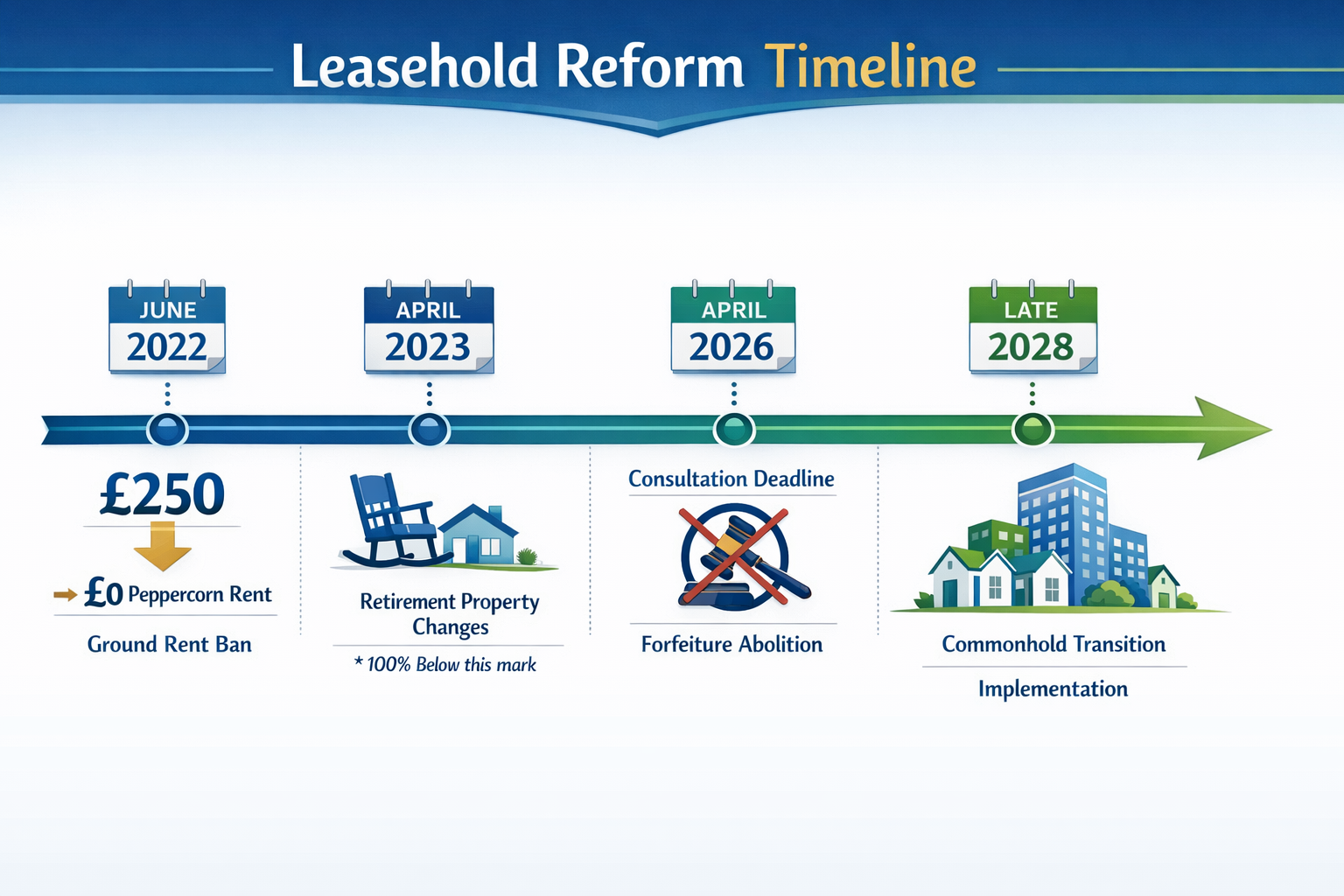
✅ Ground rent will be capped at £250 annually for existing leases, phasing down to peppercorn rent over 40 years, fundamentally changing lease extension valuations[1][2]
✅ Forfeiture procedures face abolition, removing freeholders' ability to seize properties over minor debts and creating new dispute resolution frameworks[1][2]
✅ New leasehold flats ban consultation closes April 24, 2026, with implementation expected to reshape the residential development market significantly[2]
✅ Valuation methodology guidance remains outstanding, requiring surveyors to adapt existing frameworks while awaiting definitive regulatory direction[3]
✅ RICS professional standards will be critical for navigating disputes during the multi-year transition period to commonhold structures[3][7]
Understanding the Leasehold Reform Bill's Impact on Property Valuations
The Ground Rent Cap Revolution
The most immediate impact on valuation surveys under leasehold reform bill provisions comes from the £250 annual ground rent cap for existing residential leases[1][8]. This represents a seismic shift in how surveyors calculate lease extension premiums and enfranchisement values.
Previously, ground rent capitalization formed a substantial component of freehold interest valuations, particularly for properties with escalating ground rent clauses. Some leases included provisions for ground rents to double every decade, creating significant capital values for freeholders. The new cap eliminates this revenue stream's growth potential, fundamentally altering the mathematics of lease extension valuation.
Key valuation considerations include:
- Immediate cap application: The £250 ceiling applies from the bill's enactment, expected in late 2028[1]
- Phased reduction: Ground rents will progressively decrease to peppercorn (effectively zero) over a 40-year transition period[2]
- Retrospective effect: Existing leases with higher ground rents face immediate devaluation of the freehold interest
- Marriage value implications: The reduced freehold interest directly impacts marriage value calculations in lease extensions
"The ground rent cap represents the most significant change to leasehold valuation methodology since the Leasehold Reform Act 1967, requiring surveyors to completely recalibrate their approach to freehold interest calculations." — RICS Leasehold Reform Working Group
Forfeiture Abolition and Risk Assessment
The proposed abolition of forfeiture procedures removes a fundamental risk factor from leasehold valuations[1][2]. Currently, freeholders can forfeit leases for breaches including unpaid service charges as low as £350, creating a significant risk premium in leasehold valuations.
This change affects valuation surveys in several ways:
🏢 Security of tenure: Leaseholders gain substantially enhanced security, potentially increasing leasehold values relative to freehold interests
📊 Risk premium elimination: The forfeiture risk premium that surveyors traditionally factored into leasehold valuations becomes obsolete
⚖️ Dispute resolution mechanisms: New frameworks for resolving payment disputes will require surveyors to understand alternative enforcement procedures
💰 Lender confidence: Mortgage lenders may reassess lending criteria for leasehold properties, affecting market liquidity and valuations
For professionals conducting RICS homebuyer surveys, understanding these tenure security changes becomes essential when advising clients on leasehold purchases during the transition period.
The New Leasehold Flats Ban Consultation
Perhaps the most transformative element of the reform package is the government's consultation on banning new leasehold flats, which closes on April 24, 2026[2]. This consultation addresses the scope, timing, and narrow exemptions for the ban, with implementation expected to fundamentally reshape residential development.
Valuation implications for surveyors:
| Aspect | Current Market | Post-Ban Market |
|---|---|---|
| New developments | Predominantly leasehold | Commonhold or share of freehold |
| Developer land values | Premium for freehold retention | Adjusted for commonhold structure |
| Existing leasehold stock | Standard valuation methods | Potential obsolescence discount |
| Conversion demand | Limited | Surge in leasehold-to-commonhold conversions |
Surveyors preparing valuation costs estimates must now factor in the potential for significant market restructuring as commonhold becomes the default tenure for new flats.
Valuation Surveys Under Leasehold Reform Bill: Adapting RICS Methodologies
RICS Red Book Compliance During Transition
The RICS Valuation – Global Standards (Red Book) provides the framework for professional valuations, but the leasehold reforms create unprecedented challenges for maintaining compliance during the transition period[3]. Surveyors must navigate evolving legislation while maintaining professional standards and providing reliable valuations.
Critical Red Book considerations:
📋 Assumptions and special assumptions: Valuers must clearly state assumptions about the timing and impact of legislative changes
🔍 Market evidence: Limited comparable evidence exists for properties transitioning from leasehold to commonhold structures
⚖️ Valuation uncertainty: The multi-year implementation timeline creates significant uncertainty requiring careful disclosure
📝 Reporting requirements: Enhanced reporting obligations to explain reform impacts on valuations
Professional surveyors conducting RICS valuations must stay current with evolving guidance as RICS develops specific practice statements addressing leasehold reform scenarios.
Calculating Lease Extension Premiums Under New Rules
The traditional lease extension premium calculation relies on three main components:
- Diminution in freehold value: The loss to the freeholder from granting the extension
- Freeholder's share of marriage value: The uplift in property value from extending the lease
- Compensation for other losses: Any additional losses to the freeholder
The ground rent cap fundamentally alters the first component, while forfeiture abolition affects risk assessments across all three. Surveyors must develop modified valuation models that reflect these changes:
Pre-reform calculation example:
- Ground rent: £500 annually, doubling every 25 years
- Capitalized value at 6% yield: £8,333+
- Marriage value share (50%): Significant additional premium
Post-reform calculation example:
- Ground rent: Capped at £250, declining to peppercorn
- Capitalized value: Substantially reduced
- Marriage value share: Lower due to reduced freehold interest
This recalibration requires surveyors to maintain dual valuation frameworks during the transition period, creating complexity for comparing different types of survey approaches.
Commonhold Valuation Principles
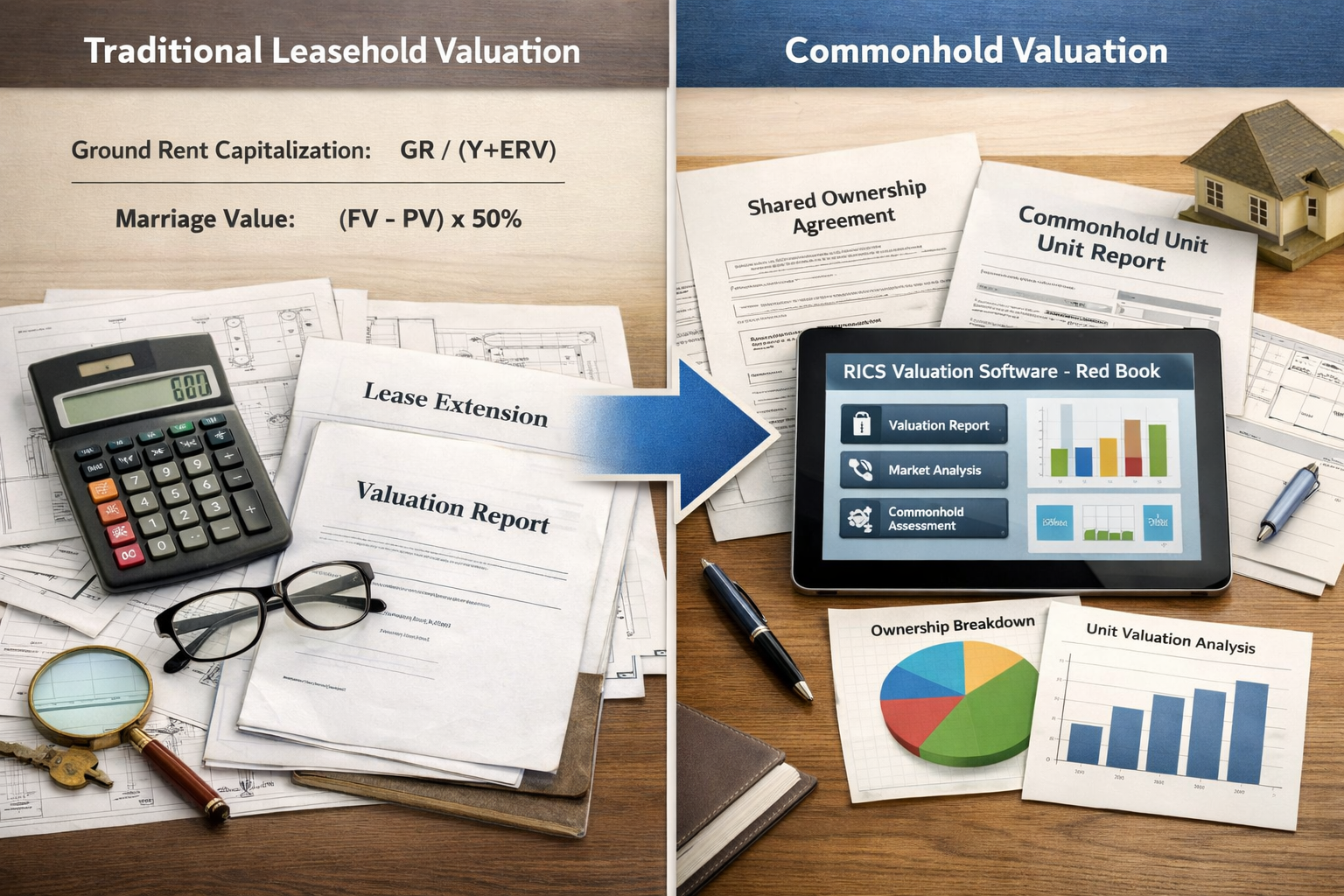
As the market transitions toward commonhold ownership, surveyors must develop expertise in commonhold unit valuations. Unlike leasehold, where the lease term significantly affects value, commonhold units represent perpetual ownership interests similar to freehold houses.
Key commonhold valuation factors:
🏗️ Unit entitlement: Each unit's proportionate share of common areas and expenses
💼 Commonhold association obligations: The financial health and management quality of the association
📊 Reserve fund adequacy: Sufficient reserves for major repairs and maintenance
⚖️ Dispute resolution mechanisms: The effectiveness of internal dispute procedures
🔧 Building condition: Enhanced importance of structural surveys given shared ownership responsibilities
Surveyors familiar with RICS shared ownership valuations will find some transferable principles, but commonhold introduces unique considerations requiring specialized knowledge.
Valuation Surveys Under Leasehold Reform Bill: Practical Implementation Strategies for 2026

Dispute Resolution and Expert Witness Requirements
The leasehold reforms create a surge in valuation disputes as stakeholders disagree on the impact of legislative changes on property values. RICS chartered surveyors increasingly find themselves providing expert witness reports in tribunal proceedings addressing:
- Lease extension premium disputes under new ground rent rules
- Enfranchisement valuations with forfeiture abolition factored in
- Commonhold conversion valuations for existing buildings
- Service charge apportionment in transitioning developments
Best practices for dispute work:
✅ Comprehensive documentation: Maintain detailed records of valuation assumptions and methodology
✅ Market evidence databases: Build robust databases of comparable transactions under various reform scenarios
✅ Legislative tracking: Monitor parliamentary progress and implementation guidance closely
✅ Professional development: Engage with RICS training on leasehold reform valuation issues
✅ Peer review protocols: Implement internal quality assurance for complex reform-related valuations
Preparing for the 2028 Implementation Timeline
While the consultation closes in April 2026, full implementation is not expected until late 2028[1]. This extended timeline creates both challenges and opportunities for surveyors preparing valuation surveys under leasehold reform bill provisions.
Strategic preparation steps:
2026 (Current Year):
- Respond to government consultations on valuation methodology
- Develop internal guidance documents for staff
- Build relationships with commonhold specialists
- Review existing valuation templates for reform compatibility
2027:
- Pilot test modified valuation approaches
- Participate in industry working groups
- Update professional indemnity insurance for reform-related risks
- Train staff on commonhold valuation principles
2028:
- Implement final valuation frameworks
- Launch reform-specific service offerings
- Market expertise in transition valuations
- Establish thought leadership through publications
Firms offering right to buy valuations and similar specialized services should consider developing parallel expertise in leasehold-to-commonhold conversions as a growth opportunity.
Technology and Data Management Solutions
The complexity of dual valuation frameworks during the transition period demands robust technology solutions. Forward-thinking surveying practices are investing in:
💻 Valuation software updates: Customized modules for ground rent cap calculations and commonhold assessments
📊 Market data analytics: Enhanced comparable evidence databases with reform-specific filters
🤖 Automation tools: Streamlined workflows for generating multiple valuation scenarios
☁️ Cloud collaboration: Secure platforms for multi-party valuations involving freeholders, leaseholders, and tribunals
📱 Mobile inspection apps: Field data collection optimized for commonhold transition assessments
These technological investments support efficiency while maintaining the professional standards required for RICS building surveys and related services.
Client Communication and Advisory Services
Perhaps the most critical skill for surveyors navigating the leasehold reforms is effective client communication. Property owners, investors, and lenders require clear explanations of how the reforms affect their interests.
Essential communication strategies:
📝 Plain language reporting: Avoid excessive technical jargon when explaining reform impacts
📊 Visual aids: Use charts and diagrams to illustrate valuation changes
⚖️ Scenario analysis: Present multiple valuation scenarios based on different reform implementation timelines
🎯 Actionable recommendations: Provide clear guidance on optimal timing for lease extensions or conversions
💡 Educational content: Develop client-facing materials explaining the reforms and their implications
Surveyors who excel at client education will differentiate themselves in a market where property owners face unprecedented complexity in understanding their asset values.
Market Stabilization and Long-Term Outlook
England's property market has shown remarkable resilience during the reform consultation period, with transaction volumes stabilizing in 2026 after initial uncertainty. However, long-term market dynamics will fundamentally shift as commonhold becomes the dominant tenure for flats.
Anticipated market developments:
📈 Leasehold premium compression: Existing leasehold properties may trade at discounts to commonhold equivalents
🏘️ Conversion surge: Mass conversions of existing leasehold blocks to commonhold structures
💰 Freehold interest devaluation: Significant value losses for freeholders holding ground rent portfolios
🏗️ Development model evolution: Developers adapting business models to commonhold structures
⚖️ Legal service expansion: Increased demand for specialist conveyancing and valuation services
Surveyors providing valuation of shared ownership properties should anticipate similar consultation and reform processes affecting that sector in future years.
Conclusion
The Valuation Surveys Under Leasehold Reform Bill: Preparing for Commonhold Transitions in England's Stabilising Market represents a defining moment for property professionals. The ground rent cap, forfeiture abolition, and proposed leasehold flats ban fundamentally reshape valuation methodologies that have remained largely unchanged for generations.
RICS chartered surveyors must embrace this transition as both a challenge and an opportunity. Those who invest in developing commonhold expertise, adapt their valuation frameworks proactively, and communicate effectively with clients will emerge as market leaders in the post-reform landscape.
Actionable Next Steps
For Property Professionals:
- Engage with RICS guidance as it develops through 2026-2028
- Invest in professional development focused on commonhold valuation principles
- Update valuation templates to accommodate dual leasehold/commonhold frameworks
- Build market evidence databases specific to reform-affected transactions
- Develop client education materials explaining reform implications
For Property Owners:
- Obtain professional valuations before and after reform implementation to understand impacts
- Consider timing of lease extensions relative to the 2028 implementation date
- Explore commonhold conversion options for existing leasehold blocks
- Review service charge arrangements in preparation for potential tenure changes
- Consult RICS chartered surveyors for personalized advice on your specific circumstances
For Investors and Lenders:
- Reassess portfolio risk in light of ground rent cap and forfeiture abolition
- Evaluate lending criteria for leasehold properties during the transition
- Monitor legislative progress through parliamentary committees and consultations
- Diversify tenure exposure to balance leasehold and commonhold holdings
- Engage specialist surveyors for due diligence on reform-affected acquisitions
The leasehold reform journey extends well beyond 2026, with full implementation not expected until 2028 and market adjustment continuing for years thereafter. However, the surveyors who begin preparing now—developing expertise, adapting methodologies, and building client relationships—will be best positioned to thrive in England's evolving property market.
As the consultation period closes in April 2026 and implementation approaches, one certainty remains: professional valuation expertise has never been more critical for navigating this historic transformation in English property ownership.
References
[1] Leasehold Reform Update January 2026 What The New Ground Rent Cap Means For Leaseholders – https://www.peterbarry.co.uk/blog/leasehold-reform-update-january-2026-what-the-new-ground-rent-cap-means-for-leaseholders/
[2] Leasehold And Freehold Reform Updates 2026 Moving Towards Commonhold – https://www.hcrlaw.com/news-and-insights/leasehold-and-freehold-reform-updates-2026-moving-towards-commonhold/
[3] Rics Responds To Latest Government Reforms On Leasehold And Commonhold – https://www.rics.org/news-insights/rics-responds-to-latest-government-reforms-on-leasehold-and-commonhold
[4] Understanding The Draft 2026 Commonhold And Leasehold Reform Bill – https://www.edwinthompson.co.uk/understanding-the-draft-2026-commonhold-and-leasehold-reform-bill/
[5] Leasehold Reform – https://hoa.org.uk/advice/guides-for-homeowners/for-owners/leasehold-reform/
[6] The Commonhold And Leasehold Reform Bill Key Questions Answered – https://www.hoganlovells.com/en/publications/the-commonhold-and-leasehold-reform-bill-key-questions-answered
[7] Why The Government Must Consult With Professionals On Leasehold Reform – https://ifamagazine.com/why-the-government-must-consult-with-professionals-on-leasehold-reform/
[8] Leasehold Reform Update January 2026 What The New Ground Rent Cap Means For Leaseholders – https://www.peterbarry.co.uk/blog/leasehold-reform-update-january-2026-what-the-new-ground-rent-cap-means-for-leaseholders/