A party wall dispute that reaches the courts can hinge on a single procedural question: was the notice actually served? In 2026, more building owners are sending notices by email as a matter of convenience, and more adjoining owners are disputing whether those emails ever constituted valid service. The answer is not a simple yes or no.
This article sets out the statutory position, what the courts have said, how proof of service works in practice, and which methods carry the least risk when serving a party wall notice.
Key Takeaways
- The Party Wall etc. Act 1996 permits service by email, but only where the recipient has agreed to receive notices electronically.
- An email sent without prior consent from the adjoining owner is unlikely to constitute valid service.
- Proof of delivery is your responsibility as the building owner, a sent-items record alone is not sufficient evidence.
- Recorded post remains the safest default method and is the one most clearly supported by statute and government guidance.
- RICS professional guidance recognises email as a valid channel but recommends traditional methods where there is any doubt about consent or deliverability.
What the Party Wall etc. Act 1996 Actually Says About Service
The Party Wall etc. Act 1996 sets out the rules for serving notices at section 15 [6]. That section states that a notice may be served by delivering it in person, by post to the last known address, or, and this is the critical point, by any other means that the recipient has agreed to in writing.
Email falls into that third category. It is not excluded, but it is conditional [3]. The adjoining owner must have agreed, in advance, to receive notices by electronic means. That agreement should itself be in writing so that it can be produced as evidence if service is later challenged.
The Electronic Communications Order 2016 reinforced this consent-based model [10]. It amended several pieces of legislation to allow electronic service, but it did not override the requirement for recipient consent. The Order makes clear that electronic service is only valid where the recipient has indicated a willingness to receive documents in that form [7].
This matters because many building owners assume that sending an email to an address they have used for general correspondence is enough. It is not. Informal emails exchanged about building works do not amount to an agreement to accept formal statutory notices by electronic means.
Validity of Email Service: The Consent Requirement in Practice
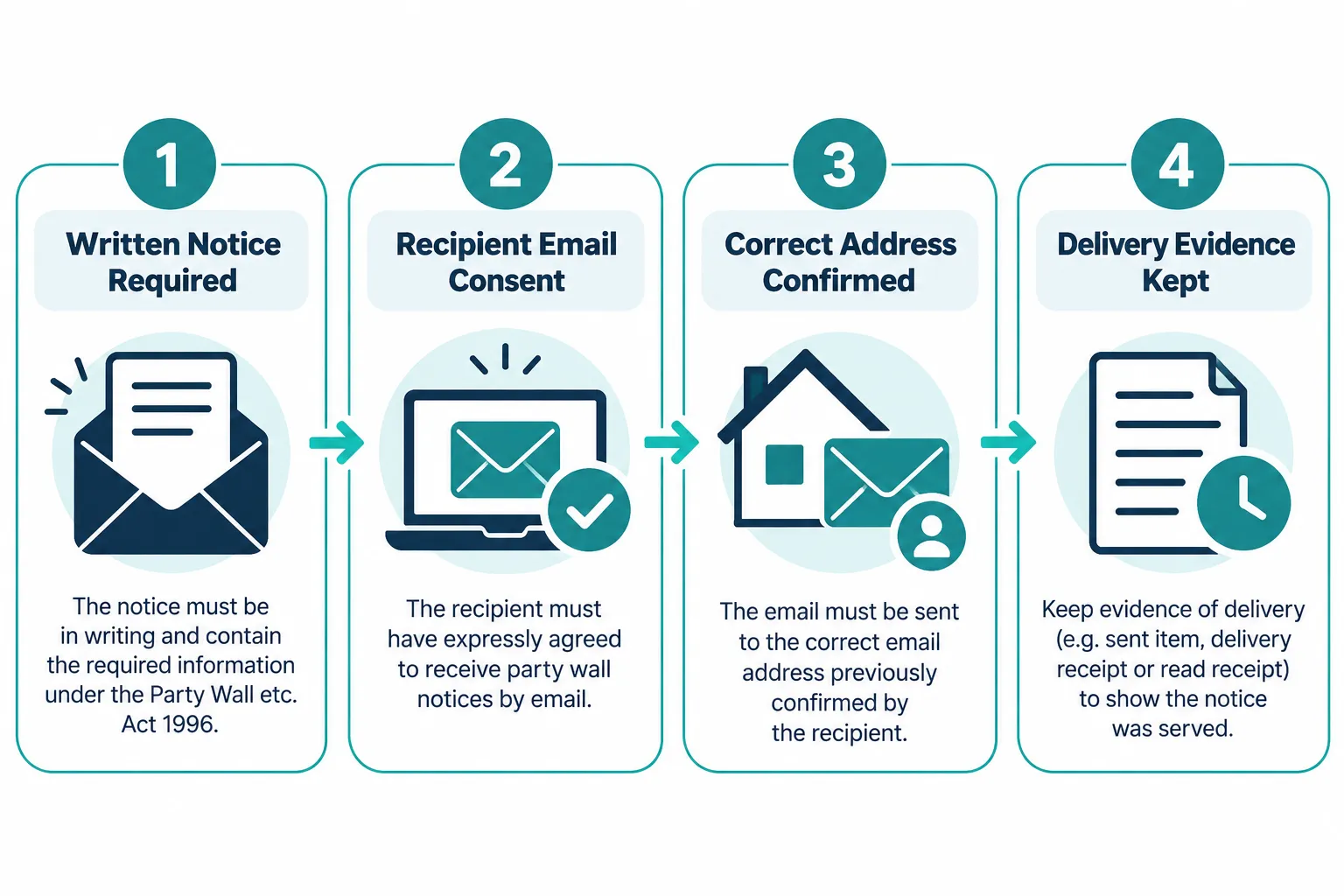
For an email notice to be valid under the Act, three conditions need to be met.
First, the adjoining owner must have consented to electronic service. That consent should be explicit and documented. A reply to a general email does not establish consent to receive statutory notices.
Second, the notice must be sent to the correct email address, one that the recipient actually uses and monitors. Sending to an old or rarely checked address creates a real risk that service will be disputed [3].
Third, the content of the notice itself must comply with the Act. The method of delivery does not change what the notice must contain: the name and address of the building owner, a description of the proposed works, and the required notice period [6].
Where any of these conditions is in doubt, email service is legally fragile. The burden of proving valid service rests with the building owner, not the adjoining owner.
What Knight v Goulandris Established
The Court of Appeal decision in Knight v Goulandris is frequently cited in party wall practice because it addressed the consequences of defective service [9]. The case confirmed that a notice which has not been validly served does not start the statutory process running. The notice periods, the deemed dispute provisions, and the right to appoint surveyors all depend on valid service having taken place.
If an email notice is later found to have been invalid, because consent was absent, the address was wrong, or delivery cannot be proved, the building owner may find that works carried out in reliance on that notice were undertaken without the protection of the Act. That exposure can be significant, particularly if the adjoining owner suffers damage. For more background on how disputes arise from defective or absent notices, see our guidance on no party wall notice served.
Proof of Service by Email: What Evidence Is Needed
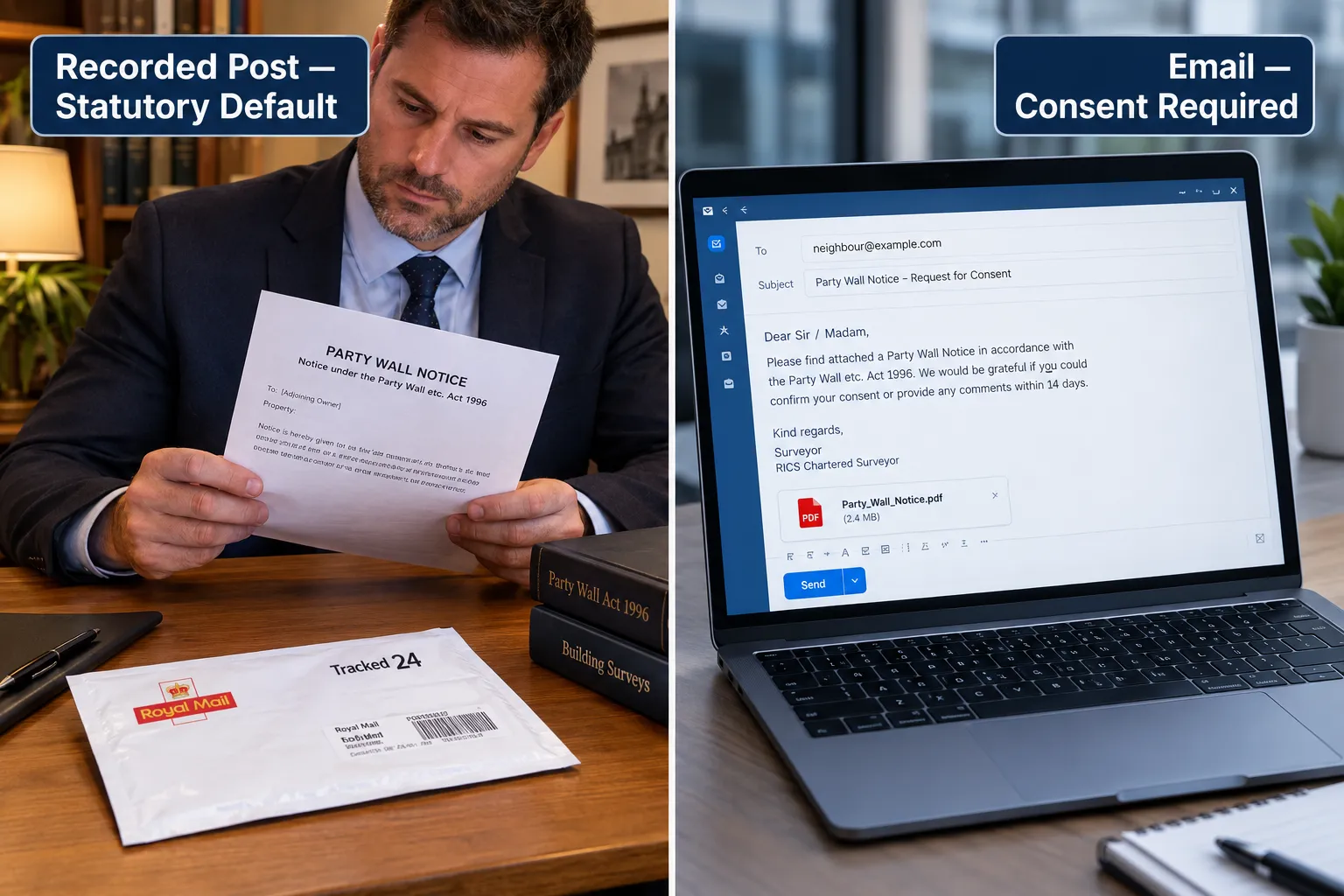
Even where consent has been obtained and the notice sent to the right address, the building owner still needs to be able to prove that service took place. A court or surveyor panel will want to see more than a sent-items record.
The following types of evidence are generally considered persuasive:
- A written record of the adjoining owner's prior consent to electronic service
- A read receipt or delivery receipt from the email system, saved as a PDF
- A reply from the adjoining owner acknowledging receipt of the notice
- A contemporaneous note of when the email was sent and to which address
- A copy of the notice itself as it was attached or embedded in the email
None of these is individually conclusive, but together they build a case that service was effected. The absence of any acknowledgement from the adjoining owner is a warning sign. If a week passes after sending an email notice with no reply, the building owner should consider re-serving by recorded post.
RICS guidance acknowledges that email service is recognised in professional practice, but it consistently recommends that surveyors advise clients to use statutory methods, particularly recorded post, where there is any uncertainty [2]. The RICS consumer guide reinforces the point that the notice must be received, not merely sent [5].
Safer Alternatives and Risk Management in 2026
Given the risks attached to email service, what are the safer options?
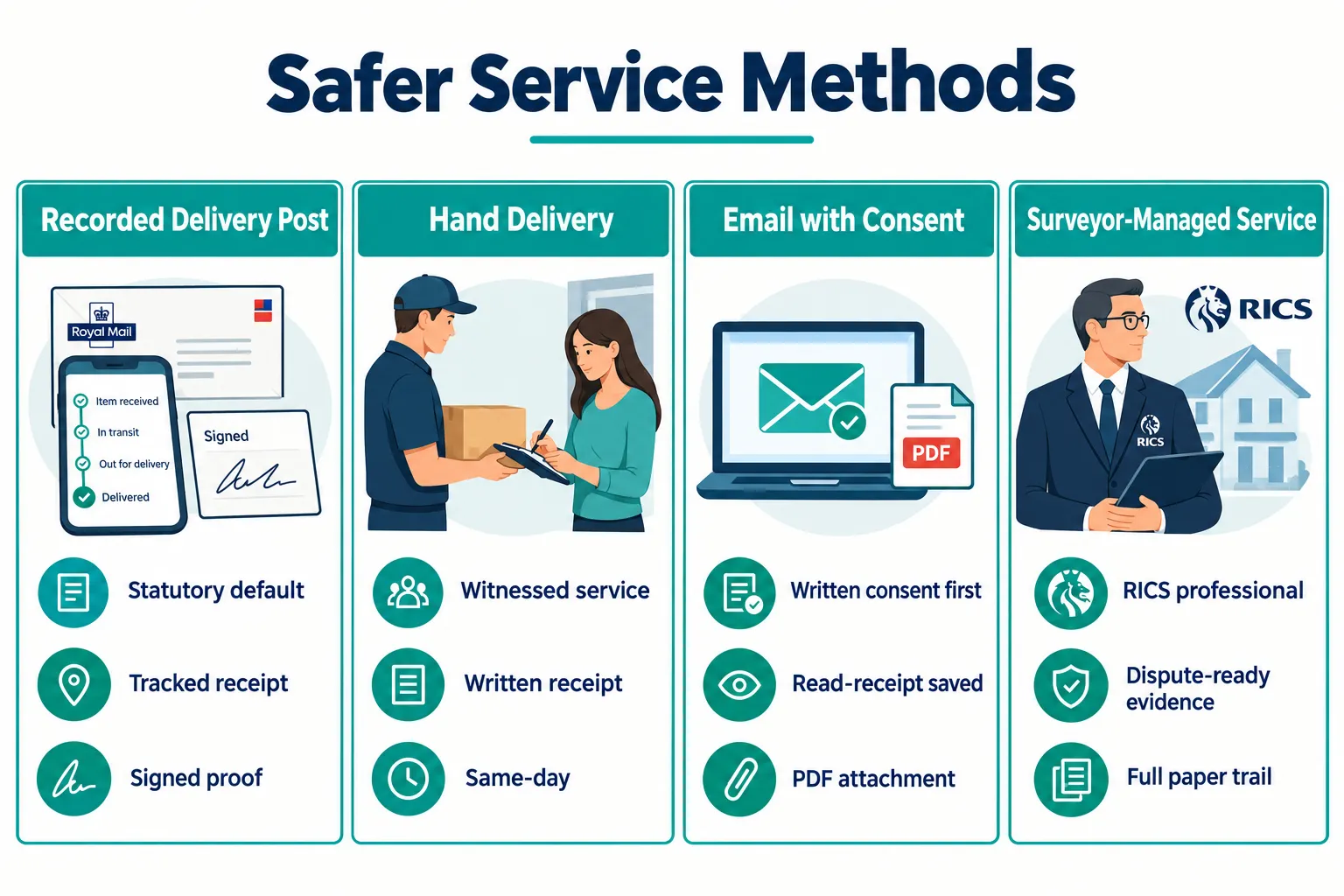
Recorded Delivery Post
This is the method most clearly supported by the Act and by the government's explanatory booklet [3]. A recorded delivery letter creates a tracked record of postage, a signature on delivery, and a date-stamped receipt. It is the default method that courts and surveyors expect to see relied upon.
The main limitation is that the recipient may refuse to sign or may not be present. In those cases, the postal service's attempted-delivery record is still useful evidence.
Personal Delivery
The Act permits personal delivery to the last known address. Handing the notice directly to the adjoining owner, with a witness present, is one of the most robust forms of service. The witness should make a contemporaneous note of the date, time, and circumstances.
Leaving Notice at the Property
Where the adjoining owner cannot be found, section 15 of the Act allows the notice to be left at the property. This should be done by putting it through the letterbox and, where possible, photographing the act of delivery with a timestamp.
Surveyor-Managed Service
Instructing a party wall surveyor to manage service on your behalf adds a professional layer of evidence. The surveyor can document service, retain copies, and advise on whether consent for email service exists. For a fuller picture of timelines and the risks of getting service wrong, see our article on serving a party wall notice in 2026.
Comparing Service Methods: A Practical Summary
| Method | Statutory basis | Consent required | Proof of delivery | Risk level |
|---|---|---|---|---|
| Recorded delivery post | Section 15, Act 1996 | No | Tracked, signed receipt | Low |
| Personal delivery | Section 15, Act 1996 | No | Witness note | Low |
| Left at property | Section 15, Act 1996 | No | Photograph, timestamp | Low, Medium |
| Electronic Communications Order 2016 | Yes, written | Read receipt, reply | Medium, High | |
| General messaging apps | Not recognised | N/A | None | Very high |
The table above reflects the position under current statute and professional guidance. Email sits in the medium-to-high risk band not because it is prohibited, but because the conditions for valid service are easily missed or disputed.
Common Mistakes That Invalidate Email Service
Building owners who rely on email service often make one or more of the following errors.
No prior consent obtained. The building owner sends the notice to an email address used for general correspondence, without first asking the adjoining owner to agree to electronic service. This is the most common failure.
Consent given verbally. The adjoining owner says in a phone call that email is fine. Verbal consent is not sufficient. The consent must be in writing so that it can be produced as evidence.
Notice sent to the wrong address. The building owner uses an old email address, a work address the recipient no longer monitors, or an address obtained from a third party. If the notice does not reach the intended recipient, service has not been effected.
No evidence of receipt retained. The building owner sends the email but does not save a read receipt, does not follow up, and cannot later produce any evidence that the notice was received. When the adjoining owner denies receipt, the building owner has nothing to counter that denial.
Notice content is defective. The email contains a brief description of the works rather than a formally worded notice. The method of delivery cannot compensate for a notice that fails to meet the statutory content requirements. For guidance on what a valid notice must contain and how disputes arise, see our overview of what a party wall dispute involves.
FAQ: Party Wall Notice Service by Email
Does sending a party wall notice by email start the notice period running?
Only if the service was valid. That requires prior written consent from the adjoining owner, the correct email address, and evidence of delivery. Without those elements, the notice period does not begin.
Can the adjoining owner consent to email service after the notice has been sent?
Retrospective consent is legally uncertain. It is far safer to obtain consent before serving the notice. If consent is given after the fact, get it in writing and treat the notice as re-served from the date of that consent.
What if the adjoining owner does not reply to an email notice?
Silence does not confirm receipt. Under the Act, if no response is received within 14 days of a party structure notice, a dispute is deemed to have arisen [6]. However, that deemed dispute only arises if service was valid in the first place. If service is in doubt, re-serve by recorded post immediately.
Is WhatsApp or SMS acceptable for serving a party wall notice?
No. Neither WhatsApp nor SMS is a recognised method of service under the Act or the Electronic Communications Order 2016. Using these channels creates no legal protection.
What happens if works proceed on the basis of an invalid email notice?
The building owner loses the statutory protection of the Act. The adjoining owner may seek an injunction to stop the works, or pursue a claim for damages if the works have already caused harm. See our article on party wall award guidance for more on the consequences of procedural failures.
Should a party wall surveyor be involved even for straightforward notices?
For any works that affect a shared wall or boundary, professional involvement reduces the risk of procedural errors. A surveyor can confirm which notices are required, manage service, and produce a party wall award that protects both parties. Our dispute resolution service page sets out how that process works.
Conclusion
Email service of a party wall notice is legally possible in 2026, but it carries procedural risks that recorded post does not. The consent requirement is not a formality, it is a condition of validity. Without prior written consent from the adjoining owner, an email notice is unlikely to be treated as valid service, and any works carried out in reliance on it may lack statutory protection.
The practical steps to take are straightforward. Before relying on email, obtain written consent from the adjoining owner. Send the notice to an address you can verify is current and monitored. Retain a read receipt, a delivery confirmation, and a copy of any acknowledgement. If there is any doubt about consent or deliverability, use recorded post.
For building owners planning works in 2026, the safest approach is to instruct a party wall surveyor to manage service from the outset. The cost of getting service right at the start is always lower than the cost of resolving a dispute that arises because it was done incorrectly.
References
[1] Party Walls – rics.org
[2] Party Wall Legislation And Procedure – rics.org
[3] The Party Wall Etc Act 1996 Explanatory Booklet – gov.uk
[4] Data – legislation.gov.uk
[5] Party Walls Consumer Guide 2022 – rics.org
[6] Party Wall etc. Act 1996 – legislation.gov.uk
[7] Uksiem 20160335 En – legislation.gov.uk
[8] Rics Party Walls 270717 Jf – nuvensurveyors.co.uk
[9] Party Wall Case Law Knight V Goulandris – ansteyhorne.co.uk
[10] Uksi 20160335 En – legislation.gov.uk