Fifty-six per cent. That is the share of landlords surveyed by The DPS who now say they intend to sell some or all of their portfolio, according to a survey released on 1 October 2026, and the figure is up from 53% when The DPS asked the same question in October 2025. For Manchester and Salford, where small landlords dominate the private rented sector, this is not an abstract national statistic. It is a signal that the city's rental supply could tighten just as the government's tenant protections take hold. This analysis of the landlords rent increases sell up Renters' Rights Act survey Manchester October 2026 data explains what the numbers mean for local landlords, buy-to-let investors and tenants, and what practical steps each group should take now.
Key Takeaways
- The DPS survey of over 1,000 landlords found 68% plan to raise rents and 56% intend to sell some or all of their portfolio, up from 53% a year earlier.
- Smaller landlords (one or two properties) are more likely to exit entirely; larger portfolio landlords are more likely to sell part of their stock.
- The Renters' Rights Act ends Section 21 evictions, makes all tenancies periodic, and limits rent rises to once a year via a Section 13 notice that tenants can challenge.
- Manchester's selective licensing schemes and intensifying Propertymark-flagged enforcement raise the compliance stakes for landlords who stay in the market.
- A pre-sale RICS valuation and condition survey help landlords price realistically, avoid mortgage down-valuations, and decide between selling with tenants in situ or vacant.
The DPS Survey: Landlords Rent Increases Sell Up Renters' Rights Act Survey Manchester October 2026 Findings Explained
The Deposit Protection Service surveyed more than 1,000 landlords in the days immediately after the Act's main provisions commenced in May 2026, with results published on 1 October 2026. The headline message, in the words of Matt Trevett, Managing Director at The DPS, is that the "wait and see" period is over: most landlord respondents "will be either keeping or raising rents." Yet only 19% said they would raise rents automatically every year, suggesting many are reacting to cost pressures rather than following a fixed strategy.
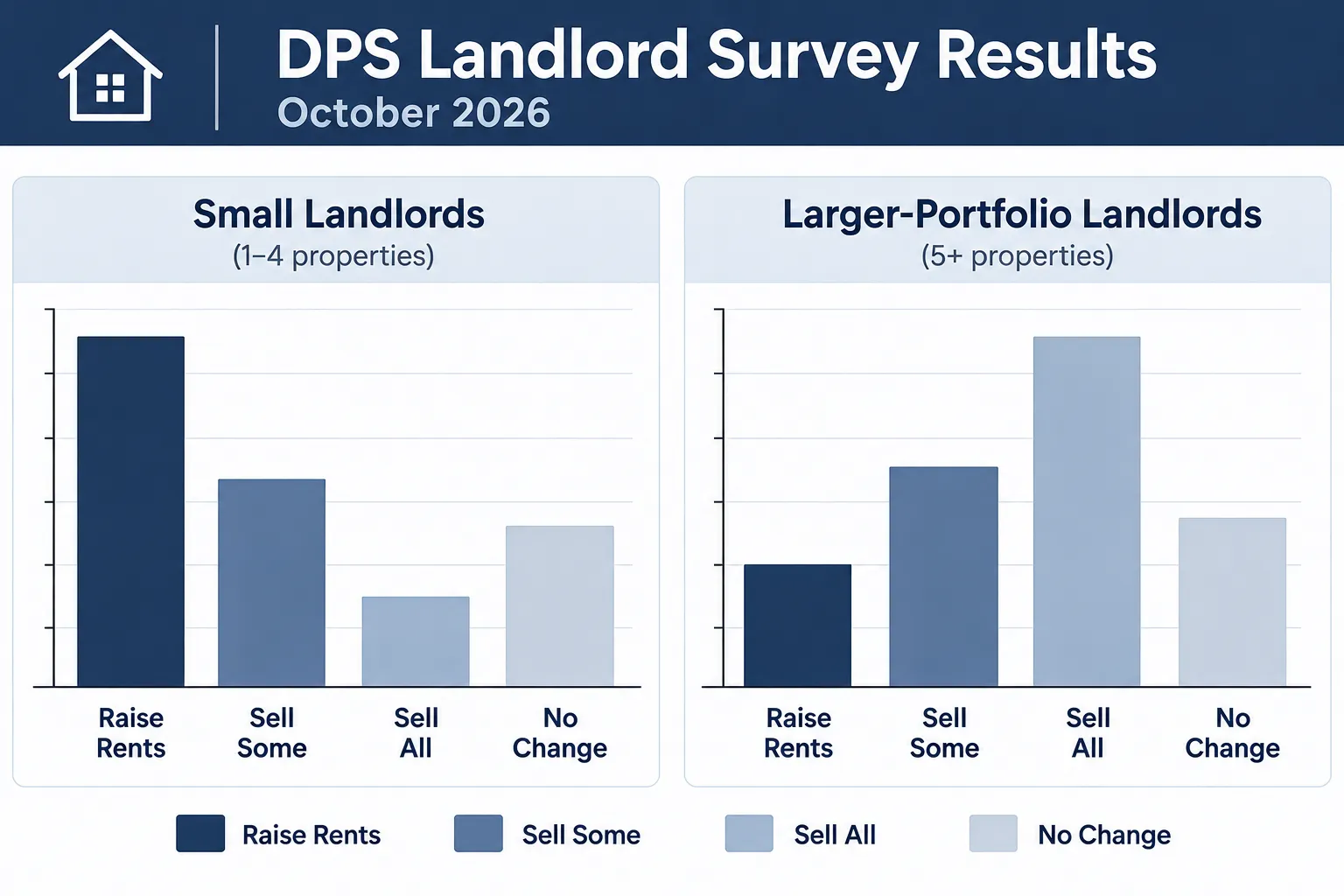
| DPS Survey Metric | Result |
|---|---|
| Landlords planning to raise rents on some/all properties | 68% |
| Landlords who would automatically raise rents annually | 19% |
| Landlords intending to sell some/all of portfolio (Oct 2026) | 56% (up from 53% in Oct 2025) |
| Small landlords (1-2 properties) wanting to sell everything | 31% |
| Small landlords wanting to sell part of portfolio | 23% |
| Small landlords planning no change | 39% |
| Larger-portfolio landlords planning to sell some properties | 48% |
| Larger-portfolio landlords planning a total exit | 16% |
| Tenants offering above asking rent (down 3 points year-on-year) | 13% |
The drivers behind rent rises are the legislation itself, rising maintenance costs and perceived risk. The drivers behind exits are the legislation, weaker returns, mortgage costs and landlords reaching retirement age. Nationally, Rightmove reported on the same date that rental demand is running 2% below last year while available stock is up 0.4%, London being the exception, with demand up 7%. The average advertised rent nationally stands at £1,578 a month, up 2.4% year-on-year.
Why Manchester and Salford Landlords Are Watching Closely
Greater Manchester's private rented sector is built on thousands of individual landlords owning one, two or a handful of properties, exactly the profile the DPS identifies as most likely to exit entirely. If even a modest share of that 31% nationally follows through locally, the effect on supply in inner Manchester and Salford could be material, particularly where selective licensing already adds administrative weight for landlords. For background on how local rents and supply have moved through the autumn, see our coverage of Manchester landlords' rents data for September 2026 and the broader Manchester property market update for September 2026.
What the Renters' Rights Act Actually Changed
Three changes matter most for the sell-or-stay decision now shaping the landlords rent increases sell up Renters' Rights Act survey Manchester October 2026 debate:
- Section 21 is gone. Landlords can no longer end a tenancy without a specified ground, removing the "no-fault" route many relied on to regain vacant possession.
- All tenancies are now periodic. Fixed terms have been replaced by rolling tenancies, changing how landlords plan turnover and refurbishment windows.
- Rent rises are capped to once a year through a formal Section 13 notice, which tenants can challenge at tribunal if they believe the increase exceeds market rent.
These changes, combined with ongoing Renters' Rights Act reforms, are the single most cited reason landlords give for both raising rents and exiting the market.
Selling Up? What Manchester Landlords Need to Know Before Listing
Deciding to sell is only the first step. Landlords exiting under the Act face a genuine choice between selling with a sitting tenant or seeking vacant possession, and that choice shapes both marketing strategy and achievable price. Selling with tenants in situ can appeal to other investors and avoids the delay of ending a tenancy, but it typically narrows the buyer pool to landlords rather than owner-occupiers. Seeking vacant possession under the new possession grounds takes longer and, because Section 21 is no longer available, landlords pursuing this route for genuine reasons such as sale or redevelopment should take advice from a solicitor experienced in the new grounds before serving any notice, this article does not constitute legal advice.

Whichever route is chosen, an independent RICS valuation is essential before a property goes to market. A realistic, evidence-based figure, rather than an optimistic agent estimate, helps avoid the kind of mortgage down-valuation that can collapse a sale weeks before completion. A Red Book valuation from Manchester RICS valuers gives sellers a defensible starting point, while a condition survey flags defects a buyer's own surveyor will find anyway, allowing the seller to price them in or fix them before marketing. This matters more in a market where house price growth across the North West has been uneven, and buyers are increasingly cautious.
Staying in the Market? Document Condition and Plan Capital Spend
For the 39% of small landlords and 23% of larger landlords planning no change, the priority shifts from selling to defending against disputes and compliance risk. With periodic tenancies now the norm, a detailed schedule of condition and inventory at the start of every tenancy is the clearest way to protect against unfounded damage claims and to support any future Section 13 rent review. Minimum property standards in the private rented sector are being tightened under the Act, so documenting condition now is prudent. Landlords should treat a condition survey as a planning tool, not just a dispute shield, it identifies where capital expenditure is needed before it becomes an enforcement issue. Understanding current rental yields across Manchester also helps landlords judge whether planned works are financially worthwhile against the returns described in the DPS survey.
What This Means for Manchester Tenants
Tenants gain predictability: rent can only rise once every 12 months via a formal Section 13 notice, and any increase believed to exceed market rent can be challenged at tribunal. With Rightmove recording rental demand 2% below last year nationally and stock up slightly, Manchester tenants may see marginally more choice than in recent years, though local supply will depend heavily on how many small landlords in the DPS survey actually follow through on selling.
Enforcement Is Intensifying
Propertymark's 1 October 2026 update warns that enforcement against landlords and agents over licensing and compliance breaches is intensifying, with substantial penalties now being applied. Manchester City Council and several Greater Manchester boroughs operate selective licensing schemes across parts of their areas, and landlords who have not reviewed their obligations recently should do so promptly. For context on how this sits alongside wider market data, see our tag pages for Manchester landlords and the 2026 rental market.
Frequently Asked Questions
Does the Renters' Rights Act limit how much rent can be increased?
It limits the frequency to once a year via a Section 13 notice, and tenants can challenge the amount at tribunal if they believe it exceeds market rent.
Can a Manchester landlord still evict a tenant to sell the property?
Section 21 no-fault evictions have ended. Landlords must rely on specified possession grounds, and a solicitor should be consulted before serving notice.
Is selling with a tenant in situ a good option?
It can speed up a sale and suit investor buyers, but it generally attracts a smaller pool of buyers than a vacant property marketed to owner-occupiers.
Why did more landlords plan to sell in October 2026 than a year earlier?
The DPS found 56% intended to sell some or all of their portfolio, up from 53% in October 2025, driven mainly by the new legislation, weaker returns and rising mortgage costs.
What should a landlord do before listing a rental property for sale?
Commission an independent RICS valuation and a condition survey to price realistically and reduce the risk of a mortgage down-valuation derailing the sale.
Conclusion
The DPS findings make clear that Manchester's rental market is entering a new phase: more landlords raising rents within the annual limit, and a rising share planning to sell, particularly among owners of one or two properties. Whether the right move is to hold, refurbish or exit, accurate, independent evidence is the starting point. Manchester Surveyors provides RICS Red Book valuations and detailed condition surveys for landlords across Manchester and Salford who need a realistic price before selling, or a clear schedule of condition before their next tenancy begins. Contact our chartered surveying team to discuss a valuation or condition report tailored to your portfolio.