{"cover":"Professional landscape format (1536×1024) hero image featuring bold text overlay 'Party Wall Surveying for First-Time Buyer Extensions: Timing and Compliance in the 2026 Affordability Boom' in extra large 70pt white sans-serif font with dark shadow effect, positioned in upper third center. Background shows modern UK terraced houses with visible shared walls, construction scaffolding on one property, young couple reviewing architectural plans in foreground, surveyor with clipboard and measuring equipment. Color scheme: deep navy blue, white, warm orange accents representing construction and growth. High contrast, magazine cover quality, editorial style with professional depth of field, bright natural lighting suggesting optimism and opportunity in property market.","content":["Detailed landscape format (1536×1024) image showing professional party wall surveyor in high-visibility vest conducting inspection between two semi-detached properties, measuring tape extended along shared wall, clipboard with official Party Wall Notice forms visible, calendar graphic overlay showing 2-4 month timeline with milestone markers, young first-time buyers standing nearby looking engaged, architectural extension drawings partially visible, bright daylight, clean modern aesthetic with blue and orange color accents, documentary photography style","Landscape format (1536×1024) infographic-style image displaying cost breakdown table for party wall surveying process, calculator and British pound sterling notes arranged professionally, split-screen composition showing surveyor fees £750-£1,800 range on left side, architectural package costs £1,295-£1,795 on right side, construction cost per square meter graphics for loft conversions and rear extensions, bar charts comparing different extension types, clean financial aesthetic with teal and gold color scheme, professional business photography with overhead flat-lay perspective","Landscape format (1536×1024) image showing bird's eye view of UK residential street with multiple terraced houses, one property highlighted with transparent overlay showing rear extension and loft conversion plans, dotted lines indicating 3-metre rule boundaries and excavation zones, neighboring properties marked with notification icons, Schedule of Condition document mockup in corner, aerial drone photography perspective, bright sunny day, urban planning aesthetic with clean geometric overlays in green and blue tones, modern architectural visualization style"]"}
The UK property market is experiencing a remarkable shift in 2026. With improved affordability measures and competitive mortgage rates, first-time buyers are flooding back into the housing market—and many are immediately planning home extensions to maximize their investment. However, one critical aspect often catches new homeowners off guard: party wall surveying requirements. Understanding Party Wall Surveying for First-Time Buyer Extensions: Timing and Compliance in the 2026 Affordability Boom has become essential knowledge for anyone looking to extend their first property without legal complications or costly delays.
As construction demand surges alongside the housing uptick, navigating the Party Wall etc. Act 1996 correctly can mean the difference between a smooth extension project and a neighborhood dispute that derails your plans for months. This comprehensive guide explores the timing strategies, compliance requirements, and neighbor negotiation tactics that first-time buyers need to master in 2026's competitive extension market.

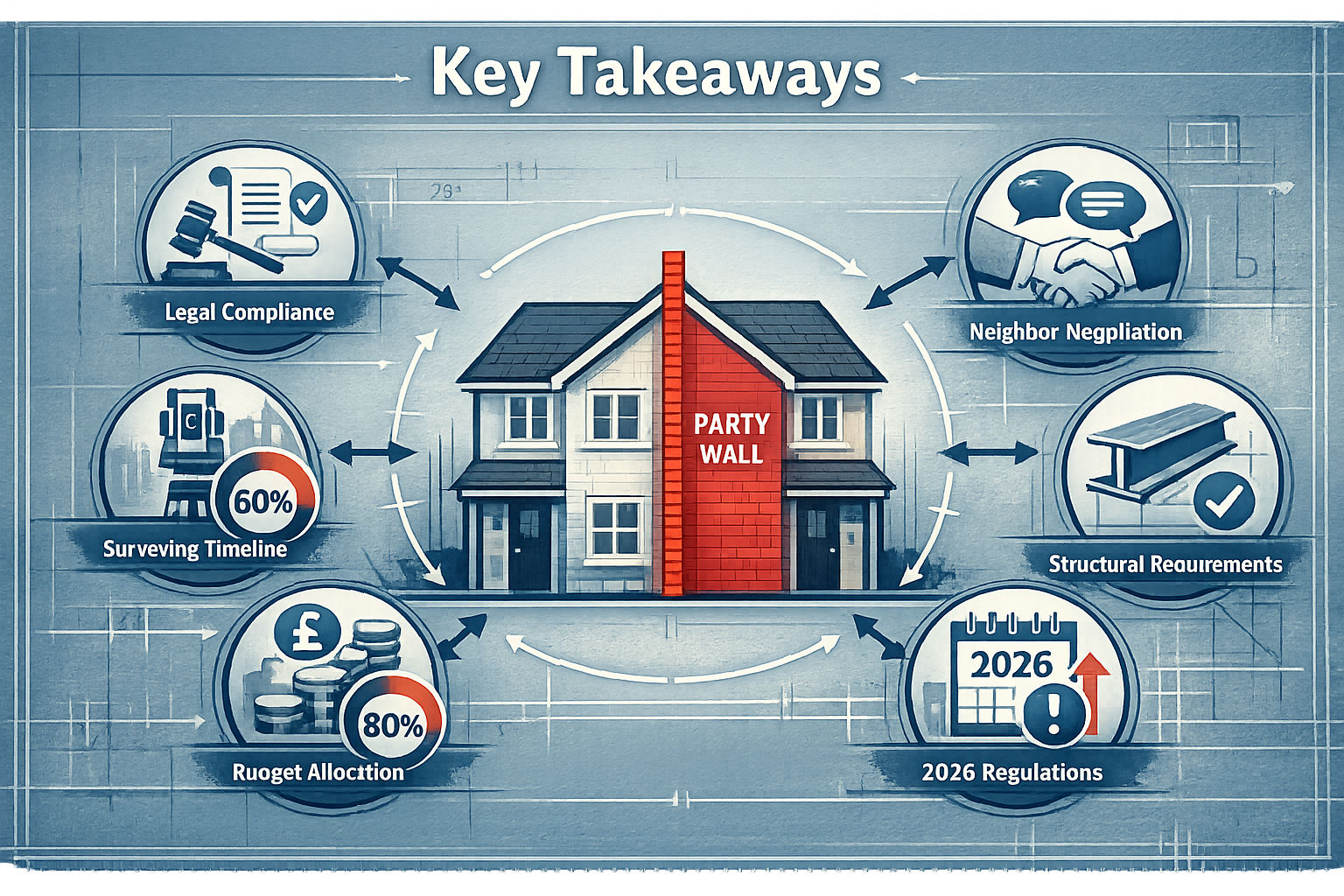
Key Takeaways
- Party wall notices must be served 2 months before construction begins, with the entire surveying process typically taking 2-4 months to complete—critical timing for first-time buyers planning extensions[2]
- Surveyor fees range from £750-£1,800 per neighbor for party wall agreements, with professional architectural packages starting at £1,295 for ground floor extensions[1]
- The Party Wall etc. Act 1996 governs all building work affecting shared walls, boundaries, and excavations within 3 meters of neighboring properties[2]
- Loft conversions and rear extensions are the most popular choices for first-time buyers in 2026, with mandatory party wall compliance when work affects shared structures[3]
- Schedule of Condition surveys protect both parties by documenting the pre-construction state of neighboring properties, preventing future disputes
Understanding Party Wall Surveying for First-Time Buyer Extensions in 2026
What Is Party Wall Surveying?
Party wall surveying is the professional process of managing building work that affects shared walls, boundaries, or structures between adjoining properties. The Party Wall etc. Act 1996 provides the legal framework that governs this process across England and Wales[2]. For first-time buyers planning extensions, this legislation ensures that both property owners' rights are protected during construction.
The Act covers three main types of work:
- Building on or near a party wall (shared wall between properties)
- Excavating within 3 meters of a neighboring building's foundation
- Creating new walls at property boundaries
When first-time buyers purchase terraced or semi-detached homes—the most common property types for new entrants—virtually any extension project will trigger party wall requirements. Understanding what happens when a neighbor carries out works without a party wall agreement highlights why proper compliance matters.
Why 2026 Is Different for First-Time Buyers
The 2026 affordability boom has created unique conditions. With government incentive schemes and improved lending criteria, first-time buyers are entering the market in record numbers. However, many are purchasing smaller starter homes with immediate extension plans rather than waiting to afford larger properties.
This strategy makes financial sense: loft conversions in London range from £2,200-£2,900 per m² (totaling £52,000-£100,000 for 20m²), while single-storey rear extensions average £3,200-£3,800 per m² (totaling £60,000-£100,000 for the same space)[1]. These costs, though substantial, remain more affordable than moving to a larger property with associated stamp duty and transaction costs.
The surge in extension activity has also increased demand for party wall surveyors, sometimes extending typical timelines during peak construction seasons.
The Complete Timeline for Party Wall Surveying for First-Time Buyer Extensions
Pre-Notice Planning Phase (Weeks 1-4)
Before serving any formal notices, first-time buyers should invest time in preliminary planning and neighbor communication. This foundational phase prevents misunderstandings and sets a collaborative tone.
Key activities include:
- 📋 Commissioning architectural designs for your extension (professional packages start at £1,295 for ground floor extensions)[1]
- 🏗️ Determining which neighbors are affected by your proposed work
- 💬 Informal discussions with neighbors about your plans
- 📊 Obtaining initial cost estimates from builders
- 🔍 Appointing a party wall surveyor to guide the process
Many first-time buyers make the mistake of serving notices before finalizing their extension design. This creates complications if plans change, requiring amended notices and restarting the statutory timeline.
Formal Notice Period (Weeks 5-12)
The Party Wall etc. Act 1996 requires specific notice periods depending on the type of work:
| Work Type | Notice Period | When It Starts |
|---|---|---|
| Party wall work | 2 months | Before construction begins |
| Excavation work | 1 month | Before construction begins |
| New boundary wall | 1 month | Before construction begins |
Your party wall surveyor will prepare and serve formal notices to all affected neighbors. These notices must include:
- ✅ Detailed description of the proposed work
- ✅ Anticipated start date
- ✅ Your contact information
- ✅ Information about the neighbor's rights under the Act
Neighbors have three response options:
- Consent in writing (work can proceed after notice period expires)
- Dissent or remain silent (triggers the dispute resolution process)
- Request modifications to protect their property
According to industry data, approximately 60-70% of neighbors consent to straightforward extension work when properly approached[2]. However, the remaining cases require formal surveyor appointments and award preparation.
Surveyor Appointment and Award Preparation (Weeks 13-20)
If your neighbor dissents or doesn't respond within 14 days, the Act requires appointing surveyors to prepare a Party Wall Award. First-time buyers have two options:
Option 1: Agreed Surveyor 🤝
Both parties agree to use a single impartial surveyor (most cost-effective, typically £750-£1,200 total)[1]
Option 2: Two Surveyors 👥
Each party appoints their own surveyor, who then jointly select a third surveyor (more expensive, typically £1,500-£3,600 total)[1]
The surveyor(s) will conduct a Schedule of Condition survey documenting the current state of the neighboring property. This critical step protects both parties by establishing a baseline for assessing any construction-related damage.
The Party Wall Award document includes:
- Detailed work specifications
- Construction methodology and timeline
- Access requirements
- Working hours restrictions
- Insurance requirements
- Dispute resolution procedures
Understanding the cost of party wall procedures helps first-time buyers budget appropriately. Remember: the building owner (you) pays all reasonable surveyor fees, including your neighbor's surveyor costs.
Construction Phase Compliance (Ongoing)
Once the Party Wall Award is issued, construction can begin—but compliance doesn't end there. First-time buyers must ensure their builders:
- 🔨 Follow the Award specifications precisely
- 📅 Adhere to agreed working hours (typically 8am-6pm weekdays)
- 🚧 Minimize disruption to neighboring properties
- 📸 Document the construction process with photographs
- 🛡️ Maintain appropriate insurance coverage
Regular communication with neighbors throughout construction maintains goodwill and prevents minor issues from escalating into formal disputes. For guidance on managing potential conflicts, review information about party wall disputes.
Cost Breakdown: Budgeting for Party Wall Surveying for First-Time Buyer Extensions
Professional Fee Structure in 2026
Understanding the complete cost picture helps first-time buyers avoid budget surprises. Party wall surveying represents just one component of total extension costs, but it's often underestimated.
Party Wall Surveying Costs:
| Service | Cost Range | Notes |
|---|---|---|
| Agreed Surveyor (single) | £750-£1,200 | Most economical option |
| Two Surveyors + Third | £1,500-£3,600 | Required if neighbor appoints own surveyor |
| Schedule of Condition | £300-£600 | Per neighboring property |
| Award Amendments | £200-£500 | If plans change mid-process |
Architectural and Planning Costs:
Professional architectural packages in 2026 include survey, drawings, planning applications, and unlimited revisions[1]:
- Ground floor extension package: £1,295
- Loft conversion package: £1,595
- First floor extension package: £1,795
These packages represent excellent value for first-time buyers, as they bundle multiple services and eliminate the risk of unexpected design fees.
Total Extension Costs:
Beyond surveying and design fees, construction costs dominate the budget:
- Loft conversions: £52,000-£100,000 (20m² at £2,200-£2,900/m²)[1]
- Rear extensions: £60,000-£100,000 (20m² at £3,200-£3,800/m²)[1]
- Professional fees: Additional £5,000-£10,000 for project management, building control, etc.[1]
For first-time buyers, loft conversions often provide better value than ground-floor extensions, offering similar space gains at potentially lower per-square-meter costs. However, loft conversions in 2026 require mandatory party wall compliance when work affects shared walls or roof structures[3].
Hidden Costs to Consider
Experienced surveyors warn first-time buyers about several commonly overlooked expenses:
💰 Neighbor's surveyor fees if they appoint their own (your responsibility)
💰 Remedial work costs if construction damages neighboring property
💰 Extended surveyor involvement if disputes arise during construction
💰 Legal fees if the dispute escalates beyond the Award process
💰 Project delays costing additional rental or mortgage payments
Building a contingency fund of 15-20% above estimated costs protects against these scenarios.
Compliance Strategies: Navigating the 3-Metre Rule and Permitted Development
Understanding the 3-Metre Rule
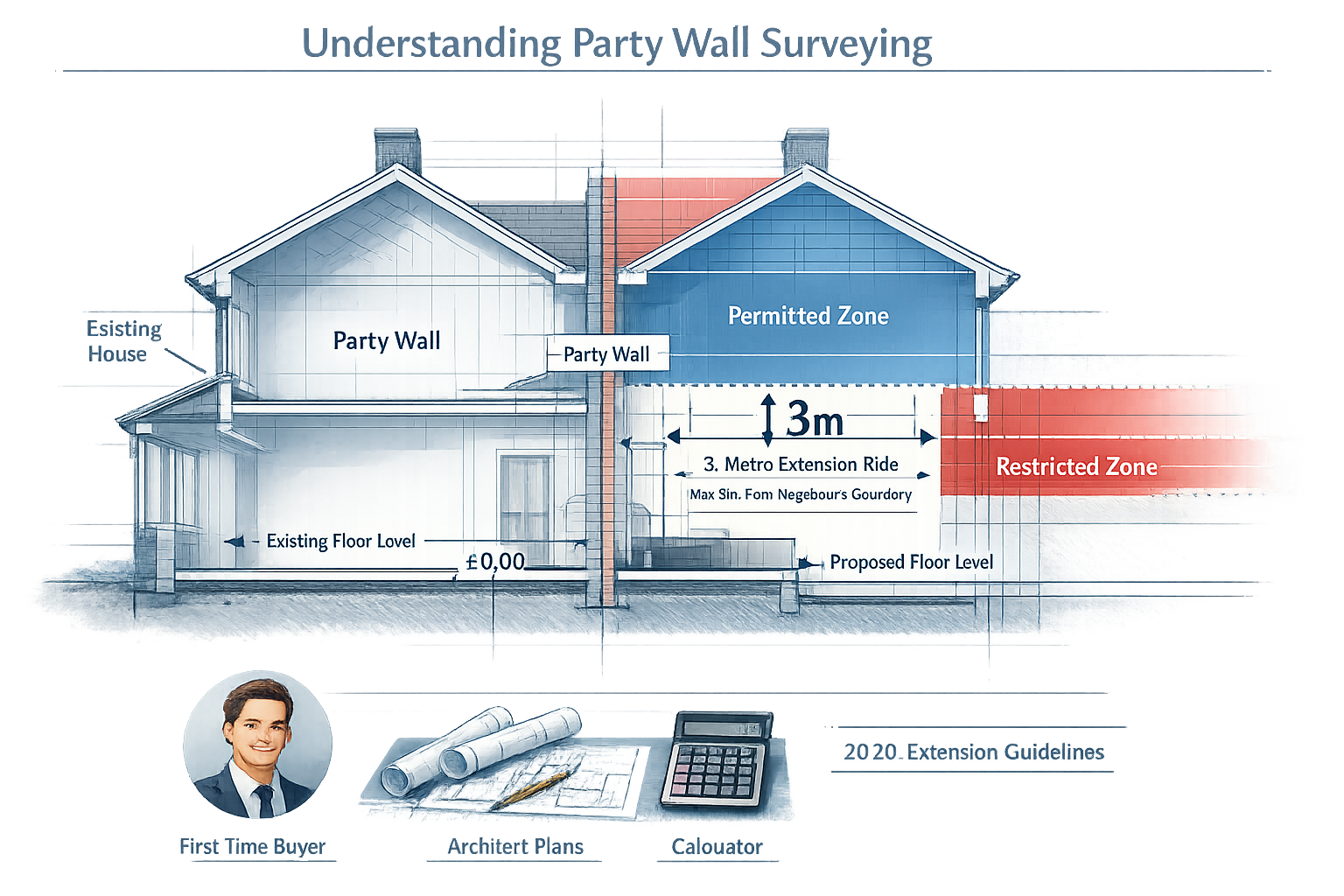
One of the most important concepts for first-time buyers planning extensions is the 3-metre rule. This provision of the Party Wall Act requires serving notice if you're excavating within 3 meters of a neighboring building where your excavation will go deeper than their foundations.
The 3-metre rule applies when:
- ✓ Digging foundations for extensions
- ✓ Creating basement conversions
- ✓ Installing deep drainage systems
- ✓ Any excavation work near property boundaries
The rule extends to 6 meters if your excavation goes deeper than a line drawn at 45 degrees from the bottom of your neighbor's foundations. This commonly affects basement projects in areas with shallow existing foundations.
First-time buyers should commission a foundation depth survey early in planning to determine whether the 3-metre rule applies to their project. This information shapes both the party wall notice requirements and construction methodology.
Permitted Development Rights in 2026
Understanding permitted development rights helps first-time buyers minimize planning complications. Current regulations allow:
Rear Extensions (Permitted Development):
- Detached homes: Up to 4m depth (8m with prior approval)
- Semi-detached/terraced: Up to 3m depth (6m with prior approval)
- Single-storey only
- Maximum height of 4m
- Not in conservation areas or on listed buildings[1]
Loft Conversions (Permitted Development):
- Volume increase up to 40m³ (terraced) or 50m³ (detached/semi-detached)
- No extension beyond existing roof plane facing highway
- Materials similar to existing property
- No verandas, balconies, or raised platforms
Important: Permitted development rights eliminate the need for planning permission, but party wall requirements still apply regardless of planning status[1]. Many first-time buyers mistakenly believe that permitted development means no neighbor consultation is needed.
Special Considerations for Conservation Areas
First-time buyers purchasing in conservation areas face additional restrictions. Article 4 directions may remove permitted development rights entirely, requiring full planning applications for extensions that would otherwise be permitted.
Before purchasing a property with extension plans, verify:
- 🏛️ Conservation area status
- 📜 Article 4 direction restrictions
- 🏗️ Local design guidelines
- 📋 Tree preservation orders
These factors significantly impact both timeline and costs for extension projects.
Neighbor Negotiation Tactics for First-Time Buyers
Building Positive Relationships Early
The most successful party wall processes begin with proactive neighbor communication before formal notices are served. First-time buyers who invest time in relationship-building often avoid formal disputes entirely.
Effective communication strategies:
- Schedule face-to-face meetings rather than relying on letters or emails
- Share detailed plans and visualizations showing how the extension will look
- Address concerns proactively about noise, dust, access, and disruption
- Offer goodwill gestures like temporary parking arrangements or shared fence repairs
- Provide direct contact information for both yourself and your builder
"The biggest mistake first-time buyers make is treating the party wall process as purely legal rather than interpersonal. Neighbors who feel respected and informed rarely create obstacles, even when they have legitimate concerns about construction impact." — Senior Party Wall Surveyor
Handling Objections Professionally
When neighbors raise concerns, first-time buyers should view these as opportunities to refine plans rather than obstacles. Common objections include:
Concern: Loss of light 📉
Response: Commission a daylight/sunlight assessment showing minimal impact; consider design modifications if impact is significant
Concern: Structural damage 🏚️
Response: Explain the Schedule of Condition process and your comprehensive insurance coverage; offer additional monitoring if needed
Concern: Construction disruption 🚧
Response: Provide detailed construction schedule with agreed working hours; establish clear communication channels for addressing issues
Concern: Property value impact 💷
Response: Share examples of similar extensions in the area; note that well-designed extensions typically enhance neighborhood property values
When neighbors appoint their own surveyor (increasing costs), resist the temptation to view this as adversarial. Their surveyor's role is to protect their legitimate interests, and the resulting Award provides clearer protection for everyone involved.
When to Seek Professional Mediation
Approximately 5-10% of party wall cases escalate beyond standard surveyor involvement[2]. Warning signs that professional mediation may be needed include:
- ⚠️ Neighbor refuses to engage with the surveyor process
- ⚠️ Allegations of bad faith or hidden motives
- ⚠️ Threats of legal action beyond the Act's provisions
- ⚠️ Historical disputes between properties
- ⚠️ Unreasonable demands unrelated to legitimate concerns
In these situations, first-time buyers should consult solicitors specializing in property disputes before construction begins. The cost of early legal advice (£500-£1,500) is minimal compared to the expense of resolving disputes after construction damage occurs.
Integration with Mandatory Condition Surveys Under 2026 Reforms
The Role of Schedule of Condition Surveys
The Schedule of Condition serves as the foundational document protecting both parties during extension work. This detailed photographic and written record documents the pre-construction state of neighboring properties, establishing a clear baseline for assessing any construction-related damage.
A comprehensive Schedule of Condition includes:
- 📸 Extensive photography of all rooms, external walls, and shared structures
- 📝 Written descriptions of existing defects, cracks, and damage
- 📏 Crack width measurements using precision gauges
- 🎥 Video documentation of particularly complex areas
- 🗺️ Floor plans showing location of documented features
For first-time buyers, understanding Schedule of Condition guidance ensures they appreciate why this process matters. Without proper documentation, distinguishing pre-existing damage from construction-related issues becomes nearly impossible, leading to costly disputes.
Best Practices for Condition Documentation
First-time buyers should insist their party wall surveyor follows these documentation standards:
Timing: Schedule of Condition surveys must occur before any construction work begins, including preliminary demolition or site setup
Scope: Document all areas potentially affected by construction, not just rooms directly adjacent to the party wall
Quality: Use professional photography equipment with proper lighting and high resolution
Storage: Maintain multiple backup copies of all documentation in secure cloud storage
Access: Ensure neighboring property owners receive copies of their Schedule of Condition
The modest cost of thorough condition documentation (£300-£600 per property)[1] provides invaluable protection against future disputes. First-time buyers who attempt to economize by skipping or rushing this step often regret the decision when post-construction disagreements arise.
Post-Construction Verification
After extension completion, the party wall surveyor should conduct a follow-up inspection comparing the neighboring property's current condition against the Schedule of Condition. This verification process:
- ✅ Identifies any construction-related damage
- ✅ Establishes repair responsibilities and costs
- ✅ Provides formal closure to the party wall process
- ✅ Protects the building owner from future claims
First-time buyers should budget for this final inspection (typically £200-£400) as part of total project costs. The peace of mind and legal protection justify the expense.
Common Pitfalls and How First-Time Buyers Can Avoid Them
Mistake #1: Starting Work Before Award Issuance
The most expensive mistake first-time buyers make is beginning construction before receiving the Party Wall Award. This violation of the Act can result in:
- 🚫 Injunctions halting all work immediately
- 💰 Legal costs for both parties
- 📅 Project delays of several months
- 🏗️ Remedial work dismantling unauthorized construction
- ⚖️ Compensation claims from neighbors
Even when neighbors verbally agree to extension plans, written consent or a formal Award is legally required before construction begins[2]. The temptation to start work "just a few days early" can derail entire projects.
Mistake #2: Inadequate Builder Briefing
First-time buyers often fail to properly brief their builders about party wall requirements. Construction teams unfamiliar with the Act may:
- Exceed agreed working hours
- Ignore access restrictions
- Damage neighboring property through carelessness
- Fail to implement required protective measures
Solution: Include party wall compliance requirements in construction contracts, with penalty clauses for violations. Provide builders with copies of the Party Wall Award and Schedule of Condition.
Mistake #3: Ignoring Insurance Requirements
The Party Wall Award typically specifies minimum insurance coverage for construction work. First-time buyers must verify their builder carries:
- Public liability insurance (minimum £5-10 million)
- Employer's liability insurance (if employing workers)
- Professional indemnity insurance (for design work)
Request certificates of insurance before work begins and verify coverage remains active throughout construction. Inadequate insurance leaves first-time buyers personally liable for any damage to neighboring properties.
Mistake #4: Poor Communication During Construction
Even with perfect party wall compliance, poor communication during construction creates unnecessary friction. First-time buyers should:
- 📱 Provide neighbors with site manager contact details for immediate issue resolution
- 📧 Send weekly progress updates via email or text
- 🗓️ Give advance notice of particularly disruptive work phases
- 🧹 Maintain site cleanliness to minimize neighborhood impact
- 🎁 Offer small gestures like occasional coffee or treats for inconvenienced neighbors
These relationship-maintenance efforts cost little but significantly reduce the risk of disputes escalating.
Frequently Asked Questions About Party Wall Surveying
Q: Do I need party wall consent for internal renovations?
A: Generally no, unless the work involves removing or altering load-bearing walls that form part of the party structure. Internal cosmetic work rarely triggers party wall requirements.
Q: What if my neighbor refuses to respond to the party wall notice?
A: Silence or refusal to respond is treated as dissent under the Act. After 14 days, you can appoint a surveyor on their behalf to prepare the Party Wall Award. They pay nothing; you cover all surveyor costs.
Q: Can neighbors prevent my extension entirely?
A: No. The Party Wall Act doesn't give neighbors veto power over permitted development or approved planning applications. However, they can require reasonable protective measures and fair compensation for any damage.
Q: How long does the party wall process take in 2026?
A: Typically 2-4 months from initial notice to Award issuance, though complex cases or high surveyor demand can extend this to 5-6 months[1][2].
Q: What happens if construction damages my neighbor's property?
A: The Schedule of Condition proves what damage is construction-related. You're legally responsible for repairs, which your builder's insurance should cover. The party wall surveyor oversees the repair process.
For more detailed answers, consult our comprehensive party wall FAQ.
Conclusion: Mastering Party Wall Surveying for Successful First-Time Buyer Extensions
The 2026 affordability boom presents unprecedented opportunities for first-time buyers to purchase and immediately enhance their properties through strategic extensions. However, success requires mastering Party Wall Surveying for First-Time Buyer Extensions: Timing and Compliance in the 2026 Affordability Boom—a complex process that blends legal compliance, neighbor diplomacy, and project management.
Key success factors for first-time buyers:
✅ Start the party wall process early (4-6 months before desired construction start date)
✅ Budget comprehensively for surveyor fees, architectural packages, and contingencies
✅ Invest in relationship-building with neighbors before serving formal notices
✅ Insist on thorough Schedule of Condition documentation to protect all parties
✅ Maintain professional communication throughout the construction process
✅ Work with experienced professionals who understand both the Act and local market conditions
The costs of proper party wall compliance—£750-£3,600 for surveying plus architectural packages from £1,295[1]—represent a modest percentage of total extension costs (£52,000-£100,000 for typical projects). Yet these professional services provide legal protection, neighbor goodwill, and project certainty that far exceed their cost.
Next Steps for First-Time Buyers Planning Extensions
- Assess your extension options: Determine whether a loft conversion, rear extension, or alternative approach best suits your property and budget
- Consult a party wall surveyor: Obtain preliminary advice about notice requirements and timeline before finalizing plans
- Commission architectural designs: Engage professionals offering comprehensive packages that include planning support
- Initiate neighbor conversations: Begin informal discussions about your plans before serving formal notices
- Verify insurance and contractor credentials: Ensure your building team understands party wall compliance requirements
The 2026 housing market rewards first-time buyers who approach extensions strategically, combining financial planning with legal compliance and interpersonal skills. By mastering party wall surveying requirements now, new homeowners position themselves for smooth, successful projects that enhance both their properties and their neighborhoods.
For personalized guidance on your specific extension project, consider consulting experienced chartered surveyors who specialize in party wall matters and understand the unique challenges facing first-time buyers in 2026's dynamic property market.
References
[1] Party Wall Agreement London 2026 – https://www.mayfairstudio.co.uk/blog/party-wall-agreement-london-2026
[2] Party Wall Surveying For Uk Home Extensions A Practical 2026 Guide For Loft Rear And Basement Projects – https://nottinghillsurveyors.com/blog/party-wall-surveying-for-uk-home-extensions-a-practical-2026-guide-for-loft-rear-and-basement-projects
[3] Party Wall Surveying Surge In 2026 Loft Conversions Navigating High Demand Compliance During Housing Uptick – https://nottinghillsurveyors.com/blog/party-wall-surveying-surge-in-2026-loft-conversions-navigating-high-demand-compliance-during-housing-uptick