A poorly chosen expert witness does not merely weaken a case, it can destroy it. Courts in England and Wales have struck out expert evidence, awarded adverse costs orders, and in some instances referred surveyors to RICS for disciplinary review, all because the instructing party failed to check whether the expert was genuinely qualified, independent, and properly instructed. Knowing how to find a property expert witness for court, covering the instruction letter, CV checks and conflicts, is therefore one of the most consequential decisions a solicitor or litigant will make in property litigation.
Key Takeaways
- Use the RICS-accredited expert witness panel as your starting point; it is updated regularly and lists surveyors who have passed a formal accreditation process.
- The RICS 5th edition Professional Standard, effective 30 November 2026, sets the current benchmark for how surveyor-expert witnesses must behave and what their reports must contain.
- A thorough CV check goes beyond general surveying credentials, it must confirm relevant court experience, recent CPD, and a clear policy on AI use in report preparation.
- Conflicts of interest must be identified and disclosed before instruction, including financial dependence on a repeat client.
- The instruction letter is a legal document: it must define scope, confirm independence, set out fee arrangements, and address delegation and AI use explicitly.
Why the RICS Accredited Panel Is Your Starting Point
The most reliable route to a suitable property expert witness is the RICS Expert Witness Accreditation Service. RICS maintains a publicly available register of accredited expert witnesses, updated several times a year, which lists surveyors who have completed formal training, passed assessments, and committed to ongoing CPD in expert witness practice [1][7].
Accreditation is not the same as being a chartered surveyor. A Fellow of RICS (FRICS) with 30 years of residential valuation experience may still lack the procedural knowledge to produce a court-compliant expert report. The accreditation process tests understanding of Civil Procedure Rules (CPR) Part 35, the expert's overriding duty to the court, and the specific requirements for written reports and joint statements [7].
The register is searchable by specialism. For property litigation, the relevant categories include:
- Residential valuation, disputes over purchase price, matrimonial asset division, or tax assessments
- Commercial valuation, rent review, lease renewal, and business rates appeals
- Building surveying, defects, disrepair, and dilapidations
- Boundary disputes, title plan interpretation and physical demarcation
If a surveyor does not appear on the RICS register, that is not automatically disqualifying, but it raises the burden of proof on the instructing party to demonstrate equivalent competence and training [5]. For cases before the First-tier Tribunal (Property Chamber) or the Upper Tribunal (Lands Chamber), judges are familiar with the RICS standard and will notice its absence.
For cases involving housing disrepair claims, a specialist in housing disrepair expert witness work will carry more weight than a generalist, even a highly experienced one. The same logic applies to valuation dispute expert witness appointments and boundary dispute expert witness instructions.
CV Checks: What to Look For Beyond General Surveying Credentials
Receiving a CV from a proposed expert witness is only the beginning. The RICS client guide for expert witnesses is explicit that instructing parties should scrutinise the CV carefully before confirming the appointment [5]. The new 5th edition Professional Standard, effective 30 November 2026, reinforces this expectation and signals that courts will hold instructing solicitors to a higher standard of due diligence [8].

A CV check for a property expert witness should cover six areas:
| Area | What to confirm |
|---|---|
| RICS membership grade | MRICS or FRICS; check current status via the RICS online register |
| Accreditation | Listed on the RICS Expert Witness Accreditation Service register [7] |
| Relevant court experience | Named cases, tribunal appearances, or joint statement experience in the same specialism |
| Recent CPD | Evidence of expert witness-specific training in the last two years, not just general surveying CPD |
| AI use policy | A clear statement on whether AI tools are used in drafting reports and how outputs are verified |
| Professional indemnity insurance | Confirmed cover for expert witness work, not just general surveying practice |
The AI point deserves particular attention. RICS has flagged AI use in expert evidence as a specific risk area [9]. An expert who uses an AI drafting tool without disclosing this, or without checking outputs against primary evidence, risks producing a report that misrepresents the basis of their opinion. The instruction letter should require the expert to confirm their AI use policy in writing before work begins.
Recent commentary from the Expert Witness Institute also urges stronger documentation of expertise within the body of the expert report itself, not just in a covering CV [10]. Courts increasingly expect the report to open with a concise summary of the expert's relevant qualifications and experience, cross-referenced to the CV appended as an exhibit.
For a broader understanding of what RICS accreditation involves from the surveyor's perspective, the article on RICS expert witness accreditation routes and requirements sets out the process in detail.
Conflicts of Interest: Screening Before Instruction
Conflicts of interest in expert witness appointments fall into two categories: direct financial conflicts and relational conflicts. Both must be screened before instruction, and both must be disclosed to the court if they exist [5][6].
Direct financial conflicts arise when the proposed expert has a financial interest in the outcome of the dispute. This includes holding shares in a party, acting as a director or officer of a company involved in the case, or having an outstanding fee dispute with one of the parties.
Relational conflicts are more common in property work and more easily overlooked. They include:
- A prior valuation of the subject property for one of the parties
- An ongoing or recent professional relationship with the instructing solicitor's firm
- Financial dependence on a repeat client, for example, a surveyor who derives 30% or more of annual income from instructions by the same firm or client [8]
The 5th edition Professional Standard requires explicit disclosure of financial dependence on a repeat client. This is a change from earlier guidance, which addressed conflicts in more general terms [8]. In practice, it means the proposed expert should be asked directly, in writing, whether they have received instructions from the instructing party or their solicitors within the last three years and what proportion of their income those instructions represent.
A practical conflict-screening questionnaire sent to the proposed expert before appointment should ask:
- Have you previously valued, surveyed, or reported on the subject property?
- Do you have any financial interest in any party to the dispute?
- Have you acted for the instructing party or their solicitors in the last three years? If so, what proportion of your income did those instructions represent?
- Are you aware of any other matter that might affect your ability to give independent evidence?
If the answer to any of these questions raises a concern, the safer course is to find a different expert. A conflict that emerges during cross-examination is far more damaging than one identified and addressed at the outset.
Drafting the Instruction Letter: Scope, Independence and Fee Arrangements
The instruction letter is not a formality. It is the document that defines the expert's role, confirms their independence, and sets the boundaries of their work. A poorly drafted instruction letter is one of the most common reasons expert evidence is challenged or excluded [5][6].
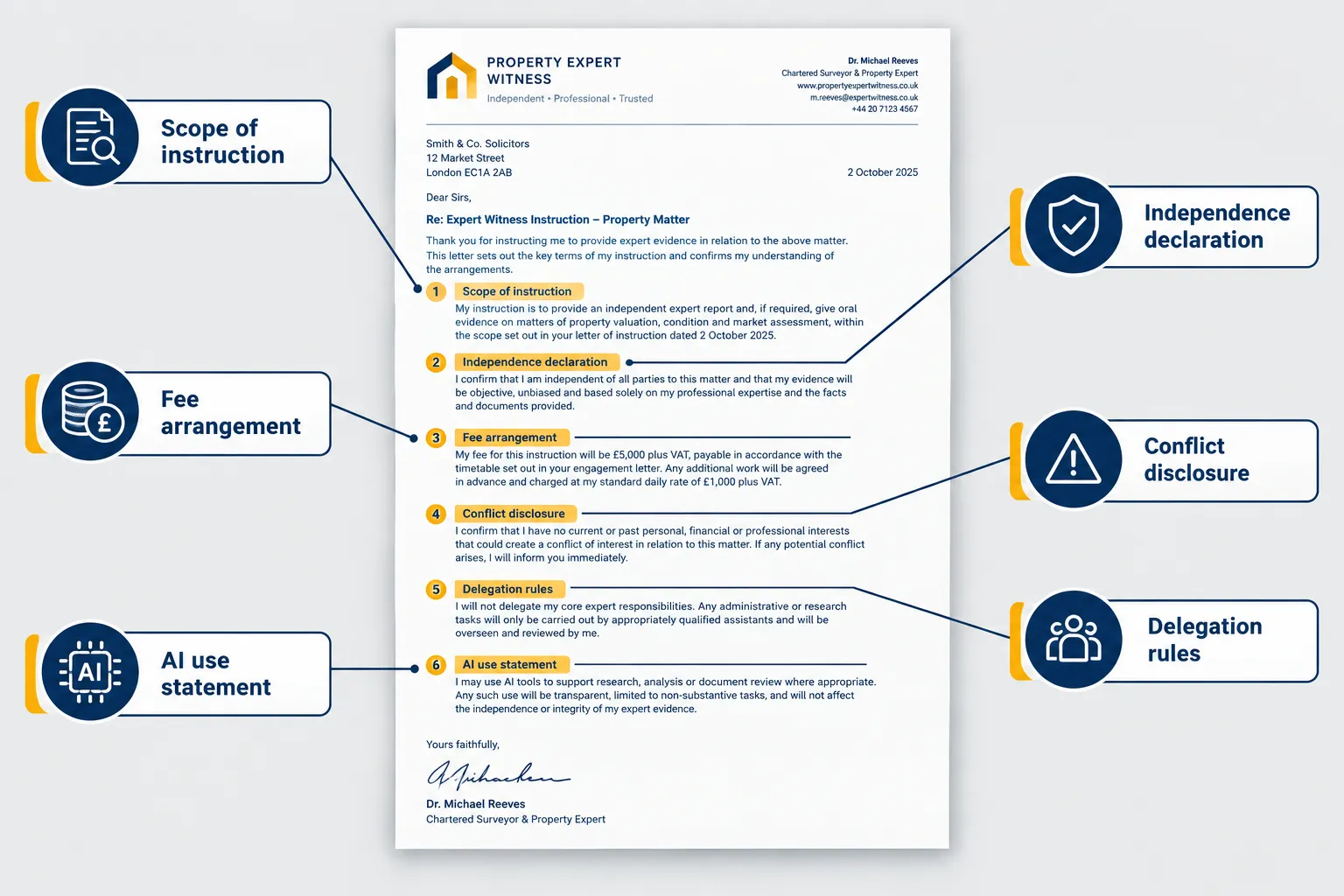
The RICS client guide identifies the following as mandatory elements of an instruction letter for a surveyor-expert witness [5]:
Scope of instruction
State precisely what the expert is being asked to opine on. For a valuation dispute, this means the date of valuation, the basis of value (market value, reinstatement cost, etc.), and the specific questions the court has ordered the expert to address. Vague instructions produce vague reports.
Confirmation of independence
The letter must confirm that the expert's duty is to the court, not to the instructing party. It should include an acknowledgement that the expert will not act as an advocate and will not alter their opinion under pressure from the instructing solicitor or client [6].
Remuneration
Set out the fee arrangement clearly, including the hourly rate, the estimated total, and the basis on which fees will be charged for attendance at court, preparation of a joint statement, and any revision of the report. Conditional fee arrangements that link payment to the outcome of the case are prohibited for expert witnesses [5].
Delegation
If the expert intends to delegate any part of the work, for example, instructing a junior surveyor to carry out the physical inspection, this must be stated in the instruction letter and disclosed in the report. The expert remains responsible for all delegated work [6].
AI use
The instruction letter should require the expert to confirm in writing whether AI tools will be used in preparing the report, how outputs will be verified, and whether AI use will be disclosed in the report itself [9].
Timetable
Include the court's timetable for exchange of expert reports and the date by which a joint statement must be produced. Experts who miss court deadlines expose the instructing party to wasted costs applications.
A checklist for the instruction letter:
- Precise scope and questions to be addressed
- Independence and duty to the court confirmed
- Fee arrangement and prohibited conditional fees
- Delegation policy
- AI use policy
- Court timetable and key dates
- Requirement to notify the instructing solicitor of any conflict that emerges after instruction
Practical Steps for Finding the Right Expert
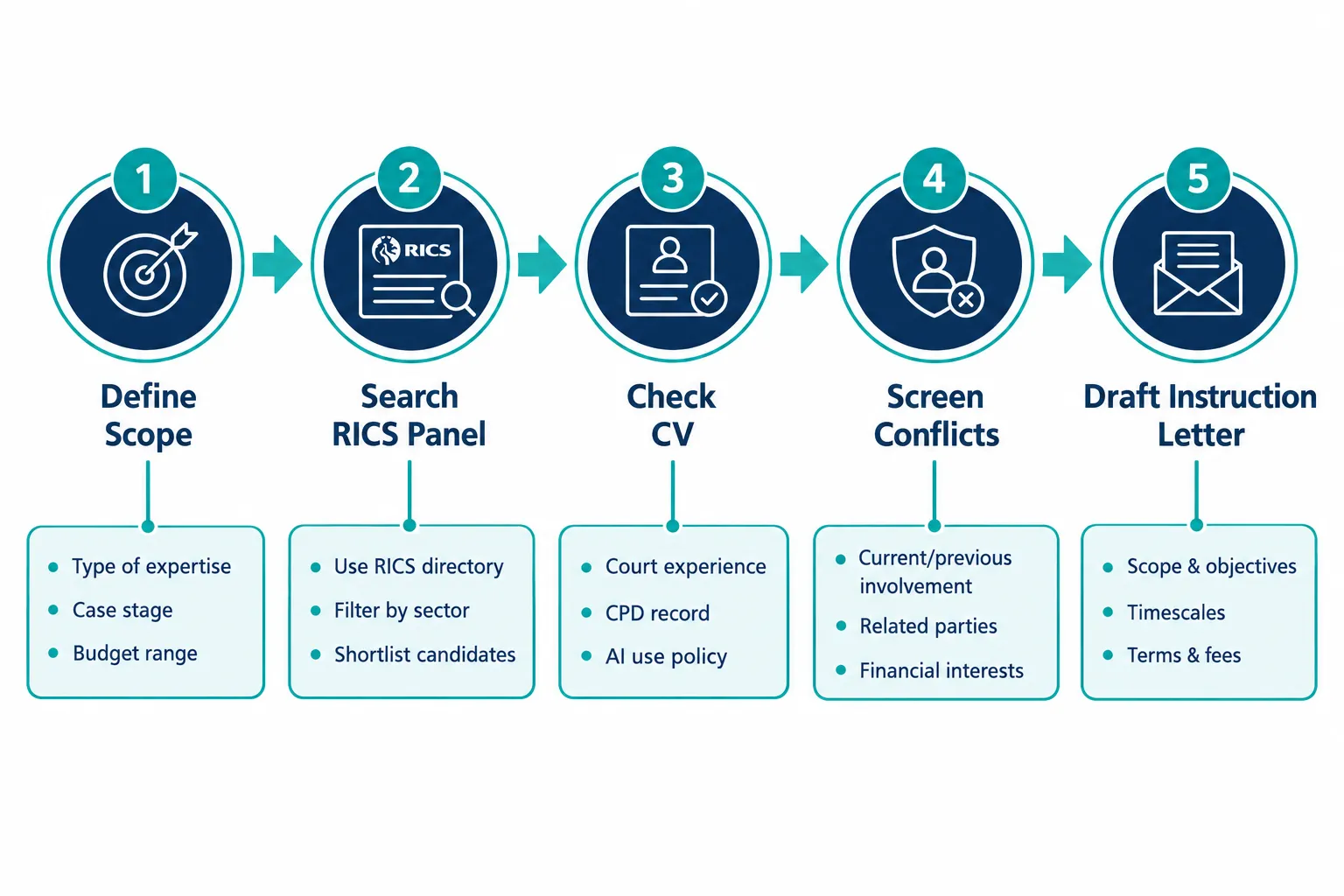
Bringing together the accreditation check, CV review, conflict screening, and instruction letter into a single workflow makes the process manageable. The steps below apply whether the case is before the County Court, the First-tier Tribunal (Property Chamber), or the Upper Tribunal (Lands Chamber).
Step 1, Define the specialism needed. A boundary dispute requires a different expert from a dilapidations claim or a leasehold enfranchisement. Be specific before searching.
Step 2, Search the RICS register. Download the current list of RICS-registered expert witnesses from the RICS website [1][4]. Filter by specialism and geography. Cross-check the shortlisted names against the RICS online member register to confirm current membership status.
Step 3, Request CVs and conflict-screening questionnaires. Send a standard questionnaire (see the conflict questions above) alongside a request for a full CV to at least two candidates. This gives a basis for comparison and a fallback if the first choice has a conflict.
Step 4, Check court experience. Ask each candidate to list cases in which they have given expert evidence in the last five years, including the tribunal or court, the nature of the dispute, and whether they produced a joint statement. A surveyor who has never given oral evidence in a contested hearing may be unsuitable for a complex trial, however strong their technical credentials.
Step 5, Confirm PI insurance. Ask for written confirmation that the expert's professional indemnity policy covers expert witness work and that the level of cover is appropriate for the value of the dispute.
Step 6, Draft and send the instruction letter. Use the checklist above. Do not rely on a generic retainer letter that was drafted for a different type of expert.
Step 7, Review the draft report before exchange. The instructing solicitor is entitled to review the draft report for factual accuracy and to point out matters the expert may have overlooked. The solicitor must not, however, ask the expert to change their opinion. Any request to alter an opinion should be refused and documented.
For cases where the surveyor's existing inspection report forms part of the evidence base, the guidance on building survey evidence and what a qualified building surveyor's credentials should look like is worth reviewing before instruction.
The Expert's Overriding Duty to the Court
No practical guide to finding a property expert witness is complete without a clear statement of the expert's primary obligation. Under CPR Part 35, the expert's duty is to the court, not to the party that instructed and is paying them. This duty overrides any obligation to the instructing party [6].
In property cases, this means the expert must:
- Give their genuine opinion, even if it is unfavourable to the instructing party
- Correct their report if new evidence changes their view
- Produce a joint statement that honestly records areas of agreement and disagreement with the opposing expert
- Not allow the instructing solicitor to edit the substance of their opinions
An expert who departs from these obligations risks being found to have given partisan evidence. Courts have the power to disallow the costs of expert evidence that was not independent, and in serious cases to refer the matter to RICS [5][8].
The Expert Witness Institute has commented that the RICS 5th edition Professional Standard, effective 30 November 2026, strengthens the existing framework rather than replacing it, but that the explicit treatment of AI use and financial dependence represents a meaningful tightening of expectations [10].
FAQ
Q: Can a surveyor act as both a party-wall surveyor and an expert witness in the same dispute?
A: No. The roles are incompatible. A party-wall surveyor acts as a quasi-arbitrator under the Party Wall etc. Act 1996 and owes duties to both owners. An expert witness owes their primary duty to the court. Combining the roles creates an irreconcilable conflict.
Q: Does the expert have to be local to the property?
A: Not as a rule, but local market knowledge matters in valuation disputes. A court may give less weight to a valuation opinion from an expert with no experience of the local market. For boundary disputes, the physical inspection is more important than local knowledge.
Q: What happens if a conflict emerges after the expert has been instructed?
A: The expert must notify the instructing solicitor immediately. Depending on the nature of the conflict, the expert may need to withdraw. Continuing to act with an undisclosed conflict is a serious professional conduct matter.
Q: Can the same expert be used for multiple cases against the same defendant?
A: This is the financial dependence scenario addressed in the 5th edition Professional Standard. If the expert derives a significant proportion of their income from a single instructing party, that dependence must be disclosed to the court [8].
Q: Is an RICS-accredited expert witness always better than a non-accredited one?
A: Accreditation is strong evidence of procedural competence. A non-accredited expert with extensive relevant court experience may still be suitable, but the instructing party should obtain written evidence of that experience and confirm the expert has received equivalent training in CPR Part 35 obligations [7].
Q: What is a joint statement and when is it required?
A: A joint statement (sometimes called a Scott Schedule in construction cases) is a document produced by the experts on each side after exchange of reports. It records matters agreed and matters still in dispute, with reasons. Courts routinely order joint statements in property cases, and judges use them to narrow the issues at trial.
Conclusion
Finding a suitable property expert witness is a structured process, not a matter of asking a trusted surveyor whether they are willing to help. The RICS accredited panel is the correct starting point. A thorough CV check, covering court experience, recent CPD, and AI use policy, filters out candidates who are technically qualified but procedurally unprepared. A written conflict-screening questionnaire, sent before any substantive discussion, protects both the instructing party and the integrity of the proceedings.
The instruction letter ties everything together. It defines scope, confirms independence, sets out fee arrangements, addresses delegation and AI use, and locks in the court timetable. A letter that omits any of these elements creates gaps that opposing counsel will exploit.
The RICS 5th edition Professional Standard, effective 30 November 2026, raises the bar for both experts and the parties who instruct them. Solicitors and litigants who follow the framework set out above, panel search, CV check, conflict screen, instruction letter, will be well placed to meet that standard and to present expert evidence that withstands scrutiny at trial.
For cases where the underlying dispute involves a surveyor's report, the guidance on surveyor's report red flags and findings that require action may also be relevant to the evidence base.
References
[1] List Of Rics Registered Expert Witnesses September 2025 – rics.org
[4] List Of Rics Registered Expert Witnesses March 2025 – rics.org
[5] Surveyors Acting As Expert Witnesses Client Guide – rics.org
[6] Surveyors Acting As Expert Witnesses Feb2023amend – rics.org
[7] Expert Witness Accreditation Service – rics.org
[8] RICS 2026 Expert Witness Guidance Key Changes For Surveyors – rimkus.com
[9] AI Expert Witness – ww3.rics.org
[10] EWI Commentary On The RICS Professional Standard And Practice Guidance – ewi.org.uk