Most buyers and landlords receive a valuation figure without any clear explanation of how it was reached. Understanding what does a property valuation include in the UK, the evidence gathered, the assumptions made, and the limitations accepted, puts you in a far stronger position, whether you are buying, selling, refinancing or resolving a dispute.
This article sets out exactly what a RICS-compliant valuation report must contain, why certain assumptions are built in by default, and where the boundaries of the valuer's duty lie.
Key Takeaways
- A RICS valuation report must state the basis of value, the valuation date, the method used, and the property's tenure and key characteristics.
- Comparable sales evidence is the primary tool in residential valuations, but valuers must explain how they selected and adjusted each comparable.
- Assumptions are formally defined conditions the valuer accepts without verification; special assumptions are explicitly hypothetical and must be flagged clearly.
- Inspection limitations, such as not opening up concealed areas or testing services, are agreed in advance and recorded in the report.
- ESG factors, fire-safety cladding evidence and leasehold-term assumptions are all subject to updated RICS standards taking effect in 2026.
The Core Components of a UK Property Valuation Report
A RICS valuation report is not simply a number on a page. It is a structured professional document governed by the RICS Valuation, Professional Standards (the Red Book), and it must contain several defined elements before it can be relied upon by lenders, solicitors, courts or tax authorities [1].
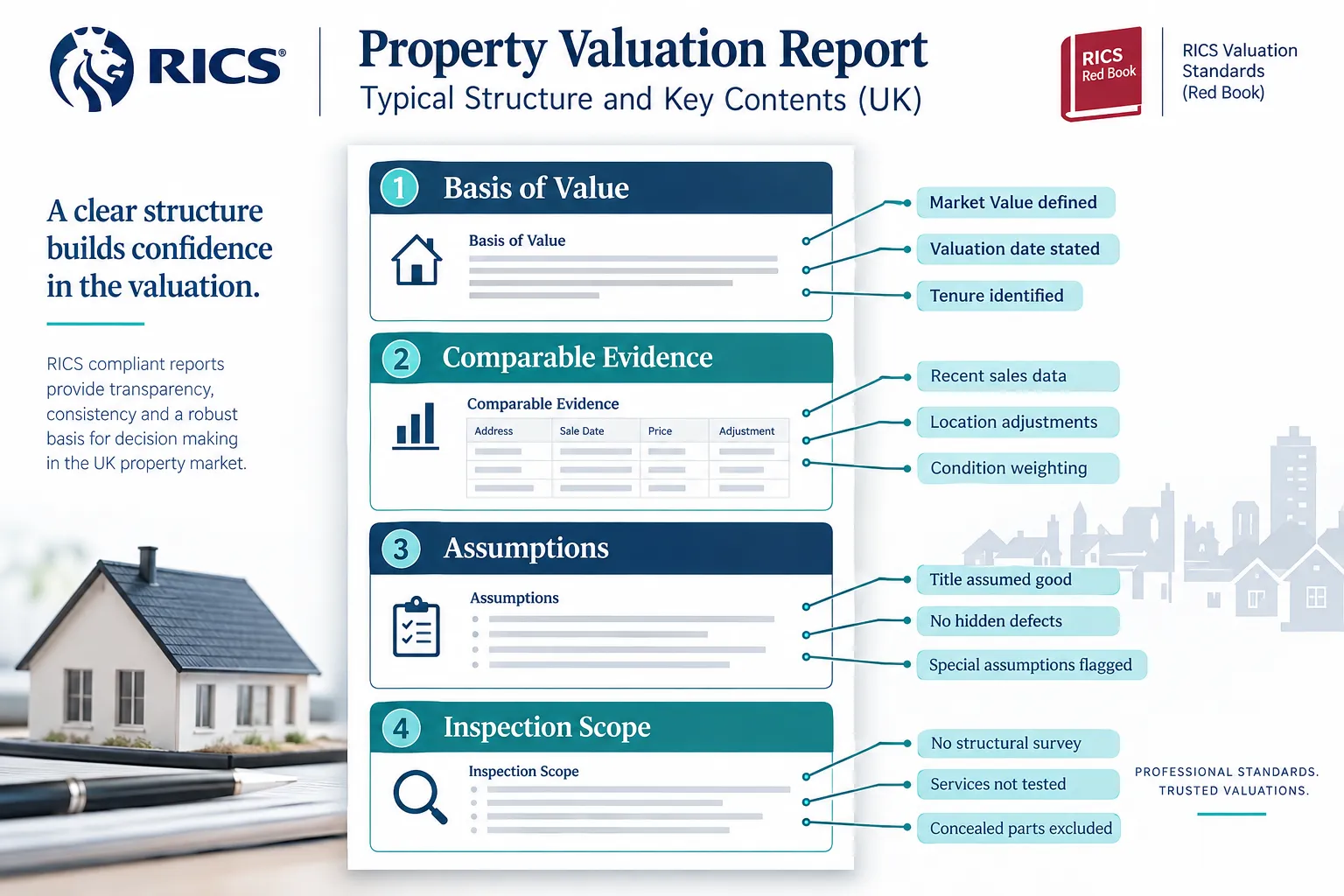
Identification of the property and interest being valued
The report must identify the property precisely, address, title number where available, and the nature of the legal interest. A freehold house, a long-leasehold flat and a short-leasehold commercial unit each require different treatment, and the valuation must state which interest is being assessed [9].
Basis of value
The most common basis for UK residential and secured lending work is Market Value, the estimated amount for which an asset should exchange on the valuation date between a willing buyer and a willing seller in an arm's-length transaction [1]. Other bases, such as Market Rent or Fair Value for financial reporting, must be named explicitly. Using the wrong basis is a source of professional negligence claims; see our guide to surveyor negligence and how to prove it for more detail.
Valuation date
Market conditions change. The report must state the date to which the opinion of value applies. A valuation prepared in January 2026 cannot be relied upon as current in July 2026 without confirmation from the valuer [9].
Valuation method and approach
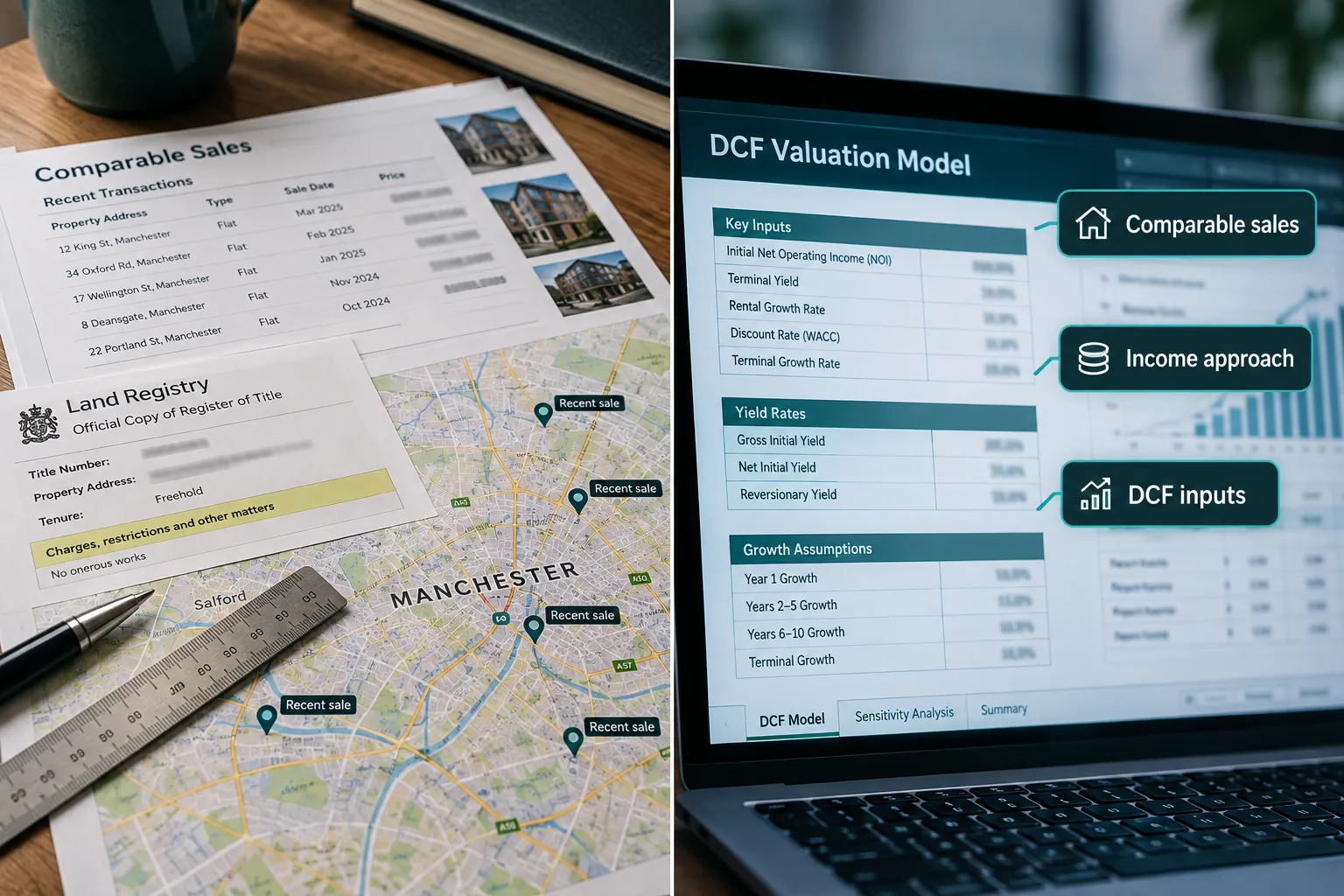
The report must identify the method used, comparables (sales comparison), income capitalisation, discounted cash flow (DCF) or depreciated replacement cost (DRC), and explain why that method is appropriate for the property and purpose [1][4]. Where a DCF model is used, the RICS response to the IVS 2026 exposure draft stresses that key inputs such as yields, growth rates and void allowances must be disclosed, along with any limitations on the model's outputs [4].
Extent of inspection
The valuer must state what was inspected and on what date. This is distinct from a building survey; a valuation inspection is visual and non-intrusive. Our RICS HomeBuyer Survey Level 2 guide explains the difference between a valuation and a condition survey in plain terms.
How Comparable Evidence Works in Residential Valuations
The comparable sales method is the standard approach for residential property in the UK. The valuer identifies recent transactions of similar properties, analyses the differences, and adjusts to arrive at an opinion of value for the subject property [6].
What makes a comparable usable?
RICS guidance on residential valuations requires the valuer to explain how comparables were selected and how adjustments were made for differences in location, property type, size, condition and market trends [6]. A sale from eighteen months ago in a rising market is a weaker comparable than one from last month; the valuer must apply a time adjustment and state it.
Recent RICS commentary on market conditions stresses heavier weighting of very recent transactions, in stabilising markets with regional variation in price growth, older evidence can mislead if it is not adjusted [6].
Adjustments the valuer makes
| Factor | Typical adjustment direction |
|---|---|
| Better location than subject | Downward adjustment to comparable |
| Larger floor area than subject | Downward adjustment to comparable |
| Superior condition | Downward adjustment to comparable |
| More recent sale in rising market | Upward adjustment to older comparable |
| Leasehold vs freehold | Separate analysis required |
Sources of comparable data
Valuers draw on Land Registry registered sales, estate agent evidence, auction results and, for commercial property, lease transactions. The report must state which sources were used [9]. For secured lending, the Bank of England's Basel 3.1 implementation rules (PS1/26) confirm that lenders should continue to rely on professional Market Value assessments grounded in transparent, well-documented evidence [10].
Commercial and investment property
For income-producing assets, the valuer analyses passing rent, estimated rental value, lease terms, voids and yield. Where a DCF approach is used, the report must disclose the discount rate, growth assumptions and the sensitivity of the output to those inputs [4]. Our page on RICS valuations and RICS valuers covers the range of valuation types available.
Assumptions, Special Assumptions and Limitations in a UK Valuation
This is the section of a valuation report that buyers and solicitors most often overlook, and it is the section that most directly affects how much weight can be placed on the figure given.
What is an assumption?
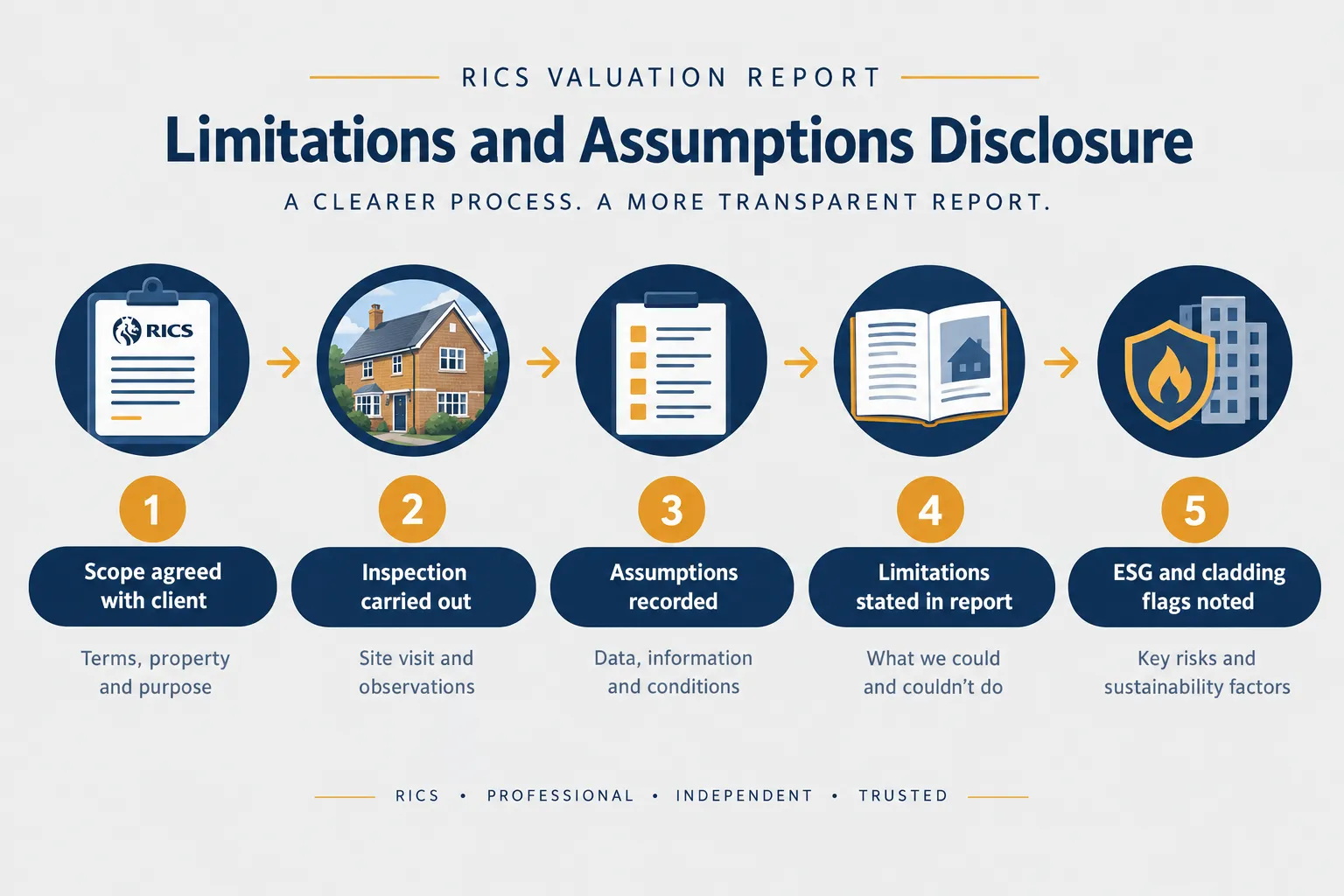
RICS defines an assumption as a supposition taken to be true that involves facts, conditions or situations affecting the subject or approach to valuation, which by agreement do not need to be verified by the valuer [9]. Standard assumptions in most UK residential valuations include:
- Good and marketable title, free from unduly onerous covenants
- No undisclosed contamination or hazardous materials on or near the site
- The property has been adequately maintained
- Planning permissions and building regulations consents are in place for any works carried out
- No structural defects beyond those visible on inspection
These are not guarantees. They are professional shorthand for conditions that are assumed to be true unless the valuer has been told otherwise.
What is a special assumption?
A special assumption is explicitly hypothetical, it assumes a condition that does not currently exist [9]. Examples include:
- Vacant possession, where the property is actually tenanted
- Planning consent granted for a development that has not yet been approved
- A lease extension completed, where the tenant has only just served notice
Special assumptions must be clearly identified, agreed with the client in advance, and justified in the report. A valuation based on an undisclosed special assumption is unreliable and potentially misleading [9].
Leasehold term assumptions
RICS and isurv valuation standards have recently updated the default assumption for unexpired leasehold term from 70 years to 85 years in relevant guidance [8]. This matters because the assumed remaining term affects the value of a leasehold flat directly. Valuers must disclose when this standardised assumption is applied and consider whether it is appropriate for the specific property [8]. For matrimonial or probate purposes, the assumed term can be critical; see our page on matrimonial valuations for context.
Inspection limitations
The RICS valuation report framework is explicit: to deliver advice within reasonable time and cost, limitations on inspection and due diligence are agreed in advance and recorded in the report [9]. Standard limitations include:
- The valuer does not carry out a structural survey
- Concealed parts of the structure are not opened up
- Building services (heating, electrics, drainage) are not tested
- The valuer relies on information supplied by the client or publicly available sources
This does not mean the valuer ignores obvious defects. Visible signs of damp, cracking or deterioration must be noted and reflected in the value. For a deeper look at what physical evidence a surveyor records, our building survey evidence tag collects relevant guidance.
ESG and sustainability assumptions
The fourth edition of the RICS global professional standard on ESG and sustainability in commercial property valuation, effective from 30 April 2026, requires valuers to identify when ESG factors are significant enough to affect value and to disclose the basis of any ESG-related assumptions in the report [3]. This includes cost assumptions for energy-efficiency upgrades and operational expenditure. Our article on sustainability ratings and commercial property value covers how EPC and BREEAM ratings feed into this analysis.
Fire safety and cladding
RICS published its second edition standard for multi-storey, multi-occupancy residential buildings with cladding in May 2026, effective from 1 November 2026 [7]. The standard sets proportionate criteria for when an EWS1 form should be requested, based on building height, cladding type, curtain wall glazing and balcony configurations. Where an EWS1 form is unavailable, the valuer must document the rationale and explain the resulting limitation on the valuation [7]. Buyers of flats in affected buildings should ask their valuer directly whether an EWS1 has been requested and what assumption has been made in its absence.
Public sector DRC valuations
For public sector financial reporting using the depreciated replacement cost method, HM Treasury has prohibited alternative-site assumptions, with mandatory application from financial years commencing 2028/29 and early adoption permitted from 2026/27 [2]. Valuation reports for public sector assets must now state explicitly that no alternative lower-value site assumption has been applied [2].
AI, Automated Valuation Models and Professional Judgement
Automated valuation models (AVMs) are increasingly used by UK mortgage lenders as a first-pass tool. RICS standards make clear that AI tools and AVMs must not replace professional judgement and must be used within the Red Book framework [5]. Where an AVM is used, confidence levels, model coverage limitations and governance arrangements must be disclosed, the same transparency requirements that apply to any other valuation input [5].
A RICS-qualified valuer remains responsible for the final opinion of value. The model is an input, not the answer.
When a Valuation Is Disputed
Disputes over property value arise in matrimonial proceedings, probate, lease extensions, compulsory purchase and negligence claims. In those contexts, the assumptions and limitations recorded in the original valuation report become central evidence. A valuation that failed to disclose a special assumption, or that relied on unadjusted comparables, may be challenged on those grounds. Our valuation dispute expert witness service covers how RICS-qualified expert witnesses approach these cases.
Frequently Asked Questions
Does a mortgage valuation protect the buyer?
No. A mortgage valuation is carried out for the lender's benefit, not the buyer's. It confirms the property is adequate security for the loan. It does not assess condition in detail. Buyers should commission a separate Level 2 or Level 3 survey.
What is the difference between an assumption and a limitation?
An assumption is a condition accepted as true without verification (e.g. good title). A limitation is a restriction on what the valuer has done (e.g. services not tested). Both must be stated in the report.
Can I ask the valuer to remove a limiting condition?
Sometimes. If you can provide additional information, such as a structural engineer's report or a drainage survey, the valuer may be able to remove the related assumption or limitation. This should be agreed before the valuation is finalised.
What happens if an assumption proves incorrect after exchange?
If a material assumption turns out to be wrong, for example, the title has an onerous covenant that was not disclosed, the valuation may no longer be reliable. Legal advice should be sought immediately.
Does a valuation include reinstatement cost for insurance purposes?
Not automatically. Market value and reinstatement cost are different figures. A separate reinstatement assessment is needed for buildings insurance. See our page on reinstatement valuation for more detail.
How recent must comparable evidence be?
RICS guidance does not set a fixed period, but valuers are expected to weight very recent transactions most heavily and to apply time adjustments to older evidence, particularly in markets with significant price movement [6].
Conclusion
A property valuation is only as reliable as the evidence, assumptions and limitations that underpin it. Knowing what does a property valuation include in the UK, from the stated basis of value and comparable evidence through to the assumptions baked in by default and the inspection scope agreed in advance, allows buyers, landlords and legal advisers to read the report critically rather than accept the headline figure at face value.
If you receive a valuation report, read the assumptions and limitations section before the figure. Ask whether any special assumptions have been made. Check whether ESG or fire-safety factors have been addressed if the property is commercial or a multi-storey flat. And if the figure is being used in a legal dispute, instruct a RICS-qualified expert witness who can assess whether the original valuation met the required standard.
For a full explanation of valuation costs or to discuss a specific valuation requirement, speak to a RICS-registered valuer directly.
References
[1] Valuation Standards – rics.org
[2] DRC Method of Valuation for Financial Reporting 1st Edition RICS – rics.org
[3] RICS Publishes Updated Global Standard ESG Sustainability Commercial Property Valuation – rics.org
[4] Finalised IVS Consultation Response – rics.org
[5] Profession Standards – rics.org
[6] Residential Valuations – rics.org
[7] RICS Publishes Updated Standard for Multi Storey Residential Buildings with Cladding – rics.org
[8] Valuation Standards – isurv.com
[9] Valuation Report Framework – rics.org
[10] RICS Update on the PRA/BoE Final Rules on the Implementation of Basel 3.1 in the UK – rics.org