A property valuation report can determine whether a mortgage is approved, a probate estate is settled correctly, or a dispute is won or lost in court. Yet most clients receive the document, scan the headline figure, and file it away without reading the sections that explain how that figure was reached, and under what conditions it holds.
Knowing how to read a property valuation report, market value, comparables and special assumptions included, turns a technical document into a practical decision-making tool.
Key Takeaways
- Market value is a precisely defined legal concept; the reported figure only holds under the exact conditions and assumptions stated in the report.
- Special assumptions can materially change the valuation figure compared with the property's actual current state, always read them before relying on any number.
- Comparables are the evidential backbone of a valuation; checking their recency, similarity and adjustments tells you how well-supported the figure is.
- RICS Red Book standards require every assumption and special assumption to be agreed in writing with the client and disclosed in full within the report.
- If the reported value surprises you, the comparables grid and the assumptions section are the first places to look for an explanation.
What a Property Valuation Report Actually Contains
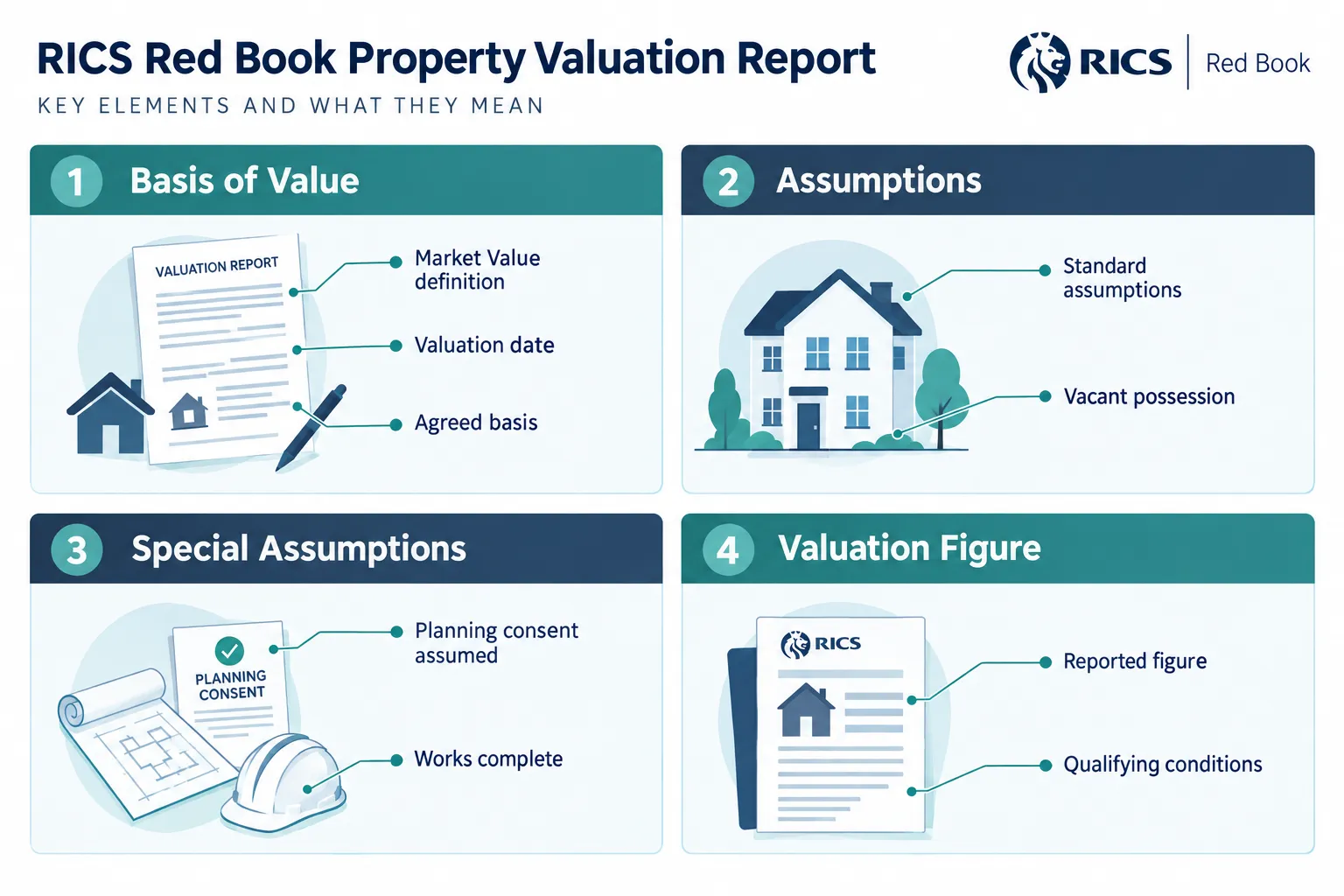
The structure of a RICS-compliant valuation report follows the framework set out in the Red Book Global Standards, which incorporate the International Valuation Standards. The report must state the basis of value, the valuation date, the identity of the property, the purpose of the valuation, and any assumptions or special assumptions that apply [5].
Most residential and commercial valuation reports in the UK open with an executive summary that states the headline figure. Do not stop there. The executive summary is a digest; the substantive content sits in the body sections that follow.
The main sections you will find in a standard Red Book report:
| Section | What it contains |
|---|---|
| Instructions and scope | Who instructed the valuer, for what purpose, and on what terms |
| Basis of value | The definition of market value (or other basis) being applied |
| Valuation date | The date on which the value is assessed, not the report issue date |
| Property description | Physical details, tenure, planning use, condition observations |
| Assumptions | Standard conditions taken as given without verification |
| Special assumptions | Departures from actual facts, must be agreed in writing [2][5] |
| Market evidence / comparables | The sales or lettings data used to support the figure |
| Valuation | The reported figure, qualified by all of the above |
| Limitations and caveats | Restrictions on reliance, scope exclusions |
The valuation date matters enormously. A report dated six months ago reflects market conditions at that time. If you are using the report for a mortgage application, a tax return, or litigation, confirm that the valuation date is appropriate for your purpose.
For a plain-English explanation of what a Red Book valuation involves before you instruct one, see this guide to Red Book Valuation in Manchester from RICS Valuers.
Understanding Market Value: The Definition That Drives the Number
Market value is not an opinion or an estimate in the colloquial sense. It is a defined legal concept. The Red Book defines it as the estimated amount for which an asset or liability should exchange on the valuation date between a willing buyer and a willing seller in an arm's length transaction, after proper marketing, where the parties had each acted knowledgeably, prudently and without compulsion [5].
Every word in that definition carries weight:
- Willing buyer and willing seller, neither party is under duress.
- Arm's length, no special relationship between the parties.
- Proper marketing, the property has been adequately exposed to the market.
- Knowledgeably and prudently, both parties understand the asset.
- Without compulsion, no forced sale.
If any of those conditions is absent in reality, the valuer may still report market value, but they must state the assumptions they have made to satisfy the definition. That is where assumptions and special assumptions become critical.
The RICS Valuation Report Framework confirms that the basis of value must be clearly stated in the report, together with the valuation date and key parameters, so that the reader knows exactly what type of value is being reported [1][3].
Why this matters for your decision:
- For a mortgage, the lender needs market value on the basis that the property could be sold in the open market. If the report contains a special assumption (for example, that planning consent has been obtained when it has not), the lender may not accept the figure for lending purposes.
- For probate, HMRC requires market value at the date of death. A report prepared for a different date or purpose cannot simply be repurposed.
- For litigation or expert witness use, the court will scrutinise whether the valuer has applied the correct basis and whether assumptions are disclosed and justified.
How to Read the Comparables Section
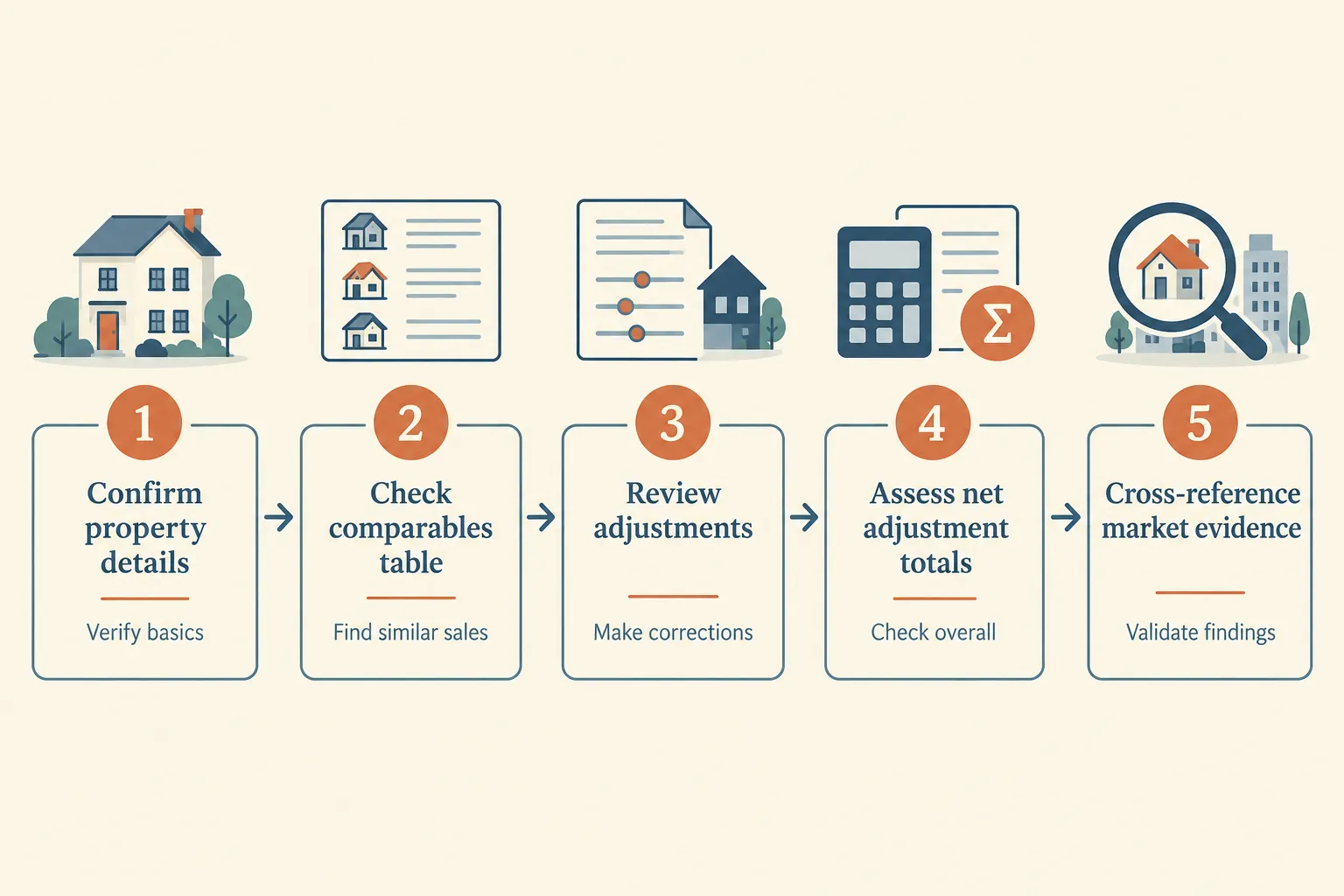
Comparables, often called "comps", are the sales or letting transactions the valuer has used as market evidence to support the reported figure. They are the factual backbone of any market value assessment.
A well-prepared report presents comparables in a grid or table that allows direct comparison between the subject property and each comparable sale. Standard columns include address, sale date, sale price, floor area, price per square foot or square metre, tenure, condition, and any adjustments applied.
What to check in the comparables table:
- Recency, Comparables should be as recent as practicable. In an active market, sales more than twelve months old carry less weight. Where the market has moved sharply, even six-month-old data may need adjustment.
- Similarity, Each comparable should share key characteristics with the subject: property type, size, tenure, location, and condition. A Victorian terrace in Salford is not a reliable comparable for a new-build apartment in Ancoats.
- Number of comparables, Three is a common minimum, but a well-supported report will typically present more, particularly where the market is thin or the property is unusual.
- Adjustments, Where a comparable differs from the subject (in size, condition, or location), the valuer applies adjustments to bring the comparable's price into line. These adjustments should be explained, not just stated as figures.
- Net adjustment totals, The net adjustment for each comparable shows how much the sale price has been moved up or down to reflect differences. Large net adjustments, say, more than 15-20% of the sale price, suggest the comparable is not very similar and should be treated with caution.
- Verification sources, The report should state where the comparable data came from: Land Registry, EPC register, agent confirmation, or the valuer's own inspection records.
For a deeper look at how adjustments to comparables affect the reported figure, the comparable adjustments tag collects relevant articles on that topic.
If you are reviewing a report in a market that has been falling, note whether the comparables pre-date the decline. A valuer working in a softening market should be selecting the most recent evidence and, where necessary, making downward adjustments to older sales. The article on independent property valuations in a cooling UK market explains why impartial evidence selection matters in those conditions.
Special Assumptions: The Section Most Readers Skip
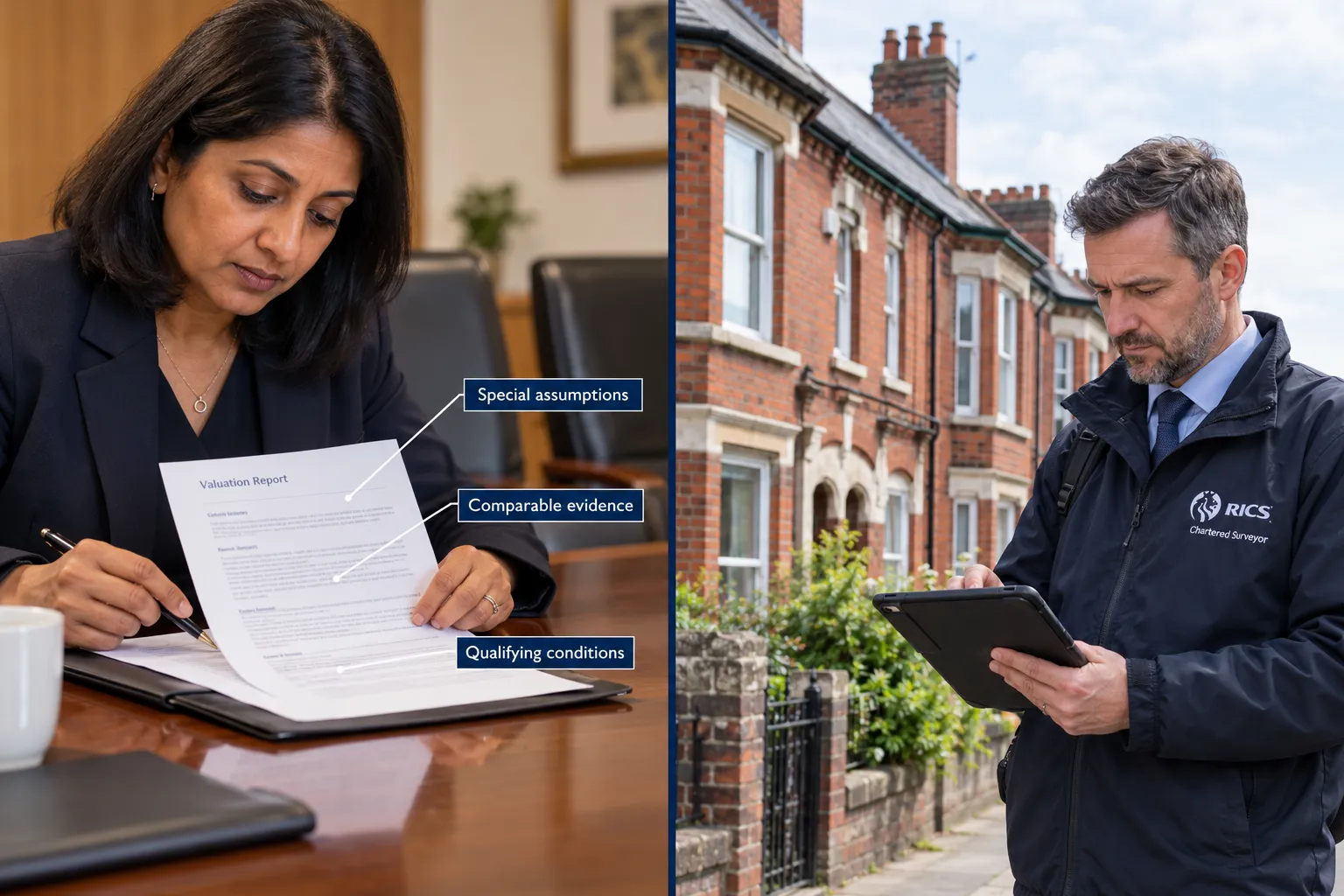
Special assumptions are the most consequential and most frequently misunderstood part of a valuation report. The Red Book defines a special assumption as one that either departs from the actual facts at the valuation date or would not typically be made by market participants [2][5].
In plain terms: a special assumption asks the valuer to value the property as if something were true that is not currently true.
Common special assumptions in UK practice:
- Vacant possession, The property is valued as if it were empty, even though it is occupied by a tenant. This typically produces a higher figure than the tenanted value.
- Planning consent obtained, The property is valued as if planning permission has been granted, when in reality the application has not yet been determined.
- Building works complete, The property is valued as if a refurbishment or development is finished, when it is still in progress. RICS guidance on development property confirms that any departure from the assumption of optimum development must be identified as a special assumption [8].
- No contamination, The property is valued as if free from contamination, pending a full environmental survey.
- Lease renewal assumed, The property is valued as if a lease renewal has been agreed, when negotiations are ongoing.
The Red Book is explicit: any special assumption must be agreed with the client in writing before the report is issued and must be fully disclosed in the report, both in the main valuation conclusion and in any executive summary [3][5][6]. If you find a special assumption buried in the body of the report but absent from the executive summary, that is a reporting deficiency worth querying.
Why special assumptions change the number:
A property valued with vacant possession may be worth 20-30% more than the same property valued subject to an existing tenancy, depending on the lease terms. A site valued on the assumption that planning consent has been obtained may be worth several multiples of its value without consent. The reported figure is only valid under the stated assumption, it does not represent what the property would fetch today in its actual condition and legal state.
If you are a buyer, lender, or solicitor relying on a valuation report, always confirm:
- Is there a special assumption?
- Has it been agreed in writing between the valuer and the instructing party?
- Does the purpose for which you are using the report require the value with or without that assumption?
If the reported figure seems surprisingly high or low, the special assumptions section is the first place to look. If you believe the figure is wrong, the process for challenging it is set out in this guide on how to challenge a surveyor's valuation.
Applying the Report to Your Specific Purpose
Different purposes require different readings of the same document.
Purchase and mortgage
A lender's mortgage valuation is prepared for the lender, not the buyer. The buyer has no right of reliance unless the terms of engagement say otherwise. If you are buying, commission a separate RICS valuation or building survey for your own protection. Check that the comparables are drawn from the same market area and that no special assumption inflates the figure above what the property is actually worth in its current state.
Probate and inheritance tax
HMRC expects market value at the date of death, on the basis of an arm's length sale with no special assumptions unless the estate's circumstances require them. If the property was tenanted at the date of death, the valuation should reflect that, a vacant possession assumption would overstate the value and produce an incorrect tax liability.
Matrimonial proceedings
Courts require a single joint expert or two separate valuers, each reporting on market value at the agreed date. Special assumptions about future development or planning are generally inappropriate unless both parties have agreed them. See the guidance on matrimonial valuations for the specific requirements in those proceedings.
Shared ownership and right to buy
These valuations follow prescribed bases set by the relevant housing association or local authority. Special assumptions about the staircasing percentage or the discount entitlement must be clearly stated. Relevant guidance is available on valuation of shared ownership and right to buy valuation.
Expert witness and dispute resolution
A valuation used as expert witness evidence must comply with CPR Part 35 and Practice Direction 35. The court will examine whether the comparables are disclosed, whether adjustments are reasoned, and whether any special assumptions are justified. An overview of when a valuation surveyor is the right expert is available in this guide on expert witness surveyor versus structural engineer.
Frequently Asked Questions
What is the difference between an assumption and a special assumption?
A standard assumption is a condition the valuer takes as given because it is reasonable and consistent with what a market participant would expect, for example, that the title is good and marketable. A special assumption departs from actual facts or from what market participants would ordinarily assume. Special assumptions must be agreed in writing and disclosed in full [2][5].
Can I rely on a valuation report prepared for someone else?
Generally, no. Valuation reports are addressed to the instructing party. Reliance by a third party requires either a duty of care letter or a separate instruction. Using a lender's mortgage valuation as your own buying decision tool carries risk.
How recent do comparables need to be?
There is no fixed rule, but RICS guidance and standard practice favour comparables from the preceding twelve months where available, and from the preceding ninety days where the market has moved quickly. The valuer should explain any use of older evidence.
What does "subject to" mean in a valuation report?
It means the reported figure is conditional. "Subject to vacant possession" means the value assumes the property is empty. "Subject to planning" means the value assumes consent has been granted. The value without those conditions may be materially different.
What should I do if the comparables seem wrong?
Note the addresses and sale dates, check them against Land Registry records, and raise specific queries with the valuer in writing. If you remain dissatisfied, the RICS complaints and appeals process provides a formal route for challenge.
Does a desktop valuation carry the same weight as a full Red Book report?
No. A desktop valuation is prepared without physical inspection and relies on secondary data sources. It carries more limitations and caveats. The differences are explained in this article on desktop house valuations.
Conclusion
A property valuation report is not simply a number on a page. It is a structured professional opinion, valid only under the conditions, assumptions, and special assumptions the valuer has stated. Reading the report properly, checking the basis of value, the valuation date, the quality and recency of comparables, and the precise wording of any special assumptions, is the difference between using the document correctly and making decisions based on a figure that may not reflect the property's actual current worth.
Practical next steps:
- Read the assumptions and special assumptions sections before you read the headline figure.
- Cross-check the comparables against publicly available Land Registry data to confirm the sales are real and recent.
- Confirm the valuation date is appropriate for your specific purpose, purchase, tax, probate, or litigation.
- If the report contains a special assumption, ask whether your purpose requires the value with or without it.
- If you are unsure whether the report is fit for purpose, instruct a RICS Registered Valuer to review it or prepare a fresh report under the correct terms of engagement.
References
[1] Valuation Report Framework 2025 – rics.org
[2] 2021 11 25 Rics Valuation Global Standards Effective 2022 – rics.org
[3] Valuation Report Framework – rics.org
[4] Terms Of Engagement Framework – rics.org
[5] Red Book Global Standards Incorporating Ivs – rics.org
[6] 2022 03 04 P Alert Supplement Nlc – rics.org
[8] Valuation Of Development Property First Edition – rics.org