
The UK property market in 2026 presents a fascinating paradox: while regional disparities have never been more pronounced, cautious optimism is finally returning to the historically volatile London and South East markets. Valuing Stabilizing Southern Properties in 2026: RICS Adjustments for London and South East Laggards has become a critical competency for chartered surveyors navigating this complex landscape. Southern properties currently command premiums of 150-200% over comparable Northern stock, yet buyer confidence in these premium markets remains fragile [1]. Understanding the Royal Institution of Chartered Surveyors (RICS) adjustments and methodologies for these "laggard" markets is essential for accurate valuations in 2026.

Key Takeaways
- 🏘️ Regional price gaps are extreme: Southern properties command 150-200% premiums over Northern equivalents, creating significant valuation challenges for surveyors in 2026
- 📊 London and South East lag nationally: These regions show more negative net balances for buyer enquiries and sales than the UK average, though improvement trends are emerging
- 📋 New RICS protocols launched: The "Evergreen RICS Valuation Methods for Stabilising London Flats: 2026 Market Protocols" provide critical frameworks for navigating current conditions
- 🌱 ESG standards now mandatory: Updated sustainability requirements effective April 2026 impact commercial property valuations across London and the South East
- 📈 Supply constraints persist: With -28% net balance on new listings, rental price expectations have surged to +28%, fundamentally affecting investment valuations
Understanding Regional Property Valuation Disparities in 2026
The geographical divide in UK property values has reached unprecedented levels in 2026, fundamentally reshaping how chartered surveyors across London approach their work. The stark reality is that comparable properties—similar in size, age, and condition—can vary by 150-200% in value simply based on their postcode [1].
The North-South Price Premium
This dramatic price differential reflects decades of economic concentration in the South East, but 2026 marks a critical inflection point. While Northern markets have shown resilience and steady growth, London and surrounding regions have experienced volatility that demands specialized valuation approaches.
Key factors driving the premium include:
- Employment concentration: Financial services, technology, and professional services sectors remain heavily concentrated in London and the South East
- International investment: Foreign buyers continue to view London property as a safe haven asset despite market fluctuations
- Infrastructure advantages: Transport links, educational institutions, and cultural amenities command significant premiums
- Historical appreciation: Long-term capital growth expectations persist despite short-term market caution
For property professionals working in South East London, South West London, and Central London, these premiums create both opportunities and valuation complexities.
Regional Performance Metrics
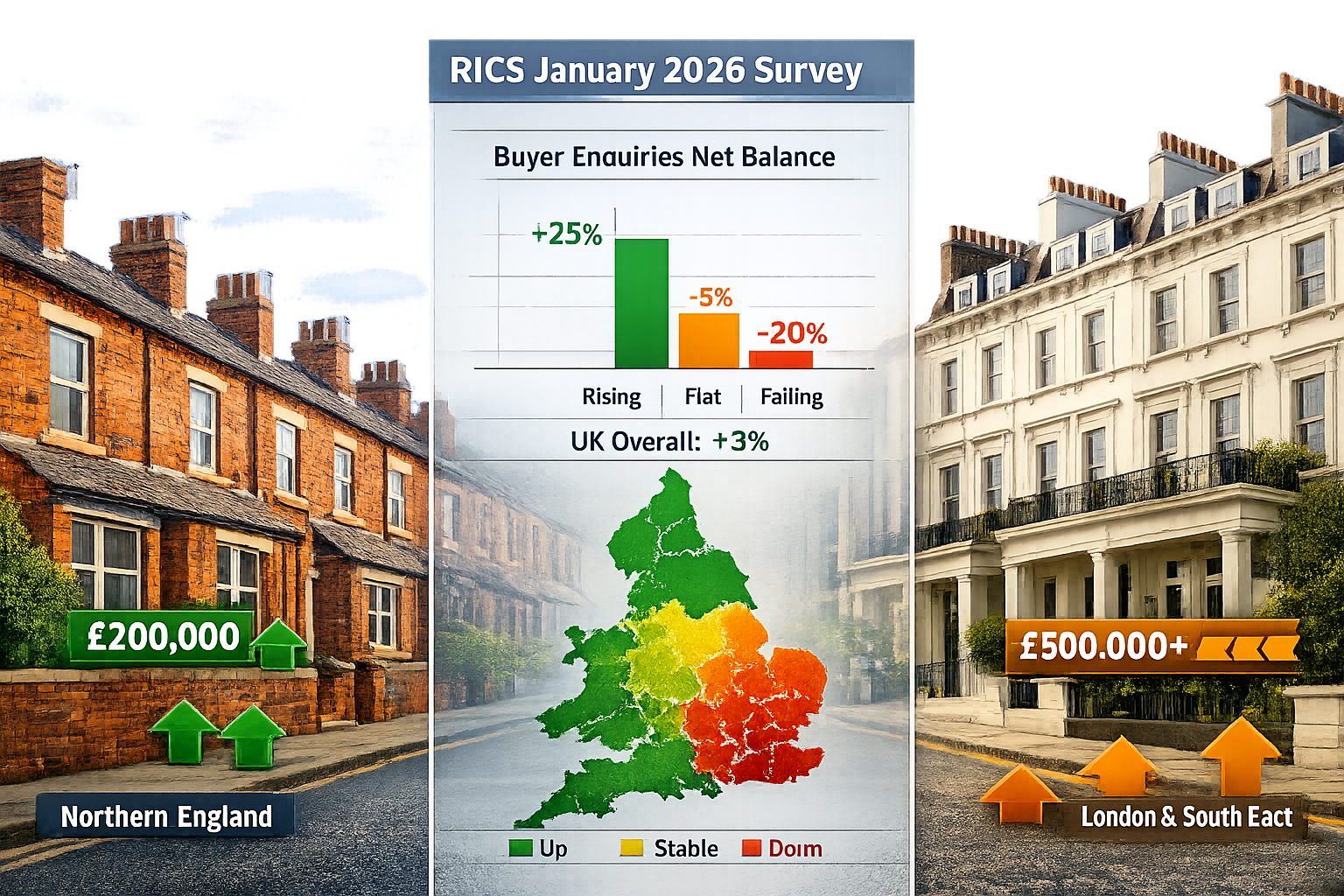
The January 2026 RICS Residential Market Survey provides crucial insights into regional variations. London, South West, South East, and East Anglia all recorded more negative net balances than the national headline average for both buyer enquiries and sales activity [2]. However, these readings showed improvement from previous months, suggesting stabilization rather than continued decline.
| Region | Buyer Enquiries Net Balance | Sales Activity Net Balance | Market Sentiment |
|---|---|---|---|
| London | -42% | -38% | Cautiously improving |
| South East | -35% | -31% | Stabilizing |
| South West | -29% | -27% | Gradual recovery |
| National Average | -24% | -22% | Moderately positive |
This data underscores why Valuing Stabilizing Southern Properties in 2026: RICS Adjustments for London and South East Laggards requires nuanced understanding of local market dynamics rather than relying solely on national trends.
RICS Valuation Adjustments for Stabilizing Southern Markets
The Royal Institution of Chartered Surveyors has responded to these unique market conditions with updated methodologies specifically designed for the challenges of 2026. Valuing Stabilizing Southern Properties in 2026: RICS Adjustments for London and South East Laggards encompasses several critical frameworks that professional surveyors must now implement.
The Evergreen RICS Valuation Methods for London Flats
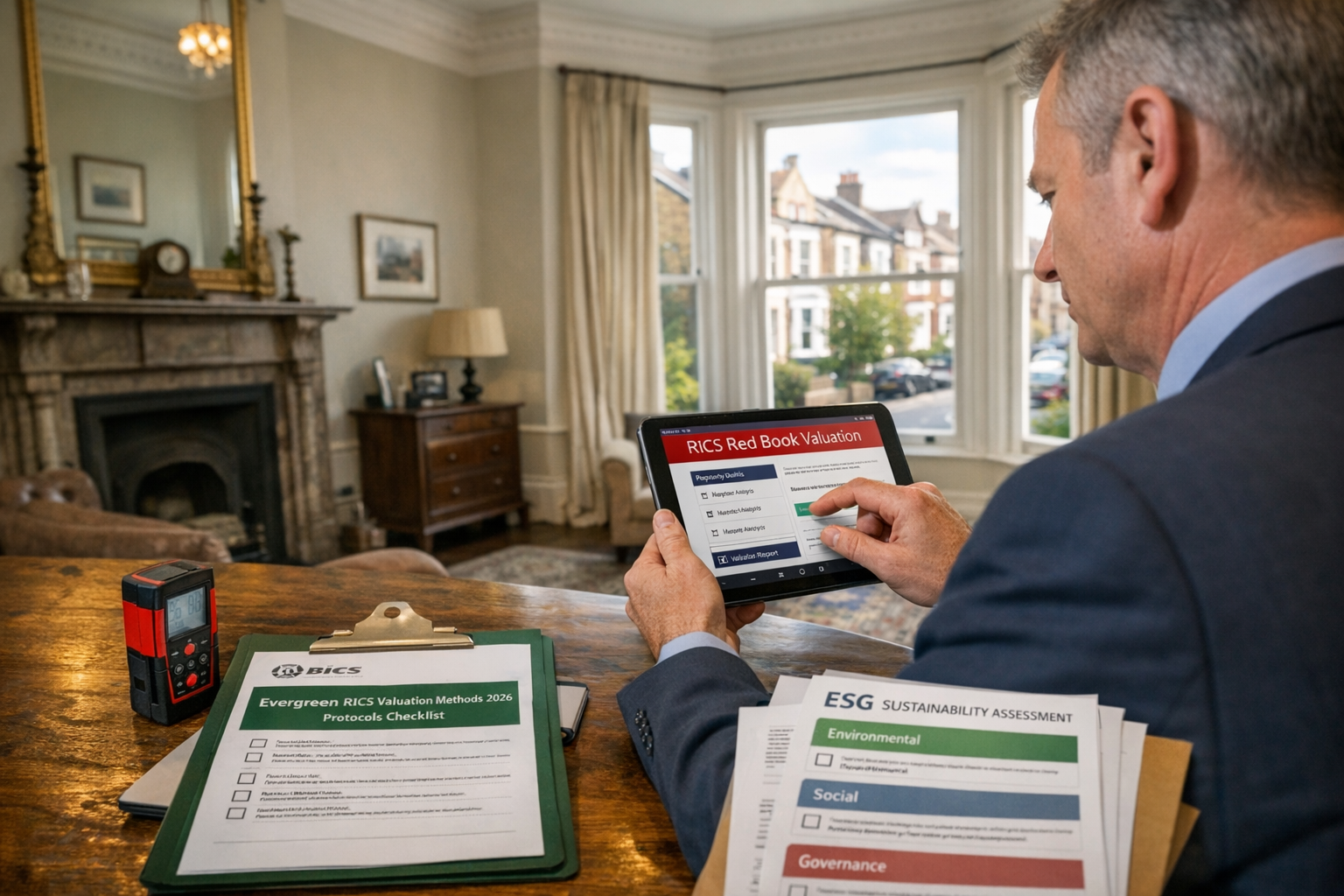
RICS introduced the "Evergreen RICS Valuation Methods for Stabilising London Flats: 2026 Market Protocols" as a critical framework for navigating current market conditions [3]. This protocol addresses the specific challenges of valuing flats in a market characterized by:
- Leasehold complexities: Remaining lease terms, ground rent obligations, and service charge volatility
- Building safety considerations: Post-Grenfell cladding issues and EWS1 certification requirements
- Market sentiment shifts: Changing preferences for space, outdoor areas, and location following pandemic-driven lifestyle changes
The Evergreen protocols emphasize dynamic adjustment factors that account for:
- Lease length degradation curves: More sophisticated modeling of how lease terms below 80 years impact value
- Building certification premiums: Quantifying the value impact of proper fire safety documentation
- Amenity weighting: Adjusting for outdoor space, parking, and home office suitability in post-pandemic valuations
- Management company quality: Assessing the financial health and reputation of residential management organizations
Red Book Compliance in Uncertain Markets
RICS valuations must adhere to the Red Book standards, which have been updated to address 2026's market conditions. For properties in stabilizing Southern markets, surveyors must pay particular attention to:
Market Value vs. Investment Value: In uncertain markets, the distinction becomes crucial. Market value reflects what a typical buyer would pay, while investment value considers a specific investor's requirements and circumstances.
Assumptions and Special Assumptions: Given market volatility, clearly stating assumptions about market conditions, buyer behavior, and future trends is essential for defensible valuations.
Uncertainty and Material Uncertainty Clauses: When market evidence is limited or contradictory—common in "laggard" markets—surveyors may need to invoke material uncertainty clauses in their reports.
High-Value Property Considerations
Post-Budget 2026, surveyors face unique challenges when valuing properties over £2 million, with the concentration of these issues particularly acute in London and South East markets [4]. The challenges include:
- Limited comparable transactions: Fewer sales in the £2m+ bracket reduce the reliability of comparative methods
- Tax implications: Stamp duty surcharges and potential wealth taxes affect buyer behavior and pricing
- International buyer sensitivity: High-value London properties depend heavily on international demand, which fluctuates with currency movements and geopolitical events
- Unique property features: Bespoke renovations, listed building status, and exceptional locations require specialized valuation expertise
For professionals conducting freehold valuations or lease extension valuations in premium Southern locations, these factors demand sophisticated analysis beyond standard methodologies.
ESG and Sustainability Valuation Standards
A significant development affecting Valuing Stabilizing Southern Properties in 2026: RICS Adjustments for London and South East Laggards is the updated global standard on ESG and sustainability in commercial property valuation, effective April 30, 2026 [5]. This standard:
- Aligns with Red Book standards and applies to all RICS members undertaking commercial property valuations globally
- Requires explicit consideration of environmental performance, energy efficiency, and climate resilience
- Mandates disclosure of sustainability metrics and their impact on value
- Addresses the "green premium" or "brown discount" increasingly evident in commercial property markets
For commercial property valuations in London and the South East, these requirements have become non-negotiable, with sustainability credentials directly affecting capital values and rental income potential.
Supply Constraints and Rental Market Dynamics
Understanding Valuing Stabilizing Southern Properties in 2026: RICS Adjustments for London and South East Laggards requires analyzing supply-demand dynamics that fundamentally affect both sales and rental valuations.
The Supply Shortage Reality
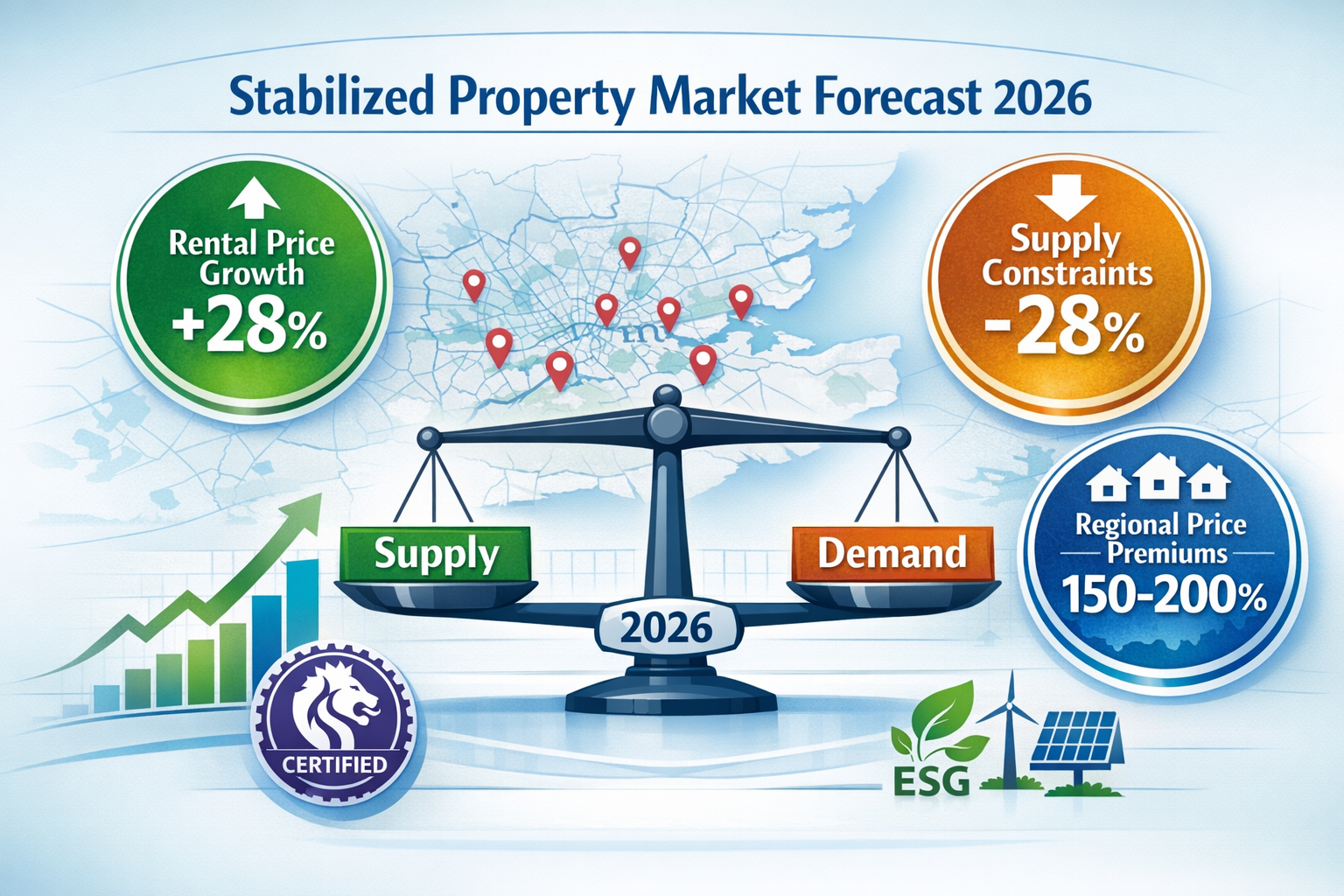
Survey respondents in January 2026 reported a constrained supply environment with a net balance of -28%, representing an improvement from -34% in the previous period but still indicating significant shortage [2]. This supply constraint manifests differently across property types:
Residential Sales Market:
- Limited new construction due to planning restrictions and development costs
- Existing homeowners reluctant to sell due to transaction costs and mortgage rate concerns
- Conversion of residential to short-term rental reducing available stock
Rental Market:
- Landlords exiting the market due to tax changes and regulatory requirements
- Student accommodation and build-to-rent developments not keeping pace with demand
- Quality rental stock particularly scarce in desirable Southern locations
Rental Price Expectations
Perhaps the most striking data point from the January 2026 RICS survey: +28% of respondents expect rental prices to rise in the near term, up dramatically from +16% in the previous period [2]. This surge in rental price expectations has critical implications for property valuations:
Investment Yield Calculations: Rising rental expectations improve investment yields, making buy-to-let properties more attractive despite higher purchase prices.
Residential Development Viability: Build-to-rent schemes become more financially viable, potentially increasing development activity in areas with planning permission.
Affordability Pressures: Continued rental growth may eventually prompt policy interventions that could affect future market conditions.
For surveyors conducting Help to Buy valuations or insurance reinstatement valuations, these rental dynamics provide important context for assessing overall market health and future price trajectories.
Location-Specific Variations
Supply constraints and rental dynamics vary significantly even within the broader "Southern" market. Professionals working in specific areas must understand local nuances:
Prime Central London (West London, Chelsea, Hampstead): International buyer demand remains strong, but political uncertainty affects transaction volumes.
Commuter Belt (Surrey, Hertfordshire, Buckinghamshire): Hybrid working patterns have sustained demand for properties offering space and accessibility.
Emerging Areas (East London, Bromley, Essex): Regeneration projects and improved transport links create pockets of strong growth within otherwise cautious markets.
Practical Valuation Tactics for Returning Buyer Confidence
As buyer confidence gradually returns to Southern markets in 2026, surveyors must adapt their methodologies to capture the nuances of stabilization. Valuing Stabilizing Southern Properties in 2026: RICS Adjustments for London and South East Laggards requires practical tactics that balance caution with recognition of emerging opportunities.
Comparative Method Refinements
The comparative method remains the primary approach for residential valuations, but 2026's market conditions demand refinements:
Time Adjustments: With market sentiment improving, recent comparables (within 3 months) carry more weight than older transactions. Apply time adjustments to reflect the improving trend.
Condition Premiums: Properties requiring minimal work command higher premiums as buyers seek "move-in ready" homes in uncertain markets. Quantify renovation requirements carefully.
Tenure Considerations: Freehold properties and long leases (999 years or share of freehold) command increasing premiums over traditional leasehold arrangements.
Location Micro-Analysis: Within neighborhoods, specific streets or even sides of streets can show significant value variations based on parking, green space access, or noise levels.
Investment Method Applications
For income-producing properties, the investment method requires careful calibration in 2026:
Yield Selection:
- Prime London residential: 3.5-4.5% depending on location and property type
- Secondary locations: 4.5-5.5% reflecting higher risk and lower liquidity
- Commercial: 5-7% with significant ESG-related adjustments
Rental Growth Assumptions: With +28% of surveyors expecting rental increases [2], building realistic growth assumptions into DCF (Discounted Cash Flow) models is crucial. Conservative approach: 3-5% annual growth over 5 years, then reverting to inflation.
Void Periods and Management Costs: Factor in realistic assumptions about tenant turnover, void periods (typically 4-6 weeks for residential), and management fees (10-15% of rental income).
Residual Valuation for Development Sites
Development sites in Southern markets require careful residual valuations that account for:
- Construction cost inflation: Building costs continue rising, affecting development viability
- Planning risk: Increasingly stringent requirements for affordable housing, sustainability, and design quality
- Sales rate assumptions: In stabilizing markets, absorption rates may be slower than historic norms
- Finance costs: Higher interest rates significantly impact development profitability
Specialist Valuation Scenarios
Certain property types and circumstances require specialized approaches:
Leasehold Enfranchisement: When valuing for lease extension or freehold purchase, understanding the Leasehold Reform Act provisions and marriage value calculations is essential.
Listed Buildings and Conservation Areas: Heritage properties in Southern markets often command premiums but require specialist knowledge of permitted alterations and maintenance obligations.
Properties with Defects: Subsidence surveys and structural issues require careful assessment of remediation costs and market stigma effects.
Mixed-Use Properties: Properties combining residential and commercial elements need careful analysis of permitted use, planning restrictions, and market demand for each component.
Risk Assessment and Valuation Uncertainty
Professional surveyors must transparently communicate risks and uncertainties when Valuing Stabilizing Southern Properties in 2026: RICS Adjustments for London and South East Laggards. Key risk factors include:
Market Risk Factors
- Interest rate trajectory: Further Bank of England rate changes could significantly affect affordability and demand
- Economic performance: Recession risks, employment levels, and wage growth directly impact housing markets
- Political developments: Tax policy changes, planning reforms, or rental market regulations could shift market dynamics
- International factors: Currency fluctuations and geopolitical events affect international buyer demand for London property
Property-Specific Risks
- Building safety: Cladding issues, fire safety compliance, and EWS1 certification status
- Climate risks: Flood risk, coastal erosion, and heat island effects increasingly affect valuations
- Lease issues: Ground rent terms, service charge disputes, and freeholder quality
- Planning constraints: Conservation area restrictions, Article 4 directions, and permitted development limitations
Reporting Uncertainty
When market evidence is limited or contradictory, RICS standards permit (and sometimes require) the inclusion of uncertainty clauses. Surveyors should:
- Clearly state assumptions: Document all assumptions about market conditions, property condition, and future trends
- Provide valuation ranges: Where appropriate, offer a range rather than a single point estimate
- Flag material uncertainty: Use formal material uncertainty clauses when market volatility or limited evidence warrants
- Recommend monitoring: Suggest periodic revaluations in rapidly changing markets
Technology and Data in Modern Valuations
The profession has embraced technology to improve accuracy and efficiency when Valuing Stabilizing Southern Properties in 2026: RICS Adjustments for London and South East Laggards:
Automated Valuation Models (AVMs)
AVMs provide useful initial estimates but have limitations in complex Southern markets:
- Strengths: Quick, cost-effective, useful for portfolio screening and mortgage lending decisions
- Weaknesses: Struggle with unique properties, limited comparables, and rapidly changing markets
- Best practice: Use AVMs as a starting point, but supplement with professional judgment and physical inspection
PropTech Solutions
Modern valuation increasingly incorporates:
- Geospatial analysis: Mapping tools that analyze location factors, transport links, and neighborhood amenities
- Big data analytics: Processing large datasets to identify pricing trends and market patterns
- Digital inspection tools: Laser measuring, 3D scanning, and drone photography for accurate property assessment
- Blockchain and digital records: Improving transparency in property transactions and ownership records
Market Intelligence Platforms
Subscription services providing real-time market data help surveyors stay current with:
- Transaction prices and volumes
- Rental market trends
- Planning application activity
- Economic indicators affecting property markets
Conclusion
Valuing Stabilizing Southern Properties in 2026: RICS Adjustments for London and South East Laggards represents one of the most challenging yet rewarding aspects of professional surveying practice in 2026. The combination of extreme regional price disparities—with Southern properties commanding 150-200% premiums over Northern equivalents—and cautiously improving market sentiment in historically volatile London and South East markets demands sophisticated, nuanced approaches [1].
The January 2026 RICS data confirms that while these Southern regions continue to show more negative net balances than the national average, improvement trends are emerging [2]. Supply constraints persist at -28%, but crucially, rental price expectations have surged to +28%, fundamentally reshaping investment valuations and market dynamics [2].
Professional surveyors must master the new RICS protocols, including the Evergreen RICS Valuation Methods for Stabilising London Flats and updated ESG sustainability standards effective April 2026 [3][5]. These frameworks provide essential guidance for navigating markets characterized by limited comparables, volatile buyer sentiment, and complex regulatory environments.
Actionable Next Steps
For property professionals working in Southern markets:
- Update methodology knowledge: Familiarize yourself with the 2026 RICS protocols and ESG standards to ensure compliance and best practice
- Invest in market intelligence: Subscribe to quality data services providing real-time transaction information and rental market trends
- Develop specialist expertise: Focus on specific property types or locations where you can build deep knowledge and competitive advantage
- Enhance client communication: Clearly explain assumptions, risks, and uncertainties in your valuation reports
- Monitor regulatory developments: Stay informed about planning reforms, building safety requirements, and tax policy changes
- Embrace technology thoughtfully: Use PropTech tools to enhance efficiency while maintaining professional judgment
- Network with peers: Engage with professional bodies and local surveyor networks to share insights and market intelligence
The Southern property markets of 2026 present challenges, but for surveyors equipped with updated RICS methodologies, robust data, and professional expertise, they also offer significant opportunities. As buyer confidence gradually returns and markets stabilize, accurate, defensible valuations will be essential for supporting informed decision-making across the residential and commercial sectors.
Whether conducting RICS valuations for mortgage purposes, investment analysis, taxation, or litigation, the principles outlined in this guide provide a foundation for professional excellence in one of the UK's most complex and valuable property markets.
References
[1] Valuing North Vs South Uk Properties In 2026 Surveyor Techn – https://nottinghillsurveyors.com/blog/valuing-north-vs-south-uk-properties-in-2026-surveyor-techn
[2] Uk Residential Market Survey January 2026 – https://www.rics.org/content/dam/ricsglobal/documents/market-surveys/uk-residential-market-survey/UK-Residential-Market-Survey_January-2026.pdf
[3] Evergreen Rics Valuation Methods For Stabilising London Flats 2026 Market Protocols – https://nottinghillsurveyors.com/blog/evergreen-rics-valuation-methods-for-stabilising-london-flats-2026-market-protocols
[4] Post Budget 2026 Valuation Challenges Surveyor Strategies For High Value Properties Over 2 Million – https://nottinghillsurveyors.com/blog/post-budget-2026-valuation-challenges-surveyor-strategies-for-high-value-properties-over-2-million
[5] Rics Publishes Updated Global Standard Esg Sustainability Commercial Property Valuation – https://www.rics.org/news-insights/rics-publishes-updated-global-standard-esg-sustainability-commercial-property-valuation