{"cover":"Professional landscape format (1536x1024) hero image with bold text overlay 'Party Wall Surveying Surge in Northern England's 2026 Housing Uptick: RICS Protocols for Loft Conversions and Extensions' in extra large 72pt white sans-serif font with dark shadow and semi-transparent navy overlay box, positioned in upper third. Background shows aerial view of Northern England terraced housing with construction scaffolding on loft conversions and extensions, warm evening light, vibrant red brick Victorian terraces, construction activity visible. Color scheme: deep navy blue, white text, warm brick red accents. Magazine cover quality, editorial style, high contrast, professional composition","content":["Detailed landscape format (1536x1024) image showing close-up of RICS chartered surveyor in high-visibility vest and hard hat conducting party wall inspection at a Northern England terraced house, holding digital tablet displaying Section 6 notice documentation, measuring tape against shared wall, construction blueprints visible, neighboring property visible through window, professional documentation clipboard, warm interior lighting, technical precision, modern surveying equipment, authentic construction site atmosphere, sharp focus on surveyor's professional assessment work","Landscape format (1536x1024) technical illustration showing cross-section architectural diagram of Victorian terraced house loft conversion with party wall clearly marked, detailed annotations pointing to steel beam insertions, roof structure modifications, party wall line highlighted in red, measurement indicators, RICS protocol checkpoints marked with green ticks, neighboring property shown in partial view, professional architectural drawing style with blueprint aesthetic, clean technical rendering, educational diagram quality with measurement scales and regulatory compliance markers","Landscape format (1536x1024) image depicting formal dispute resolution meeting scene with three RICS surveyors seated around modern conference table reviewing party wall award documents, professional office setting in Manchester or Leeds, large windows showing Northern England cityscape, documents spread on table including schedules of condition, cost award calculations visible on laptop screen, professional handshake occurring, warm office lighting, contemporary business environment, collaborative atmosphere, legal documentation visible, professional surveying practice interior"]}
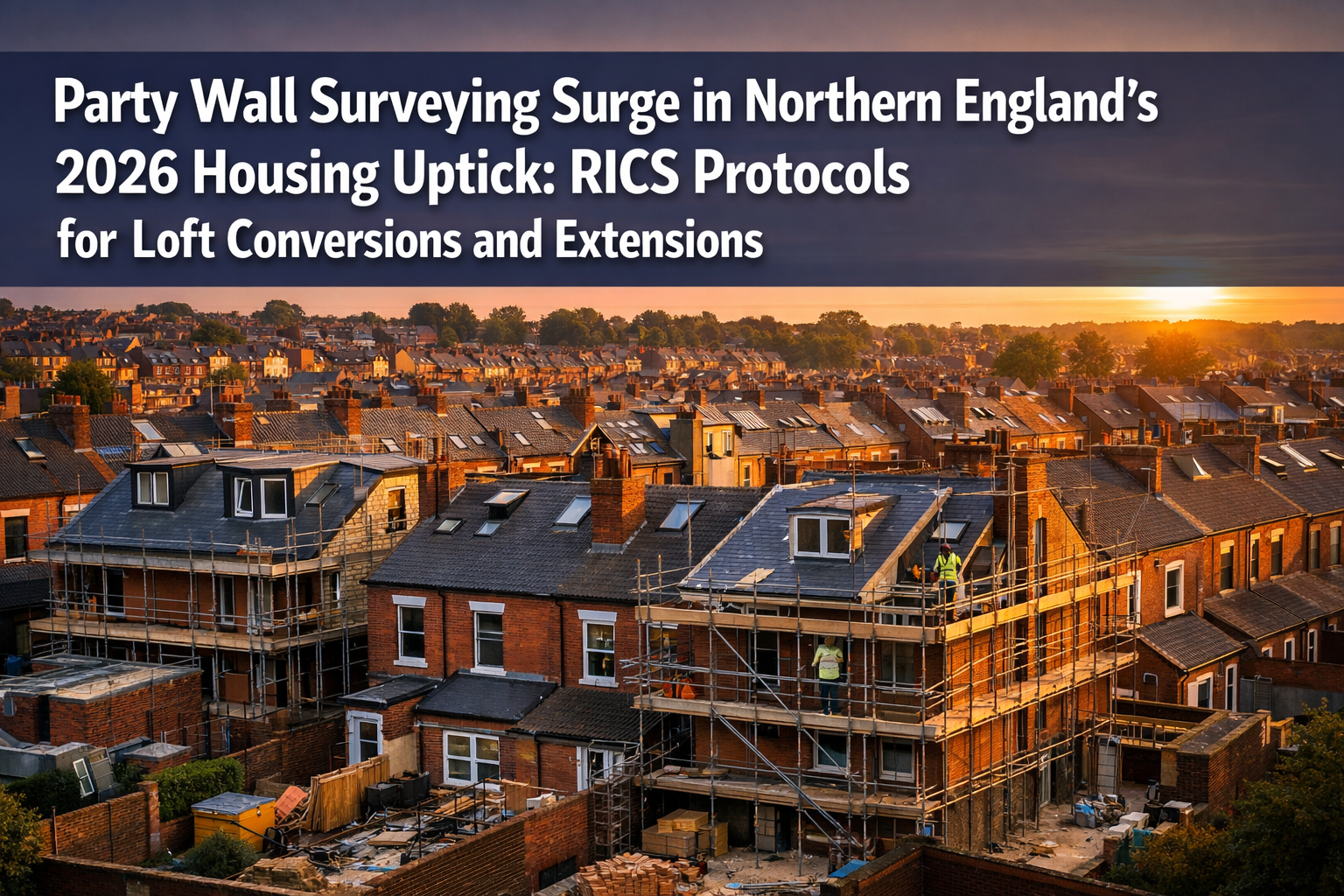
As buyer confidence returns to Northern England's property market in 2026, homeowners across Manchester, Leeds, Liverpool, and Newcastle are embarking on ambitious home improvement projects. This renewed activity has triggered a Party Wall Surveying Surge in Northern England's 2026 Housing Uptick: RICS Protocols for Loft Conversions and Extensions, with chartered surveyors reporting unprecedented demand for party wall services. The combination of rising property values, limited housing stock, and the desire to maximize existing space has created perfect conditions for loft conversions and extensions—projects that frequently require formal party wall procedures under the Party Wall etc. Act 1996.
The surge presents both opportunities and challenges for property owners navigating the complex landscape of neighbor relations, legal compliance, and construction timelines. Understanding RICS protocols, Section 6 notices, dispute resolution mechanisms, and cost award procedures has become essential knowledge for anyone planning structural work in Northern England's densely packed terraced streets and semi-detached neighborhoods.
Key Takeaways
✅ Northern England's 2026 housing market revival has created unprecedented demand for party wall surveying services, particularly for loft conversions and extensions in terraced properties.
✅ Section 6 notices under the Party Wall etc. Act 1996 require specific timelines and procedures, with RICS-qualified surveyors playing crucial roles in protecting both building owners and adjoining owners.
✅ Dispute resolution processes follow standardized protocols, with appointed surveyors producing party wall awards that include detailed schedules of condition and cost allocation frameworks.
✅ RICS professional standards mandate that only chartered surveyors with MRICS or FRICS designations should be appointed to party wall surveyor roles, ensuring competent oversight of high-volume regional projects.
✅ Cost awards and fee structures in party wall procedures must follow transparent methodologies, with building owners typically bearing surveyor fees unless the party wall award specifies alternative arrangements.
Understanding the Party Wall Surveying Surge in Northern England's 2026 Housing Uptick
The Party Wall Surveying Surge in Northern England's 2026 Housing Uptick: RICS Protocols for Loft Conversions and Extensions reflects fundamental shifts in regional housing dynamics. Northern England's property market has experienced remarkable resilience, with homeowners choosing renovation over relocation due to competitive mortgage rates and limited new-build availability.
Regional Housing Market Dynamics
Northern England's terraced housing stock—particularly prevalent in Manchester, Leeds, Bradford, and Liverpool—creates unique party wall considerations. These Victorian and Edwardian properties feature shared structural walls, making virtually any significant renovation subject to party wall legislation.
Key market drivers include:
- 📈 Property value increases of 8-12% across Northern England metropolitan areas in 2025-2026
- 🏠 Limited housing inventory pushing homeowners toward maximizing existing space
- 💰 Favorable lending conditions making home improvements financially attractive
- 👨👩👧👦 Growing families requiring additional bedrooms through loft conversions
The concentration of terraced housing means that loft conversions requiring party wall procedures have become the most common trigger for surveyor appointments in 2026.
Types of Work Triggering Party Wall Requirements
Understanding which construction activities require formal party wall procedures prevents costly delays and neighbor disputes. The Party Wall etc. Act 1996 covers three main categories of work [3]:
| Work Type | Notice Required | Common in Northern England |
|---|---|---|
| Building on/astride the boundary line | Party Structure Notice | Extensions, new walls between properties |
| Works to existing party walls | Party Structure Notice | Loft conversions with beam insertions, underpinning |
| Excavations within 3-6 meters | Notice of Adjacent Excavation | Basement conversions, foundation work |
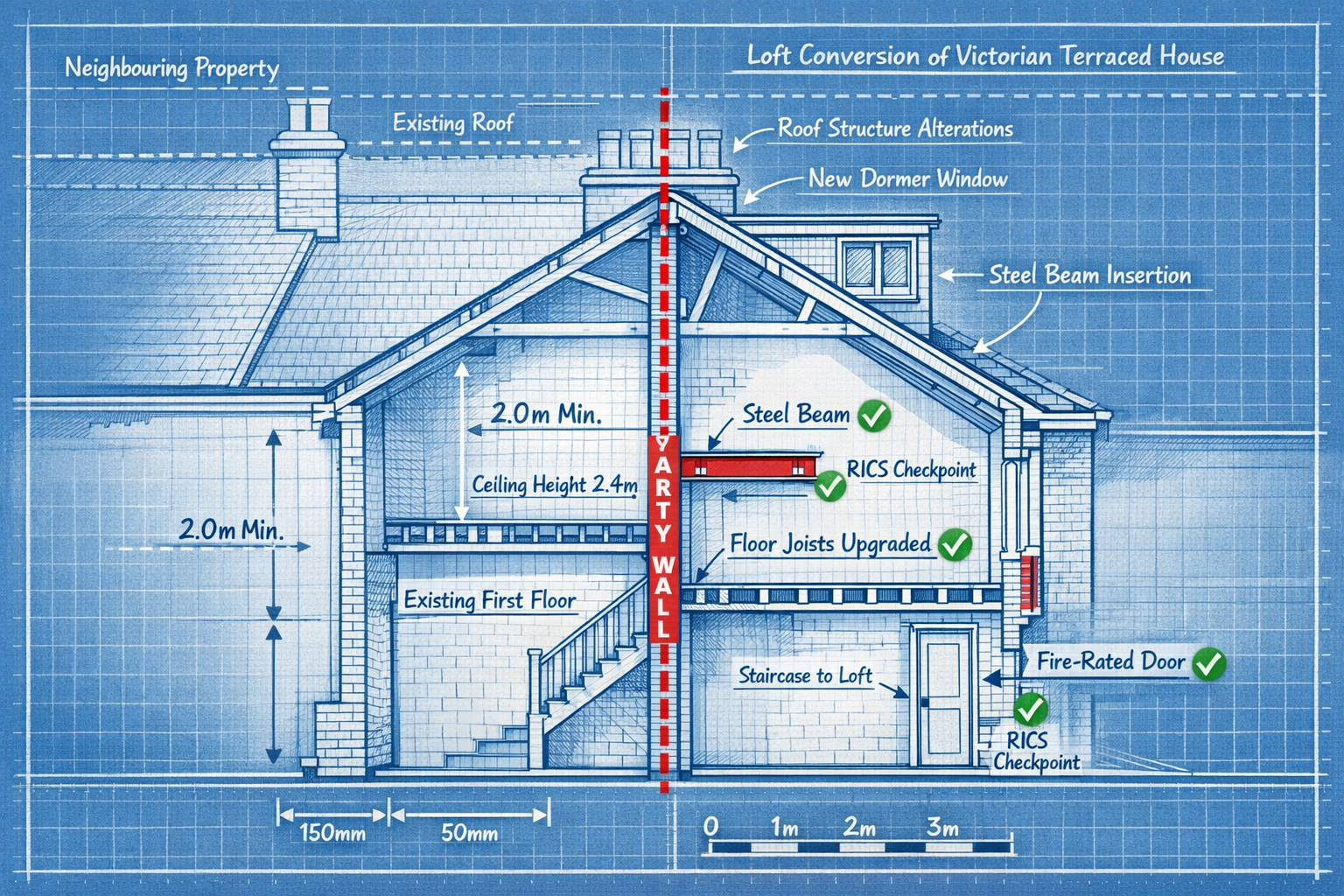
Loft conversions typically require party structure notices when work involves:
- Installing steel beams into shared walls
- Raising party wall height for additional headroom
- Cutting into party walls for staircase access
- Modifying chimney breasts on shared walls
Extensions trigger requirements when construction occurs on or within specified distances of boundary lines. The surge in both project types has created substantial demand for qualified party wall surveyors throughout Northern England's urban centers.
RICS Protocols for Section 6 Notices and Surveyor Appointments
The Royal Institution of Chartered Surveyors (RICS) provides comprehensive guidance on party wall procedures through its authoritative publication on party wall legislation and procedure [1]. These protocols ensure professional standards during the Party Wall Surveying Surge in Northern England's 2026 Housing Uptick: RICS Protocols for Loft Conversions and Extensions.
Section 6 Notice Requirements and Timelines
Section 6 of the Party Wall etc. Act 1996 establishes the framework for appointing surveyors when disputes arise or when adjoining owners do not consent to proposed works. RICS guidance emphasizes strict adherence to statutory timelines [1]:
Critical Timeline Elements:
- Party Structure Notice: Minimum two months before work commences
- Notice of Adjacent Excavation: Minimum one month before work begins
- Response Period: Adjoining owners have 14 days to consent or dissent
- Deemed Dissent: Failure to respond within 14 days constitutes dissent, triggering surveyor appointment
When dissent occurs or no response is received, the building owner must initiate the surveyor appointment process. Understanding party wall consent procedures prevents procedural errors that could invalidate notices.
Appointing Qualified RICS Surveyors
RICS consumer guidance explicitly recommends that appointed surveyors hold chartered status with MRICS (Member) or FRICS (Fellow) designations [2]. This professional requirement ensures surveyors possess:
- ✓ Technical competence in building construction and structural assessment
- ✓ Legal knowledge of the Party Wall etc. Act 1996 and case law
- ✓ Professional indemnity insurance protecting all parties
- ✓ Ethical standards governed by RICS professional conduct regulations
The appointment process follows three possible scenarios:
Scenario 1: Agreed Surveyor
Both parties jointly appoint a single "agreed surveyor" who acts impartially. This streamlined approach reduces costs and accelerates the award process.
Scenario 2: Two Surveyors
Each party appoints their own surveyor. The two surveyors collaborate to produce the party wall award, appointing a third surveyor only if they cannot reach agreement.
Scenario 3: Third Surveyor
When the two appointed surveyors disagree on specific matters, they select a third surveyor to resolve the dispute. This surveyor's decision is binding.
In Northern England's high-volume market, many building owners seek RICS home survey specialists who also provide party wall services, ensuring comprehensive property expertise.
Producing Schedules of Condition
A critical RICS protocol involves preparing detailed schedules of condition before work commences. These documents serve multiple purposes:
🔍 Evidence Documentation: Photographic and written records of the adjoining property's pre-work condition
📋 Dispute Prevention: Clear baseline for assessing whether construction caused damage
⚖️ Legal Protection: Admissible evidence if disagreements arise about damage responsibility
RICS guidance recommends schedules include:
- Comprehensive photographs of all rooms adjoining the party wall
- Detailed descriptions of existing cracks, settlement, or defects
- External condition documentation
- Date-stamped evidence with witness signatures
The surge in party wall activity across Northern England has elevated the importance of thorough schedules, as surveyors report increased scrutiny from adjoining owners concerned about construction impacts.
Dispute Resolution Timelines and Cost Award Procedures in the 2026 Surge
The Party Wall Surveying Surge in Northern England's 2026 Housing Uptick: RICS Protocols for Loft Conversions and Extensions has brought dispute resolution procedures into sharp focus. With thousands of party wall projects proceeding simultaneously across the region, understanding resolution timelines and cost frameworks has become essential.
Standardized Dispute Resolution Process
RICS protocols establish clear procedures when disagreements arise during party wall processes [1]. The structured approach ensures fair treatment while maintaining project momentum:
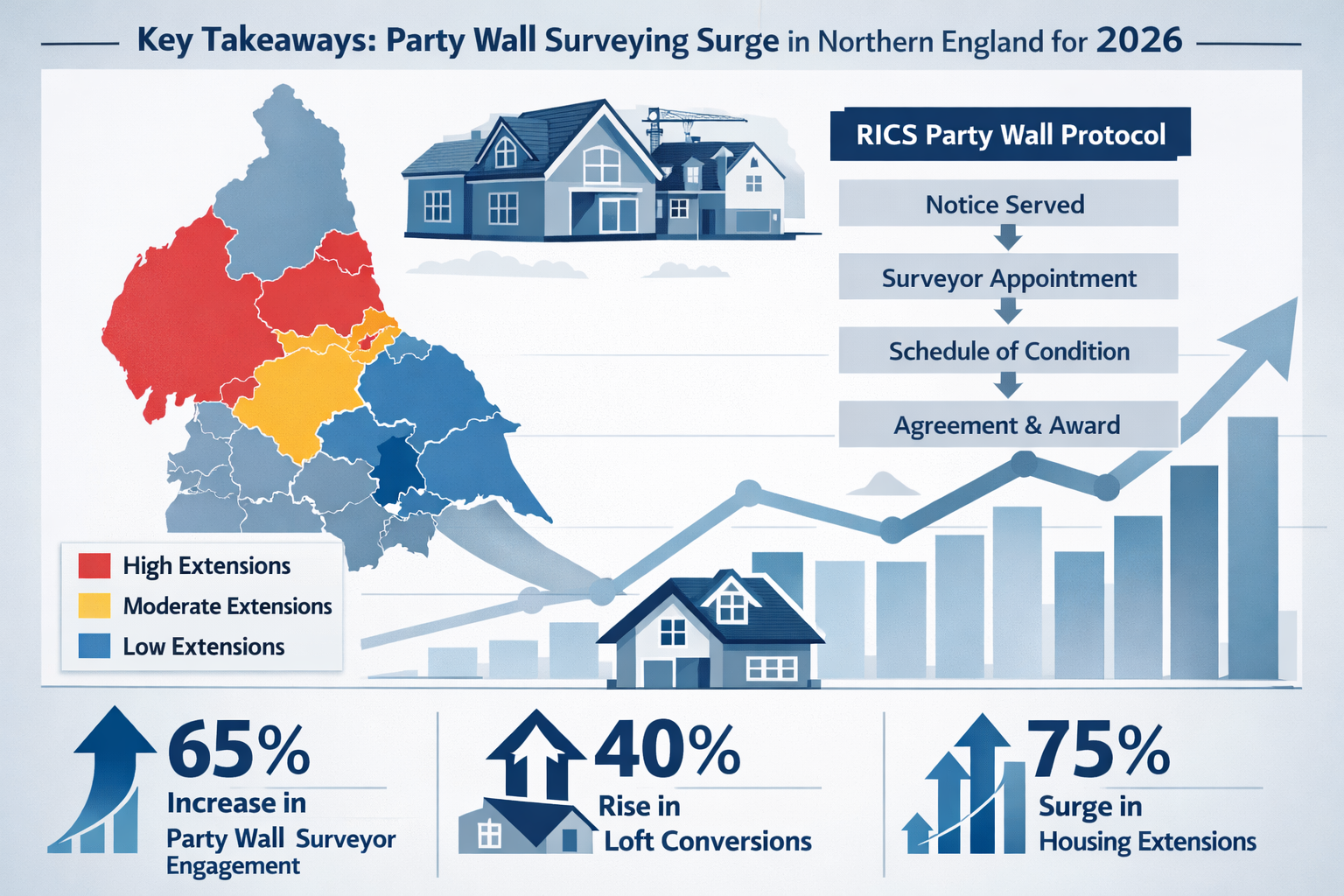
Stage 1: Initial Disagreement (Days 1-14)
When an adjoining owner dissents to the party structure notice or fails to respond within 14 days, a dispute is deemed to exist. The building owner must immediately initiate surveyor appointments.
Stage 2: Surveyor Appointment (Days 15-28)
The building owner requests the adjoining owner to appoint a surveyor or consent to an agreed surveyor. If the adjoining owner fails to appoint within 10 days, the building owner may appoint on their behalf—a provision that prevents indefinite delays.
Stage 3: Award Preparation (Days 29-60)
Appointed surveyors inspect both properties, prepare schedules of condition, and draft the party wall award. RICS guidance suggests awards should be issued within reasonable timeframes, typically 4-6 weeks from appointment, though complex projects may require longer.
Stage 4: Award Issuance and Appeal Period (Days 61-75)
Once issued, parties have 14 days to appeal the award to the County Court. Appeals must identify specific award elements being challenged, not general dissatisfaction.
This timeline framework helps Northern England property owners plan construction schedules realistically. Delays often occur when no party wall notice has been served, requiring retrospective procedures that complicate projects.
Cost Award Allocation and Fee Structures
Cost allocation represents a frequent source of confusion in party wall procedures. RICS protocols provide clarity on who pays surveyor fees and how costs should be distributed [1]:
General Principles:
💷 Building Owner's Responsibility: The building owner typically pays all reasonable surveyor fees for both their own surveyor and the adjoining owner's surveyor, plus any agreed surveyor fees.
💷 Reasonableness Standard: Fees must be "reasonable" considering the work's complexity, property values, and time required. Surveyors cannot charge excessive fees simply because the building owner bears costs.
💷 Fee Agreement Transparency: RICS standards require surveyors to provide fee estimates before appointment, with clear hourly rates or fixed-fee structures.
Typical Fee Ranges in Northern England (2026):
| Project Complexity | Agreed Surveyor Fee | Two Surveyors (Total) |
|---|---|---|
| Simple loft conversion | £800-£1,200 | £1,600-£2,400 |
| Complex extension | £1,200-£2,000 | £2,400-£4,000 |
| Multiple properties affected | £2,000-£3,500 | £4,000-£7,000 |
Understanding party wall award guidance helps building owners budget appropriately for these professional fees.
Special Considerations for High-Volume Regional Projects
Northern England's 2026 surge has created unique challenges requiring adapted RICS protocols:
Surveyor Capacity Constraints
The unprecedented demand has stretched surveyor availability, particularly for RICS-qualified professionals. Building owners should:
- Book surveyors 6-8 weeks before notice service
- Verify RICS membership through the RICS register
- Consider agreed surveyor appointments to reduce scheduling conflicts
Neighboring Multiple Properties
Terraced housing often means party walls with properties on both sides. This requires:
- Separate notices to each adjoining owner
- Potentially multiple surveyor appointments
- Coordinated schedules of condition for multiple properties
- Higher total costs due to increased complexity
Excavation Notices for Extensions
Extensions requiring foundations within 3 meters of neighboring structures trigger excavation notice requirements. RICS protocols mandate:
- Detailed foundation depth specifications
- Structural engineer calculations
- Enhanced monitoring during excavation
- More frequent surveyor site visits
Consequences of Non-Compliance
The surge in activity has also increased enforcement actions when building owners bypass party wall procedures. Understanding what happens without a party wall agreement highlights serious risks:
⚠️ Injunction Applications: Adjoining owners can seek court injunctions halting construction
⚠️ Retrospective Awards: Courts may order retrospective party wall procedures, causing expensive delays
⚠️ Damage Liability: Without schedules of condition, building owners face difficulty disproving damage claims
⚠️ Increased Costs: Legal proceedings and work stoppages dramatically exceed proper party wall procedure costs
RICS protocols emphasize prevention through proper notice service and professional surveyor engagement from project inception.
Best Practices for Building Owners in 2026
Successfully navigating the Party Wall Surveying Surge in Northern England's 2026 Housing Uptick: RICS Protocols for Loft Conversions and Extensions requires strategic planning:
1. Early Engagement (12+ weeks before construction)
- Consult RICS surveyors during design phase
- Identify all party wall implications
- Budget for surveyor fees and potential delays
2. Neighbor Communication (8-10 weeks before construction)
- Informally discuss plans before formal notices
- Address concerns proactively
- Build goodwill that facilitates consent
3. Proper Notice Service (6-8 weeks before construction)
- Use RICS-recommended notice templates
- Serve notices by recorded delivery
- Maintain proof of service documentation
4. Professional Surveyor Selection (4-6 weeks before construction)
- Verify RICS chartered status
- Request fee estimates in writing
- Check availability for award preparation timeline
5. Schedule of Condition Preparation (2-4 weeks before construction)
- Coordinate access with adjoining owners
- Ensure comprehensive photographic evidence
- Obtain signed acknowledgments
6. Award Compliance (Throughout construction)
- Adhere strictly to award conditions
- Facilitate surveyor site visits
- Document compliance for future reference
For comprehensive guidance, consult our party wall FAQ addressing common questions arising in Northern England's current market.
Regional Variations and Local Considerations
While the Party Wall etc. Act 1996 applies uniformly across England and Wales, Northern England's specific housing characteristics create regional nuances:
Victorian and Edwardian Terraced Housing
The prevalence of 19th and early 20th-century terraced properties introduces:
- Solid brick party walls without cavities, requiring careful beam insertion techniques
- Shared chimney breasts complicating removal or modification
- Settlement patterns making pre-work condition documentation critical
- Historic construction methods requiring specialist surveyor knowledge
Urban Density Factors
Northern England's compact urban development means:
- Close neighbor proximity increasing sensitivity to construction disruption
- Multiple adjoining properties requiring coordinated notice procedures
- Limited access for construction equipment affecting work methods
- Parking constraints complicating material delivery and surveyor visits
Economic Considerations
Northern England's property values, while rising, remain below London and Southeast levels, affecting:
- Proportionality of fees to property values and project costs
- Surveyor availability with some London-based practitioners less active regionally
- Cost-benefit calculations for agreed versus separate surveyor appointments
- Dispute likelihood with cost-conscious homeowners scrutinizing expenses
Conclusion
The Party Wall Surveying Surge in Northern England's 2026 Housing Uptick: RICS Protocols for Loft Conversions and Extensions represents a significant moment in the region's property market evolution. As homeowners across Manchester, Leeds, Liverpool, and Newcastle invest in loft conversions and extensions, proper adherence to RICS protocols and Party Wall Act procedures has never been more critical.
Understanding Section 6 notice requirements, engaging RICS-qualified chartered surveyors, preparing comprehensive schedules of condition, and following established dispute resolution timelines protects both building owners and adjoining owners. The standardized processes ensure construction proceeds smoothly while preserving neighbor relations and property values.
Actionable Next Steps
For building owners planning loft conversions or extensions in Northern England during 2026:
✅ Step 1: Consult a RICS-qualified chartered surveyor with party wall expertise at least 12 weeks before planned construction start dates.
✅ Step 2: Review detailed schedule of condition guidance to understand documentation requirements.
✅ Step 3: Prepare accurate party structure notices or excavation notices using professional templates, ensuring all technical details are correct.
✅ Step 4: Engage with neighbors early, explaining planned work and addressing concerns before formal notice service.
✅ Step 5: Budget appropriately for surveyor fees, typically £1,600-£4,000 for standard residential projects with two surveyors appointed.
✅ Step 6: Maintain meticulous records throughout the process, including all correspondence, notices, awards, and compliance documentation.
The surge in party wall activity reflects Northern England's housing market vitality and homeowner confidence. By following RICS protocols and engaging qualified professionals, property owners can successfully navigate party wall procedures, complete valuable home improvements, and maintain positive neighbor relationships—ensuring the region's housing stock continues evolving to meet modern family needs while respecting the legal framework protecting all parties' interests.
References
[1] Jan 22 Party Wall Legislation And Procedure 7th Edition – https://www.rics.org/content/dam/ricsglobal/documents/standards/jan_22_party_wall_legislation_and_procedure_7th_edition.pdf
[2] Party Walls – https://www.rics.org/consumer-guides/party-walls
[3] Party Wall Agreement – https://hoa.org.uk/advice/guides-for-homeowners/i-am-improving/party-wall-agreement/