Professional landlords and institutional investors operate in a different league than individual buy-to-let owners. When managing portfolios worth millions, they cannot afford surprises. Every property must meet investment-grade standards—a benchmark that demands comprehensive defect identification, systematic repair prioritization, and long-term asset protection. Understanding Building Survey Defects in Buy-to-Let Properties: Prioritizing Repairs When Institutional Landlords Demand Investment-Grade Standards has become essential for surveyors, property managers, and investors navigating the increasingly sophisticated rental market of 2026.
The stakes have never been higher. Institutional landlords face stringent regulatory requirements, tenant expectations shaped by consumer protection laws, and financial pressures from lenders who scrutinize portfolio quality. A single overlooked defect can cascade into costly repairs, tenant disputes, or compliance failures that jeopardize entire investment strategies.
Key Takeaways
✅ Investment-grade standards require systematic defect categorization using frameworks that distinguish between immediate safety hazards, compliance risks, and long-term maintenance needs
✅ Institutional landlords prioritize defects based on financial impact, tenant retention, regulatory compliance, and asset value preservation rather than simple repair costs
✅ Comprehensive building surveys must address structural integrity, building envelope performance, mechanical systems, and compliance issues to meet institutional investment criteria
✅ Repair prioritization frameworks balance urgency, cost, and strategic value, enabling landlords to allocate capital efficiently across property portfolios
✅ Professional surveyor expertise is essential for identifying hidden defects and providing defensible recommendations that satisfy lender requirements and due diligence standards
Understanding Investment-Grade Property Standards in the Buy-to-Let Sector
What Makes a Property "Investment-Grade"?
Investment-grade properties meet specific criteria that institutional investors and lenders use to assess risk and value. These standards go far beyond basic habitability requirements. They encompass:
Structural soundness 🏗️ – No significant defects affecting load-bearing elements, foundations, or overall building stability
Building envelope integrity – Weathertight roof coverings, properly functioning rainwater goods, sound external walls with adequate damp-proofing
Mechanical and electrical compliance – All systems meeting current regulations with appropriate certification and remaining service life
Energy efficiency benchmarks – Minimum EPC ratings (typically C or above for institutional portfolios in 2026) with modern insulation and heating systems
Regulatory compliance – Full adherence to HMO licensing, fire safety regulations, gas and electrical certification requirements
Tenant appeal factors – Modern kitchens and bathrooms, adequate storage, good natural light, and contemporary finishes
Institutional landlords view properties as financial instruments that must generate predictable returns with minimal volatility. Any defect threatening rental income, increasing maintenance costs, or creating compliance risks directly impacts investment performance.
The Institutional Landlord Perspective
Unlike individual landlords who might tolerate minor issues or defer maintenance, institutional investors operate with:
📊 Portfolio-wide risk management frameworks that aggregate defect data across hundreds or thousands of units
💰 Sophisticated financial modeling that calculates the net present value of repair decisions versus ongoing maintenance costs
⚖️ Compliance-first approaches driven by regulatory obligations and reputational considerations
📈 Asset value optimization strategies that prioritize repairs enhancing property value and rental yields
🔍 Professional management standards requiring detailed documentation, regular inspections, and proactive maintenance
Working with chartered surveyors who understand these institutional requirements ensures survey reports address the specific concerns that drive investment decisions.
Common Building Survey Defects in Buy-to-Let Properties
Structural and Fabric Defects
Foundation and subsidence issues represent the most serious category of defects. Signs include:
- Progressive cracking in walls, particularly diagonal cracks wider than 3mm
- Doors and windows that stick or no longer close properly
- Visible settlement or tilting of floor levels
- Gaps between walls and ceilings or floors
Professional subsidence surveys provide essential evidence for institutional investors, as these defects can render properties unmortgageable and require extensive remediation.
Roof defects frequently appear in buy-to-let properties, especially older conversions:
- Missing, slipped, or damaged roof tiles allowing water penetration
- Failed roof valleys and flashing details
- Deteriorated flat roof coverings approaching end of service life
- Inadequate roof ventilation causing condensation damage
Specialist roof surveys identify these issues before they cause interior damage that disrupts tenancies.
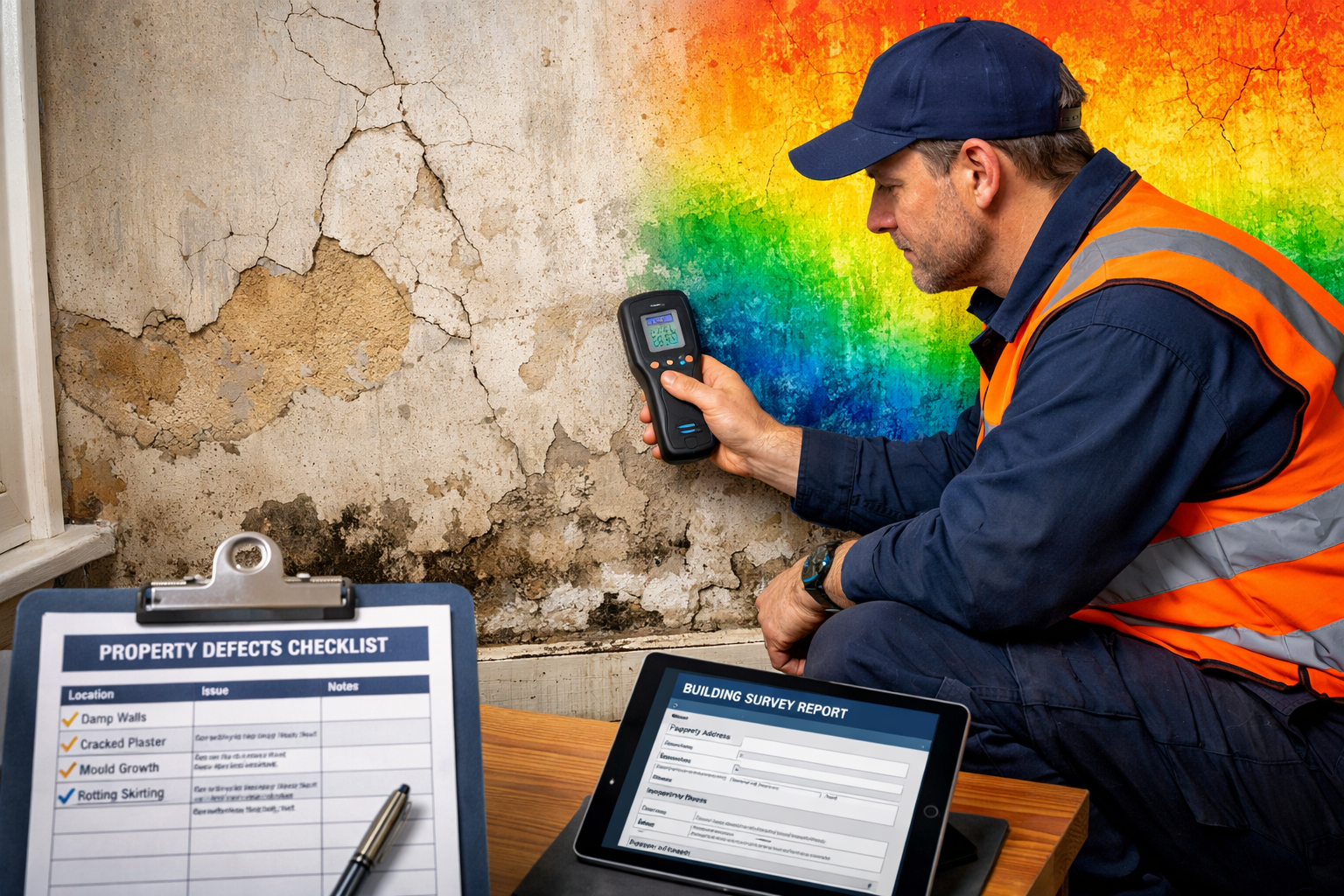
Damp and water penetration remains the most common defect category:
- Rising damp from failed or absent damp-proof courses
- Penetrating damp through solid walls, around windows, or from defective render
- Condensation damp from inadequate ventilation and heating
- Plumbing leaks from aging pipework or poor installations
Timber defects often go undetected without invasive investigation:
- Wet rot in window frames, floor joists, or roof timbers
- Dry rot in poorly ventilated areas with persistent moisture
- Woodworm infestation in structural timbers
- Deflection or sagging of floor joists indicating structural weakness
Building Services and Compliance Issues
Electrical system defects create immediate safety and compliance risks:
- Outdated wiring systems lacking modern circuit protection
- Insufficient socket provision requiring trailing leads
- Absence of current electrical safety certification
- DIY modifications not complying with Part P Building Regulations
Heating and plumbing deficiencies impact tenant satisfaction and energy efficiency:
- Aging boilers approaching end of service life (typically 15 years)
- Inadequate heating provision for property size
- Lead pipework requiring replacement
- Absence of thermostatic radiator valves reducing efficiency
Fire safety compliance gaps particularly affect HMOs and converted properties:
- Inadequate fire doors and compartmentation
- Missing or insufficient smoke and heat detection
- Lack of emergency lighting in common areas
- Inadequate escape routes or fire-resistant construction
Energy efficiency shortfalls directly impact rental viability:
- Single-glazed windows requiring replacement
- Insufficient loft or wall insulation
- Inefficient heating controls
- Poor airtightness increasing heat loss
Institutional landlords increasingly commission comprehensive structural surveys that address all these defect categories systematically.
Building Survey Defects in Buy-to-Let Properties: Prioritizing Repairs When Institutional Landlords Demand Investment-Grade Standards
The Four-Category Defect Classification System
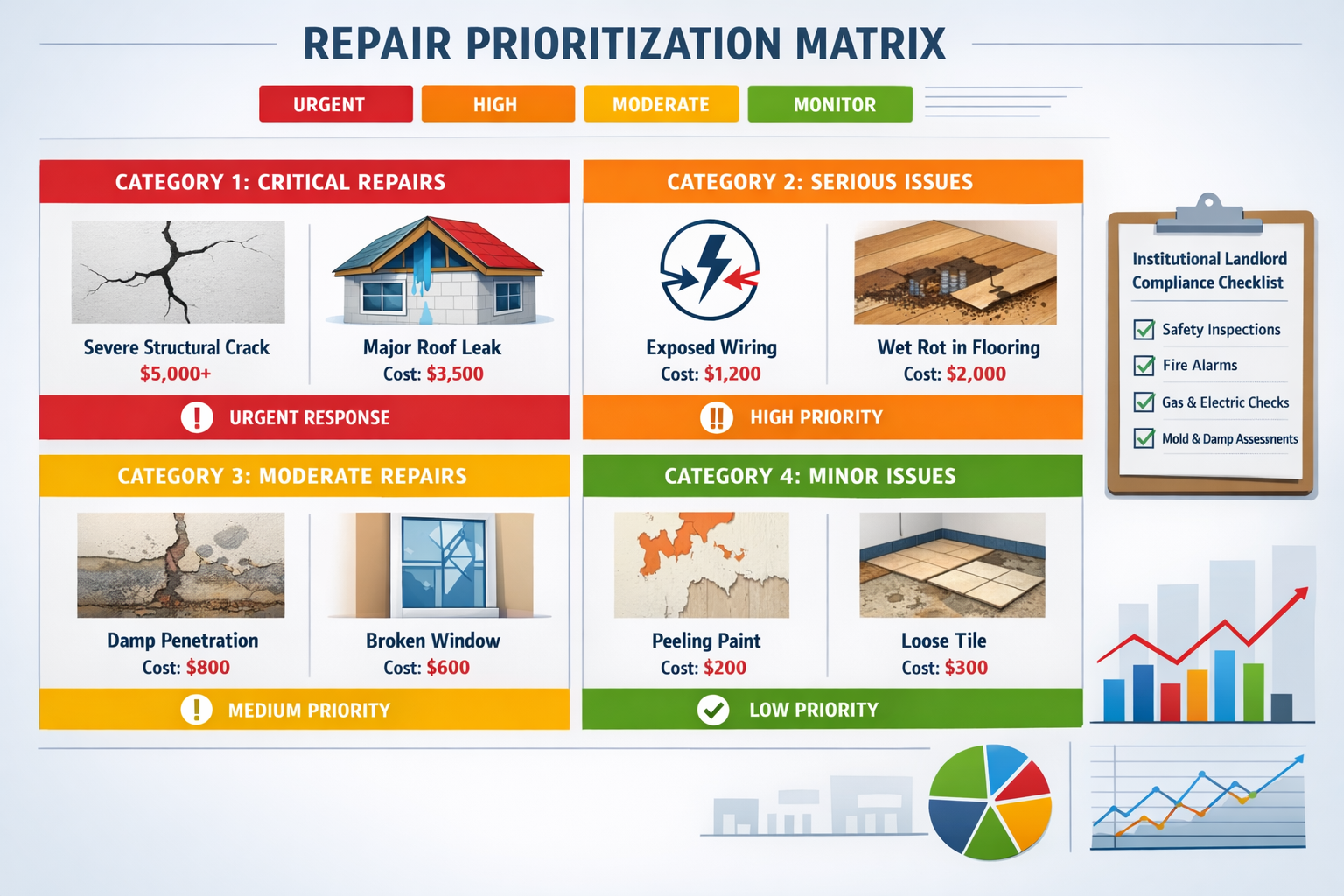
Professional surveyors typically classify defects using a priority framework that institutional landlords can translate directly into action plans:
Category 1: Urgent Repairs (Immediate Action Required) ⚠️
These defects pose immediate risks to:
- Safety – structural instability, electrical hazards, gas leaks, fire safety failures
- Legal compliance – regulatory breaches requiring immediate rectification
- Property protection – active water ingress causing progressive damage
Timeline: Address within 1-4 weeks
Examples:
- Dangerous electrical installations
- Active roof leaks
- Structural movement requiring monitoring or stabilization
- Gas safety certificate failures
- Missing fire doors in HMOs
Category 2: Essential Repairs (Short-Term Priority) 🔧
Defects that will:
- Deteriorate rapidly if not addressed within months
- Impact tenant retention through reduced comfort or functionality
- Increase operating costs through energy inefficiency or recurring maintenance
Timeline: Address within 3-12 months
Examples:
- Aging boiler approaching failure
- Deteriorating roof coverings with 1-2 years remaining life
- Rising damp requiring damp-proof course installation
- Windows requiring replacement for energy efficiency
- Bathroom or kitchen approaching end of serviceable life
Category 3: Desirable Improvements (Medium-Term Planning) 📋
Repairs that:
- Enhance property value and rental appeal
- Improve operational efficiency reducing long-term costs
- Prevent future deterioration through proactive maintenance
Timeline: Address within 1-3 years
Examples:
- External redecoration protecting building fabric
- Heating system upgrades improving efficiency
- Insulation improvements exceeding minimum standards
- Modernization of dated but functional facilities
- Preventative timber treatment
Category 4: Monitoring Required (Long-Term Considerations) 👁️
Issues requiring:
- Ongoing observation to track progression
- Future budget allocation for eventual replacement
- Maintenance planning to maximize service life
Timeline: Monitor and plan for 3-5+ years
Examples:
- Minor cracking requiring monitoring
- Building components with 5+ years remaining service life
- Cosmetic issues not affecting functionality
- Environmental factors requiring observation
Financial Prioritization Framework
Institutional landlords apply additional financial analysis to defect prioritization:
| Priority Factor | Weight | Consideration |
|---|---|---|
| Safety & Compliance Risk | 40% | Regulatory penalties, liability exposure, tenant safety |
| Asset Value Impact | 25% | Effect on property valuation and saleability |
| Rental Income Protection | 20% | Tenant retention, void periods, rental competitiveness |
| Operational Cost Reduction | 10% | Energy efficiency, maintenance frequency, management time |
| Strategic Alignment | 5% | Portfolio standards, brand positioning, exit strategy |
This framework ensures repair decisions align with investment objectives rather than simply addressing defects in isolation.
Repair Cost-Benefit Analysis
Professional property managers calculate the return on repair investment using:
Net Present Value (NPV) Analysis
- Compare repair costs against avoided future expenses
- Factor in rental income protection during repair period
- Consider property value enhancement
Payback Period Calculation
- Determine months required to recover repair investment through reduced costs or increased rent
- Institutional standards typically require payback within 3-5 years
Risk-Adjusted Returns
- Weight repair benefits by probability of negative outcomes if deferred
- Assign higher value to compliance and safety repairs
Portfolio-Level Optimization
- Allocate capital across properties to maximize overall portfolio performance
- Identify properties requiring strategic investment versus disposal
Working with RICS-qualified surveyors ensures defect assessments include the detailed cost estimates and prioritization recommendations institutional investors require.
Implementing Investment-Grade Repair Strategies

Creating a Comprehensive Repair Plan
Institutional landlords develop multi-year capital expenditure plans that:
- Aggregate defect data from building surveys across entire portfolios
- Categorize repairs using standardized classification systems
- Estimate costs with quantity surveyor input for major works
- Schedule works to minimize tenant disruption and optimize contractor efficiency
- Allocate budgets based on strategic priorities and cash flow projections
- Track completion using property management software with compliance monitoring
Best Practice: Rolling Survey Programs
Rather than one-off surveys at acquisition, sophisticated landlords implement:
- Annual condition assessments for high-value properties
- Quinquennial surveys for standard portfolio properties
- Event-triggered surveys following tenant reports, storm damage, or compliance changes
- Pre-sale surveys ensuring accurate disclosure and pricing
Contractor Selection and Quality Control
Investment-grade repairs require:
Qualified contractors with:
- Relevant trade certifications and insurance
- Experience with occupied rental properties
- Understanding of compliance requirements
- Proven track record with institutional clients
Detailed specifications covering:
- Materials meeting or exceeding building regulations
- Workmanship standards and guarantees
- Project timelines and tenant communication protocols
- Handover documentation and certification
Quality assurance processes including:
- Pre-commencement site meetings
- Progress inspections by surveyors or project managers
- Snagging lists and remedial work tracking
- Final certification and warranty documentation
Many institutional landlords engage project management services to oversee major repair programs and ensure quality standards.
Tenant Communication and Management
Professional landlords recognize that repair programs affect tenant satisfaction and retention:
Proactive communication includes:
- Advance notice of planned works with clear timelines
- Explanation of benefits to tenants (improved heating, reduced drafts, etc.)
- Coordination of access to minimize disruption
- Compensation or rent abatement for significant inconvenience
Temporary relocation for major works:
- Alternative accommodation during extensive repairs
- Storage of tenant belongings
- Clear agreements on duration and costs
- Incentives for cooperation
Post-completion follow-up:
- Tenant satisfaction surveys
- Prompt resolution of any issues
- Documentation of improvements for future reference
Compliance Documentation and Audit Trails
Institutional investors maintain comprehensive records demonstrating:
📄 Survey reports with dated defect identification and recommendations
📄 Repair specifications and contractor quotations
📄 Completion certificates for building control, electrical, gas, and fire safety works
📄 Photographic evidence of before, during, and after conditions
📄 Compliance certificates with renewal tracking systems
📄 Expenditure records linking repairs to specific defects and properties
This documentation satisfies:
- Lender requirements for portfolio financing
- Regulatory inspections and licensing applications
- Due diligence for property disposals
- Insurance claims and tenant disputes
- Tax reporting for capital expenditure
Regional Considerations for Building Survey Defects
Defect patterns and repair priorities vary significantly by location. Institutional landlords operating across multiple regions must understand local characteristics:
London and Southeast England properties often feature:
- Victorian and Edwardian conversions with complex structural alterations
- Solid wall construction requiring specialized damp solutions
- High property values justifying extensive refurbishment
- Strict local authority licensing and compliance requirements
Investors operating in areas like Fulham, Clapham, or Putney benefit from surveyors familiar with period property defects.
Home Counties markets including Hertfordshire, Surrey, and Berkshire present:
- Mix of period and modern construction
- Suburban family housing requiring different standards
- Commuter market tenant expectations
- Variable local authority approaches to licensing
Regional cities feature:
- More modern housing stock with different defect profiles
- Lower property values affecting repair economics
- Growing institutional investment in purpose-built rentals
- Emerging compliance requirements
Local surveyor knowledge proves invaluable—professionals operating in specific areas like Watford, St Albans, or Guildford understand regional construction methods and common defects.
Specialized Defect Considerations
Non-Standard Construction Properties
Properties built using non-traditional methods require specialized assessment:
- Concrete construction (PRC, Airey, Wimpey No-Fines) with mortgageability concerns
- Timber-frame buildings requiring specific inspection protocols
- Steel-frame houses with corrosion risks
- Thatched properties with unique insurance and maintenance requirements
Non-standard construction specialists provide essential expertise for institutional investors considering these properties.
Environmental Hazards
Modern due diligence includes:
Asbestos – Properties built before 2000 likely contain asbestos-containing materials requiring:
- Professional asbestos surveys
- Management plans for undisturbed materials
- Licensed removal for damaged or disturbed asbestos
Contaminated land – Former industrial sites or areas near historical pollution sources need environmental assessments
Radon – Properties in affected areas require testing and mitigation systems
Japanese knotweed – Invasive species requiring specialized treatment and affecting mortgageability
Leasehold Complications
Buy-to-let properties held on leasehold introduce additional considerations:
- Lease length affecting mortgageability and value
- Service charge obligations for building maintenance
- Freeholder responsibilities versus leaseholder repair obligations
- Lease extension requirements for properties approaching short leases
Understanding lease extension valuations and freehold acquisition helps institutional investors assess total ownership costs.
Technology and Innovation in Defect Management
Digital Survey Technologies
Modern building surveys increasingly utilize:
Thermal imaging cameras detecting:
- Hidden moisture penetration
- Insulation gaps and thermal bridges
- Heating system inefficiencies
- Air leakage points
Moisture meters providing:
- Quantified damp readings
- Differentiation between condensation and penetrating damp
- Monitoring of drying progress after repairs
Drone surveys enabling:
- Safe inspection of high-level roofs and chimneys
- Comprehensive photographic records
- Access to otherwise inaccessible areas
- Cost-effective repeat inspections
3D scanning and modeling creating:
- Accurate dimensional records
- Virtual property tours for remote stakeholders
- Integration with BIM for planned works
Property Management Software Integration
Institutional landlords deploy sophisticated systems that:
📱 Centralize defect data from multiple survey sources
📱 Track repair status across portfolios with automated alerts
📱 Schedule preventative maintenance based on component service lives
📱 Generate compliance reports for regulatory requirements
📱 Calculate portfolio-level metrics on repair expenditure and asset condition
📱 Integrate with financial systems for budgeting and forecasting
Predictive Maintenance Approaches
Advanced landlords move beyond reactive repairs toward:
Condition-based monitoring using:
- IoT sensors tracking temperature, humidity, and building movement
- Smart meters identifying unusual consumption patterns
- Automated alerts for emerging issues
Lifecycle planning incorporating:
- Component replacement schedules based on expected service lives
- Planned obsolescence of building services
- Proactive replacement before failure
Data analytics revealing:
- Common defect patterns across property types
- Optimal repair timing and methods
- Contractor performance benchmarks
Working with Professional Surveyors for Investment-Grade Assessments
Selecting the Right Survey Level
Institutional investors typically commission:
RICS Level 3 Building Surveys (formerly Full Structural Surveys) providing:
- Comprehensive defect identification
- Detailed descriptions of construction and condition
- Advice on repair options and costs
- Prioritized recommendations aligned with investment criteria
Specialist surveys addressing:
- Structural engineering concerns
- Damp and timber defects
- Environmental hazards
- Building services condition
Stock condition surveys for portfolio acquisitions:
- Standardized assessment across multiple properties
- Aggregated repair cost estimates
- Risk-rated defect categorization
- Strategic investment recommendations
Survey Brief Requirements
Institutional clients should specify:
✅ Investment objectives – rental yield targets, hold periods, exit strategies
✅ Compliance requirements – specific regulations applicable to intended use
✅ Tenant profile – standards expected by target demographic
✅ Portfolio context – how property fits within broader investment strategy
✅ Reporting format – integration with internal systems and decision frameworks
✅ Cost estimation detail – level of accuracy required for budgeting
Interpreting Survey Reports for Investment Decisions
Professional reports should enable investors to:
- Quantify total repair costs with appropriate contingencies
- Identify deal-breakers – defects making property unsuitable for intended use
- Negotiate price adjustments based on required works
- Plan capital expenditure over realistic timescales
- Assess compliance risks and remediation requirements
- Evaluate ongoing maintenance costs affecting investment returns
Surveyors familiar with institutional requirements provide actionable recommendations rather than simply cataloging defects.
Conclusion: Achieving Investment-Grade Standards Through Strategic Defect Management
Building Survey Defects in Buy-to-Let Properties: Prioritizing Repairs When Institutional Landlords Demand Investment-Grade Standards requires a sophisticated, systematic approach that balances immediate safety concerns with long-term asset value optimization. The professional landlords and institutional investors dominating the rental market in 2026 cannot afford reactive maintenance or deferred repairs that compromise property performance.
Success depends on:
🎯 Comprehensive defect identification through professional building surveys that address structural, fabric, services, and compliance issues
🎯 Systematic prioritization frameworks categorizing repairs by urgency, financial impact, and strategic value
🎯 Evidence-based decision making using cost-benefit analysis and portfolio-level optimization
🎯 Quality execution with qualified contractors, detailed specifications, and robust quality assurance
🎯 Proactive asset management implementing preventative maintenance and lifecycle planning
🎯 Professional surveyor partnerships providing expertise, local knowledge, and investment-focused recommendations
Next Steps for Institutional Landlords
Before acquisition:
- Commission comprehensive Level 3 building surveys from qualified RICS surveyors
- Request defect prioritization aligned with investment criteria
- Obtain detailed repair cost estimates for financial modeling
- Assess compliance gaps and remediation requirements
During ownership:
- Implement rolling survey programs maintaining current condition data
- Develop multi-year capital expenditure plans
- Track repair completion and compliance certification
- Monitor asset performance against investment benchmarks
For portfolio optimization:
- Aggregate defect data identifying systemic issues
- Benchmark properties against investment-grade standards
- Identify disposal candidates requiring excessive capital investment
- Prioritize capital allocation to highest-return opportunities
The rental property landscape continues evolving, with rising tenant expectations, stricter regulations, and increasing competition from institutional operators. Only landlords who maintain investment-grade standards through professional defect management and strategic repair prioritization will achieve sustainable returns in this demanding market.
Partnering with experienced surveyors who understand institutional requirements transforms building surveys from compliance exercises into strategic tools that protect capital, optimize returns, and ensure long-term portfolio success.