
Planning a loft conversion or rear extension in 2026? If you live in a terraced or semi-detached property, there's one crucial step many homeowners overlook until it's too late: party wall surveying. This seemingly complex legal requirement can make or break your project timeline and budget. Understanding Party Wall Surveying for Loft Conversions and Rear Extensions: A Practical 2026 Guide for Terraced and Semi-Detached Homes will save you months of delays and thousands of pounds in avoidable costs.
The Party Wall etc. Act 1996 governs what happens when your building work affects the shared wall between you and your neighbour. With approximately 95% of London building projects requiring party wall agreements—and similar percentages in other densely populated UK areas—getting this right from the start is essential. This practical guide breaks down everything homeowners need to know in plain English, from notice periods to costs, timelines to common pitfalls.
Key Takeaways
- Building owners pay all party wall surveyor costs, including both their own surveyor and their neighbour's surveyor fees—typically £900–£1,800 per surveyor for loft conversions
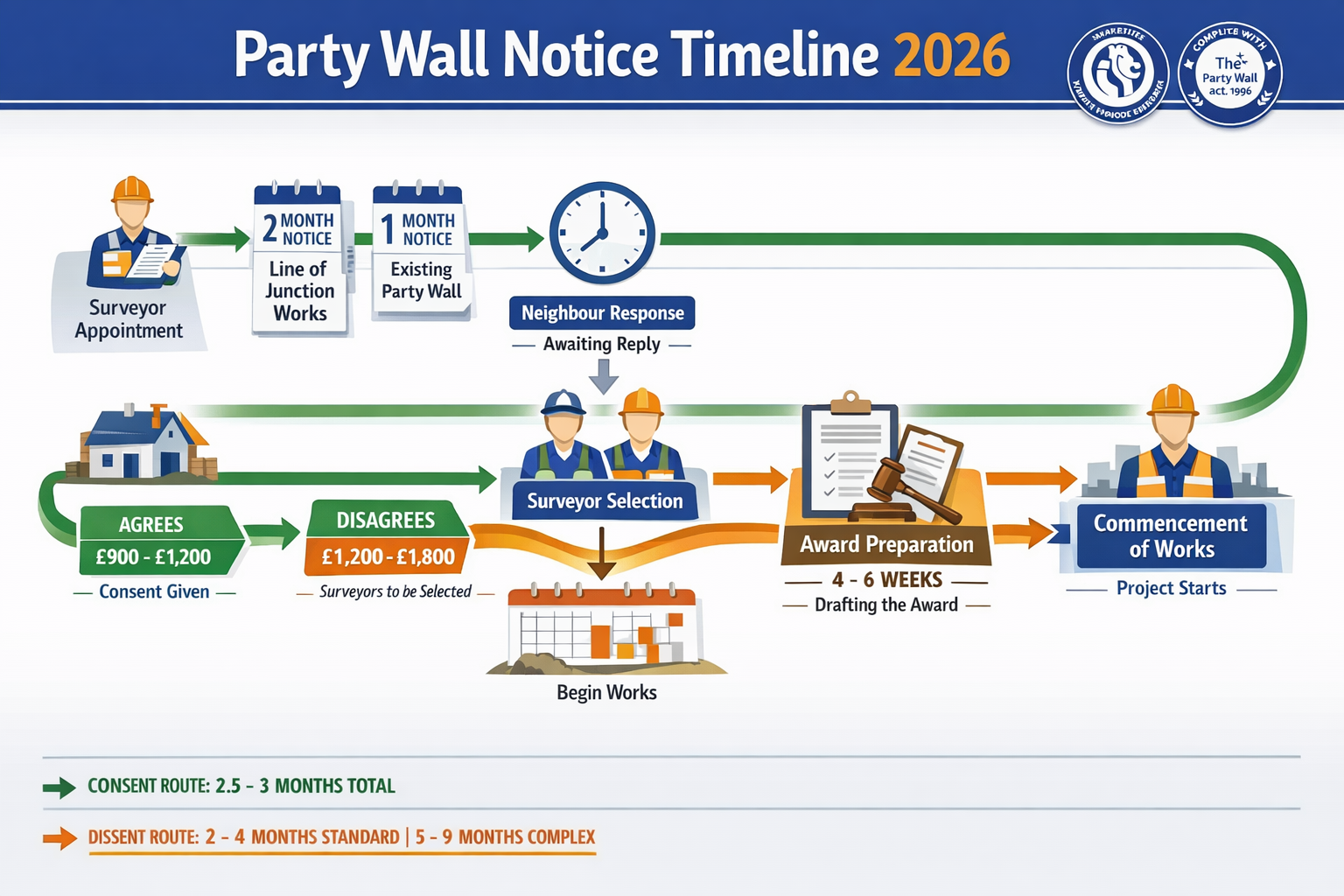
- Notice periods require 2 months for new boundary work and 1 month for work affecting existing party walls, with realistic timelines of 2–4 months from surveyor appointment to breaking ground
- The Party Wall Act applies even with planning permission—they are completely separate legal requirements that operate independently
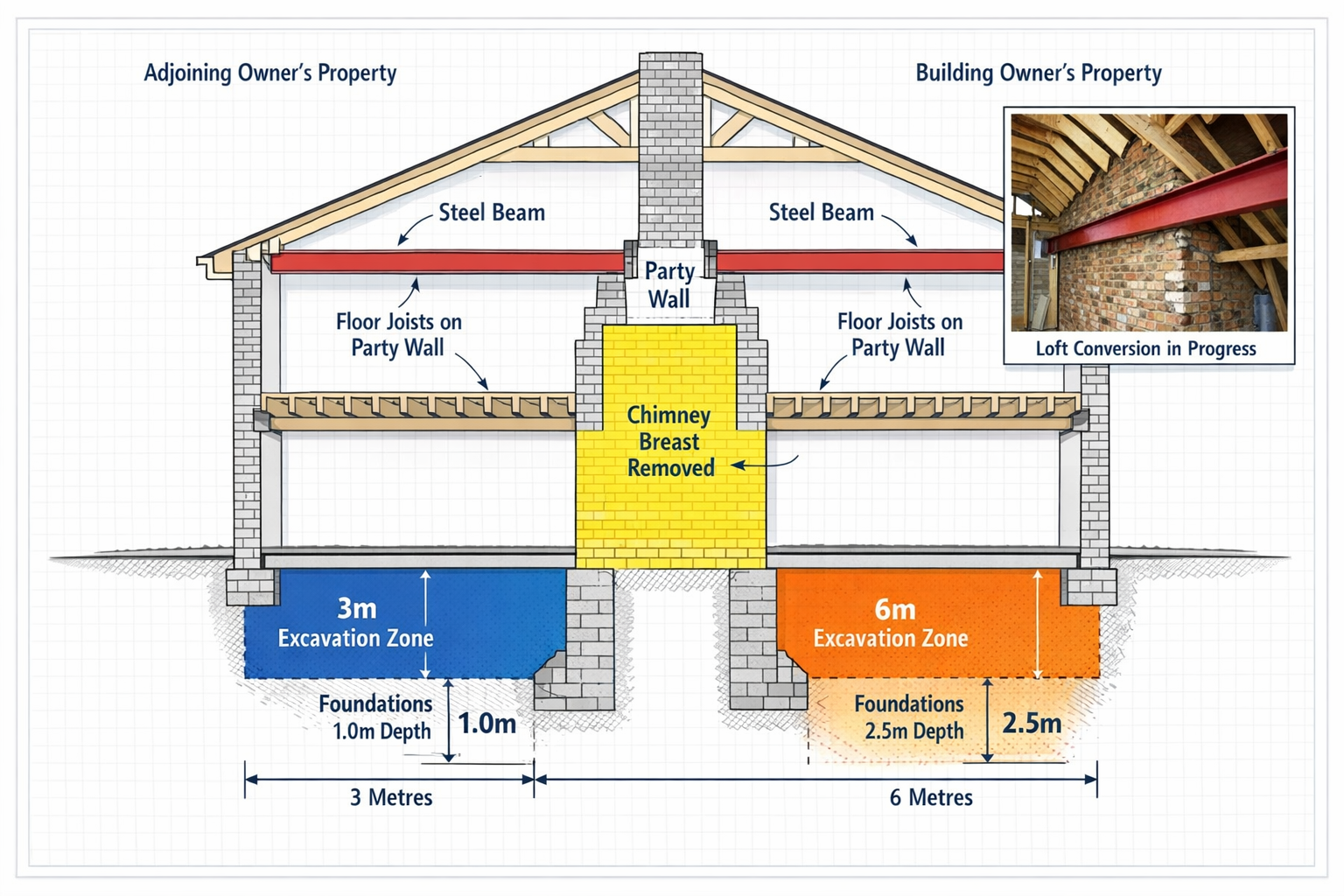
- Excavation within 3 metres of a neighbour's foundation (or 6 metres at certain angles) triggers additional notice requirements beyond standard party wall work
- Early engagement with qualified party wall surveyors prevents costly delays and protects both you and your neighbour through proper documentation
Understanding When Party Wall Surveying Applies to Your Project
What Triggers the Party Wall etc. Act 1996?
The Party Wall etc. Act 1996 covers three main types of work that commonly affect terraced and semi-detached homeowners planning loft conversions or rear extensions:
1. Work Directly on an Existing Party Wall 🏗️
This includes:
- Cutting into the party wall to insert steel beams for loft conversions
- Removing chimney breasts that form part of the shared wall
- Inserting damp-proof courses
- Raising the party wall height for loft extensions
- Underpinning the party wall
2. Building on the Boundary Line (Line of Junction)
This applies when you're constructing a new wall directly on the property boundary, such as:
- Single-storey rear extensions built up to the boundary
- Garden walls along the property line
- New foundations at the boundary
3. Excavation Near Neighbouring Structures
Known as the 3-metre rule, excavation notices are required when:
- Digging within 3 metres of a neighbour's structure and going below their foundation level
- Digging within 6 metres if excavating within a 45-degree angle from the bottom of their foundation
Common Loft Conversion Scenarios
For Party Wall Surveying for Loft Conversions and Rear Extensions: A Practical 2026 Guide for Terraced and Semi-Detached Homes, loft conversions typically trigger party wall requirements when:
| Loft Conversion Work | Party Wall Notice Required? | Notice Type |
|---|---|---|
| Steel beam bearing on party wall | ✅ Yes | Party Structure Notice |
| Removing shared chimney breast | ✅ Yes | Party Structure Notice |
| Raising party wall for dormer | ✅ Yes | Party Structure Notice |
| Internal loft work (no wall contact) | ❌ No | None |
| New party wall insulation | ✅ Yes | Party Structure Notice |
Our detailed guide on loft conversions and party walls provides specific scenarios and requirements.
Rear Extension Party Wall Requirements
Single-storey rear extensions in terraced and semi-detached properties almost always require party wall procedures because:
- The new extension typically sits on or near the boundary line
- Foundations require excavation close to neighbouring structures
- The new wall may need to tie into or abut the existing party wall
Important: Party wall agreements are needed even for permitted development projects. Planning permission and the Party Wall Act operate completely independently—having one doesn't exempt you from the other.
The Party Wall Surveying Process: Step-by-Step Timeline
Phase 1: Initial Planning and Surveyor Appointment (Weeks 1-2)
Before serving any notices, building owners should:
- Appoint a qualified party wall surveyor early in the design stage
- Review architectural plans to identify all party wall implications
- Prepare accurate drawings and specifications
- Determine which neighbours will be affected
"The biggest mistake homeowners make is leaving party wall matters until after planning permission is granted. By then, you've already lost valuable time." — Party Wall Surveyor, London
Your surveyor will help you understand exactly which notices you need to serve and to whom. For complex projects involving shared chimneys or multiple party walls, professional guidance is invaluable.
Phase 2: Serving Party Wall Notices (Months 1-2)
The statutory notice periods are:
- 2 months' notice for Line of Junction work (building on the boundary)
- 1 month's notice for work on existing party structures or excavation
Notices must include:
- Detailed description of the proposed work
- Drawings showing the work
- Start date (at least the statutory period away)
- Statement of the building owner's rights and the adjoining owner's rights
Critical timing note: In 2026's competitive construction market, realistic timelines from surveyor appointment to breaking ground are:
- Best case (neighbour consents): 2.5–3 months
- Standard case (neighbour dissents, Award needed): 2–4 months
- Complex case (access disputes, multiple neighbours): 5–9 months
Phase 3: Neighbour Response Period (14 Days)
After receiving your notice, your neighbour has 14 days to respond in one of three ways:
-
Consent in writing ✅
- Work can proceed after the notice period expires
- No Award needed (though still advisable for protection)
- Rare in practice—most neighbours seek professional advice
-
Dissent or no response 📋
- Triggers the formal surveyor appointment process
- Neighbour selects their own surveyor (at your cost)
- Most common scenario in urban areas
-
Request an Agreed Surveyor 🤝
- Single surveyor acts for both parties
- Can reduce costs (£1,500–£2,800 in London total)
- Requires agreement from both parties—uncommon
For detailed information about securing party wall consent, including template responses and negotiation strategies, refer to our comprehensive guide.
Phase 4: Survey and Award Preparation (Weeks 6-12)
Once surveyors are appointed, the process involves:
Schedule of Condition 📸
- Professional photographic survey of the neighbour's property
- Documents pre-existing defects and conditions
- Protects both parties from spurious damage claims
- Typically costs £300–£600 as part of surveyor fees
Learn more about Schedule of Condition requirements and what they should include.
Award Preparation
The surveyors prepare a Party Wall Award document that includes:
- Detailed description of permitted works
- Working hours and access arrangements
- Special foundations or construction methods required
- Rights of entry for inspection
- Dispute resolution procedures
Awards typically take 4–6 weeks to prepare and must be agreed by both surveyors (or determined by a Third Surveyor if they disagree).
Phase 5: Commencement and Monitoring
Once the Award is served:
- Work can commence on the specified date
- Surveyors may inspect during construction
- Any variations require agreement
- Final inspection confirms compliance
Party Wall Surveyor Costs in 2026: What to Expect
Fee Structures and Regional Variations
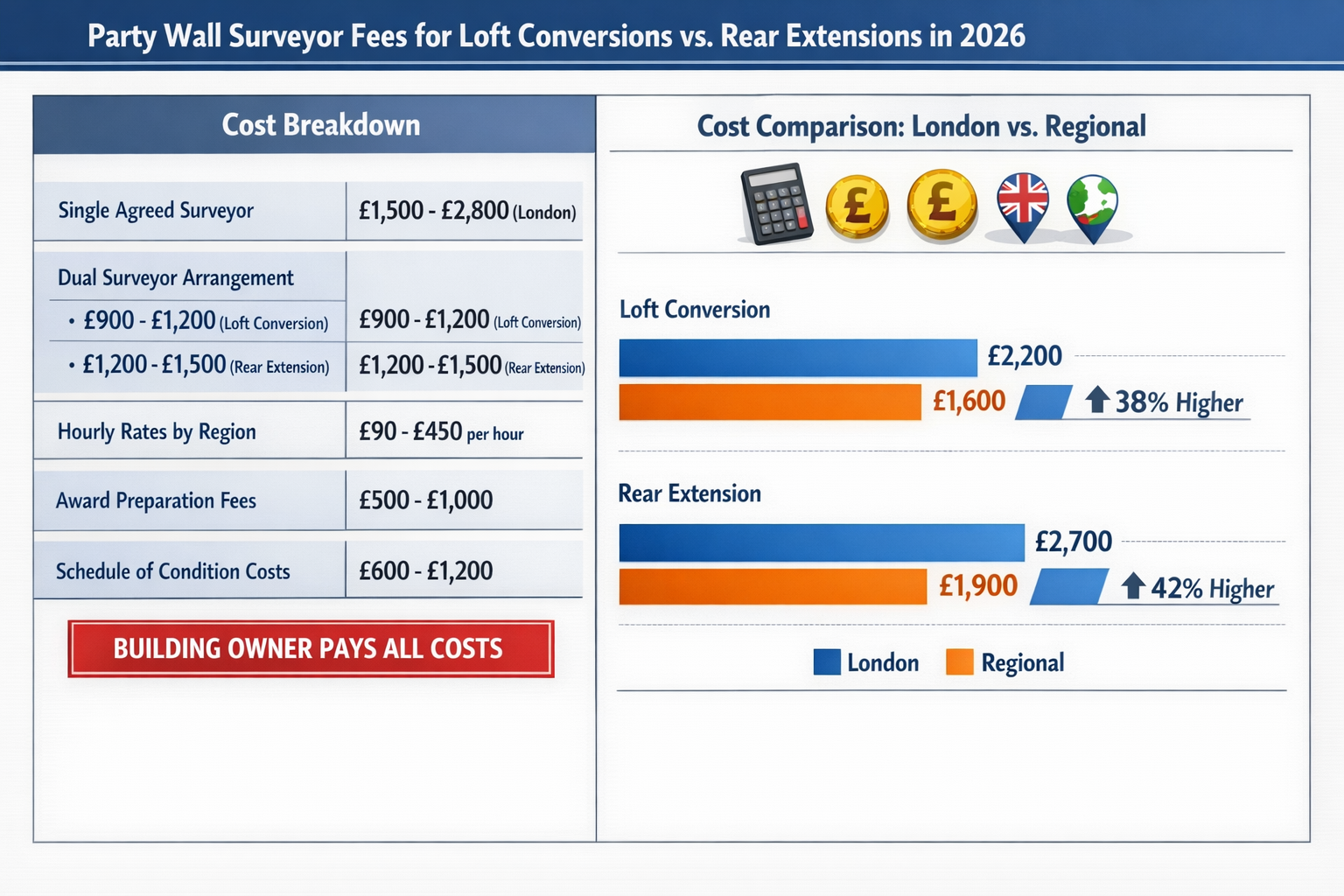
Understanding Party Wall Surveying for Loft Conversions and Rear Extensions: A Practical 2026 Guide for Terraced and Semi-Detached Homes means budgeting appropriately for surveyor costs. Building owners pay all party wall surveyor fees—both their own surveyor and their neighbour's surveyor.
Typical 2026 Costs:
| Project Type | Single Surveyor (Regional) | Single Surveyor (London) | Per Neighbour |
|---|---|---|---|
| Loft Conversion | £900–£1,200 | £1,200–£1,800 | Each affected neighbour |
| Rear Extension | £1,200–£1,500 | £1,500–£2,000 | Each affected neighbour |
| Combined Project | £1,500–£2,000 | £2,000–£2,800 | Each affected neighbour |
| Agreed Surveyor | £1,500–£2,000 | £1,500–£2,800 | Total (both parties) |
Hourly Rates by Region (2026):
- Regional UK: £90–£150 per hour
- Greater London: £150–£250 per hour
- Central London: £200–£450 per hour
Cost Variables That Affect Your Quote
Several factors influence final surveyor costs:
Project Complexity 🔧
- Simple single-wall loft conversion: lower end of range
- Multiple party walls affected: additional fees per wall
- Structural complications: premium rates
- Historic or listed buildings: specialist expertise required
Number of Affected Neighbours 👥
- Terraced house with two adjoining properties: double the surveyor costs
- Corner properties: potentially three or four neighbours
- Flats: multiple leaseholders may be affected
Geographical Location 📍
London commands premium rates due to:
- Higher demand and property values
- Greater surveyor expertise concentration
- Increased complexity of urban projects
- Higher professional indemnity insurance costs
Additional Services 📋
- Schedule of Condition surveys: £300–£600
- Multiple site visits: £150–£300 per visit
- Expert witness services (if disputes escalate): £250–£450/hour
- Third Surveyor appointment (for disputes): additional £1,500–£3,000
Hidden Costs to Budget For
Beyond surveyor fees, factor in:
- Delays to project start: 2–4 months can mean increased material costs in inflationary markets
- Design modifications: Awards may require changes to foundations or construction methods
- Access provisions: Temporary scaffolding or protective measures for neighbour's property
- Dispute resolution: If neighbours raise concerns, additional surveyor time accrues
Money-saving tip: Appointing your surveyor early and maintaining good neighbour relations can prevent costly delays and disputes. A £1,000 investment in proper party wall procedures can save £10,000+ in project delays and legal complications.
Common Pitfalls and How to Avoid Them
Mistake #1: Starting Work Without Proper Notices
The Problem:
Many homeowners assume that because their extension has planning permission or is permitted development, they can proceed immediately. Neighbours carrying out works without party wall agreements create legal liability and risk injunctions.
The Consequences:
- Neighbours can obtain court injunctions stopping your work
- Retrospective Awards are more expensive and complicated
- Damage claims become harder to defend
- Relationship breakdown with neighbours
- Potential criminal prosecution under the Act
The Solution:
Serve notices before appointing builders and signing contracts. Build the 2–4 month party wall timeline into your project planning from day one.
Mistake #2: Choosing the Wrong Surveyor
The Problem:
Not all surveyors are equally qualified in party wall matters. Some builders offer "free party wall services" that lack proper independence or expertise.
What to Look For:
- ✅ RICS-qualified Chartered Building Surveyor
- ✅ Specialist party wall experience (minimum 5 years)
- ✅ Professional indemnity insurance (minimum £2 million)
- ✅ Member of Faculty of Party Wall Surveyors (desirable)
- ✅ Local knowledge of your property type
- ✅ Clear fee structure in writing
Red Flags:
- ❌ Builder's "mate" who does party walls on the side
- ❌ Vague fee estimates without site inspection
- ❌ Promises to "get it done quickly" by cutting corners
- ❌ No professional qualifications or insurance
Mistake #3: Poor Communication with Neighbours
The Problem:
Formal party wall notices arriving without prior conversation can antagonize neighbours and trigger unnecessary dissent.
Best Practice Approach:
- Informal discussion first: Explain your plans before formal notices
- Share preliminary drawings: Visual aids help neighbours understand scope
- Address concerns proactively: Noise, dust, access, parking
- Maintain regular updates: Throughout the notice and construction period
- Document everything: Follow up conversations with written confirmation
"In 15 years of party wall work, I've found that 80% of disputes stem from poor communication, not genuine technical concerns." — Senior Party Wall Surveyor
Mistake #4: Ignoring Excavation Requirements
The Problem:
Many homeowners focus on the party wall itself but overlook excavation notice requirements for foundations.
When Excavation Notices Apply:
- Digging within 3 metres of neighbour's building and going below their foundation level
- Digging within 6 metres if excavation creates a 45-degree angle below their foundation
For detailed guidance, review our explanation of excavation notices for party walls.
The Solution:
Your architect and structural engineer must provide foundation depths and proximity measurements. Your party wall surveyor uses these to determine if excavation notices are needed in addition to party structure notices.
Mistake #5: Inadequate Schedule of Condition
The Problem:
Rushed or incomplete pre-work condition surveys lead to disputes about damage responsibility.
What a Proper Schedule Should Include:
- 📸 Comprehensive photographs (100+ images for typical property)
- 📝 Written descriptions of all defects, cracks, and existing damage
- 📏 Measurements and crack width monitoring
- 🗺️ Floor plans showing photograph locations
- 📅 Date-stamped evidence
- ✍️ Professional surveyor's signature
Read our detailed guide on Schedule of Condition best practices to understand what should be documented.
Protection for Both Parties:
A thorough Schedule protects:
- Building owners from spurious damage claims
- Adjoining owners by documenting their property's condition
- Builders by clarifying pre-existing issues
Frequently Asked Questions About Party Wall Surveying
Do I Need Party Wall Consent for Permitted Development?
Yes. This is one of the most common misconceptions. Planning permission (or permitted development rights) and party wall requirements are completely separate legal frameworks. You need to comply with both.
The Party Wall etc. Act 1996 applies regardless of whether you have:
- Full planning permission
- Permitted development rights
- Certificate of Lawfulness
- Building Regulations approval
For more clarity, visit our party wall FAQ section.
What If My Neighbour Refuses to Cooperate?
Good news: The Act is designed to handle non-cooperation. If your neighbour:
- Refuses to consent: This triggers the surveyor appointment process (standard procedure)
- Won't appoint a surveyor: You can appoint one on their behalf after 10 days
- Refuses access for Schedule of Condition: The Award can proceed based on external inspection only
- Disputes the Award: A Third Surveyor can be appointed to resolve disagreements
The Act ensures your legitimate work can proceed even without neighbour cooperation—but proper procedures must be followed.
Can I Use the Same Surveyor as My Neighbour?
Technically yes, but rarely happens. This is called an "Agreed Surveyor" arrangement where one surveyor acts impartially for both parties.
Advantages:
- Lower total costs (£1,500–£2,800 vs. £3,000–£6,000 for two surveyors)
- Faster process
- Simpler communication
Why It's Uncommon:
- Requires both parties to agree (most neighbours prefer independent representation)
- Perceived conflict of interest
- Neighbours' solicitors usually advise separate surveyors
In practice, fewer than 5% of party wall matters proceed with an agreed surveyor in urban areas.
How Long Does the Entire Process Take?
Realistic 2026 timelines for Party Wall Surveying for Loft Conversions and Rear Extensions: A Practical 2026 Guide for Terraced and Semi-Detached Homes:
Optimistic Scenario (Neighbour Consents):
- Week 1-2: Appoint surveyor, prepare notices
- Week 3-4: Serve 1-month notice
- Week 5-8: Notice period expires, Schedule of Condition
- Total: 2.5–3 months
Standard Scenario (Neighbour Dissents):
- Week 1-2: Appoint surveyor, prepare notices
- Week 3-10: Serve 2-month notice (for Line of Junction work)
- Week 11-12: Neighbour dissents, appoints surveyor
- Week 13-18: Surveyors prepare Award (4-6 weeks)
- Total: 3–4.5 months
Complex Scenario:
- Multiple neighbours: add 2-4 weeks per additional party
- Access disputes: add 4-8 weeks
- Third Surveyor required: add 6-12 weeks
- Total: 5–9 months
What Happens If Damage Occurs During Construction?
The Party Wall Award establishes the framework for handling damage:
- Schedule of Condition provides baseline evidence
- Surveyor inspection determines if damage is construction-related
- Building owner's responsibility to make good any damage caused by the works
- Dispute resolution through the appointed surveyors if parties disagree
This is why proper documentation through a Schedule of Condition is essential—it removes ambiguity about what damage existed before work commenced.
Do I Need a Party Wall Agreement for Internal Loft Conversion?
It depends. A purely internal loft conversion that doesn't affect the party wall doesn't require party wall procedures. However, most loft conversions in terraced and semi-detached homes do affect the party wall because they involve:
- Steel beams bearing on or cutting into the party wall
- Removing chimney breasts that form part of the party structure
- Raising the party wall height for dormers
- Installing new floor joists that bear on the party wall
If in doubt, consult a party wall surveyor during the design stage. The cost of a preliminary consultation (£150–£300) is far less than the cost of getting it wrong.
Practical Tips for Homeowners in 2026
Start Early and Budget Realistically
Timeline Planning:
- Begin party wall discussions 6 months before intended construction start
- Factor 3–4 months minimum for party wall process
- Don't sign builder contracts until Awards are in place
- Build contingency time for potential delays
Budget Planning:
For a typical terraced house loft conversion affecting two neighbours:
- Party wall surveyor fees: £3,600–£7,200 (your surveyor + two neighbours' surveyors)
- Schedule of Condition: £600–£1,200
- Contingency for variations: 10% of surveyor costs
- Total party wall budget: £4,500–£9,000
Maintain Detailed Records
Create a party wall file containing:
- 📧 All email correspondence with neighbours
- 📋 Copies of all notices served (with proof of service)
- 📸 Your own photographs of neighbour's property
- 📄 All surveyor correspondence and invoices
- 📝 Award documents and any variations
- 🗓️ Timeline log of key dates
This documentation proves invaluable if disputes arise or when selling your property.
Choose Your Builder Wisely
Select contractors with party wall experience:
- ✅ Previous experience with party wall projects
- ✅ Understanding of Award conditions and restrictions
- ✅ Willingness to accommodate surveyor inspections
- ✅ Proper insurance (including party wall damage cover)
- ✅ References from projects with similar party wall requirements
Brief your builder thoroughly on:
- Working hours specified in the Award
- Access restrictions
- Protection measures required
- Notification requirements for inspections
Know When to Seek Additional Help
Beyond party wall surveyors, you may need:
Structural Engineers:
- Design foundations that comply with party wall requirements
- Specify steel beam sizes and bearing details
- Provide calculations for Award appendices
Solicitors:
- If disputes escalate beyond surveyor resolution
- For injunction defense if you've inadvertently started work
- When party wall disputes become adversarial
Specialist Consultants:
- Acoustic engineers for noise-sensitive conversions
- Conservation specialists for listed buildings
- Arboriculturists if tree roots affect party walls
Understanding Your Rights and Obligations
As a Building Owner, You Have the Right To:
- Carry out necessary work to your property
- Appoint a qualified surveyor
- Expect reasonable cooperation from neighbours
- Proceed even if neighbours object (following proper procedures)
As a Building Owner, You Must:
- Serve proper notices with adequate time
- Pay all reasonable party wall surveyor costs
- Make good any damage caused by your works
- Work within the conditions specified in the Award
- Provide access for surveyor inspections
As an Adjoining Owner, You Have the Right To:
- Receive proper notice of proposed works
- Appoint your own surveyor (at building owner's cost)
- Have your property condition documented
- Receive compensation for any damage
- Refuse unreasonable working hours or access
Conclusion: Taking Action on Your Party Wall Requirements
Party Wall Surveying for Loft Conversions and Rear Extensions: A Practical 2026 Guide for Terraced and Semi-Detached Homes doesn't need to be overwhelming. While the process adds time and cost to your project, it provides essential legal protection for both you and your neighbours. In 2026's cost-conscious construction market, getting party wall procedures right the first time prevents expensive delays and disputes.
Your Action Plan
Immediate Steps (This Week):
- ✅ Review your architectural plans to identify party wall implications
- ✅ Research and shortlist qualified party wall surveyors in your area
- ✅ Have an informal conversation with affected neighbours about your plans
- ✅ Request preliminary quotes from 2-3 surveyors
Short-term Steps (This Month):
- ✅ Appoint your party wall surveyor
- ✅ Finalize construction drawings with architect and structural engineer
- ✅ Prepare and serve party wall notices
- ✅ Budget £4,500–£9,000 for party wall costs (typical terraced house)
Medium-term Steps (Next 3-4 Months):
- ✅ Coordinate surveyor appointments and Schedule of Condition
- ✅ Review and agree Party Wall Award terms
- ✅ Brief your builder on Award conditions
- ✅ Maintain regular communication with neighbours
Final Thoughts
The Party Wall etc. Act 1996 exists to balance property owners' rights to improve their homes with neighbours' rights to protection from damage and disruption. While it may seem like bureaucratic red tape, proper party wall surveying:
- Protects your investment through documented conditions
- Prevents costly disputes by establishing clear procedures
- Maintains neighbour relations through formal, fair processes
- Ensures legal compliance that protects property value
- Provides insurance against spurious damage claims
In dense urban environments where terraced and semi-detached homes dominate, party wall procedures are simply part of responsible property ownership. By understanding the requirements, budgeting appropriately, and engaging qualified professionals early, your loft conversion or rear extension project can proceed smoothly and legally.
For personalized guidance on your specific project, consult with an RICS-qualified party wall surveyor who can assess your plans and provide accurate timelines and costs. The investment in proper party wall procedures pays dividends in peace of mind and project success.
Ready to start your party wall process? Visit our main party wall services page to learn more about how we can help with your loft conversion or rear extension project.