{"cover":"Professional landscape format (1536x1024) hero image with bold text overlay 'When Do You Need an Expert Witness Surveyor?' in extra large 72pt white sans-serif font with dark shadow, centered in upper third. Background shows UK courtroom interior with professional surveyor holding technical documents and blueprints, gavels and property plans visible on mahogany desk, scales of justice subtly in background. Color scheme: deep navy blue, gold accents, white text. High contrast, editorial magazine cover quality, legal and property expertise aesthetic, photorealistic rendering.","content":["Detailed landscape format (1536x1024) image showing split-screen comparison: left side displays professional surveyor examining property valuation documents with Red Book RICS standards visible, calculator and property photographs on desk; right side shows courtroom setting with judge's bench and witness stand. Central overlay text 'CPR Part 35 Compliance' in bold typography. Color palette: professional blues and grays, warm wood tones. Photorealistic, editorial quality with infographic elements showing expert witness duties flowchart.","Landscape format (1536x1024) technical illustration showing three distinct property dispute scenarios in triptych layout: left panel shows boundary fence dispute with surveyor measuring land with theodolite equipment and disputed boundary line highlighted in red; center panel displays building with structural cracks and defects marked with annotation callouts; right panel shows two property valuations side-by-side with price discrepancy highlighted. Professional architectural drawing style mixed with photorealistic elements, clean lines, technical precision, muted color scheme with accent colors for key dispute areas.","Landscape format (1536x1024) professional photograph of RICS-accredited expert witness surveyor in business attire presenting evidence in modern UK tribunal setting, pointing to large display screen showing detailed property survey report with photographs, floor plans, and valuation figures. Tribunal panel visible in background, legal representatives taking notes. Foreground shows organized case files, RICS professional standards documentation, and expert witness report bound documents. Bright, professional lighting, corporate documentary style, conveys authority and expertise."]}
When property disputes escalate beyond negotiation and land in court or tribunal proceedings, the testimony of an expert witness surveyor can make or break a case. Whether facing a negligent valuation claim, battling over boundary lines, or proving building defects caused financial loss, understanding when and why to engage an expert witness surveyor is crucial for legal professionals and property owners alike. This comprehensive guide explores when do you need an expert witness surveyor, examining the UK legal framework, common dispute scenarios, and professional standards that govern this specialized field in 2026.

Key Takeaways
- Expert witness surveyors provide independent, impartial evidence to courts and tribunals in property disputes, governed by Civil Procedure Rules Part 35 and RICS professional standards
- The RICS 5th Edition Professional Standard for expert witnesses is now in effect in 2026, introducing global application and addressing modern technology challenges
- Common scenarios requiring expert witness surveyors include valuation disputes, building defect claims, boundary disagreements, and professional negligence cases
- Expert witnesses have a primary duty to the court, not to the party instructing them, distinguishing them from ordinary consultants
- Proper engagement requires understanding single joint expert appointments, CPR-compliant report formats, and the accreditation standards expected by legal professionals
Understanding the Expert Witness Surveyor Role
What Makes an Expert Witness Different?
An expert witness surveyor occupies a unique position in legal proceedings. Unlike a consultant hired to advance a client's interests, an expert witness owes their primary duty to the court or tribunal, not to the instructing party. This fundamental distinction shapes every aspect of their work, from initial instruction to courtroom testimony.
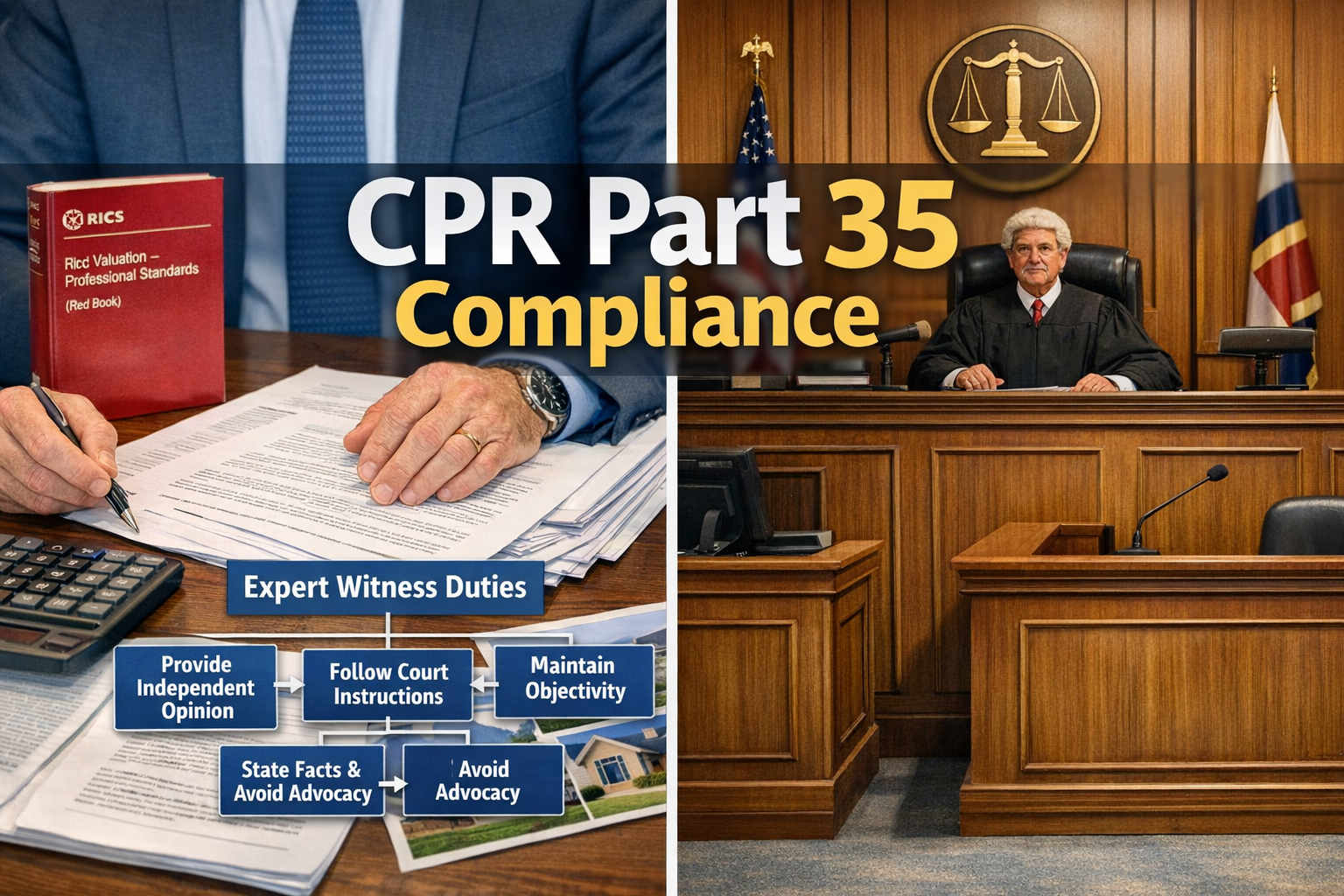
The Civil Procedure Rules (CPR) Part 35 establishes the framework governing expert evidence in England and Wales. Under these rules, expert witnesses must:
- Provide independent, unbiased opinions based on their expertise
- Assist the court in understanding technical matters outside ordinary knowledge
- Restrict their evidence to matters within their area of competence
- Declare any conflicts of interest or relationships that might affect impartiality
The Royal Institution of Chartered Surveyors (RICS) supplements these legal requirements with professional standards. The recently implemented RICS Professional Standard for Surveyors Acting as Expert Witnesses 5th Edition represents a significant update from the previous 4th Edition (published April 2014, amended February 2023). Unlike its predecessor, which applied only to the UK, the 5th Edition has global application and addresses emerging risks including conditional fees and modern technology challenges.[1][2]
RICS Expert Witness Accreditation
While not mandatory, the RICS Expert Witness Accreditation Service (EWAS) provides a voluntary quality mark that solicitors and barristers increasingly seek when selecting expert witnesses. Updated as recently as March 2025, this accreditation requires dedicated training and assessment, demonstrating a surveyor's competence in expert witness procedures beyond their technical surveying expertise.[3]
Accredited experts must demonstrate proficiency in:
✅ CPR Part 35 compliance and court procedures
✅ Report writing to professional standards
✅ Cross-examination techniques and courtroom conduct
✅ Conflict management and ethical considerations
✅ Fee arrangement protocols and terms of engagement
For those seeking expert witness report services, RICS accreditation provides assurance of both technical competence and procedural expertise.
When Do You Need an Expert Witness Surveyor? Common Dispute Scenarios
Valuation Disputes and Negligent Valuation Claims
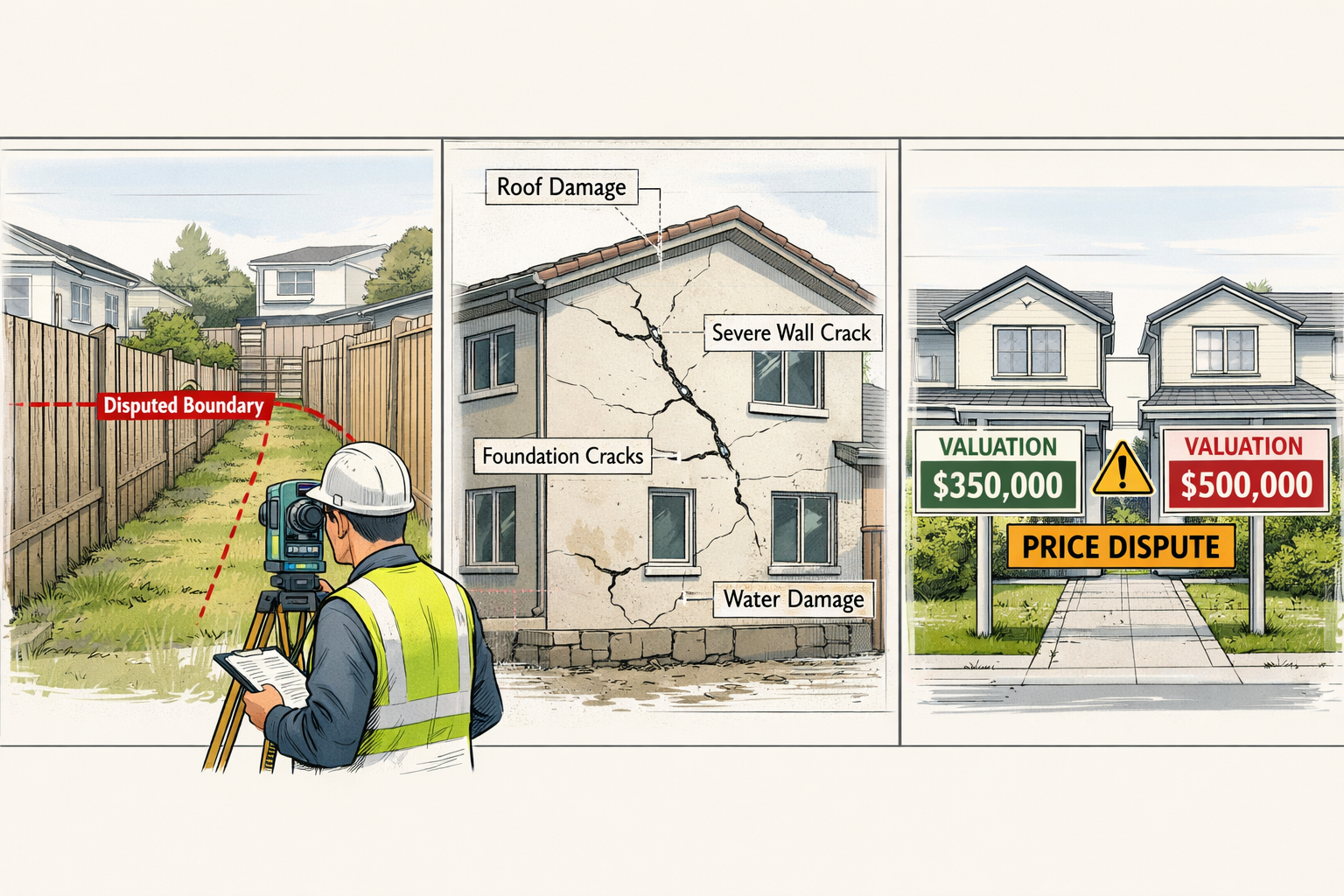
Valuation disputes represent one of the most common scenarios requiring expert witness testimony. These cases typically arise when:
Professional Negligence Claims: A property purchaser alleges their surveyor provided a negligent valuation, causing them to overpay for a property. The claimant must prove the valuation fell outside the acceptable "bracket" of professional opinion and that they suffered quantifiable loss as a result.
Matrimonial Proceedings: During divorce settlements, parties may disagree on property values. Expert witnesses provide matrimonial valuations that assist courts in achieving equitable asset division.
Probate Disputes: Beneficiaries or HMRC may challenge estate valuations, requiring independent expert opinion on market value at the date of death. Specialized valuation for probate services often transition to expert witness roles when disputes arise.
Compulsory Purchase and Compensation: When public authorities acquire property compulsorily, expert witnesses determine fair compensation based on market value and disturbance costs.
Lease Extension and Enfranchisement: Disputes over premium calculations for lease extensions or collective enfranchisement frequently require expert valuation evidence under the Leasehold Reform Act.
The expert witness in valuation disputes must demonstrate their opinion aligns with RICS Red Book standards and accepted valuation methodology. Understanding whether a mortgage valuation is the same as a survey helps contextualize the different standards applicable to various valuation purposes.
Building Defect and Dilapidation Claims
Construction defects and dilapidation disputes demand expert witnesses who can identify causation, quantify remedial costs, and attribute responsibility. Key scenarios include:
Latent Defects: Purchasers discovering hidden defects after completion may pursue claims against sellers or their surveyors. Expert witnesses must determine whether defects were reasonably discoverable during pre-purchase surveys and quantify diminution in value.
New Build Snagging Disputes: When developers dispute the extent or cost of remedial works for defects in new properties, expert witnesses provide objective assessments of defect severity and appropriate remediation.
Commercial Dilapidations: At lease end, landlords and tenants often disagree on dilapidation liabilities. Expert witnesses assess breach of repairing covenants and quantify reasonable remedial costs, considering diminution in value and statutory caps.
Professional Negligence (Building Surveys): Claims that surveyors failed to identify or properly report defects require expert evidence on whether the survey met professional standards and whether earlier detection would have prevented loss.
For those seeking comprehensive defect assessment, a RICS specific defect survey provides the technical foundation that may later support expert witness testimony if disputes arise.
Boundary Disputes and Rights of Way
Boundary disagreements between neighbors can escalate into bitter legal battles requiring expert surveyor testimony. These disputes involve:
Disputed Boundary Lines: When title plans prove ambiguous or conflicting evidence exists regarding historic boundaries, expert surveyors analyze deeds, Ordnance Survey records, physical features, and occupation patterns to determine the legal boundary position.
Adverse Possession Claims: Parties claiming land through long possession require expert evidence demonstrating the extent and nature of occupation relative to boundary positions.
Rights of Way and Easements: Disputes over access rights, extent of easements, or obstruction claims benefit from expert analysis of historic usage, physical constraints, and reasonable access requirements.
Party Wall Disputes: While party wall disputes typically involve party wall surveyors under the Party Wall etc. Act 1996, these can escalate to litigation requiring expert witness evidence on damage causation or award reasonableness.
Professional boundary surveys establish baseline positions, but expert witness surveyors bring additional skills in evidence analysis, legal interpretation, and courtroom presentation when these matters reach litigation.
Other Common Expert Witness Scenarios
Subsidence and Structural Movement: Determining causation (tree roots, drainage, mining, construction activity) and appropriate remediation requires specialist expertise.
Right to Buy Valuations: Disputes over discount calculations or market value assessments in social housing purchases may require tribunal evidence.
Commercial Rent Reviews: When landlords and tenants cannot agree on reviewed rents, expert witnesses provide market rental evidence.
Planning and Development Disputes: Expert evidence on property values before and after planning decisions, or on development viability, supports planning appeals and judicial reviews.
The Expert Witness Process: From Instruction to Evidence
Initial Instruction and Conflicts of Interest
The expert witness engagement begins with proper instruction, governed by strict professional standards. The RICS 5th Edition emphasizes clear terms of engagement and robust conflict of interest management.[2]
Before accepting instruction, expert witnesses must:
🔍 Verify competence in the specific technical area
🔍 Identify conflicts including previous relationships with parties, properties, or related matters
🔍 Clarify scope of work and reporting requirements
🔍 Agree fee arrangements (noting restrictions on conditional fees)
🔍 Confirm availability for report preparation and potential court attendance
The current RICS standard addresses emerging risks around conditional fee arrangements, which can compromise the appearance of independence. Expert witnesses must structure fees to avoid any suggestion that payment depends on case outcome.[1]
Single Joint Experts vs. Party-Appointed Experts
Courts increasingly favor Single Joint Expert (SJE) appointments to reduce costs and streamline proceedings, particularly in lower-value claims. Under this arrangement:
- Both parties jointly instruct one expert
- The expert owes duties equally to both parties (and ultimately to the court)
- Parties share costs equally unless otherwise ordered
- Both parties may submit written questions to the expert
However, in complex or high-value disputes, courts may permit party-appointed experts, where each side instructs their own expert. This approach allows:
- More detailed exploration of technical issues
- Alternative methodological approaches
- Robust testing of opposing positions
- Joint expert meetings to narrow issues
Regardless of appointment type, the expert's primary duty remains to the court, not to the instructing party or parties.
CPR Part 35 Compliant Report Writing
The expert witness report represents the cornerstone of expert evidence. CPR Part 35 and its Practice Direction specify mandatory content requirements:
Essential Report Elements:
- Expert's qualifications and experience relevant to the issues
- Statement of truth confirming understanding of duties to the court
- Instructions received (including questions to be answered)
- Facts and assumptions upon which the opinion is based
- Investigation and methodology employed
- Opinion and reasoning clearly explained
- Range of opinion if the issue falls within a spectrum of professional views
- Summary of conclusions with clear answers to instructed questions
- Declaration that the expert understands their duty and has complied with it
- Statement of truth in prescribed form
The report must be clear, comprehensive, and comprehensible to non-technical readers (judges, tribunals, juries). Technical jargon requires explanation, and opinions must be supported by reasoned analysis, not mere assertion.
Expert Meetings and Joint Statements
When parties appoint separate experts, the court typically orders an expert meeting to identify areas of agreement and disagreement. This "without prejudice" discussion allows experts to:
- Clarify technical understanding
- Identify common ground
- Narrow disputed issues
- Agree facts where possible
- Define remaining areas of disagreement
Following the meeting, experts produce a joint statement listing agreed facts, agreed opinions, disagreed matters (with brief reasons), and any further information needed. This document significantly streamlines trial preparation and may facilitate settlement.
Court Attendance and Cross-Examination
If settlement proves impossible, expert witnesses attend trial or hearing to give oral evidence. This involves:
Examination-in-Chief: The instructing party's barrister asks questions to present the expert's evidence (often limited if a detailed report exists).
Cross-Examination: Opposing counsel tests the expert's opinions, methodology, assumptions, and credibility. Effective cross-examination preparation requires:
- Thorough knowledge of all case documents
- Understanding of opposing expert's position
- Ability to defend methodology and assumptions
- Maintaining composure and impartiality under pressure
- Acknowledging limitations or errors when appropriate
Re-Examination: The instructing barrister may ask follow-up questions to clarify points raised in cross-examination.
Throughout testimony, experts must remember their duty to assist the court, even if answers prove unhelpful to the instructing party. Advocacy or partisan behavior undermines credibility and breaches professional obligations.
Professional Standards and Best Practices in 2026
The RICS 5th Edition: Key Changes
The RICS Professional Standard for Surveyors Acting as Expert Witnesses 5th Edition, now in effect in 2026, introduces several important updates:
Global Application: Unlike the UK-only 4th Edition, the new standard applies to RICS members worldwide, reflecting the international nature of property disputes and RICS membership.[1]
Technology and Modern Risks: The 5th Edition explicitly addresses challenges arising from digital communication, electronic disclosure, remote hearings (accelerated by COVID-19), and data security obligations.[1]
Enhanced Integrity Requirements: Strengthened guidance on impartiality, independence, and conflicts of interest responds to evolving court expectations and professional scrutiny.
Fee Arrangement Protocols: More detailed requirements govern fee structures, particularly addressing conditional or contingent arrangements that might compromise independence.[2]
Expanded Expertise Areas: Recognition of emerging surveying specialisms and the need for experts to clearly define and remain within their competence boundaries.
Maintaining Professional Independence
The hallmark of effective expert witness work is demonstrable independence. Best practices include:
📋 Documented methodology showing objective analysis
📋 Balanced reporting acknowledging strengths and weaknesses in all positions
📋 Transparent assumptions clearly stated and justified
📋 Willingness to modify opinions when presented with new evidence
📋 Avoidance of advocacy or partisan language
📋 Clear fee arrangements divorced from case outcomes
Experts who maintain independence earn credibility with courts, even when their opinions prove unfavorable to instructing parties. Conversely, perceived bias or advocacy can destroy an expert's effectiveness and damage professional reputation.
Quality Assurance and Continuing Development
Leading expert witness surveyors implement quality assurance processes including:
- Peer review of draft reports before submission
- Continuing professional development in both technical and procedural areas
- Case debriefs to learn from each engagement
- Updated knowledge of case law affecting expert evidence
- Technical library maintenance with current standards, guidance, and research
The RICS Expert Witness Accreditation Service requires ongoing demonstration of competence, ensuring accredited experts maintain currency in both surveying practice and expert witness procedures.[3]
Selecting the Right Expert Witness Surveyor
Essential Qualifications and Experience
When solicitors or parties select expert witness surveyors, key criteria include:
Technical Expertise: Deep knowledge in the relevant specialism (valuation, building surveying, boundary determination, etc.). Generalist surveyors may lack the detailed expertise required for complex disputes.
Expert Witness Experience: Understanding CPR Part 35, report writing standards, and courtroom procedures. Technical competence alone does not guarantee effective expert witness performance.
Professional Credentials: RICS membership (MRICS or FRICS) provides baseline assurance, while RICS Expert Witness Accreditation demonstrates additional procedural competence.
Relevant Case Experience: Track record in similar disputes, ideally with experience of the specific court or tribunal (County Court, High Court, First-tier Tribunal, Upper Tribunal, etc.).
Communication Skills: Ability to explain complex technical matters clearly to non-specialist audiences, both in writing and orally.
Availability and Responsiveness: Capacity to meet court-imposed deadlines and attend hearings on required dates.
Questions to Ask Potential Experts
Before instruction, solicitors should explore:
- What is your specific experience in [valuation/defects/boundaries]?
- How many expert witness cases have you handled?
- What proportion of your work involves expert witness appointments?
- Have you been cross-examined in court? How many times?
- Do you hold RICS Expert Witness Accreditation?
- Can you identify any potential conflicts of interest?
- What is your fee structure and availability?
- Can you provide references from previous instructing solicitors?
For property owners considering whether to engage an expert witness, consulting with legal advisors about the strength of the case and proportionality of expert costs is essential before proceeding.
Understanding Costs and Proportionality
Expert witness fees represent a significant litigation cost. Typical charging structures include:
- Hourly rates for report preparation, meetings, and court attendance
- Fixed fees for defined scope reports
- Daily rates for court attendance
In 2026, expert witness surveyor fees typically range from £150-£400+ per hour depending on expertise, complexity, and geographic location. Court attendance often commands premium daily rates of £2,000-£5,000+.
Courts apply proportionality principles when assessing costs, potentially disallowing excessive expert fees even for successful parties. Understanding valuation costs and survey pricing helps contextualize expert witness fees within the broader spectrum of surveying services.
Conclusion: Making Informed Decisions About Expert Witness Surveyors
Understanding when do you need an expert witness surveyor empowers both legal professionals and property owners to navigate disputes effectively. Whether facing valuation disagreements, building defect claims, or boundary disputes, expert witness surveyors provide the independent, technically-grounded evidence that courts and tribunals require to reach informed decisions.
The implementation of the RICS 5th Edition Professional Standard in 2026 reinforces the importance of selecting properly qualified, demonstrably independent experts who understand both their technical specialism and their procedural obligations under CPR Part 35. With global application and enhanced guidance on modern technology challenges, these standards ensure expert witness surveying keeps pace with evolving legal and professional expectations.
Key Action Steps
For those considering expert witness engagement:
✅ Assess necessity: Determine whether technical complexity and dispute value justify expert costs
✅ Seek early advice: Engage experts early for preliminary opinions on case strength
✅ Verify credentials: Confirm RICS membership, relevant experience, and ideally EWAS accreditation
✅ Check independence: Ensure no conflicts of interest that might undermine credibility
✅ Clarify scope: Provide clear instructions defining questions to be answered
✅ Understand process: Familiarize yourself with CPR Part 35 requirements and expert obligations
✅ Consider SJE: Explore single joint expert appointments for proportionate dispute resolution
Whether you require a comprehensive RICS valuation that might later require expert witness support, or face an existing dispute demanding immediate expert evidence, selecting the right surveyor with appropriate technical expertise and procedural competence remains paramount.
The expert witness surveyor's unique role—serving the court while applying specialized knowledge—makes them indispensable in resolving property disputes fairly and efficiently. By understanding when and how to engage these professionals, parties can navigate even complex disputes with confidence, supported by credible, independent evidence that assists tribunals in reaching just outcomes.
References
[1] Rics Consultation On Professional Standard For Surveyors Acting As Expert Witnesses 5th Edition 2025 – https://www.ewi.org.uk/News/rics-consultation-on-professional-standard-for-surveyors-acting-as-expert-witnesses-5th-edition-2025
[2] Surveyors Acting As Expert Witnesses – https://www.rics.org/profession-standards/rics-standards-and-guidance/sector-standards/dispute-resolution-standards/surveyors-acting-as-expert-witnesses
[3] Expert Witness Accreditation Service – https://www.rics.org/dispute-resolution-service/panel-of-experts/expert-witness-accreditation-service