Bungalows have quietly become one of the UK's most sought-after property types in 2026, with sustained demand from multiple buyer segments creating a competitive market landscape. According to RICS data, single-storey properties continue to command premium valuations despite representing only a small fraction of available housing stock. Understanding Valuing Bungalows in 2026 UK Markets: Building Survey Insights for High-Demand Segments requires combining sophisticated valuation strategies with comprehensive structural assessments to build buyer and investor confidence in this specialized property sector.
The convergence of demographic shifts, accessibility requirements, and lifestyle preferences has transformed bungalows from niche properties into highly competitive assets. Yet accurate valuation remains challenging due to limited comparable sales data, regional variations, and the critical importance of structural condition in determining true market value.
Key Takeaways
✅ Sustained Demand Drivers: Bungalows attract multiple high-value segments including downsizers aged 65+, accessibility-focused buyers, and lifestyle purchasers seeking single-level living
✅ Premium Valuations: Single-storey properties command 15-25% premiums over equivalent two-storey houses in high-demand locations due to scarcity and demographic trends
✅ Survey-Critical Assets: Building survey findings significantly impact bungalow valuations, with structural issues like roof deterioration, foundation settlement, and damp affecting prices by 10-30%
✅ Regional Variations: Coastal areas, retirement destinations, and accessible market towns show strongest bungalow price growth in 2026, outpacing general housing market trends
✅ Investment Opportunity: Limited new construction and aging housing stock create supply constraints that support long-term value appreciation for well-maintained bungalows
Understanding High-Demand Bungalow Segments in 2026 UK Markets
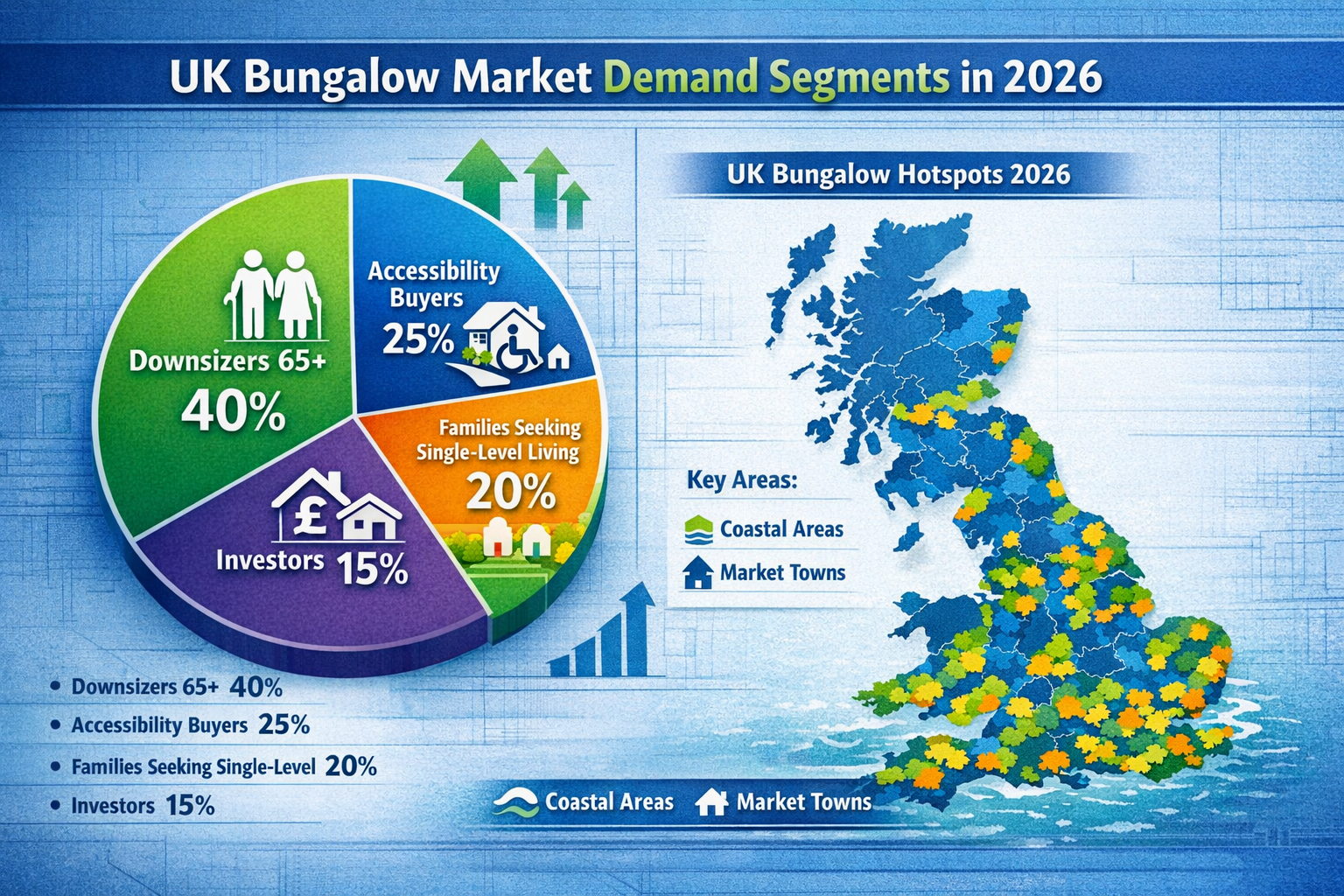
The bungalow market in 2026 demonstrates remarkable resilience across multiple buyer demographics, each bringing distinct valuation considerations and purchasing criteria.
The Downsizer Demographic 🏡
Mature homeowners aged 65 and above represent the largest and most financially capable segment pursuing bungalows in 2026. This demographic typically:
- Possesses substantial equity from previous property ownership
- Prioritizes accessibility features and future-proofing
- Values proximity to healthcare facilities and community amenities
- Demonstrates willingness to pay premiums for move-in ready conditions
The downsizer segment particularly values properties that have undergone recent updates to electrical systems, heating infrastructure, and accessibility modifications. RICS building surveys play a crucial role in confirming these properties meet modern standards and won't require immediate capital expenditure.
Accessibility-Focused Buyers
Individuals and families requiring wheelchair accessibility or mobility adaptations create consistent demand for bungalows with:
- Level access entrances and wide doorways
- Wet rooms or accessible bathroom facilities
- Open-plan layouts facilitating movement
- Adequate space for medical equipment or care provision
This segment often works with occupational therapists and requires detailed building assessments to confirm properties can accommodate specific adaptations. Understanding these requirements helps valuers accurately price properties with existing accessibility features at appropriate premiums.
Lifestyle and Family Buyers
A growing cohort of younger families and lifestyle purchasers seeks bungalows for:
- Enhanced outdoor living and garden access
- Reduced stair-related safety concerns with young children
- Easier supervision of children across single-level layouts
- Potential for loft conversions adding value over time
This segment typically has longer ownership horizons and may accept properties requiring modernization, provided structural surveys confirm sound foundations and major building elements.
Investment and Portfolio Buyers
Property investors increasingly recognize bungalows as resilient assets offering:
- Strong rental yields from downsizer and accessibility markets
- Limited new supply supporting capital appreciation
- Diversification from standard buy-to-let portfolios
- Potential for value-add through extensions or conversions
Investment buyers require comprehensive valuation analysis balancing current rental income against capital growth potential and maintenance obligations specific to single-storey construction.
Building Survey Insights: Critical Factors in Valuing Bungalows in 2026 UK Markets
Structural condition exerts disproportionate influence on bungalow valuations compared to multi-storey properties. The concentrated footprint and specific construction characteristics of bungalows create unique survey considerations that directly impact market value.
Roof Structure and Condition Assessment
Roof integrity represents the single most critical valuation factor for bungalows. Unlike two-storey properties where roof issues affect a smaller proportion of living space, bungalow roof problems impact the entire dwelling.
Key survey findings affecting valuation include:
| Roof Issue | Typical Value Impact | Survey Detection Method |
|---|---|---|
| Minor tile slippage | 2-5% reduction | Visual external inspection |
| Significant felt deterioration | 5-10% reduction | Loft void inspection |
| Structural timber decay | 10-20% reduction | Moisture readings, probing |
| Complete re-roof required | 15-25% reduction | Comprehensive structural assessment |
Chartered surveyors conducting building surveys on bungalows pay particular attention to:
- Roof void ventilation: Inadequate ventilation accelerates timber decay
- Insulation condition: Compressed or damaged insulation indicates moisture issues
- Structural adequacy: Many 1960s-1980s bungalows have undersized roof timbers
- Flat roof sections: Common over extensions, requiring specialized assessment
The 2026 market shows buyers increasingly commissioning specialist roof surveys before purchase, recognizing that replacement costs of £8,000-£15,000 significantly impact investment returns.
Foundation and Ground Floor Considerations
Bungalows' entire living accommodation rests at ground level, making foundation integrity and floor condition paramount to valuation.
Solid Floor Vulnerabilities
Many UK bungalows feature solid concrete floors that present specific risks:
- Ground heave: Clay soils can cause upward pressure and cracking
- Settlement: Inadequate foundations lead to differential movement
- Damp penetration: Failed damp-proof membranes affect entire living space
- Insulation deficiency: Older properties lack adequate thermal barriers
Damp surveys frequently identify rising damp and condensation issues more prevalent in single-storey construction due to reduced natural ventilation and temperature differentials.
Foundation Assessment Red Flags
Survey findings that substantially reduce bungalow valuations include:
🚩 Diagonal cracking indicating subsidence or heave (10-30% value reduction)
🚩 Stepped cracking in brickwork suggesting foundation movement (8-20% reduction)
🚩 Door and window misalignment from structural settlement (5-15% reduction)
🚩 Floor level variations exceeding acceptable tolerances (10-25% reduction)
Professional valuers in 2026 increasingly require structural engineer reports for properties showing movement indicators before finalizing valuations, recognizing that foundation repairs can exceed £20,000-£50,000.
External Wall Construction and Condition
The construction type and condition of external walls significantly influences both valuation and insurability of bungalows.
Traditional Cavity Wall Construction
Standard cavity wall bungalows (1960s onwards) require assessment of:
- Cavity wall tie condition and corrosion
- Wall tie replacement requirements (£2,000-£5,000 impact)
- Cavity insulation presence and effectiveness
- External render condition and adhesion
Non-Standard Construction Challenges
Many post-war bungalows feature non-standard construction methods that complicate valuation:
- Concrete frame systems: Require specialist structural assessment
- Timber frame: Need careful moisture and structural integrity checks
- Steel frame: Potential corrosion issues affecting longevity
- Prefabricated systems: May face mortgage lending restrictions
Properties with non-standard construction typically experience 5-20% valuation discounts due to limited mortgage availability and higher insurance costs. Comparing different types of survey helps buyers understand which assessment level suits non-standard properties.
Services and Systems Assessment
Heating, electrical, and plumbing systems in bungalows present unique considerations affecting valuation:
Heating System Efficiency
Single-storey layouts create specific heating challenges:
- Greater heat loss through roof space (largest surface area)
- Difficulty achieving even temperature distribution
- Higher energy costs compared to compact two-storey properties
- Increased importance of insulation quality
Bungalows with outdated heating systems (pre-2005 boilers, storage heaters) face valuation reductions of 3-8% as buyers factor replacement costs of £3,000-£6,000.
Electrical Installation Condition
Many bungalows built 1950s-1980s retain original electrical installations requiring complete rewiring:
- Absence of RCD protection (safety concern)
- Inadequate circuit provision for modern usage
- Deteriorated wiring insulation
- Non-compliant consumer units
Properties requiring complete rewiring face 5-12% valuation adjustments, with costs ranging £3,500-£7,000 depending on property size and access complexity.
Valuation Methodologies and Market Analysis for Bungalows in 2026 UK Markets
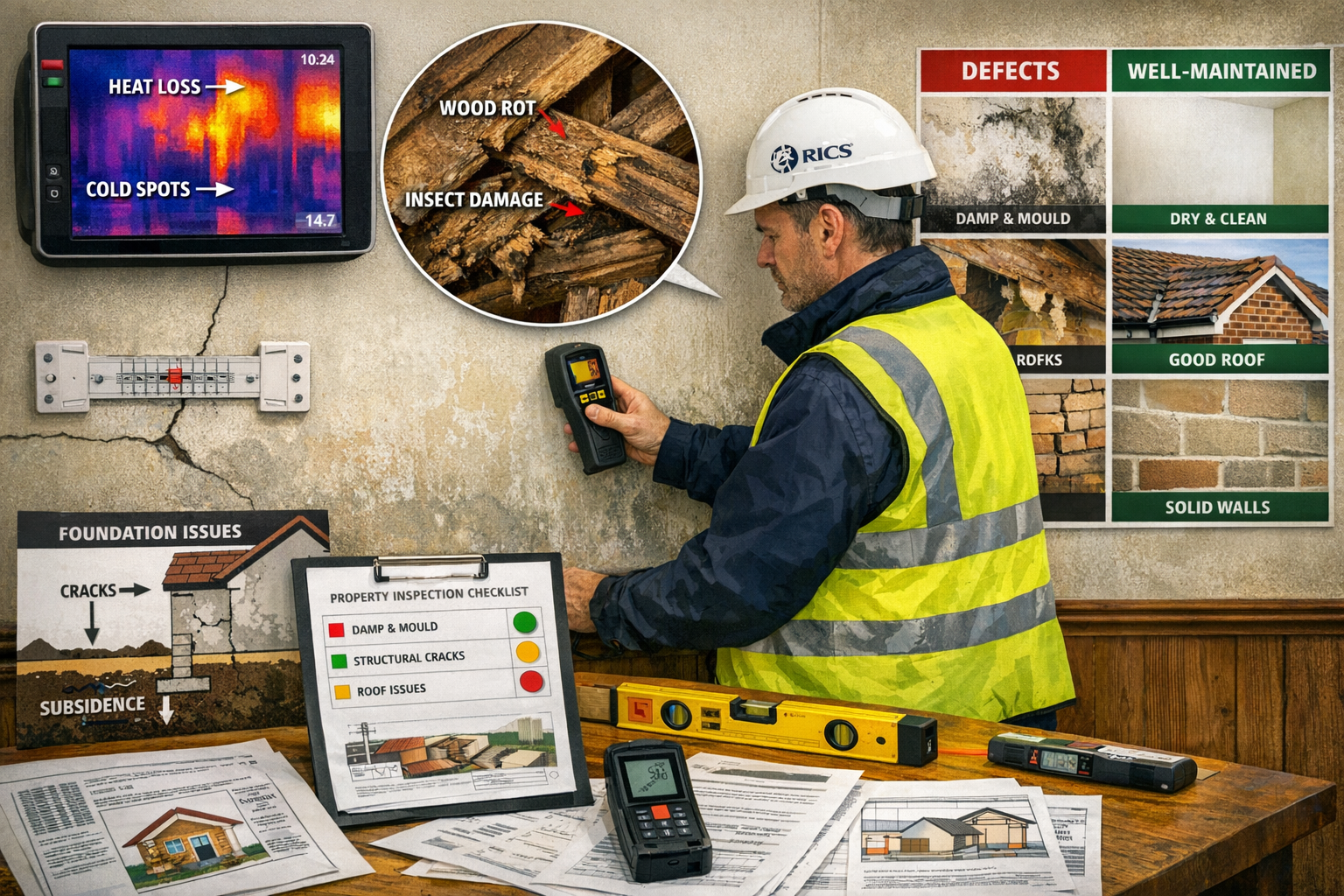
Accurate valuation of bungalows requires specialized approaches that account for limited comparable sales, unique buyer demographics, and structural considerations specific to single-storey properties.
Comparative Market Analysis Challenges
Scarcity of comparable sales represents the primary challenge in bungalow valuation. In many UK locations, bungalows constitute only 5-8% of housing stock, creating difficulties in identifying truly comparable transactions.
Establishing Meaningful Comparables
Professional valuers in 2026 employ sophisticated approaches to comparative analysis:
Geographic Expansion: Widening search radius to 3-5 miles for comparable sales
Time Adjustment: Using sales within 12-18 months with appropriate market movement adjustments
Cross-Type Comparison: Analyzing two-storey properties and applying single-storey premiums
Feature Weighting: Adjusting for plot size, accommodation, and condition differences
The table below illustrates typical adjustment factors applied in 2026 bungalow valuations:
| Comparable Difference | Typical Adjustment | Rationale |
|---|---|---|
| Additional bedroom | +8-12% | Scarcity value for 3+ bed bungalows |
| Garage vs no garage | +5-8% | High value to target demographic |
| 100m² additional plot | +3-7% | Garden access priority for buyers |
| Recent renovation | +10-18% | Downsizer preference for turnkey |
| Coastal location | +15-25% | Premium retirement destination |
Price Per Square Foot Analysis
Square footage valuation provides useful benchmarks but requires careful application to bungalows due to:
- Premium pricing for single-storey accommodation
- Higher build costs per square foot than two-storey equivalents
- Plot value representing larger proportion of total value
- Regional variations in bungalow desirability
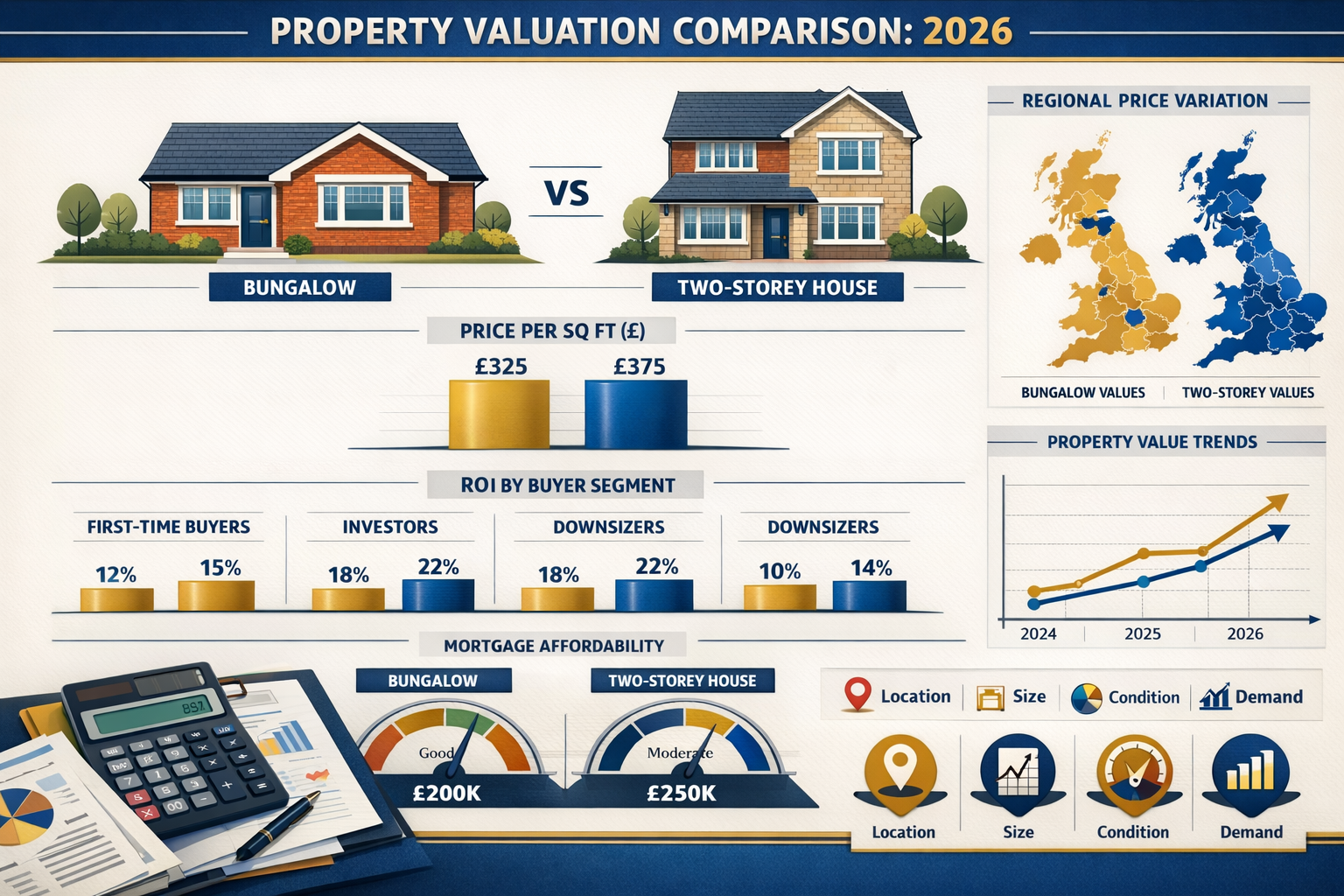
2026 market data indicates bungalows command £180-£320 per square foot depending on location and condition, compared to £150-£280 for equivalent two-storey properties in the same areas.
Residual Valuation for Development Potential
Bungalows with extension or conversion potential require residual valuation approaches considering:
Loft Conversion Potential
Properties with adequate roof height and structure for conversion show enhanced values:
- Feasible conversion: 8-15% premium over standard bungalow
- Planning permission granted: 12-20% premium
- Completed conversion: 25-40% value uplift
Surveyors assess structural capacity, planning constraints, and building regulation compliance when evaluating conversion potential.
Extension Possibilities
Bungalows on generous plots with extension potential attract premium valuations:
- Side extension feasibility: +5-10%
- Rear extension potential: +8-12%
- Planning permission secured: +10-18%
Which survey do you need depends partly on whether buyers intend immediate development or long-term occupation.
Investment Yield Calculations
Buy-to-let investors apply income-based valuation approaches to bungalows:
Rental Yield Analysis
Bungalows typically generate gross yields of 4-6.5% depending on location and target tenant:
- Downsizer rental market: 4-5% (premium properties, lower yields)
- Accessibility-focused tenants: 5-6% (specialized demand)
- Family rentals: 5.5-6.5% (standard market rates)
Net yields after maintenance, insurance, and void periods typically range 3.5-5.5%, comparing favorably to two-storey properties given lower maintenance complexity.
Capital Growth Projections
Limited supply and sustained demographic demand support long-term capital appreciation for well-maintained bungalows:
- 2024-2026 period: 3-7% cumulative growth (regional variation)
- 2026-2031 forecast: 15-25% growth in high-demand locations
- Outperformance vs general housing: +2-4% annually
Regional variations significantly impact growth projections, with coastal retirement destinations and accessible market towns showing strongest performance.
Regional Market Variations in 2026
Geographic location exerts substantial influence on bungalow valuations and market dynamics:
High-Demand Regions
Coastal areas including:
- South coast retirement destinations (Devon, Dorset, East Sussex)
- North Wales coastal towns
- East Anglian coastal communities
These locations show bungalow premiums of 20-35% over inland comparables due to retirement migration and lifestyle appeal.
Market Towns and Accessible Locations
Well-connected market towns with:
- Good healthcare infrastructure
- Active community facilities
- Public transport links
- Retail and leisure amenities
Properties in these locations command 10-20% premiums and demonstrate strong liquidity with average marketing periods of 8-14 weeks versus 12-20 weeks in less accessible areas.
Urban and Suburban Markets
Metropolitan areas show more modest bungalow premiums (5-12%) but benefit from:
- Larger buyer pools
- Stronger rental demand
- Better transport infrastructure
- Proximity to specialist healthcare
Survey-Adjusted Valuation Framework
Professional valuers in 2026 employ survey-informed valuation adjustments that systematically account for building condition:
Base Market Value (from comparables)
Less: Major structural issues (-10% to -30%)
Less: Services replacement requirements (-3% to -12%)
Less: Roof replacement/major repairs (-8% to -20%)
Less: Damp/water ingress issues (-5% to -15%)
Plus: Recent quality improvements (+5% to +18%)
Plus: Energy efficiency upgrades (+3% to +8%)
= Survey-Adjusted Market Value
This framework ensures valuations reflect true condition and immediate capital expenditure requirements, providing realistic pricing for negotiations.
Strategic Considerations for Buyers, Sellers, and Investors
Successfully navigating the 2026 bungalow market requires understanding how building survey insights inform strategic decision-making across different stakeholder perspectives.
Buyer Due Diligence Strategies
Prospective purchasers should prioritize comprehensive pre-purchase assessments:
Survey Level Selection
The specialized nature of bungalow construction justifies investment in thorough surveys:
- RICS Level 3 Building Survey: Recommended for all bungalows over 30 years old
- Structural engineer reports: Essential where movement indicators present
- Specialist roof surveys: Valuable for properties with complex roof configurations
- Damp and timber surveys: Important for single-storey ground-level properties
Working with RICS chartered building surveyors ensures professional standards and comprehensive assessment coverage.
Negotiation Leverage from Survey Findings
Survey results provide substantial negotiation opportunities:
💷 Major structural issues: 15-25% price reduction justifiable
💷 Roof replacement required: £10,000-£15,000 deduction
💷 Complete rewiring needed: £4,000-£7,000 adjustment
💷 Heating system replacement: £3,000-£6,000 reduction
💷 Damp remediation works: £2,000-£8,000 depending on extent
Buyers in 2026 increasingly request retention of funds pending completion of essential works rather than simple price reductions, providing security that issues will be addressed.
Seller Preparation and Value Maximization
Property owners preparing bungalows for sale benefit from proactive condition assessment:
Pre-Sale Survey Benefits
Commissioning surveys before marketing provides:
- Transparency: Builds buyer confidence and reduces transaction failures
- Realistic pricing: Avoids overvaluation and prolonged marketing
- Targeted improvements: Identifies high-ROI repairs before listing
- Negotiation strength: Demonstrates property knowledge and preparation
Addressing survey-identified issues before marketing typically generates ROI of 150-300% through faster sales and better prices.
Strategic Improvement Priorities
Not all repairs generate equal value returns. Priority improvements for 2026 include:
High-Return Investments (ROI 200-400%):
- Roof repairs and maintenance
- Damp remediation and prevention
- Heating system upgrades to efficient models
- Cosmetic improvements (decoration, flooring)
Medium-Return Investments (ROI 100-200%):
- Kitchen and bathroom modernization
- Window replacement (if failing)
- Garden improvements and landscaping
- External repointing and rendering
Lower-Return Investments (ROI 50-100%):
- Complete electrical rewiring (essential but limited value return)
- Structural underpinning (necessary but expensive)
- Extensive remodeling (may not suit buyer preferences)
Investment Portfolio Strategies
Property investors employ specialized approaches to bungalow acquisitions:
Value-Add Acquisition Criteria
Successful investors target properties with:
- Cosmetic neglect but sound structure: 15-25% below market value
- Extension or conversion potential: 20-30% value uplift opportunity
- Below-market pricing from motivated sellers: 10-20% discounts
- Rental demand exceeding supply: Strong yield potential
Comprehensive structural surveys help investors distinguish between cosmetic issues (low-cost fixes) and structural problems (capital-intensive repairs).
Portfolio Diversification Benefits
Bungalows provide portfolio diversification through:
- Different tenant demographics (older, accessibility-focused)
- Lower tenant turnover (average tenancy 3-5 years vs 1-2 years)
- Reduced maintenance complexity (single-level access)
- Resilient capital values (limited supply, sustained demand)
Professional Valuation Engagement
Both buyers and sellers benefit from independent professional valuations that:
- Provide objective market value assessments
- Identify comparable sales and adjustment factors
- Account for survey findings and condition issues
- Support mortgage applications and lending decisions
- Offer negotiation frameworks for transactions
Professional valuers combine market knowledge with building survey insights to deliver comprehensive assessments that support informed decision-making in the complex 2026 bungalow market.
Conclusion
Valuing Bungalows in 2026 UK Markets: Building Survey Insights for High-Demand Segments requires sophisticated integration of market analysis, demographic understanding, and comprehensive structural assessment. The sustained demand from downsizers, accessibility-focused buyers, and lifestyle purchasers creates competitive market conditions where accurate valuation becomes critical to successful transactions.
Building survey findings exert disproportionate influence on bungalow values compared to multi-storey properties, with roof condition, foundation integrity, and services infrastructure directly impacting pricing by 10-30% in many cases. The scarcity of comparable sales and specialized construction characteristics demand professional expertise from RICS chartered surveyors who understand single-storey property nuances.
Key Success Factors for 2026
✔️ Comprehensive due diligence: Invest in thorough building surveys before purchase decisions
✔️ Realistic valuation: Account for structural condition and immediate capital requirements
✔️ Regional awareness: Understand local market dynamics and demand drivers
✔️ Professional guidance: Engage qualified surveyors and valuers with bungalow expertise
✔️ Long-term perspective: Recognize demographic trends supporting sustained bungalow demand
Actionable Next Steps
For Buyers: Commission comprehensive RICS building surveys before purchase, use findings to negotiate fair pricing, and budget for identified repairs in financial planning.
For Sellers: Obtain pre-sale condition assessments, address high-ROI improvements before marketing, and price realistically based on survey-informed valuations.
For Investors: Target properties with value-add potential, conduct thorough due diligence on structural condition, and calculate returns accounting for bungalow-specific maintenance requirements.
For All Stakeholders: Recognize that building survey insights provide essential foundation for confident decision-making in the specialized bungalow market, where condition assessment directly translates to accurate valuation and successful transactions.
The 2026 UK bungalow market offers significant opportunities for informed participants who combine market knowledge with comprehensive structural assessment. By integrating professional survey insights with sophisticated valuation methodologies, buyers, sellers, and investors can navigate this high-demand segment with confidence and achieve optimal outcomes in their property transactions.