Around one in five UK property purchases is renegotiated after a survey reveals defects the buyer did not expect, and in a flat or cautious market, that figure climbs higher still. When structural defects found in building surveys trigger that conversation, the difference between a well-handled renegotiation and a collapsed sale often comes down to process: knowing which defects matter, gathering the right evidence, and making a structured, proportionate request to the seller.
This guide moves beyond defect identification to walk through every practical step, from commissioning specialist reports and obtaining contractor quotes to framing a written renegotiation and deciding when to walk away entirely.
Key Takeaways
- Not every defect justifies renegotiation; focus on issues requiring immediate professional attention that cost more than roughly £1,000 to repair.
- Never renegotiate before specialist investigations and written contractor quotes are in hand, evidence is everything.
- In England and Wales, buyers can renegotiate at any point before exchange of contracts and are under no legal obligation to proceed at the original price.
- Successful renegotiations typically result in 5-10% reductions overall, with major structural problems supporting adjustments of £20,000-£50,000 or more.
- The four main resolution options are: price reduction, seller-arranged repairs, cost-splitting, or a retention/escrow arrangement.
Understanding Which Structural Defects Trigger Renegotiation
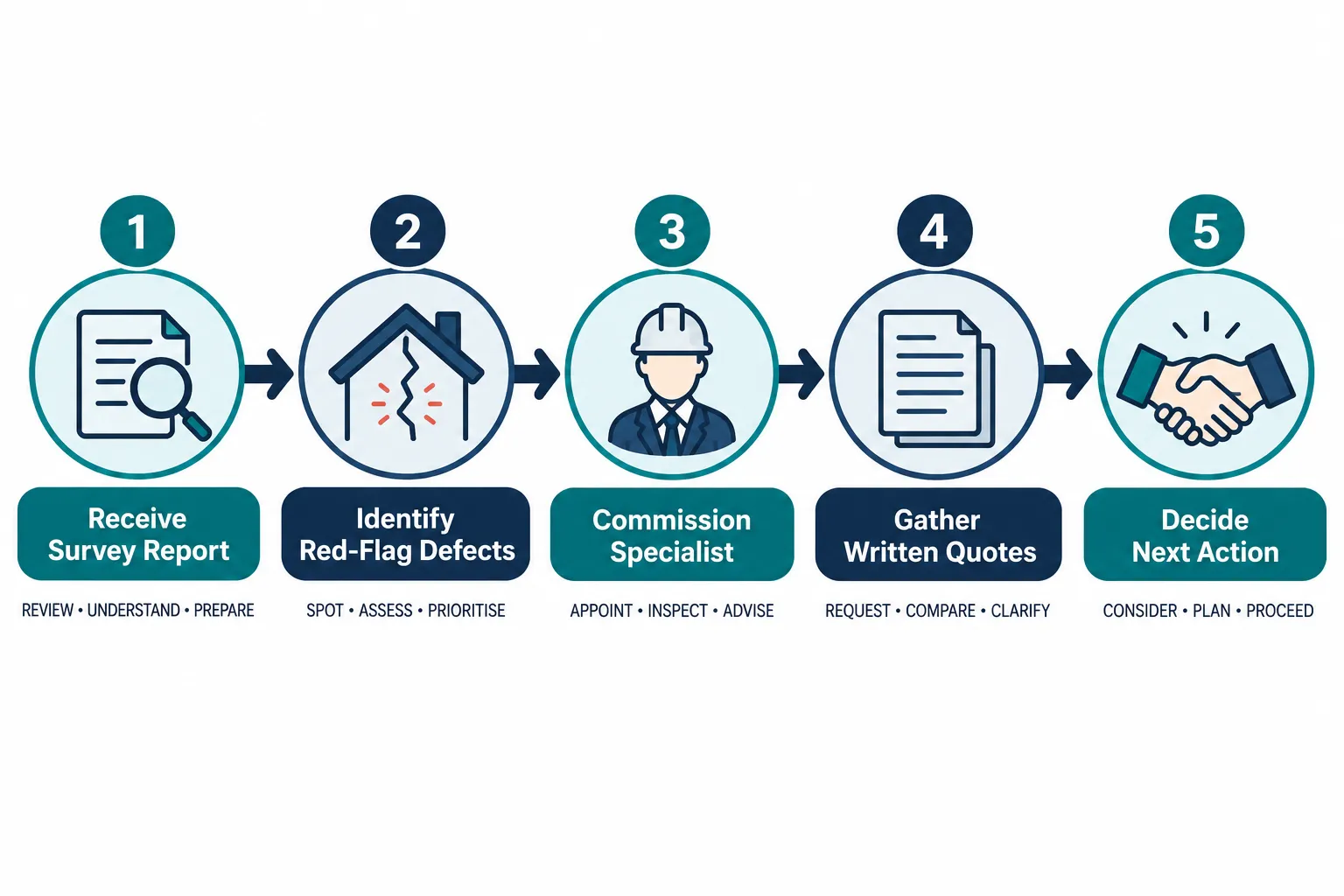
Not all survey findings carry the same weight. A RICS Level 3 Full Building Survey, the most detailed option and the one recommended for older, larger, or non-standard properties, uses a condition rating system where Condition 3 items require urgent attention [5]. It is these Condition 3 findings, particularly those with structural implications, that form the basis of any serious renegotiation.
The structural defects most consistently flagged as "red flag" or "major" issues in 2026 surveyor guidance include:
- Subsidence and heave, ground movement causing differential settlement, often indicated by diagonal cracks at window and door corners, sticking doors and windows, and sloping floors [2][7]
- Significant structural movement, cracks wider than 5mm, stepped cracking in brickwork, or separation between structural elements [8]
- Major damp affecting load-bearing timbers, wet rot or dry rot in floor joists, roof timbers, or lintels, which can compromise structural integrity [2]
- Serious roof defects, failed roof structures, significant sagging, or widespread tile/slate failure beyond routine maintenance [4]
- Defective drainage, collapsed or root-invaded drains that can undermine foundations over time [2]
- Hazardous materials, asbestos in textured coatings, insulation, or roof sheets, which carries both health and remediation cost implications [7]
A useful filter: if the defect demands immediate professional attention and the repair cost exceeds approximately £1,000, it is worth including in a renegotiation discussion [6]. Issues whose total repair costs approach 10-15% of the property's value are commonly considered potential deal-breakers [7].
"Structural movement highlighted in a survey requires urgent expert investigation to understand how seriously the building is affected." [8]
By contrast, routine maintenance items, worn sealant, minor repointing, dated kitchens, are expected in older properties and should not normally form part of a price reduction request. Sellers and agents will dismiss a renegotiation that conflates genuine structural risk with ordinary wear and tear [10].
The Step-by-Step Process After Structural Defects Are Found
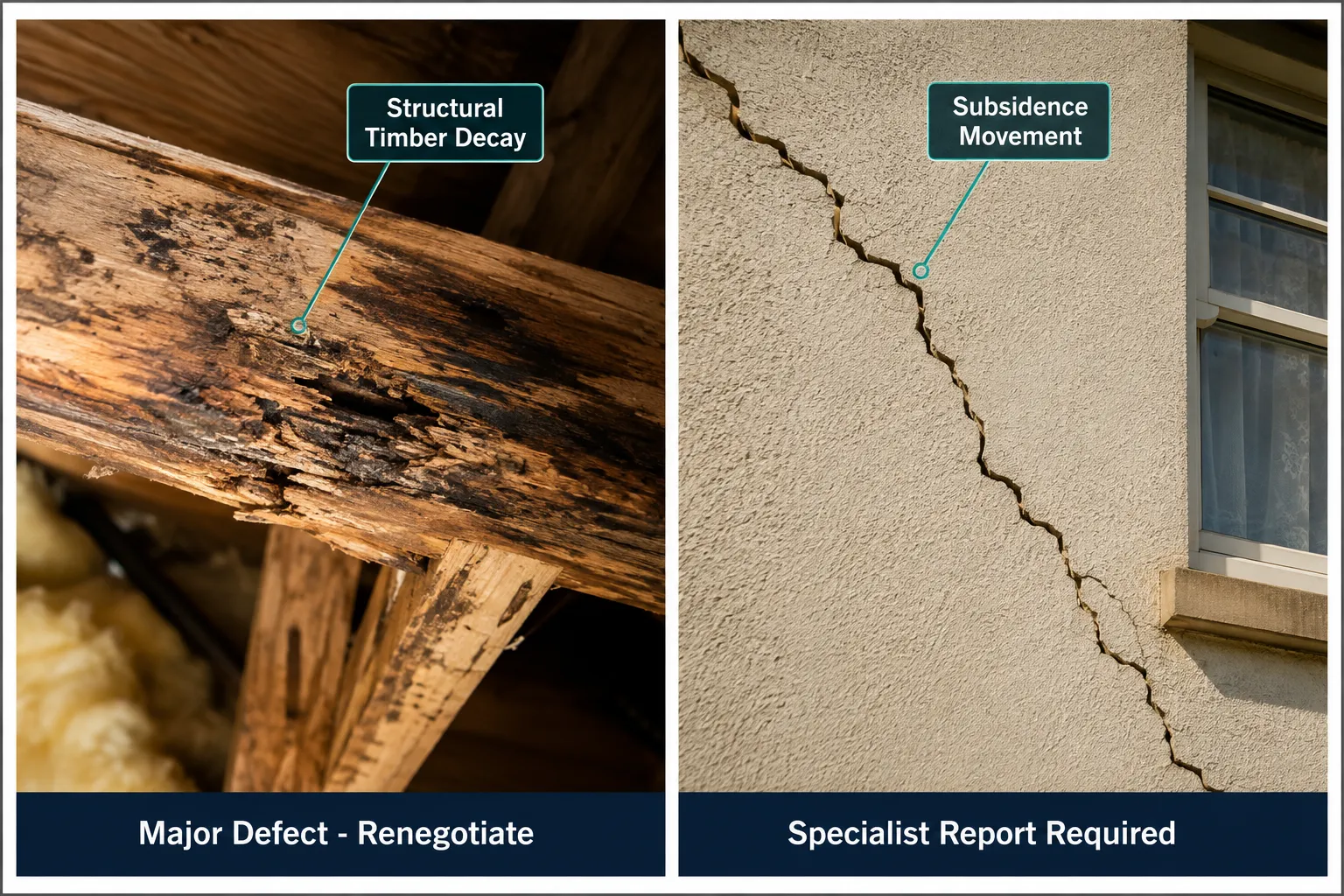
The single most common mistake buyers make after receiving a concerning survey is to rush straight to a renegotiation demand. Without specialist reports and written quotes, any figure proposed is guesswork, and sellers know it. A structured approach protects the buyer's position and produces a far more persuasive case.
Step 1: Read the Survey Report Carefully
Review every Condition 3 rating and any advisory notes about structural movement, damp, or hazardous materials. Note the surveyor's own cost estimates where provided. These estimates are typically conservative ranges rather than precise figures, but they establish a credible starting point [7].
Step 2: Commission Specialist Investigations
For any finding involving possible structural movement, subsidence, or serious timber decay, the survey report itself is not sufficient to quantify the problem. Commission the appropriate specialist:
| Defect Type | Specialist Required |
|---|---|
| Subsidence / ground movement | Structural engineer or geotechnical engineer |
| Timber rot / woodworm | Specialist timber treatment surveyor |
| Asbestos | Licensed asbestos surveyor |
| Drainage failure | CCTV drainage survey contractor |
| Roof structure failure | Structural engineer or specialist roofing contractor |
This step takes time, typically one to three weeks, but it is non-negotiable. A January 2026 guide for homebuyers is explicit: structural movement requires "urgent expert investigation" before any other decision is made [8].
Step 3: Obtain Written Contractor Quotes
Once specialist reports confirm the nature and extent of each defect, obtain at least two written quotes from qualified contractors for the remediation work. For major structural issues, three quotes are preferable. These quotes should:
- Describe the scope of work in detail
- Specify materials and methods
- Include VAT
- Be dated and on headed paper
Written quotes carry far more weight in a renegotiation than verbal estimates or online cost calculators [13].
Step 4: Build Your Defect Schedule
Compile a clear written schedule that lists every material defect, the survey's condition rating, the specialist's findings, and the contractor's quoted remediation cost. Add a 10-20% contingency to each line item to account for unforeseen complications, this is standard practice and widely accepted by sellers and their agents [7].
A sample defect schedule might look like this:
| Defect | Survey Rating | Specialist Finding | Quote | Contingency (15%) | Total |
|---|---|---|---|---|---|
| Subsidence to rear extension | Condition 3 | Active movement confirmed | £18,500 | £2,775 | £21,275 |
| Dry rot to ground floor joists | Condition 3 | Moderate spread | £6,200 | £930 | £7,130 |
| Failed flat roof | Condition 3 | Full replacement needed | £4,800 | £720 | £5,520 |
| Total | £33,925 |
Step 5: Decide on Your Approach
Before contacting the seller, decide which resolution option best fits the situation. The four main routes are explored in the next section.
Step 6: Submit the Request in Writing
Always put the renegotiation request in writing, submitted via the estate agent. The written communication should include:
- A clear reference to the survey findings
- The attached defect schedule with quotes
- The specific price reduction or alternative remedy requested
- A reasonable deadline for a response
Verbal requests are easily misrepresented and leave no paper trail. Written requests, backed by documented evidence, are harder to dismiss and create a record if the matter escalates [13].
Renegotiation Options and How to Choose Between Them
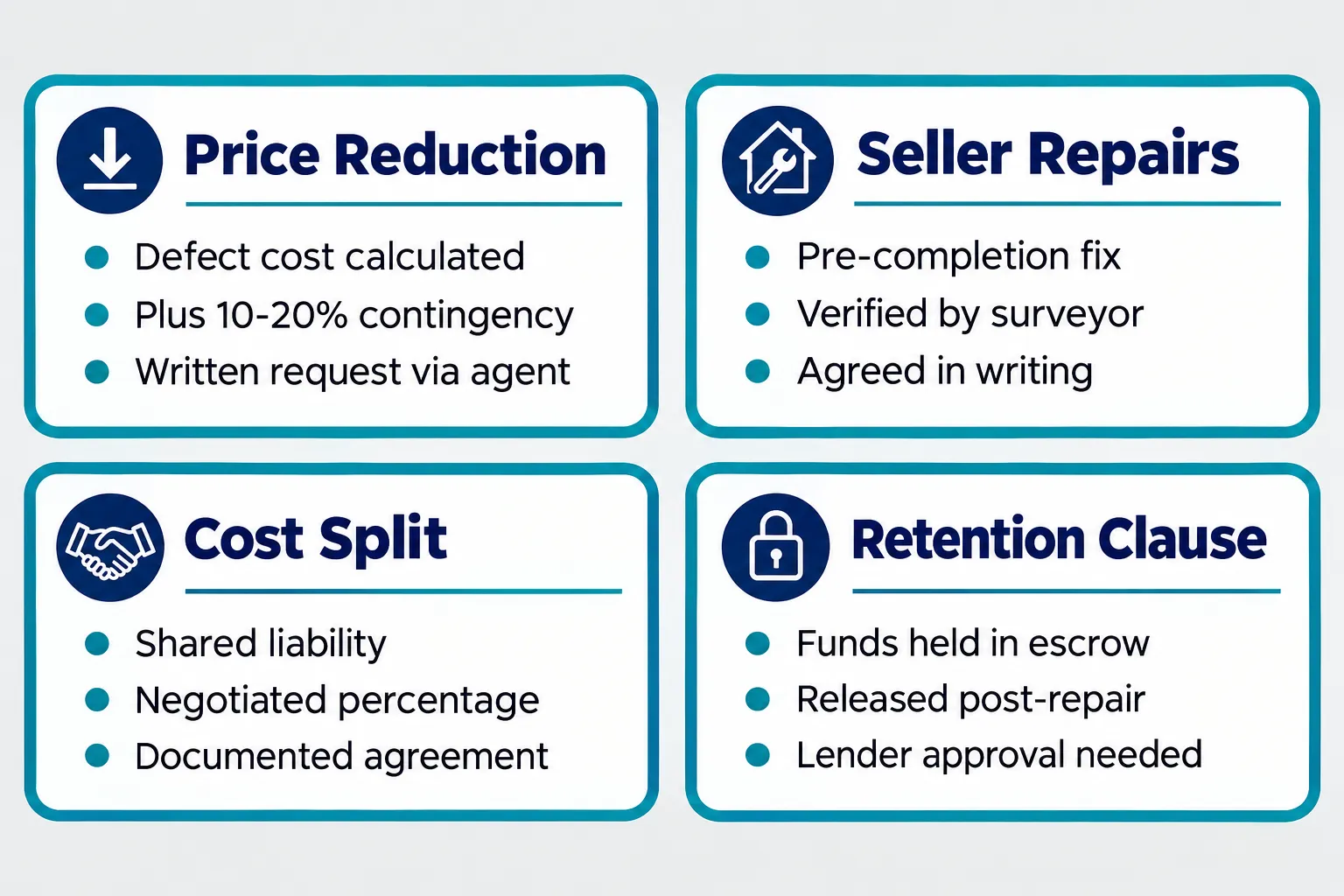
Once the evidence is assembled, buyers in England and Wales have a clear legal position: before exchange of contracts, there is no obligation to proceed at the original agreed price, and renegotiation is entirely legitimate [6][15]. The question is which mechanism best serves the buyer's interests.
Option 1: Straight Price Reduction
The most straightforward approach. The buyer requests a reduction equivalent to the total defect schedule figure (quotes plus contingency). This is the cleanest resolution and avoids the risk of seller-arranged repairs being done to a lower standard.
Typical scale of reductions in 2026:
- Minor cosmetic or maintenance issues: £1,000-£3,000
- Moderate defects (e.g., partial roof repairs, localised damp): £5,000-£15,000
- Major structural defects or full roof replacement: £20,000-£50,000+
- Severe subsidence or foundation problems: potentially more, or deal-breaker territory [3][7]
Successful renegotiations across the market commonly result in overall reductions of around 5-10% of the original offer price [3].
Option 2: Seller Arranges Repairs Before Completion
The seller instructs and pays for the remediation work before the sale completes. This can work well where the seller has existing relationships with contractors or where speed matters. However, buyers should insist on:
- Written confirmation of the scope of works
- The right to have the completed works inspected by their own surveyor before exchange or completion
- Warranties or guarantees for the work being assigned to the buyer [13]
Option 3: Cost-Splitting
Both parties agree to share the cost of remediation, often as a compromise when a full reduction would threaten the sale. This is more common where the defect was partially reflected in the original asking price or where the market is competitive.
Option 4: Retention / Escrow Arrangement
A portion of the purchase price is held back in a solicitor's escrow account until the specified works are completed and verified. This is particularly useful where:
- The seller cannot afford to fund repairs upfront
- The works cannot be completed before the agreed completion date
- The buyer wants certainty that remediation actually happens [15]
Note: Lenders may have views on retention arrangements, and mortgage offers can be affected by serious structural defects. It is important to inform the mortgage lender of any significant survey findings and to check whether the lender requires specialist reports or imposes conditions on the offer [7][8].
When to Walk Away
Some defects are not negotiable in a practical sense. If the total remediation cost approaches or exceeds 15% of the property value, if the property is at risk of becoming unmortgageable, or if specialist investigations reveal ongoing active movement with no clear resolution, walking away before exchange is the rational decision [7]. The survey fee is a sunk cost; proceeding into a structurally compromised property is a far larger financial risk.
Keeping Records and Protecting Your Position
Good documentation serves two purposes: it strengthens the renegotiation, and it protects the buyer after purchase if defects are not properly resolved.
RICS guidance on defects and rectification stresses the importance of maintaining clear records throughout, photographs, correspondence, specialist reports, and contractor communications [9]. This is especially relevant where:
- A new-build warranty or contractual defect period applies
- The buyer later needs to pursue a contractor for substandard remediation work
- There is a dispute about whether a defect was disclosed before exchange
Practical records to keep:
- The original survey report with condition ratings
- All specialist investigation reports
- Written contractor quotes (dated)
- The defect schedule submitted to the seller
- All written correspondence with the agent and seller
- Photographs of each defect, timestamped
Even where a renegotiation concludes smoothly, retaining this documentation protects the buyer's position for years after completion [9].
Market Conditions and Negotiation Leverage
The strength of a buyer's renegotiation position is not purely about the defects themselves, it is also shaped by the market. In a flat or falling market, buyers have more leverage to present clear evidence of structural defects and use it to secure meaningful reductions or remediation commitments [13].
In a competitive or rising market, sellers have more options and may be less willing to reduce the price, knowing that another buyer may be waiting. In those conditions, the buyer's best strategy is to focus only on the most material, unexpected defects, those that were not reflected in the agreed price, and to present a tightly evidenced, proportionate request rather than a sweeping demand [10].
Across all market conditions, the consistent advice from 2026 surveyor and buyer guidance is the same: be structured, be proportionate, and be prepared to compromise. Renegotiations that focus on legitimate, significant, unexpected defects backed by written evidence tend to succeed. Those that attempt to use a survey as a general price-chipping exercise tend to collapse the deal entirely [7][10].
Conclusion
Structural defects found in building surveys are not the end of a property transaction, but they do require a disciplined, evidence-led response. The process is clear: read the survey carefully, commission specialist investigations before making any demands, gather written contractor quotes, build a documented defect schedule with a contingency allowance, and then make a structured written request to the seller.
Actionable next steps:
- Identify every Condition 3 item in the survey report and separate structural concerns from routine maintenance.
- Instruct the appropriate specialist, structural engineer, timber surveyor, drainage contractor, within days of receiving the survey.
- Obtain at least two written contractor quotes per major defect and add a 10-20% contingency.
- Choose the resolution option that best fits the situation: price reduction, seller repairs, cost-split, or retention.
- Submit the renegotiation request in writing via the agent, with the full defect schedule attached.
- Inform the mortgage lender of any significant findings and confirm the offer remains valid.
- Keep all records, reports, quotes, correspondence, photographs, in a single file for future reference.
A well-prepared buyer, armed with specialist reports and contractor quotes, is in a strong position to reach a fair resolution. The goal is not to win an argument, it is to arrive at a purchase price that genuinely reflects the condition of the property being bought.
References
[1] Renegotiating A House Purchase After A Building – reddit.com
[2] 10 Common Home Defects Found In Property Surveys And How To Fix Them – lmsurveyors.co.uk
[3] Renegotiating A House Offer After Your Survey – reallymoving.com
[4] How A Pre Purchase Survey Protects Your Negotiation Power – mvsurveying.co.uk
[5] What Sort Of Survey Should I Have – hoa.org.uk
[6] Negotiating House Price After Survey – blueblossomsurveysltd.co.uk
[7] Negotiating After Survey – housesurveys.co.uk
[8] 5 Most Common Home Survey Problems And What To Do Next – morganandassociates.co.uk
[9] Defects And Rectification Archived – rics.org
[10] My House Survey Has Come Back With Problems What Should I Do Next – fourthwallbc.com