Nearly one in five homebuyers who commission a survey later discover defects that were not flagged in their report, defects that cost thousands of pounds to fix. For buyers of older, larger, or altered properties, the stakes are even higher. Understanding RICS Building Survey Standards in the UK: What Homebuyers Should Expect from a Level 3 Inspection is not a bureaucratic exercise; it is one of the most financially consequential pieces of knowledge a buyer can possess before exchanging contracts.
The Royal Institution of Chartered Surveyors (RICS) sets the professional benchmark for residential surveys in the UK through its Home Survey Standard. The Level 3 Building Survey, formerly called the Full Structural Survey, sits at the top of that framework. Yet many buyers still commission a Level 2 HomeBuyer Report when their property clearly warrants a Level 3, often because they do not fully understand what the higher standard actually delivers or demands from the surveyor. [1]
Key Takeaways
- A RICS Level 3 Building Survey is the most thorough residential inspection available and is mandatory for older, larger, or significantly altered properties.
- The current RICS Home Survey Standard (first edition, November 2020) defines precise obligations for Level 3 surveyors; a second edition is in development as of 2026.
- Level 3 reports must cover structure, damp, drainage, roof voids, and concealed areas, going well beyond what a Level 2 inspection requires.
- Homebuyers have a right to expect a written report with condition ratings, repair recommendations, and maintenance advice, not just a list of observations.
- Non-RICS inspections carry no equivalent professional obligations, leaving buyers exposed to gaps in coverage that can prove costly.
Understanding the Three Levels of RICS Home Surveys
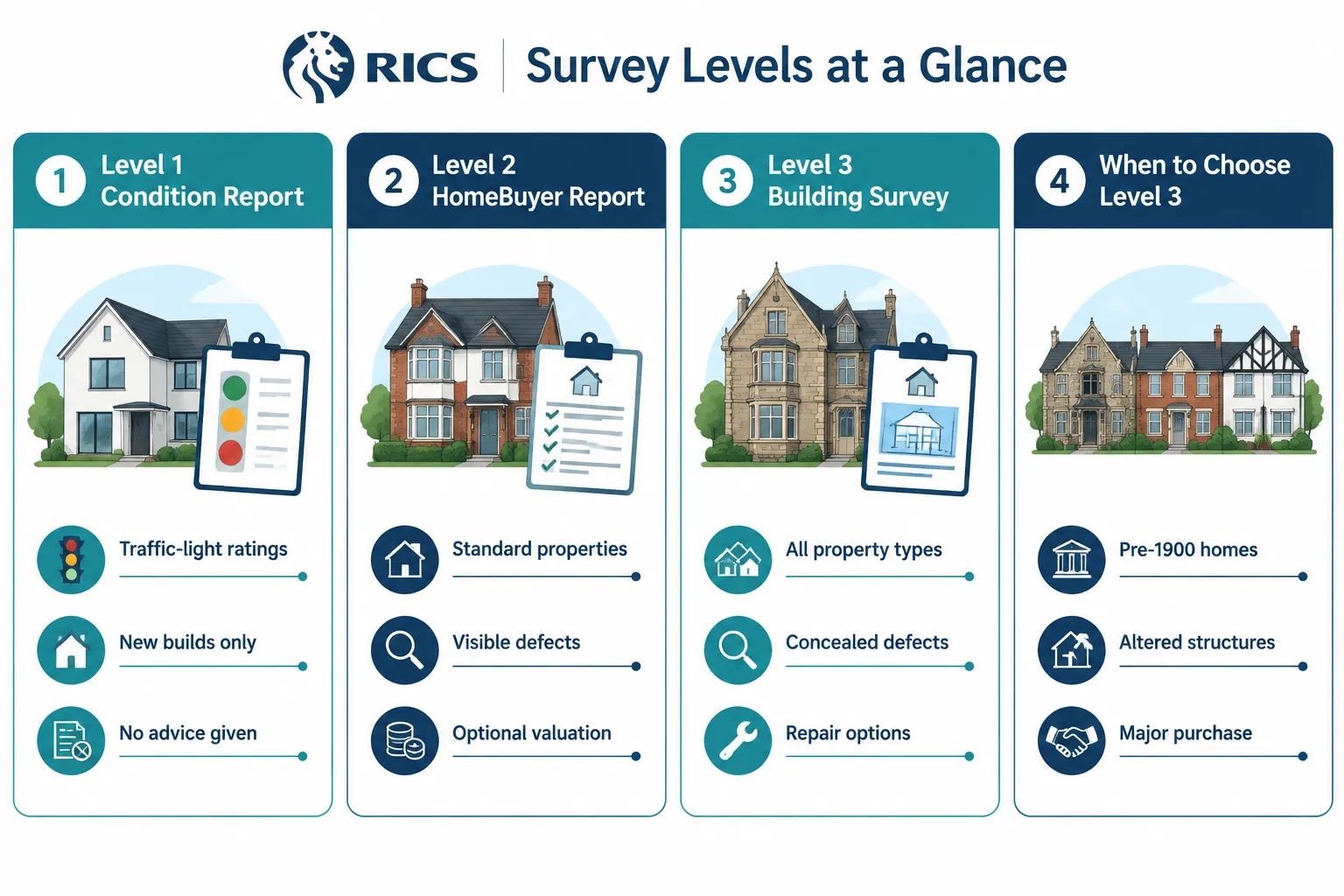
The RICS Home Survey Standard, published in November 2020 and effective from 1 March 2021, replaced a patchwork of earlier guidance with a single, unified framework covering three levels of service. [2] Each level is calibrated to a different property type and buyer need.
Level 1, Condition Report: The most basic service, designed for conventional modern properties in apparent good condition. It uses a traffic-light rating system and provides no advice or valuation. It is rarely appropriate for anything built before the 1980s.
Level 2, HomeBuyer Report: A mid-range survey for conventional properties of standard construction that appear to be in reasonable condition. The surveyor inspects accessible and visible areas, provides condition ratings, and may include an optional market valuation. It does not include testing of services or detailed investigation of concealed areas.
Level 3, Building Survey: The most comprehensive option. It is designed for larger, older, or significantly altered properties and for buyers who need a thorough understanding of a building's condition. It requires the surveyor to investigate concealed areas where safe and reasonable to do so, to comment on the construction methods used, and to provide repair and maintenance recommendations. [8]
The table below summarises the key differences:
| Feature | Level 1 | Level 2 | Level 3 |
|---|---|---|---|
| Condition ratings | Yes | Yes | Yes |
| Visible defects noted | Basic | Yes | Yes |
| Concealed area investigation | No | Limited | Yes |
| Construction method commentary | No | Limited | Yes |
| Repair/maintenance advice | No | Limited | Detailed |
| Services tested | No | Basic | Yes |
| Suitable for pre-1900 properties | No | Rarely | Yes |
| Optional valuation | No | Yes | Yes |
What a Level 3 Inspection Must Cover Under Current RICS Guidance
The RICS Home Survey Standard sets out mandatory requirements for Level 3 inspections that go significantly beyond what many buyers, and some non-RICS inspectors, assume. [2] Understanding these requirements is the core of knowing what RICS Building Survey Standards in the UK: What Homebuyers Should Expect from a Level 3 Inspection actually means in practice.
Structural and Fabric Inspection
The surveyor must inspect all accessible parts of the building fabric, including the roof covering (from ground level or from within the roof void where safe access is available), external walls, chimneys, windows, doors, and floors. Where elements are concealed, for example, beneath fitted carpets or behind cladding, the surveyor must note this limitation and advise on further investigation where the risk warrants it. [8]
Structural movement is a central concern. The surveyor must assess cracks, settlement, subsidence, and any signs of ongoing movement, distinguishing between historic movement that has stabilised and active movement that may require engineering input.
The Whole-Building Approach to Damp and Moisture
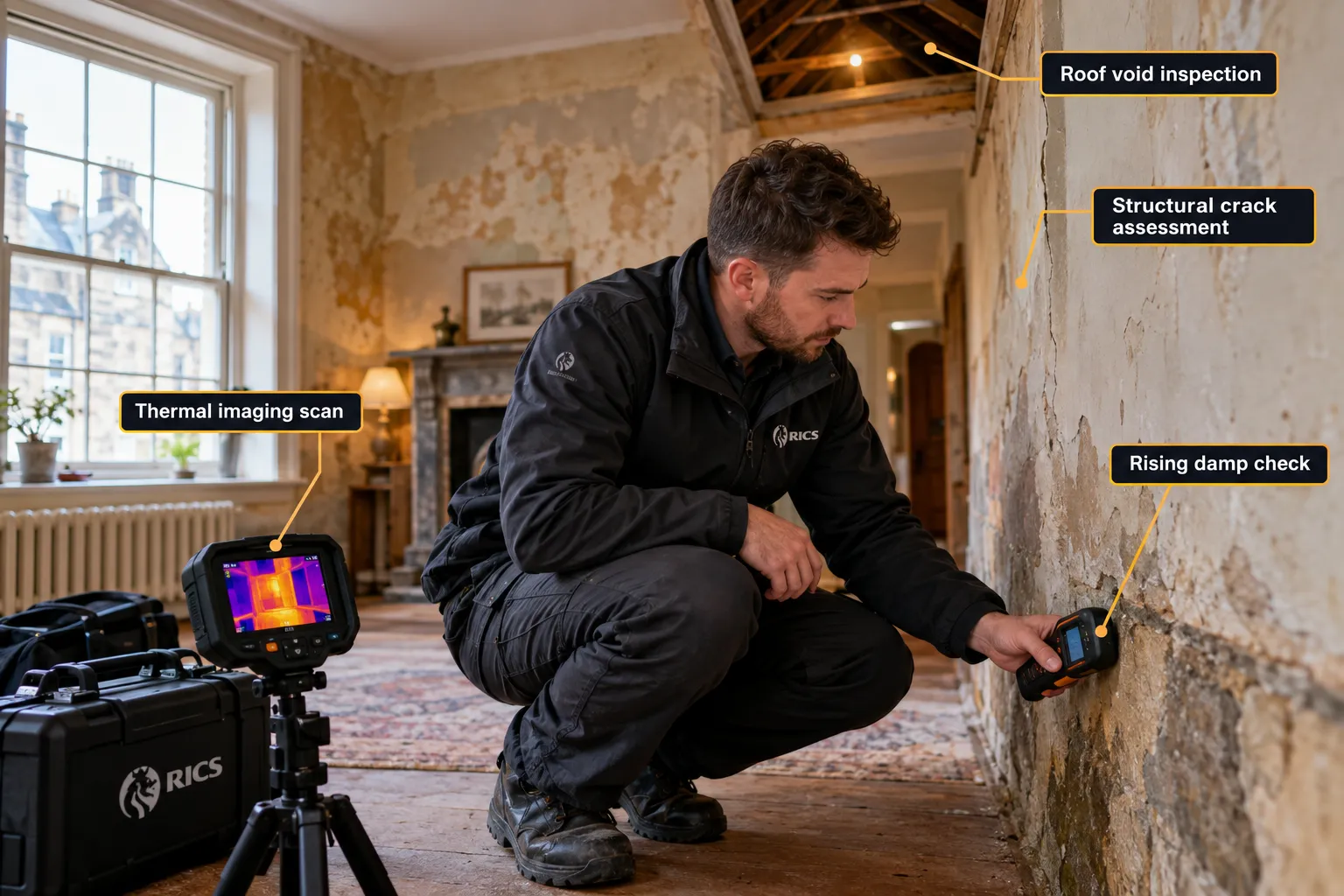
One of the most important, and most frequently misunderstood, aspects of a Level 3 survey is the approach to damp. The RICS Home Survey Standard requires a whole-building moisture assessment, not simply the use of a hand-held moisture meter to produce a set of surface readings. [2]
This means the surveyor must consider:
- Rising damp: Whether genuine rising damp is present, distinguishing it from condensation or penetrating damp
- Penetrating damp: Sources from defective roofing, guttering, pointing, or window seals
- Condensation: Patterns of moisture related to ventilation, heating, and occupancy
- Interstitial condensation: Moisture forming within the building fabric itself, particularly in insulated or retrofitted structures
A competent Level 3 surveyor will use moisture meters as one tool within a broader diagnostic process. They will cross-reference meter readings with visual inspection, thermal imaging where appropriate, and an assessment of the building's construction type. A damp-proof course company's survey is not a substitute for this process, it is a sales-led assessment that typically recommends chemical injection regardless of the actual cause of moisture.
Services, Drainage, and External Areas
Under the Level 3 standard, the surveyor must carry out a basic functional test of services, heating, plumbing, and electrical, and report on their apparent condition and age. [8] This does not replace specialist reports from Gas Safe engineers or NICEIC electricians, but it does mean the surveyor must flag obvious deficiencies and recommend specialist follow-up where needed.
Drainage is inspected visually, and the surveyor must comment on the type of drainage system and any visible defects. External areas including outbuildings, boundary walls, paths, and drives are included within scope.
The Written Report: What It Must Look Like
The Level 3 report is not simply a list of observations. Under RICS guidance, it must: [2]
- Use a standardised condition rating system (Condition Rating 1, 2, or 3)
- Provide a clear description of each element inspected
- Explain the significance of defects found
- Give repair and maintenance recommendations
- Identify items requiring urgent attention
- Note limitations on the inspection and recommend further specialist investigation where appropriate
Condition Rating 3 items require urgent attention or immediate repair. Condition Rating 2 items need repair or replacement but are not urgent. Condition Rating 1 items are in satisfactory condition. This system gives buyers a clear hierarchy of concern rather than a dense narrative that obscures what actually matters.
How Level 3 Compares With Non-RICS Inspections and Why It Matters
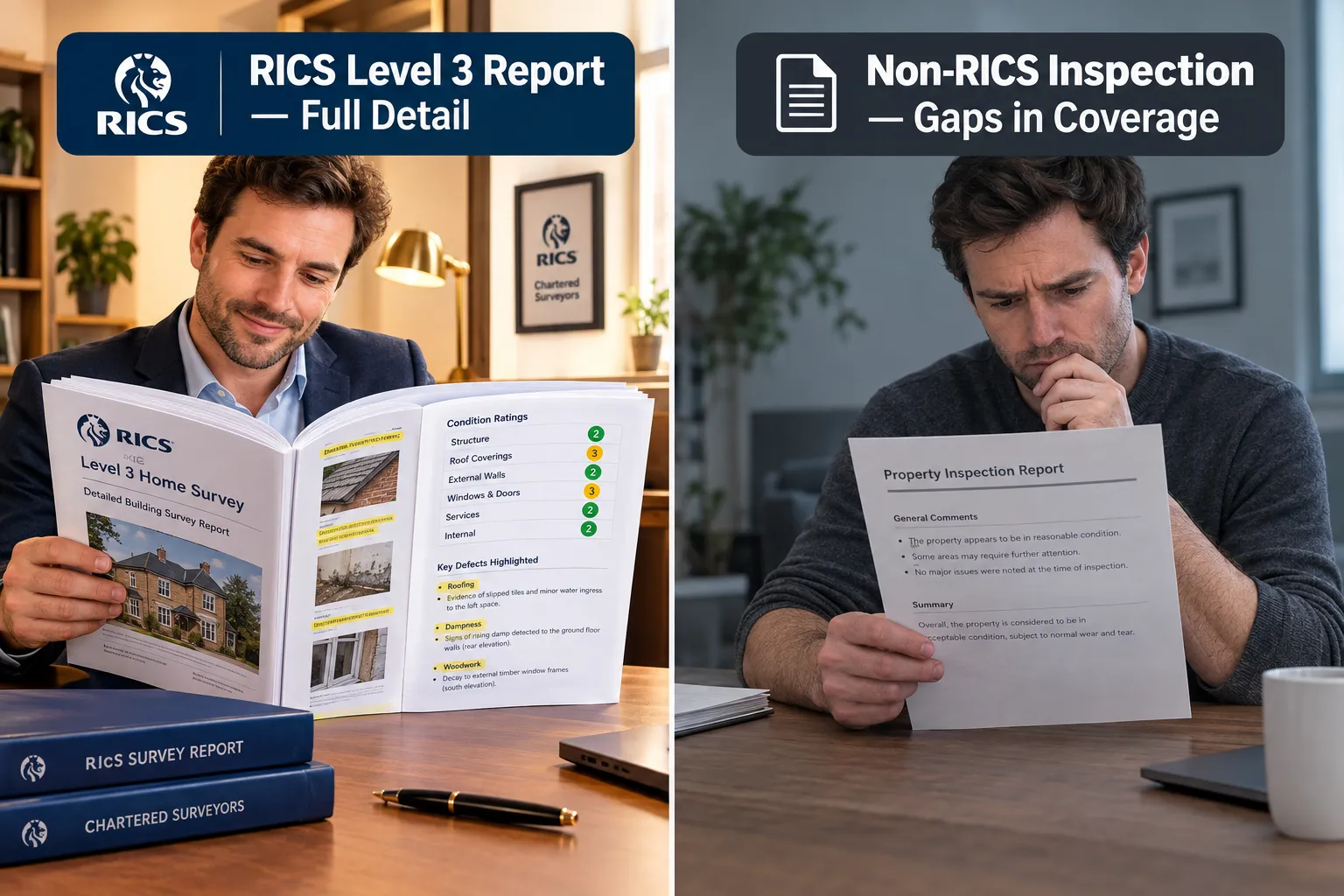
The proliferation of online property platforms and independent "property inspection" services has created genuine confusion in the market. Some services market themselves with language that sounds equivalent to a RICS survey but carries none of the same professional obligations. Understanding RICS Building Survey Standards in the UK: What Homebuyers Should Expect from a Level 3 Inspection requires understanding what a non-RICS inspection simply cannot provide.
Professional Accountability and Insurance
A RICS-regulated surveyor operates under mandatory professional indemnity insurance, is bound by the RICS Rules of Conduct, and is subject to disciplinary proceedings if their work falls below the required standard. [10] If a RICS surveyor misses a significant defect that a competent surveyor should have identified, the buyer has a clear route to redress.
A non-RICS inspector may carry their own insurance, but they are not subject to the same mandatory standard of care, the same scope of inspection, or the same reporting obligations. There is no equivalent to the RICS Home Survey Standard governing what they must inspect or how they must report it.
The Terms of Engagement Obligation
Before a Level 3 survey begins, the RICS surveyor must provide written Terms of Engagement confirming the scope of service, the fee, and any known limitations. [7] This is a mandatory requirement under the Home Survey Standard, not an optional courtesy. It gives buyers a contractual basis for understanding exactly what they are paying for before the inspection takes place.
Vendor-Commissioned Surveys: An Emerging Practice
A notable trend in 2026 is the growth of vendor-commissioned Level 3 surveys, sellers commissioning a survey before listing a property to provide transparency to buyers and accelerate the conveyancing process. While this practice has genuine benefits in terms of transaction speed and market confidence, buyers should be aware that a vendor-commissioned survey was prepared for the seller, not for them. A buyer relying on a vendor's survey has no direct contractual relationship with the surveyor. Commissioning an independent Level 3 survey remains the most robust form of protection.
The Second Edition of the RICS Home Survey Standard: What Is Changing
The RICS Home Survey Standard is currently under revision. RICS has confirmed that a second edition is in development, with a consultation process that has examined several proposed changes to the Level 3 framework. [5]
Key areas under review include:
- Clearer guidance on the whole-building moisture approach, particularly in the context of retrofit insulation and energy efficiency upgrades that can alter moisture dynamics in older properties
- Strengthened requirements around competence, with proposals to tighten the qualifications required to sign off a Level 3 report
- Enhanced consumer communication, including clearer language in reports to ensure that Condition Rating 3 items are not buried within lengthy technical narratives
- Digital and AI-assisted reporting, with guidance being developed on how surveyors may use AI tools in drafting reports while maintaining professional responsibility for the content
Prediction (clearly labelled): Based on RICS's published progress update and the typical timeline for standards development, the second edition of the Home Survey Standard is likely to be published in late 2026 or early 2027, with a transition period before it becomes mandatory. [5] Buyers commissioning surveys in the interim are protected by the current first-edition standard, which remains fully in force.
Fees, Valuations, and Market Context in 2026
Level 3 Building Survey fees in 2026 typically range from approximately £600 to £1,500 or more, depending on the property's size, age, location, and complexity. Fees for large rural or historic properties can exceed this range. The RICS does not set fixed fees; surveyors compete on price, but the scope of the inspection is defined by the standard regardless of fee level.
An optional market valuation can be added to a Level 3 survey, though many buyers obtain a separate RICS Red Book valuation or rely on their mortgage lender's valuation for this purpose. It is important to understand that a mortgage lender's valuation is not a survey, it is a brief assessment carried out for the lender's security purposes and provides no meaningful protection for the buyer.
Why Detailed Surveys Matter More in a Softer Market
In a housing market characterised by slower transaction volumes and greater buyer caution, as seen in much of 2025 and into 2026, a Level 3 survey provides significant negotiating leverage. A detailed report identifying Condition Rating 3 defects gives the buyer documented evidence to renegotiate the purchase price or request remedial works before exchange. In a rising market, buyers sometimes waive surveys to move quickly. In a softer market, the calculus changes: the cost of a Level 3 survey is modest relative to the cost of an undetected structural defect or a failing drainage system.
What Homebuyers Should Do Before and After Commissioning a Level 3 Survey
Before commissioning:
- Verify that the surveyor is RICS-regulated by checking the RICS Find a Surveyor directory
- Confirm in writing that the service being provided is a Level 3 Building Survey under the RICS Home Survey Standard, not a generic "building inspection"
- Review the Terms of Engagement carefully before signing, check what is excluded and whether any specialist reports are recommended in advance [7]
- Ask whether the surveyor has experience with the specific construction type (e.g., timber frame, solid wall, listed building)
After receiving the report:
- Read the executive summary and the Condition Rating 3 items first, these are the priority
- Do not dismiss Condition Rating 2 items; they represent future expenditure that should inform the purchase price
- Use the report's repair recommendations to obtain contractor quotes before exchange where possible
- If the report recommends specialist investigations (structural engineer, drainage CCTV, asbestos survey), commission these before exchange, not after
Conclusion
For any buyer purchasing an older, larger, or non-standard property in the UK, a RICS Level 3 Building Survey is not a luxury, it is the appropriate professional standard. The RICS Home Survey Standard defines clear, mandatory obligations for what a Level 3 inspection must cover, how the surveyor must report findings, and what protections the buyer has if the work falls below standard. No non-RICS inspection carries equivalent obligations or equivalent accountability.
Actionable next steps for homebuyers in 2026:
- Confirm the property type warrants a Level 3 survey, as a rule of thumb, any property built before 1920, any property that has been significantly extended or altered, and any property with visible defects should receive a Level 3, not a Level 2.
- Use the RICS website to verify the surveyor's registration and check their specialist experience before instructing. [1]
- Read the Terms of Engagement before the survey begins and confirm the scope in writing.
- Treat the report's condition ratings as a financial planning tool, not just a pass/fail verdict.
- Monitor RICS communications for the publication of the second-edition Home Survey Standard, which is expected to strengthen Level 3 requirements further. [5]
The RICS framework exists to protect buyers from one of the most financially significant decisions they will ever make. Using it fully, and understanding what it demands, is the most straightforward way to ensure that protection is real.
References
[1] Home Survey Standards – rics.org
[2] Home Survey Standard Nov 2020 – rics.org
[3] Home Survey Standard – isurv.com
[4] Building Surveying Standards – rics.org
[5] Home Survey Standard 2nd Edition A Progress Update – rics.org
[6] Home Survey Basis For Conclusions Pdf – rics.org
[7] Home Survey Standard Toe Guidance For Members – rics.org
[8] Rhs Level Three – rics.org
[9] Final Vers Response To Rics Iv 24 07 19 – isva.org.uk
[10] Profession Standards – rics.org