Nearly one in three homebuyers in the UK relies solely on a mortgage valuation before exchanging contracts, a decision that can leave serious structural defects completely undiscovered until after completion. Understanding the distinction at the heart of Building Survey vs Valuation Survey in the UK: How to Avoid the Wrong Report for Your Property is not a technicality; it is a financial safeguard that can save tens of thousands of pounds.
The confusion is understandable. Both reports involve a qualified professional visiting a property, and both are often referred to loosely as "surveys." Yet the two documents serve entirely different purposes, protect entirely different parties, and carry very different levels of detail. Ordering the wrong one is one of the most common, and most costly, mistakes in the UK property buying process.
Key Takeaways
- A valuation tells you what a property is worth; a building survey tells you what condition it is in.
- Mortgage valuations protect the lender, not the buyer, expert guidance updated in 2026 consistently warns buyers never to rely on them alone.
- RICS Home Survey Standard sets three levels of inspection, with Level 3 (the full building survey) recommended for older, larger, or structurally complex properties.
- Combining a Level 2 HomeBuyer Report with a separate valuation is a practical middle-ground for standard properties in reasonable condition.
- Choosing the wrong report type is avoidable with a simple checklist based on property age, type, and purchase purpose.
What a Valuation Survey Actually Does, and Does Not Do
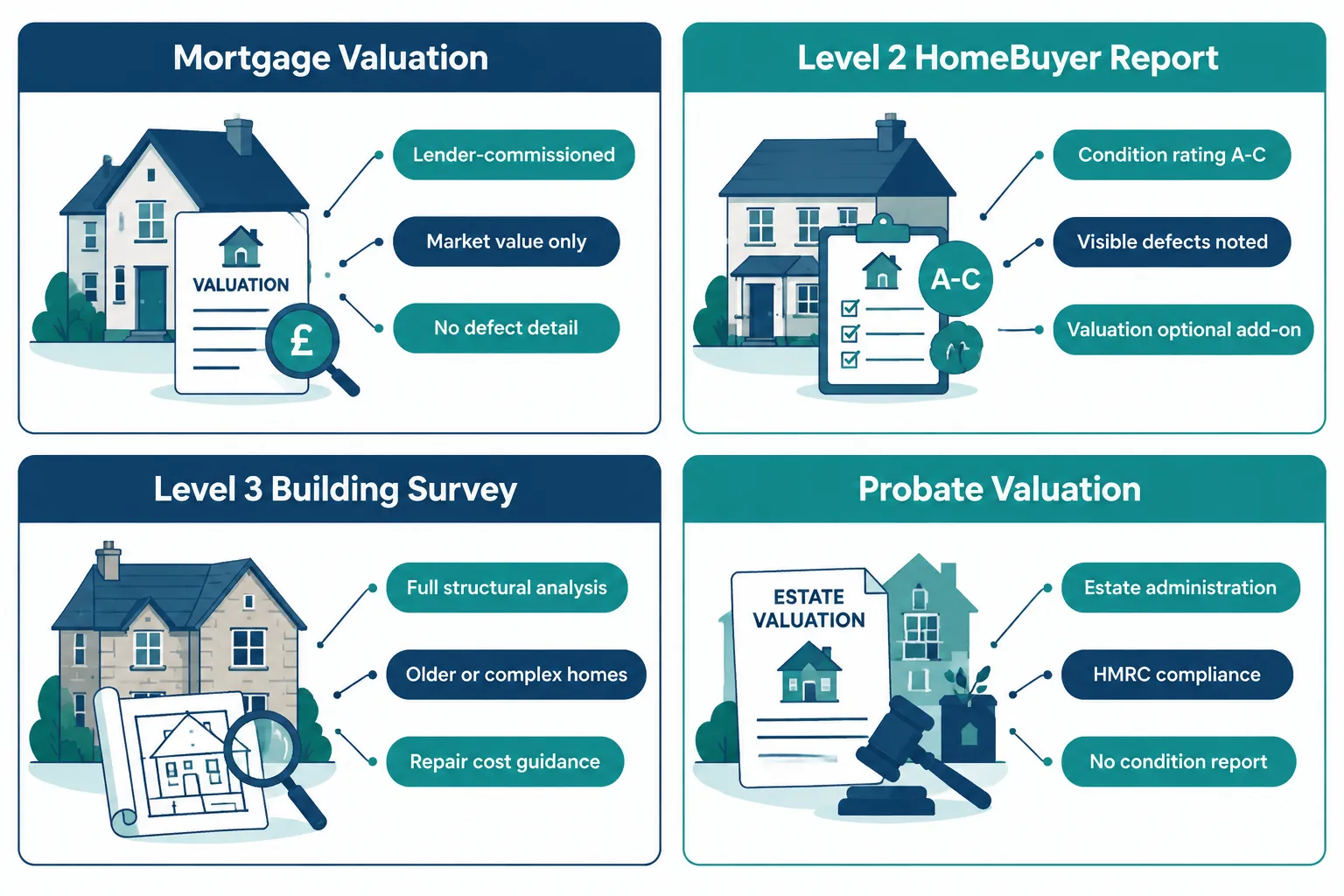
A valuation survey answers one question: how much is this property worth on the open market today? It does not assess whether the roof is failing, whether there is subsidence, or whether the damp patch in the corner bedroom is superficial or structural. Its purpose is to confirm to a mortgage lender that the property provides adequate security for the loan being advanced. [6]
This distinction matters enormously. The valuation is commissioned by the lender and paid for by the buyer, but the resulting report is written for the lender's benefit. The buyer typically receives a copy, but the surveyor's duty of care runs primarily to the lending institution, not to the purchaser.
Common scenarios where a valuation is the appropriate, and sufficient, report:
- A mortgage application on a modern, standard-construction property in good condition
- A remortgage where no structural concerns have been raised
- A probate valuation required for HMRC inheritance tax purposes
- A Help to Buy or shared ownership scheme requiring a formal market appraisal
In each of these cases, the goal is a defensible market figure, not a structural assessment. Confusing these two objectives is where buyers go wrong.
"Valuations equal worth; surveys equal condition.", Industry rule of thumb, updated January 2026 [7]
A mortgage valuation is typically brief, sometimes completed in under 30 minutes, and covers only what is visible from ground level without moving furniture, lifting carpets, or accessing roof spaces. It will flag only the most obvious and severe defects, and only when they materially affect lending value. [6]
The RICS Home Survey Standard: Three Levels of Inspection
The Royal Institution of Chartered Surveyors (RICS) governs the professional framework for residential surveys in the UK through its Home Survey Standard. The standard, first published in November 2020 and currently under active review with a second edition update in progress as of April 2026, establishes three distinct levels of residential inspection. [9]
Level 1, Condition Report
The most basic survey product. It provides a traffic-light condition rating for different elements of the property but offers no advice on repairs, no valuation, and no detailed commentary. It is suitable only for newer properties in good condition where the buyer simply wants a formal record of the property's state. [5]
Level 2, HomeBuyer Report
The most widely commissioned survey in the UK residential market. A Level 2 report includes a condition rating for each element, identifies defects that need attention, and, if the optional valuation add-on is included, provides a market value and reinstatement cost. [6]
A Level 2 is appropriate for:
- Conventional properties built after approximately 1900
- Properties in reasonable condition with no obvious structural concerns
- Standard construction (brick, tile, timber frame of a known type)
Level 3, Building Survey (Full Structural Survey)
The most comprehensive inspection available under the RICS Home Survey Standard. A Level 3 building survey involves a thorough examination of all accessible parts of the property, including roof spaces, underfloor areas, and structural elements. It provides detailed advice on defects, their likely causes, and the range of repair options available. [3]
A Level 3 is strongly recommended for:
- Properties built before 1900, particularly Victorian and Edwardian stock
- Listed buildings or properties in conservation areas
- Any property showing visible signs of structural movement, damp, or significant disrepair
- Unusual or non-standard construction (flint, cob, timber frame, concrete panel)
- Properties that have been significantly extended or altered
- High-value purchases where the cost of the survey is proportionate to the risk
Real UK Scenarios: When Each Report Is the Right Choice
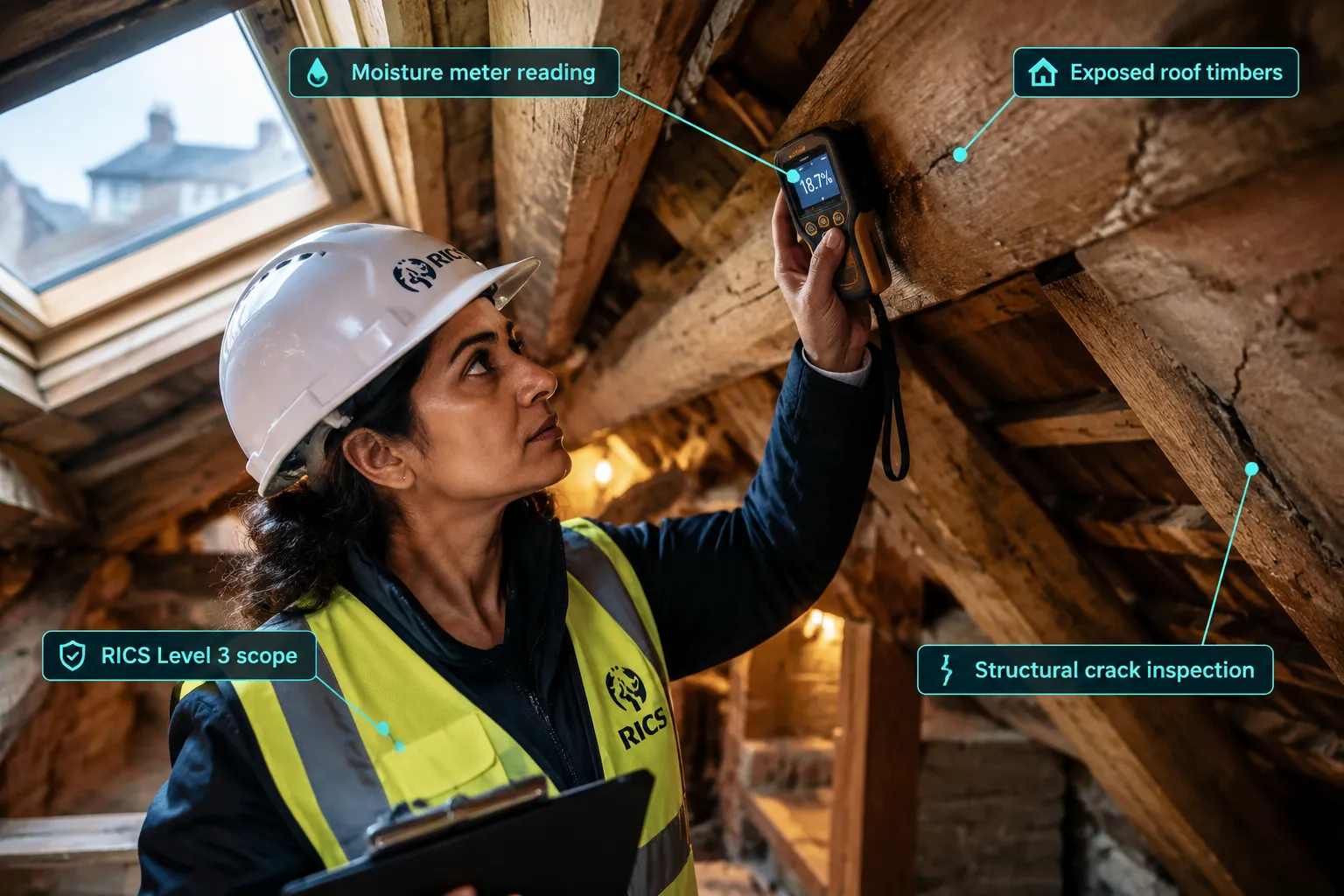
Understanding the abstract difference between a building survey and a valuation survey becomes much clearer when applied to real situations that UK buyers and property owners actually face.
Scenario 1: First-Time Buyer, 1990s New-Build Semi-Detached
A buyer purchasing a 1995-built semi-detached property in standard brick construction, with no visible defects noted during viewings, and a mortgage application in progress. The lender will commission a mortgage valuation automatically. The buyer should commission at minimum a Level 2 HomeBuyer Report with the optional valuation add-on. This provides condition ratings, flags any defects, and gives an independent market value check, all for a modest additional cost beyond the mortgage valuation fee. [6]
Relying on the mortgage valuation alone in this scenario is the single most common mistake first-time buyers make. Consumer guidance updated in August 2026 explicitly warns that a mortgage valuation "is not a survey and will not tell you about the condition of the property." [6]
Scenario 2: Cash Buyer, 1880s Victorian Terrace with Visible Cracks
No mortgage means no automatic valuation is triggered. The buyer is entirely responsible for commissioning their own due diligence. A Level 3 Building Survey is the only appropriate choice here. Victorian terraces are prone to settlement, chimney stack deterioration, original timber rot, lead pipework, and single-skin rear extensions. A Level 2 report will not provide the depth of structural commentary needed to make an informed decision or negotiate on price. [3] [7]
Scenario 3: Probate, Executor Valuing a Deceased Estate
An executor administering an estate needs a formal market valuation for HMRC. They do not need a building survey. A RICS Red Book valuation (a formal written valuation compliant with the RICS Valuation, Global Standards) is what is required. This is a pure valuation exercise with no condition assessment component. Commissioning a full building survey in this context would be unnecessary expenditure. [4]
Scenario 4: Remortgage on a Property Owned for 10 Years
The lender will typically instruct an Automated Valuation Model (AVM) or a brief desktop valuation. No structural survey is needed unless the owner has concerns about specific defects they wish to understand before undertaking repairs. In that case, a targeted structural engineer's report on a specific element (such as a cracked gable wall) is more cost-effective than a full Level 3 survey.
Scenario 5: Buying a 1960s Concrete-Panel Property
Non-standard construction is a significant risk category. Many concrete-panel systems built between 1950 and 1980 are designated as defective under the Housing Defects Act. A Level 3 Building Survey is essential, and the surveyor should be specifically experienced in non-standard construction. A Level 2 report will not provide the depth of analysis needed. [7]
Why "Cheap" Valuations Create Expensive Problems
The cost differential between a mortgage valuation and a full building survey is real but frequently misunderstood as a reason to skip the more detailed report. Industry cost data updated in January 2026 indicates that a Level 2 HomeBuyer Report typically costs between £400 and £1,000 depending on property value and location, while a Level 3 building survey ranges from £600 to £1,500 or more for larger or complex properties. [6]
Set against the average UK house price, these figures represent a fraction of a percentage point of the transaction value. Yet the defects a building survey can identify, structural movement, failing flat roofs, outdated electrical installations, or invasive Japanese knotweed, can easily cost £10,000 to £50,000 or more to remediate.
The cost-risk calculation is straightforward:
| Report Type | Typical Cost Range | Protects | Covers Condition |
|---|---|---|---|
| Mortgage Valuation | £150, £400 | Lender | No |
| Level 1 Condition Report | £250, £400 | Buyer (basic) | Basic only |
| Level 2 HomeBuyer Report | £400, £1,000 | Buyer | Yes (visible) |
| Level 3 Building Survey | £600, £1,500+ | Buyer | Yes (comprehensive) |
The market reality is that valuations still dominate the overall "surveys and valuations" landscape by volume, largely because mortgage lenders drive demand for them automatically. [10] This creates a structural imbalance: the most commonly produced report is also the least useful to the buyer as a tool for understanding what they are actually purchasing.
How to Avoid Ordering the Wrong Report: A Practical Checklist
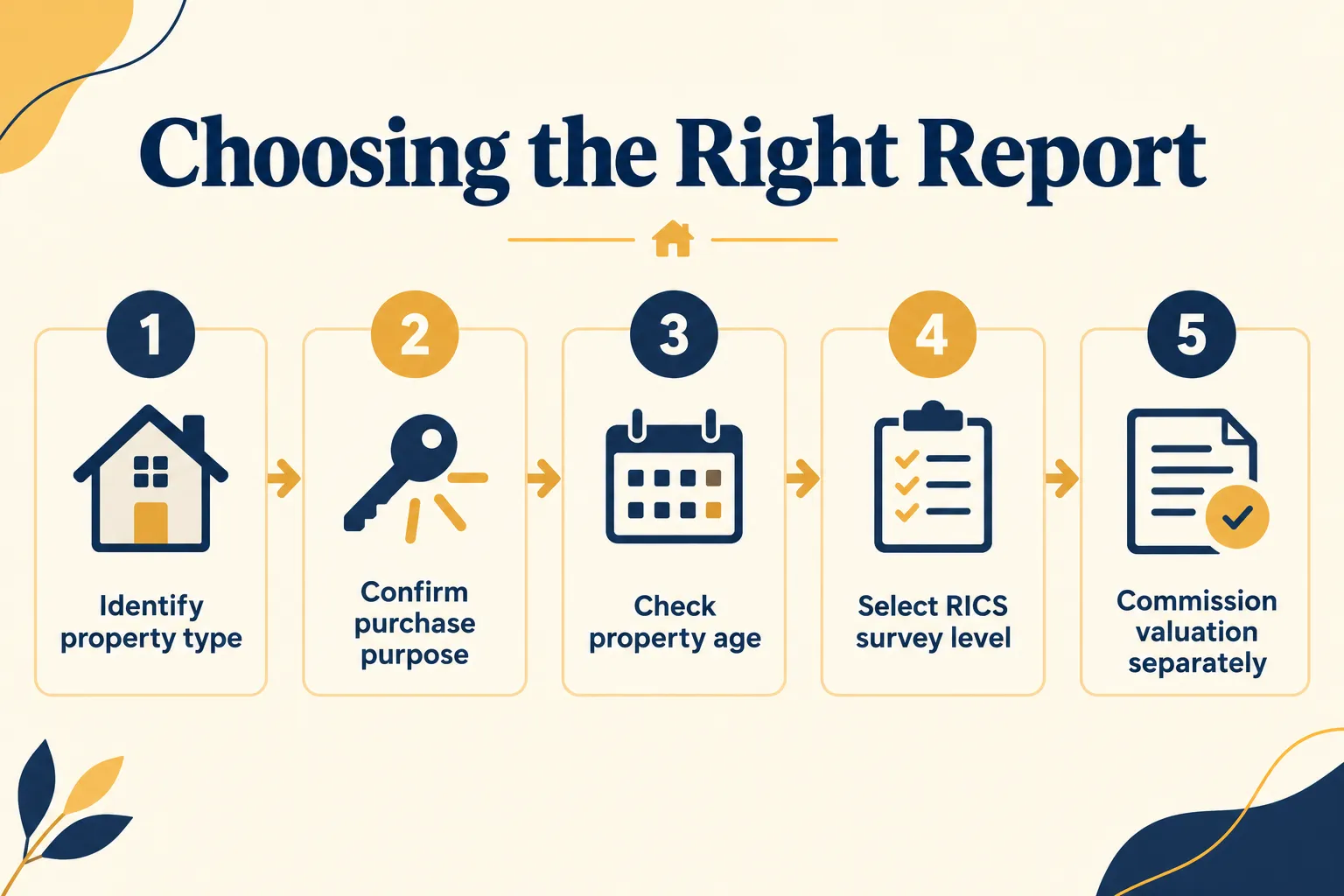
The RICS Home Survey Standard 2nd edition, currently under active review as of April 2026, places increased emphasis on consumer protection and clear communication about the scope and limitations of each survey level. [9] The following checklist reflects the practical guidance emerging from that updated framework.
Step 1, Identify the purpose of the report
Ask: is this report needed to satisfy a lender, to inform a purchase decision, or to comply with a legal or tax obligation? Each purpose points to a different product.
Step 2, Assess the property's age and construction type
- Post-2000, standard construction: Level 2 is usually sufficient
- Pre-1919, or any non-standard construction: Level 3 is the minimum appropriate choice
- Listed or conservation area property: Level 3, with specialist input if required
Step 3, Check for visible warning signs
If viewings have revealed any of the following, a Level 3 survey is warranted regardless of property age: visible cracking to external or internal walls, signs of damp or staining, sagging roof lines, evidence of significant extensions or alterations, or any structural irregularity.
Step 4, Decide whether a valuation is needed separately
A Level 3 building survey does not include a valuation by default. If an independent market value is needed, for negotiation, probate, or any other purpose, instruct the surveyor to provide a valuation as a separate element of the instruction. Many RICS surveyors can provide both within a single visit. [5]
Step 5, Verify RICS registration
All residential surveys and valuations should be carried out by a Chartered Surveyor registered with RICS. The RICS Find a Surveyor tool allows buyers to verify credentials and locate local practitioners with relevant experience. The Home Survey Standard requires that surveyors operate within their area of competence, a surveyor without experience of listed buildings, for example, should not be instructed on a Grade II listed farmhouse. [3] [5]
Step 6, Read the terms of engagement carefully
Before instructing any surveyor, read the terms of engagement. These set out exactly what is included, what is excluded, and the limitations of the inspection. A Level 2 report, for instance, will not include areas that are inaccessible, concealed, or outside the surveyor's line of sight. Understanding these limitations before, not after, the report is delivered prevents misplaced expectations.
Combining Survey and Valuation: The Practical Middle Ground
For the majority of standard residential purchases, the most effective approach is to combine a Level 2 HomeBuyer Report with valuation into a single instruction. This gives the buyer a condition assessment, a market value, and a reinstatement cost figure for buildings insurance purposes, all from one visit by one surveyor. [6]
For older or more complex properties, the combination shifts: a Level 3 Building Survey plus a separate formal valuation provides comprehensive structural intelligence alongside a defensible market figure. The additional cost is modest relative to the transaction value and the potential cost of undiscovered defects.
What no buyer should do is treat the mortgage valuation as a substitute for either. Industry expert commentary published in January 2026 is unequivocal on this point: "never rely on the mortgage valuation alone." [7] It is a lender's tool, not a buyer's protection.
Conclusion: Getting the Right Report Before You Commit
The distinction at the core of Building Survey vs Valuation Survey in the UK: How to Avoid the Wrong Report for Your Property is ultimately simple: valuations establish worth, surveys establish condition. Conflating the two, or defaulting to the cheapest option because it appears in the mortgage paperwork, is a risk that can result in significant financial loss after completion.
Actionable next steps for any UK property buyer in 2026:
- Never treat a mortgage valuation as a substitute for an independent survey, commission one regardless of what the lender arranges.
- Use the property's age, construction type, and visible condition to determine the appropriate RICS survey level (1, 2, or 3).
- For any property built before 1919, showing structural concerns, or of non-standard construction, instruct a Level 3 Building Survey without exception.
- If a market value figure is needed for any purpose beyond mortgage lending, commission a formal RICS valuation as a separate or combined instruction.
- Verify the surveyor's RICS registration and confirm their experience with the specific property type before instructing.
- Read the terms of engagement before the survey takes place, not after, understanding the scope and limitations upfront prevents disputes later.
The RICS Home Survey Standard continues to evolve, with the second edition under active review in 2026, reinforcing consumer protection and professional competence as its central pillars. [9] Buyers who engage with that framework, rather than defaulting to the minimum required by their lender, are the ones who complete on properties with full knowledge of what they are buying.
References
[1] Home Surveys – rics.org
[2] The New Home Survey Standard – ww3.rics.org
[3] Home Survey Standard Nov 2020 – rics.org
[4] Building Surveying Standards – rics.org
[5] Home Survey Standards – rics.org
[6] House Surveys Uk The Costs Types And Benefits Of An Rics Home Survey – rics.org
[7] Survey Vs Valuation – loudwater-bc.com
[8] Rics Resources Uk – imfuna.com
[9] Home Survey Standard 2nd Edition April 2026 Update – rics.org
[10] Connells Group Market Report Q2 2025 Final – connellsgroup.co.uk