Roughly one in three residential construction projects in England and Wales triggers the Party Wall etc. Act 1996, yet many homeowners only discover this after a neighbour has raised a formal objection and work has already been delayed. Understanding Party Wall Awards in the UK: what they contain, how they protect you and why you need one before building is not just useful background knowledge; it is practical, project-critical information that can save thousands of pounds and prevent months of disruption.
This guide walks through the anatomy of a typical Award, the timeline from serving a notice to receiving a signed document, and the protections the process provides to both building owners and their neighbours.
Key Takeaways
- A Party Wall Award is a legally binding document that authorises notifiable construction works and sets out the precise terms under which those works may proceed.
- The Award protects adjoining owners through a Schedule of Condition and damage-compensation provisions, and protects building owners by providing legal certainty to proceed.
- The process begins with a formal party wall notice and typically takes four to twelve weeks from notice to signed Award, depending on complexity.
- Typical Award costs range from around £1,000 for simple agreed-surveyor cases to £6,000 or more where two surveyors are appointed for complex schemes.
- A strict 14-day appeal window applies once an Award is served; after that window closes, the Award binds both current and future owners of the properties.
What Is a Party Wall Award and When Is One Required
A Party Wall Award is the formal, legally binding document produced under the Party Wall etc. Act 1996 that resolves a notified "dispute" and authorises specific construction works affecting a shared or boundary wall [7][10]. The word "dispute" is used in a technical sense: it arises automatically whenever an adjoining owner either dissents from a party wall notice or simply fails to respond within 14 days of receiving one [1][7].
The Act requires a notice before work can lawfully start on a range of notifiable activities, including:
- Extensions that involve cutting into or building on a party wall
- Loft conversions that require steel beams to be inserted into a shared wall
- Basement conversions that involve excavation near a neighbouring foundation
- Structural alterations to a wall that stands on the boundary between two properties
Once a dispute arises, whether through active dissent or simple non-response, one or more surveyors must be appointed, and they must produce an Award before work begins [1][10]. Government guidance updated in August 2026 confirms this sequence clearly: if neighbours cannot agree informally, surveyors produce an Award specifying what work can happen, how it will be carried out, and who pays what [3][10].
The Contents of a Party Wall Award: A Detailed Breakdown
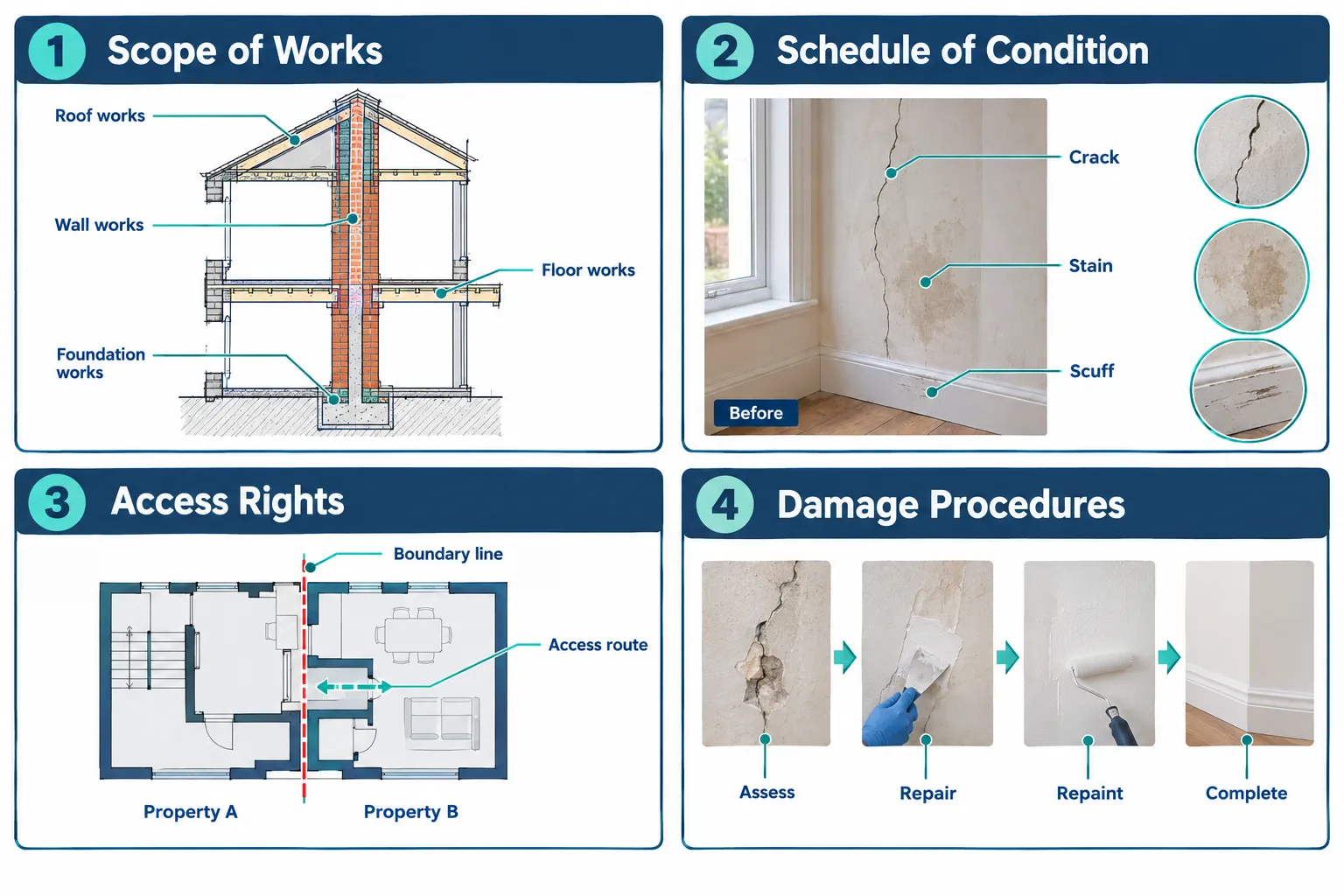
Understanding Party Wall Awards in the UK, what they contain, how they protect you and why you need one before building, starts with knowing exactly what the document includes. A well-drafted Award is a comprehensive legal instrument, not a simple letter of permission. The following six elements are standard in virtually every Award.
1. Scope of Permitted Works
The Award opens with a precise description of the works that are authorised. This section references the approved drawings, structural engineer's calculations and any relevant planning documents. It defines the boundary of what is permitted: any works that fall outside this scope are not covered by the Award and may constitute a trespass or breach of the Act [1][7][10].
Why this matters: If a contractor deviates from the agreed drawings during construction, the building owner loses the Act's protection for those additional works. Keeping the Award's scope accurate and up to date is therefore essential.
2. Method and Timing of Works
This section sets out how the works must be carried out and when. It typically specifies:
- Permitted working hours (commonly 8 am to 5 pm on weekdays, restricted on weekends and bank holidays)
- Requirements to limit dust, vibration and noise to reasonable levels
- Obligations to provide temporary weatherproofing, hoarding or support to the adjoining structure during construction [1][3][11]
These conditions are designed to minimise disruption to the neighbour's enjoyment of their property throughout the build.
3. Schedule of Condition
The Schedule of Condition is arguably the most important protective document within the Award for an adjoining owner. Surveyors inspect the neighbour's property, typically including all rooms adjacent to the works, the loft, cellar and external elevations, and record its condition in detail before construction begins [1][7][11].
The Schedule usually contains:
- Dated, time-stamped photographs of every relevant wall, ceiling, floor and external surface
- Written descriptions of any pre-existing cracks, damp patches, settlement marks or cosmetic defects
- A floor plan indicating the rooms inspected
"The Schedule of Condition is the baseline against which any post-construction damage claim is assessed. Without it, disputes about what was pre-existing and what was caused by the works become very difficult to resolve."
After construction, surveyors compare the property's current condition against this record. If new damage has appeared, the building owner is required to make it good or pay compensation [1][11]. Without a Schedule, an adjoining owner would struggle to prove that any crack or defect was caused by the works rather than pre-existing.
4. Access Rights
The Award grants the building owner's contractors a right of access to the adjoining property where this is reasonably necessary to carry out the works [1][10]. This might include:
- Access to erect scaffolding on the neighbour's land
- Entry to inspect or protect the adjoining wall during construction
- Access to carry out remedial works if damage occurs
Access rights are subject to reasonable notice (typically not less than 14 days, unless agreed otherwise) and must be exercised at reasonable times. The Award sets out these conditions explicitly, giving both parties a clear framework.
5. Damage and Compensation Procedures
This section establishes what happens if the works cause damage to the adjoining property. It typically provides that:
- The building owner must make good any damage caused, either by carrying out repairs or by paying the reasonable cost of repairs
- The surveyors (or a third surveyor if the two appointed surveyors cannot agree) determine whether damage was caused by the works and, if so, what remedy is appropriate [1][7][11]
This mechanism removes the need for the adjoining owner to pursue a civil claim in court for minor damage, which would be far more costly and time-consuming.
6. Costs and Surveyors' Fees
The Award states who pays the surveyors' fees and any other costs associated with the party wall process. In the vast majority of cases, the building owner pays all reasonable costs, since it is their project that has triggered the process [1][10][11]. Where an adjoining owner has appointed their own surveyor, the building owner typically pays that surveyor's reasonable fees as well.
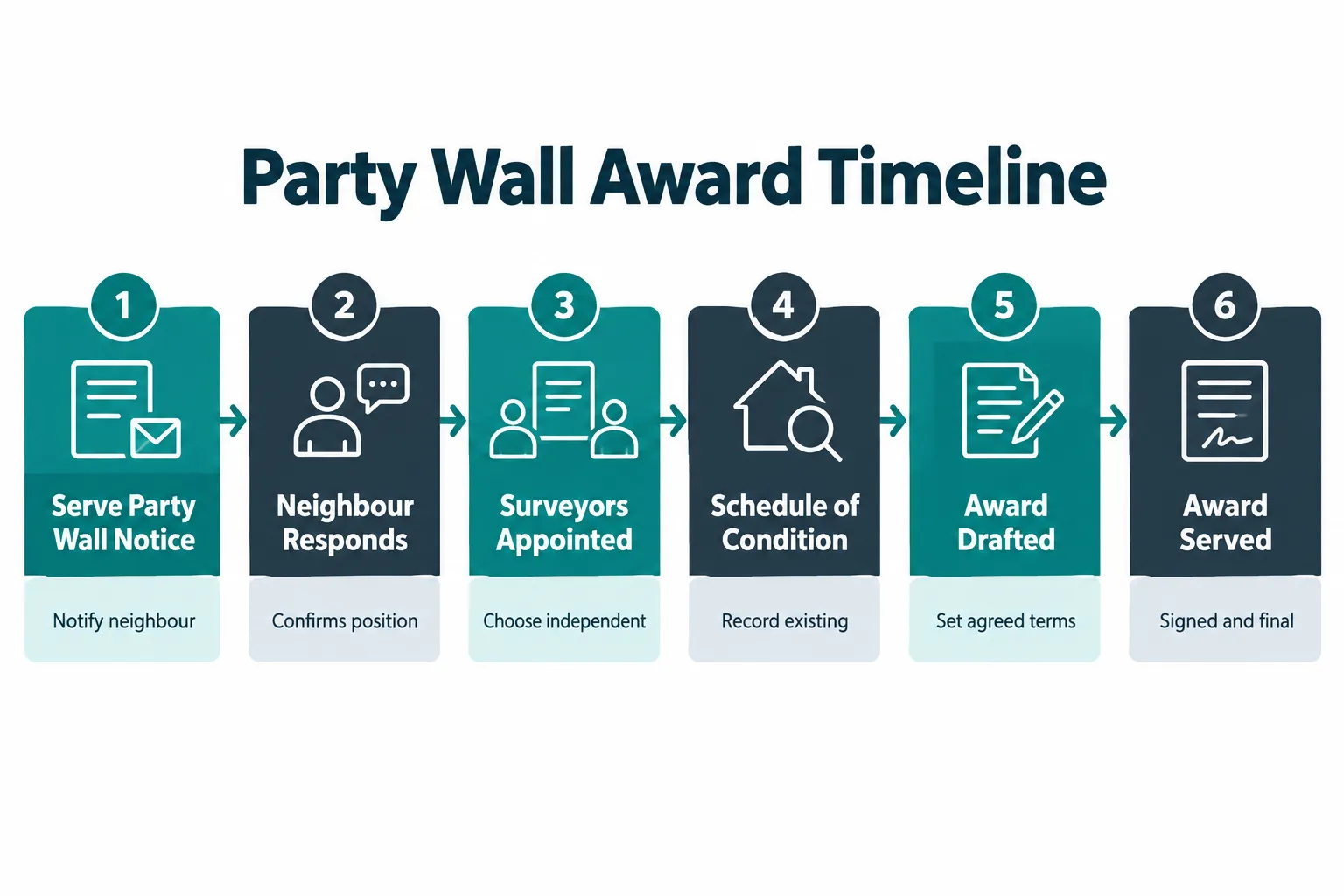
The Timeline: From Serving a Notice to a Signed Award
Knowing the timeline is essential for project planning. The party wall process has fixed statutory deadlines that cannot be shortened, and in 2026 surveyor demand is creating additional delays in some areas [5][8]. Building realistic time into a project programme is critical.
| Stage | Typical Duration | Key Action |
|---|---|---|
| Serve party wall notice | Day 1 | Building owner serves written notice on all adjoining owners |
| Response period | Up to 14 days | Adjoining owner consents, dissents or fails to respond (triggering a dispute) |
| Surveyor appointments | 1-2 weeks | Parties appoint an agreed surveyor or each appoints their own |
| Schedule of Condition survey | 1-2 weeks | Surveyor(s) inspect and record the adjoining property |
| Award drafted and agreed | 2-4 weeks | Surveyors draft, review and agree the terms of the Award |
| Award served on both parties | Day of service | Both building and adjoining owners receive the signed Award |
| 14-day appeal window | 14 days | Either party may appeal to the county court; after this, the Award is binding |
Total typical timeline: Four to six weeks for a straightforward agreed-surveyor case; eight to twelve weeks where two surveyors are appointed or the works are complex [5][8].
In 2026, industry practitioners are reporting bottlenecks in some areas due to high demand for party wall services, making early notice-serving even more important [8]. Homeowners planning extensions or loft conversions are advised to serve notices as early as possible, ideally two to three months before the intended start date, to avoid being delayed on site.
The 14-Day Appeal Right
Once an Award is served, either party has exactly 14 days to appeal to the county court under section 10(17) of the Act [10][15]. Grounds for appeal include cases where the surveyors lacked jurisdiction, where the works go beyond what the Act permits, or where the Award imposes unlawful conditions [7]. This window is tightly enforced: once it closes, the Award becomes binding on both current and future owners of the properties, dramatically reducing the risk of later injunctions or disputes [1][7][10].
How Party Wall Awards Protect Both Owners, and Why You Need One Before Building
The protections provided by Party Wall Awards in the UK, what they contain, how they protect you and why you need one before building, flow in both directions.
Protection for Adjoining Owners
For neighbours, the Award provides:
- A pre-construction baseline through the Schedule of Condition, making it straightforward to identify and claim for any damage caused by the works [1][11]
- Limits on disruption, including restricted working hours, dust and vibration controls, and requirements for temporary weatherproofing [1][3]
- A clear compensation mechanism that avoids the need for costly court proceedings over minor damage [7][11]
- Legal standing: the Award is enforceable, meaning a neighbour can seek an injunction if the building owner breaches its terms
Protection for Building Owners
For the person carrying out the works, the Award provides:
- Legal authority to proceed with works that would otherwise risk being stopped by injunction [10][11]
- Certainty about scope: the Award confirms exactly what is permitted, reducing the risk of a neighbour claiming that works exceeded what was agreed [1][7]
- Binding effect on future owners: if the building owner sells during or after the project, the Award protects the new owner as well [1][10]
- A documented record that the correct process was followed, which is increasingly relevant to conveyancers and mortgage lenders
"Starting notifiable works without a valid Award, or without having served a notice at all, exposes a building owner to injunction proceedings, which can halt a project entirely and generate substantial legal costs."
The Cost of Getting It Wrong
Homeowners who begin notifiable works without serving a notice or obtaining an Award risk injunction proceedings in the county court. The costs of an injunction application, combined with the delay and potential requirement to undo completed works, will almost always far exceed the cost of the party wall process itself [2][7][9]. Authoritative homeowner guides in 2026 consistently stress that obtaining an Award before building is essential for larger projects such as extensions, basement conversions and loft conversions [2][9][11].

Costs, Surveyors and the 2026 Landscape
As of 2026, typical surveyor rates for party wall work are around £150 to £200 per hour [2][5]. The total cost of an Award depends primarily on whether the parties use an agreed surveyor (one surveyor acting for both) or each appoint their own:
- Agreed surveyor, simple works: approximately £1,000 to £1,500 [2][5]
- Agreed surveyor, complex works: can reach £3,000 or more [5]
- Two surveyors appointed: total fees commonly fall in the £2,000 to £6,000+ range [5][8]
Using an agreed surveyor is generally faster and more cost-effective where the parties have a reasonably cooperative relationship. However, an adjoining owner is always entitled to appoint their own surveyor, and the building owner must pay that surveyor's reasonable fees [1][10].
The RICS 8th Edition Consultation
Professional practice is currently evolving. The Royal Institution of Chartered Surveyors (RICS) launched a consultation on a new 8th edition of its Party Wall Legislation and Procedure guidance in April 2026, with the final document expected to take effect approximately three months after publication [4][6]. The draft includes an updated model Award, revised surveyor appointment letters and tightened best-practice standards around notice drafting and Award structure [4]. Importantly, the underlying statute, the Party Wall etc. Act 1996, remains unchanged, so the core rules on notices, surveyors and Awards continue to apply in their current form [12][13].
Homeowners and practitioners should watch for the publication of the final 8th edition, as it will set new benchmarks for how Awards are structured and what they must contain.
Practical Steps: Getting Your Award Right
For homeowners planning notifiable works in 2026, the following steps will help ensure the party wall process runs smoothly:
- Identify all notifiable works early, consult a party wall surveyor or solicitor before finalising designs to confirm whether the Act applies.
- Serve notices in good time, aim to serve at least two months before the intended start date to allow for the full statutory process, especially given current surveyor demand [8].
- Use standard notice templates, government guidance recommends using standard templates to reduce the risk of a notice being challenged as invalid [3].
- Consider an agreed surveyor, where relations with neighbours are good, an agreed surveyor will typically produce an Award more quickly and at lower cost [2][5].
- Review the draft Award carefully, check that the scope of works matches the approved drawings, that the Schedule of Condition is thorough, and that access and damage provisions are clearly stated [1][7].
- Note the 14-day appeal deadline, both parties should take independent advice promptly if they have any concerns about the Award's terms [7][10].
- Keep the Award on file, the document should be retained for the life of the building, as it is binding on future owners and may be required by conveyancers on sale [1][10].
Conclusion
Party Wall Awards in the UK, what they contain, how they protect you and why you need one before building, represent one of the most practically important legal documents in residential construction. A well-drafted Award does far more than give permission to build: it records the pre-construction condition of a neighbour's property, sets binding rules on how works must be carried out, establishes a clear mechanism for resolving damage claims, and provides legal certainty for the building owner to proceed with confidence.
The process has fixed timelines that cannot be rushed, and in 2026 surveyor demand is adding pressure to those timelines in many areas. The single most effective action any homeowner planning an extension, loft conversion or structural alteration can take is to start the party wall process early, well before the intended construction start date.
Actionable next steps:
- Consult a qualified party wall surveyor as soon as designs are at an advanced stage to confirm whether the Act applies and which notices are needed.
- Serve party wall notices as early as possible, using standard templates recommended in government guidance [3].
- Budget realistically for surveyor fees and build the full party wall timeline into the project programme.
- Retain the signed Award and all supporting documents, they are binding on future owners and will be required on any future sale of the property.
References
[1] Party Wall Agreement Uk 2026 – pg-construction.co.uk
[2] Party Wall Agreement – hoa.org.uk
[3] Preventing And Resolving Disputes In Relation To Party Walls – gov.uk
[4] Rics 8th Edition Party Wall Guidance – hudsonpartywallsurveyors.co.uk
[5] Party Wall Award – partywallsurveyorlondon.uk
[6] Rics Publishes Updated Standard For Multi Storey Residential Buildings With Cladding – rics.org
[7] Party Wall Award Appeal Costs 2026 – calchub.uk
[8] Party Wall Awards In 2026 Construction Boom Safeguarding Projects Amid Surveyor Shortages – partywallsurveyorlondon.uk
[9] Rics Consumer Guide Party Walls – ricsfirms.com
[10] If You Cant Agree – gov.uk