
Private rental sector landlords face unprecedented liability as structural collapse officially enters the regulatory framework under Awaab's Law Phase 2 in 2026. With over 4.4 million privately rented homes in England—many built before modern building codes—the expansion of hazard categories beyond damp and mould now captures sagging floors, cracked load-bearing walls, and compromised roof structures. Surveyors conducting Level 3 Building Surveys for Structural Collapse Risks in PRS Under Awaab's Law 2026: Emergency Hazard Checklists must navigate strict investigation timelines whilst documenting defects that could trigger mandatory repairs within weeks, not months.
The shift from traditional Housing Health and Safety Rating System (HHSRS) scoring to person-centred assessment means structural defects previously classified as lower-priority Category 2 hazards can now demand immediate landlord action if tenant circumstances elevate the risk profile. This article provides comprehensive emergency hazard checklists, investigation protocols, and compliance timelines specifically designed for RICS Level 3 building surveys in the private rented sector.
Key Takeaways
- Structural collapse becomes a regulated hazard in 2026 under Awaab's Law Phase 2, requiring landlords to investigate significant structural defects within 10 working days of notification [7]
- Person-centred assessment replaces automatic HHSRS scoring, meaning structural hazards may qualify for mandatory repair even if they score as Category 2 under traditional evaluation methods [7]
- Emergency response timelines mandate written investigation summaries within 3 working days of survey completion, with safety measures commencing within 5 working days for confirmed hazards [4]
- Level 3 surveys must document pre-existing structural deficiencies in party wall scenarios and older housing stock where collapse risks intersect with tenant vulnerability factors [8]
- Remedial action deadlines require full repair initiation within 12 weeks for complex structural work, creating significant liability exposure for non-compliant landlords [1]
Understanding Awaab's Law 2026 Structural Collapse Provisions
Awaab's Law emerged from the tragic death of two-year-old Awaab Ishak in 2020, whose prolonged exposure to severe damp and mould in social housing proved fatal. The legislation initially targeted social landlords with mandatory repair timescales for emergency hazards and damp/mould conditions in Phase 1 (2023). Phase 2, commencing in 2026, extends these protections to the private rented sector whilst dramatically expanding the hazard categories under regulatory control [7].
What Qualifies as Structural Collapse Risk Under the New Framework
Structural collapse hazards encompass any defect presenting "significant risk of harm" through potential building failure. This includes:
- Foundation subsidence or settlement causing structural movement exceeding acceptable tolerances
- Load-bearing wall failures including severe cracking, bulging, or loss of structural integrity
- Floor joist deterioration from rot, insect infestation, or overloading causing dangerous deflection
- Roof structure compromise including truss failures, purlin sagging, or rafter decay
- Staircase structural deficiencies where collapse could cause serious injury
- Chimney breast removal without proper structural support installation
- Loft conversion overloading where additional loads exceed original design capacity
The critical distinction from previous HHSRS assessments lies in the person-centred evaluation approach. A structural defect that might score as Category 2 (lower priority) under traditional methodology can now trigger mandatory landlord action if tenant circumstances—such as young children, elderly occupants, or mobility-impaired residents—elevate the actual risk of harm [7].
Timeline Requirements for Investigation and Remediation
The legislative framework establishes strict timescales that fundamentally alter surveyor responsibilities:
| Phase | Timeframe | Required Action |
|---|---|---|
| Notification | Day 0 | Landlord becomes aware of potential structural hazard |
| Investigation | Within 10 working days | Structural survey must be commissioned and completed |
| Written Summary | Within 3 working days after investigation | Detailed findings provided to tenant in accessible format |
| Safety Measures | Within 5 working days of confirmation | Immediate protective measures must commence |
| Full Repair Initiation | Within 12 weeks | Complex structural repairs must begin (not complete) [1][4] |
These compressed timelines eliminate the traditional "wait and monitor" approach many landlords previously employed with structural defects. Surveyors conducting Level 3 Building Surveys for Structural Collapse Risks in PRS Under Awaab's Law 2026: Emergency Hazard Checklists must provide actionable findings within days, not weeks.
Emergency Hazard Checklists for Level 3 Structural Surveys in PRS Properties
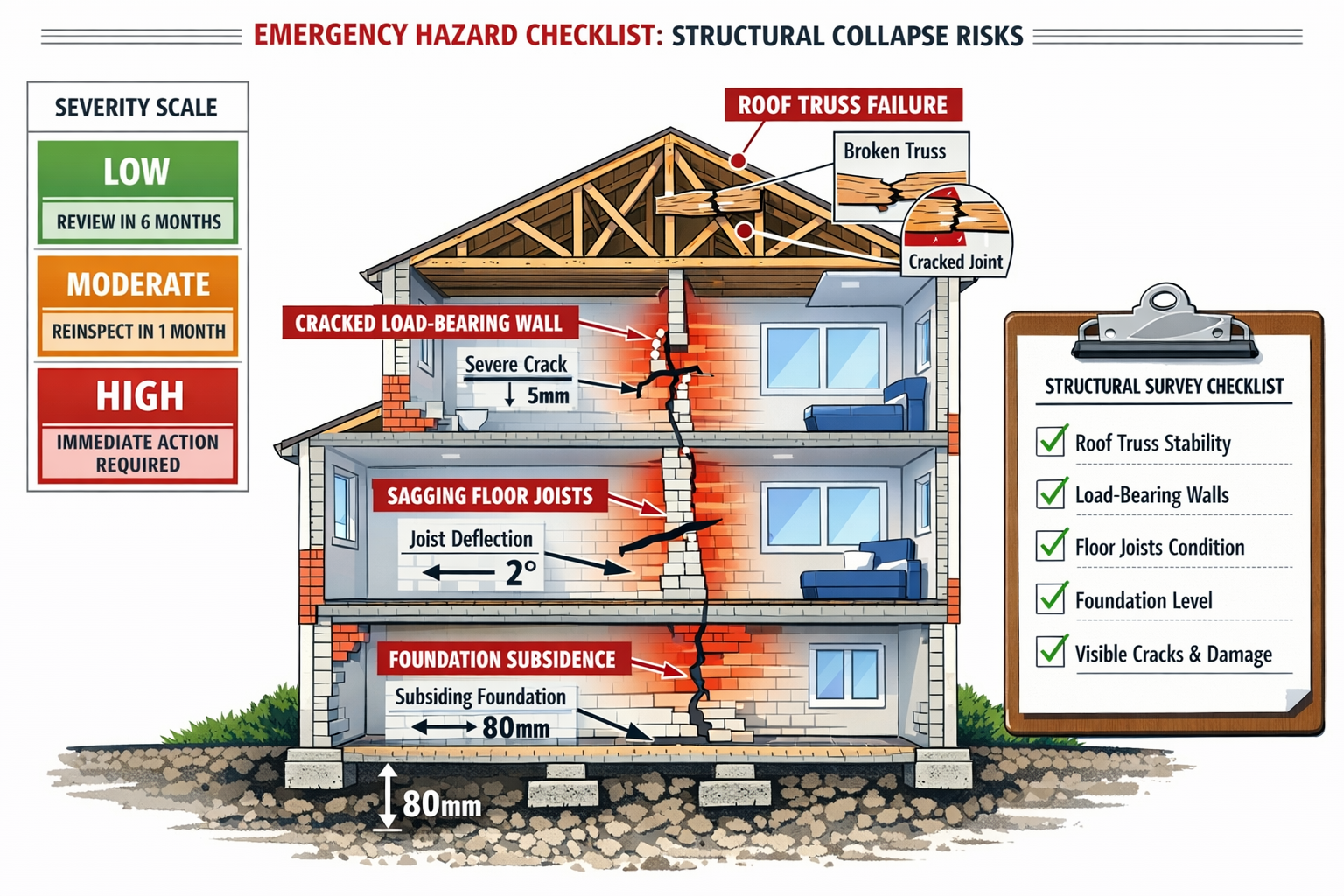
Comprehensive hazard identification requires systematic evaluation of structural elements most prone to failure in aging rental stock. The following checklists integrate Awaab's Law compliance requirements with RICS building survey best practices.
Foundation and Substructure Assessment Protocol
Visual Inspection Indicators:
- ✅ Stepped cracking in external brickwork exceeding 5mm width
- ✅ Diagonal cracks radiating from window/door openings
- ✅ Separation between walls and floors visible internally
- ✅ Doors and windows binding in frames due to structural movement
- ✅ Sloping floors with gradient exceeding 1:100 over 3m span
- ✅ External ground level changes indicating settlement
- ✅ Drainage defects causing soil erosion near foundations
Instrumentation Requirements:
- Crack width measurement with graduated gauge (record all cracks >3mm)
- Floor level survey using laser level or spirit level with precision measurement
- Moisture meter readings at wall/floor junctions to identify water ingress
- Photographic documentation with scale references for all defects
Person-Centred Risk Factors:
Does the property house young children who could be injured by falling masonry? Are elderly or disabled tenants unable to evacuate quickly if collapse occurs? These vulnerability factors transform standard Category 2 subsidence into actionable hazards under the person-centred assessment model [7].
Load-Bearing Wall and Structural Masonry Evaluation
Load-bearing wall failures represent the highest-consequence structural collapse risk in Victorian and Edwardian terraced properties—the predominant housing type in many PRS portfolios.
Critical Defect Identification:
- 🔴 Horizontal cracking at floor joist bearing points (indicates overloading)
- 🔴 Bulging or bowing exceeding 20mm over wall height
- 🔴 Missing or corroded wall ties in cavity wall construction
- 🔴 Removal of chimney breasts without proper support installation
- 🔴 Lintels showing deflection or cracking above openings
- 🔴 Parapet walls leaning outward or showing separation
- 🔴 Internal walls with severe plaster cracking indicating structural movement
Investigation Methodology:
Surveyors must distinguish between cosmetic cracking and structural defects requiring immediate intervention. The structural engineering assessment should include:
- Crack pattern analysis to determine whether movement is historic (stable) or ongoing (progressive)
- Tell-tale installation where crack activity status cannot be determined from single inspection
- Opening up works where concealed structural elements require exposure for proper assessment
- Structural calculations to verify load paths and bearing capacities, particularly in altered properties
For party wall scenarios in terraced or semi-detached PRS properties, surveyors must document pre-existing structural deficiencies that could constitute collapse hazards, as these now carry mandatory disclosure requirements under the extended Awaab's Law framework [8].
Floor Structure and Timber Decay Assessment
Suspended timber floors in pre-1950s housing present elevated collapse risks when combined with inadequate ventilation, rising damp, or pest infestation.
Comprehensive Floor Survey Checklist:
- 🟡 Visible deflection when walking across rooms
- 🟡 Springy or bouncy floor surfaces indicating joist deterioration
- 🟡 Gaps appearing between floorboards and skirting boards
- 🟡 Musty odors suggesting concealed timber decay
- 🟡 Evidence of woodworm infestation in exposed timbers
- 🟡 Inadequate underfloor ventilation (blocked airbricks)
- 🟡 Contact between timber and masonry without damp-proof membrane
- 🟡 Notching or drilling of joists exceeding Building Regulations limits
Invasive Investigation Requirements:
Surface inspection alone cannot adequately assess floor structure integrity. Level 3 building surveys for Awaab's Law compliance should include:
- Lifting floorboards at representative locations to inspect joist condition
- Moisture content testing of timber elements using resistance-type moisture meters
- Probe testing of joist ends where they bear into walls (primary decay location)
- Structural load testing where floor capacity is questionable
- Specialist timber survey if active infestation or extensive decay is identified
Where floor collapse risk is confirmed, immediate safety measures might include temporary propping, load restrictions, or room closure pending full remedial works [4].
Roof Structure and Covering Integrity Evaluation
Roof structure failures can cause catastrophic collapse, particularly in properties with cut timber roofs or those subjected to unauthorized alterations.
Roof Structure Hazard Indicators:
- ⚠️ Sagging ridge lines visible from external inspection
- ⚠️ Purlin deflection or cracking in roof space
- ⚠️ Rafter spreading causing wall plate displacement
- ⚠️ Missing or inadequate lateral restraint straps
- ⚠️ Truss plate failures in modern trussed rafter roofs
- ⚠️ Timber decay in roof timbers from water ingress
- ⚠️ Overloading from excessive roof covering layers
- ⚠️ Loft conversions without proper structural design
Advanced Inspection Techniques:
Traditional roof surveys may not adequately capture structural collapse risks. Enhanced methodologies include:
- Drone surveys for high-level external inspection without scaffolding access
- Thermal imaging to identify concealed water penetration causing timber decay
- Structural engineering review of load paths and member sizing
- Building Control records search to verify whether alterations received approval
The person-centred assessment framework means that roof structure defects in properties housing vulnerable tenants—particularly top-floor flats with elderly occupants—may require more urgent intervention than identical defects in ground-floor accommodations [7].
Implementing Person-Centred Assessment for Structural Hazards in PRS
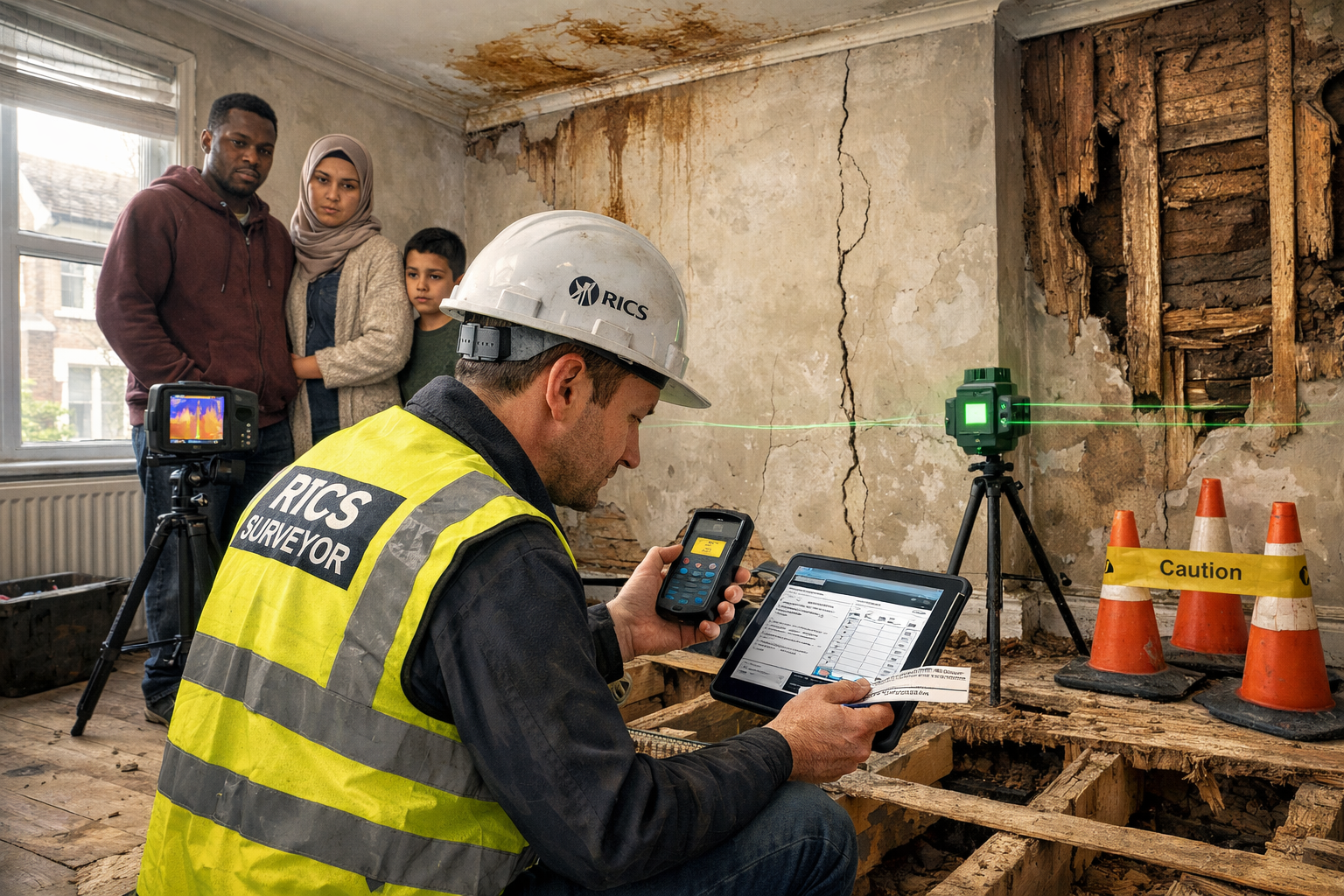
The paradigm shift from automatic HHSRS scoring to person-centred evaluation fundamentally changes how surveyors assess structural collapse risks under Level 3 Building Surveys for Structural Collapse Risks in PRS Under Awaab's Law 2026: Emergency Hazard Checklists.
Vulnerability Factors That Elevate Structural Hazard Priority
Traditional HHSRS methodology assessed hazards based on statistical likelihood and severity for a "standard" occupant. The person-centred approach requires surveyors to consider actual tenant circumstances:
High-Priority Vulnerability Indicators:
- 👶 Young children (increased injury severity from structural failure)
- 👴 Elderly occupants (reduced mobility for emergency evacuation)
- ♿ Disabled residents (physical barriers to escaping collapse)
- 🏠 Ground floor occupants (higher risk from upper floor collapse)
- 🛏️ Bedroom locations (extended exposure during sleep hours)
- 👨👩👧👦 Large families (multiple persons at risk simultaneously)
A structural defect that might receive a Category 2 (Band F) HHSRS score—traditionally requiring repair "within 12 months"—can now trigger the 10-day investigation and 12-week repair initiation timeline if tenant vulnerability factors are present [7].
Documentation Requirements for Compliance
Surveyors must provide written summaries that meet strict accessibility and comprehension standards. The investigation report should include:
- Plain language hazard description avoiding technical jargon
- Photographic evidence with clear annotation of defects
- Immediate safety recommendations for tenant protection
- Repair scope outline indicating complexity and likely duration
- Interim measures specification if full repair requires extended timeframe
- Tenant rights explanation including complaint escalation procedures
The written summary must be delivered to tenants within 3 working days of investigation completion, creating tight turnaround requirements for surveying practices [4].
Coordinating with Specialist Consultants
Complex structural collapse risks often require multi-disciplinary assessment beyond the scope of building surveyors alone. Effective coordination includes:
- Structural engineers for load calculations and remedial design
- Geotechnical specialists for foundation failure investigation
- Timber specialists for decay extent and treatment specification
- Building Control for regulatory compliance verification
- Party wall surveyors where defects affect adjoining properties
When commissioning structural engineering assessments, surveyors must communicate the compressed Awaab's Law timelines to ensure specialist reports arrive within the 10-day investigation window.
Compliance Flowchart and Remediation Timelines
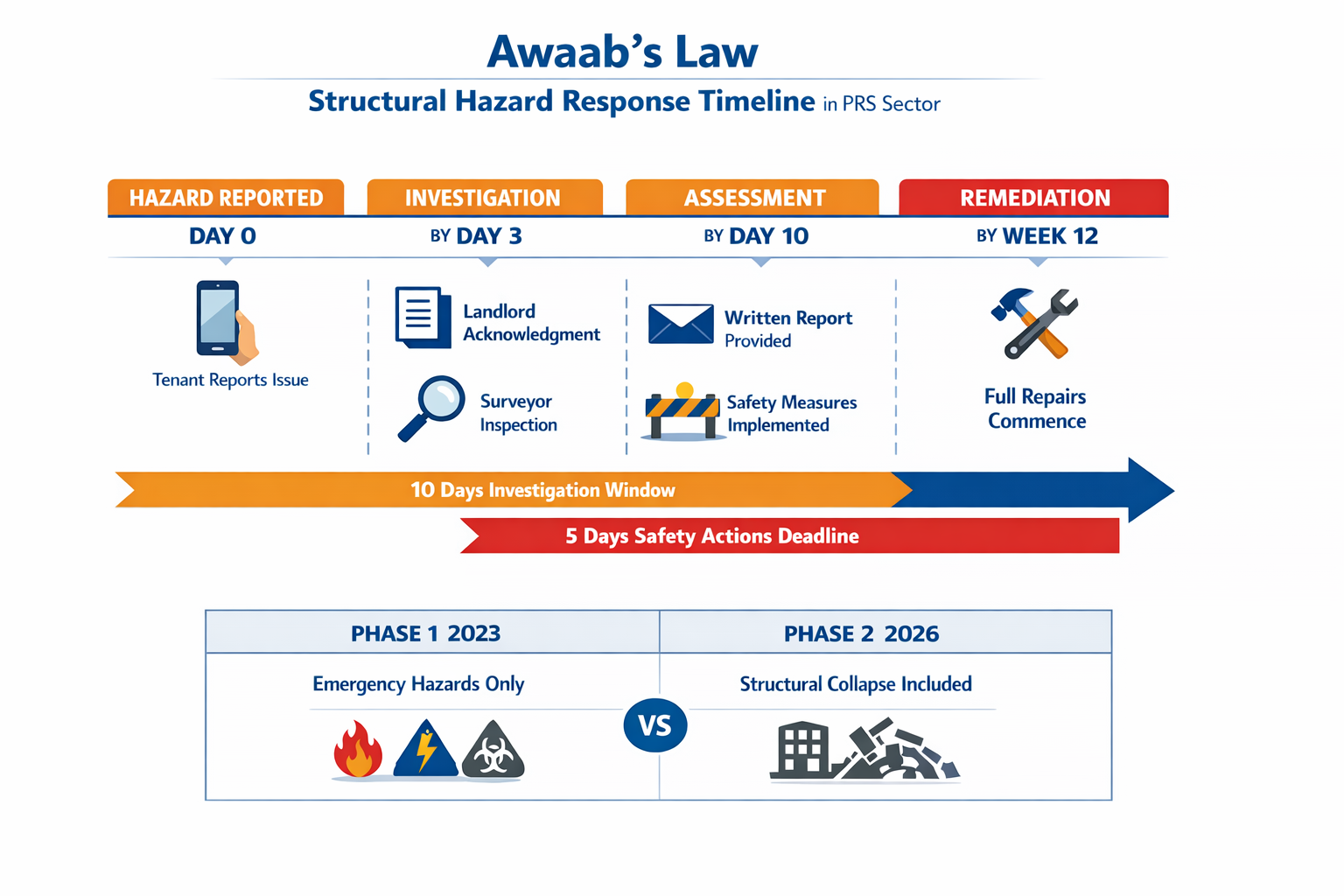
Understanding the precise sequence and timing of mandatory actions prevents landlord non-compliance and protects tenants from prolonged exposure to structural collapse risks.
Day 0-10: Investigation and Assessment Phase
Triggering Events:
- Tenant reports structural defect concerns
- Surveyor identifies potential collapse hazard during routine inspection
- Third-party notification (neighbor, contractor, local authority)
Landlord Obligations:
Within 10 working days of becoming aware of the potential hazard, the landlord must commission and complete a competent investigation. For structural collapse risks, this typically requires a RICS chartered building surveyor conducting a Level 3 survey with structural engineering input where necessary [4][7].
Surveyor Deliverables:
- Comprehensive structural assessment report
- Hazard categorization under person-centred framework
- Immediate safety recommendations
- Remedial scope and cost estimate
- Timeline for full repair completion
Day 11-13: Written Summary Delivery
Within 3 working days after investigation completion, landlords must provide tenants with a written summary in accessible format. This document serves as the official notification of findings and proposed actions [4].
Essential Summary Components:
- ✍️ Clear description of structural defect identified
- ✍️ Explanation of risk level and urgency
- ✍️ Immediate safety measures being implemented
- ✍️ Full repair timeline and scope
- ✍️ Tenant rights and complaint procedures
- ✍️ Contact information for follow-up questions
Failure to provide this written summary within the statutory timeframe constitutes a breach of Awaab's Law, potentially triggering enforcement action by local housing authorities.
Day 14-18: Safety Measures Implementation
For confirmed structural collapse hazards, safety measures must commence within 5 working days of hazard confirmation. These interim protections might include:
- 🛡️ Temporary propping of compromised structural elements
- 🛡️ Load restrictions or room closure for unsafe areas
- 🛡️ Installation of monitoring equipment for ongoing movement
- 🛡️ Weather protection to prevent further deterioration
- 🛡️ Tenant relocation if property is imminently dangerous
The 5-day safety measure deadline runs concurrently with planning for full remedial works, not sequentially [1].
Week 3-12: Full Repair Mobilization
Complex structural repairs must be initiated (not completed) within 12 weeks of hazard confirmation. This timeline acknowledges that major structural works—such as underpinning, steelwork installation, or roof reconstruction—require design, procurement, and Building Control approval processes [1].
Acceptable Repair Initiation Evidence:
- Structural engineer's remedial design completed
- Building Control application submitted
- Contractor appointed with signed contract
- Materials ordered with delivery scheduled
- Site mobilization commenced with visible progress
Landlords cannot use the 12-week window as a delay tactic. Demonstrable progress toward repair completion must be evident, with realistic completion schedules communicated to tenants.
Enforcement and Penalties for Non-Compliance
Local housing authorities possess enhanced enforcement powers under Awaab's Law, including:
- Improvement Notices with mandatory compliance deadlines
- Civil penalties up to £30,000 for serious breaches
- Rent Repayment Orders allowing tenants to reclaim up to 12 months' rent
- Banning orders preventing serious offenders from letting properties
- Prosecution for the most egregious cases of tenant endangerment
The introduction of structural collapse as a regulated hazard significantly expands the circumstances under which these enforcement actions can be deployed [6].
Practical Considerations for Surveyors and Landlords
Survey Specification and Fee Implications
The enhanced investigation requirements for Level 3 Building Surveys for Structural Collapse Risks in PRS Under Awaab's Law 2026: Emergency Hazard Checklists increase survey scope and cost compared to traditional pre-purchase inspections.
Scope Enhancements Include:
- Invasive investigation (lifting floorboards, accessing concealed spaces)
- Specialist equipment deployment (moisture meters, crack gauges, laser levels)
- Structural engineering consultation for complex defects
- Accelerated reporting to meet 10-day investigation deadline
- Tenant vulnerability assessment and person-centred evaluation
- Detailed remedial specification and cost estimation
Landlords should anticipate survey pricing reflecting these additional requirements, particularly for older properties with known structural issues.
Insurance and Liability Considerations
Professional indemnity insurance for surveyors conducting Awaab's Law compliance surveys requires careful specification. Policies should provide adequate coverage for:
- Errors or omissions in structural hazard identification
- Inadequate person-centred risk assessment
- Delayed reporting causing landlord non-compliance
- Underestimation of repair urgency or scope
Landlords should similarly review their property insurance to ensure structural collapse risks are adequately covered, particularly where surveys identify defects requiring monitoring before full repair.
Proactive Survey Strategies for PRS Portfolios
Rather than waiting for tenant complaints to trigger reactive investigations, prudent landlords are implementing proactive survey programs:
Portfolio Risk Assessment Approach:
- Age-based prioritization (pre-1919 properties surveyed first)
- Construction type targeting (Victorian terraces, non-standard construction)
- Previous defect history (properties with known structural issues)
- Tenant vulnerability profiling (families with young children, elderly occupants)
- Cyclical inspection programs (5-year structural survey cycles)
This proactive approach not only ensures Awaab's Law compliance but also protects landlords from the reputational and financial consequences of structural failure incidents.
Record-Keeping and Evidence Management
Comprehensive documentation provides essential protection against compliance challenges:
📋 Essential Records:
- Complete survey reports with photographic evidence
- Written summaries delivered to tenants with proof of receipt
- Correspondence regarding hazard notifications and responses
- Contractor quotes and remedial work specifications
- Building Control approvals and completion certificates
- Monitoring records for ongoing structural movement
- Tenant communication logs regarding repairs and safety measures
These records demonstrate due diligence and good faith compliance efforts, which can mitigate penalties even if technical breaches occur.
Conclusion
The extension of Awaab's Law to encompass structural collapse risks in the private rented sector represents a fundamental shift in landlord obligations and surveyor responsibilities. Level 3 Building Surveys for Structural Collapse Risks in PRS Under Awaab's Law 2026: Emergency Hazard Checklists must now integrate person-centred assessment methodologies, compressed investigation timelines, and enhanced documentation standards that prioritize tenant safety over traditional cost-benefit analysis.
For surveyors, the new framework demands more invasive investigation techniques, accelerated reporting processes, and closer collaboration with structural engineers and specialist consultants. The shift from HHSRS scoring to person-centred evaluation requires professional judgment that considers tenant vulnerability alongside technical defect severity.
For landlords, particularly those managing older housing stock with inherent structural challenges, proactive survey programs and prompt remedial action are no longer optional. The 10-day investigation window and 12-week repair initiation deadline eliminate the traditional "wait and see" approach that previously characterized structural defect management in the PRS.
Actionable Next Steps
For Landlords:
- Commission Level 3 building surveys for all pre-1945 rental properties
- Establish relationships with RICS chartered surveyors and structural engineers capable of meeting Awaab's Law timelines
- Review tenant demographics to identify high-vulnerability properties requiring priority assessment
- Implement cyclical inspection programs to identify emerging structural issues before tenant complaints
- Ensure adequate insurance coverage for structural collapse risks and compliance-related liabilities
For Surveyors:
- Update survey templates and checklists to incorporate Awaab's Law structural collapse protocols
- Develop fast-track reporting processes to meet 10-day investigation deadlines
- Establish referral networks with structural engineers and specialist consultants
- Enhance professional indemnity insurance to cover expanded liability exposure
- Undertake continuing professional development on person-centred assessment methodologies
For Tenants:
- Report structural concerns promptly in writing to create formal notification record
- Request written investigation summaries within statutory 3-day timeframe
- Document landlord responses (or lack thereof) for potential enforcement action
- Contact local housing authority if landlord fails to meet investigation or repair timelines
- Understand rights to rent repayment and civil penalty compensation for non-compliance
The integration of structural collapse into the Awaab's Law framework acknowledges that housing quality encompasses more than damp and mould—it requires fundamental structural integrity that protects tenants from catastrophic building failure. As Phase 2 implementation proceeds through 2026, the surveying profession plays a critical role in identifying hazards, guiding remediation, and ultimately ensuring that private rental housing meets acceptable safety standards for all occupants, regardless of vulnerability.
References
[1] Awaabs Law Explained – https://firntec.com/blog/awaabs-law-explained
[2] Building Survey Defect Documentation Under Awaabs Law 2026 Fire Electrical And Structural Hazard Protocols For Prs Properties – https://nottinghillsurveyors.com/blog/building-survey-defect-documentation-under-awaabs-law-2026-fire-electrical-and-structural-hazard-protocols-for-prs-properties
[4] Awaabs Law Is Here The Surveyors Guide For Compliance – https://www.surventrix.com/blog/awaabs-law-is-here-the-surveyors-guide-for-compliance
[6] Awaabs Law Explained – https://www.hawesandco.co.uk/blog/awaabs-law-explained
[7] Awaabs Law Guidance For Social Landlords Timeframes For Repairs In The Social Rented Sector – https://www.gov.uk/government/publications/awaabs-law-guidance-for-social-landlords/awaabs-law-guidance-for-social-landlords-timeframes-for-repairs-in-the-social-rented-sector
[8] Awaabs Law Extensions To Prs In 2026 Party Wall And Building Survey Protocols For New Hazard Categories – https://nottinghillsurveyors.com/blog/awaabs-law-extensions-to-prs-in-2026-party-wall-and-building-survey-protocols-for-new-hazard-categories