The First-tier Tribunal (Property Chamber) has ordered Urban Splash Limited and four associated companies to pay £46,500,650 towards the cost of fixing fire-safety defects in seven Manchester apartment buildings. The decision, published on 5 November 2026, was made under the Building Safety Act 2022 on applications brought by the Secretary of State for Housing, Communities and Local Government.
For anyone who owns, rents, or is thinking of buying a flat in one of these blocks, or in any converted mill or tower built in the same era, this decision matters. It shows how far the law now reaches when fire-safety defects are found after construction, and who can end up paying.
Key Takeaways
- The First-tier Tribunal ordered Urban Splash Limited and four associated companies to pay £46.5 million under remediation contribution orders covering seven Manchester buildings.
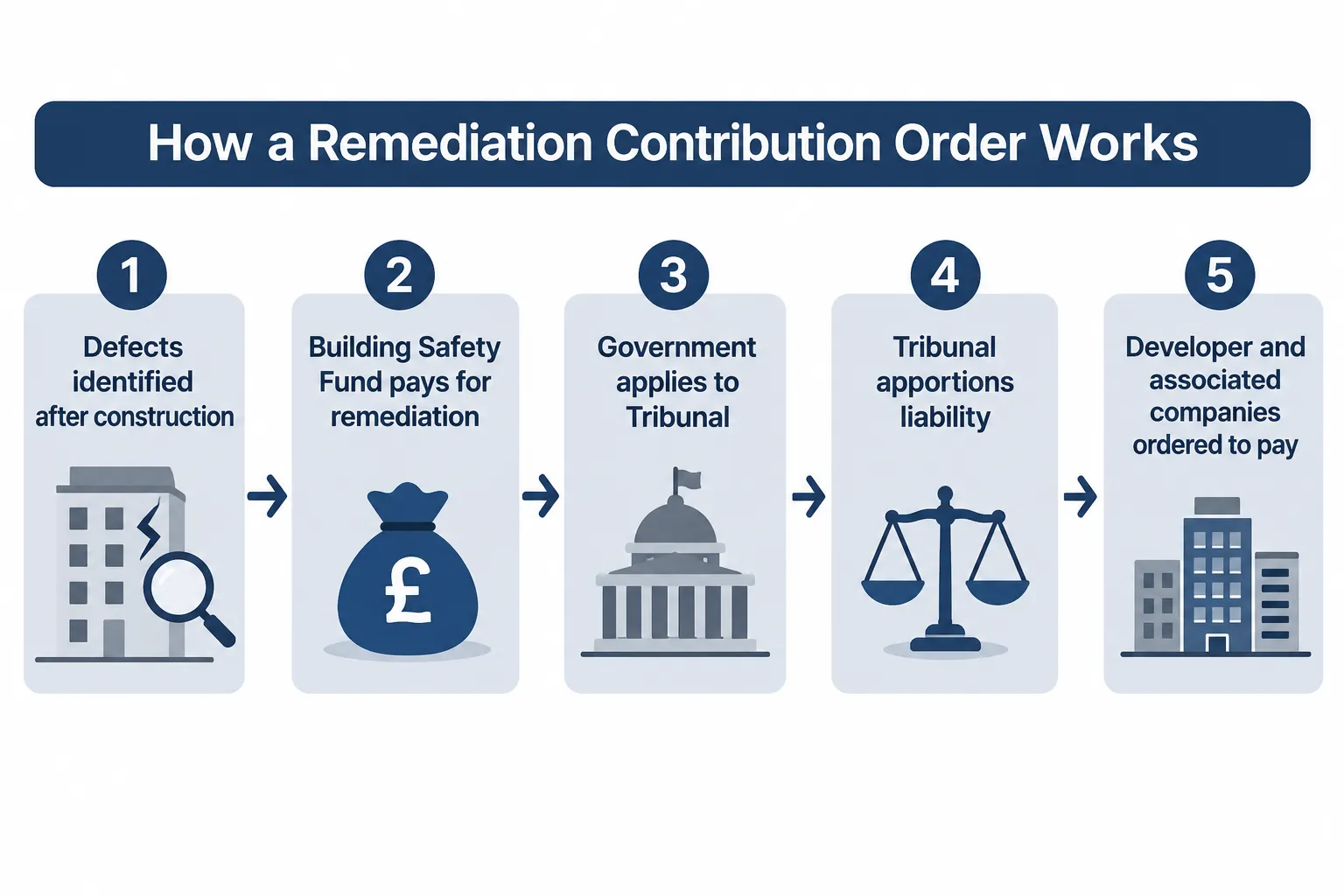
- The case was brought by the Secretary of State for Housing, Communities and Local Government to recover public money already spent through the Building Safety Fund.
- The Tribunal applied a 10% reduction to reflect accepted Government regulatory failures, but stressed this was not a finding that Government caused 10% of the defects.
- Liability under a remediation contribution order can extend beyond the original developer to associated companies in the same corporate group.
- Flat buyers and leaseholders in Manchester's older apartment blocks should ask specific questions about building safety status before committing to a purchase, and take solicitor's advice.
What the Tribunal Decided
The case, Secretary of State for Housing, Communities and Local Government v Urban Splash Limited and others, First-tier Tribunal (Property Chamber), neutral citation 2026 UKFTT 1426 (PC), concerned seven applications for remediation contribution orders (RCOs) under section 124 of the Building Safety Act 2022. The hearing began in April 2026.
The buildings involved, all developed by Urban Splash Limited between roughly 2000 and 2008, are Burton Place in Castlefield, the Chips Building in New Islington, Christabel House, Emmeline House and Sylvia House on Dalton Street, the Moho Building on Ellesmere Street, and The Box Works on Worsley Street.
The Tribunal found each building had relevant fire-safety defects, including combustible materials, ineffective cavity barriers and fire-stopping, and compartmentation failures. The extent of some defects was disputed between the parties. The investigations that uncovered these issues followed the Grenfell Tower fire of June 2017.
Reasonable remediation expenditure, including VAT, was calculated at £60,638,548. Of that, £51,510,063 had been paid through the Building Safety Fund. After applying a 10% reduction to reflect accepted Government regulatory failures, the total liability under the orders came to £46,500,650. The Tribunal was explicit that this reduction "was not a finding that Government was responsible for 10% of the defects or remediation costs."
Five respondents were ordered to pay jointly and severally: Urban Splash Limited, Urban Splash Developments Limited, Urban Splash Group Holdings Limited, Urban Splash Work Limited and Stubbs Mill LLP. Applications against four other companies were dismissed. The Tribunal found it "just and equitable" to make the orders against those five, while confirming that mere association with a developer does not by itself create liability. It also recognised Urban Splash's "useful and responsible assistance" with the post-Grenfell investigations.
What Is a Remediation Contribution Order?
A remediation contribution order is a creation of the Building Safety Act 2022. It allows the First-tier Tribunal to order a developer, landlord, or an associated company to contribute towards the cost of fixing relevant defects in a relevant building. The Act was designed partly to stop leaseholders and the taxpayer being left to cover costs that arose from poor design or construction decisions made years earlier.
"We are here because the taxpayer has had to pay some £50m to remediate these buildings.", Kerry Bretherton KC, for the Government
Urban Splash's counsel put a different view to the Tribunal.
"We categorically did not fail to do the right thing, we did what we could, when we could.", Nicholas Dennys KC, for Urban Splash
What makes the Urban Splash ruling significant beyond the figures is the group-wide reach of the order. The Tribunal confirmed that responsibility is not confined to the entity that built the original scheme. Martin McKeague, real estate litigation partner at Walker Morris, which acted for the Government, called the outcome "an important step in the government's efforts to recover public money," adding that responsibility "can extend beyond the original developer to the wider enterprise."
An Urban Splash spokesperson said the scale of the liability was "significant for a business of our size," that the company is reviewing the decision and taking legal advice, and that it was disappointed entities that played no part in the original development were included among the respondents.
What This Means If You Own a Flat in One of These Buildings
This case was about recovering the cost of remediation already carried out, largely funded through the Building Safety Fund. It was not a finding that the seven buildings are currently unsafe to live in. Leaseholders in Burton Place, the Chips Building, Christabel House, Emmeline House, Sylvia House, the Moho Building or The Box Works should not read the ruling as new evidence of ongoing risk.
That said, leaseholders with questions about the remediation history of their block, or about service charges linked to past fire-safety works, are entitled to ask their managing agent or freeholder for an update. The Building Safety Act 2022 also gives qualifying leaseholders certain protections against being charged for specific categories of remediation cost. Whether those protections apply in an individual case depends on the facts, including the lease terms and when the flat was bought, so leaseholders should take advice from a solicitor rather than assume a blanket exemption applies.
What Flat Buyers in Manchester Should Check Before Committing
Anyone buying a flat in a converted mill, tower, or purpose-built block in Greater Manchester, particularly buildings from the 2000s regeneration era, should build a short checklist into the purchase process.
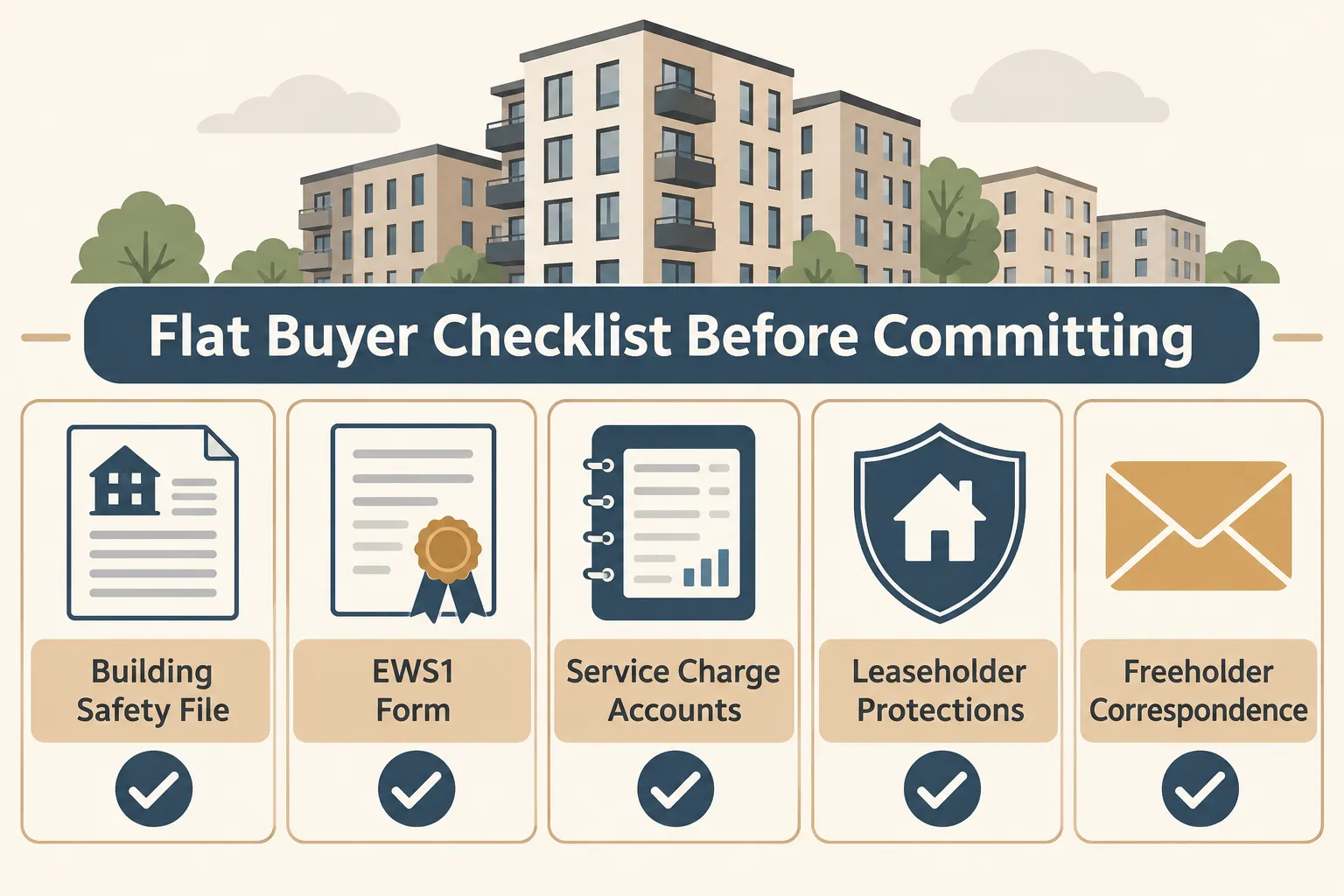
| What to check | Why it matters |
|---|---|
| Building safety file or fire risk assessment | Shows whether known defects have been identified and whether works are planned or complete |
| EWS1 form or equivalent evidence | Many lenders require this on certain blocks before agreeing a mortgage |
| Service charge accounts and reserve fund | Reveals whether remediation costs have been, or are expected to be, passed to leaseholders |
| Leaseholder protection status under the Building Safety Act 2022 | Determines whether certain remediation costs can lawfully be recovered from the leaseholder |
| Freeholder or managing agent correspondence on remediation | Flags ongoing disputes, like the one just decided against Urban Splash |
A conveyancing solicitor should raise these points formally through enquiries before exchange. Buyers should not rely on verbal assurances from an estate agent or seller about fire-safety status; ask for documents.
What a RICS Surveyor Can and Cannot Tell You
A RICS Home Survey, whether Level 2 or Level 3, examines the condition of the flat itself and the visible parts of the common areas a surveyor can reasonably access, such as stairwells, lobbies and external elevations visible from ground level. It will flag obvious signs of disrepair and note matters that warrant further investigation.
A general building survey is not the same as a fire engineer's assessment of the external wall system. Confirming whether a block's cladding, cavity barriers or fire-stopping meet current standards sits outside the scope of a standard residential survey and requires specialist fire-engineering input, often the basis of an EWS1 form. Where a block is high-rise or has a known remediation history, buyers should ask their solicitor whether an EWS1 or equivalent certificate is available, and should not assume a standard survey covers that ground.
Notes for Landlords and Investors
Landlords holding flats in older Manchester conversions should keep remediation and service charge records up to date, since lenders and prospective buyers will scrutinise this documentation more closely following high-profile rulings of this kind. Investors considering a purchase of multiple units in a single block should factor in the time a conveyancer will need to establish the building's safety and remediation history, and should be prepared for that process to take longer than for a standard modern flat with no history of defects.
Frequently Asked Questions
What is a remediation contribution order?
It is an order the First-tier Tribunal can make under section 124 of the Building Safety Act 2022, requiring a developer, landlord or associated company to contribute to the cost of fixing relevant fire-safety defects in a building.
Does this ruling mean the seven Manchester buildings are unsafe now?
No. The case concerned recovery of money already spent on remediation, much of it through the Building Safety Fund. It was not a finding about current safety.
Can leaseholders be charged for the remediation costs covered by this order?
The Building Safety Act 2022 gives qualifying leaseholders certain protections against specific remediation costs. Whether these apply depends on individual circumstances, so leaseholders should seek advice from a solicitor.
Will Urban Splash appeal the decision?
The company has said it is reviewing the decision and taking legal advice. No further detail on an appeal has been confirmed.
Should I get an EWS1 form before buying a flat in one of these buildings?
Ask your conveyancing solicitor and mortgage lender whether an EWS1 form or equivalent is required for the specific block. Requirements vary by lender and by building.
Does a standard RICS survey check for cladding and fire-safety defects?
A RICS Home Survey assesses the flat and visible common areas but does not replace a fire engineer's assessment of external wall systems. Specialist input is usually needed for that.
Conclusion
The £46.5 million figure is the headline, but the lasting significance of the Urban Splash ruling lies in how it confirms the reach of the Building Safety Act 2022: liability for historic fire-safety defects can follow a developer's wider corporate group, not just the single company that built the scheme. For flat owners, buyers and landlords across Greater Manchester, the sensible response is practical, not alarmed. Request the building safety file. Check the service charge accounts. Ask about EWS1 status where relevant. Speak to a solicitor about leaseholder protections before exchange. Manchester Surveyors provides RICS Home Surveys and valuations across Greater Manchester and can advise on what a standard survey will and will not tell you about a flat in a block with a safety or remediation history.