
By 2026, average senior housing occupancy across the United States is forecast to exceed 90% — the highest level recorded in over two decades of NIC MAP tracking [3]. That single statistic is reshaping how developers, investors, and surveyors approach every stage of a senior community project, from the first site walk to the final structural assessment.
Senior Housing Site Surveys: Meeting 2026 Demand with Tech-Enabled Precision is no longer a niche specialty. It has become a critical discipline at the intersection of demographic urgency, regulatory complexity, and rapidly evolving survey technology. The baby boomer generation — roughly 76 million people born between 1946 and 1964 — is now firmly in its senior years, and the supply of purpose-built senior communities is struggling to keep pace [6]. For surveyors and developers, that gap creates both pressure and opportunity.
This article examines how the senior housing sector is deploying technology-enabled surveying strategies to meet 2026 demand, what those surveys must cover, and why precision matters more now than at any previous point in the sector's history.
Key Takeaways
- Senior housing occupancy is projected to surpass 90% in 2026, creating intense pressure on developers to identify and assess viable sites faster and more accurately.
- Tech-enabled tools — including drone surveys, GIS demographic mapping, AI-powered demand modeling, and 3D laser scanning — are transforming how senior housing sites are evaluated.
- Wellness-focused design and accessibility mapping are no longer optional; they are core components of any credible senior housing site survey.
- Structural assessments, subsidence checks, roof condition reports, and asbestos surveys remain foundational requirements before any senior community development proceeds.
- Chartered surveyors who combine traditional RICS-standard assessments with modern data tools deliver the most defensible, investor-ready site reports in 2026.
The Demographic Pressure Driving Senior Housing Site Surveys in 2026

The numbers behind the 2026 senior housing surge are not projections — they are already materializing. The oldest baby boomers turned 80 in 2026, entering the age bracket most associated with assisted living and memory care demand. Meanwhile, new senior housing construction starts have remained constrained by high interest rates, elevated construction costs, and a shortage of suitable development land [3].
This supply-demand imbalance has a direct effect on how site surveys are commissioned and conducted. When occupancy is tight and every viable parcel is contested, developers cannot afford to proceed on instinct. They need surveys that answer precise questions:
- Is this site demographically viable for the intended care level?
- What is the competitive landscape within a five-mile radius?
- Does the physical condition of the land or existing structures support the proposed development timeline?
- Are there hidden risks — subsidence, contamination, structural defects — that could derail the project?
AI-augmented market and site surveys are emerging as best practice for 2026 senior housing development [1]. These tools layer predictive demographic data over physical site assessments, giving development teams a unified picture of both market viability and structural readiness before a single planning application is filed.
The role of the chartered surveyor has expanded accordingly. Where a site survey once focused almost exclusively on physical condition, it now integrates population aging data, care needs forecasting, accessibility compliance modeling, and competitive supply mapping. Understanding which type of survey is needed at each stage of the development process is therefore more important than ever.
Why Baby Boomer Aging Changes the Survey Brief
The boomer generation is not a homogeneous group. It spans a wide range of health profiles, income levels, and lifestyle expectations. A senior housing site survey in 2026 must account for this diversity. A site that suits an independent living community may be entirely wrong for a memory care facility, and the physical survey requirements differ significantly between the two.
Key demographic variables that now inform senior housing site surveys include:
| Variable | Why It Matters for Site Assessment |
|---|---|
| Age cohort concentration | Determines care level demand within 5-10 year horizon |
| Household income levels | Shapes unit mix and amenity programming |
| Existing senior housing supply | Identifies absorption risk and competitive gaps |
| Proximity to healthcare | Affects site desirability and regulatory compliance |
| Transport accessibility | Critical for both residents and care staff recruitment |
Integrating this data into the survey brief — before physical inspection begins — ensures that the structural and condition assessments are framed by real market context [6].
What a Comprehensive Senior Housing Site Survey Must Cover
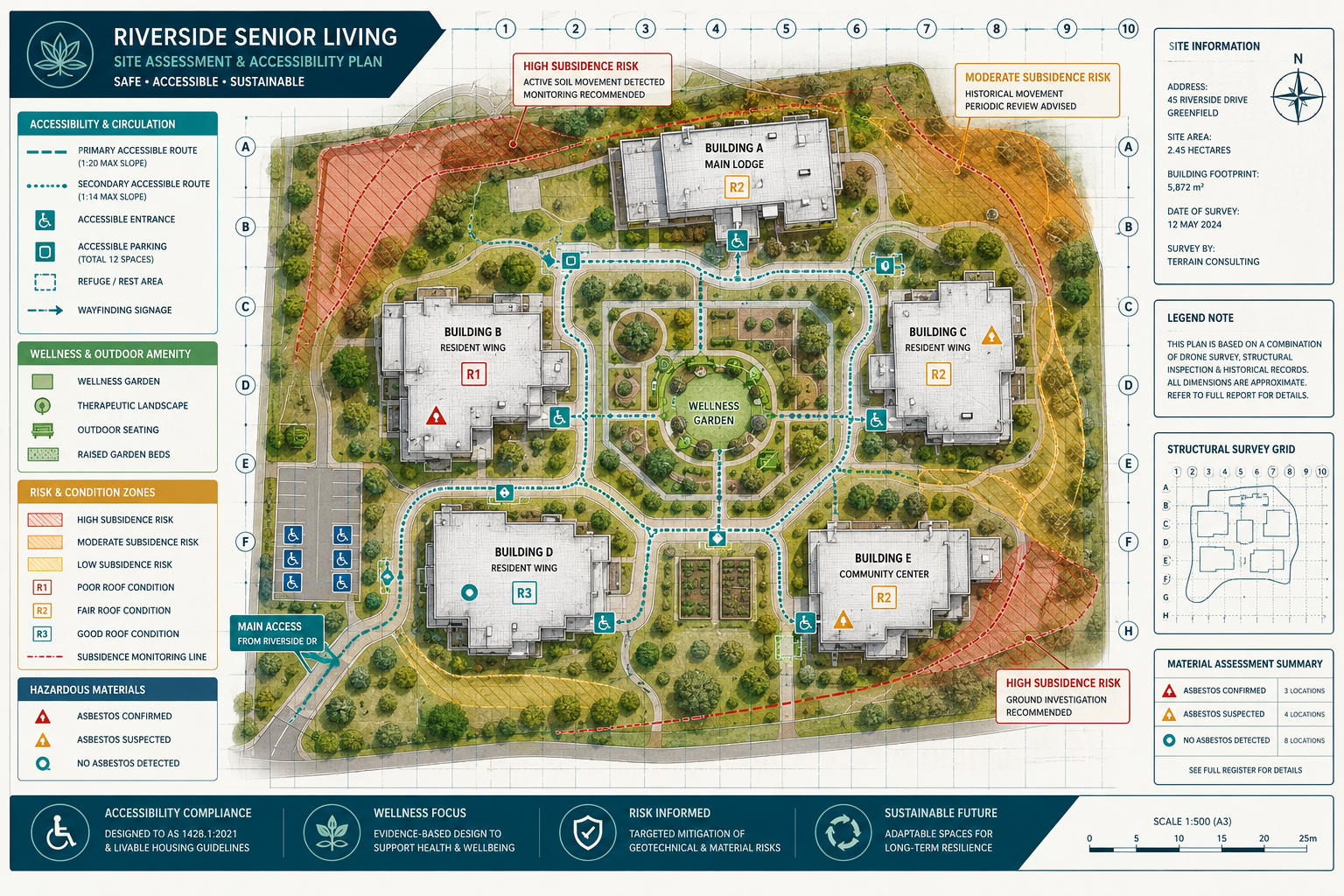
Senior Housing Site Surveys: Meeting 2026 Demand with Tech-Enabled Precision requires a layered approach. No single inspection type captures the full picture. A robust survey program for a senior housing development typically combines several specialist assessments.
Structural and Building Condition Surveys
For any site involving existing structures — whether a conversion, a care home refurbishment, or a mixed-use redevelopment — a thorough structural survey is the foundation of the entire assessment process. Structural surveys identify load-bearing deficiencies, wall tie failures, settlement cracks, and other defects that could compromise the safety and longevity of a senior living environment.
Given that senior residents may have limited mobility and heightened vulnerability to environmental hazards, structural integrity standards are non-negotiable. A RICS building survey provides the most detailed condition report available under RICS standards, making it the preferred choice for complex senior housing developments involving older or non-standard construction.
Subsidence and Ground Condition Surveys
Many of the sites being evaluated for senior housing in 2026 are brownfield or previously developed land — precisely because greenfield sites in accessible suburban locations are scarce. Brownfield sites carry elevated risk of ground instability, historic contamination, and variable load-bearing capacity.
A dedicated subsidence survey is essential before any foundation design is finalized. Subsidence risk is particularly consequential in senior housing because:
- Ground movement can cause progressive structural damage that is difficult and expensive to remediate post-construction
- Insurance and financing for senior housing assets is highly sensitive to subsidence history
- Regulatory bodies scrutinize ground stability reports as part of care home registration processes
Geotechnical and topographic surveying, including preliminary civil investigations, forms a standard part of senior housing site due diligence [5]. This work establishes soil bearing capacity, drainage characteristics, and the presence of any underground voids or former industrial infrastructure.
Roof Condition Surveys
For conversion projects and refurbishments of existing care homes or institutional buildings, a detailed roof survey is a high-priority component. Roof failures in senior living environments carry serious consequences — water ingress can damage electrical systems, create slip hazards, and compromise air quality in ways that are particularly harmful to elderly residents.
Drone-assisted roof surveys are now standard practice for large senior housing campuses, enabling surveyors to inspect inaccessible areas safely and document condition with photographic precision. This technology reduces survey time, improves coverage, and produces a more defensible record for insurers and investors.
Asbestos Surveys
Any senior housing project involving a building constructed before 2000 requires a formal asbestos survey. This is a legal requirement under the Control of Asbestos Regulations 2012, and it is especially relevant in the senior housing sector because:
- Many care homes and institutional buildings being repurposed date from the 1960s through 1990s
- Asbestos-containing materials (ACMs) are common in ceiling tiles, pipe lagging, floor tiles, and roofing sheets from this era
- Demolition or refurbishment without proper asbestos management creates serious health and legal liability
An asbestos management survey identifies the location, condition, and risk level of all suspected ACMs. A refurbishment/demolition survey goes further, providing the information needed to safely remove ACMs before construction work begins.
Accessibility and Wellness Layout Mapping
This is where 2026 senior housing site surveys diverge most sharply from standard commercial development assessments. Accessibility mapping is not simply about meeting Building Regulations Part M requirements. It is about designing environments that actively support the health, mobility, and wellbeing of residents across a spectrum of physical and cognitive abilities.
"The most competitive senior communities in 2026 are those designed around resident wellness from the ground up — and that design process starts with the site survey." [8]
Wellness-focused layout considerations that should be captured at the survey stage include:
- Gradient and terrain analysis — identifying slopes that may create barriers for wheelchair users or residents with limited mobility
- Natural light mapping — assessing solar orientation to optimize daylighting in living spaces and communal areas, which has documented benefits for residents with dementia [4]
- Outdoor space accessibility — evaluating the feasibility of sensory gardens, walking paths, and therapeutic outdoor environments
- Emergency egress routes — mapping evacuation pathways that accommodate residents with mobility aids
- Proximity to amenities — measuring walkable or accessible distances to healthcare, retail, and community facilities
A stock condition survey can provide a systematic baseline for existing senior housing assets, capturing the current state of all building elements and informing capital expenditure planning for accessibility upgrades.
Technology Tools Transforming Senior Housing Site Surveys: Meeting 2026 Demand with Tech-Enabled Precision

The technology transformation in senior housing site surveys is not theoretical. It is being deployed on live projects across the UK and internationally, and it is producing measurably better outcomes in terms of survey speed, accuracy, and investor confidence.
Drone and UAV Surveys
Unmanned aerial vehicles (UAVs) have become standard equipment for senior housing site surveys. Their applications include:
- Roof and facade condition inspections without scaffolding
- Topographic mapping of large campus sites
- Thermal imaging to identify heat loss, moisture ingress, and insulation deficiencies
- Progress monitoring during construction phases
Drone surveys reduce the time required to assess large sites by up to 60% compared to traditional ground-based methods, while producing higher-resolution photographic records [2].
GIS and Demographic Modeling
Geographic Information System (GIS) platforms allow surveyors and developers to overlay physical site data with population aging maps, healthcare facility locations, competitor supply data, and transport accessibility scores. This produces a site viability assessment that combines physical condition with market context in a single analytical framework.
AI-powered demand prediction tools are taking this further, using machine learning to forecast senior housing demand at the postcode level based on current demographic trends, health data, and housing market indicators [1]. These tools are particularly valuable in identifying undersupplied markets where a well-surveyed site could support rapid absorption.
3D Laser Scanning and BIM Integration
3D laser scanning (LiDAR) produces highly accurate point cloud models of existing buildings and sites. For senior housing conversions and refurbishments, these models enable:
- Precise measurement of existing floor plans without manual tape measurement
- Identification of structural anomalies invisible to the naked eye
- Direct integration with Building Information Modelling (BIM) platforms for design and construction planning
- Accurate cost estimation for accessibility upgrades and structural remediation
When combined with a commercial building survey, 3D scanning dramatically improves the accuracy of condition reports for large senior housing assets.
Digital Survey Platforms and Reporting
Senior housing investors and operators in 2026 expect survey reports that are digital, searchable, and integrated with asset management systems [9]. Modern survey platforms allow chartered surveyors to produce reports that include:
- Geotagged photographic evidence linked to specific building elements
- Condition ratings with automated maintenance cost projections
- Risk-scored summaries for rapid investor review
- Integration with compliance tracking systems for ongoing regulatory reporting
This shift toward digital reporting is not merely cosmetic. It reduces the time between survey completion and investment decision, which matters enormously in a market where viable senior housing sites are in short supply [10].
Practical Steps for Commissioning a Senior Housing Site Survey in 2026
For developers, investors, and operators planning senior housing projects, the following framework reflects current best practice:
-
Define the care model first. Independent living, assisted living, and memory care have different structural, accessibility, and regulatory requirements. The survey brief must reflect the intended care level.
-
Commission a multi-disciplinary survey team. A single surveyor rarely covers all required disciplines. A senior housing site survey typically requires structural, environmental, accessibility, and market analysis expertise working in coordination.
-
Prioritize RICS-accredited surveyors. RICS standards provide the quality benchmark that lenders, insurers, and planning authorities expect. Working with RICS-certified experts ensures that reports meet the evidentiary standards required for planning, financing, and regulatory approval.
-
Integrate technology from the outset. Drone surveys, GIS mapping, and 3D scanning should be specified in the initial survey brief, not added as afterthoughts. Early integration reduces duplication and produces a more coherent dataset.
-
Plan for phased surveys on complex sites. Large senior housing campuses often require phased survey programs — initial desktop and site reconnaissance, followed by detailed physical inspections, followed by specialist reports (asbestos, ground conditions, accessibility). Phasing allows early red flags to be identified before significant survey expenditure is committed.
-
Budget for remediation. Survey findings on brownfield or older sites almost always identify remediation requirements. Factoring remediation costs into the development appraisal from the survey stage prevents costly surprises at planning or construction.
Conclusion
The convergence of baby boomer aging, constrained senior housing supply, and technology-enabled survey methods has created a defining moment for the sector in 2026. Senior Housing Site Surveys: Meeting 2026 Demand with Tech-Enabled Precision is not simply a matter of ticking regulatory boxes — it is the foundation on which viable, safe, and commercially successful senior communities are built.
Actionable next steps for developers and investors:
- Engage a RICS-accredited chartered surveyor with demonstrable senior housing experience before committing to any site acquisition
- Specify drone, GIS, and 3D scanning capabilities in the survey brief for all sites above a threshold size or complexity
- Ensure the survey program includes structural, subsidence, roof, and asbestos assessments as a minimum for any existing building
- Incorporate wellness layout and accessibility mapping as a core deliverable, not an optional add-on
- Use digital survey reporting platforms to accelerate the path from survey completion to investment decision
The senior housing sector's 2026 demand surge will not wait for slow, incomplete, or imprecise site assessments. The developers and operators who invest in rigorous, technology-enabled surveying now will be best positioned to deliver the communities that an aging population urgently needs.
References
[1] Ai Silver Wave Senior Housing Demand Prediction 2026 – https://www.theaiconsultingnetwork.com/blog/ai-silver-wave-senior-housing-demand-prediction-2026
[2] Design Reality – https://geobility.systems/en/blog/design-reality/
[3] Senior Housing – https://www.pwc.com/us/en/industries/financial-services/asset-wealth-management/real-estate/emerging-trends-in-real-estate-pwc-uli/property-type-outlook/senior-housing.html
[4] Pmc10855261 – https://pmc.ncbi.nlm.nih.gov/articles/PMC10855261/
[6] Senior Housing Playbook Part 4 Emerging Trends Strategic Outlook – https://accreteadvisors.com/wp-content/uploads/2026/03/Senior-Housing-Playbook-Part-4_-Emerging-Trends-Strategic-Outlook.pdf
[8] How Smart Tech Is Revolutionizing Senior Community Living In 2026 – https://allseniors.org/articles/how-smart-tech-is-revolutionizing-senior-community-living-in-2026/
[9] New Technology Adoption Senior Living 2026 – https://pointclickcare.com/resource/senior-living-software/ebooks-white-papers/new-technology-adoption-senior-living-2026/
[10] Senior Living Trends For 2026 And Beyond – https://www.providermagazine.com/Articles/Pages/Senior-Living-Trends-for-2026-and-Beyond.aspx