HMRC referrals to the Valuation Office Agency (VOA) for property valuation checks rose by approximately 23.5% in the past year alone, a figure that signals a structural shift in how the tax authority treats reported property values on inheritance tax returns and capital gains computations [1][2]. For executors, trustees, landlords and homeowners, the question of which value to report, at which date and on which basis has never carried greater financial and legal weight.
This article explains the principles behind property valuation for tax purposes in the UK, covering capital gains tax (CGT), inheritance tax (IHT) and the Annual Tax on Enveloped Dwellings (ATED). It draws a clear line between the formal, documented valuations that HMRC expects and the informal marketing appraisals that estate agents routinely provide, and explains why that distinction matters.
Key Takeaways
- Tax valuations must be tied to a specific statutory valuation date and prepared on the correct basis of value, "open market value" is not the same as a marketing guide price.
- HMRC now uses AI and data-matching tools to cross-check reported property values against VOA and other datasets, making unsupported figures far more likely to be challenged [2].
- The VOA formally merged with HMRC on 1 April 2026, streamlining how valuations are obtained and disputed across CGT, IHT and ATED [5].
- Agricultural Property Relief (APR) and Business Property Relief (BPR) moved to a banded regime from 6 April 2026, placing greater pressure on accurate valuations at the date of death [8].
- A RICS Red Book valuation provides the documented comparable evidence and professional accountability that HMRC expects when a figure is challenged.
Why Tax Valuations Are Different from Marketing Appraisals
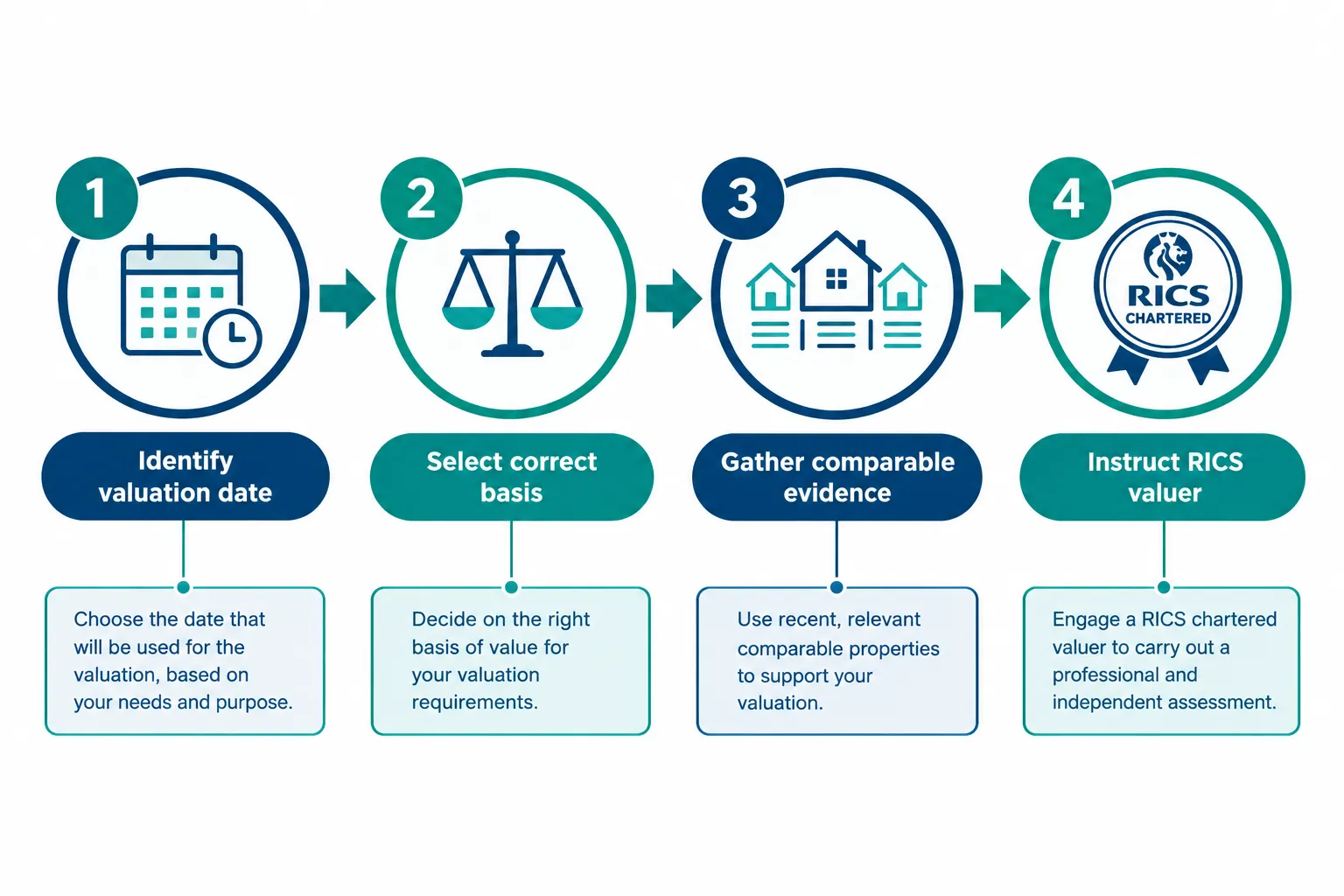
An estate agent's marketing appraisal is a commercial opinion about what a property might achieve in current market conditions. It is designed to attract an instruction, not to withstand regulatory scrutiny. A tax valuation serves an entirely different purpose: it must establish the open market value of a property at a precisely defined statutory date, supported by documented comparable evidence and prepared by a valuer who accepts professional accountability for the figure.
HMRC defines open market value for most property taxes as the price a property would fetch if sold on the open market between a willing buyer and a willing seller, neither acting under compulsion, with full knowledge of the property's condition and title. That definition appears across CGT, IHT and ATED guidance, and it is deliberately objective, it excludes the optimism that can creep into a marketing appraisal and the pessimism that can appear in a distressed-sale figure.
The valuation date is not negotiable. For CGT, it is the date of disposal (normally exchange of contracts). For IHT, it is the date of death. For ATED, it is a fixed statutory revaluation date set by legislation, currently 1 April 2022 for properties held at that date, or the later acquisition date [4][6]. Using a value from a different date, even one that is only weeks away from the correct date, can produce a figure that HMRC will reject.
A formal RICS Red Book valuation addresses both requirements. It states the basis of value, identifies the valuation date, sets out the comparable transactions relied upon and is signed by a RICS-registered valuer who is bound by professional standards. That paper trail is precisely what HMRC's compliance teams, and, increasingly, its AI-driven data-matching systems, look for when reviewing a return [2].
For context on how RICS valuers approach the factors that determine market value, the factors of valuation framework covers location, condition, tenure, comparable evidence and special assumptions in detail.
It is also worth understanding the difference between a formal RICS valuation and an automated or desktop estimate. An online house valuation versus a RICS valuation comparison shows why algorithmic tools lack the evidential weight HMRC requires, they cannot account for condition, access constraints or special purchaser value, all of which affect open market value.
Property Valuation for Tax Purposes in the UK: Capital Gains Tax
The CGT Valuation Date and Basis
For CGT on residential property, the gain is calculated by reference to the disposal proceeds (or the open market value at the date of disposal if the transaction is not at arm's length) minus the acquisition cost (or open market value at acquisition, where relevant). Rates for 2025/26 are 18% within the basic-rate band and 24% for gains above that band [4].
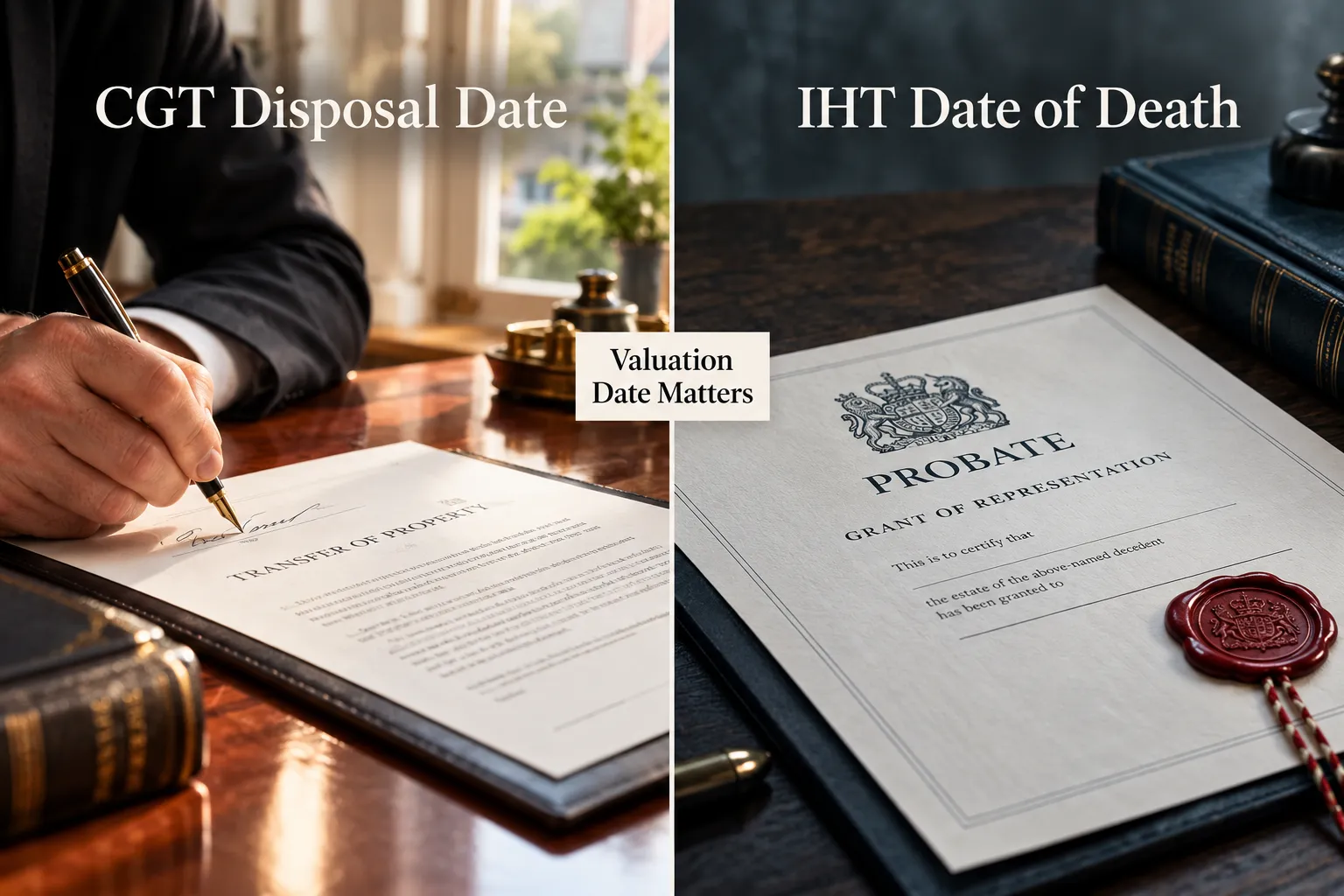
The valuation date for CGT is the date of disposal, for a conventional sale, that is the date contracts are exchanged, not the date of completion. Where a property is gifted, transferred between connected persons or disposed of below market value, HMRC substitutes open market value at the date of the transaction. That substitution is where disputes most commonly arise, because the parties have no arm's-length price to rely on.
HMRC offers a post-transaction valuation check (PTVC) service, allowing taxpayers to ask HMRC to confirm the value used in a CGT computation after the disposal has taken place [4]. The PTVC is not a rubber stamp, HMRC may challenge the figure, but it does provide a degree of certainty before the return is filed. Obtaining a RICS valuation before requesting a PTVC significantly reduces the risk of a challenge, because the valuer's comparable evidence is already documented.
Probate and Inherited Property
Where a property is inherited and later sold, the CGT base cost is the probate value, the open market value at the date of death used for IHT purposes. If that probate value was set too low (perhaps because the estate relied on an estate agent's estimate rather than a formal valuation), the base cost will be understated and the eventual CGT gain will be overstated. Conversely, if the probate value was set too high to minimise CGT exposure, HMRC may challenge it on the IHT return. The two taxes pull in opposite directions, which is why the valuation at death must be genuinely defensible rather than optimised for one tax in isolation.
Property Valuation for Tax Purposes in the UK: Inheritance Tax, APR, BPR and the New Banded Regime
Valuation at the Date of Death
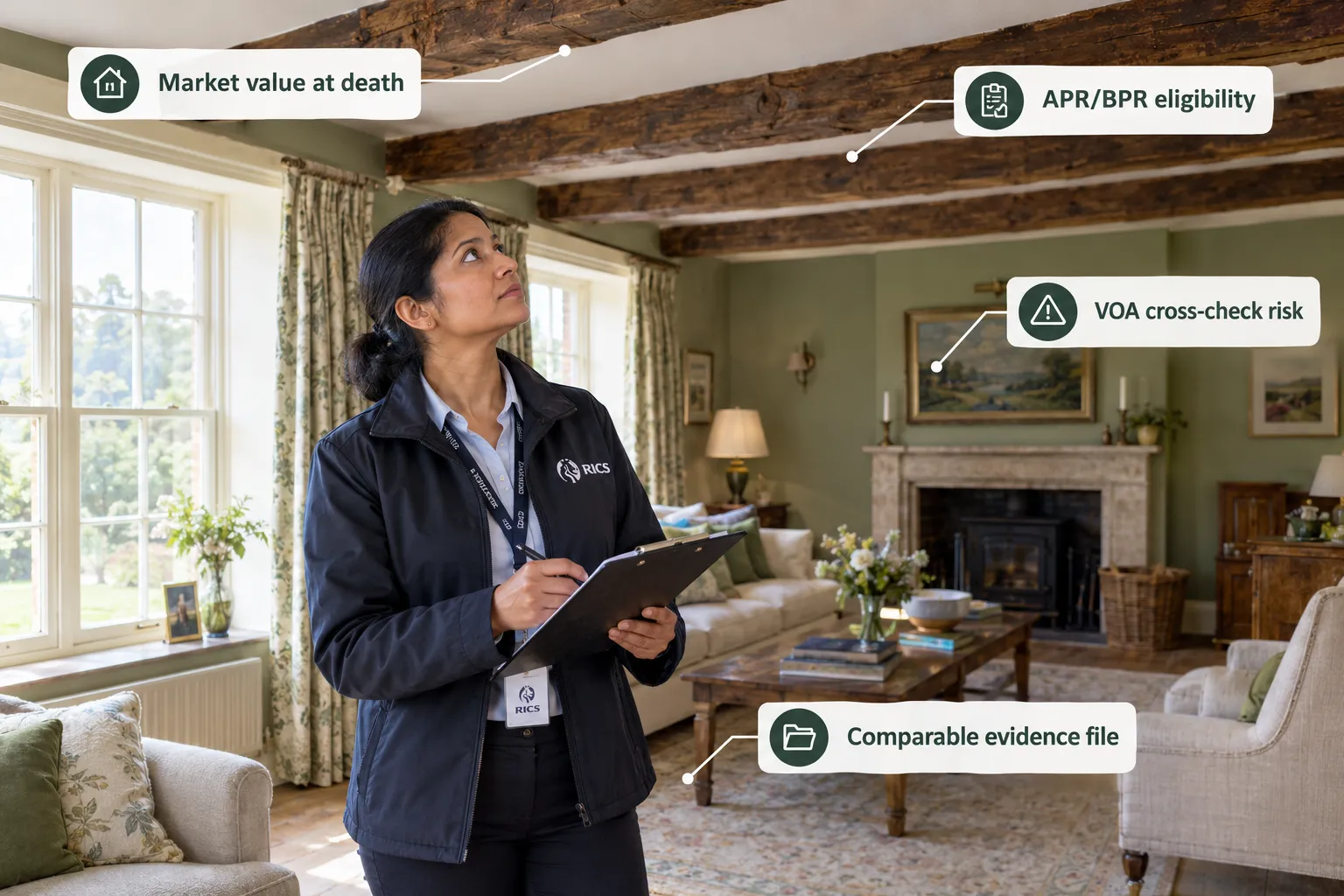
IHT is charged on the value of a deceased person's estate at the date of death. Every asset, including property, must be valued at its open market value on that date [8][10]. The standard nil-rate band remains £325,000 and the residence nil-rate band (RNRB) is £175,000, both frozen until at least 6 April 2031 [7]. The RNRB tapers away for estates above £2 million, making accurate property valuations critical for estates in that range.
HMRC's IHT compliance teams have significantly increased their use of VOA referrals, with the VOA now formally integrated into HMRC from 1 April 2026 [5]. This structural change means that property values on IHT400 returns are now subject to more systematic cross-checking against VOA data, Land Registry transaction records and the AI-driven data-matching tools HMRC has deployed [2]. Executors who submit figures based solely on estate agent estimates face a materially higher risk of challenge than those who commission a RICS Red Book valuation.
Personal liability is a real concern. Where an executor submits an IHT return with an unsupported valuation that HMRC subsequently challenges, the executor may face additional IHT, interest (currently set at four percentage points over base rate on late payments) and, in some cases, personal exposure [1][2].
Agricultural Property Relief and Business Property Relief: The 2026 Changes
From 6 April 2026, APR and BPR moved to a banded regime under the Finance Act 2026 [8]. The key features are:
| Relief band | Rate | Notes |
|---|---|---|
| Up to £1 million (APR/BPR combined) | 100% relief | Per person; transferable between spouses/civil partners |
| Above £1 million (APR/BPR eligible assets) | 20% IHT effective rate | Half the standard 40% rate |
| Combined spousal/civil partner allowance | Up to £2 million | Across two estates |
The £1 million APR/BPR allowance is indexed with CPI but then fixed until at least 2029-30 alongside the main nil-rate band and RNRB [7]. For farming estates and family businesses, this change makes accurate valuations at death far more consequential. An estate that previously attracted 100% APR on the full agricultural value must now establish whether that value exceeds £1 million, and by how much, to calculate the IHT charge on the excess at 20%.
Valuations for APR/BPR claims at death must cover not just the land and buildings but also livestock, machinery, stocks and growing crops where relevant. IHT on APR/BPR eligible property can be paid in up to 10 annual instalments, with no interest if the first instalment is paid within six months of death. That instalment option is valuable, but it depends on the initial valuation being defensible, a subsequent upward revision by HMRC will generate interest on the additional tax from the original due date.
Offshore Structures and the Look-Through Rules
From 6 April 2026, legislation introduced by the Finance Act 2026 looks through non-UK companies and similar entities so that the value of UK agricultural land and buildings held through those structures is brought into the IHT charge [3]. This closes a long-standing route by which some estates held agricultural assets through offshore envelopes to sidestep IHT. Valuations for affected estates must now establish the underlying open market value of the UK property, not merely the value of the shares in the holding company.
ATED: Fixed Revaluation Dates and Band Thresholds
The Annual Tax on Enveloped Dwellings applies to high-value UK residential properties held through companies and certain other structures. Unlike CGT and IHT, ATED does not use a rolling market valuation, it uses fixed statutory revaluation dates [4][6].
Properties held on or before 1 April 2022 use that date as the current revaluation point. HMRC requires open-market "willing buyer/willing seller" valuations in pounds sterling, with revaluations every five years after 1 April 2012 [6]. The next revaluation date will be 1 April 2027.
ATED band thresholds matter enormously. A property that sits near the boundary between two bands will attract a significantly different annual charge depending on which side of the threshold its value falls. HMRC recommends professional valuations, particularly where a property is close to a band boundary, precisely because the financial stakes of being in the wrong band are high [6]. A desktop house valuation may be sufficient for properties comfortably within a band, but properties near thresholds warrant a full RICS inspection.
Looking further ahead, the Office for Budget Responsibility has set out a planned high-value council tax surcharge from April 2028 for English properties valued by the VOA at over £2 million (in 2026 prices) [9]. The surcharge will run across four bands, with annual charges from £2,500 for properties in the £2-2.5 million range up to £7,500 for those valued at £5 million or more, uprated annually with CPI [9]. Accurate VOA valuations will therefore determine future local tax liabilities for high-value homes, adding another layer of consequence to the valuation process.
Instructing a RICS Valuer: What to Expect
A RICS Red Book valuation for tax purposes follows a defined process. The valuer inspects the property, researches comparable transactions in the relevant market at the correct valuation date, applies adjustments for condition, tenure and any special features, and produces a written report that states the basis of value and the valuation date explicitly.
For IHT and CGT purposes, the report should include:
- The statutory basis of value (open market value)
- The precise valuation date
- A schedule of comparable transactions with analysis
- Any special assumptions or caveats (for example, development potential, hope value or access constraints)
- The valuer's RICS registration details and professional indemnity insurance confirmation
Where a valuation is disputed by HMRC, the matter may proceed to the First-tier Tribunal (Tax Chamber). In that context, the RICS valuer may be required to act as an expert witness in property disputes, presenting evidence and responding to cross-examination. The discipline of expert witness work is distinct from standard valuation practice, and it is worth understanding the difference between an expert witness surveyor and a structural engineer when a dispute involves both valuation and physical condition.
For properties in the North West, the RICS valuation surveyor service in Manchester provides Red Book valuations for tax, probate, matrimonial and other formal purposes.
FAQ
Does an estate agent's valuation satisfy HMRC for IHT purposes?
An estate agent's opinion of value is not a formal valuation and does not carry the evidential weight of a RICS Red Book report. HMRC may accept it for straightforward estates, but it is increasingly likely to refer the figure to the VOA for checking, particularly given the 23.5% rise in referrals [1]. For estates above the nil-rate band or where APR/BPR is claimed, a RICS valuation is strongly advisable.
What happens if HMRC challenges the valuation on an IHT return?
HMRC will typically write to the executor with a revised figure. If the parties cannot agree, the matter goes to the Lands Chamber of the Upper Tribunal or the First-tier Tribunal (Tax Chamber), depending on the nature of the dispute. Additional IHT, interest and potentially penalties may follow [2][10].
Can the same valuation be used for both IHT and CGT?
Only if the valuation date is the same, which it will be where a property is sold shortly after probate at a price close to the probate value. Where there is a gap between the date of death and the date of disposal, the two valuations will differ and separate reports may be needed.
How often must ATED valuations be updated?
Every five years from 1 April 2012. The current revaluation date for properties held on or before 1 April 2022 is 1 April 2022. The next revaluation date is 1 April 2027 [6].
What is the valuation date for a property gifted rather than sold?
For CGT, the date of the gift (exchange of contracts or, for an unconditional gift, the date of transfer). For IHT on potentially exempt transfers that become chargeable, the value is generally fixed at the date of the gift, though HMRC may also consider the value at death in certain circumstances.
Do the new APR/BPR rules affect urban investment property?
No. APR applies to agricultural land and buildings; BPR applies to qualifying business assets. Standard buy-to-let and commercial investment property does not qualify for either relief, so the new banded regime does not apply to those assets.
Conclusion
Property valuation for tax purposes in the UK, whether for capital gains, inheritance tax or ATED, is a precise discipline that demands the right basis of value, the right valuation date and documented comparable evidence. It is not a task that an estate agent's marketing appraisal can reliably perform, and HMRC's increasingly data-driven enforcement environment means that unsupported figures carry greater risk than ever before [1][2].
The practical steps for property owners, executors and trustees are straightforward:
- Identify the correct valuation date before instructing anyone, it is set by statute and cannot be adjusted retrospectively.
- Instruct a RICS-registered valuer to prepare a Red Book report on the open market value basis, with comparable evidence documented.
- Consider both CGT and IHT implications simultaneously where a property is inherited and later sold, to avoid a figure that is defensible for one tax but problematic for the other.
- Review ATED valuations ahead of the 1 April 2027 revaluation date, particularly for properties near band thresholds.
- For farming and business estates, obtain specialist RICS valuations that cover the full range of APR/BPR eligible assets, given the new £1 million relief cap from 6 April 2026 [8].
HMRC's merger with the VOA and its deployment of AI-driven cross-checking tools mean the days of informal estimates passing without scrutiny are over. A defensible, professionally prepared valuation is the most cost-effective protection available.
References
[1] HMRC Ramps Up Scrutiny Of Property Valuations – thenegotiator.co.uk
[2] HMRC Property Valuation Scrutiny Consequences – gbnews.com
[3] HMRC Trusts And Estates Newsletter February 2026 – gov.uk
[4] Tax Property June 2025 – forrester-boyd.co.uk
[5] Shares and Assets Valuation Manual Updates – gov.uk
[6] Annual Tax on Enveloped Dwellings Pre-Return Banding Checks – gov.uk
[7] Inheritance Tax Thresholds – gov.uk
[8] HMRC Trusts And Estates Newsletter August 2026 – gov.uk
[9] Supplementary Forecast Information: High Value Council Tax Surcharge Costing – obr.uk
[10] Inheritance Tax Manual Updates – gov.uk