Seven new towns. One of them is already being built in your backyard. The UK Government's 2026 New Towns Programme has shortlisted Manchester Victoria North as one of just seven candidate locations nationally — and with 430 homes already completed, 550 under construction, and over 4,800 with planning permission, this is no future promise. It is a live, accelerating pipeline that will reshape North Manchester for the next two decades. For homeowners, developers, investors, and surveyors, understanding the Manchester Victoria North new town 15,000 homes regeneration 2026 landscape is no longer optional.
This article breaks down exactly what is happening, what it means for property values, and the critical surveying implications every professional and buyer needs to understand right now.
Key Takeaways 🏗️
- Victoria North has been shortlisted under the UK Government's 2026 New Towns Programme, targeting 15,000 homes across ~155 hectares of brownfield land north of Manchester Victoria Station.
- The scheme is a £3.9–4.0bn, 20-year joint venture between Manchester City Council and Far East Consortium (FEC), covering seven distinct neighbourhoods.
- Surveyors face a complex brownfield brief: contamination, compulsory purchase, party wall, rights of light, and Future Homes Standard compliance are all live issues.
- North West asking prices rose +2.6% year-on-year in May 2026, with Victoria North's pipeline likely to sustain demand across surrounding North Manchester neighbourhoods.
- The Platform4 initiative is unlocking disused railway land for self-build plots, creating niche but significant surveying and valuation opportunities.
Table of Contents
- What Is Manchester Victoria North and the 2026 New Towns Programme?
- The Seven Neighbourhoods: Delivery Pipeline at a Glance
- Platform4: Railway Land, Self-Build, and Niche Opportunities
- Surveying Implications: Brownfield Due Diligence and Contamination
- Party Wall, Rights of Light, and High-Density Schemes
- Valuation Impacts on North Manchester Property
- Future Homes Standard: Energy and Carbon Expectations
- FAQ
- Conclusion
What Is Manchester Victoria North and the 2026 New Towns Programme? {#what-is-manchester-victoria-north}
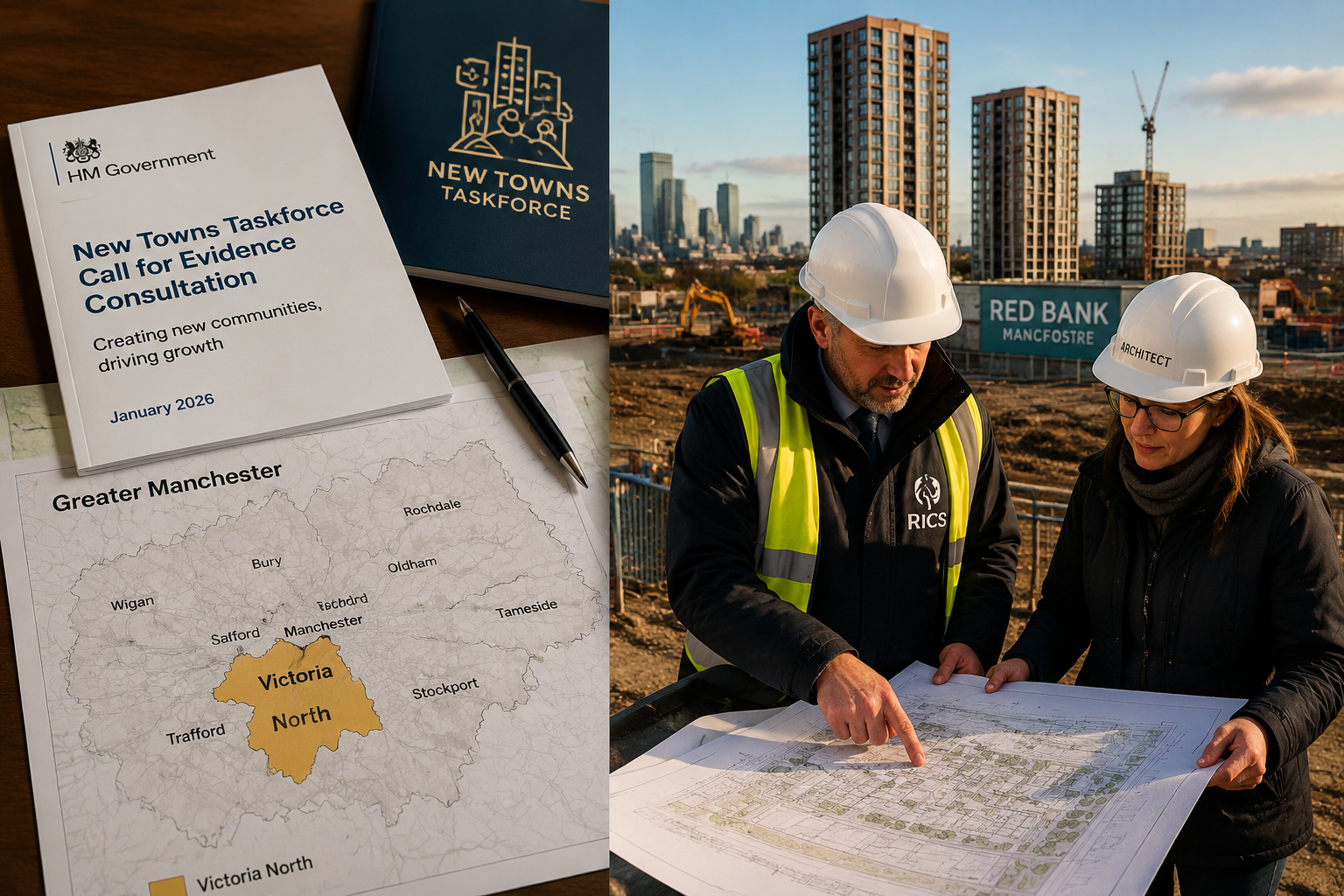
Manchester Victoria North is widely described as the largest regeneration project in Manchester's history and one of the most significant urban renewal programmes anywhere in the UK. Stretching across roughly 150–155 hectares (approximately 380 acres) of largely brownfield land north of Manchester Victoria Station — bounded loosely by the River Irk, Queen's Park, and Collyhurst — it is a long-term joint venture between Manchester City Council and Far East Consortium (FEC).
The headline ambition: approximately 15,000 new homes for around 35,000–40,000 new residents, supported by new tram stops, schools, medical facilities, parks, and retail spaces. The projected total investment sits at £3.9–4.0bn over a 20-year build-out.
In early 2026, the UK Government's New Towns Taskforce shortlisted Victoria North as one of seven candidate locations under its national New Towns Programme. A public consultation closed on 18 May 2026, with a final decision expected in summer 2026. Crucially, the programme does not come with a ring-fenced funding pot. Instead, qualifying schemes can access existing instruments — including the £16bn National Housing Bank — for technical studies, masterplanning, remediation, land acquisition, and enabling works.
💡 Pull Quote: "Victoria North is not a future concept — it is an active construction site with over 5,000 homes either completed, under construction, or approved."
For the Manchester Victoria North new town 15,000 homes regeneration 2026 surveyors community, this distinction matters enormously. Unlike greenfield new towns such as Tempsford (targeting up to 40,000 homes on open land), Victoria North is an inner-city brownfield regeneration — meaning surveyors face a far more complex technical and legal environment from day one.
The Seven Neighbourhoods: Delivery Pipeline at a Glance {#seven-neighbourhoods}
Victoria North is divided into seven distinct neighbourhoods, each at a different stage of planning and delivery. Understanding the pipeline helps surveyors, investors, and developers prioritise their attention.
| Neighbourhood | Status (2026) | Key Details |
|---|---|---|
| Red Bank | Partially complete | Victoria Riverside: 634 homes in three towers, partial handover achieved |
| Collyhurst Village | Phase 1 live | 274 homes; 130 as social housing |
| South Collyhurst | Phase 1 live | Included in 274-home Phase 1 total |
| Collyhurst Phase 2 | Consultation (March 2026) | ~550 additional homes + new community park |
| Dantzic Street | Masterplanning | Near-term planning submissions expected |
| Angel Meadow | Pipeline | Infrastructure-led enabling works ongoing |
| Miles Platting | Pipeline | Longer-term phasing |
Overall pipeline snapshot (early 2026):
- ✅ 430 homes completed
- 🔨 ~550 homes under construction
- 📋 4,801 homes with planning permission
- 📝 ~550 homes planning submission due autumn 2026
This is a decade-long workload for surveyors, project managers, and built-environment professionals. The affordable housing component — with at least 258 affordable units in early phases and more secured through Section 106 agreements — adds layers of viability assessment and valuation complexity.
Platform4: Railway Land, Self-Build, and Niche Opportunities {#platform4}
One of the lesser-discussed but genuinely exciting elements of the wider Victoria North ecosystem is the Platform4 initiative. This programme targets disused and underused railway land within and adjacent to the regeneration zone, with some plots designated for self-build and custom-build housing.
For self-builders and their surveyors, Platform4 plots present a distinctive brief:
- Irregular plot geometries from former rail infrastructure
- Potential ground contamination from historic railway use (hydrocarbons, heavy metals, asbestos)
- Proximity to live rail corridors, requiring specialist structural and acoustic assessments
- Bespoke planning conditions tied to design codes aligned with Victoria North's masterplan
If you are advising a self-builder on a Platform4 plot, a thorough RICS building survey of any existing structures on site — combined with a Phase 1 and Phase 2 environmental assessment — is non-negotiable before any purchase commitment.
Surveying Implications: Brownfield Due Diligence and Contamination {#surveying-implications}
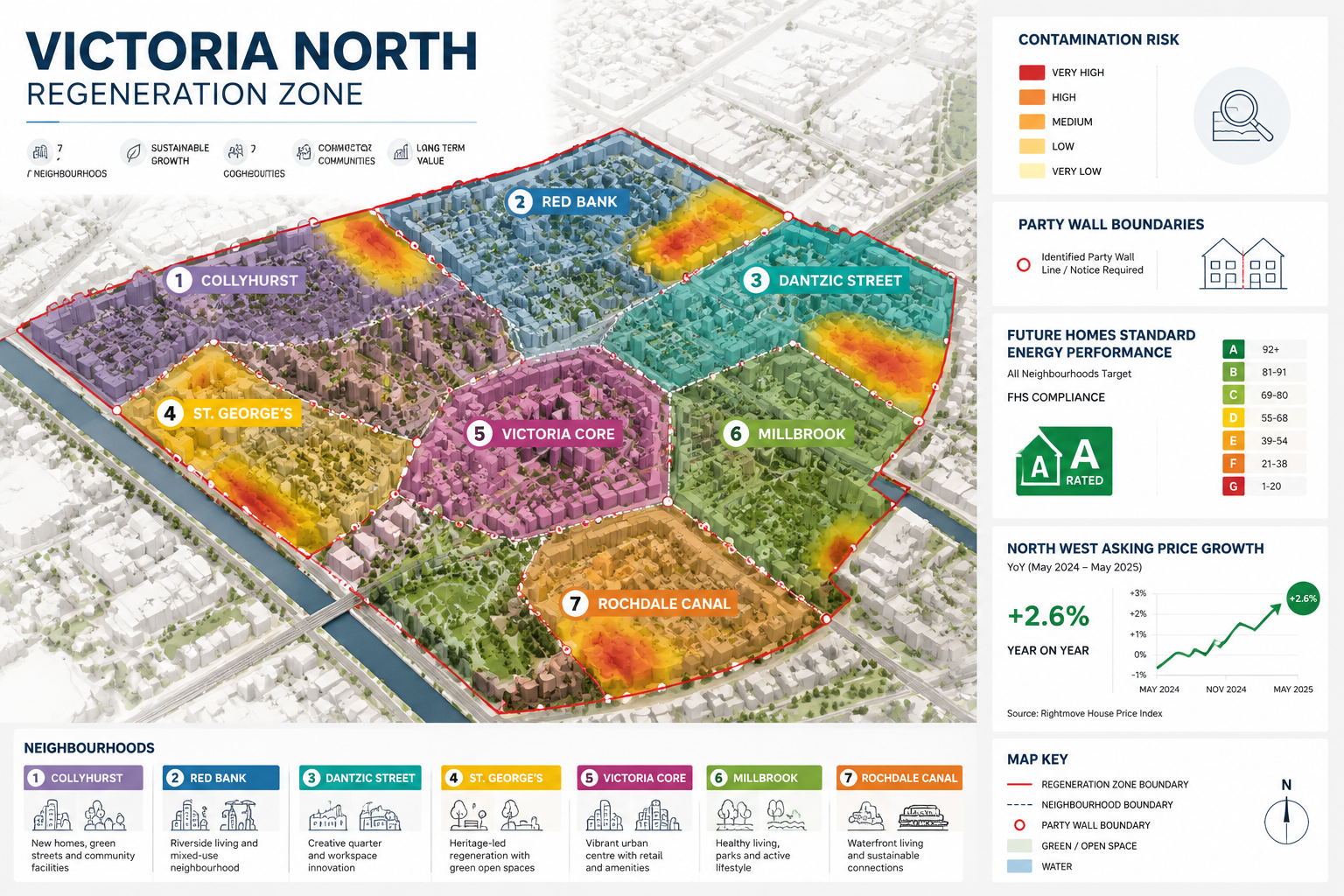
This is where the Manchester Victoria North new town 15,000 homes regeneration 2026 surveyors brief becomes technically demanding. The entire scheme sits on land with centuries of industrial, railway, and urban use. Brownfield due diligence here is not a box-ticking exercise — it is a critical risk management function.
Contamination and Environmental Surveys 🔬
Key contamination risks on Victoria North land include:
- Hydrocarbon and petroleum contamination from former industrial uses
- Heavy metals (lead, arsenic, cadmium) in made ground
- Asbestos in demolished structures — our asbestos survey service is frequently instructed on sites of this type
- Ground gas (methane, carbon dioxide) from organic fill materials
- Japanese knotweed and other invasive species on derelict land
A Phase 1 Desk Study (reviewing historical maps, environmental databases, and site walkovers) should always precede a Phase 2 intrusive investigation. For developers acquiring land within the Victoria North boundary, failing to commission adequate contamination surveys before exchange is a significant financial and legal risk.
Structural and Subsidence Risks 🏚️
North Manchester's geology — including areas of shallow coal measures and river valley alluvium near the Irk — creates real subsidence risk that demands careful geotechnical assessment. Foundation design for high-density residential towers must account for variable ground conditions, and existing neighbouring properties may require monitoring surveys during piling and excavation works.
Snagging on New Builds 🔍
For buyers purchasing off-plan or newly completed homes within Victoria North — particularly in Red Bank and Collyhurst — commissioning an independent snagging report before legal completion is strongly advisable. New-build defects in high-density schemes are common, and identifying them before handover protects buyers' legal rights under the New Homes Quality Code.
Party Wall, Rights of Light, and High-Density Schemes {#party-wall-rights-of-light}
High-density urban regeneration at the scale of Victoria North creates a party wall and rights of light environment of considerable complexity. With towers of 15–25+ storeys being constructed in close proximity to existing terraced streets in Collyhurst and Miles Platting, two legal frameworks become especially important.
Party Wall Act 1996 ⚖️
Any construction, excavation, or structural alteration within 3–6 metres of a neighbouring property's foundations triggers obligations under the Party Wall Act. For developers within Victoria North, this means:
- Serving formal Party Wall Notices on all adjoining owners
- Agreeing Schedules of Condition to record the pre-existing state of neighbouring properties — see our guide on schedule of condition surveys
- Appointing agreed or separate Party Wall Surveyors to prepare Awards
Homeowners in Collyhurst, Ancoats, and Miles Platting who receive a Party Wall Notice should seek independent surveying advice promptly. Do not simply sign a developer's proposed Award without understanding your rights.
Rights of Light 🌤️
Tall buildings cast long shadows. Rights of light disputes are increasingly common in dense urban regeneration schemes, and Victoria North's tower-led Red Bank and Dantzic Street phases are no exception. Neighbouring property owners who can demonstrate an established right of light (typically 20+ years of uninterrupted natural light through a defined aperture) may be entitled to an injunction or financial compensation.
Developers should commission rights of light assessments before submitting planning applications. Surveyors advising existing property owners near the development boundary should flag this issue proactively.
Valuation Impacts on North Manchester Property {#valuation-impacts}
The broader North West property market is performing well. Rightmove's May 2026 data shows North West asking prices up +2.6% year-on-year — a figure that reflects genuine demand recovery across the region. Victoria North is both a symptom and a driver of this trend in North Manchester specifically.
How Victoria North affects surrounding valuations:
| Factor | Impact on Surrounding Property Values |
|---|---|
| New transport infrastructure (tram stop proposals) | 📈 Positive premium within 800m |
| Increased housing supply (15,000 units) | ⚖️ Moderating effect on acute shortage |
| Improved public realm and parks | 📈 Positive for Collyhurst, Miles Platting |
| Construction noise/disruption (short-term) | 📉 Temporary discount during active phases |
| Affordable housing mix (Section 106) | ⚖️ Neutral to slight positive for community stability |
For homeowners and investors in North Manchester, a professional RICS valuation is increasingly important to establish an accurate baseline — particularly if you are remortgaging, selling, or assessing a portfolio. Generic automated valuation models (AVMs) frequently fail to capture the regeneration premium (or discount) accurately in rapidly changing micro-markets like this one.
💡 Pull Quote: "In a regeneration zone, a mortgage valuation is not the same as a survey — and it is certainly not the same as a Red Book RICS valuation."
Developers and registered providers acquiring land or existing stock within the Victoria North boundary should also consider insurance reinstatement valuations to ensure buildings insurance reflects current rebuild costs — which have risen sharply since 2022.
Future Homes Standard: Energy and Carbon Expectations {#future-homes-standard}
Every new home built within Victoria North from 2026 onwards will be subject to the Future Homes Standard (FHS), which requires new-build homes to produce approximately 75–80% less carbon than homes built under previous Part L regulations. This has direct implications for surveyors, developers, and buyers.
Key FHS requirements affecting Victoria North builds:
- 🔋 No gas boilers — all new homes must use low-carbon heating (heat pumps, district heating networks, or similar)
- 🏠 High fabric performance — enhanced insulation, triple glazing, and airtightness standards
- ☀️ Renewable energy integration — photovoltaic panels and battery storage increasingly standard
- 📊 SAP 10.2 energy modelling — required at design and as-built stages
For surveyors carrying out RICS home surveys on newly completed Victoria North properties, understanding FHS compliance — and identifying where developers have fallen short — is a growing area of technical competence. Buyers should specifically request confirmation of the as-built Energy Performance Certificate (EPC) rating and the heating system specification before exchange.
District heating networks are likely across several Victoria North neighbourhoods, given the density of development. These create specific legal and service charge considerations that surveyors and solicitors must address in due diligence.
FAQ {#faq}
Q1: Is Manchester Victoria North officially confirmed as a new town?
As of mid-2026, Victoria North has been shortlisted by the New Towns Taskforce as one of seven candidate locations. A final government decision is expected in summer 2026 following the public consultation that closed in May 2026. Work on the ground is already well advanced regardless of the formal designation.
Q2: Do I need a survey if I'm buying a new-build in Victoria North?
Yes. A developer's warranty (such as NHBC Buildmark) is not a substitute for an independent survey. A snagging report before legal completion can identify defects that the developer is obliged to rectify at no cost to you.
Q3: What surveying work is most in demand in the Victoria North area right now?
In 2026, the highest-demand surveying workstreams include: contamination and environmental surveys, party wall awards, monitoring surveys during construction, Red Book valuations for land acquisition and affordable housing viability, and snagging inspections on completed units.
Q4: How does Victoria North affect the value of my existing home in Collyhurst or Miles Platting?
The regeneration is broadly positive for surrounding property values over the medium to long term, particularly as public realm, transport, and amenities improve. Short-term construction disruption may cause modest temporary discounts. A professional Manchester valuation will give you an accurate, evidence-based figure rather than relying on automated estimates.
Q5: What is Platform4 and how does it relate to self-build?
Platform4 is an initiative targeting disused railway land in Manchester — including land within and adjacent to the Victoria North zone — for development, with some plots allocated for self-build and custom-build housing. Self-builders on these plots face specific challenges around contamination, ground conditions, and design code compliance.
Q6: Will Future Homes Standard apply to all homes in Victoria North?
Yes. All new homes granted planning permission from 2026 onwards must comply with the Future Homes Standard, meaning no gas boilers and significantly enhanced energy performance. This affects both the build specification and the ongoing running costs for buyers.
Conclusion {#conclusion}
The Manchester Victoria North new town 15,000 homes regeneration 2026 programme is not a planning aspiration — it is a live, funded, and accelerating transformation of North Manchester. With over 5,000 homes in the delivery pipeline, a £3.9bn investment commitment, and potential New Towns Programme backing from the UK Government, the scale and longevity of this scheme are without precedent in the city's modern history.
For surveyors, the implications are both immediate and long-term. Brownfield contamination surveys, party wall awards, rights of light assessments, subsidence monitoring, snagging inspections, and Red Book valuations are all in active demand across the Victoria North boundary and its surrounding neighbourhoods. The Future Homes Standard raises the technical bar for every new-build assessment. And the Platform4 railway land initiative creates a niche but growing self-build market that requires specialist surveying input.
For homeowners, investors, and developers in North Manchester, the message is clear: get accurate, independent professional advice now, before the market moves further and before legal or technical risks crystallise.
Your Next Steps ✅
- Buying near Victoria North? Commission an independent RICS home survey or homebuyer survey before exchange.
- Selling or remortgaging? Get a Red Book RICS valuation to capture the regeneration premium accurately.
- Developing land in the zone? Instruct contamination surveys, party wall surveyors, and rights of light assessors early in the process.
- Received a Party Wall Notice? Seek independent advice — review our guide on party wall obstructions and rights.
- Ready to talk? Get a quote from Manchester Surveyors today.